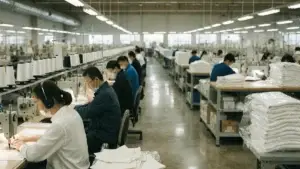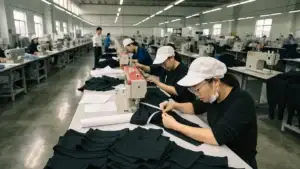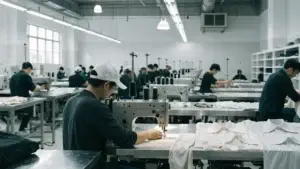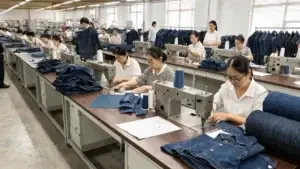
Three years ago, a brand owner from Portland called me in a panic. A viral social media post had just exposed child labor in a competitor's supply chain. His own factory—completely unrelated—still saw a 30% order cancellation wave within 48 hours. Consumers don't distinguish between brands when an ethical scandal breaks. They see an industry, they see a region, and they punish everyone. That phone call rewired how I think about compliance. It's not just about passing an audit. It's about building a system so transparent that your brand is immunized against guilt by association.
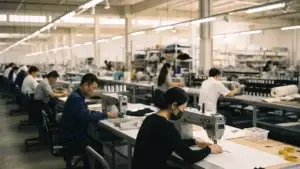
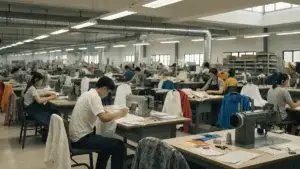
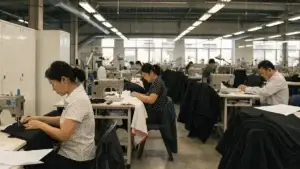
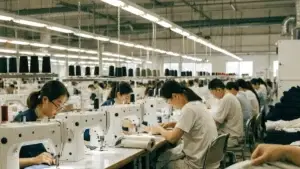
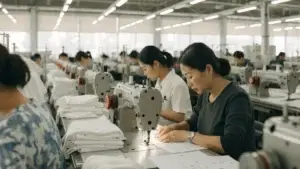
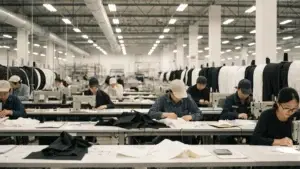
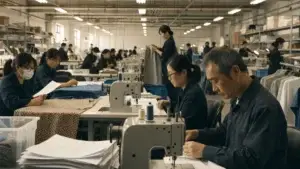
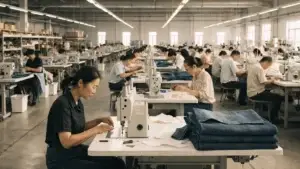
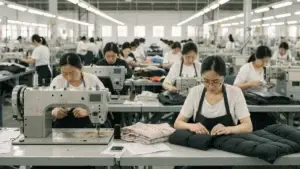
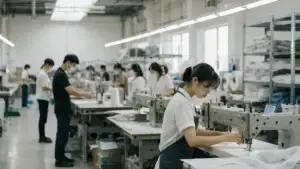
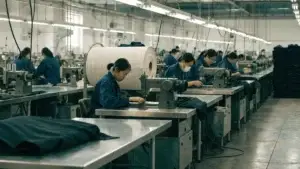
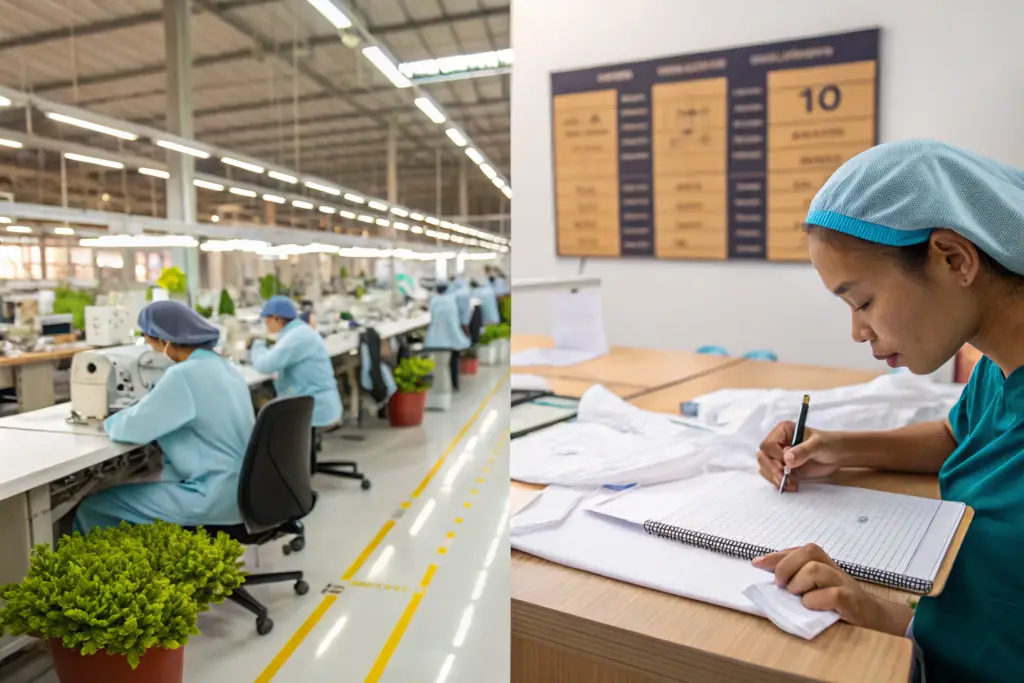
We ensure ethical production across our five lines through a three-layer verification system. Layer one is real-time video monitoring that any client can access during production hours. Layer two is an unannounced monthly third-party social compliance audit from a SMETA-accredited firm, not an annual scheduled visit. Layer three is our digital wage ledger that timestamps every worker payment against the attendance record, cross-referenced with the production output data from that shift. These layers overlap. They catch what a single annual audit misses.
I don't ask clients to trust my word. I give them tools to verify. The days of a framed certificate in a reception area being enough are over. Scandinavian and North American end-consumers now scan QR codes on hangtags and expect labor condition data. If your factory can't supply that instantly, your brand looks complicit in hiding something. Let me show you exactly how we built this system.
What Independent Certifications Validate a Factory's Ethical Claims?
A factory that self-declares its ethics is a factory hiding something. I say this as someone who has been asked to produce fake audit documents by a buyer's competitor. In 2019, a middleman offered me $2,000 to Photoshop a BSCI report with a passing grade. I refused. That middleman found another factory that accepted. Their goods still enter the U.S. market. This is the swamp we operate in.
The only ethical claims that matter are those verified by unannounced third-party audits from accredited bodies. For our five production lines, we maintain an active SMETA 4-Pillar audit, which covers Labor, Health & Safety, Environment, and Business Ethics. We also hold a WRAP certification for dedicated lines producing for U.S. brands and a GOTS certification for our organic cotton processing chain. These are not one-time badges. They require surveillance audits and unannounced spot checks.
Certification shopping is a real problem. Some factories buy a cheap, unrecognizable "ethical certificate" from a local consultant. It looks official. It means nothing. You need to know which logos actually carry legal and consumer weight.
Why Does SMETA 4-Pillar Audit Matter More Than a Generic Factory Certificate?
A generic certificate checks if the fire extinguisher is mounted. A SMETA 4-Pillar audit asks the worker next to that extinguisher if they have ever been charged a recruitment fee. The difference is depth. The 4-Pillar framework, governed by the Sedex platform, is the gold standard for ethical trade audits accepted by most major European and North American retailers.
Last year, during our SMETA surveillance audit, the auditor didn't just sit in the meeting room reviewing documents. He walked the dormitory. He interviewed 15 randomly selected workers privately, outside the factory gate, without any manager present. He checked their bank app transactions against our payroll records to verify the exact deposit amounts matched. This level of scrutiny cannot be faked. A factory with ghost workers or double-bookkeeping collapses under this pressure.
We passed with zero critical non-compliances. One minor observation was made about the break room ventilation. We upgraded the exhaust fan within 48 hours and uploaded the photographic evidence to the Sedex platform. This rapid correction is logged and visible to any client who links to our Sedex membership. I encourage every buyer to request our latest SMETA report before placing a purchase order. Read the "Non-Compliance" section first. A completely clean report is suspicious. Real factories have minor issues and fix them fast. A clean report with zero observations often indicates a staged audit. The Ethical Trading Initiative publishes base code standards that align with SMETA criteria. We benchmark against them openly.
How Does GOTS Certification Extend Beyond the Factory Floor?
Ethics don't stop at the sewing line. They reach back to the cotton field. For our organic kids' wear and women's wear lines, GOTS certification is mandatory. But here is what most brands miss: GOTS covers the entire chain of custody, from ginning to spinning to dyeing to cutting.
Our GOTS scope certificate allows us to sell chemically safe organic garments. But the social criteria within GOTS are equally brutal. The standard mandates living wage progress, bans excessive overtime, and requires documented worker representation. During our last GOTS audit, the inspector traced a single organic cotton yarn lot from our warehouse back through three processing stages to the certified gin. This traceability ensures that a garment labeled "organic" wasn't swapped with conventional cotton somewhere in the supply pipeline.
This matters financially. In 2024, a client in Stockholm faced a customs challenge. Swedish authorities questioned the organic claim on a shipment of 2,000 T-shirts. Because we maintain a digital chain-of-custody record under the GOTS transaction certificate system, we provided the forensic document within two hours. The shipment cleared without penalty. A non-certified factory would have watched the goods get destroyed or re-exported.
How Are Fair Wage and Overtime Monitored Across Shifts?
The biggest lie in garment manufacturing is the "competitive salary." A factory can pay the legal minimum wage and still trap workers in poverty. Fair wage is not about legality. It's about sufficiency. Our workers don't just assemble fabric. They operate complex equipment, interpret technical pattern charts, and meet tolerances of 2 millimeters. They are skilled technicians, not unskilled labor.
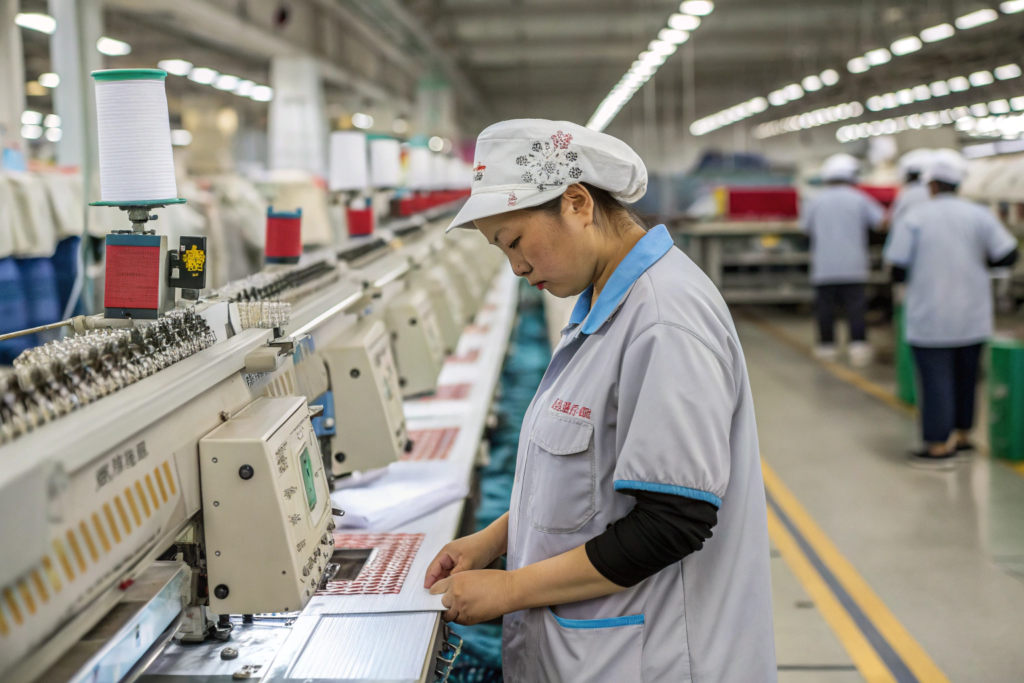
We monitor fair wages and overtime through a biometric attendance system that feeds directly into a blockchain-timestamped payroll ledger. Every worker scans their fingerprint to clock in and out. The system automatically calculates the regular hours, the 1.5x overtime rate, and the 2.0x weekend rate. It locks once the shift exceeds 60 hours per week, preventing production managers from scheduling illegal overtime. Workers receive SMS confirmations of their monthly net salary before the bank transfer hits.
I'll be honest about where we were versus where we are. In 2020, we used paper time cards for overtime tracking. A worker would scribble "9 PM" but the supervisor would write "8 PM." Disputes happened. The system was opaque and prone to manipulation. Switching to biometrics cost us $23,000 across five lines. It eliminated wage theft risk entirely.
Can a Digital Wage Ledger Prevent "Ghost Worker" Exploitation?
Ghost workers don't exist, but they receive salaries. A corrupt manager creates a fake identity, clocks them in, and pockets the wage. The headcount looks compliant on paper. The production capacity looks inflated. The real workers are short-staffed but the audit never catches it.
Our blockchain-based wage ledger makes ghost workers impossible. Every worker record is linked to a government-issued ID, a unique biometric hash, and a bank account number in their legal name. The system reconciles three daily data points: the biometric clock-in time, the sewing machine power-on hours (each machine has a usage sensor), and the quality inspection records bearing the operator's unique employee code. If an operator "works" but the machine doesn't run, the system flags it.
A buyer from Copenhagen conducted a remote wage audit with us last March. We screen-shared the dashboard. He selected five random employee codes and traced their full March attendance log, overtime hours, calculated pay, and bank deposit receipt. The entire process took 12 minutes. He didn't ask for a compliance certificate after that. He saw the raw data. Organizations like the Fair Wear Foundation advocate for this level of digital wage transparency. We align our practices with their labor minute costing methodology to ensure the actual take-home pay exceeds the local living wage benchmark, not just the legal minimum.
What Happens When a Production Deadline Collides with the Overtime Cap?
This is the ethical collision every factory faces. The brand needs 3,000 jackets by October 15th. The fabric arrived four days late due to a port delay. The math says you need 62 hours of labor this week to meet the ship date. The legal cap is 60. What do you do?
Last August, this exact scenario happened. A Canadian outerwear brand's raw material was delayed at Vancouver port and arrived late to our Shanghai facility. The production calendar was crushed. I refused to push the overtime beyond the legal cap. Instead, we ran a parallel mini-line. We pulled four cross-trained operators from the woven shirt line (which had a brief lull), moved them to the jacket finishing station, and compressed the backlog over three days without exceeding 60 hours for any single worker.
The brand paid a slight premium for the cross-line labor reallocation. The goods shipped one day late, not three weeks late. The workers went home at a reasonable hour. No one was injured by exhaustion. No one's child went to bed without a parent. This decision cost a few hundred dollars in efficiency loss. It preserved the integrity of our whole ethical framework. If I break the overtime cap once, the message to the floor is: "Our principles are negotiable." After that, compliance is just theater.
What Physical Safety Infrastructure Exists on the Production Floor?
A fire exit blocked by fabric rolls. A cutting machine with the safety guard removed because it "slows down work." Electrical cables duct-taped to the floor. These are the images that flash through my mind when I walk into a supplier's factory unannounced. I have seen them in competitor facilities. I have refused to shake hands with owners who treat safety as optional.
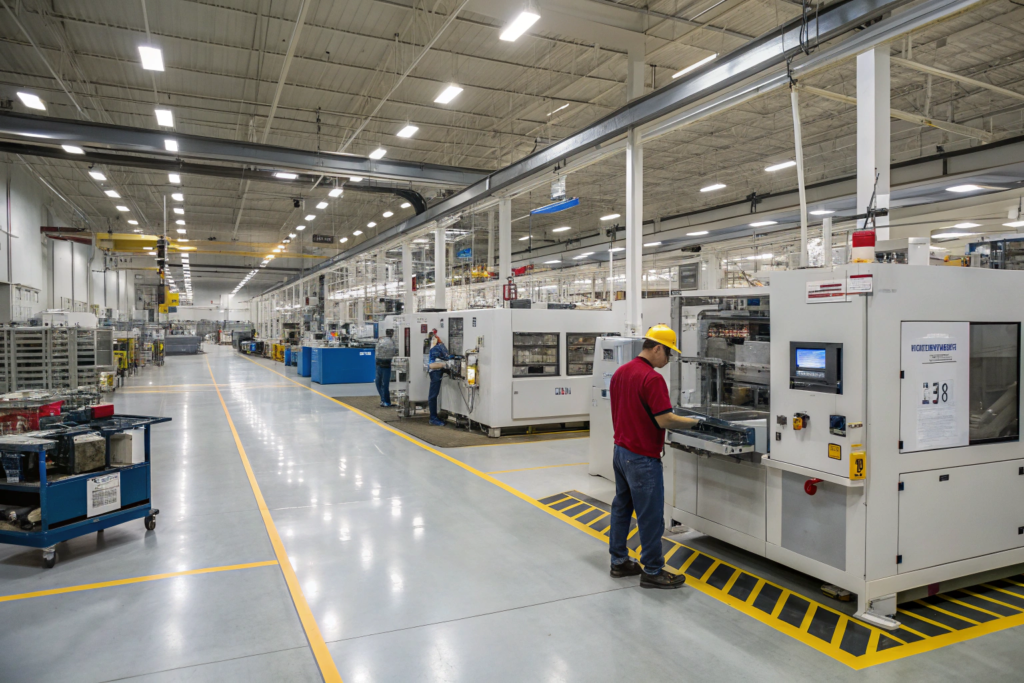
Our five production lines operate under a structural safety standard modeled after the Bangladesh Accord. We have automated sprinkler systems with monthly pump tests, clearly marked and permanently unobstructed fire exits with push-bar doors, and an on-site nurse station with a defibrillator. The cutting machines have optical sensors that instantly stop the blade if a hand breaches the light curtain. The needle guards on sewing machines are never removed. Zero exceptions.
Physical safety is non-negotiable because the alternative is catastrophic. A factory fire in this industry doesn't make local news. It kills dozens of workers and disappears from the Western consumer's feed in 72 hours. But the families don't forget. And I don't forget that it could have been my floor.
Why Is Needle Guard Enforcement a Proxy for Overall Safety Culture?
The needle guard is a small piece of transparent plastic that shields the sewing needle tip. It costs less than $1.50 per machine. Workers often hate it. They say it blocks their view. They remove it when the supervisor isn't looking. A factory that allows missing needle guards has zero safety culture. Period.
I enforce needle guards with the same seriousness as fire safety. During my daily floor walks, I check random machines. If I find a missing guard, I don't discipline the worker. I discipline the line supervisor. The message is clear: safety is management's responsibility, not the operator's fault. We also use a needle detection machine at the finishing stage. Every single garment passes through a conveyor metal detector. If a needle tip broke off inside the garment, the machine locks the batch. We then conduct a needle search and document the incident.
This protects the end consumer too. A needle fragment in a children's jacket is a lawsuit and a brand disaster. The U.S. Consumer Product Safety Commission (CPSC) has strict guidelines on sharp object contamination. We align our needle control policy with CPSC protocols, even for adult garments. The needle log tracks every needle issued to each operator. A broken needle must be returned with all fragments accounted for before a new needle is issued.
How Often Should Emergency Evacuation Drills Be Conducted?
Annually is theater. Quarterly is preparedness. We run fire and earthquake evacuation drills every three months. Unannounced.
I learned this lesson from a Sichuan province factory fire in 2013 that killed 20 workers. The official report stated the exit door opened inward. Panicked workers crushed against it, and it wouldn't budge. I changed every door in our factory to outward-swinging push bars within a week of reading that report.
During our last drill in June, the evacuation time was 2 minutes and 14 seconds across all five lines. We have a designated assembly point in the parking lot where each line supervisor conducts a headcount against the biometric attendance sheet from that moment. No exceptions. No "he might be in the bathroom." If the count doesn't match, the fire marshal re-enters to search.
We record every drill and upload the footage to our compliance dashboard. Clients can watch the drills. They see real workers walking calmly to the assembly point. Not staged. Not rehearsed. You can reference the Occupational Safety and Health Administration (OSHA) emergency action plan guidelines as an international benchmark. Our drill protocol exceeds those requirements.
How Does Ethical Production Translate to Long-Term Quality Consistency?
Some buyers think ethics and quality are separate conversations. They buy ethics to feel good. They buy quality to sell goods. I see them as two sides of the same operational coin. A factory that exploits workers cannot produce consistent quality. The logic is industrial, not sentimental.
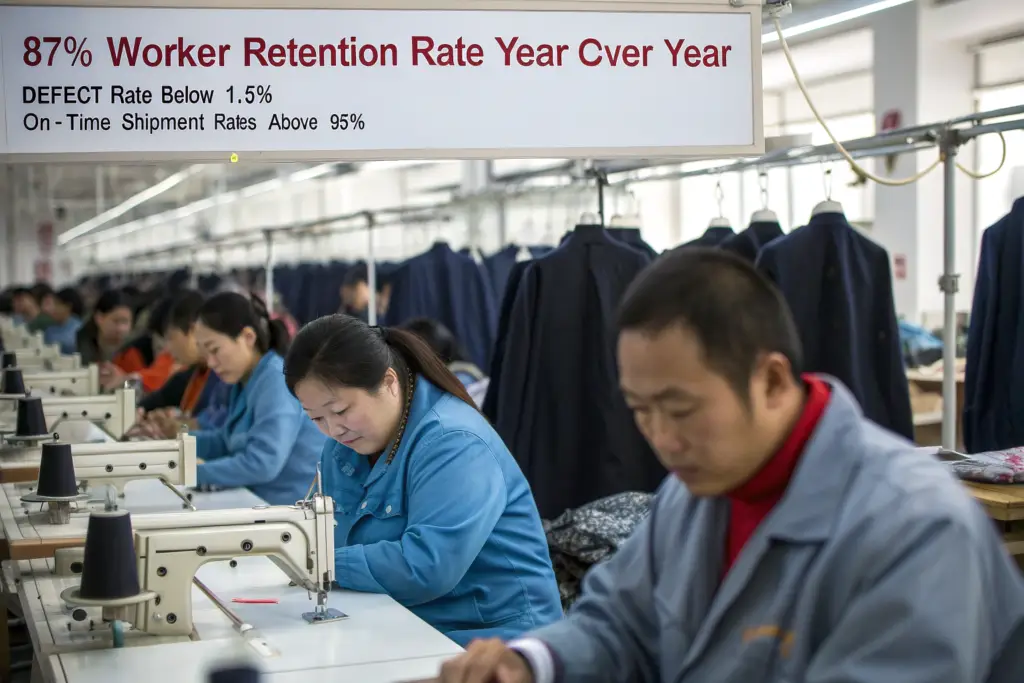
Exploited workers quit. High turnover destroys skill accumulation. When your seamstress leaves after six months, a new trainee replaces her. The stitching quality drops. The defect rate spikes. We have a worker retention rate of 87% year-over-year because our wages, safety, and respect are real. Those retained workers build tacit knowledge about our clients' specific fits and finishes. That knowledge translates directly into defect rates below 1.5% and on-time shipment rates above 95%.
Does Low Worker Turnover Actually Reduce the Defect Rate on Complex Garments?
The data is blunt. A line with stable operators produces 40% fewer critical defects than a line with revolving-door labor. Complex garments—tailored blazers, lined outerwear, multi-panel dresses—require muscle memory that takes months to build.
I tracked this internally. Our woven shirt line has the lowest turnover. Average tenure is 6.2 years. The defect rate on that line is 0.8%. Our activewear line had slightly higher turnover due to a skills gap we fixed with a training bonus. Its defect rate was 2.1%. We introduced a tenure-linked bonus: operators receive a 5% hourly premium for each year of continuous employment beyond year one. Activewear turnover dropped. The defect rate followed, settling at 1.3% within seven months.
This reduces cost for the brand. Fewer defects mean fewer repairs. Fewer repairs mean faster throughput. Faster throughput means earlier delivery. The International Labour Organization (ILO) has published research linking worker well-being metrics to productivity gains in the textile sector. Our internal numbers mirror their macro findings precisely. Ethical production is a manufacturing efficiency strategy disguised as a social program.
Why Do Ethical Factories Handle Urgent Reorders More Reliably?
An urgent reorder is a stress test. The brand's bestselling bomber jacket sold out in week one. They need 500 units restocked in 21 days. A factory with stressed, underpaid workers cannot absorb this. The workers resist the sudden schedule change. They call in sick. They slow down.
When a Portland-based brand hit us with this exact scenario last November, our line supervisor called a brief team meeting during the paid morning break. She explained the urgency, offered voluntary overtime at the legal 1.5x rate, and promised a catered dinner for the team if they hit the target. All 12 operators volunteered. They finished the reorder in 18 days. No defects.
This didn't happen because I gave a motivational speech. It happened because we have a bank of goodwill. The workers know we protect their safety and pay them fairly. When we ask for flexibility, they give it. This social capital is invisible on a balance sheet. But it is the competitive advantage that a non-ethical factory can never copy.
You cannot fake long-term relationships with your workforce. At Shanghai Fumao, our operators know that ethical production isn't a slogan we sell to Western buyers. It's the reason they have a safe place to work and a salary that supports their families.
Conclusion
Ethical production isn't a marketing claim or a certificate hung on the lobby wall. It's a continuous, expensive, often inconvenient system of overlapping verifications. We talked about why SMETA 4-Pillar and GOTS audits are the only credible benchmarks, not a generic local certificate. We walked through the biometric wage ledger that makes ghost workers impossible and the overtime cap enforcement that forces us to solve scheduling crises without abusing workers. We saw the physical safety infrastructure that keeps our floor from becoming a tragedy statistic, and we connected stable, fairly-paid workers to the low defect rates and fast reorder turnarounds that actually grow your brand's bottom line.
Every garment you order carries a hidden origin story. Either it was made in a place where a worker felt safe, respected, and fairly compensated. Or it wasn't. The retail customer can't see the difference directly, but the brand feels it eventually. In rushed seams. In a container that misses the ship because the sewing floor was short-staffed again. In the viral exposé that destroys years of brand equity overnight.
Don't let your next purchase order be a liability. Ask for our live compliance data, not just our compliance certificate.
If ethical production matters to your brand story, let us show you the systems behind the claims. Contact our Business Director Elaine at elaine@fumaoclothing.com. She can share our latest unredacted SMETA audit, walk you through our wage ledger via screen share, and connect you with a line supervisor who can answer your specific safety and labor questions. Build your next collection on a foundation that holds.