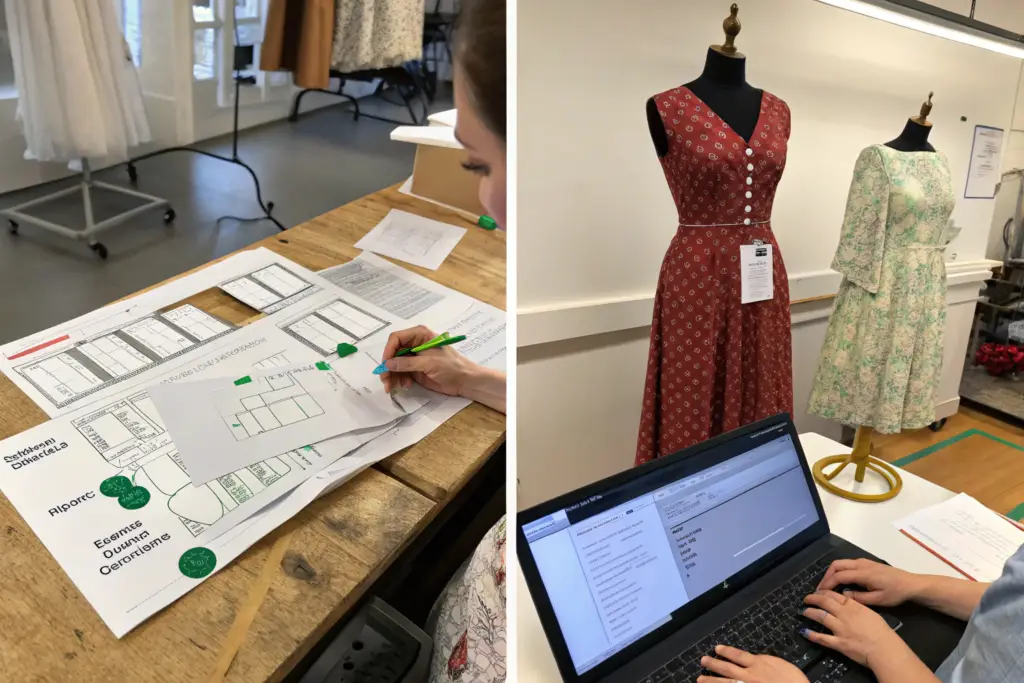
In the summer of 2023, I sat with our production manager and reviewed a season's worth of sampling data. We had produced 340 physical samples for our brand partners across four collections. Of those 340 samples, 127 required three or more iterations before approval. 42 required five or more iterations. Each iteration consumed fabric, sewing labor, pattern-making time, and courier shipping. The total cost of those extra iterations exceeded $28,000. The total time lost was over 400 cumulative days of development delay. The root cause was not that our pattern makers were incompetent or that our sample sewers were careless. The root cause was that errors were being discovered at the physical sample stage, where the cost of correction is highest, rather than at the specification stage, where the cost of correction is near zero. That season, I redesigned our entire sampling workflow. The following season, the number of samples requiring more than two iterations dropped by 62%. The cost savings were substantial. The time savings were transformative.
A clothing manufacturer reduces sampling errors before mass production by shifting error detection upstream to the pre-sample specification review, by using 3D simulation to catch proportion, fit, and design errors before physical cutting, by standardizing fit blocks so that basic fit is proven before the first sample is cut, and by implementing a formal sample submission package that includes a self-inspection report completed by the sample room before the sample ships to the brand. Each of these strategies addresses a different source of sampling error: ambiguous specifications, unvisualized design issues, unproven fit foundations, and incomplete internal review. Together, they form a system that catches errors when they are cheapest to fix.
At Shanghai Fumao, I do not view sampling errors as inevitable. I view them as process failures. Every sample that requires a third iteration is evidence of a gap in our pre-sample review. Every sample that is rejected for a measurement that was clearly stated on the tech pack is evidence of a discipline failure in our sample room. The goal is not to make sampling errors impossible, that is not realistic in a creative, iterative process. The goal is to eliminate the preventable errors and compress the iteration cycle for the remaining creative refinements. Here is how we do it.
How Does a Pre-Production Spec Review Catch Errors Before Sampling?
The most cost-effective time to catch a sampling error is before the sample is cut. The pre-production specification review is a structured meeting where the factory's technical team examines the brand's tech pack for completeness, internal consistency, and production feasibility. This review happens after the purchase order is received but before the pattern is drafted. It is the factory's opportunity to identify every ambiguity, contradiction, and missing specification that would otherwise be discovered when the physical sample is evaluated by the brand.
A pre-production spec review must cover five categories: measurement completeness, verifying that every measurement point on the spec sheet has a target value and a tolerance, construction clarity, verifying that every seam type, stitch type, and stitch density is specified with an ISO code or a clear diagram, material compatibility, verifying that the specified fabric, interlining, and trim are compatible with each other and with the intended wash and finish processes, labeling and packaging accuracy, verifying that the label specifications match the legal requirements for the destination market, and grade rule verification, confirming that the measurements across all sizes follow a consistent grade and do not contain anomalies. A spec review that covers these five categories will catch 80% of the errors that cause sample rejection.
At Shanghai Fumao, the pre-production spec review is mandatory. It is conducted by a team of three: our pattern-making supervisor, our fabric technician, and our quality manager. Each reviews the tech pack from their area of expertise. The pattern maker checks the measurements and grade rules. The fabric technician checks the material compatibility and the wash and finish feasibility. The quality manager checks the construction specifications and the label requirements. The findings are consolidated into a single query document that is sent to the brand within 48 hours of receiving the tech pack. Here is how we check measurement consistency and material compatibility.

What Measurement Inconsistencies Should a Pattern Maker Flag Immediately?
A pattern maker reading a spec sheet is looking for numbers that do not add up. A common error is a body length measurement that is inconsistent with the sum of the component measurements. The spec sheet lists a body length of 60 centimeters for a dress. It also lists a bodice length of 25 centimeters and a skirt length of 37 centimeters. 25 plus 37 equals 62, not 60. The pattern maker flags the discrepancy. The brand confirms whether the body length is 60 or 62. The discrepancy is resolved before the pattern is drafted.
Another common error is a grade rule that produces an impossible measurement at the largest or smallest size. The size Medium has a chest measurement of 100 centimeters. The grade is 4 centimeters per size. The size 3XL chest measurement should be 112 centimeters. The spec sheet shows 108 centimeters. The grade rule is not consistently applied. The pattern maker flags the error. The brand confirms the correct grade. The error is fixed in the specification, not in the pattern. These numerical consistency checks are mechanical, not creative, and they prevent a category of errors that are expensive to fix after the sample is cut.
How Does a Fabric Technician Verify Material Compatibility Before Cutting?
A fabric technician reviews the tech pack for material combinations that will fail during production or during consumer use. A common incompatibility is a heavyweight denim specified with a lightweight fusible interlining. The interlining will not provide enough structure for the denim. The collar or waistband will be limp. The technician flags the incompatibility and recommends a heavier interlining.
Another common incompatibility is a fabric with high shrinkage specified with a lining with low shrinkage. After the first wash, the face fabric shrinks more than the lining, and the garment puckers. The technician checks the shrinkage rates of both materials. If they are mismatched, the technician recommends either changing one material or pre-shrinking the face fabric before cutting. A third incompatibility is a heat-sensitive fabric specified with a fusible interlining that requires a high fusing temperature. The fabric will scorch or develop shine during fusing. The technician flags the issue and recommends a lower-temperature fusible or a sew-in interlining.
What Role Does 3D Simulation Play in Eliminating Fit and Proportion Errors?
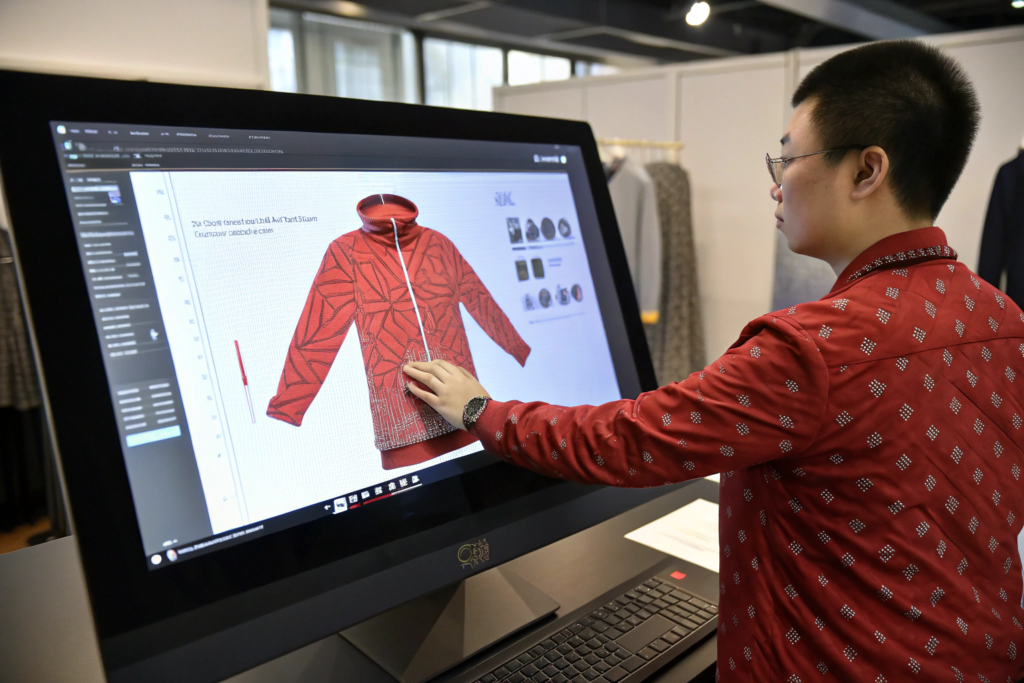
3D simulation is the most powerful error-reduction tool available to a modern garment factory. It allows the pattern maker and the brand to evaluate the fit, proportion, and drape of a garment on a customizable avatar before a single meter of physical fabric is cut. Errors that would have required a physical sample iteration to discover, a collar that is too wide for the body, a sleeve pitch that causes drag lines, a pocket placement that looks correct on a flat sketch but wrong on a 3D body, are visible in the simulation within hours of the pattern being drafted.
3D simulation reduces sampling errors by making fit and proportion issues visible while the design is still digital. The brand can rotate the garment, zoom in on details, toggle between colorways, and view the garment on avatars of different sizes. The pattern maker can adjust the pattern in response to the brand's feedback and regenerate the simulation within hours. The number of physical sample iterations drops because the first two or three rounds of revision happen digitally, at near-zero marginal cost and near-zero time cost. The physical sample that is eventually cut is a confirmation of the approved digital simulation, not a discovery tool.
At Shanghai Fumao, 3D simulation is integrated into our standard sampling workflow. For every new style, we build a 3D simulation before we cut the first physical sample. The simulation is submitted to the brand for review. The brand provides feedback. We adjust the digital pattern and resubmit. When the brand approves the simulation, we cut the physical confirmation sample. The physical sample is almost always approved on the first or second iteration because the fit and proportion issues were resolved digitally. Here is how 3D catches proportion errors and how it integrates with digital pattern adjustments.
How Does 3D Catch Proportion Issues That a Flat Tech Pack Sketch Misses?
A flat tech pack sketch is a two-dimensional representation of a three-dimensional object. It cannot show how the garment will hang on a body, how the fabric will drape, or how the proportions will relate to human anatomy. A collar that looks perfectly proportioned on a flat sketch may overwhelm the shoulders when rendered in 3D on a body. A pocket that looks correctly placed on a flat sketch may sit too low, below the natural waist, when the garment is simulated.
3D simulation places the garment on an avatar with realistic human proportions. The designer can see immediately that the collar is too wide, the pocket is too low, or the sleeve is too short relative to the body length. These proportion errors are obvious in 3D in a way they are not obvious in 2D. The correction is made to the digital pattern. The simulation is updated. The brand reviews the corrected version. The proportion error is resolved before the first physical sample is cut. The time and cost of a physical sample iteration that would have been required to discover the same error are eliminated.
Can 3D Simulation Accurately Predict Drape on Different Body Sizes?
3D simulation software uses the physical properties of the fabric, weight, thickness, stretch, bend stiffness, shear stiffness, to calculate how the fabric will drape on the body. The simulation is accurate for smooth, uniform fabrics. For textured, irregular fabrics, the simulation provides a good approximation but not a perfect reproduction.
The powerful application for sizing is the ability to simulate the same garment on multiple avatar sizes. A dress can be simulated on a size Small avatar, a size Medium avatar, and a size Large avatar. The brand can see how the proportions shift across the size range. A design detail that looks balanced on a size Medium may look out of scale on a size Small or size Large. The brand can adjust the grading to maintain the design intent across all sizes. This multi-size simulation is impossible with physical samples, which are typically only produced in the base size. The 3D simulation provides sizing insight that would otherwise only be discovered during production, when the cost of correction is highest.
Why Are Standardized Fit Blocks the Foundation of Accurate Sampling?
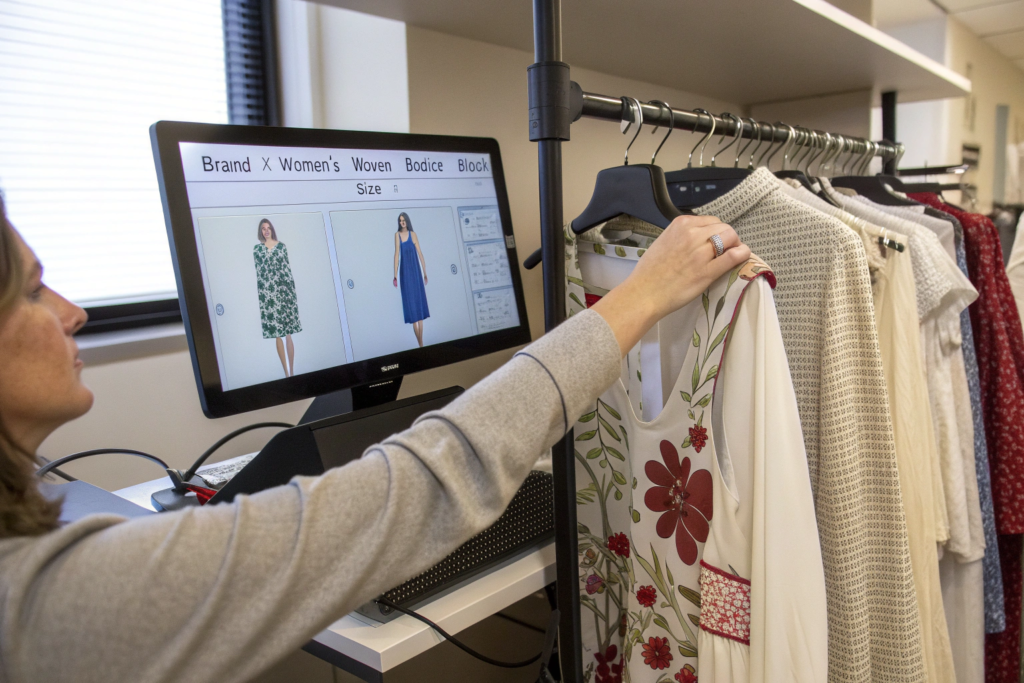
A fit block is a proven pattern foundation that has been fitted, tested, and approved through multiple seasons of production. It represents the brand's specific fit standard for a particular garment category and body type. A brand's woven blouse block has a specific shoulder slope, a specific armhole depth, a specific bust dart position, and a specific ease allowance that fits the brand's target customer. When a new blouse style is developed, the pattern maker starts from the approved block rather than drafting a new pattern from scratch.
Standardized fit blocks reduce sampling errors by ensuring that the fundamental fit of the garment is correct before the style-specific design details are added. The shoulder slope, the armhole shape, the body length proportion, and the sleeve pitch are proven. The pattern maker modifies the block to add the new collar, the new sleeve length, or the new hem detail, but the underlying fit is unchanged. The first sample fits the brand's fit model correctly at the core fit points. The sampling iterations focus on the new design elements, not on basic fit corrections that should have been resolved seasons ago.
At Shanghai Fumao, I maintain a digital fit block library for every long-term brand partner. The library is built over the first two to three seasons of the partnership. The initial seasons require more sampling iterations as the fit is perfected. Once the block is locked, the sampling efficiency improves dramatically. A brand that has a locked fit block with us can develop a new style with one or two physical sample iterations, compared to three or four for a brand without a locked block. Here is how blocks are developed and how they are maintained.
How Are Brand-Specific Fit Blocks Developed and Locked?
A brand-specific fit block is developed through a structured fit approval process during the first seasons of the partnership. The brand provides their target body measurements, their preferred fit preference, slim, regular, relaxed, and a reference garment that represents their fit standard. Our pattern team drafts an initial block and produces a fit sample in a standard base fabric. The brand evaluates the fit sample on their fit model and provides detailed fit comments.
The pattern team adjusts the block and produces a second fit sample. The process repeats until the brand approves the fit. The approved block is then locked in our digital pattern system. The lock means that the core fit elements, shoulder slope, armhole, body length proportion, cannot be changed without a formal block revision process. The block becomes the foundation for all future styles in that category. The initial investment in perfecting the fit pays off in reduced sampling iterations for every subsequent style.
How to Maintain Fit Block Accuracy Across Seasons and Fabric Changes?
A fit block is not static. It must be maintained. Fabrics change between seasons. A block developed for a rigid cotton poplin will not produce the same fit in a stretch cotton sateen. The pattern maker must adjust the block for the specific fabric properties of each season's production. The adjustment is a block modification, not a new block development. The core fit elements are preserved. The ease is adjusted for the fabric stretch. The shrinkage allowance is adjusted for the fabric shrinkage rate.
The block is also reviewed after production to verify that it performed correctly. If post-production quality data shows a recurring fit issue, a tight sleeve, a gaping neckline, the block is reviewed and adjusted. The block revision is documented and approved by the brand. The revised block becomes the new locked version for future seasons. This maintenance process ensures that the fit block remains accurate over time and across fabric changes. A block that is developed and never reviewed will drift as fabrics, bodies, and styles evolve.
How Should a Sample Submission Package Be Structured to Minimize Back-and-Forth?
A sample that arrives at the brand's office without documentation is an incomplete submission. The brand must measure the sample, compare it to the spec sheet, and discover discrepancies that the factory should have caught before shipping. The brand discovers that the body length is 1 centimeter short of the spec. The brand rejects the sample. The factory produces a corrected sample. The round-trip consumes two weeks. The error was measurable in the factory's sample room. The factory did not measure before shipping.
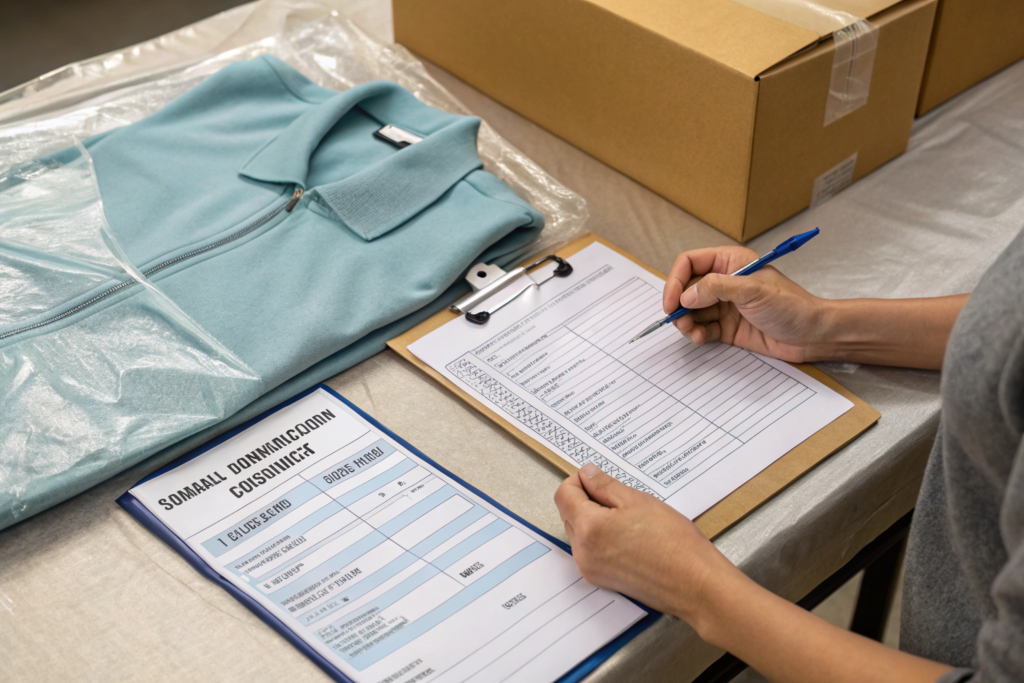
A complete sample submission package includes the physical sample, a self-inspection measurement report showing the target measurement, the actual measurement, and the deviation for every measurement point on the spec sheet, a fabric and trim confirmation card with the actual fabric quality, color, and trim items attached and labeled, a visual quality checklist confirming that all construction details match the tech pack, and a pattern maker's fit note commenting on any fit points that the pattern maker believes require the brand's attention. This package ensures that the factory has verified the sample against the specification before the brand sees it. Errors that the factory can detect are caught before shipping. The brand's review focuses on the aesthetic and fit evaluation, not on basic specification verification.
At Shanghai Fumao, no sample leaves our facility without a complete submission package. The package is assembled by the sample room supervisor and reviewed by the pattern maker. If the self-inspection report shows a measurement deviation outside the tolerance, the sample is not shipped. It is corrected in-house. The brand receives a sample that has already passed our internal quality check. The brand's rejection rate drops. The number of sampling iterations drops. The development timeline compresses. Here is what the measurement report should contain and how the pattern maker's fit notes add value.
What Should a Self-Inspection Measurement Report Include?
The self-inspection measurement report is a table with three columns for each measurement point: target measurement from the spec sheet, actual measurement on the sample as measured by our inspector, and deviation in centimeters or inches. The report must cover every measurement point on the spec sheet, not a selection. A report that shows only the key measurements is a partial inspection.
The report must be signed and dated by the inspector. The deviations must be within the tolerances specified in the tech pack. If any deviation exceeds the tolerance, the sample must be corrected and re-measured before shipping. The brand receives the report with the sample. The brand can spot-check a few measurements to verify the report's accuracy. The brand's measurement time is reduced from 30 minutes per sample to 5 minutes. The brand's confidence in the factory's self-inspection capability increases with each accurate report.
How Do Pattern Maker Fit Notes Improve the Brand's Review Process?
The pattern maker who developed the sample has spent hours examining the fit on the dress form. They have observed the drape, the hang, and the movement of the garment. They may have noticed a subtle fit point that is within measurement tolerance but does not look ideal. The sleeve cap has a slight puff that was not specified. The hem flares slightly more than the sketch indicated. The collar stand leans forward fractionally.
The pattern maker documents these observations in a fit note that accompanies the sample. The note might say: "Sleeve cap ease is 1.5 cm. Spec calls for 1.0 cm. We recommend reducing ease. Please review and advise." The brand reads the note, looks at the sleeve, and confirms the adjustment. The issue is resolved collaboratively, not discovered adversarially. The fit note demonstrates that the pattern maker is thinking critically about the garment, not just executing the spec. It builds the brand's trust in the factory's technical judgment. It also catches issues that the brand might miss in a quick visual review, preventing a production problem that would only be discovered when the fit model tries on the production sample.
Conclusion
Sampling errors are not a cost of doing business. They are a cost of inadequate process. The factory that reviews the spec before cutting, simulates the garment in 3D before sewing, builds on a proven fit block before designing, and inspects the sample before shipping, produces samples that are approved in fewer iterations, at lower cost, and in less time. The reduction in sampling errors is not a matter of hiring better pattern makers. It is a matter of building a system that catches errors at the stage where they are cheapest to fix.
At Shanghai Fumao, our sampling system is built on these four principles. Every tech pack is reviewed by three technical specialists before the pattern is drafted. Every new style is simulated in 3D before the first physical sample is cut. Every brand partner has a locked fit block that is maintained across seasons. Every sample ships with a complete submission package that proves we have verified the sample against the specification. The system did not appear overnight. It was built over years, one process improvement at a time, each improvement driven by an error that we were determined never to repeat.
If your sampling process is consuming too much time, too much budget, or too much patience, let us show you how our system works in practice. We can walk you through a sample submission package, demonstrate our 3D simulation capability, and explain how we would develop and lock a fit block for your brand. Reach out to our Business Director, Elaine, at elaine@fumaoclothing.com. The sample that is right the first time is not an accident. It is an engineered outcome.