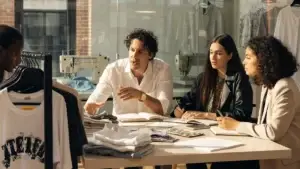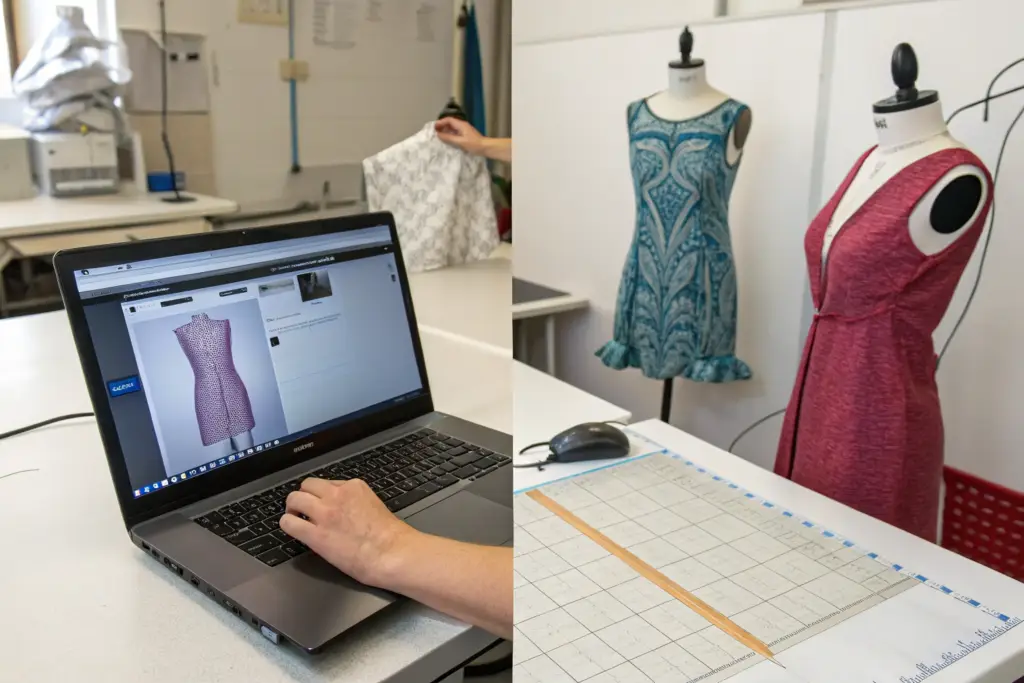
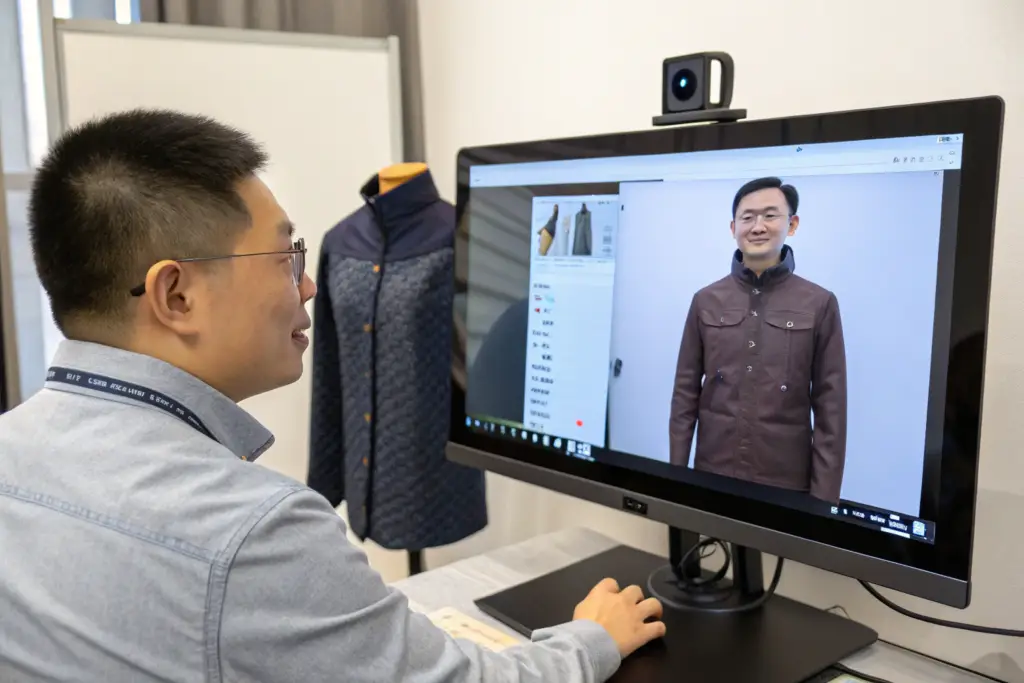
In the spring of 2025, a menswear brand owner from Seattle showed me his sampling budget for the previous year. He had spent $48,000 on physical samples across three collections. That figure covered fabric, trim, cutting labor, sewing labor, and express courier fees. He had produced an average of 3.2 physical samples per style before reaching approval. His average sample turnaround time was 18 days. His Fall collection development calendar, which should have been a relaxed, creative process, was a sequence of compressed deadlines, rushed courier shipments, and anxious waiting. He asked me if there was a better way. I opened my laptop and showed him a 3D simulation of one of his jacket styles. The simulation showed the drape of the fabric, the fall of the collar, and the placement of the pocket, all rendered on a customizable avatar. He rotated the jacket, zoomed in on the cuff detail, and toggled between three colorways. He approved the simulation in twelve minutes. The physical sample that followed required one iteration, not three. The sampling cost for that style dropped by 62%.
3D sampling reduces physical sampling costs and errors by shifting the iterative design refinement from the physical world to the digital world, where changes are instantaneous and cost nothing. A brand buyer can review fit, proportion, fabric drape, color, and trim placement on a photorealistic 3D simulation before a single meter of fabric is cut. The digital sample catches proportion errors, color mismatches, and design miscommunications at a stage where the fix is a mouse click, not a remake. The physical sample that follows is a confirmation, not an exploration. The number of physical sample iterations drops from three or four to one or two. The total sampling cost drops by 40% to 70%. The development calendar compresses by two to four weeks per style.
At Shanghai Fumao, I invested in 3D sampling technology in 2023. It was not a small decision. The software, the training, and the integration with our physical sampling workflow required a significant commitment of time and capital. I made the investment because I saw that 3D was not a gimmick. It was the future of garment development. The brands that adopt 3D sampling now are building a structural cost and speed advantage that their competitors will struggle to match. Let me explain exactly how the technology works, where it excels, where it has limits, and how to integrate it into a real-world buying and production workflow.
What Is 3D Sampling and How Does It Fit into the Garment Development Process?
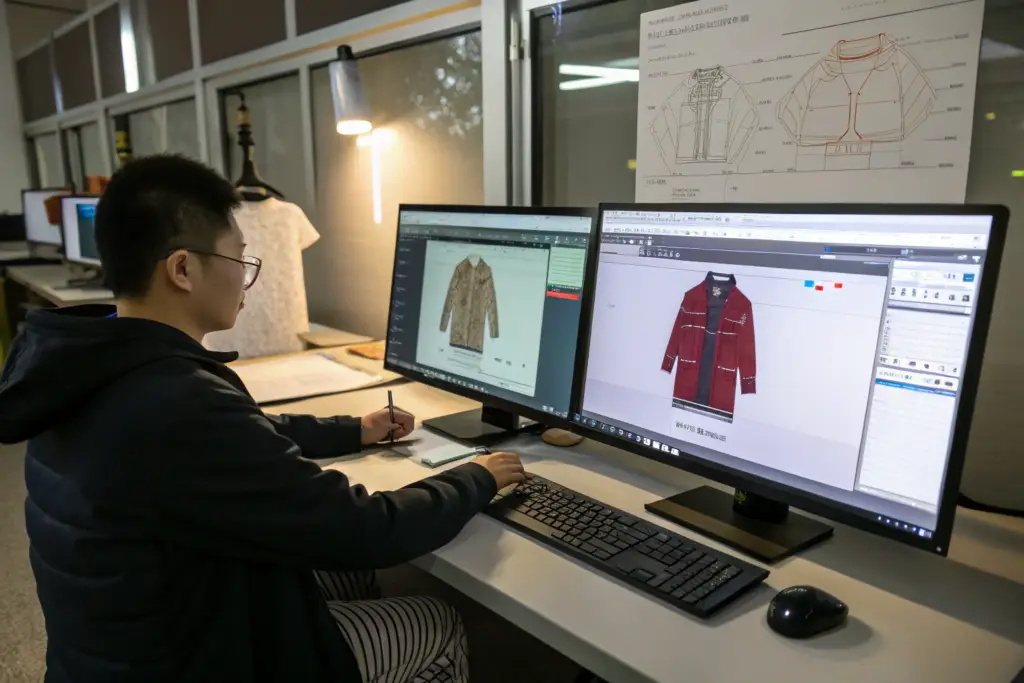
3D sampling is not a replacement for physical sampling. It is a new step inserted into the development process before the first physical sample is cut. The process begins the same way. The brand provides a tech pack, a design sketch, measurement specifications, and construction details. The difference is that, before the factory cuts and sews a physical sample, a 3D artist builds a digital twin of the garment using specialized software such as CLO, Browzwear, or Optitex. The digital twin uses the exact 2D pattern pieces, the specified fabric properties, and the specified trims to create a photorealistic simulation of the garment on a customizable avatar.
3D sampling fits into the garment development process as the step between the tech pack approval and the first physical sample. The brand reviews the 3D simulation for fit, proportion, design details, and color. Revisions are made to the digital pattern in real time, and the simulation is updated in hours, not weeks. Only when the digital sample is approved does the factory cut and sew the first physical sample. The physical sample then serves as a validation of the digital simulation, rather than as the starting point for iterative refinement. This compressed workflow reduces the total sampling timeline by 30% to 50% and reduces the number of physical sample iterations per style from an industry average of three to four down to one or two.
The 3D sample is not a cartoon. It is an engineering-accurate representation of how the specific fabric, with its specific weight, stretch, bend, and shear properties, will behave when cut to the specific pattern and worn on a body. The simulation accounts for gravity, for the collision of fabric layers, and for the internal structure of the garment. A jacket simulation shows the roll of the lapel, the hang of the lining, and the set of the sleeve. A dress simulation shows the drape of the skirt, the gather of the ruching, and the fall of the cowl neck. Here is how the technology handles fabric properties and what the current technical limits are.
How Accurately Can 3D Software Simulate Fabric Drape and Texture?
The accuracy of a 3D simulation depends on the quality of the fabric data input. Every fabric has measurable physical properties: weight, thickness, stretch, bend stiffness, shear stiffness, and surface friction. These properties determine how the fabric drapes, how it folds, and how it moves. 3D software can measure these properties using a fabric analysis kit, a small machine that stretches, bends, and shears a fabric swatch and uploads the data to the software. The simulation then uses this data to calculate the fabric's behavior under gravity.
For smooth, uniform fabrics like woven cotton poplin, polyester crepe, or denim, the simulation is highly accurate. The drape of a cotton twill pant in 3D will closely match the drape of the physical pant. For textured, irregular fabrics like heavily brushed fleece, bouclé knits, or napped wool, the simulation is less accurate because the surface texture is complex and the light interaction with the fiber tips is difficult to model. For these fabrics, the 3D simulation provides a good approximation of the silhouette and proportion, but the tactile hand feel and the visual depth of the texture cannot be fully captured. The physical sample remains essential for final approval of textured fabrics. I use 3D for silhouette and proportion approval on all fabrics, but I always set the expectation with brand partners that heavily textured fabrics require a physical hand feel check.
What Technical Skills Does a Factory Need for Effective 3D Sampling?
Effective 3D sampling requires a combination of skills that is not common in traditional garment factories. The 3D artist must understand pattern making, because the digital garment is built from the 2D pattern pieces and the simulation accuracy depends on correct pattern construction. The artist must understand fabric properties, because the simulation parameters must be set correctly for the fabric to behave realistically. The artist must also have an aesthetic eye, because the simulation must be styled, lit, and presented in a way that allows the brand to make an informed approval decision.
At Shanghai Fumao, our 3D team is recruited from our pattern-making and sample-room staff. I selected pattern makers who were interested in digital technology and trained them on the software. This combination of traditional garment knowledge and digital skills is more effective than hiring a 3D generalist without garment experience. A 3D artist who does not understand armhole depth or sleeve cap ease cannot build an accurate jacket simulation. A pattern maker who understands 3D can. The investment in training is real, but the return in sampling efficiency and client satisfaction is substantial.
How Can 3D Sampling Reduce the Number of Physical Sample Iterations?
The traditional sampling process is iterative and wasteful. The brand sends a tech pack. The factory produces a physical sample in two to three weeks. The brand receives the sample, tries it on a fit model, and identifies issues. The collar is too wide. The sleeve pitch is wrong. The body length is 1.5 inches too short. The brand marks up the sample, writes a fit comment, and sends it back to the factory. The factory produces a second physical sample. The cycle repeats. Each iteration costs money, consumes fabric, and consumes time. The average brand produces three to four physical samples per style before approval.
3D sampling compresses the iteration cycle by shifting the first two or three rounds of revision from the physical world to the digital world. The brand reviews the initial 3D simulation and provides feedback. The factory adjusts the digital pattern and regenerates the simulation in hours, not weeks. The brand reviews the revised simulation. This cycle can happen two, three, or four times within a single week, at zero marginal cost per iteration. By the time the factory cuts the first physical sample, the digital sample has already been through multiple rounds of refinement. The physical sample arrives at the brand as a near-final confirmation, not as a first-draft exploration. The number of physical iterations drops from three or four to one or two.
The cost savings from eliminated physical iterations are substantial. A single physical sample of a moderately complex jacket costs between $150 and $400 to produce, including fabric, trim, cutting, sewing, and courier shipping. Eliminating two physical iterations per style saves $300 to $800 per style. Across a collection of 40 styles, the savings range from $12,000 to $32,000. The time savings are equally important. Two eliminated physical iterations compress the development timeline by four to six weeks, which can be the difference between a brand that secures retail floor space and a brand that misses the buying window. Here is a specific cost comparison and the common errors that 3D catches.
What Is the Cost Comparison Between 3D Iterations and Physical Samples?
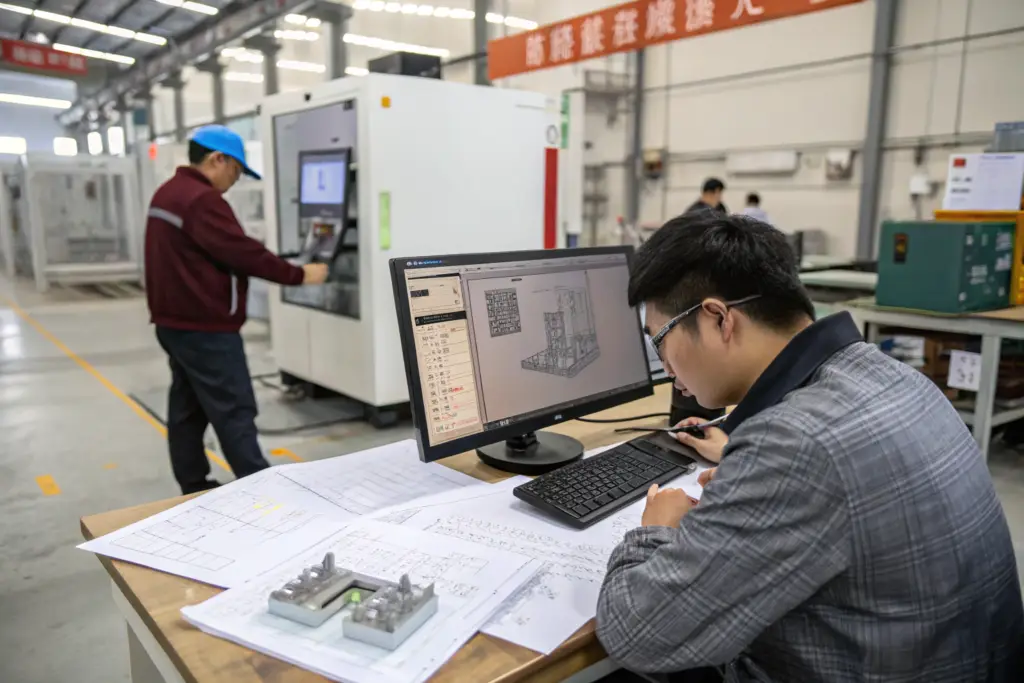
A physical sample iteration costs the brand for materials, labor, and shipping. A 3D iteration costs the brand nothing beyond the initial 3D development fee. The factory invests in the software, the hardware, and the skilled labor to create the initial 3D simulation. The marginal cost of adjusting the digital pattern and regenerating the simulation is negligible. The brand can request five, ten, or twenty digital revisions without incurring additional sampling charges.
A typical cost comparison for a mid-complexity woven jacket: traditional physical sampling, 4 physical samples at $280 each including courier, total $1,120, timeline 8 to 10 weeks. 3D-assisted sampling, 1 initial 3D simulation at $150 development fee, 3 digital revision rounds at zero marginal cost, 1 physical confirmation sample at $280, total $430, timeline 4 to 5 weeks. The cost savings are $690 per style, a 62% reduction. The time savings are 4 to 5 weeks. For a brand developing 30 styles per season, the seasonal savings exceed $20,000 in sampling costs and 4 months of cumulative development time.
What Common Fit and Proportion Errors Does 3D Catch Before Cutting?
3D simulation is particularly effective at catching proportion errors that are difficult to visualize from a flat tech pack sketch. A sleeve that is too short relative to the body length. A pocket placement that looks correct on a flat drawing but sits too low on a 3D body. A collar width that overpowers the shoulder width. A button stance that disrupts the visual balance. These proportion errors are immediately visible in a 3D simulation because the garment is viewed on a body, in 3D, at scale.
The 3D simulation also catches pattern construction errors that would produce fit problems. A sleeve cap height that is mismatched to the armhole depth, which would cause diagonal drag lines. A crotch curve that is too shallow, which would cause pulling when the wearer sits. A shoulder slope angle that does not match the avatar's shoulder, which would cause gaping at the neckline. These pattern errors are visible in the simulation as stress maps, color overlays that show where the fabric is under tension. The pattern maker can see the tension areas and adjust the pattern before a single stitch is sewn.
How Does 3D Sampling Improve Communication Between Buyers and Manufacturers?
The greatest source of error in garment development is miscommunication. A brand buyer writes a fit comment: "The collar feels too heavy." The factory pattern maker reads the comment. What does "heavy" mean? Too wide? Too thick? Too structured? The pattern maker interprets "heavy" as the collar width and reduces the width by 0.5 inches. The buyer receives the revised sample and the collar still feels heavy because the issue was the interlining thickness, not the width. The communication loop has failed because language was used to describe a three-dimensional, tactile problem.
3D sampling replaces ambiguous written communication with precise visual communication. The brand buyer views the 3D simulation, identifies the issue, and marks up the simulation directly. They can circle the collar, draw an arrow, and type "reduce collar width by 0.5 inches" or "reduce interlining stiffness" or "lower collar stand height by 0.25 inches." The factory pattern maker sees the marked-up simulation, understands exactly what the buyer is requesting, and adjusts the digital pattern accordingly. The revised simulation confirms that the adjustment achieved the desired result. The communication loop is closed visually, not linguistically.
This visual communication is particularly valuable when the buyer and the factory team do not share a native language. A marked-up 3D simulation is a universal visual language. The circle around the collar means "look here." The arrow means "change this." The text provides the specific instruction. The combination of visual and textual communication is far more precise than text alone. I have observed that brands using 3D sampling experience significantly fewer "fit comment misinterpretation" errors than brands using traditional text-and-photo fit comments. Here is how 3D serves as a common language and how it handles color and trim placement.
How Does 3D Serve as a Visual Common Language Across Language Barriers?
A 3D simulation is inherently multilingual. A collar that is too wide looks too wide, regardless of whether the reviewer speaks English, Mandarin, Spanish, or French. The visual information transcends the language barrier. When a buyer in New York circles a pocket on a simulation and types "move pocket 2cm toward center front," the pattern maker in Shanghai sees the visual circle and reads the numerical instruction. The number "2cm" is unambiguous in any language. The combination of visual targeting and numerical specification is extremely robust against translation errors.
This visual common language is not just about avoiding errors. It is about building a shared understanding of the brand's aesthetic standards. Over time, as the pattern maker sees the buyer's markups on multiple simulations, the pattern maker internalizes the brand's preferences. The pattern maker learns that this buyer prefers a narrower collar, a longer body, a softer shoulder. The 3D markups become a training dataset for the factory's understanding of the brand. The number of revisions required per style decreases over time because the pattern maker is anticipating the buyer's preferences based on the accumulated visual history.
Can 3D Simulations Accurately Show Color and Trim Placement?
Yes, and this is one of the most practical applications of 3D sampling. A buyer can toggle between multiple colorways of the same style in seconds. A jacket appears in black, in deep green, in terracotta. The buyer can see how the color interacts with the silhouette, how the stitching contrast reads, and how the hardware finish looks against the fabric. This colorway review, which would require multiple physical samples or an expensive lab dip and sample combination, happens in a single digital file.
Trim placement is equally precise. A zipper, a button, an embroidered logo, a screen-printed graphic can be placed on the 3D simulation at exact scale and in exact position. The buyer can see the size of the logo relative to the garment, the placement of the zipper relative to the seam, and the spacing of the buttons. If the logo feels too large or the zipper feels too long, the adjustment is a parameter change, not a physical remake. At Shanghai Fumao, I use 3D simulations to confirm logo placement and size with brand partners before the embroidery or screen printing is set up. This single step has eliminated the costly and time-consuming problem of incorrect logo sizing on physical samples.
What Are the Limitations of 3D Sampling and When Are Physical Samples Still Essential?
I am an advocate for 3D sampling, but I am not a zealot. 3D is a powerful tool with specific, well-defined limitations. A brand buyer who understands these limitations can use 3D for the 80% of decisions it handles perfectly and rely on physical samples for the 20% of decisions that still require a physical garment. A brand buyer who expects 3D to do everything will be disappointed and may make approval decisions based on incomplete information.
3D sampling has three primary limitations: it cannot replicate the tactile hand feel of a fabric, the sensation of softness, crispness, or weight in the hand, it cannot fully simulate the dynamic behavior of a garment during complex body movements such as walking, sitting, raising arms, or bending, and it cannot replicate the exact visual appearance of highly textured, irregular, or reflective fabrics such as brushed fleece, bouclé, sequins, or high-shine synthetics. For these evaluations, a physical sample is essential. The optimal workflow uses 3D for initial silhouette, proportion, color, and trim review, then cuts a single physical confirmation sample for the tactile and dynamic evaluations that 3D cannot provide.
I tell every brand partner who adopts 3D sampling with us: "The digital sample answers 80% of the questions. It tells you if the garment is proportioned correctly, if the colors work together, and if the design details are placed correctly. The physical sample answers the remaining 20%. It tells you if the fabric feels right against the skin and if the garment moves comfortably on a body. Do not skip the physical confirmation sample. Just reduce the number of physical samples that came before it." Here is what 3D cannot simulate and how smart brands balance digital and physical.
What Fabric and Fit Characteristics Cannot Be Digitally Replicated?
Hand feel is irreducibly physical. The softness of a brushed cashmere, the crispness of a starched cotton poplin, the plushness of a shearling, the cool, slick feel of a cupro lining. These tactile sensations cannot be transmitted through a screen. A 3D simulation can show you the visual texture, but it cannot let you touch it. The consumer will touch the garment. The buyer must touch it too.
Stretch and recovery are difficult to simulate accurately in real-time 3D. The software can model the amount of stretch in a knit fabric and can show how the garment conforms to the body. But the dynamic recovery, how quickly the fabric snaps back after being stretched, how it behaves after multiple wear cycles, and how it holds its shape, cannot be fully simulated. A legging that looks perfect in 3D might bag at the knee in physical reality after an hour of wear. Dynamic fit during complex movement is another limitation. 3D avatars can be posed in static positions, but the fluid transition between poses, the fabric bunching and releasing during a walk cycle, the collar shifting when the wearer turns their head, requires animation capabilities that are still developing. For garments where dynamic fit is critical, activewear, tailored jackets, close-fitting dresses, a physical fit sample on a live model is still essential.
How to Create a Hybrid Workflow That Balances Digital and Physical Samples?
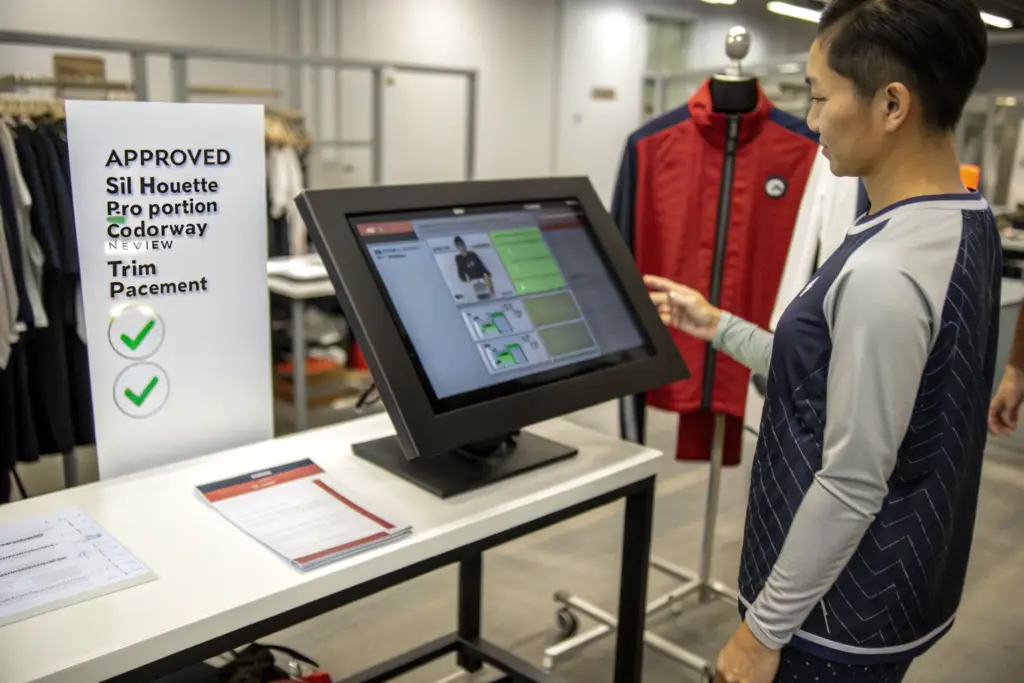
The hybrid workflow is simple and structured. Step one: the brand provides the tech pack and design reference. Step two: the factory builds the 3D simulation and submits it for initial review. Step three: the brand reviews the simulation for silhouette, proportion, color, and trim placement. The brand provides markups and feedback. Step four: the factory revises the digital simulation and resubmits. Steps three and four repeat until the digital sample is approved. Step five: the factory cuts and sews a single physical confirmation sample. Step six: the brand evaluates the physical sample for hand feel, stretch recovery, and dynamic fit. Step seven: if the physical sample matches the approved digital sample, the style is approved for production. If there are tactile or dynamic issues, a single physical revision is made.
This hybrid workflow captures the speed and cost advantages of 3D for the iterative refinement stages while preserving the essential physical evaluation for the final confirmation. The total number of physical samples per style drops from three or four to one or two. The total development timeline drops by 30% to 50%. The total sampling cost drops by 40% to 70%. The hybrid workflow is not a compromise. It is the optimal balance of digital efficiency and physical fidelity.
Conclusion
3D sampling is not the future of garment development. It is the present. The technology is mature, the software is accessible, and the return on investment is measurable. A brand that adopts 3D sampling today will reduce its sampling costs by half, compress its development calendar by a month, and eliminate the most common source of fit and proportion errors, the ambiguous written fit comment. The savings compound with every season, every style, and every collection.
At Shanghai Fumao, I have made 3D sampling a standard part of our development service. Every brand partner who works with us has the option to begin their sampling process with a 3D simulation. The brands that have adopted the hybrid workflow report faster approvals, fewer remakes, and a more collaborative, less stressful development process. The technology is an investment for the factory, but it is a gift to the brand.
If you are tired of paying for three rounds of physical samples per style, waiting three weeks for each round, and still receiving a final sample that does not match your vision, let us show you how 3D sampling works in practice. We can run a pilot on one of your existing styles, build the 3D simulation, and let you compare the digital sample to your physical reference. Reach out to our Business Director, Elaine, at elaine@fumaoclothing.com. The sample that costs nothing to revise is the sample that gets revised until it is right.