I watched a distributor lose $180,000 last spring. It was not because her dresses were ugly. They were beautiful. It was not because the price was too high. Her margin was 65%. She lost the money because the container arrived on April 10th. Her buyer meeting was on March 1st. The window closed. Those 3,000 units of floral midi dresses went straight to a discount warehouse. She recovered 20 cents on the dollar. The unit price she negotiated so hard became meaningless. The lead time destroyed her.
Lead time is more critical than unit price for seasonal women's wear orders because fashion operates on a fixed, unforgiving calendar. A missed delivery window turns spring styles into autumn dead stock, wiping out any profit margin you negotiated. Reliable, shorter lead times allow distributors to capitalize on trend peaks and reorder winning styles mid-season. A cheap garment that arrives late is far more expensive than a slightly pricier one that arrives on time.
This is the brutal math of seasonal fashion. You are not just selling clothes. You are selling timeliness. A Christmas sweater has full price value on December 10th. On December 26th, it is worth 50% off. On January 5th, it is almost worthless. Price is a number on a spreadsheet. Lead time is the difference between a sell-out and a write-off. At Shanghai Fumao, we have restructured our entire production system around this reality. Speed with control is the only product that matters.
Why Does a 15-Day Delay Destroy a Seasonal Fashion Collection's Profit?
A 15-day delay sounds small. It is just two weeks. In a factory making basic t-shirts, two weeks is nothing. But in women's seasonal fashion, 15 days is an eternity. The selling window for a specific seasonal item is painfully short. A spring transitional jacket has about 8 weeks of peak selling. A holiday party dress has maybe 4 weeks. When you lose 15 days, you are not losing a fraction of your sales. You are often losing the prime two weeks where full-price sell-through happens.
A 15-day delay destroys a seasonal collection's profit by forcing the distributor into mandatory markdowns right when the product hits the floor. Late goods miss the planned marketing push and the initial high-intent customer traffic. The lost full-price sales can never be recovered, turning a projected 60% margin into a single-digit loss after warehousing and liquidation costs are factored in.
Think of it like selling fresh strawberries. On day one, they command a premium. On day ten, you are giving them away. Fashion is a perishable product. The value decays rapidly once the season starts. You cannot store summer dresses in a freezer and sell them next summer. Next year, the silhouette, hem length, or color palette will have changed. You are selling fresh fruit, and the clock is ticking.
How Does the "Markdown Calendar" Punish Late Arrivals?
The retail calendar is ruthless. Major department stores and online platforms have fixed markdown schedules. They do not care about your shipping delay. The system is automated. If the goods are not on the floor by the "floor-ready date," the algorithm already has them flagged for the first price reduction cycle.
Here is a real example. A boutique chain in the Midwest ordered lightweight linen trousers from us for their "Summer Preview" floor set on April 15th. Their plan was to sell at full price for 6 weeks, then take a 25% markdown, then a final 50% clearance. The container was delayed 3 weeks. The trousers landed on May 6th. They missed the full-price window entirely. The store had to put them straight onto a 30% off rack to compete with rivals who already had linen pants on sale. The distributor still paid the full unit price to us, but her revenue per unit collapsed.
The schedule is predictable. Most retailers follow a strict pattern:
| Retail Phase | Timeline | Price Action | Impact of Late Delivery |
|---|---|---|---|
| Floor Set Launch | Week 1-2 | Full Price Selling | Completely missed. Zero high-margin revenue. |
| First Markdown | Week 5-6 | 25-30% Off | Late goods enter here. Margin already cut by a third. |
| Mid-Season Sale | Week 8-9 | 40-50% Off | Heavy competition. Barely breaking even on landed cost. |
| Final Clearance | Week 11-12 | 60-70% Off | Selling below cost. Warehouse space wasted. |
I remember a client from Atlanta who specialized in occasion wear. She ordered a rare style of mother-of-the-bride dress. A 20-day delay meant the dresses arrived one week before the peak June wedding season started. She had no time to photograph them properly or send them to her boutique accounts. She sold 30% of the stock at full price. The rest she held until next year, but the style had shifted slightly. The dresses looked dated. She eventually liquidated them online for less than the cost of the fabric. The $9 unit price advantage she had negotiated with her previous supplier did not matter at all. She lost tens of thousands. This is why tracking retail math through resources like the National Retail Federation is essential for understanding the true cost of markdowns.
Can Late Shipments Damage Your Relationship with Boutique Buyers?
Late shipments do not just steal your profit; they steal your reputation. Your boutique buyers are small business owners. They have limited shelf space and limited cash flow. If they budget $5,000 for your spring collection and it does not arrive, they have a gap on their racks. A gap means lost foot traffic. They will not forgive you twice.
A boutique owner in Texas told me this directly. She said, "I love your designs, but if you miss my delivery window again, I will stop booking you. I cannot sell empty hangers." Her words stuck with me. The distributor who supplies her is not just selling clothes. She is selling reliability. If the distributor fails, the boutique owner looks bad to her own customers. Trust is a fragile thing in this business.
When we ship for a distributor, we know the box is not going to a warehouse. It is going to a real store with a real woman waiting to style a mannequin. If we are late, that mannequin stays naked. That is a loss of confidence that no discount can repair. We solve this by using our own disciplined production timeline and working with reliable freight partners who understand the urgency of retail. We study logistics trends closely through platforms like FreightWaves to anticipate global shipping disruptions before they impact our outbound schedules.
How Can Agile Supply Chains Beat Fast Fashion Trends to Market?
Fast fashion giants like Zara and Shein have set a dangerous benchmark. They get a trend from the catwalk to the consumer in under 15 days. That speed warps customer expectations. Your boutique customer sees a celebrity wear a puff-sleeve dress on Instagram. She wants it now. Not in 60 days. If you, as a distributor, cannot supply that demand quickly, the customer will find an alternative. The trend window is shrinking from months to weeks.
An agile supply chain allows small and medium distributors to beat fast fashion trends to market by slashing decision-making time and using pre-positioned raw materials. Instead of reacting to a trend, agile factories and distributors can forecast fabric needs and start cutting within 48 hours of order confirmation. This speed creates a local competitive advantage against the global giants, capturing sales at full margin before the mass market saturates.
Agile does not mean chaotic. It means prepared. It means you have already solved the fabric sourcing and pattern challenges for a trend category before the specific order even arrives. At Shanghai Fumao, we build a library of approved "trend-ready" fabrics every season. We do not wait for a purchase order to start developing the wash or the drape.
What Is a "Reactive Fabric Program" and How Does It Cut Lead Time?
A reactive fabric program is a gamble that almost always pays off. It means we, the factory, invest in greige goods. Greige is the raw, un-dyed, unfinished fabric. We buy it in bulk before the season starts, based on trend forecasting. It sits on a roll, waiting.
When you place an order for a hot pink linen dress, we do not need to wait 20 days for the mill to spin the yarn and weave the fabric. The greige is already here. We just send it to the dye house. The dyeing and finishing take 5 to 7 days instead of 25 to 30. This single step cuts 20 days out of the lead time. It is the single most powerful speed lever we have.
We did this for a distributor who spotted a tangerine orange trend exploding in June. She needed 800 pieces of a crinkle cotton blouse quickly for a mid-summer refresh. Normally, the fabric alone would take a month. We had greige cotton in our warehouse. We dyed it to her exact Pantone match in six days. The blouses were shipped three weeks after her deposit. She sold them at full price while the trend was still hot. By the time other distributors got similar styles in stock, the market was cooling. She had already moved on to the next trend. This kind of program relies on tight coordination with dyeing facilities, using standards for color accuracy like those defined by Pantone for consistent, fast color matching.
Can "Just-in-Time" Trims Sourcing Prevent Design Delays?
Trims are the little things that kill big timelines. A custom button, a specific zipper, a branded hangtag. These small items have long lead times. A custom metal button might take 3 weeks to mold and polish. If you order them after the sample is approved, you automatically add 3 weeks to your delivery date.
We use a "Just-in-Time" trim library. We pre-source and stock a wide array of high-end standard trims. We have catalogs of gold zippers, mother-of-pearl buttons, and custom-woven labels that are already on our shelves. If a distributor can choose a button from our in-house library, the lead time for trims drops from 21 days to zero. It is an immediate time saving.
Of course, if the design demands a completely unique, custom-tooled button, that takes time. No way around it. But we are honest with our clients. We tell them directly: "This choice saves you $0.10 per unit but costs you three weeks. That choice costs $0.15 and saves you three weeks. Which is more valuable for this season?" Most distributors, once they see the math, choose the in-house trim. The speed-to-market advantage is worth far more than the $0.05 unit saving. This is a perfect example of where we use sourcing databases like Thomasnet to qualify alternative trim suppliers quickly without sacrificing compliance.
What Are the Hidden Costs of Choosing the Lowest Unit Price Garment Supplier?
We all love a good deal. I am a businessman, and I understand the pressure to keep costs down. But I have also cleaned up enough messes to know that the lowest sticker price is usually a lie. It is a bait-and-switch. The price per piece looks amazing on the invoice. Then the hidden costs start piling up. The quality is inconsistent, so you pay for re-inspections. The communication is terrible, so you pay with your time and sanity. The paperwork is wrong, so you pay customs penalties.
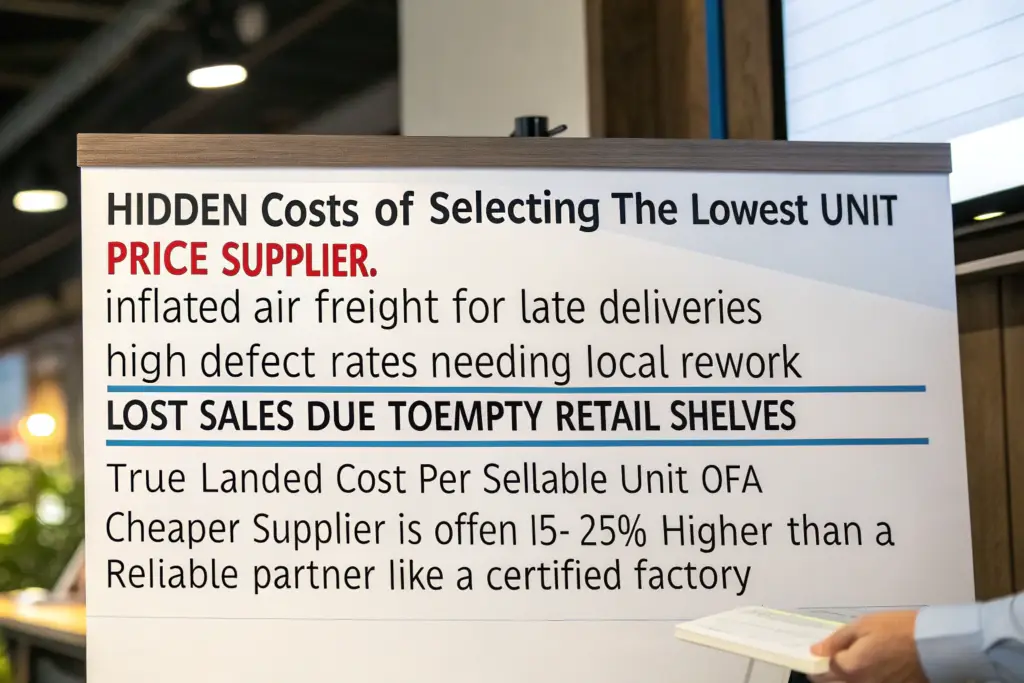
The hidden costs of choosing the lowest unit price supplier include inflated air freight for late-running goods, high defect rates requiring local rework, and lost sales from empty retail shelves. When you add up the non-conformance costs, the true "landed cost per sellable unit" of a cheap supplier is often 15-25% higher than that of a slightly more expensive but reliable partner like a certified factory.
Calculating the true cost requires brutal honesty. You cannot just look at the FOB price. You must look at the total cost of ownership. This includes the cost of your time, the cost of your stress, and the cost of the lost repeat business from your customers who received poor quality. Cheap becomes very expensive very quickly.
Why Does a Low FOB Price Often Lead to Poor Fabric Quality?
A factory offering a suspiciously low price is not performing magic. They are cutting corners. The first corner they cut is always the raw material. A garment is mostly fabric. To drop the price by 30%, they must use cheaper fabric. They might substitute a short-staple cotton for a long-staple one. The result is a t-shirt that pills after three washes. They might use a lighter weight knit than the spec calls for. The dress becomes see-through in sunlight.
I saw a tragic case of this last year. A distributor switched from us to a cheaper factory for a viscose wrap dress. The sample from the cheap factory was fine; it was probably made with good fabric. But the bulk production used a different, thinner viscose. When the dresses arrived and customers wore them, the seams started ripping on the first wear. The fabric did not have the tensile strength to hold the stitching under stress. The distributor had to accept returns from 40% of her boutique accounts. She lost money on every single dress. The cheap unit price destroyed her brand.
Good fabric costs what it costs. We always use certified fabric mills that provide a spec sheet for weight, composition, and strength. We test the bulk fabric before cutting. We do not rely on the mill's word alone. We verify. This verification process prevents the "bait and switch" that is so common in low-cost sourcing. Resources like the Better Cotton Initiative help us source sustainable and high-quality fibers with traceable origins, ensuring the fabric integrity matches the order specification.
How Do Delays Force You into Expensive Air Freight?
This is the most painful hidden cost. The factory misses the production deadline by two weeks. The sea freight option will take 30 days. That means the goods arrive two weeks after the season is over. The distributor panics. She has no choice. She must ship by air.
Air freight for apparel is a margin killer. A container of dresses that costs $3,000 to ship by sea can cost $20,000 by air. That $17,000 difference is not a bill to the factory. The factory has your money already. It is your bill. You have to pay it just to get the goods out of hock. You are held hostage by the late delivery.
We had a client come to us after such a nightmare. Her previous supplier was 25 days late on a 3,000-unit order of party wear. She had to air freight the whole shipment to not lose her major department store contract. The air freight bill wiped out her entire profit margin. She would have been better off paying us a dollar more per unit and shipping by sea. That extra dollar was an insurance policy against the $50,000 air freight disaster. We calculate this scenario with all our distributors. We show them that a reliable sea freight timeline, using schedules we track via global carriers like Maersk, is a massive financial advantage over a "cheap" factory forcing you into the air.
How Do I Verify If a Chinese Factory Really Delivers on Its Promised Timeline?
Trust is built on verification. I say this to every new distributor who contacts us. You should not trust me just because my website looks nice. You should trust me because my claims can be checked. A factory promising a 30-day lead time is easy to find. A factory that actually delivers in 30 days is rare. You need a method to separate the honest operators from the time liars. Time liars will tell you what you want to hear and then go silent when the deadline passes.
You can verify a Chinese factory's real production timeline by requesting a detailed reverse-engineered schedule, checking past shipping documents like Bills of Lading, and conducting a video walkthrough to see the actual work-in-progress on the floor. A real partner provides full transparency into their production planning, while a time liar offers only vague promises and excuses.
There is a specific process for this. It is not invasive. It is standard due diligence for any serious business. If a factory resists these simple checks, treat that resistance as a red flag. It means they have something to hide. I welcome these checks at Shanghai Fumao because they allow us to prove our system works.
Why Is a "Reverse Production Calendar" the Ultimate Test of Honesty?
A reverse production calendar starts with your final ship date and works backward. It breaks the 30 or 45 days into individual operations. It forces the factory to commit to specific dates for specific tasks. A liar will not do this. A liar wants to stay vague so they can shift the blame later.
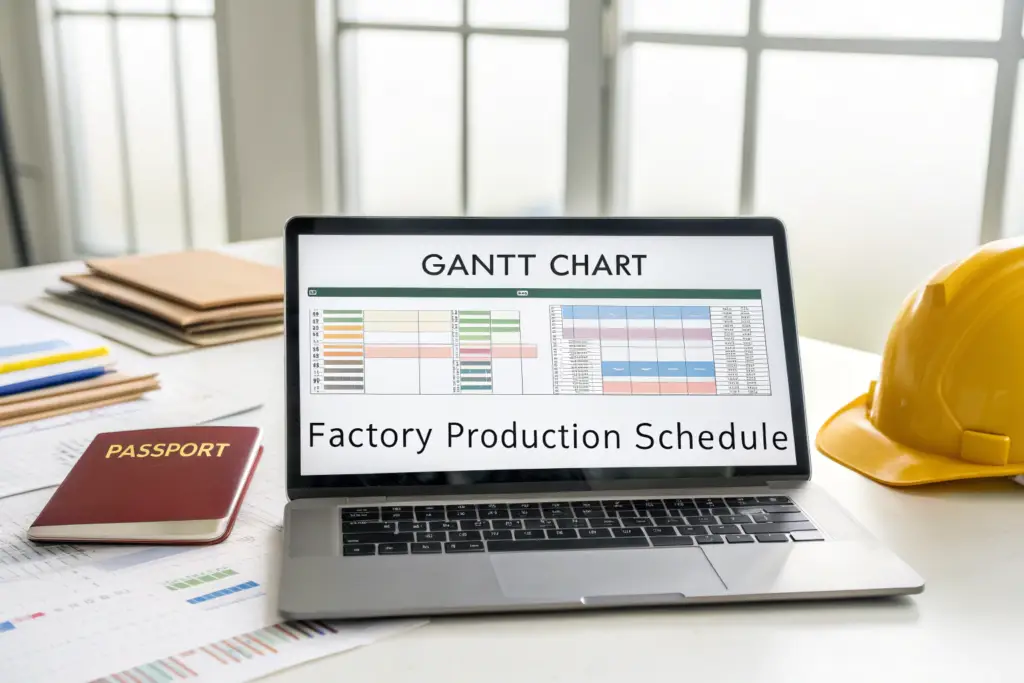
Here is the test. Ask your supplier: "If I need a ship date of August 1st, show me the dates you will finish cutting, finish sewing, and start packing." A good factory answers in hours, not days. They send you a Gantt chart or a simple spreadsheet. It looks like this:
| Production Milestone | Planned Date | Dependency |
|---|---|---|
| Fit Sample Approval | June 15th | Client Sign-off |
| Fabric Sourcing | June 18th | L/C or Deposit Received |
| Bulk Cutting Start | June 28th | Fabric Passes Inspection |
| Sewing Line Start | July 5th | Trim Inventory Check |
| Washing/Finishing | July 15th | Sewing Output Complete |
| Final QC Inspection | July 22nd | Packing List Ready |
| Container Loading | July 29th | Booking Confirmed |
| Target Vessel Departure | August 1st | Customs Clearance Done |
I shared this exact table with a swimwear distributor last summer. She had never seen a factory present a schedule this way. She said it immediately reduced her anxiety. She could track progress against a real plan. If the cutting was supposed to start on the 28th, she could ask for a photo of the cut panels on the 29th. It turned our relationship from a guessing game into a managed project. This kind of structured planning is aligned with project management principles found in frameworks like those described by the Project Management Institute, applied directly to a textile manufacturing environment.
How Can You Check Past Shipping Records to Confirm On-Time Performance?
Talking is cheap. Shipping documents are facts. A Bill of Lading (B/L) is a legal document issued by a shipping company. It has a date on it. It proves when cargo was loaded onto a vessel. You can ask a factory for redacted copies of Bills of Lading for recent orders similar to yours.
Look at the factory's promise. Did they promise a 40-day lead time? Then check the B/L date against the original purchase order date for that shipment. If the gap is consistently 50 or 60 days, the factory is lying about its capability. They are advertising a speed they cannot deliver. This simple check takes five minutes of your time and saves weeks of heartache.
We keep a detailed record of our Key Performance Indicators, and On-Time Delivery rate is the top one. We share this metric openly. In 2025, our on-time shipment rate was over 97% for seasonal orders. We can back this claim up with data. We also advise clients on what to look for in shipping documents, even consulting publicly available resources from logistics education hubs like Incoterms Explained to help them understand their title and risk transfer points.
When a client asks us for proof, I feel proud to send them the evidence. It shows we respect their need for security. A distributor cannot run their business by hoping the factory is telling the truth. They must know the truth. And the truth is always available in the paperwork.
Conclusion
Seasonal women's wear is not a business for the slow or the disorganized. It is a precision race against a calendar that shows no mercy. We have looked closely at why lead time beats unit price every single time. A 15-day delay does not just shift a schedule; it triggers an unstoppable chain reaction of markdowns, lost margins, and damaged boutique relationships. We have seen how agile supply chains, using reactive fabric programs and stocked trim libraries, can collapse lead times and allow small distributors to win against the giant fast-fashion machines. And we have faced the hidden, ugly costs of that "cheap" unit price: the air freight hostage situations and the fabric failures that destroy your brand's credibility.
The core lesson is simple. You are not buying a garment. You are buying a delivery date. The value of a summer dress on May 15th is $80. The value of that same dress on August 1st is $25. The unit price you negotiate in March does not change this math. A supplier who gets this, who has built their factory culture around the deadline rather than just the cost, is the only supplier worth having.
At Shanghai Fumao, we have oriented our entire operation to serve this truth. Our production lines, our raw material inventory, and our communication protocols are all designed to protect your selling window. We want to be the partner who helps you ship on time, capture full margin, and grow your brand without the constant stress of missed deadlines.
If you are ready to work with a partner who treats your calendar like a contract, I invite you to contact our Business Director, Elaine. She can provide you with a sample reverse production calendar for your next seasonal order, share our on-time delivery statistics, and discuss how our agile programs can slash weeks off your standard lead times. Reach out to Elaine directly at elaine@fumaoclothing.com. Let's ensure your next collection arrives exactly when it is supposed to, priced to sell, and ready to win the season.