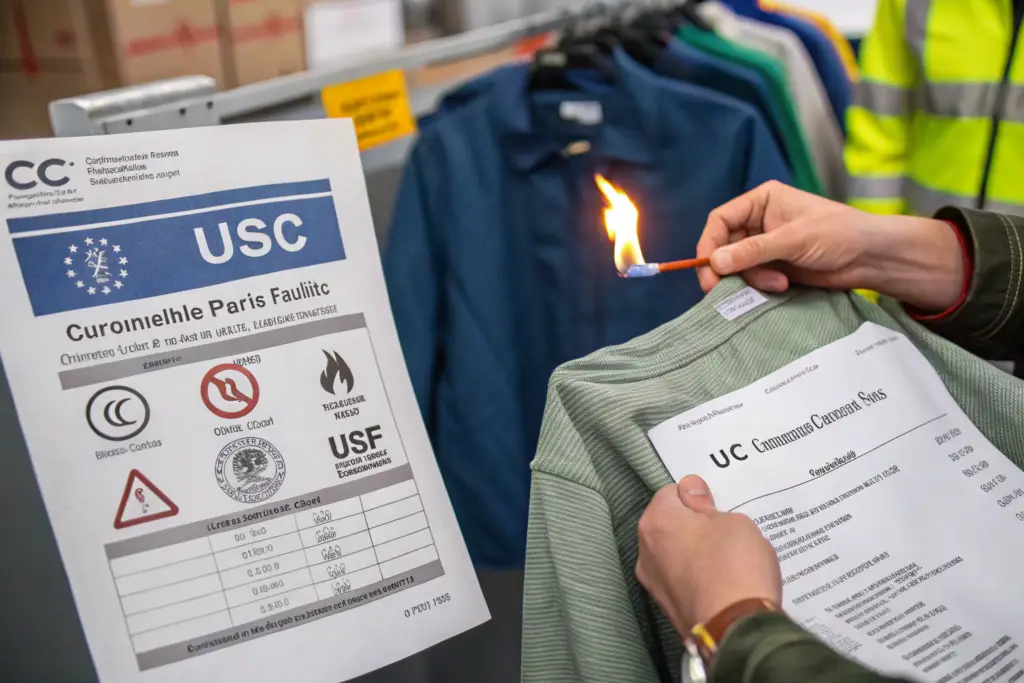
In the spring of 2025, a children's wear brand owner from Florida sat in my office at Shanghai Fumao, visibly shaken. Her shipment of 3,200 brushed cotton pajama sets had been detained at the Port of Los Angeles. The CPSC inspector had pulled a sample for flammability testing. The fabric failed. The pajamas were classified as dangerously flammable under 16 CFR Part 1615. The shipment was refused entry. The brand had to recall the units that had already reached their retail accounts. The total cost, including the lost inventory, the recall logistics, the retail chargebacks, and the legal fees, exceeded $140,000. The brand owner asked me, "Why didn't my previous factory tell me this was a problem?" The answer was painful but simple. The factory did not know. The fabric supplier had provided a generic test report from an unaccredited lab. The factory had accepted it without verification. The brand had never specified a flammability testing requirement in the purchase order. The system failed at every checkpoint.
The legal requirements for garment flammability labels in the US are governed by the Flammable Fabrics Act and enforced by the Consumer Product Safety Commission under 16 CFR Part 1610 for general wearing apparel and 16 CFR Parts 1615 and 1616 for children's sleepwear. In the EU, flammability requirements are governed by the General Product Safety Directive and harmonized standards, primarily EN 14878 for children's sleepwear and EN 1103 for general apparel, with additional requirements under REACH for flame retardant chemicals. The US system is prescriptive and test-method-specific. The EU system is performance-based and relies on harmonized standards that provide a presumption of conformity. A garment that is legal in one market may be illegal in the other.
At Shanghai Fumao, I have implemented a flammability compliance protocol that verifies fabric performance before cutting begins. I do not trust a supplier's certificate. I test the fabric myself or through an accredited third-party lab. I do this because the cost of a flammability failure is not measured in the cost of the test. It is measured in the cost of the detention, the recall, and the reputational damage to the brand. This is the regulatory landscape every US and EU brand must navigate, and this is how to navigate it.
What Are the Specific Flammability Standards for General Apparel in the US?
The foundational regulation for garment flammability in the United States is the Flammable Fabrics Act, implemented through 16 CFR Part 1610. This standard applies to all general wearing apparel, which means any garment that is not specifically regulated as children's sleepwear or protective clothing. The standard establishes a test method and three classes of flammability. Class 1, Normal Flammability, is the only acceptable result for most apparel. Class 2, Intermediate Flammability, is a cautionary category with restrictions. Class 3, Rapid and Intense Burning, is banned for sale in the United States.
16 CFR Part 1610 requires that general apparel fabrics pass a flammability test using a standardized apparatus and specimen preparation method. The test measures the time required for a flame to travel a specified distance along a fabric specimen held at a 45-degree angle. Fabrics that burn too quickly, with a flame spread time of less than 3.5 seconds for smooth fabrics or a rapid surface flash for raised-surface fabrics, are classified as Class 3 and are illegal for sale. The regulation applies to the fabric, not just the finished garment, and the responsibility for compliance rests with the importer of record, which is the US brand or distributor, not the overseas factory.
The test is deceptively simple. The consequences of ignoring it are not. A Class 3 fabric sold in the US is a banned hazardous substance. The CPSC has the authority to seize the goods, issue a mandatory recall, and impose civil penalties. The brand is legally responsible, even if the factory assured them the fabric was compliant. Here is how the test classifies different fabric types and why raised-surface fabrics are uniquely dangerous.
How Does the 45-Degree Flammability Test Classify Fabrics?
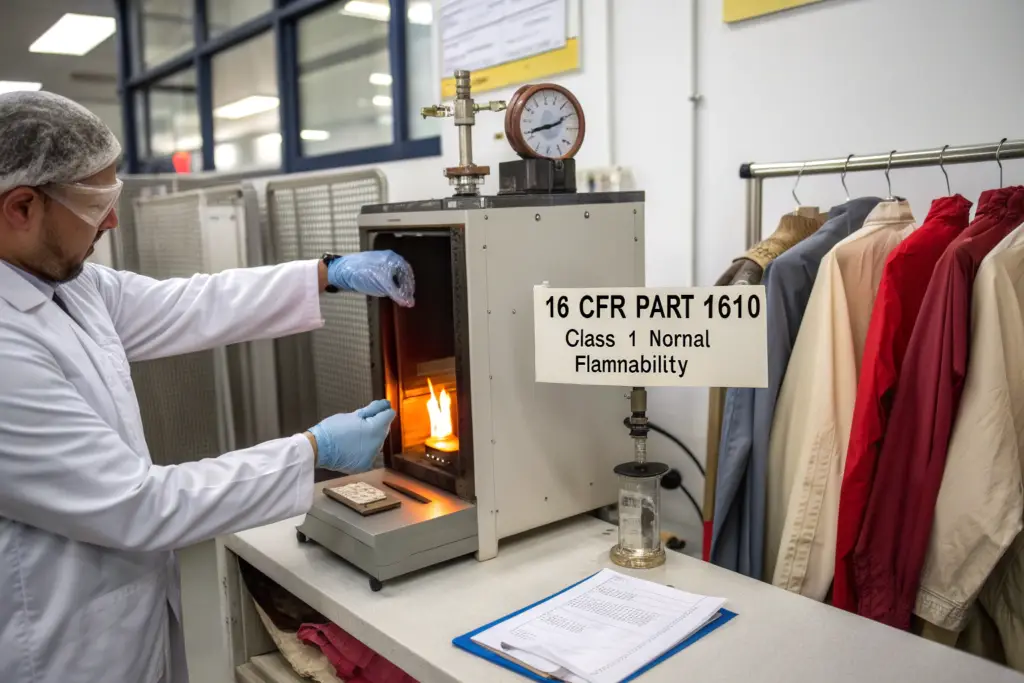
The 16 CFR Part 1610 test uses a standardized fabric specimen, 2 inches by 6 inches, mounted at a 45-degree angle in a metal cabinet. A calibrated flame is applied to the lower end of the specimen for one second. The tester measures the time it takes for the flame to travel the length of the specimen. The classification depends on the flame spread time and the fabric type.
For plain-surface fabrics, those without a raised fiber surface, a flame spread time of 3.5 seconds or more is Class 1, Normal Flammability. A flame spread time of less than 3.5 seconds is Class 3, Rapid and Intense Burning, and the fabric is banned. For raised-surface fabrics, those with a napped, brushed, or fleeced surface, the test is more complex. The fabric is tested with the raised surface facing the flame. If the surface ignites and the flame spreads rapidly across the nap, the fabric fails as a surface flash, even if the base fabric would pass. This surface flash phenomenon is the reason that brushed cotton, rayon chenille, and certain fleeces are high-risk fabrics for flammability compliance.
Why Are Raised-Surface Fabrics Considered High-Risk for Flammability?
A raised fiber surface creates a higher surface area exposed to oxygen. When a flame contacts a brushed or napped fabric, the individual fibers ignite rapidly, and the flame can spread across the surface at a speed far exceeding the spread rate on a smooth fabric of the same fiber composition. A smooth cotton fabric might pass the Class 1 requirement easily. The same cotton, brushed on the face for softness, might fail catastrophically with a surface flash that consumes the specimen in under a second.
This is why any garment that uses brushed fleece, sherpa, faux fur, or heavily napped flannel must be tested in its finished state, after brushing, not before. I have seen a mill submit a passing test report for a cotton twill, then deliver a brushed version of the same fabric for a hoodie program. The brushed fabric was never tested. It was a different material from a flammability perspective, and it was Class 3. The brand was fortunate that their CPSC-compliant testing protocol caught the failure before production. I require every raised-surface fabric to be tested for flammability in its finished state, with the raised surface oriented toward the flame, and I recommend every US brand do the same.
What Are the Stricter Rules for Children's Sleepwear in the US Market?
Children's sleepwear is the most heavily regulated apparel category in the United States. The tragic history of children suffering burn injuries from flammable pajamas in the 1940s and 1950s led to the enactment of specific, stringent standards that are separate from and far more demanding than the general apparel standard. 16 CFR Parts 1615 and 1616 govern children's sleepwear for sizes 0 through 14. The standards apply to any garment intended to be worn primarily for sleeping, including pajamas, nightgowns, robes, and loungewear marketed as sleepwear.
Children's sleepwear in the US must meet one of two compliance paths: the fabric must pass the vertical flame test specified in 16 CFR Parts 1615 and 1616, which requires the fabric to self-extinguish and leave a char length of no more than 17.8 centimeters, or the garment must be tight-fitting and meet specific dimensional criteria that reduce the air gap between the fabric and the skin, which reduces flammability risk. Tight-fitting sleepwear must carry a permanent label stating "For child's safety, garment should fit snugly. This garment is not flame resistant. Loose-fitting garment is more likely to catch fire." Loose-fitting sleepwear must be made from fabric that passes the vertical flame test.
The distinction between tight-fitting and loose-fitting is critical. A brand that produces loose-fitting cotton pajamas that have not been treated with flame retardant and do not pass the vertical flame test is selling an illegal product in the United States. The CPSC enforces these standards aggressively. Here is how the vertical flame test differs from the general apparel test and what the tight-fitting exemption actually requires.
How Does the Vertical Flame Test Differ from the 45-Degree Test?
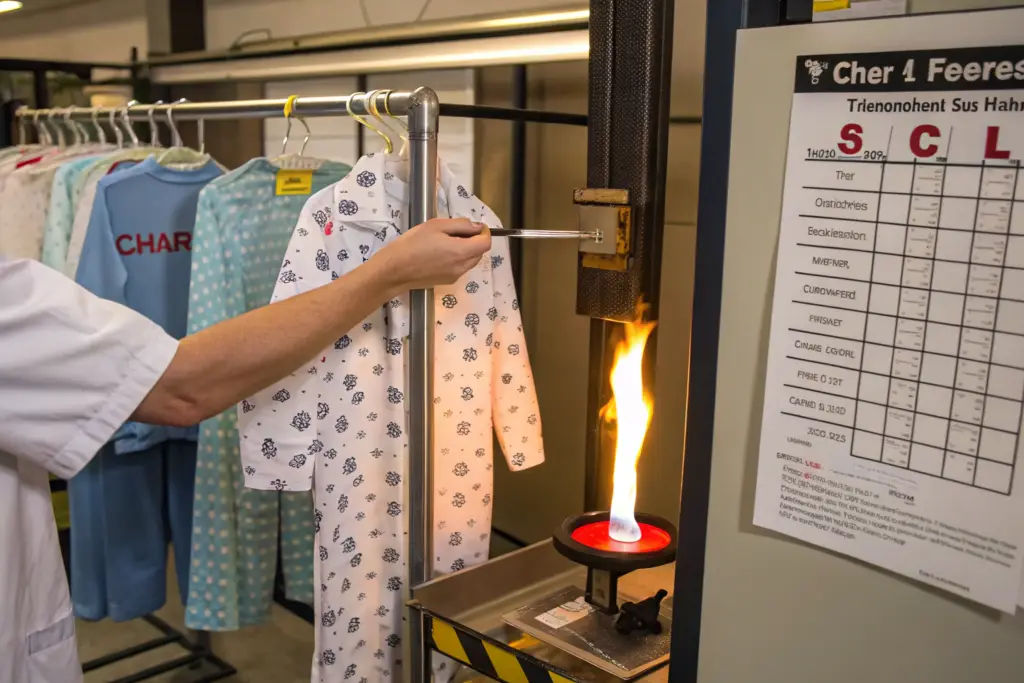
The vertical flame test for children's sleepwear is fundamentally different from the 45-degree test for general apparel. The specimen is mounted vertically. The flame is applied to the bottom edge for a specified duration. The test measures the char length, the distance the fabric burns upward from the point of flame impingement, after the flame is removed. The fabric must self-extinguish. The average char length across five specimens must not exceed 17.8 centimeters, or 7 inches. No individual specimen can have a char length of 25.4 centimeters, or 10 inches.
This is a much more demanding standard than the general apparel test. Most untreated cotton and cotton-blend fabrics will not pass the vertical flame test. They will continue to burn after the flame is removed, and the char length will exceed the limit. To pass, the fabric must either be inherently flame-resistant, such as certain synthetic fibers, or be treated with a flame-retardant chemical that is durable to multiple launderings. The test must be performed after 50 wash and dry cycles, simulating the life of the garment. A fabric that passes before washing but fails after washing is not compliant. The 50-cycle durability requirement is the aspect of children's sleepwear testing that is most frequently overlooked by new brands.
What Are the Exact Labeling Requirements for Tight-Fitting Sleepwear?
Tight-fitting sleepwear that relies on the exemption from the vertical flame test must comply with specific dimensional requirements and carry a specific permanent label. The dimensional requirements ensure that the garment fits closely against the body, with minimal air gap. The CPSC provides detailed measurement charts for each size range. The garment must meet every specified measurement at the chest, waist, seat, thigh, and arm.
The label must read exactly: "For child's safety, garment should fit snugly. This garment is not flame resistant. Loose-fitting garment is more likely to catch fire." The label must be permanently attached to the garment, not on a hangtag. The text must be in a specified font size and color that contrasts with the background. The label must be placed on the center back of the garment, immediately below the neckline, where it is visible and legible. A brand that uses the tight-fitting exemption but does not include the exact label, or places the label in the wrong location, or sizes the garment too loosely, is selling a non-compliant product. I maintain a template of the CPSC-required label text and placement specifications and provide it to every children's wear brand we produce for.
How Do EU Flammability Regulations Differ from the US Approach?
The European Union regulates garment flammability through a fundamentally different legal architecture than the United States. The US system is prescriptive. The regulation specifies the exact test method, the exact apparatus, and the exact pass/fail criteria. The manufacturer must use that specific test. The EU system is directive-based. The General Product Safety Directive requires that all consumer products placed on the EU market be safe. It does not specify a single test method. Instead, it references harmonized standards developed by European standards bodies. If a manufacturer tests to the harmonized standard and the product passes, the product is presumed to be safe and compliant with the directive.
The EU approach to garment flammability relies on the General Product Safety Directive, which requires that garments not present a flammability risk under reasonably foreseeable conditions of use. Compliance is demonstrated by testing to harmonized standards: EN 14878 for children's sleepwear, which specifies a surface flash test similar in concept to the US raised-surface test, and EN 1103 for general apparel, which provides a test method for flame spread. There is no EU-wide mandatory vertical flame test equivalent to 16 CFR 1615/1616. However, individual EU member states may impose additional requirements, and the lack of a prescriptive federal standard does not relieve the brand of the general safety obligation.
The practical difference for a brand is that EU compliance requires engagement with the standards process and a safety risk assessment, not simply running a prescribed test. The brand must evaluate the garment's intended use, the fabric's flammability characteristics, and the foreseeable risks. A brand that sells a brushed cotton robe in the EU without testing it for surface flash is not necessarily violating a specific regulation, but is likely violating the general safety obligation. Here is how the EU standards work and what the CE marking actually covers.
What Is the Role of EN 14878 in Children's Sleepwear Safety?
EN 14878 is the harmonized European standard for the flammability of children's sleepwear. It applies to garments intended for sleeping for children up to 14 years of age. The test method measures surface flash time, the time it takes for a flame to spread across the surface of the fabric. The standard sets a minimum surface flash time. Fabrics that exhibit a rapid surface flash fail the standard.
The key difference from the US children's sleepwear standard is that EN 14878 does not require a vertical flame test with a char length measurement. It does not require the fabric to self-extinguish. It does not mandate flame-retardant treatment. The standard focuses on the speed of surface flame spread. A fabric that burns slowly, even if it does not self-extinguish, may still pass EN 14878. The standard also allows for a "low flammability" classification that is less strict than the US tight-fitting exemption. A brand selling children's sleepwear in the EU must test to EN 14878 or an equivalent method and maintain a technical file documenting the test results and the safety assessment.
Does the EU Require a Specific Flammability Label Format?
The EU does not mandate a specific flammability warning label for general apparel in the same way the US mandates the tight-fitting sleepwear label. However, if a garment presents a specific flammability risk, the General Product Safety Directive requires that the risk be communicated to the consumer through labeling. The label must be in the official language of the member state where the product is sold.
The care label, which is mandatory under EU textile labeling regulations, typically includes the ISO care symbols. The care symbols can include a warning symbol related to flammability risk, a triangle with a flame symbol, if the fabric requires specific care to maintain its flammability performance. For children's sleepwear that has been treated with flame retardant, the care label must indicate whether the treatment is durable and provide washing instructions that maintain the treatment. The label must not claim "flame resistant" or similar unless the garment has been tested and proven to meet the relevant standard. I recommend EU brands include a "Keep Away from Fire" warning on all children's sleepwear hangtags and permanent labels as a baseline risk mitigation measure, even if the harmonized standard does not explicitly require it.
How to Build a Flammability Compliance Testing Protocol for Your Brand?
A flammability compliance protocol is not a single test. It is a documented system that integrates flammability risk assessment into every stage of product development and production. The brand that tests only the final production sample is testing too late. The brand that relies on the factory's generic test report is not testing at all. The protocol must begin at the fabric development stage and continue through production lot testing.
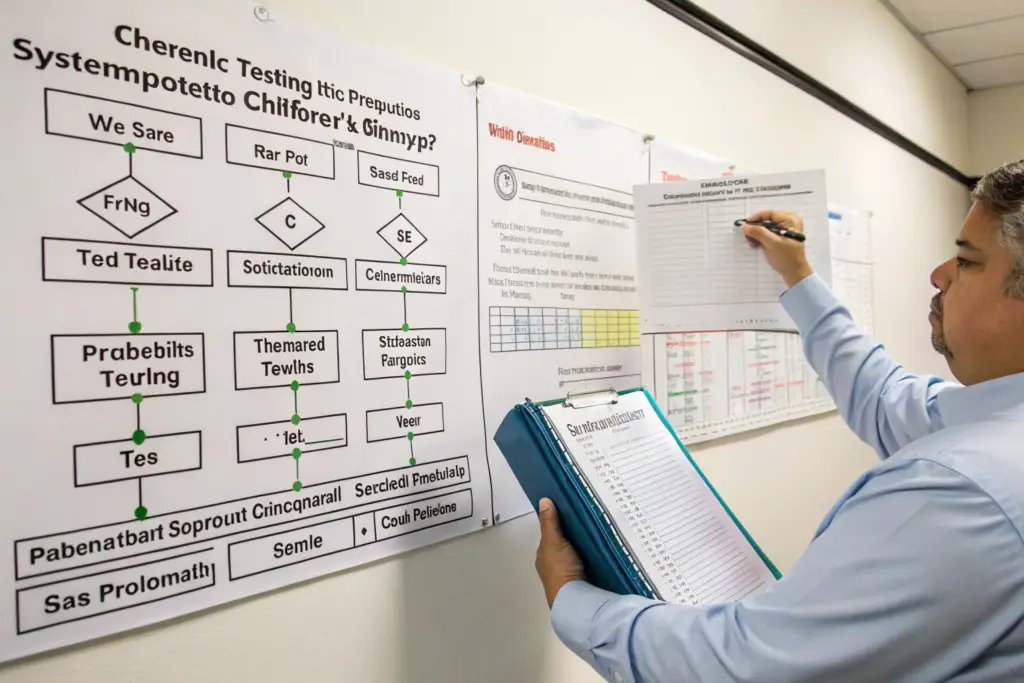
An effective flammability compliance protocol consists of five elements: a design-stage risk assessment that classifies each garment by its regulatory category, general apparel, children's sleepwear tight-fitting, children's sleepwear loose-fitting, a fabric-stage flammability test on the actual production fabric in its finished state, performed by an accredited laboratory, a durability test for children's sleepwear that repeats the flammability test after 50 wash-dry cycles, a production lot verification test that confirms the production fabric matches the tested fabric, and a documentation file for each style that contains all test reports, a compliance certificate, and label proofs. This file is the brand's legal defense in the event of a CPSC inquiry or a customs detention.
At Shanghai Fumao, I do not wait for the brand to request flammability testing. I flag high-risk fabrics and product categories at the development stage and recommend the appropriate test protocol. If the brand does not have a protocol, I provide ours. Here is how to identify high-risk products before production and how to maintain a technical file that withstands regulatory scrutiny.
How to Identify High-Risk Garment Categories Before Production?
The risk assessment begins with three questions. First, is the garment intended for children under 14? If yes, the regulatory scrutiny is higher. Second, is the garment intended for sleeping? The word "pajama," "nightgown," "sleepsuit," or marketing imagery showing a child in bed triggers the sleepwear classification, regardless of what the brand calls the product internally. Third, does the fabric have a raised surface? Brushed, napped, fleeced, chenille, or faux fur surfaces are high-risk for rapid surface flash.
A garment that is children's sleepwear, made from a raised-surface fabric, and loose-fitting is the highest-risk combination. It will almost certainly fail the US vertical flame test unless the fabric is inherently flame-resistant or treated with durable flame retardant. It will require testing under both US and EU standards if sold in both markets. I recommend brands maintain a "Flammability Risk Matrix" that categorizes each style at the design stage and triggers the required testing protocol. The matrix prevents the mistake of discovering a flammability problem after the fabric is cut and the production is committed.
What Documentation Proves Compliance to a Customs Inspector?
A customs inspector or a CPSC investigator will ask for the technical file. The file must be complete, organized, and immediately available. It should contain the test report from an accredited laboratory, with the lab's ISO 17025 accreditation clearly stated, the test method used, the test results, the date of testing, and the sample identification linking the tested fabric to the production fabric. It should contain a compliance certificate, either a Children's Product Certificate for children's sleepwear or a General Certificate of Conformity for general apparel, signed by a responsible officer of the importing company. It should contain the fabric specification sheet, the purchase order for the fabric, and the production lot numbers. It should contain photographs of the compliant label permanently attached to the garment.
A file that is missing any of these elements is not a complete defense. A customs inspector who cannot verify the link between the test report and the production fabric will detain the shipment. The brand that maintains a complete technical file for each style, organized and accessible, will clear customs quickly and respond to any post-market inquiry with confidence. I provide our brand partners with a compliance file template and a checklist. The documentation burden is real, but it is trivial compared to the cost of a detention or recall.
Conclusion
Garment flammability compliance is a legal obligation, not a quality option. The US system demands specific test methods and specific labels, with the strictest standards reserved for children's sleepwear. The EU system demands a general safety assessment supported by harmonized standards, with language-specific labeling and technical documentation. A brand that sells in both markets must navigate both systems, and the differences between them are significant enough that a single compliance approach will not cover both.
At Shanghai Fumao, I have built our flammability compliance capability to serve brands in both markets. We test fabrics in their finished state. We test children's sleepwear fabrics after 50 wash cycles. We maintain technical files for every style. We print compliant labels with the exact text, font, and placement specified by the relevant regulation. We do this because the factory's responsibility is not just to sew the garment. It is to ensure that the garment, when it reaches the consumer, is safe.
If you are developing a collection that includes high-risk fabrics, children's wear, or sleepwear, and you need a manufacturing partner who understands the flammability compliance landscape in both the US and EU, let us discuss your product categories. We can help you classify your products, select the appropriate test protocols, and build the technical file that protects your brand. Reach out to our Business Director, Elaine, at elaine@fumaoclothing.com. A flammability test costs a few hundred dollars. A flammability recall costs a brand.