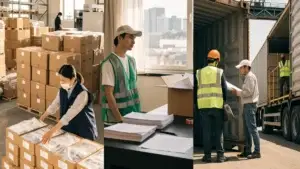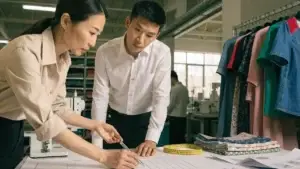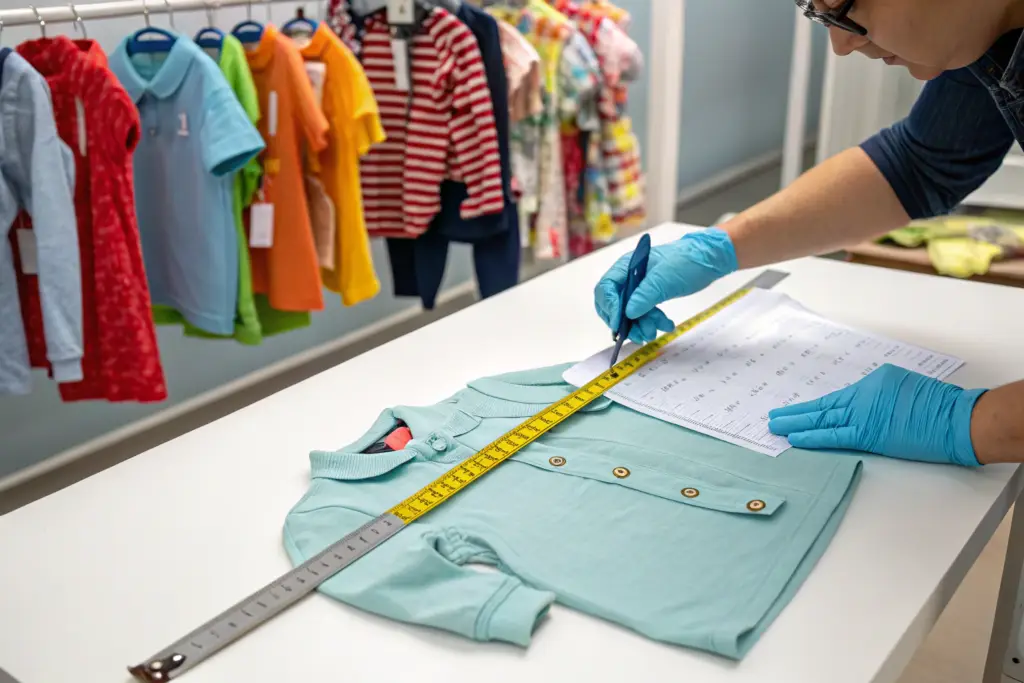
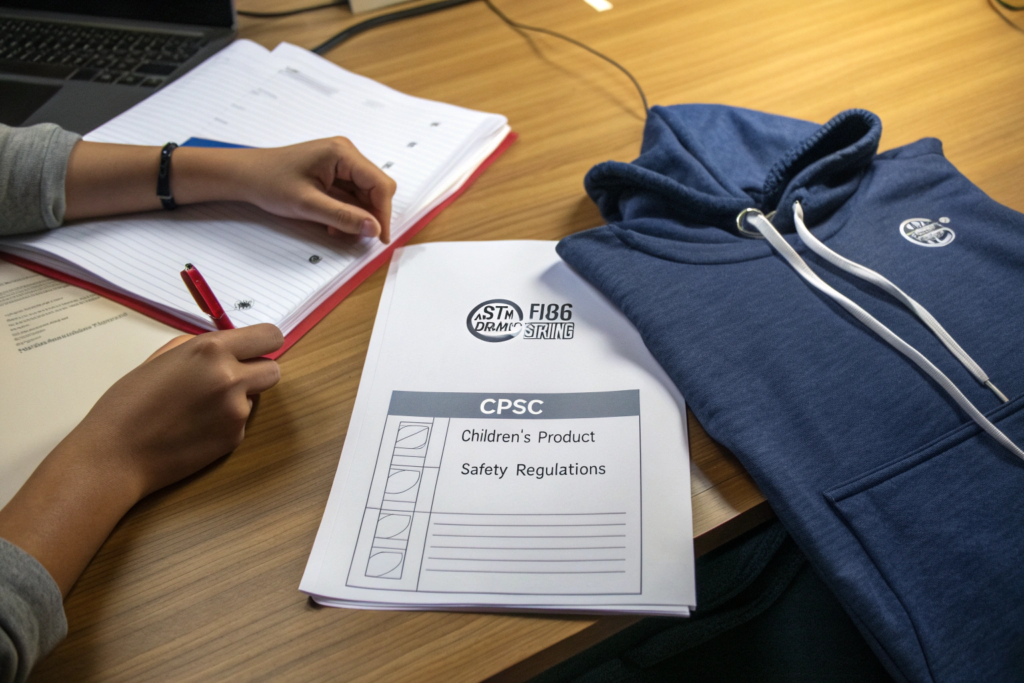
In the autumn of 2024, a children's wear brand owner from Boston sat in my office with a CPSC recall notice in her hand. Her shipment of 2,800 toddler hoodies had been flagged during a retail audit. The hoodies had a functional drawstring in the hood. That drawstring, compliant in some international markets, is a banned strangulation hazard under US children's clothing safety standards. The entire shipment was recalled. The brand paid for the recall logistics, the retail chargebacks, and the legal fees. The total cost exceeded $90,000. The drawstring had been included because the factory had used a standard hoodie pattern without recognizing that a children's hoodie requires a different safety specification. The brand owner asked me, "How do I make sure the next factory does not make a mistake like this?" I told her that the answer is a quality control checklist built specifically for kids' wear, applied at multiple checkpoints, by inspectors who are trained in children's product safety, not just general garment quality.
The top quality control checkpoints for kids' wear production in China are separated into mandatory safety checks, which verify compliance with CPSC and EU child safety regulations and are non-negotiable, and standard quality checks, which verify garment construction and aesthetics. The mandatory safety checkpoints include small parts attachment testing for buttons, snaps, and embellishments, drawstring and cord length verification against ASTM F1816 or EN 14682, flammability testing per 16 CFR Part 1615/1616 for sleepwear or 16 CFR Part 1610 for general apparel, lead and phthalate testing for all accessible components, and sharp point and sharp edge testing for all accessible hardware. A factory that treats kids' wear quality control as standard garment quality control is a factory that will produce a recall.
At Shanghai Fumao, I established a dedicated kids' wear quality control team in 2022. The team reports to our quality manager but receives separate training on children's product safety regulations. Their checklists are different from our adult apparel checklists. Their inspection tools include a small parts cylinder, a tension gauge for snap buttons, a sharp edge tester, and a drawstring length gauge. Their authority is absolute. If a kids' wear garment fails a safety checkpoint, production stops until the failure is resolved. No concession. No negotiation. The cost of a recall justifies zero tolerance on safety. Here are the specific checkpoints organized by production stage.
What Safety Regulations Must Be Checked Before Production Even Begins?
The most effective quality control checkpoint for kids' wear happens before a single meter of fabric is cut. It is the pre-production safety review. The factory's quality team reviews the tech pack, the design sketch, and the trim specifications against the applicable safety regulations for the destination market. This review catches design-level safety violations before they become production-level safety violations. A drawstring in a hood, a button that is too small on a garment for a child under three, a rhinestone embellishment that is not adequately attached. These are design decisions that become safety hazards. Catching them at the tech pack review stage costs nothing to fix. Catching them on the finished garment costs the production run.
The pre-production safety review must verify the design against four regulatory areas: small parts regulations for the intended age grade, the CPSC defines a small part as any object that fits entirely into a small parts cylinder simulating a child's throat, drawstring and cord requirements per ASTM F1816 for the US or EN 14682 for the EU, which specify maximum lengths and prohibited locations, flammability requirements, which classify the garment as general apparel or sleepwear and determine the applicable test standard, and chemical safety requirements under CPSIA, which mandate lead and phthalate limits for children's products. The review must be conducted by a person who has been trained on the specific regulations for the intended market. A review conducted by a general garment technician who is not familiar with children's safety standards is not a valid review.
At Shanghai Fumao, every kids' wear tech pack goes through a pre-production safety review before the pattern is finalized. The review is documented on a checklist that is signed and filed in the production record. If a safety issue is found, the brand is notified with a specific recommendation. The brand approves the modification. The tech pack is updated. Production proceeds with a compliant design. Here is how we check for small parts and drawstring compliance.
How to Verify That Buttons, Snaps, and Embellishments Meet Small Parts Regulations?
The small parts regulation is simple in principle and strict in application. Any component of a garment intended for a child under three years old that detaches during normal use and fits entirely into the small parts cylinder is a banned hazardous substance. The small parts cylinder has an internal diameter of 31.7 millimeters and a depth that varies. If the component fits inside, it is a choking hazard. The regulation applies to buttons, snaps, rivets, decorative bows, appliqués, embroidery patches, and any other attached component.
The pre-production check verifies that all components are either too large to fit into the cylinder, or are attached in a way that they cannot be detached by a child. A button that is sewn on with standard thread is not adequately attached. A button that is sewn on with a locking stitch and a backer button, or a snap that is attached with a mechanical fastener that requires a specific pull force to detach, may be adequate. The attachment method must be specified in the tech pack and verified through pull testing on the finished garment. The pre-production review identifies which components require pull testing and ensures the factory has the required test equipment. The CPSC small parts regulation is the governing standard.
What Are the Drawstring and Cord Length Limits for Different Age Groups?
Drawstrings and cords on children's clothing are regulated by ASTM F1816 in the United States and EN 14682 in the European Union. The standards are similar but not identical. A brand selling in both markets must comply with both. The fundamental rule is that drawstrings are prohibited in the hood and neck area of children's clothing for sizes 2T through 12 for the US and up to 14 years for the EU. There are no exceptions. A functional drawstring in a hood is a banned hazard. Period.
For waist and bottom drawstrings, the standards specify maximum lengths and require that the drawstring be secured at the center back so it cannot be pulled out unevenly. For the US market, waist drawstrings on clothing for sizes 2T through 16 must be no longer than 3 inches when the garment is fully expanded. For the EU market, waist drawstrings must not exceed 20 centimeters in length and must be secured. The pre-production review checks the drawstring specification in the tech pack against these limits. If the tech pack shows a drawstring that exceeds the limit, it is flagged and the brand is notified before cutting begins.
What Inline Quality Checks Prevent the Most Common Kids' Wear Defects?
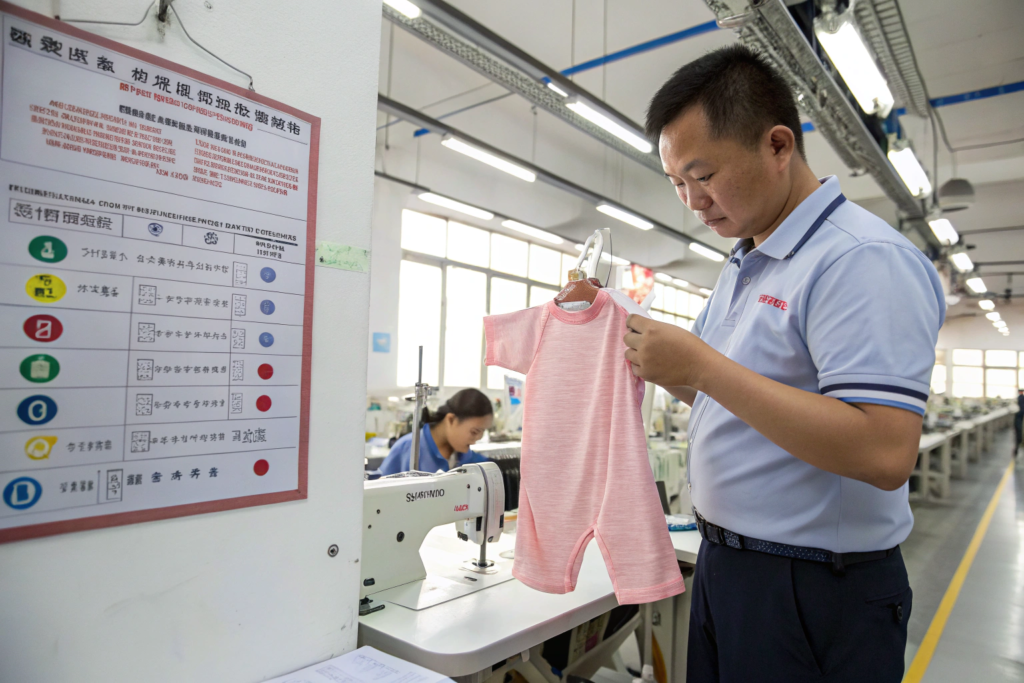
Inline inspection is quality control that happens during production, not after it. The inspector works within the sewing line, checking a sample of units from each operator at regular intervals. For kids' wear, inline inspection focuses on the safety-critical attachment points that end-of-line inspection might miss because they are hidden or require testing that cannot be performed on a finished garment without damaging it.
The critical inline checkpoints for kids' wear are snap and button attachment strength tested with a tension gauge on a sample of units per hour, seam strength at stress points including the crotch seam, armhole, and shoulder seam, neck opening size measured with a go/no-go gauge to ensure the garment can be put on and taken off easily without posing a strangulation risk, and decorative attachment security for appliqués, bows, and labels, verified by a manual pull test. These checks must be performed by a dedicated inline inspector who is stationed on the kids' wear line and who stops the line if a safety-critical failure is detected.
The inline inspector's role is different from the end-of-line inspector. The end-of-line inspector evaluates the finished garment. The inline inspector prevents defects from being built into the garment in the first place. The inline inspector catches a loose snap on unit 50, alerts the snap-attachment operator, and the operator corrects the machine setting. The remaining 450 units in the batch are produced with secure snaps. The end-of-line inspector can only find the loose snaps after all 500 units are complete. The inline approach is both faster and more effective. Here is how we test snap strength and seam security on the line.
How to Test Snap and Button Attachment Strength During Production?
A snap or button that detaches from a children's garment is a choking hazard and a recall risk. The attachment strength must be verified during production, not assumed. The test uses a tension gauge, a calibrated instrument that measures the force required to pull the snap or button away from the fabric. The test is destructive. The snap or button is pulled until it detaches, and the peak force is recorded. The minimum acceptable force is specified in the brand's quality manual, typically 15 to 20 pounds of force for snaps on children's garments, or by applicable regulations.
The inline inspector tests a sample of units from each snap-attachment station at a defined frequency, such as five units per operator per hour. The test is recorded in the inline inspection log. If a snap fails below the minimum force, the inspector tests additional units from the same operator to determine the scope of the problem. The machine setting, the die pressure or the stitching tension, is adjusted. The test is repeated until the failure is resolved. The failed garments are removed from the line and either reworked or discarded. The ASTM D7142 standard provides the test method for snap attachment strength.
What Seam Strength Tests Are Appropriate for Active Kids' Wear?
Children do not wear clothes gently. They run, climb, pull, and tug. Seams on children's garments must withstand active use. The crotch seam on a romper, the armhole seam on a T-shirt, the shoulder seam on a dress, these are stress points that fail if the seam strength is inadequate.
The inline inspector tests seam strength by applying a manual pull test. The inspector grips the fabric on either side of the seam and pulls firmly. The seam should not separate, pucker, or show thread breakage. For a more quantitative test, a seam strength test can be performed using a tensile testing machine on a sample of units pulled from the line. The minimum seam strength is specified in the brand's quality manual, typically 10 to 15 pounds of force for woven seams and 8 to 12 pounds for knit seams. Seam strength testing is particularly important for sleepwear, where a failed seam can expose the child to loose fabric that poses an entanglement risk.
What Final Inspection Protocols Are Specific to Children's Garments?
The final inspection for kids' wear is more rigorous than the final inspection for adult apparel. It includes all the standard garment quality checks, measurement verification, visual defect inspection, color matching, label accuracy, plus a set of safety-specific checks that are unique to children's products. These safety checks are not optional. They are not nice-to-have. They are the difference between a shipment that clears customs and sells at retail, and a shipment that is detained, recalled, or rejected.
The final inspection protocols specific to children's garments include a 100% safety check of every unit for drawstring and cord compliance, a small parts attachment verification using a pull test on a sample of units per the AQL sampling plan, a sharp point and sharp edge test on all accessible hardware and embellishments, a label compliance check verifying the presence of the tracking label, the care label, the fiber content label, and the country of origin label in the correct format and language, and a functional test of all closures, zippers, snaps, and buttons, to ensure they operate smoothly without pinching skin. The final inspection is conducted under the AQL sampling plan specified in the purchase order, with the safety-specific checks applied at a tightened inspection level.
At Shanghai Fumao, our kids' wear final inspection is a two-stage process. Stage one is the safety inspection. Every unit in the inspection sample is checked for the safety-specific items first. If any unit fails a safety check, the entire lot is placed on hold, regardless of the AQL result on the general quality checks. Safety failures are not averaged. They are absolute. Stage two is the general quality inspection, which proceeds only after the safety inspection is passed. Here is how we test for sharp edges and how we verify the tracking label.
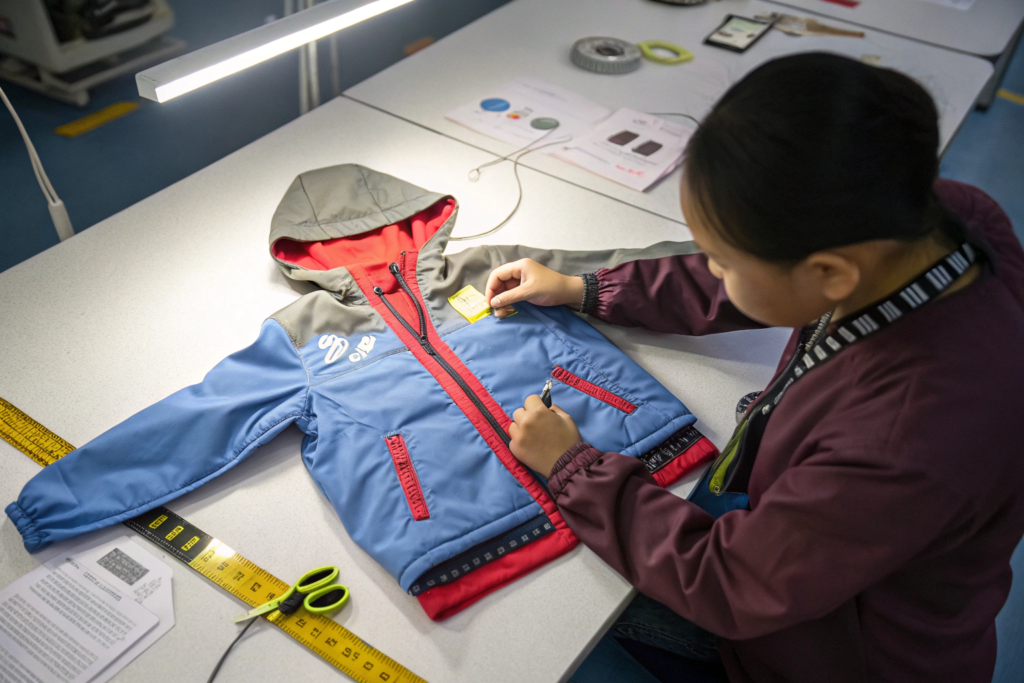
How to Conduct a Sharp Point and Sharp Edge Test on Finished Garments?
A sharp point or sharp edge on a children's garment can cut or puncture a child's skin. Zipper teeth, metal snaps, decorative pins, sequins, and wire-supported bows are common sources. The test uses a sharp point tester and a sharp edge tester, instruments specified by CPSC regulations. The sharp point tester applies a calibrated force to the point. If the point penetrates a reference material beyond a specified depth, it is a sharp point and fails. The sharp edge tester uses a Teflon tape wrapped around a rotating mandrel. If the edge cuts the tape, it is a sharp edge and fails.
The final inspector tests all accessible hardware and embellishments on the sample units. If any unit contains a sharp point or sharp edge, the component is a safety failure. The lot is placed on hold. The component must be replaced with a compliant alternative, or the affected units must be reworked to eliminate the hazard. A brand cannot sell a children's garment with a sharp point, even if the sharp point is on a decorative element that is not intended to be touched. Children touch everything. The CPSC sharp point and edge regulations define the test methods.
What Tracking Label Information Is Required and How Is It Verified?
The tracking label is a legal requirement under CPSIA for all children's products sold in the United States. It must be permanently attached to the garment. It must contain specific information: the manufacturer's name or registered identification number, the location of production including city and country, the date of production expressed as a month and year or a date code, and a cohort or batch number that allows the manufacturer to trace the specific production batch. The tracking label is the traceability mechanism that enables a recall. Without it, a recall cannot be targeted, and the entire brand inventory may be considered part of the recall scope.
The final inspector checks every unit in the inspection sample for the presence of the tracking label, the legibility of the information, and the accuracy of the information against the production records. The batch number on the label must match the batch number on the cutting work order and the sewing line traveler tickets. A missing, illegible, or inaccurate tracking label is a major defect. The lot is placed on hold until the labels are corrected. The tracking label is not a design element. It is a legal document.
What Chemical Safety Testing Is Mandatory for Kids' Wear Exports?
Chemical safety testing for children's wear is not a quality choice. It is a legal requirement. The Consumer Product Safety Improvement Act mandates specific limits for lead in surface coatings and lead in substrates, and bans specific phthalates in children's products. These requirements apply to every children's garment sold in the United States. A factory that produces children's wear without a chemical testing program is producing products of unknown legality.
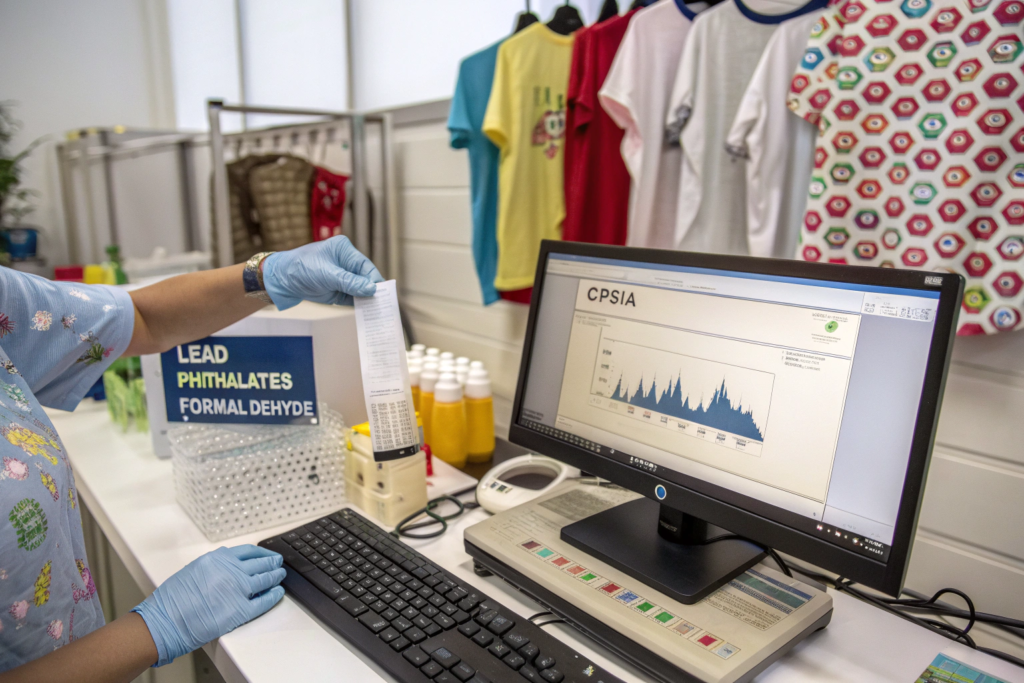
The mandatory chemical safety tests for US-bound kids' wear are total lead in surface coatings, which applies to painted or printed surfaces and has a limit of 90 parts per million, total lead in substrates, which applies to the fabric, buttons, zippers, and other accessible components and has a limit of 100 parts per million, and phthalate content for the six banned phthalates, DEHP, DBP, BBP, DINP, DIBP, and DPENP, each limited to 0.1% of the component weight. For EU-bound kids' wear, additional tests under REACH regulations may be required, including tests for specific azo dyes, formaldehyde, and other restricted substances. The testing must be performed by a CPSC-accepted laboratory, and the results must be documented in a Children's Product Certificate that accompanies the shipment.
At Shanghai Fumao, we do not rely on our fabric suppliers' certificates for chemical safety. We send fabric, trim, and print samples to an accredited third-party laboratory for CPSIA testing before production begins. The test reports are included in the production file. The Children's Product Certificate is prepared and signed before the shipment leaves our facility. The testing costs money and takes time. It costs far less than a recall. Here is how print and dye testing works and how we build a technical file.
How Are Prints, Dyes, and Embellishments Tested for Chemical Compliance?
A garment is not just fabric. It is fabric plus dye plus print plus coating plus embellishment. Each component must be tested. A cotton T-shirt with a screen-printed graphic has at least three components requiring chemical testing: the cotton fabric, the screen printing ink, and any dye used to color the fabric. If the T-shirt has a rhinestone embellishment, the rhinestone and its adhesive must be tested.
We send a complete garment assembly, or a kit of all components, to the testing laboratory. The lab tests the fabric for lead in substrates and phthalates. The lab tests the print for lead in surface coatings. The lab tests the embellishments for lead and phthalates. The testing is comprehensive. A test report that covers only the fabric but not the print is not a valid compliance document for the finished garment. The brand's Children's Product Certificate must reference test reports that cover every accessible component.
How to Build a Children's Product Certificate That Passes Customs Inspection?
The Children's Product Certificate is the legal document that declares the children's product complies with all applicable CPSC safety rules. It must be furnished to the distributor, the retailer, and, upon request, to the CPSC and Customs and Border Protection. A CPC that is incomplete, inaccurate, or unsupported by valid test reports will result in a customs detention.
A valid CPC contains the following information: the product name and description, the name of the US importer or domestic manufacturer certifying compliance, the contact information for the certifying party, the name of the foreign manufacturer, the location and date of manufacture, the date and location of testing, the name and contact information of the CPSC-accepted testing laboratory, and a list of each CPSC safety rule to which the product is certified. The CPC must be signed by a responsible officer of the certifying company. At Shanghai Fumao, we prepare a draft CPC for every kids' wear order and provide it to the brand with the test reports. The brand reviews, signs, and files the CPC. The document is ready before the shipment arrives at the port of entry.
Conclusion
Kids' wear quality control is a discipline, not an afterthought. The checkpoints are specific, the regulations are strict, and the consequences of failure are severe. A factory that treats kids' wear production as standard apparel production with smaller measurements is a factory that will eventually cause a recall. A factory that has a dedicated kids' wear QC team, a pre-production safety review process, an inline safety inspection protocol, a mandatory chemical testing program, and a documented Children's Product Certificate procedure is a factory that takes children's safety seriously.
At Shanghai Fumao, my kids' wear QC team operates with the authority to stop production for any safety violation. They are trained on CPSC and EU regulations. They use calibrated test equipment. They document every inspection and every test. They do this because a child who wears a garment we produced must be safe. That is not a marketing claim. That is a manufacturing obligation.
If you are producing children's wear and you want a manufacturing partner whose quality control system is built around the specific safety requirements of kids' products, let us walk you through our checkpoints. We can share our pre-production safety review checklist, our inline inspection protocols, and our chemical testing documentation. Reach out to our Business Director, Elaine, at elaine@fumaoclothing.com. A children's garment that is beautiful but unsafe is not a garment. It is a liability.