
You negotiated a great FOB price with a supplier. The linen pants are finished. They are packed in a container. The factory sends you a photo of the truck leaving their loading dock. You feel a sense of relief. Then the emails start. The freight forwarder needs a bond. Customs is holding the shipment for a random exam. The port charges are higher than expected. The trucking company needs a delivery appointment. You are not a logistics manager. You are a brand owner or a distributor. You wanted to sell pants, not navigate a maze of customs regulations, tariff codes, and port fees. Every hour you spend untangling shipping problems is an hour you are not growing your business.
The top three benefits of DDP shipping for linen pants importers are a single, predictable landed cost that eliminates hidden fees and allows accurate margin calculation, a transfer of customs clearance risk and responsibility from you to the supplier who is motivated to classify goods correctly, and a dramatically simplified logistics experience where you track one shipment from one partner instead of coordinating three separate entities across two continents. DDP replaces logistics anxiety with a fixed cost and a single point of accountability.
My name is Elaine. At Shanghai Fumao, I have watched hundreds of shipments leave our factory. I have also answered the panicked phone calls from brand owners whose FOB shipments went wrong. A few years ago, I made a decision. We would offer DDP as our standard shipping model, not just as an occasional option. We did this because I realized that a beautiful pair of linen pants sitting in a customs warehouse is not a product. It is a problem. And a supplier who ships FOB and then says "not my responsibility" is not a partner. In this article, I will break down each of the three DDP benefits with real numbers, real scenarios, and the specific mechanisms that make DDP the superior choice for importers who want to focus on building their brand, not managing their supply chain.
How Does DDP Provide a Single, Predictable Landed Cost?
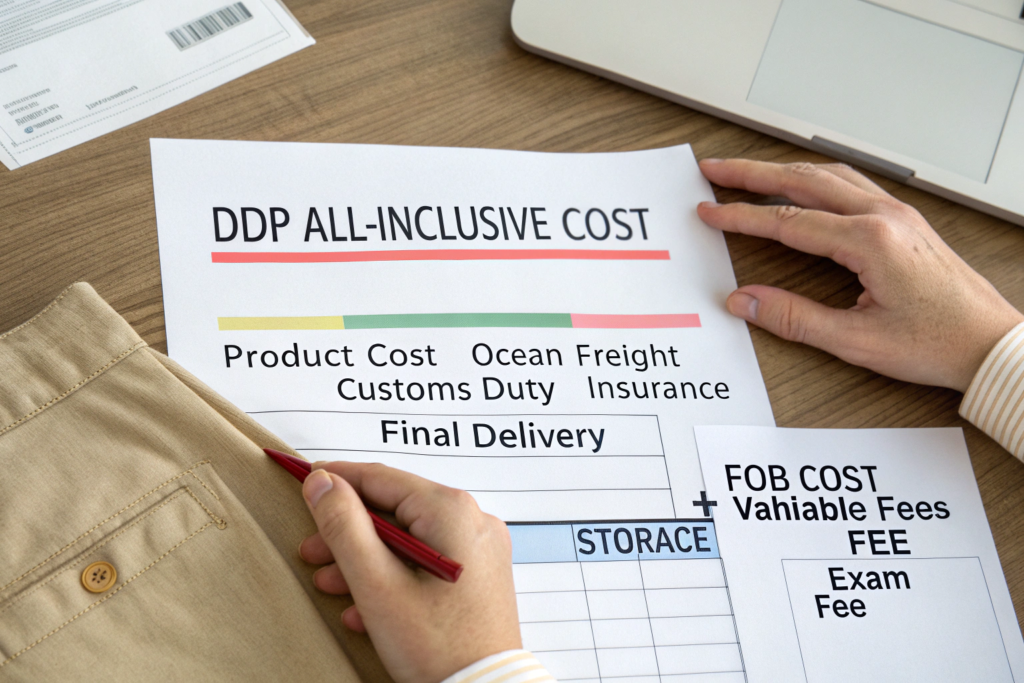
The most dangerous number in garment importing is the FOB price. It looks clean. It looks complete. It is neither. The FOB price covers the product loaded onto a vessel at the port of origin. After that, you are on your own. You pay ocean freight. You pay insurance. You pay customs duties. You pay customs broker fees. You pay port handling charges. You pay trucking to your warehouse. Some of these costs are predictable. Many are not. A customs exam can add $500 to $1,500 in unexpected fees. Port congestion can add storage charges of $100 per day. The FOB price that looked so attractive on the quote sheet mutates into a landed cost that is 30% to 50% higher than you budgeted.
DDP shipping replaces a variable, multi-party cost structure with a single, fixed price per unit that includes every cost from our factory floor to your warehouse door. When we quote a DDP price of $13.50 per unit, that is the exact number you pay. There are no additional invoices, no surprise fees, and no storage charges. You know your true cost per unit before you set your retail price. This allows you to calculate your margin with certainty and price your products with confidence.
What Hidden Costs Disappear When You Switch From FOB to DDP?
The FOB hidden cost list is long and familiar to anyone who has imported goods. Customs bond fees, merchandise processing fees, harbor maintenance fees, container freight station charges, chassis rental, port security fees, and fuel surcharges. These are not optional. They are not scams. They are standard, legal charges that your freight forwarder or customs broker will bill you after the shipment has already arrived. You cannot refuse to pay them because your goods are effectively held hostage until the fees are cleared.
With DDP, all of these fees are absorbed into our quoted price. We are responsible for them. We negotiate them with our logistics partners. Because we ship regularly, we receive volume discounts that an individual importer shipping a few containers per season cannot access. We also have the expertise to minimize certain fees through correct documentation and efficient routing. For example, we know that filing the Importer Security Filing accurately and on time avoids the $5,000 late-filing penalty. We know that correct tariff classification under the Harmonized System avoids a customs exam that costs both time and money. A U.S. importer who misclassifies linen pants under the wrong HTS code faces penalties and back duties. We have a dedicated logistics team that handles this classification. The cost of that expertise is built into our DDP price, but it saves you far more than it costs in avoided fees and penalties. The hidden costs of FOB shipping analysis reveals that importers routinely underestimate their true landed cost by 20% to 35% when relying on FOB pricing. This underestimation flows directly into your margin. A pant you thought cost $10.00 landed actually cost $13.50. The $3.50 difference is your profit, converted into logistics fees you did not see coming.
How Does a Fixed Landed Cost Enable Accurate Margin Planning?
Margin planning requires a stable cost input. If your landed cost fluctuates by 15% to 30% from shipment to shipment due to freight rate volatility, fuel surcharges, or port delays, your margin is a guess. You might set a retail price that looks profitable on a spreadsheet, only to discover after the season ends that you lost money on every unit when the actual landed costs are tallied.
With a DDP price locked in at the time of order, your margin calculation is fixed. A pant with a $13.50 DDP landed cost, sold at a $54 wholesale price, generates a $40.50 gross margin. That margin does not change if the container ship is rerouted around a conflict zone, adding a week and fuel charges. It does not change if the port imposes a new congestion surcharge. The risk of logistics cost fluctuation is transferred to us, the supplier. We manage that risk by working with multiple freight carriers, pre-booking space, and maintaining buffer capacity in our logistics partnerships. We also hedge our freight rates by committing to a minimum volume with our carriers, which stabilizes our cost and allows us to offer a stable DDP price to you. The total landed cost calculation for importers guide explains how predictability in logistics costs is more valuable than the lowest possible cost. A slightly higher but predictable cost allows you to plan your business. A lower but unpredictable cost forces you to gamble on every shipment. Most successful brands prefer planning over gambling.
How Does DDP Transfer Customs Risk to the Supplier?
Customs clearance is not just an administrative step. It is a legal process in which the importer of record assumes liability for the accuracy of the declaration. If the goods are undervalued, misclassified, or misdescribed, the importer of record is the entity that Customs and Border Protection pursues. Under FOB terms, you are the importer of record. You are legally responsible for the actions of a supplier you did not choose and a broker you may have never met. If the supplier made a mistake on the commercial invoice, it is your signature on the customs forms, your bond on the line, and your brand's name on the penalty notice.
Under DDP terms, the supplier is the importer of record. We are legally responsible for customs clearance, tariff classification, duty payment, and compliance with all import regulations. If a customs officer questions the valuation, we provide the documentation. If a penalty is assessed due to a documentation error, we pay it. This risk transfer is not a minor convenience. It is a fundamental legal protection that shields your business from the financial and legal consequences of import compliance errors.
What Happens When a Supplier Misclassifies Goods Under FOB?
Tariff classification is the process of assigning the correct 10-digit Harmonized Tariff Schedule code to each product. Linen pants might seem straightforward. They are not. The duty rate varies depending on the fiber content, the gender of the intended wearer, and sometimes even the specific construction. A supplier who classifies your linen pants under a synthetic fiber code to save duty is committing customs fraud. Under FOB, you are the one who committed the fraud in the eyes of the law, because you are the importer of record.
I know of a situation where a U.S. importer received a CBP audit notice two years after importing a shipment. The supplier had used an incorrect HTS code that resulted in an underpayment of duties. The total underpayment across four shipments was approximately $8,000. CBP assessed the back duties, plus a penalty of 20% of the underpaid amount, plus interest dating back to the original entry dates. The total bill was nearly $12,000. The supplier, who had made the classification error, was in a different country and refused to pay. The importer, who had never even seen the HTS code on the entry documents, was legally liable. This is the hidden liability embedded in every FOB shipment. Under DDP, that liability rests with us. We use a licensed customs broker who specializes in textile and apparel imports. We classify your goods correctly because a misclassification costs us money directly. The U.S. Customs import compliance responsibilities page makes clear that the importer of record bears the ultimate legal responsibility. DDP moves that responsibility to the party who actually controls the documentation: the supplier.
How Does DDP Protect Your Brand From Customs Detention?
When a shipment is detained for a customs exam, the clock starts ticking. Storage charges accrue daily at the bonded warehouse. The exam itself may involve a full unpacking and repacking, which can damage goods if not done carefully. The exam can take days or weeks, depending on the port's workload and the nature of the suspicion. During this time, your delivery is delayed, your launch date is threatened, and your cash is tied up in inventory you cannot sell.
Under FOB, you receive an email from your customs broker: "Shipment held for exam." You have no control over the process. You cannot provide the documentation because the supplier holds it. You wait. You pay the storage fees. Under DDP, we receive the exam notice. We provide the documentation immediately because we prepared it. We have experience responding to exam requests because we do this regularly. We manage the exam process because we are financially motivated to get the goods cleared and delivered. The exam still happens, but the burden of managing it rests on us, not on you. Your involvement is a status update, not a crisis. The customs exam process for imported textiles describes the potential for delay and damage. A supplier who handles this for you is not just providing a service. They are providing peace of mind. That peace of mind has real financial value because it protects your season, your launch date, and your customer relationships.
How Does DDP Simplify Your Supply Chain Into a Single Point of Accountability?
An FOB shipment forces you to become a logistics coordinator. You manage the relationship with the factory until the goods are on the vessel. Then you manage the freight forwarder. Then you manage the customs broker. Then you manage the trucking company. Each entity is independent. Each entity blames the other when something goes wrong. The forwarder says the factory provided incomplete documents. The broker says the forwarder missed the filing deadline. The trucker says the broker didn't release the hold. You are in the middle, receiving no useful information, unable to fix a problem you did not create.
DDP condenses four separate relationships into one. You deal with Shanghai Fumao. We deal with the freight forwarder, the customs broker, and the trucking company. When you have a question about where your shipment is, you ask us. We find the answer. When a problem occurs, you ask us to fix it. We own the problem. This single point of accountability eliminates the finger-pointing and information fragmentation that turns a simple shipment into a part-time job managing logistics.

What Does "Single Point of Contact" Mean in a Real Shipment Scenario?
Imagine a scenario. Your shipment was scheduled to arrive at your warehouse on June 1st. On May 28th, you need to know the exact delivery date to schedule your warehouse team. Under FOB, you call your broker. The broker says, "The container is at the port but there is a hold. Call the forwarder." You call the forwarder. The forwarder says, "The hold is from customs. Call the broker." You call the broker again. The broker says, "We need a document from the supplier." You email the supplier. It is nighttime in China. You wait 12 hours. The supplier replies with a document. You send it to the broker. The broker releases the hold. The delivery is delayed by three days. Your warehouse team was scheduled and is now idle.
Under DDP, you send one email to us. "Elaine, what is the delivery ETA?" We check our logistics dashboard. We see the hold. We contact our broker directly. We provide the document because we have it on file. We resolve the hold. We reply to you within two hours: "There was a minor documentation hold. It is resolved. Delivery is confirmed for June 1st. Here is the trucking company's contact and the delivery appointment number." The three-day delay never happens because the problem was solved by the party who had all the information and all the relationships. This is the practical, daily difference between FOB and DDP. It is not about the big disasters. It is about the hundred small friction points that consume your time, drain your energy, and distract you from growing your brand. The single point of contact logistics model research confirms that consolidating logistics accountability reduces resolution time and improves shipment reliability. One relationship, one email, one solution.
How Does a Unified Logistics Team Respond Faster to Disruptions?
Global shipping is inherently unstable. Vessels are delayed. Ports are congested. Weather disrupts schedules. When a disruption occurs, the response speed determines whether your delivery is delayed by two days or two weeks. A fragmented logistics chain responds slowly because information must pass through multiple companies with different priorities. Your shipment is one of hundreds to the freight forwarder. Your delay is not their top priority.
Our logistics team manages our shipments end-to-end. When a disruption occurs, we see it on our dashboard in real time. A vessel is delayed by a storm in the Pacific. We immediately check whether your shipment is on that vessel. If it is, we calculate the new estimated arrival date. We assess whether the delay threatens your in-store date. If it does, we begin exploring recovery options: rerouting, expedited customs clearance, faster trucking from the port. We communicate the issue and the recovery plan to you before you even knew there was a problem. This proactive disruption management is only possible because we control the logistics chain. A forwarder working for an FOB importer has no incentive to proactively solve a delay that is not their fault. They will deliver the goods when they arrive and bill you for the service. The supply chain disruption management best practices emphasize that speed of response is the critical factor in minimizing disruption impact. A unified team that owns the entire chain can respond in hours. A fragmented chain responds in days. In the seasonal fashion business, days are the difference between full-price sales and markdowns.
Conclusion
DDP shipping transforms the importing experience from a fragmented, high-risk, and unpredictable process into a simple, protected, and cost-certain transaction. The first benefit, a single predictable landed cost, allows you to calculate your true margin and price your products with confidence, free from the hidden fees that routinely inflate FOB shipments by 20% to 35%. The second benefit, the transfer of customs risk, shields your business from the legal and financial consequences of misclassification, documentation errors, and customs exams, placing the liability on the party that controls the paperwork. The third benefit, a single point of accountability, collapses four separate vendor relationships into one, eliminates the finger-pointing that delays problem resolution, and enables proactive disruption management that protects your delivery dates.
At Shanghai Fumao, we made DDP our standard shipping model because we believe a supplier's responsibility does not end at the loading dock. It ends when you open the carton in your warehouse and the pants are exactly as you expected. We want our clients spending their time on design, marketing, and sales, not on customs bonds, HTS codes, and port storage fees. If you are currently importing under FOB terms and feeling the friction of managing a fragmented logistics chain, or if you are placing your first order and want to start with a shipping model that protects your time and your margin, I am ready to provide a DDP quote for your specific order. Contact me, Elaine, at elaine@fumaoclothing.com. Send me your order details and your delivery address, and I will return a single, fixed DDP price that includes everything. No surprises. No hidden fees. Just pants, delivered.