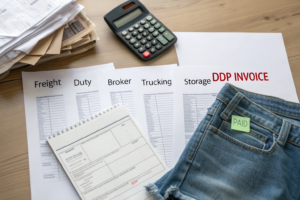
You see a price of $3.50 per pair on Alibaba. You think you found a deal. You order 3,000 pairs. The invoice says $10,500. You wire the deposit. Three months later, the shorts arrive at your warehouse. But the total cost on your credit card statement tells a different story. There is the ocean freight invoice you did not budget for. The customs duty bill. The brokerage fee. The trucking charge from the port. The $1,200 you spent fixing the zippers on 200 defective pairs. That $3.50 short actually cost you $7.80. Your margin is gone. You would have been better off paying a higher unit price to a factory that quoted you the real, all-in cost upfront.
The true cost of a high-quality denim short from China, landed at your U.S. warehouse under DDP terms, ranges from $7.50 to $12.50 per unit for orders of 2,000 to 5,000 pieces. This includes the garment cost, the custom wash, the branded hardware, the export packaging, the ocean freight, the U.S. customs duty, the brokerage, and the inland trucking. The garment ex-factory cost alone is $4.50 to $7.00 for a quality short with 10.5 oz denim, a YKK zipper, and a medium complexity wash.
I run Shanghai Fumao, a factory that competes in the mid-to-premium tier of this market. I have seen the hidden costs that destroy a brand's profit. I have also seen the corners that cheap factories cut to hit a low headline price. In this article, I will break down the true cost structure of a denim short, line by line. I will show you where a cheap factory saves money, and what that saving costs you in quality, returns, and reputation. By the end, you will know exactly what you should be paying and what you are actually getting for your money.
What Are the Real Cost Components of a Denim Short from China?
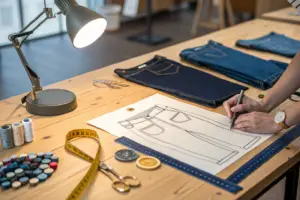
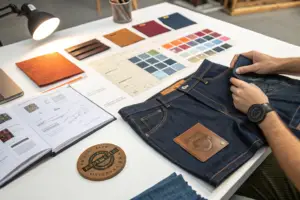
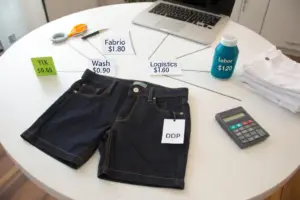
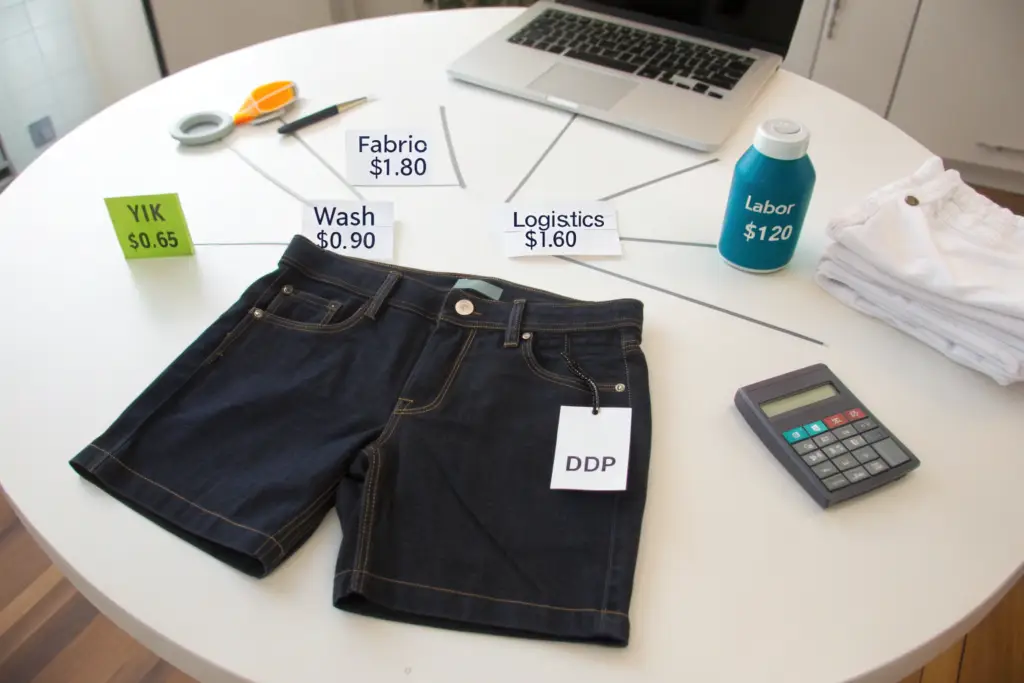
A denim short is not a single thing with a single price. It is a bundle of components and processes, each with its own cost. The fabric. The hardware. The labor to cut and sew. The wash. The packaging. The logistics. A factory that quotes you a single number is hiding the breakdown. A factory that refuses to share the breakdown is probably hiding a markup or a substitution.
When you see a breakdown, you can ask intelligent questions. "Why is the fabric cost $1.80? Is that 10.5 oz or 8 oz?" "Why is the hardware $0.40? Is that YKK or a generic zipper?" "Why is the wash cost $0.50? Is that a basic rinse or an enzyme stone wash?" A transparent factory welcomes these questions. A factory that resists them is selling you a mystery box. The mystery box always contains a downgrade. Always.
Let me show you the line-by-line cost structure of a quality denim short, so you can read a quotation like a professional.
How Is the Garment Ex-Factory Cost Broken Down?
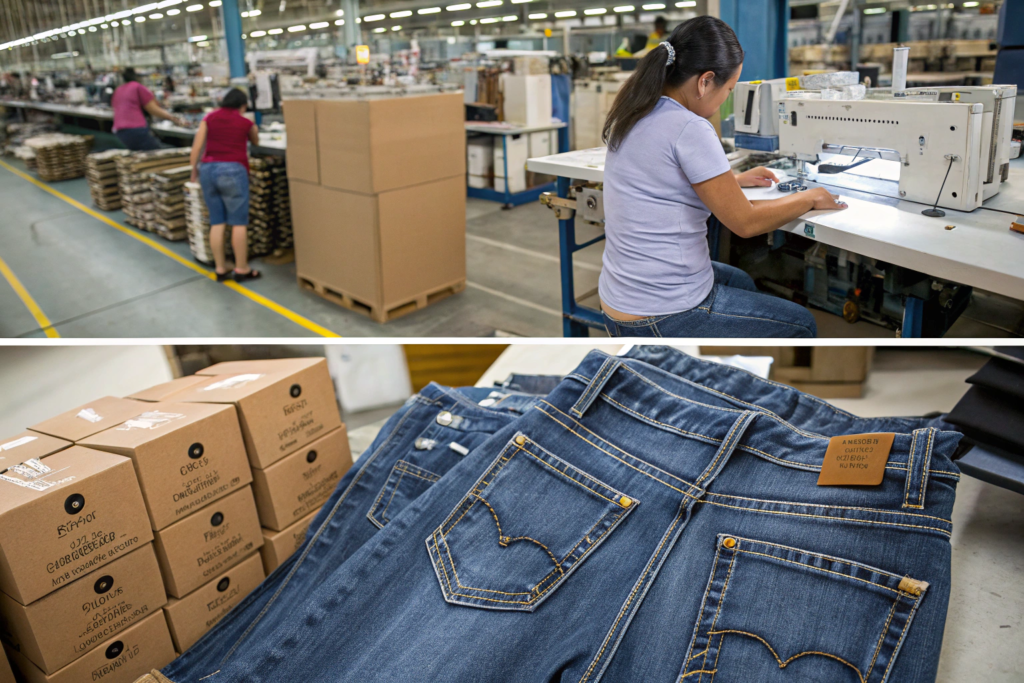
The ex-factory cost, also called the FOB cost, is the price of the finished short sitting on our loading dock, ready to be handed to your forwarder. It breaks down into four main categories.
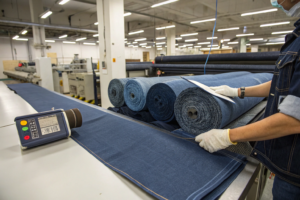
Fabric is the largest component. For a standard 10.5 oz 3/1 twill denim, 99% cotton 1% spandex, the fabric cost per short is approximately $1.60 to $2.20. This assumes a fabric width of 62 inches and a fabric consumption of 1.2 yards per short, which accounts for the pattern pieces plus cutting waste. A lighter 8 oz denim costs less per yard but may require more yardage for structure. A heavier 12 oz rigid denim costs more per yard. The denim fabric pricing varies with cotton futures and mill capacity.
Hardware is the second component. A YKK standard metal zipper costs $0.35 to $0.55. A generic zipper costs $0.15 to $0.25. The button and rivet set costs $0.10 to $0.30 depending on whether it is standard or custom-engraved. The difference between a YKK zipper and a generic zipper is about $0.30 per short. On a 5,000-unit order, that is $1,500. The returns from zipper failure on a generic zipper will cost far more than $1,500 in refunds, return shipping, and lost repeat customers.
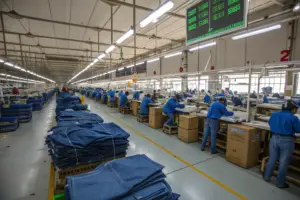
Labor is the third component. Cutting, sewing, and finishing a denim short on our production line takes approximately 28 minutes of direct labor. At our labor rate, this costs $1.00 to $1.50 per short. A factory paying below-market wages can reduce this to $0.60, but that factory will have high worker turnover, inconsistent quality, and a higher risk of labor audit failure. Wash is the fourth component. A basic rinse wash costs $0.30 to $0.50. A medium enzyme stone wash costs $0.60 to $1.00. A complex vintage fade with ozone and hand sanding can cost $1.50 to $2.50. The garment manufacturing cost breakdown shows that labor typically accounts for 15% to 25% of the ex-factory cost in Chinese production, which is higher than in Bangladesh or Vietnam but reflects the higher skill level and faster turnaround time.
What Are the Additional Costs Beyond the Ex-Factory Price?
The ex-factory price is where many buyers stop their comparison. This is a mistake. The costs beyond the factory gate are significant and can vary wildly depending on the shipping terms and the factory's logistics competence.
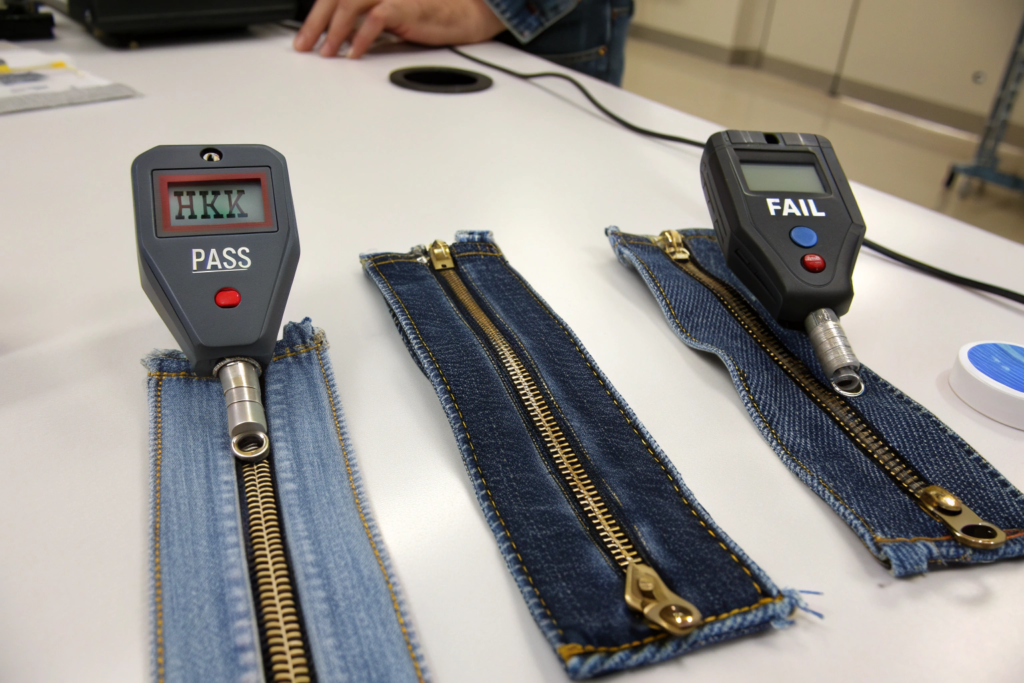
Ocean freight from Shanghai to Los Angeles for a 40-foot container is currently around $3,500 to $5,500 depending on the season and the carrier. A container holds approximately 25,000 pairs of denim shorts. The freight cost per unit is therefore $0.14 to $0.22. U.S. customs duty on cotton denim shorts is 16.6% of the declared customs value. If the customs value is the FOB price of $5.50, the duty is $0.91 per pair. Customs bond, brokerage fees, and documentation charges add $0.15 to $0.30 per pair. Inland trucking from the port to your warehouse adds $0.10 to $0.25 per pair depending on distance. Port handling and terminal fees add another $0.08 to $0.15.
These costs total approximately $1.40 to $1.90 per pair on top of the FOB price. A $5.50 FOB short becomes a $6.90 to $7.40 landed cost. And this assumes everything goes smoothly. If the container is selected for a customs exam, add $500 to $1,000 in exam fees. If the port is congested and the container sits for a week, add $150 to $300 in demurrage. These hidden logistics costs are the reason we strongly recommend DDP terms for buyers who do not have their own customs broker and freight forwarder relationships. The landed cost calculation guide from Shipping Solutions explains the full list of charges that must be accounted for. Under DDP, we absorb all of these variable costs into a single, guaranteed price per unit. You pay one price. The shorts arrive at your door. No surprises.
How Does Fabric Quality Impact the Final Cost?
Fabric is the heart of the short. It is also the largest single cost component. This is where cheap factories make their biggest savings. They buy cheaper fabric. It looks similar on a swatch. It feels a bit thinner, a bit rougher. The customer notices the difference after three washes. The shorts lose their shape. The knees bag out. The color fades to an ugly, patchy blue.
The cost difference between good denim and cheap denim is real and measurable. It comes down to the cotton staple length, the yarn spinning method, the weave density, and the dyeing process. A cheap factory can save $0.80 to $1.20 per short on fabric alone. That saving becomes your problem when your returns spike and your repeat purchase rate drops.
Let me show you the four fabric variables that determine both the cost and the quality of your denim shorts.
What Is the Price Difference Between Ring-Spun and Open-End Denim?
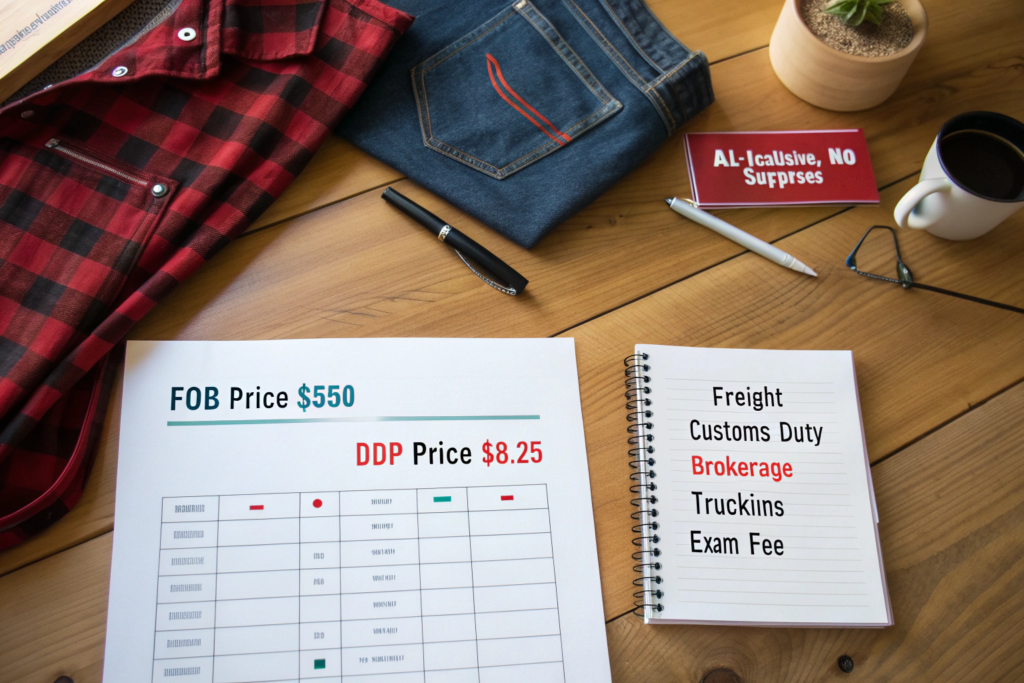
The spinning method determines the strength, softness, and appearance of the yarn. Ring-spun yarn is made by twisting and thinning the cotton fibers on a ring frame. The process is slow and expensive. The resulting yarn is strong, soft, and has a slightly uneven, characterful surface. Open-end yarn is made by a faster, cheaper rotor spinning process. The resulting yarn is more uniform but weaker and less soft.
A yard of ring-spun denim costs approximately $1.80 to $2.20. A yard of open-end denim costs $1.30 to $1.60. The difference per short, at 1.2 yards consumption, is $0.60 to $0.72. A cheap factory will use 100% open-end yarn. You will notice the difference after washing. Ring-spun denim becomes softer with each wash. Open-end denim stays stiff or becomes rough. Ring-spun denim holds the indigo dye better because the twisted fiber structure traps the dye molecules. Open-end denim fades faster and less attractively. The ring-spun vs open-end denim comparison on Heddels explains the technical differences in detail. For a brand that wants a premium feel and a vintage fade, ring-spun is worth the additional cost. For a mass-market brand competing purely on price, open-end may be acceptable, but the brand must understand what they are trading away.
How Do Dyeing Methods Affect Cost and Color Longevity?
Indigo dyeing is not a single process. Rope dyeing passes the yarn through a sequence of indigo dye baths, oxidizing between each dip. The indigo penetrates in layers, creating a ring-dyed effect where the core of the yarn remains white. This is the classic denim look. The white core is exposed as the shorts wear, creating authentic fade patterns. Rope dyeing is expensive. It requires large machinery and careful process control.
Slasher dyeing, also called sheet dyeing, passes the warp yarn sheet through fewer dye baths with shorter oxidation times. The indigo penetration is shallower. The color is less rich. The fade is less dimensional. Slasher dyeing is cheaper, about 15% to 20% less per yard than rope-dyed fabric. Some cheap factories use a pigment-dyed denim, where the color sits on the surface of the yarn like paint. Pigment-dyed denim does not fade. It chips and peels. It looks like plastic after a few washes. The cost difference between rope-dyed and pigment-dyed denim can be $1.00 per yard or more. A brand that does not specify the dyeing method in their purchase order may receive pigment-dyed fabric without knowing it. The rope dyeing vs slasher dyeing article on Denims and Jeans provides a detailed technical comparison. We exclusively use rope-dyed fabric for our indigo denim shorts. We specify it on every purchase order to the mill. The additional cost is built into our pricing, and we do not substitute to save money.
What Is the Hidden Cost of Cheap Hardware and Trim?
A zipper fails. The customer cannot close the fly. The shorts are unwearable. A button pops off when the customer sits down. The shorts go in the trash. A rivet falls off the pocket corner. The pocket rips. These are not minor annoyances. They are product failures. Each one is a return, a refund, a one-star review, and a customer lost forever.
Cheap hardware saves money upfront and costs a fortune downstream. The difference between a YKK zipper and a no-name generic zipper is approximately $0.30 per unit. On a 3,000-unit order, that is $900 saved. One single product return with free return shipping can cost $7 to $12 in postage and processing. If 5% of the generic zippers fail, that is 150 returns. The return cost alone is $1,050 to $1,800. The math is brutal. Cheap hardware is a negative-sum game.
Here is a detailed comparison of hardware quality levels and what they cost both upfront and downstream.
How Do YKK Zippers Compare to Generic Alternatives in Cost and Failure Rate?
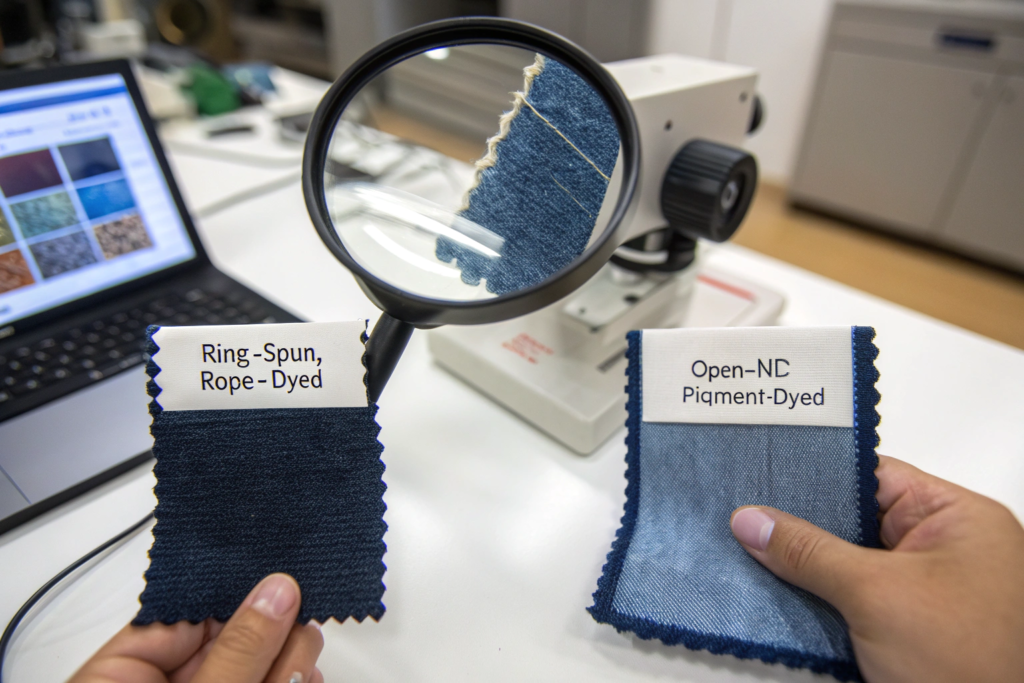
YKK is the industry standard for a reason. Their manufacturing tolerances are microscopic. The teeth mesh perfectly. The slider travels smoothly. The auto-lock mechanism engages reliably. A YKK zipper is rated for 5,000 open-close cycles without failure. We test this on our reciprocating machine. The failure rate in our incoming inspection is below 0.1%.
A generic zipper from a small hardware factory in a provincial town looks similar. The teeth are roughly the same size. The slider looks like a YKK slider. But the metal alloy is softer. The teeth casting is less precise. The slider lock spring is weaker. The failure rate is not 0.1%. It is 2% to 5%. On a 5,000-unit order, that is 100 to 250 zipper failures. The cost difference is $0.30 per unit. The total saving is $1,500. The cost of 250 returns at $10 each is $2,500. The cost of 250 one-star reviews is incalculable but real. The YKK zipper quality standards are published on their corporate website. We use YKK or SBS zippers exclusively. SBS is a Chinese brand that has closed the quality gap with YKK in recent years and is slightly less expensive, about $0.25 per zipper. We offer both and let the client choose based on their brand positioning and budget.
What Should You Know About Button and Rivet Quality Grading?
Not all metal buttons are created equal. A quality button is made from zinc alloy or brass, die-cast in a precision mold, and electroplated with a finish that resists tarnish and corrosion. A cheap button is made from iron, stamped rather than cast, and painted rather than plated. The paint chips. The iron rusts. The button looks terrible after three washes.
The cost difference is $0.05 to $0.10 per button. The failure mode is not just aesthetic. A cheap button has a weak shank attachment. When the customer sits down and the waistband stretches, the shank can snap. A quality button withstands 20 pounds of pull force. We test every incoming batch. A cheap button fails at 10 pounds. The cost of a button failure is a pair of shorts that cannot be closed. That is a full return. The metal hardware for apparel quality standards are similar across major suppliers. The attachment method also matters. We use a two-prong shank attachment with a die press, not a hand hammer. The die press ensures consistent pressure and a secure clinch. A hand hammer attachment varies with the strength of the operator and leads to loose buttons. The machine costs more to operate but eliminates a major failure point.
How Can DDP Pricing Protect You from Hidden Logistics Costs?
You might be comfortable handling your own freight. You might have a forwarder you trust. But if you are comparing factory quotes, you must compare apples to apples. An FOB quote from Factory A and a DDP quote from Factory B are not comparable. The FOB quote looks cheaper, but it excludes costs that the DDP quote includes. The only way to compare is to calculate the total landed cost for both.
DDP pricing is not just about convenience. It is about risk transfer. When a factory quotes DDP, they are accepting the risk of freight rate increases, customs duty changes, and port congestion charges. They have factored these risks into their price. If the risks do not materialize, the factory makes a slightly higher margin on the logistics portion. If the risks do materialize, the factory absorbs the loss. For the buyer, the cost is fixed and predictable. For a brand that needs to plan retail pricing and gross margin months in advance, that predictability is worth a premium.
Let me explain how our DDP pricing model works and how it compares financially to an FOB model in a real-world scenario.
What Is Included in Our DDP Price and What Is Excluded?
Our DDP price includes everything from our factory floor to your warehouse dock. Fabric, hardware, labor, wash, packaging, export documentation, ocean freight, marine insurance, U.S. customs duty, customs bond, brokerage, port handling, and inland trucking to your specified delivery address.
What is excluded? Only the costs that are under your control as the buyer. Storage at your warehouse. Distribution to your retail customers. Marketing and selling costs. And any customs duties above the standard rate if you have provided incorrect product classification information. The DDP price is calculated per unit. For a 3,000-unit order of our standard 10.5 oz denim shorts with a medium enzyme wash and DDP delivery to a West Coast warehouse, the price is approximately $8.50 to $9.50 per unit. To an East Coast warehouse, add $0.30 to $0.50 for the additional inland trucking. The price is quoted before sampling and is valid for 30 days. After 30 days, we review the freight and cotton cost components and adjust if necessary. This is the DDP Incoterms 2020 definition applied to the denim short context. The key point is that the seller bears all risk until the goods are at the buyer's premises. This is the maximum obligation for the seller and the minimum risk for the buyer.
How Does a DDP Quote Compare to an FOB Quote in a Real Scenario?
Let me give you a specific example based on a real quotation we provided to a client in March 2026. The client was comparing our DDP quote to a Vietnamese factory's FOB quote for a similar specification denim short.
The Vietnamese FOB quote was $5.20 per unit. Our DDP quote was $8.80 per unit, delivered to Dallas, Texas. At first glance, the Vietnamese quote looked $3.60 cheaper. The client calculated the additional costs. Ocean freight from Ho Chi Minh City to Dallas, allocated per unit: $0.45. U.S. customs duty at 16.6% on the FOB value: $0.86. Customs bond and brokerage: $0.25. Inland trucking from the Houston port to Dallas: $0.20. Port handling: $0.12. Total additional costs: $1.88. Total landed cost of the Vietnamese FOB order: $7.08. The difference was not $3.60. It was $1.72. The client then factored in the cost of a third-party inspection, which he always commissions for new factories. Inspection cost: $350, or $0.12 per unit. Corrected total: $7.20. The client also factored in the risk of the Vietnamese factory's less established quality record. He had experienced quality issues with a previous Vietnamese order. He estimated a 2% defect rate, which would cost him approximately $0.30 per unit in returns and replacements. Risk-adjusted total: $7.50. Our DDP quote of $8.80 was still $1.30 higher. But for that $1.30, the client received YKK zippers instead of generic, ring-spun denim instead of open-end, our documented quality control system, and zero logistics risk. He chose our quote. The landed cost comparison method is the only fair way to evaluate competing factory quotes. The lowest FOB is never the lowest total cost.
Conclusion
The true cost of a high-quality denim short from China is not a single number. It is a range, from about $7.50 to $12.50 per unit landed, depending on your fabric weight, your wash complexity, your hardware choices, and your delivery location. Within that range, every dollar buys you something specific. The extra $0.30 for a YKK zipper buys a 0.1% failure rate instead of a 5% failure rate. The extra $0.60 for ring-spun denim buys a softer hand feel and a more authentic fade. The extra $1.00 for rope-dyed indigo buys a dimensional color that ages beautifully instead of a flat blue that peels. The extra $1.30 for a DDP quote buys the elimination of logistics risk and the predictability of a fixed landed cost.
The cheap route is expensive. The $3.50 Alibaba short becomes a $7.80 short after freight, duty, returns, and frustration. And that $7.80 short is still made with open-end denim, a generic zipper, and a pigment dye that will chip. The premium route costs more upfront and less over the life of the product. Fewer returns. Fewer one-star reviews. More repeat customers. A higher average order value. The math is clear once you look at the total system cost, not just the ex-factory unit price.
I encourage you to demand a line-by-line cost breakdown from every factory you evaluate. If they refuse, walk away. If they provide it, study it. Ask about the fabric weight, the spinning method, the zipper brand, the wash process. The answers will tell you whether the price is a bargain or a trap. And if you want a quote from a factory that provides the full breakdown and offers a guaranteed DDP landed price, contact our Business Director, Elaine. She will send you a detailed quotation with the fabric spec, the hardware brand, the wash description, and the DDP price to your specific warehouse. Reach her at elaine@fumaoclothing.com. The true cost of denim shorts is the cost of the shorts that sell, not the shorts that sit in your warehouse waiting for a discount rack. At Shanghai Fumao, we make shorts that sell.