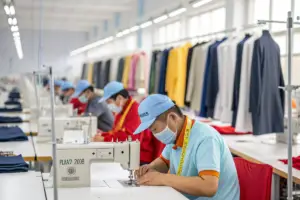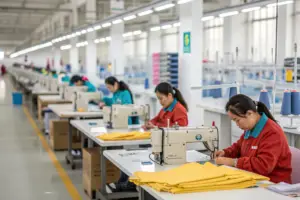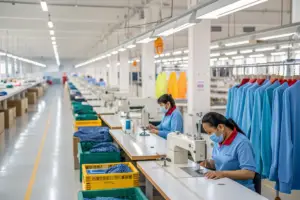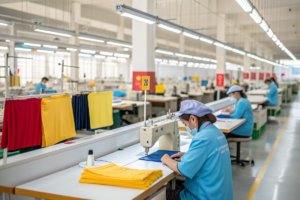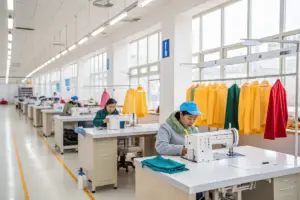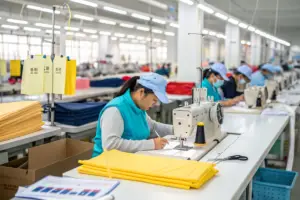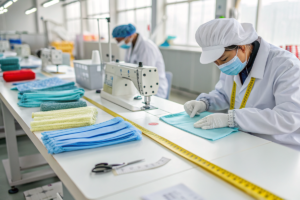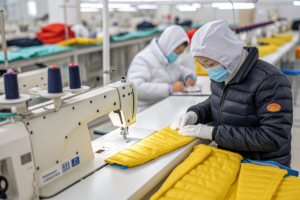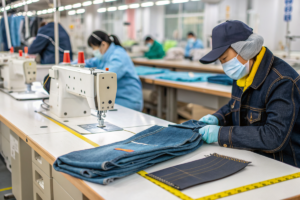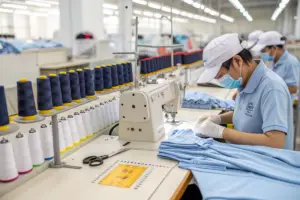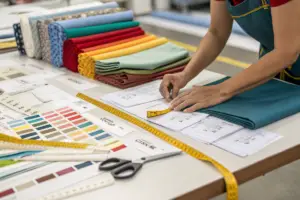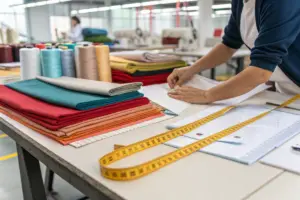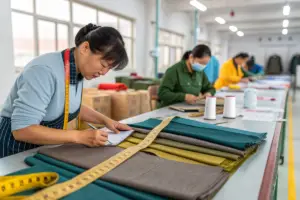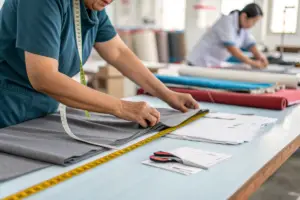
Fabric is the foundation. You can sew the most beautiful pattern in the world. You can apply the most stunning wash. But if the denim fabric itself is weak, unstable, or poorly dyed, the shorts will fail. They will rip at the knee. They will twist at the side seam. The indigo will bleed onto your customer's white sofa. I have seen a single bad fabric lot destroy a brand's summer season. Two thousand pairs of shorts. All cut. All sewn. All washed. All packed. And all returned because the fabric was underweight and tore after three wears. The brand owner lost $45,000. The factory blamed the mill. The mill blamed the factory. The brand owner was left holding the financial bag. Nobody controlled the fabric quality at the beginning. That is where the control must start.
Shanghai Fumao controls denim fabric quality through a four-gate system. Gate one is mill selection. We only buy from three long-term partner mills with documented quality histories. Gate two is incoming fabric inspection. Every roll is checked for weight, weave density, skew, and visual defects before it enters the cutting room. Gate three is shrinkage and color fastness testing. We wash and measure fabric samples from every lot before production begins. Gate four is ongoing in-process monitoring. We track the performance of the fabric during cutting and sewing and flag any roll that behaves differently than expected.
This system did not appear overnight. It was built over years of learning from failures. My own failures. I have bought cheap fabric. I have trusted mill promises without testing. I have shipped shorts that I knew, deep down, were not quite right. Each of those mistakes taught me a lesson, and each lesson became a permanent fixture in our quality control process. Let me show you how each gate works, what specific tests we run, and how this system protects your order from becoming a cautionary tale.
How Do We Select and Vet the Mills That Supply Our Denim?
The quality of your shorts is determined the moment the cotton yarn is spun. No amount of careful sewing can fix a fabric that was woven with weak yarn, uneven tension, or contaminated cotton. The mill is the most important partner in the supply chain. A bad mill will ship you fabric with dead cotton, nep counts that are off the chart, or shade variations from roll to roll. A great mill will deliver consistent, stable fabric that cuts cleanly, sews smoothly, and washes predictably.
We do not source denim from open markets. We do not buy from brokers who aggregate fabric from multiple mills and sell it as "similar quality." We buy directly from three partner mills. Each one has been audited by our team. Each one has a documented track record with us spanning at least three years and dozens of successful orders. This direct, long-term relationship means the mills know our standards. They know we test. They know we reject. They pre-sort their best lots for our orders because they do not want the hassle of a return. The relationship is the first quality filter.
Let me explain the specific criteria we use to select a mill and the ongoing monitoring that keeps them performing.
What Criteria Must a Denim Mill Meet to Become Our Supplier?
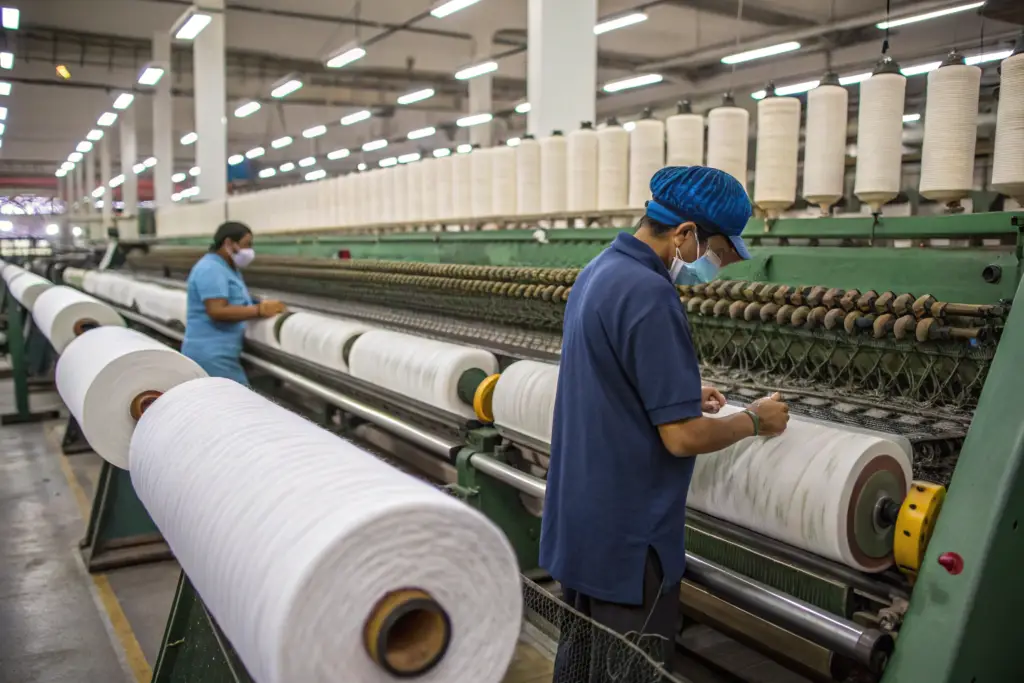
We have a ten-point mill qualification checklist. I will share the five most critical points. First, the mill must use certified cotton. Either BCI (Better Cotton Initiative) or organic certified. This ensures traceability back to the gin. Second, the mill must have an in-house yarn spinning operation. Mills that buy yarn on the open market have less control over tensile strength and twist consistency. Third, the mill must use rope dyeing technology, not sheet dyeing, for our indigo denim. Rope dyeing produces a deeper, more consistent indigo penetration with a distinctive ring-dyed core that ages beautifully. Fourth, the mill must have a fully equipped internal testing lab with a universal tensile tester, a Martindale abrasion machine, and a spectrophotometer. If they do not test, we cannot trust their shipments. Fifth, the mill must have a documented environmental management system. Our mills treat their wastewater and have valid discharge permits. You can learn about the rope dyeing vs sheet dyeing difference to understand why it matters for premium denim. A mill that passes all five criteria gets a trial order. We run a small batch of 500 yards through our entire production process and measure the results before committing to volume.
How Often Do We Audit Our Denim Mill Partners?
Annually, at minimum. We conduct a two-day on-site audit at each partner mill every year. The audit team includes our head of quality and our production director. They do not just tour the showroom. They walk the spinning floor. They check the humidity control in the yarn storage area. Cotton yarn is sensitive to moisture. If the storage area is too dry, the yarn becomes brittle. If too humid, mildew can form.
The audit team pulls random rolls from the warehouse and cuts samples for immediate testing. They check the dye range for consistent temperature and chemical dosing. They review the maintenance logs for the looms. A loom with poor maintenance produces fabric with thick and thin places, which create weak spots in your shorts. The audit concludes with a scorecard. The scorecard affects the mill's allocation of our orders. The best-performing mill gets the highest volume. The second-best gets the next highest. This competition for our business is a deliberate strategy. It keeps all three mills motivated to maintain quality because they know their performance directly impacts their revenue from us. The supplier performance audit concept is part of the ISO 9001 quality management framework. Our mills are ISO 9001 certified, but we do not rely on their certificate alone. We verify with our own eyes, every year.
What Incoming Fabric Tests Do We Perform Before Cutting?
The fabric arrives at our factory in rolls. Each roll is a promise from the mill. Our job is to verify that promise before we cut into it. If we cut defective fabric into thousands of shorts, we own the problem. The mill might give us a credit for the fabric cost, but they will not pay for the cutting labor, the sewing labor, the wash cost, or the lost production time. The financial incentive to catch defects at the incoming stage is enormous. A yard of rejected fabric costs us the price of that yard. A short made from defective fabric and caught at final inspection costs us ten times that amount. A defective short that reaches your customer costs us a client.
Our incoming fabric inspection is a bottleneck. We do not allow fabric to flow into the warehouse until it has been inspected and released. The inspection team works on a dedicated floor with calibrated equipment. They know that the production manager is waiting for fabric. They also know that they report to the quality director, not the production manager. This separation of authority is intentional. The person inspecting the fabric has no incentive to pass bad rolls to keep the line running. Their only incentive is to catch defects.
Here is the detailed process that every roll of denim fabric goes through before it receives a "cut" release tag.
How Does Our 4-Point Fabric Inspection System Work?
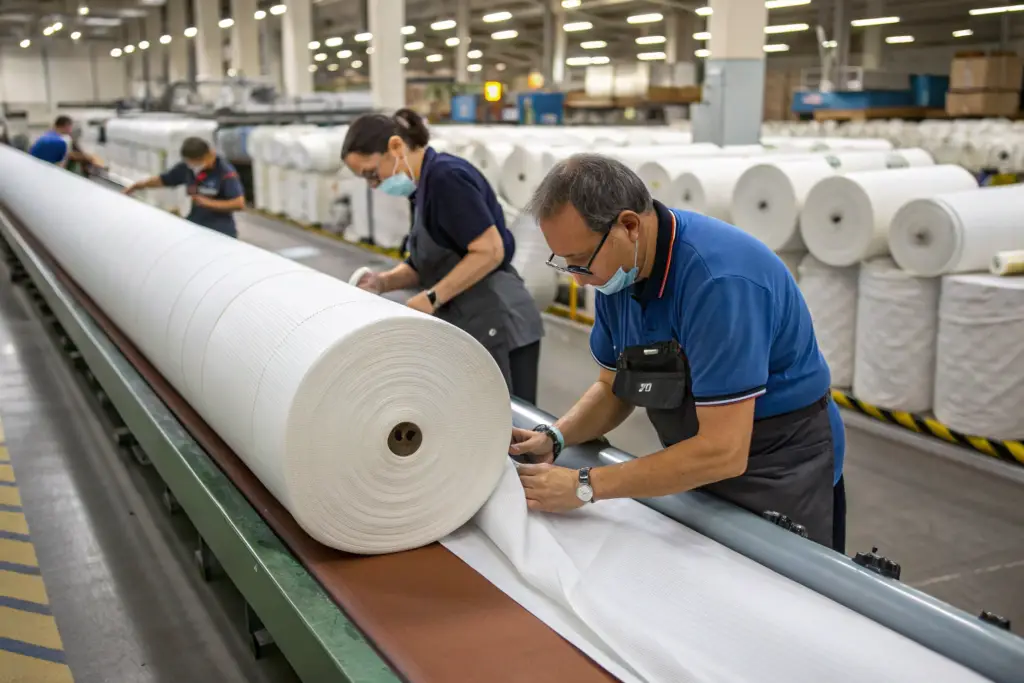
The 4-point system is the standard method for grading fabric defects in the apparel industry. It assigns points to defects based on their length. A defect less than 3 inches gets 1 point. A defect 3 to 6 inches gets 2 points. A defect 6 to 9 inches gets 3 points. A defect over 9 inches gets 4 points. A hole, regardless of size, gets 4 points.
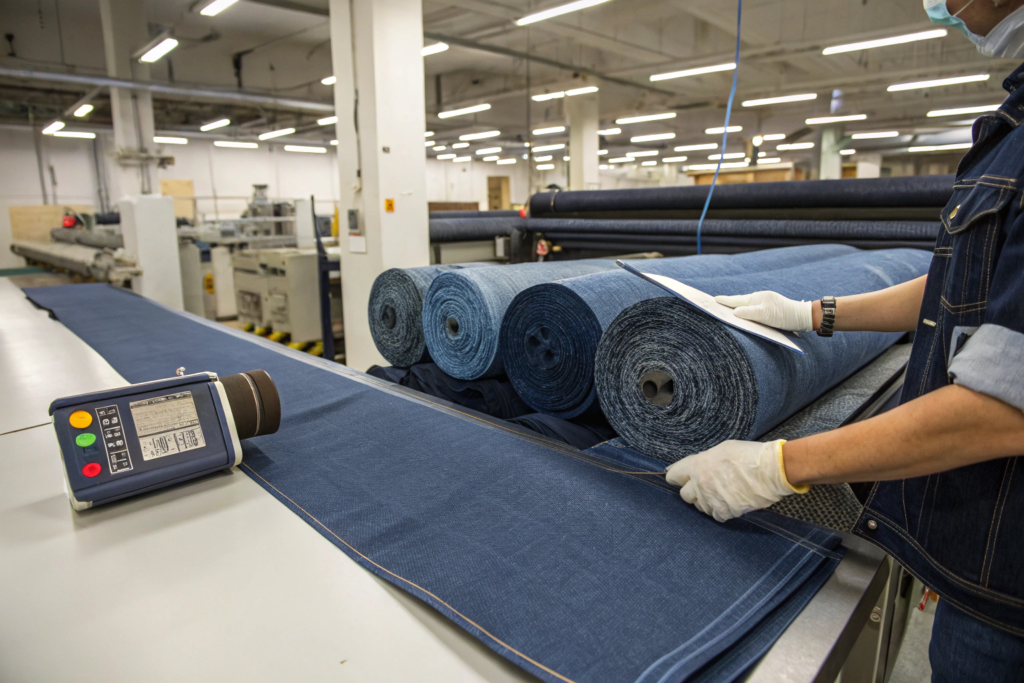
We inspect 100% of the denim fabric we receive. Not a sample. Every single roll. The fabric runs over a backlit inspection table. The light shines through the denim, revealing thin spots, thick spots, slubs, broken yarns, and weaving defects that would be invisible under normal lighting. The inspector marks each defect with a colored sticker and records it on the inspection sheet. At the end of the roll, the total penalty points are divided by the roll length in hundreds of yards. If the score exceeds 40 points per 100 square yards, the roll is rejected. We also inspect for continuous defects. A continuous shade variation down the entire length of the roll is not captured well by the point system. A separate visual shade band comparison is performed. The 4-point fabric inspection standard is maintained by the American Society for Quality. Our acceptance threshold of 40 points per 100 square yards is stricter than the industry norm of 40 points per 100 linear yards for denim fabrics. We use square yards because it accounts for the fabric width. A wide roll has more area and should be held to a proportionally higher standard.
What Physical Tests Do We Run on Every Incoming Lot?
The 4-point inspection catches visible defects. It does not catch hidden structural problems. For that, we run a battery of physical tests on a sample cut from the beginning of each fabric lot. A lot is defined as one dye batch from one mill. If the mill sends us 50 rolls from the same dye lot, we test once. If they send 30 rolls from lot A and 20 rolls from lot B, we test both lots separately.
We test five parameters on every lot. Fabric weight, using a GSM cutter and a calibrated scale. Our target is 10.5 oz per square yard for our standard denim, with a tolerance of plus or minus 0.3 oz. Fabric weave density, counting the warp and weft yarns per inch with a pick glass. If the count is low, the fabric is loosely woven and will not hold its shape. Tensile strength, cutting a strip and pulling it apart on a universal tester. We require a minimum of 350 Newtons in the warp direction. Tear strength, which measures the force required to propagate a tear. Denim shorts tear at stress points like the crotch and the pocket corners. Our minimum is 25 Newtons. And skew, measuring the diagonal twist of the fabric after washing. We cut a square, mark it, wash it three times, and measure the distortion. Over 3% skew is a rejection. These tests follow the ASTM textile testing standards. They are industry-recognized methods. The numbers we set are our internal standards, which are tighter than the general industry recommendations. We shared these numbers with our mills. They know the gate they must pass.
How Do We Test for Shrinkage and Color Fastness Before Production?
You can cut and sew a perfect short. Then your customer washes it once. The waistband shrinks an inch. The indigo bleeds onto the white pocket lining. The short is ruined. The customer is angry. The return is processed. Shrinkage and color fastness are the two fabric behaviors that destroy customer satisfaction fastest. They are also the two behaviors that are most predictable if you test for them properly.
We do not guess at shrinkage. We do not rely on the mill's word. We test every dye lot before the cutting order is released. The test takes 24 hours. It is a mandatory hold point in our production schedule. If a lot fails, we do not cut it. We negotiate a return or a discount with the mill. A discount means we can use the fabric for styles where a tighter fit is acceptable. A return means the mill takes the fabric back and replaces it. The key point is that the fabric does not proceed to cutting with an unknown shrinkage value. The value is known. The pattern is adjusted to compensate. The customer receives a short that fits, even after they wash it.
Here are the specific test protocols we use and the thresholds we enforce.

What Is Our Shrinkage Test Protocol and What Threshold Do We Enforce?
We test shrinkage according to AATCC Test Method 135. This is the standard dimensional change test for woven fabrics after home laundering. We cut a 60 cm by 60 cm square from the fabric sample. We mark three pairs of reference points in the warp and weft directions, exactly 50 cm apart. We wash the sample three times in a standard home washing machine at 40 degrees Celsius with a standard detergent. We tumble dry after each wash. After the third cycle, we measure the distance between the reference points again.
The percentage change is the shrinkage rate. Our maximum allowable shrinkage is 2% in both the warp and weft directions. If the test shows 2.5% warp shrinkage, the lot is rejected for full-price production. The fabric can only be used if the client agrees to accept a pre-shrunk garment or if the pattern is adjusted by the exact shrinkage percentage. This pattern adjustment is standard practice. A 2% shrinkage means we grade the pattern 2% larger so that the finished garment, after the customer's first wash, measures exactly the specified size. The AATCC 135 test method is the industry reference. The 2% threshold is our internal standard. Many mass-market brands accept 3% shrinkage. We do not, because a 3% shrinkage on a 32-inch waistband is almost a full inch. A customer who orders a 32 and gets a 31 after one wash will return the shorts. The cost of that return is far higher than the cost of rejecting the fabric.
How Do We Test Color Fastness to Prevent Indigo Bleeding?
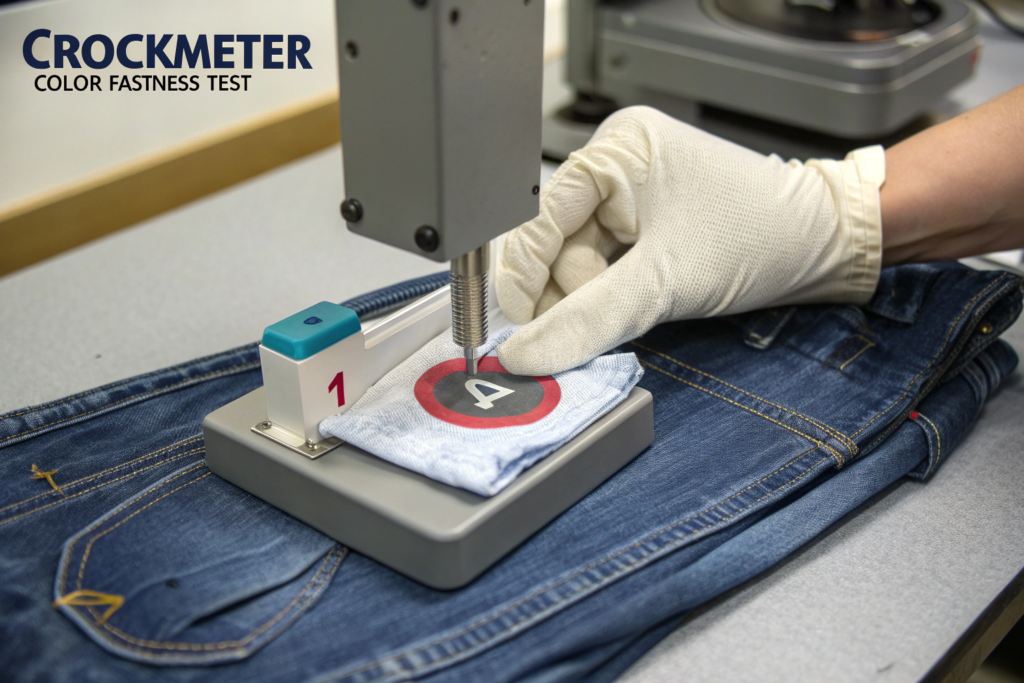
Crocking is the technical term for color transfer by rubbing. We test both dry crocking and wet crocking according to AATCC Test Method 8. A white test cloth is rubbed against the denim sample under controlled pressure on a Crockmeter machine. The amount of color transferred to the white cloth is compared to a standard gray scale rating from 1 to 5, with 5 being no transfer and 1 being severe transfer.
Our minimum standard is grade 4 for dry crocking and grade 3.5 for wet crocking. Wet crocking is always worse because moisture opens the cotton fiber and releases more indigo. A result of 3.5 on wet crocking means there is visible color transfer, but it is light and acceptable for denim. A result of 3.0 or below is a fail. We also test wash fastness, which measures color change and staining after washing. We use AATCC Test Method 61, the accelerated laundering test. The denim sample is washed with a multifiber test strip that contains strips of different fiber types. After washing, we check how much indigo has stained the white nylon, cotton, acetate, and other fibers on the strip. This simulates what happens when your customer washes the shorts with a white t-shirt. A high level of staining is a fail. The AATCC color fastness standards are the global benchmark for textile color testing. We perform these tests in our in-house lab before cutting. If a lot fails, we can ask the mill to apply an additional fixation treatment to lock in the indigo. If the re-treatment does not work, the lot is rejected. The test costs about $50 in labor and materials per lot. The cost of shipping shorts that bleed indigo onto your customers' clothes is a damaged brand reputation that no amount of money can quickly repair.
What Ongoing Monitoring Ensures Fabric Consistency Across the Entire Production Run?
Incoming inspection catches the bad rolls before cutting. Shrinkage and crocking tests catch the lot-level problems. But fabric can vary within a lot. The shade can drift slightly from the beginning of the roll to the end. The weave can be tighter in the center than at the edges. These intra-roll and roll-to-roll variations are subtle. They do not show up in a single incoming test. They show up when you cut 500 shorts and notice that the left leg panels are a slightly different shade than the right leg panels on a handful of pieces.
Ongoing monitoring during production is the final safety net. It catches the subtle variations that the incoming tests missed. It involves the cutting team, the sewing team, and the wash team all acting as additional quality sensors. They are trained to notice fabric behavior that deviates from normal. A cutter who has handled our denim for five years can feel when a roll is slightly stiffer than usual. A sewing operator can feel when the needle is piercing harder than normal, indicating a denser weave. These human sensors feed information back to the quality team, who can then isolate the affected rolls and adjust the process.
Let me explain the two monitoring practices that prevent small fabric variations from becoming big production problems.
How Does Shade Band Sorting Prevent Color Mismatch in the Final Garment?
Indigo dye is sensitive. Slight differences in dye bath temperature, immersion time, or oxidation time can cause shade variation from roll to roll, even within the same dye lot. The human eye can detect a Delta E of 2.0 or higher. That means two panels cut from different rolls could look like two different colors of blue when sewn into the same short.
To prevent this, we sort every roll into shade bands. A shade band is a group of rolls that are visually identical under controlled D65 lighting. Our incoming inspection team cuts a small swatch from each roll and labels it with the roll number. The swatches are laid out on a large table under a lightbox. Two technicians independently sort the swatches into groups of matching shade. If they disagree on a roll, a third technician breaks the tie. Each group becomes a shade band. When the cutting order is issued, the cutting team is instructed to cut all panels for a given size and wash from the same shade band. This ensures that the front panel and the back panel of a single short come from visually identical fabric. The fabric shade banding technique is standard practice in premium garment manufacturing. A factory that skips this step is gambling that the mill's dye lot control was perfect. Our experience is that mills are good, but not perfect. Shade banding catches the imperfections.
What Happens When the Sewing Team Identifies a Fabric Behavior Issue?
Sewing operators are the people who spend the most time touching your fabric. They handle every inch of every panel. They can feel when something is wrong. We train our operators to report fabric issues immediately through a simple red tag system.
If an operator feels that the fabric is feeding differently through the machine, that the needle is making a different sound, or that the seam is puckering more than usual, they stop. They attach a red tag to the piece and place it in the quality hold bin. The line supervisor calls the fabric quality technician. The technician examines the piece. She checks the roll number. She checks whether other pieces from the same roll are showing the same issue. If the issue is confirmed, the remaining fabric on that roll is quarantined. It is not cut until the root cause is understood. It might be a sizing issue from the mill. Sizing is the starch coating applied to warp yarns before weaving. If the sizing is inconsistent, the fabric stiffness varies, and the sewing behavior changes. It might be a tension issue on our own cutting or spreading equipment. Either way, the roll is held until the problem is resolved. This in-process quality control loop means a fabric problem that affects only two rolls is caught within hours. It does not become a problem that affects 2,000 finished shorts discovered at final inspection. The operators are the heroes of this system. Their alertness is the last line of defense.
Conclusion
Quality denim shorts start with quality denim fabric, and quality fabric is not found by luck. It is manufactured by mills that have been rigorously vetted against a ten-point checklist. It is verified by a 100% incoming inspection that shines a backlight through every yard and catches the thin spots and weaving defects invisible to the naked eye. It is tested in a laboratory for weight, tensile strength, tear strength, and skew, with hard numerical rejection thresholds. It is subjected to mandatory shrinkage and color fastness testing before a single cutting blade touches it, with a 2% shrinkage cap and a grade 4 dry crocking minimum. And it is monitored continuously during production by shade band sorting teams and sewing operators empowered to red-tag any roll that behaves differently than the standard.
This four-gate system costs us money. The testing equipment. The inspector salaries. The rejected fabric we return to mills. The production delays when a lot fails and we have to wait for a replacement. I accept these costs because the alternative is far more expensive. Shipping a defective batch of shorts costs the fabric, the labor, the freight, the duty, and most expensively, the client relationship. I have learned this lesson the hard way. The cheap route is the expensive route in the long run.
If you want a factory that treats fabric quality as a measurable, verifiable system and not a vague promise, we should connect. Our Business Director, Elaine, can send you a sample of our 10.5 oz denim with the test report for that specific lot. She can also walk you through a video of our backlit inspection table and our laboratory testing equipment. Reach her at elaine@fumaoclothing.com. You should know exactly what your shorts are made of. At Shanghai Fumao, we can show you the test data to prove it.