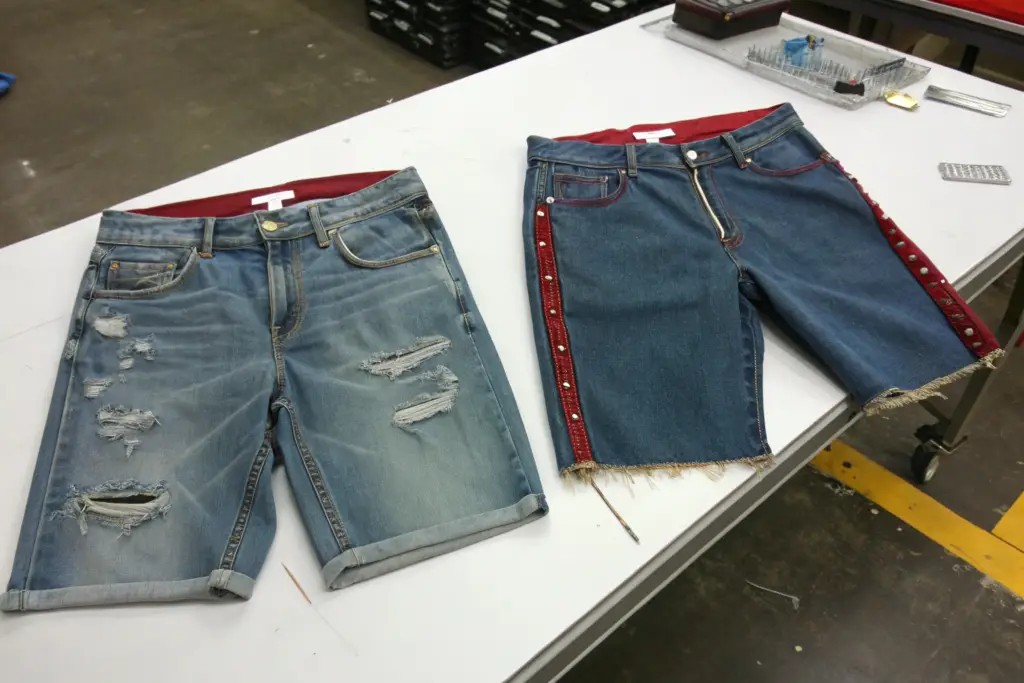
You open the shipping carton with excitement. This is the order you have been waiting for. The denim shorts that are supposed to launch your summer collection. You pull out the first pair. The zipper sticks. You check the second pair. The waistband is twisted. You grab a third pair. The wash looks nothing like the approved sample. Your stomach drops. This is not inventory. This is a liability. I have heard this exact story from over a dozen American brand owners in the past two years. They tried to save $0.80 per unit. They ended up with a garage full of shorts they cannot sell and a one-star review rating that will take months to repair. Low-quality denim shorts are not a bargain. They are the most expensive mistake you can make in the apparel business.
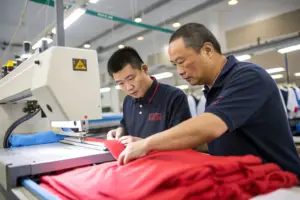
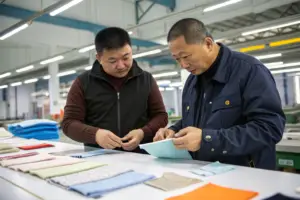
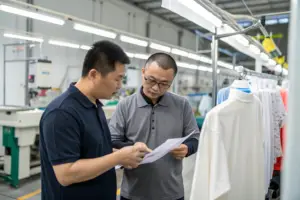
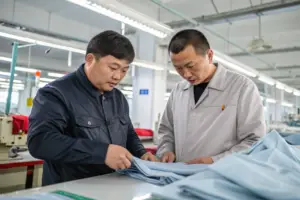
Shanghai Fumao helps you avoid low-quality denim shorts by building four protective barriers around your order. First, we reject substandard fabric before it touches the cutting table using a 7-point inspection system. Second, we run in-line quality audits every hour during sewing to catch defects when only five pieces are affected, not five hundred. Third, we subject every batch to laboratory wash testing that measures shrinkage and color bleeding against hard numerical thresholds. Fourth, we require a final AQL 1.5 inspection by an audit team that reports to me directly, not to the production manager.
These barriers are not a marketing gimmick. They are a physical system of checks and balances that stops defective shorts from ever reaching your warehouse. I want to show you exactly how this system works, why most factories skip these steps, and how you can access this level of protection for your next order. Because once you see what real quality control looks like, you will never accept a "trust me" handshake from a supplier again.
What Are the Hidden Defects Most Buyers Overlook in Bulk Orders?
Most buyers inspect a sample with their own hands. They feel the fabric. They check the stitch. They zip the fly. The sample is perfect. They approve it. Then the bulk shipment arrives, and everything is different. Why? Because a sample is made by the factory's most skilled worker in the sampling room. It is a handcrafted promise, not a production reality. The bulk order comes from the production line, where speed, fatigue, and machine drift introduce variations that never existed in the sample.
The defects that kill a brand's reputation are rarely the obvious ones like a missing button. The obvious defects get caught. The killers are the hidden defects. The ones that only appear after the customer takes the shorts home and wears them. The ones that cause a silent return, where the customer does not even complain, they just leave a two-star review and never buy from you again. You need to understand these hidden defects so you can demand the right tests before shipping. A factory that does not talk about these specific failure modes is either ignorant or hiding something.
Let me expose the three most common hidden defects that we specifically engineer our quality system to prevent.
How Does Fabric Skewing Ruin the Fit After the First Wash?
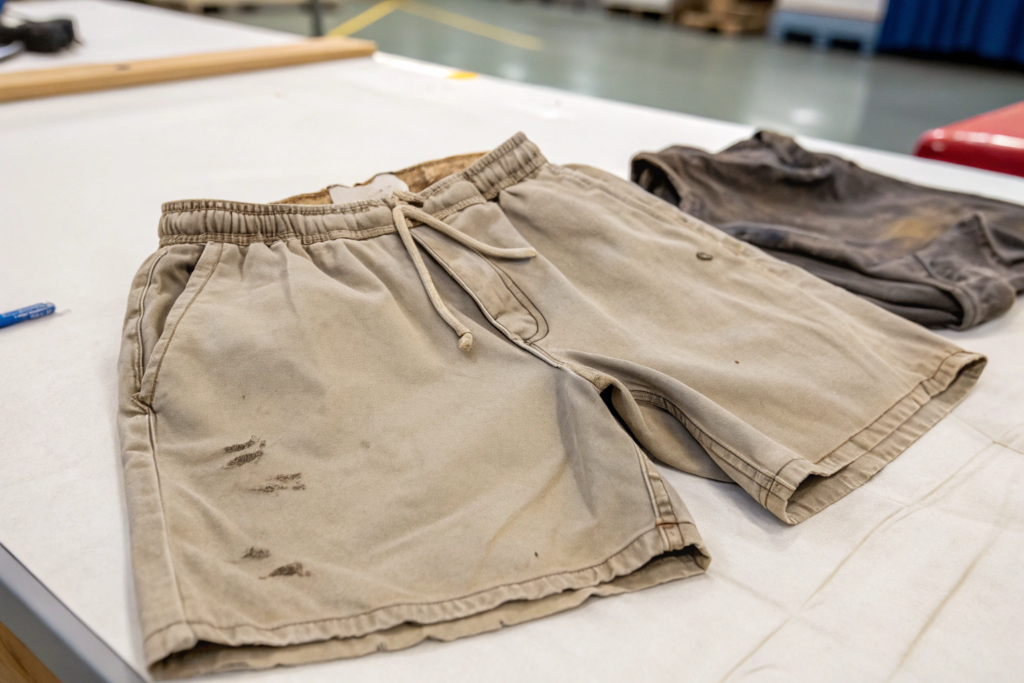
Fabric skewing is when the weft yarns are not perpendicular to the warp yarns. The denim is twisted at a slight angle. When you lay the shorts flat, the side seam spirals around the leg instead of running straight. It looks fine on the hanger. But when the customer washes them, the skew relaxes, and the entire leg twists.
This defect originates at the fabric mill. The denim was not properly stabilized during the finishing process. A factory that just buys the cheapest available fabric will not catch this. We catch it with a simple test. We cut a square of fabric, mark it, wash it, and measure the diagonal pull. If the skew exceeds 3%, we reject the roll. We use a skew and bow measurement tool on every incoming batch. Last year, a Nashville-based boutique owner came to us after her previous supplier shipped 2,000 pairs where the side seam twisted almost 15 degrees after washing. The shorts looked distorted on the body. Her return rate hit 18%. We re-cut the order with properly stabilized 3/1 twill denim that we had skew-tested. Her return rate dropped back to 2%. The test takes five minutes. The cost of skipping it is your entire brand reputation.
Why Does Thread Degradation Cause Seams to Fail After Minimal Wear?
The thread that holds your denim shorts together is under constant stress. Every time the customer sits down, the seat seam stretches. Every time they put something in the pocket, the bar tack takes a load. Cheap spun polyester thread will look fine on day one. After ten washes and some UV exposure from sunlight, it becomes brittle. Then it snaps.
We use corespun thread on all stress points. Corespun has a polyester core wrapped in cotton. The polyester gives it strength. The cotton gives it the look and feel of a natural fiber. It resists abrasion better than standard spun poly. We also require a minimum thread tensile strength of 1,200 grams. Our incoming thread is tested on a single-thread strength tester. If a cone falls below that threshold, it is returned to the supplier. The thread tensile strength standard defines how this is measured. We also specify the stitches per inch. For the inseam, we use 10 to 12 stitches per inch. Below 8, the seam will grin open when stressed. Above 14, the needle damages the fabric. There is a precise Goldilocks zone. A factory that does not have a thread testing protocol is gambling with your seams. That gamble always loses.
How Does Our Pre-Production Protocol Stop Defects Before They Start?
The most expensive defect is the one you build into 3,000 pieces before anyone notices. Stopping a defect on the cutting table costs a few yards of fabric. Stopping it after sewing costs hours of rework labor. Stopping it after shipping costs your customer relationship. The time to win the quality battle is before the sewing machines start humming.
Our pre-production protocol is a mandatory sequence that every new style must pass before it is released to the production floor. This is not a suggestion. It is a locked gate. The protocol has three stages: the fabric risk assessment, the pre-production sample approval meeting, and the pilot run. Each stage has a sign-off sheet. If a signature is missing, the style does not move forward. I personally review the sign-off sheets at the weekly production meeting. This top-down insistence on protocol adherence is what keeps the system honest.
Let me walk you through two specific pre-production steps that separate a controlled launch from a quality disaster waiting to happen.
What Is a Pilot Run and Why Does It Save You from Batch Failures?
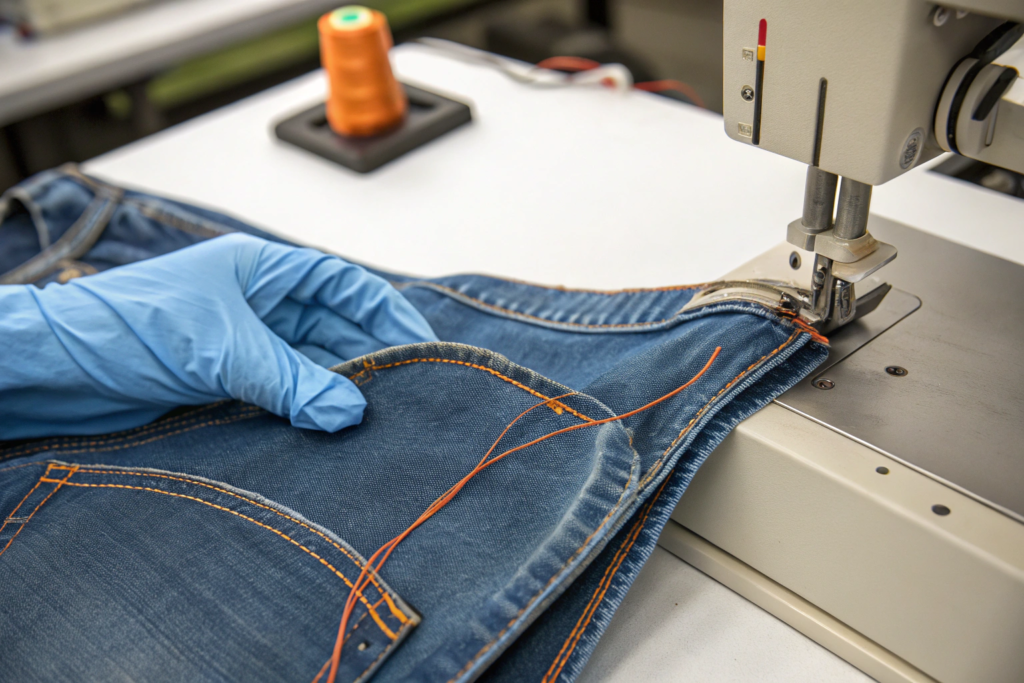
A pilot run is a miniature production run, typically 10 to 20 pieces, made on the actual production line by the actual operators who will sew your bulk order. It is not made in the sampling room by the master seamstress. It is made under real factory conditions.
The pilot run exposes the gap between the ideal and the real. The master seamstress can sew a perfect 3D pocket curve because she has 20 years of experience. The production line operator has three years. The pilot run shows us whether the operator, using the standard work instructions and jigs, can replicate the sample quality. We measure every piece from the pilot run. If the variation is too high, we do not proceed. We adjust the jig, add a visual guide sticker to the machine, or retrain the operator. A Miami-based brand's cargo denim shorts had a complex bellows pocket with six corners. The sample was perfect. The pilot run showed that operators were consistently over-trimming the corner seam allowance, creating a weak point. We added a laser guide line on the sewing machine bed. The problem was solved before we cut the bulk 4,000 pairs. The pilot run methodology is a core concept in manufacturing quality. Skipping it is like launching a new app without beta testing. You are exposing your customers to bugs that should have been caught internally.
How Do We Approve Wash Recipes to Prevent Color Mismatch?
The wash is the visual identity of the short. If the bulk wash is one shade lighter than the approval sample, your entire inventory looks like a misrepresentation of the product you marketed. Customers feel tricked. Returns spike.
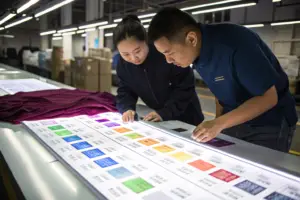
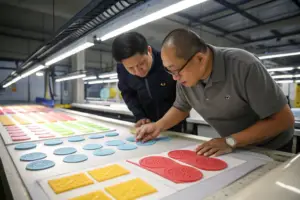
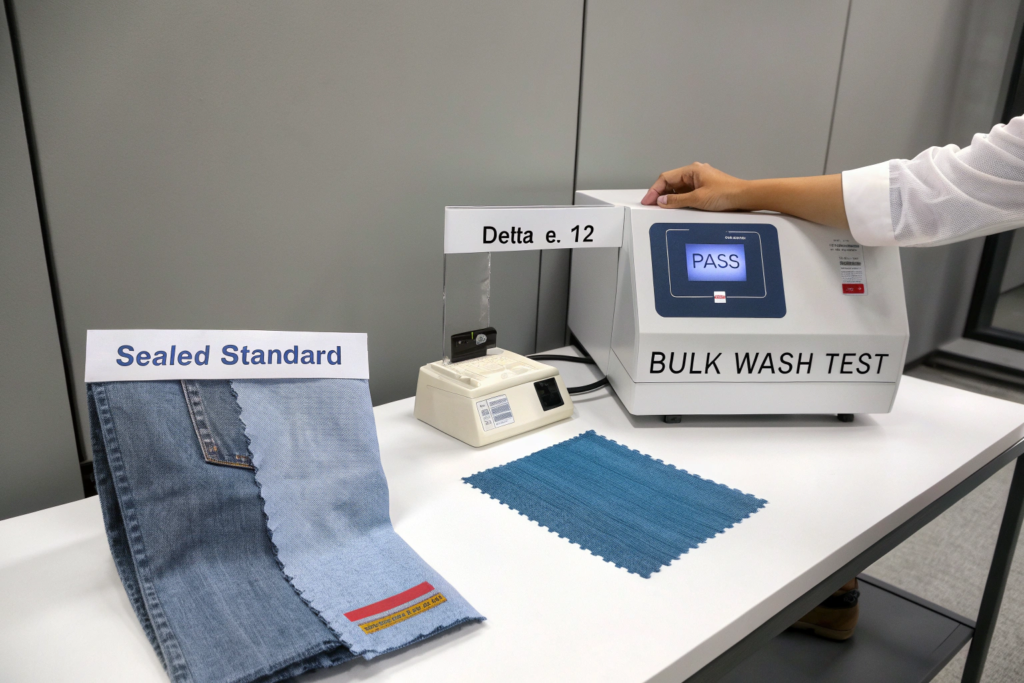
Our wash approval process uses objective, numerical color measurement. We start with a lab dip from our wash house. The lab dip is a small swatch washed to your requested recipe. We measure it with a spectrophotometer and record the Lab* color coordinates. This becomes the sealed standard. Before the bulk wash, we run a production sample through the exact production wash machine, not the small lab machine. We measure that sample. The Delta E, the numerical difference between the production sample and the sealed standard, must be below 1.5. If it is 1.6, the wash recipe is adjusted and tested again. The human eye can perceive a Delta E of 2.0 or higher. We hold to 1.5 to create a safety margin. This color matching spectrophotometer technology removes subjectivity. "That looks a bit light" is not an actionable instruction. "Delta E is 2.3 on the L axis, increase enzyme time by 3 minutes" is an actionable instruction. Data-driven wash approval eliminates the most common cause of bulk rejection in denim manufacturing.
What In-Line and Final Inspection Systems Guarantee Consistency?
Pre-production stops the design flaws. In-line inspection stops the production drift. Machines vibrate out of calibration. Thread tension knobs get bumped. Operator fatigue sets in after lunch. These small changes accumulate. Without in-line inspection, the 500th pair off the line can measure significantly differently from the 1st pair, even though both were made on the same machine with the same operator.
Our inspection system is a net with three layers. The first layer is self-inspection by the operator at the end of each operation. The second layer is the roving in-line auditor who checks a random sample every hour from each line. The third layer is the final outgoing quality control team that inspects the finished, packed product using the AQL sampling standard. These layers catch different types of problems at different stages. A skipped stitch gets caught at layer one. A gradually loosening waistband measurement gets caught at layer two. A packaging label error gets caught at layer three. No single layer is sufficient alone. Together, they form a defense that low-quality factories cannot replicate.
Here is the detailed breakdown of how we maintain vigilance from the first stitch to the sealed carton.
What Does an Hourly In-Line Audit Actually Check?
The roving auditor carries a clipboard, a tape measure, a seam ripper, and a stopwatch. Every hour, on a random minute, she walks to a specific station on each production line. She picks up the last three pieces that the operator has finished. She does not let the operator select the pieces. She takes them herself.
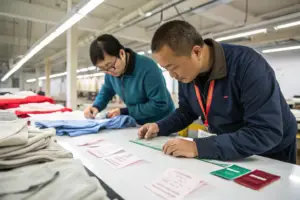
She checks three things. First, the critical measurements. On the waistband station, she measures the waistband width at the center front, center back, and side seams on all three pieces. If the range across the three pieces exceeds 0.5 cm, she flags it. Second, she checks for visual defects. Skipped stitches, pleated seams, uneven topstitching. Third, she checks the machine settings. Is the stitch per inch count correct? Is the differential feed set properly? She records all findings on a time-stamped audit sheet. If she finds a defect, she marks the piece with a red tag and places it in a rework bin. She then checks the next five pieces off that station. If two or more have the same defect, she stops the line and calls the mechanic. This in-line quality audit process catches problems within the hour they begin. The alternative, waiting until final inspection, means hundreds of defective pieces have already been produced. The math is simple. An hourly audit limits the damage radius to about 30 pieces. A final-only inspection can mean a damage radius of 500 pieces.
How Does an AQL 1.5 Final Inspection Differ from the Industry Standard AQL 2.5?
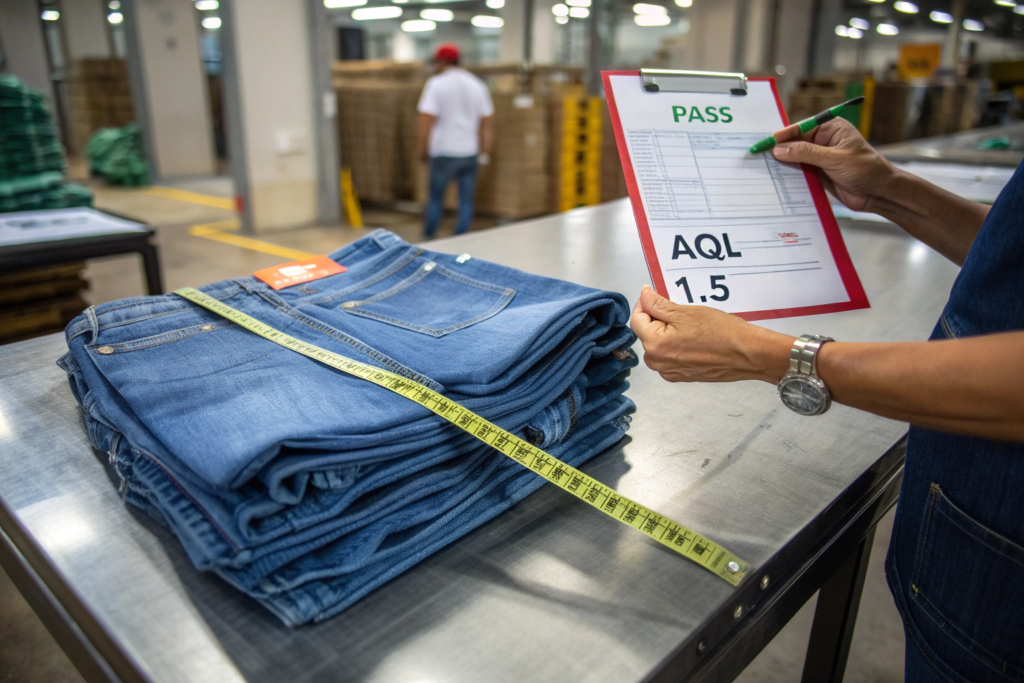
AQL stands for Acceptable Quality Level. It is the maximum number of defects a buyer will accept in a random sample. The industry standard for apparel is AQL 2.5. This means in a sample of 200 pieces, up to 10 major defects are considered "acceptable." Ten defects. That is ten unhappy customers. Ten potential returns. Ten reasons for a one-star review.
We inspect at AQL 1.5 for major defects. In that same sample of 200 pieces, we accept no more than 7 major defects. More importantly, we treat the AQL number as a ceiling, not a target. Our internal goal is zero defects found in the final audit. If even one major defect is found, the audit team leader writes a corrective action report. The lot goes to a 100% re-inspection. We do not ship until the lot passes with zero major defects at the re-inspection. This costs us money. It delays shipments occasionally. It is a constant source of tension between the production manager, who wants to ship, and the quality manager, who wants to hold. I side with the quality manager. Every single time. You can study the AQL sampling standards to understand the statistical basis. The key insight is that switching from 2.5 to 1.5 is not just a number change. It represents a cultural decision to reject the idea that a certain number of customer disappointments is acceptable.
How Can a True DDP Partnership Eliminate Your Post-Shipping Surprises?
The quality battle does not end when the shorts are packed into the carton. It ends when the shorts are in your hands, inside your warehouse, and you have confirmed that they match the approval sample. Anything that happens between the factory door and your warehouse door is still a quality risk. Cartons get crushed. Moisture gets in. Customs opens the container and repacks it badly. The shipping process can damage goods that were perfect when they left the factory.
A true DDP partnership means the factory takes legal and financial responsibility for the goods until they are delivered to your address. This is not just a shipping term. It is an alignment of incentives. When I am responsible for the goods, I pack them better. I choose more reliable forwarders. I handle customs paperwork with extreme precision. If the goods arrive damaged or delayed, it is my loss, not yours. This alignment of risk is the ultimate quality guarantee. A factory that sells FOB and washes its hands of the shipment has less motivation to package for a rough ocean crossing. A factory that sells DDP thinks about the entire journey from cutting table to your shelf.
Let's examine how the DDP model protects your brand from two specific post-shipping nightmares.
How Does DDP Protect You if Goods Are Damaged During Ocean Freight?
Ocean freight is violent. Containers sway. Boxes shift. Condensation forms inside the metal walls. A poorly packed carton of denim shorts can arrive with mold spots, crushed corners, or water stains. Under FOB terms, you own this damage. You file a claim with the shipping line. You negotiate with their surveyor. You wait months for a partial payout.
Under our DDP terms, I own the damage. I am the one filing the claim. You refuse the damaged cartons on delivery. You deduct them from the invoice. The replacement or credit is immediate. Because this risk is mine, I pack to prevent it. We use heavy-duty, double-wall export cartons. We seal each carton with a desiccant pack inside to absorb moisture. We strap the pallets with steel bands. We use corner protectors. These packing upgrades cost about $0.15 per unit. Many FOB factories skip them because the damage risk is yours, not theirs. The ocean freight cargo damage problem is well documented in shipping insurance data. Moisture-related damage accounts for a significant percentage of apparel cargo claims. A DDP factory that packs for moisture prevention is saving you from a statistical probability that becomes a financial reality when you least expect it.
What Happens If Customs Finds an Issue with the Classification?
Customs classification determines the duty rate you pay. Women's cotton denim shorts have a specific HTS code. If the factory classifies them incorrectly, Customs can seize the shipment, assess back duties, and fine the importer. Under FOB, the importer is you. You are on the hook for the factory's paperwork error.
Under our DDP model, we are the Importer of Record. We clear the goods through Customs under our bond. If Customs challenges the classification, our customs broker responds. If a higher duty is assessed, we pay it, not you. This forces us to be meticulous in our classification. We do not guess the HTS code. We review the binding rulings database. We consult with our licensed customs broker. We have the shorts physically examined by a customs specialist if the style has an unusual fiber blend that could fall under a different heading. A Denver-based brand owner told me last month about his nightmare with a previous Vietnamese factory. They classified his cotton-spandex blend shorts incorrectly. U.S. Customs audited his imports two years later. He received a bill for $11,000 in back duties and penalties. The factory was unreachable. The HTS classification database is public. You can look up your product. But the responsibility for correct classification should rest on the party that manufactured the product and knows the exact fiber content. Under DDP, it does.
Conclusion
Low-quality denim shorts are not an inevitable risk of overseas manufacturing. They are the predictable result of a factory system that lacks specific, named, and enforced quality barriers. I have shown you the four barriers we built at Shanghai Fumao. The 7-point incoming fabric inspection that rejects twisted, underweight denim before it touches a cutting blade. The pre-production pilot run that exposes operator skill gaps before they become bulk defects. The hourly in-line audits that limit the damage radius of any machine drift to 30 pieces instead of 500. And the final AQL 1.5 inspection with a zero-defect internal goal that refuses to accept the industry's casual tolerance for customer disappointment.
These barriers are expensive to maintain. They require equipment like spectrophotometers and tensile testers. They require salaries for auditors who do not report to production managers. They require a factory owner who will sit in a meeting and tell the production team that the shipment is delayed by three days because the wash Delta E was 1.6, not 1.5. I have had those uncomfortable meetings. I will have them again. Because the alternative, shipping shorts that I know are slightly off, is a slow poison. It kills your brand one review at a time. And it kills my factory's reputation one lost client at a time.
The DDP shipping model extends this quality commitment across the ocean. I own the product until you accept it. I own the Customs classification. I own the moisture damage risk. I own the freight delays. You own the joy of opening a carton and finding exactly what you approved, ready to sell, with no surprises.
If you are tired of the quality gamble, if you want a denim shorts manufacturer whose financial interests are aligned with your brand's reputation, then we should talk. Our Business Director, Elaine, can send you a copy of our quality assurance manual, a video tour of our testing laboratory, and a sample pair of shorts produced under the exact system described in this article. Email her at elaine@fumaoclothing.com. Let Shanghai Fumao be the partner that turns your denim sourcing from a risk into a certainty.