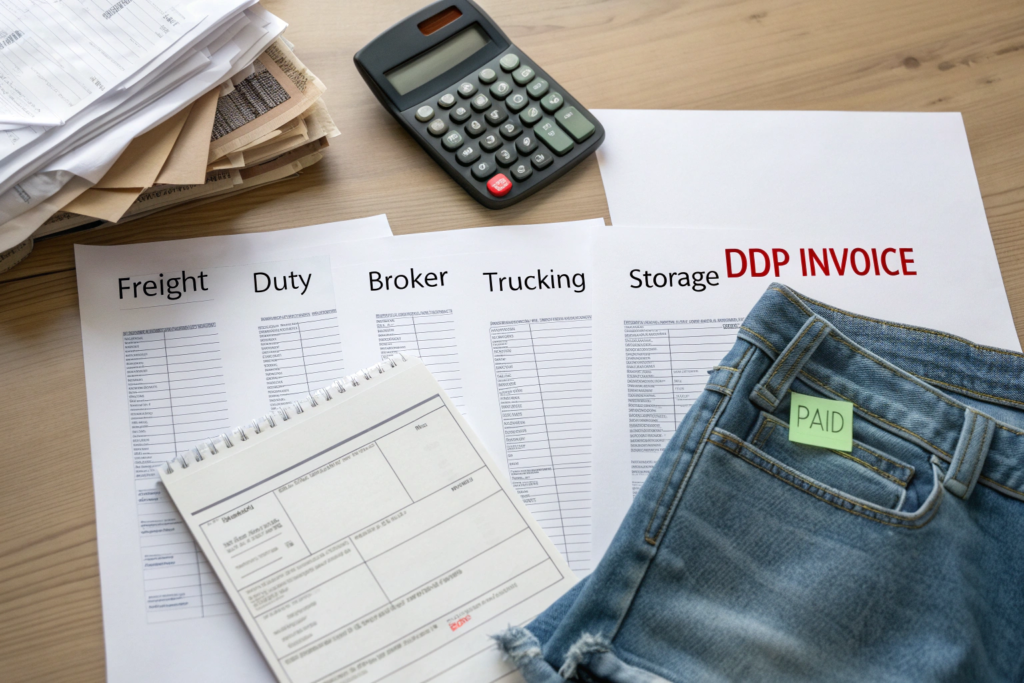
You negotiated a great FOB price. $5.20 per pair. You feel like a savvy buyer. You wire the deposit. The shorts are produced. They leave the factory gate in Shanghai. That is where your financial visibility ends. A month later, the freight forwarder sends an invoice. Ocean freight: $1,200. Then the customs broker sends an invoice. Duty: $2,600. Bond fee: $150. Then the port sends an invoice. Terminal handling: $350. Then the trucking company sends an invoice. Delivery: $480. Your $5.20 short did not cost $5.20. It cost $7.80. And you did not budget for $7.80. Your margin is in pieces. The FOB price was a mirage. The real price was hiding in a stack of invoices you had never seen before.
DDP, which stands for Delivered Duty Paid, simplifies denim shorts importing by replacing a dozen variable, unpredictable costs with a single, fixed price per unit. Under DDP, the factory is responsible for ocean freight, marine insurance, U.S. customs duty, customs bond, brokerage, port handling, and inland trucking to your specified warehouse. You pay one price. The shorts arrive at your door. You do not deal with freight forwarders, customs brokers, port terminals, or trucking dispatchers. You deal with one company, and that company is financially responsible for the entire journey.
I run Shanghai Fumao, and I switched my factory to a DDP-first model five years ago after watching too many clients get burned by logistics surprises. I want to explain exactly how DDP works, what it includes and excludes, how it compares financially to FOB in real scenarios, and why it fundamentally changes the buyer-factory relationship from adversarial to aligned. If you have ever been blindsided by a freight invoice, this article is for you.
What Exactly Is DDP Shipping and What Does It Cover?
DDP is one of the Incoterms published by the International Chamber of Commerce. It stands for Delivered Duty Paid. The definition is simple. The seller delivers the goods to the buyer at the named place of destination, cleared for import, and ready for unloading. The seller bears all costs and risks of transporting the goods to that destination, including import duties and taxes.
In plain language, DDP means we handle everything from our factory floor to your warehouse dock. We book the ocean freight. We pay the freight charges. We insure the cargo. We clear U.S. Customs. We pay the import duty. We arrange the truck from the port to your address. You open your warehouse door. The shorts are there. You sign the delivery receipt. That is your only involvement in the logistics process. The contrast with FOB is stark. Under FOB, your responsibility begins when the goods cross the ship's rail. You arrange the freight. You arrange the insurance. You arrange the customs clearance. You pay the duty. You arrange the trucking. Each of these steps involves a different company, a different invoice, and a different potential for delay or unexpected cost.
Let me define the scope of DDP clearly and explain the seller's obligations under this Incoterm.
How Do Incoterms Define the Seller's Responsibilities Under DDP?
The International Chamber of Commerce publishes the official Incoterms rules, last updated in 2020. Under DDP, the seller has the maximum level of obligation. The seller must deliver the goods, cleared for import, at the named place of destination. The seller bears all costs and risks up to that point.
The specific seller responsibilities include the export packaging, the export customs clearance in the country of origin, the main carriage, which is usually ocean freight for denim shorts, the marine cargo insurance, the import customs clearance in the country of destination, the payment of import duties, taxes, and customs fees, the unloading from the main carriage at the destination terminal, and the inland transportation to the named place of delivery. The buyer's responsibilities are minimal. The buyer must pay the agreed price, assist the seller with any information needed for export or import formalities, and take delivery of the goods at the named place. That is it. The DDP Incoterms 2020 official definition is clear. The seller does everything. The buyer pays one price and receives the goods. This is the maximum convenience for the buyer and the maximum responsibility for the seller. We choose to operate on DDP because we believe the seller, who ships containers every week, is better equipped to manage logistics than the buyer, who imports a few times a year.
What Specific Logistics Costs Are Included in Our DDP Price?
When we quote a DDP price for denim shorts, the price includes every logistics cost from our factory to your warehouse. I will list each component so you know exactly what you are paying for and what you are not.
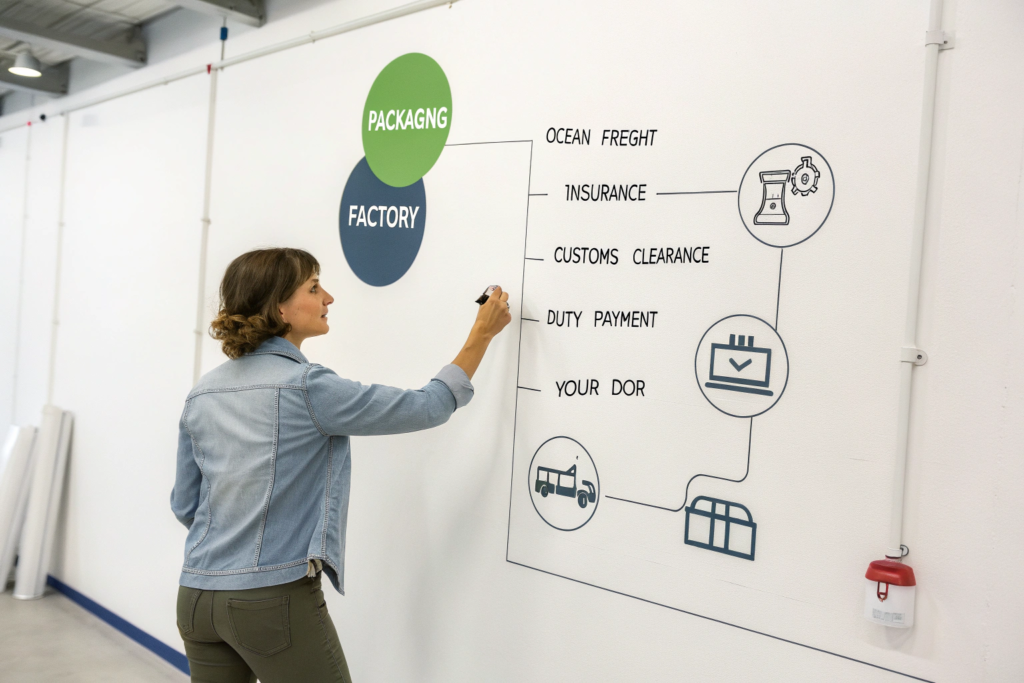
The DDP price includes export packaging, which is our standard double-wall export cartons with polybagging, desiccant packs, and palletization. It includes export customs clearance at Shanghai port, including the documentation fee and the terminal handling charge at origin. It includes ocean freight from Shanghai to the destination port, at the carrier rate we have negotiated under our annual contract. It includes marine cargo insurance at 110% of the invoice value, covering loss or damage during transit. It includes import customs clearance at the destination port, performed by our licensed U.S. customs broker. It includes the U.S. customs duty, calculated at the correct HTS rate for cotton denim shorts, which is typically 16.6% but varies by fiber composition. It includes the customs bond, the Merchandise Processing Fee, and the Harbor Maintenance Fee. It includes destination terminal handling, which covers the unloading and storage of the container at the port. It includes inland trucking from the port to your delivery address, with liftgate service if required.
What is not included? Storage at your warehouse after delivery. Any additional duties or penalties resulting from incorrect product information you provided. Any costs arising from your failure to accept delivery at the agreed time. And any costs from a customs exam, unless the exam is caused by our documentation error. If Customs randomly selects the container for an X-ray or intensive exam, that cost is ours under DDP. The DDP cost breakdown includes all of these elements. The key benefit is that they are bundled into a single, predictable number.
How Does DDP Compare Financially to FOB and Other Incoterms?
FOB looks cheaper. That is why many buyers choose it. The FOB unit price is lower because it excludes all the post-factory costs. The buyer sees $5.20 FOB versus $8.80 DDP and thinks they are saving $3.60 per unit. They are not saving $3.60. They are deferring $3.60 in costs that they will pay later, to different parties, in different currencies, with less predictability. The only fair comparison is the total landed cost, including every cost from factory to warehouse.
When you calculate the total landed cost, DDP is often competitively priced with FOB, and sometimes cheaper. This is because we, as a high-volume shipper, have negotiated freight rates, broker fees, and insurance premiums that are lower than what an individual importer can obtain. We also have the expertise to classify goods correctly, avoid customs delays that generate storage fees, and optimize container loading to reduce per-unit freight costs. The buyer who imports two containers a year is a small customer to a freight forwarder. We are a large customer. Our rates reflect that volume.
Let me show you the math with a specific example and compare DDP to the other Incoterms you might encounter.
What Is the Real-World Cost Comparison Between an FOB Quote and Our DDP Quote?
Let me use a real example from a quotation we provided in March 2026. The client was a brand owner in Chicago, ordering 3,000 pairs of our standard 10.5 oz denim shorts with medium enzyme wash. We quoted both FOB and DDP so the client could see the difference.
Our FOB Shanghai quote was $5.80 per unit. Our DDP Chicago quote was $8.50 per unit. The difference is $2.70. The client, experienced in importing, calculated the additional costs for the FOB option. Ocean freight from Shanghai to Chicago, allocated per unit: $0.48. Marine insurance: $0.05. U.S. customs duty at 16.6% on the FOB value: $0.96. Customs bond and brokerage: $0.28. Destination terminal handling: $0.15. Inland trucking from the Chicago rail terminal to the warehouse: $0.22. Total additional costs: $2.14. Total landed cost under FOB: $7.94. The difference between FOB landed cost and DDP was $0.56 per unit. For that $0.56, the client eliminated the administrative work of coordinating four different service providers. They eliminated the risk of a surprise demurrage charge if the container was delayed. They eliminated the risk of a customs exam fee. And they received a single invoice with a guaranteed price. The client chose DDP. The total cost difference across the 3,000-unit order was $1,680. The client valued the time savings, the risk elimination, and the predictable cash flow at more than $1,680. The FOB vs DDP total cost analysis shows that the headline price difference shrinks dramatically when all costs are accounted for.
How Do CIF and DAP Compare to DDP in Terms of Buyer Responsibility?
CIF, Cost, Insurance, and Freight, is a middle ground. The seller pays the ocean freight and insurance to the destination port. The buyer handles customs clearance, duty, and inland trucking. CIF transfers risk at the destination port, not the origin port like FOB, but the buyer still has significant responsibilities. DAP, Delivered at Place, goes further. The seller delivers the goods to the named place, ready for unloading. The buyer handles import customs clearance and duty. DDP goes the furthest. The seller handles everything, including customs clearance and duty.
The choice between these Incoterms depends on your importing experience. If you are a large brand with a dedicated logistics team, a U.S. customs bond, and established relationships with brokers and truckers, FOB or CIF may work well for you. You can leverage your buying power to negotiate competitive freight and brokerage rates. DDP would give you less control over carrier selection and less visibility into logistics costs. If you are a small or medium brand without a logistics team, without a customs bond, and without the volume to negotiate competitive rates, DDP is the clear winner. It outsources the entire logistics function to a party that does it every day. The Incoterms comparison guide provides a full matrix of seller and buyer obligations for each term. For the typical denim shorts buyer, DDP offers the best combination of cost predictability and administrative simplicity.
What Hidden Risks Does DDP Eliminate for Denim Shorts Buyers?
FOB is not just a financial calculation. It is a risk transfer. When the goods cross the ship's rail, the risk transfers from the seller to the buyer. If the container falls off the ship, that is the buyer's loss. If the port is congested and storage fees accumulate, that is the buyer's cost. If Customs classifies the goods under a higher duty rate, that is the buyer's bill. The buyer, who is sitting in an office thousands of miles from the port, is now responsible for a physical shipment they cannot see, touch, or control.
DDP keeps the risk with the party that can manage it. We ship containers every week. We know the carriers with the best on-time records. We know the ports with the lowest congestion. We know the customs brokers who file paperwork correctly. We know the HTS classification for denim shorts because we classify them every day. If something goes wrong, we have the relationships and the expertise to resolve it quickly. The buyer has none of these advantages. Transferring logistics risk to an inexperienced buyer is a recipe for a bad outcome.
Let me describe three specific risks that DDP eliminates and what each risk can cost a buyer under FOB terms.

How Does DDP Protect You from Customs Clearance Delays and Fees?
U.S. Customs and Border Protection is not a vending machine where you insert paperwork and goods come out. It is a law enforcement agency. It can detain your shipment for document review. It can select your container for an X-ray or physical exam. It can assess additional duties if it disagrees with the declared value or classification.
Under FOB, you are the Importer of Record. You are legally responsible for the accuracy of the customs declaration. If the declaration has an error, even an error made by your customs broker, you are liable for the penalties. If the container is held for exam, you pay the exam fee, which can be $500 to $1,000, and you pay the storage charges while the container waits. Under DDP, we are the Importer of Record. We handle the customs clearance. If an error is made, we are liable. If the container is examined, we pay the fee. If the port charges storage, we pay the invoice. Your financial exposure is zero. This is a significant risk transfer. The U.S. Customs entry process guide for importers outlines the responsibilities and potential pitfalls. A first-time importer navigating this process alone is taking on a risk they do not fully understand.
What Happens When Port Congestion or Container Damage Occurs?
The ports of Los Angeles and Long Beach are the busiest in the United States. They periodically experience severe congestion due to labor actions, chassis shortages, and volume spikes. A container can sit at the terminal for one to three weeks beyond the scheduled arrival. Every day beyond the free storage time, the terminal charges demurrage. Demurrage rates escalate over time. A two-week delay can generate a $2,000 to $3,000 storage bill.
Under FOB, this is your bill. You cannot negotiate it away. You pay it to get your goods released. Under DDP, this is our bill. We pay it. We also have more tools to avoid it. Our forwarders track vessel schedules and terminal conditions. If a port is congested, we can route the container through an alternative port. We can arrange expedited pick-up to minimize storage time. We can leverage our volume to get priority processing from terminal operators. Container damage during ocean transit is another risk. A container can be dropped. It can be crushed in a stack collapse. The contents can be water-damaged from a leak. Under FOB, you file the insurance claim with the shipping line. The process is slow and the payout is uncertain. Under DDP, we file the claim. We replace or credit the damaged goods immediately. You are not involved. The port congestion demurrage fees are a known risk in international shipping. DDP transfers that risk to the party that ships every day and has systems to manage it.
How Does Our DDP Process Work from Order to Delivery?
Understanding DDP conceptually is one thing. Seeing the step-by-step process is another. When you place a DDP order with us, the process is a defined sequence of events. You are informed at each stage. You do not need to take any action beyond the initial order confirmation and the final delivery acceptance. The logistics engine runs in the background, managed by our team.
This process is designed to be boring. Boring is the goal. An exciting logistics process means something went wrong. A boring logistics process means everything happened on schedule, the paperwork was correct, the container moved smoothly, and the delivery occurred as planned. We have refined this process over thousands of shipments to the U.S. and, more recently, to Europe.
Let me walk you through the entire DDP journey for a typical denim shorts order, from the factory floor to your warehouse dock.
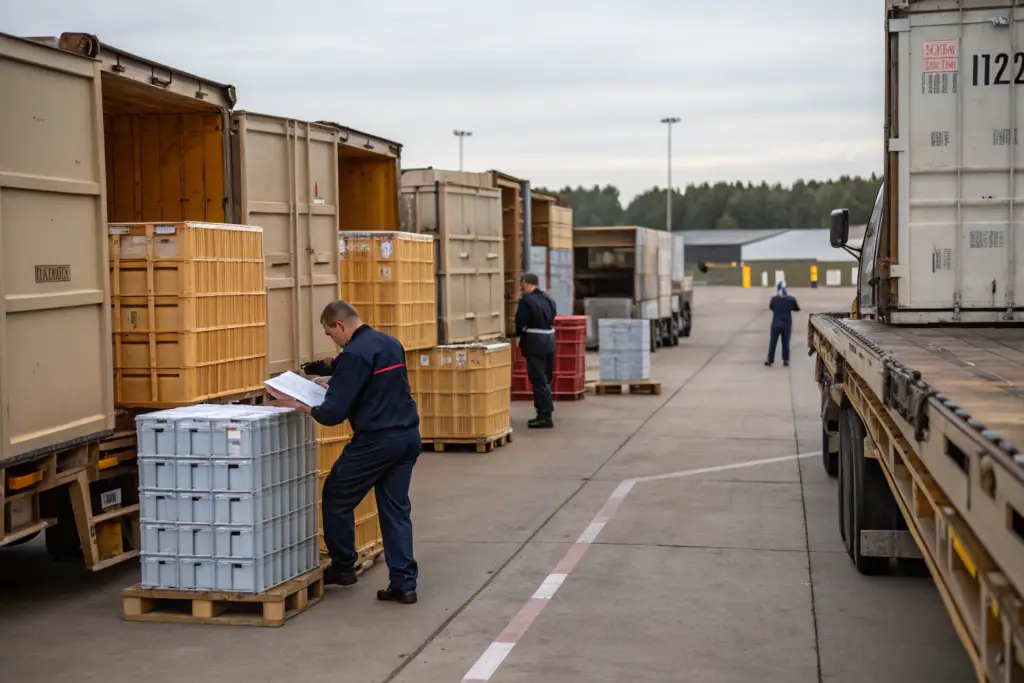
What Are the Key Milestones in a DDP Shipment from Our Factory?
The DDP process has seven key milestones that we track and report to you.
Milestone one is Order Confirmation and Production Start. We confirm the DDP price, the delivery address, and the production schedule. The price is fixed. The production begins. Milestone two is Production Completion and Packing. The shorts are sewn, washed, inspected, and packed into export cartons. We send you photos of the packed cartons with your shipping marks. Milestone three is Export Booking and Container Loading. We book the ocean freight under our contract. The container is loaded at our factory and trucked to the port of Shanghai. We send you the container number and the vessel name. Milestone four is Export Customs Clearance and Vessel Departure. We clear Chinese export customs. The container is loaded onto the vessel. We send you the bill of lading and the vessel departure confirmation. Milestone five is Import Customs Pre-Clearance. While the vessel is in transit, we file the U.S. customs entry through our broker. We pay the estimated duties. We receive the customs release, usually before the vessel arrives. Milestone six is Vessel Arrival and Port Release. The container is discharged at the destination port. It clears customs. It is released to our trucking partner. We send you the customs release confirmation. Milestone seven is Inland Transit and Final Delivery. The truck delivers the container to your specified address. You inspect the cartons for external damage. You sign the delivery receipt. The DDP delivery is complete. Each milestone is tracked on our digital production board, which you have access to. You can see the status of your shipment at any time. The DDP shipping process follows these standard steps. The key is communication. You are never in the dark.
How Do We Handle Customs Brokerage and Duty Payment on Your Behalf?
We have a longstanding relationship with a licensed U.S. customs broker. The broker operates under a power of attorney from our company. For each DDP shipment, we provide the broker with the commercial invoice, the packing list, the bill of lading, and the manufacturer's affidavit or other required documentation. The broker classifies the goods under the correct Harmonized Tariff Schedule code. For women's cotton denim shorts, the HTS code is typically 6204.62. The duty rate is 16.6% for most cotton denim shorts, but it varies by fiber composition and country of origin.
The broker files the Entry Summary, CBP Form 7501, electronically with U.S. Customs. The duties and fees are paid from our broker's account, which we fund. The broker transmits the release to the terminal and the trucker. We receive a copy of the entry summary and the duty payment confirmation. We provide these to you for your records. You do not need a customs bond. You do not need to register as an importer. You do not interact with the broker at all. The U.S. customs broker role is explained on the CBP website. A good broker is a valuable partner. Our broker has handled thousands of apparel entries and knows the specific requirements for denim garments, including the fiber content verification and the care label compliance checks that Customs may request.
Conclusion
DDP is not a shipping term. It is a decision to transfer logistics risk from the buyer, who imports occasionally, to the seller, who ships every day. Under DDP, you pay one price per unit. That price includes the garment, the export packing, the ocean freight, the marine insurance, the U.S. customs duty, the customs bond, the brokerage, the port handling, and the inland trucking to your warehouse. You do not coordinate four different service providers. You do not open a stack of unexpected invoices. You do not learn customs clearance the hard way.
The financial comparison between FOB and DDP is closer than most buyers assume. When you add the freight, the duty, the broker fees, the port charges, and the trucking to an FOB quote, the total landed cost is often within 50 cents of our DDP price. For that small difference, you eliminate hours of administrative work, the risk of demurrage charges, the risk of customs exam fees, and the anxiety of not knowing where your container is or what it will cost when it arrives.
I switched Shanghai Fumao to a DDP-first model because I was tired of watching my clients struggle with logistics. The factory that makes the shorts should be responsible for getting the shorts to the buyer's door. That alignment of responsibility creates accountability. If the logistics fail, the factory fails. That is how it should be.
If you want to experience importing denim shorts as a single, predictable transaction rather than a multi-party logistics project, contact our Business Director, Elaine. She will prepare a DDP quotation to your specific delivery address, with a detailed breakdown of what is included. She can also connect you with a current DDP client who can share their experience. Her email is elaine@fumaoclothing.com. At Shanghai Fumao, we do not just make the shorts. We get them to your door. One price. One invoice. One responsible party. That is the DDP difference.