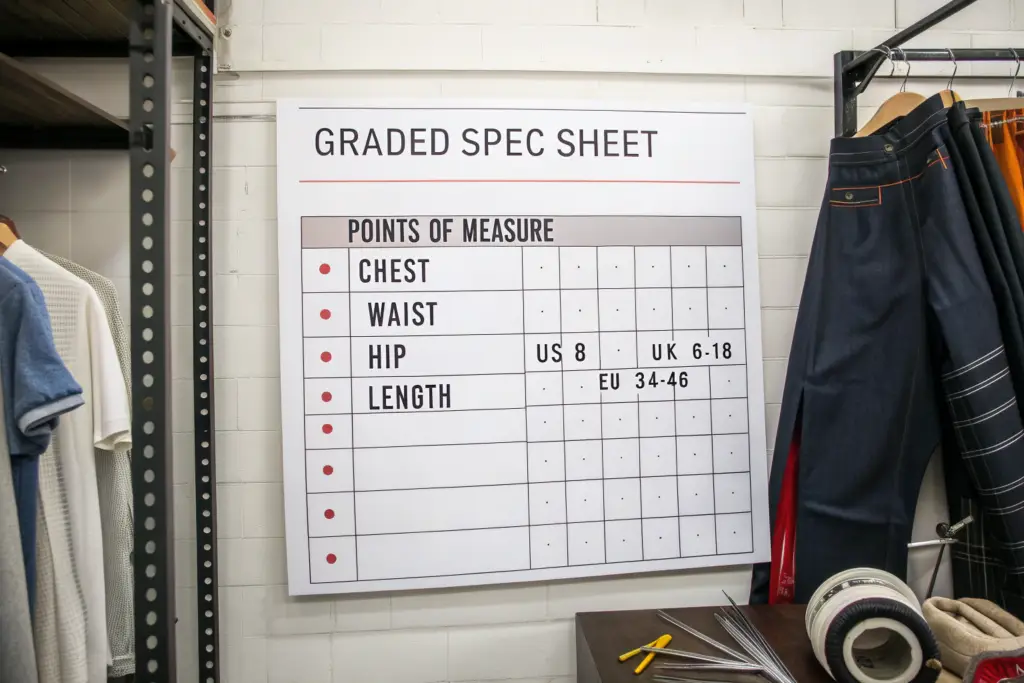
You have perfected the fit of your sample on a US size 6 fit model. The garment looks stunning. Now you need to produce it in sizes 0 through 14 for your US customers, and you are also planning to sell into the European market, which uses a completely different sizing system. You send your pattern to the factory and hope for the best. When the bulk arrives, the size 10 fits like an 8, and the European size 38 is completely off. A frustrated brand owner told me, "I used to think grading was just 'making things bigger.' Then my customers from the UK started complaining that my 'Medium' was tiny. I realized international sizing was a science I didn't understand."
Grading is the precise, mathematical process of scaling a base-size pattern to create a full size range. It is not simply "adding an inch to everything." A professional grader uses a set of rules, called grade rules, to incrementally adjust specific points on the pattern (chest, waist, hip, length) based on body growth averages. Understanding international sizing requires knowing that a US, UK, and EU "Medium" all correspond to different base body measurements, and the grade rules between sizes also differ.
At Shanghai Fumao, our in-house pattern makers and graders ensure your designs fit perfectly across all sizes and international markets. We are the technical partners who translate your vision into a globally wearable fit. Let me demystify the grading process and explain how we ensure your size Medium in New York fits just as perfectly as your size Medium in London or Berlin.
What Exactly Is Pattern Grading and How Does It Work?
Grading is one of the most misunderstood steps in product development. It is not a simple percentage increase or a "stretch" of the whole pattern. It is a sophisticated, point-by-point mathematical translation that accounts for how the human body actually grows in three dimensions. A professional grader uses a "grade rule" table, which specifies exactly how much each critical point on a pattern must move for each size increment.
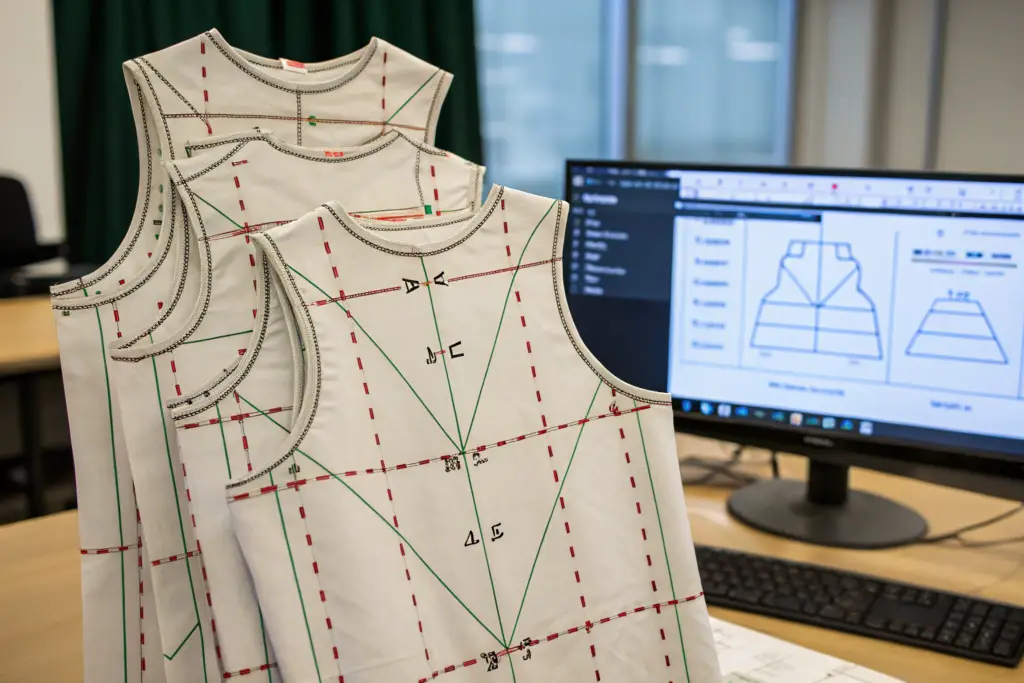
Pattern grading is the process of taking a perfected base-size pattern (e.g., a US size 8) and creating a full range of larger and smaller sizes by shifting specific points on the pattern by precise, predetermined increments. These increments are called "grade rules." The rules are not uniform; a chest point might move 1 inch per size, while a shoulder point might only move 1/4 inch. The process is a complex, 2D representation of 3D body growth, ensuring a consistent fit and silhouette across the entire size curve.
I recall a brand founder who was frustrated because her beautiful size 6 dress was getting terrible reviews in sizes 10 and 12 for being "too short and too boxy." Her previous factory had simply added a flat percentage to the entire pattern. The proportions were ruined. We explained that professional grading requires moving the bust, the waist, and the hip points at different rates to maintain the intended silhouette. We re-graded her pattern using our standard, body-contoured grade rules. The next run of larger sizes received glowing reviews for their perfect fit. She learned that grading is a specialized skill, not a simple calculation. This is the expertise of our pattern making and grading department .
What Is a "Grade Rule" and How Is It Determined?
A grade rule is a set of specific X and Y coordinate movements for every single point on a pattern. For example, the rule might state: "For each size increase, the chest point moves outward by 1 inch and downward by 0.25 inches." These rules are based on extensive industry data on average body measurements and growth patterns for a specific target demographic. A good factory has a library of proven grade rules. This is a core part of our technical design expertise .
Why Is a "Base Size" So Important in the Grading Process?
The base size, usually your sample size (e.g., US 8), is the anchor. All grading radiates outward from this perfect center. The fit is perfected on this single size, and the entire size run is then mathematically derived from it. If your base size sample is not a perfect representation of your target customer's body, the entire size run will be flawed. This is why we are so meticulous about the fit sample process .
What Are the Key Differences Between US, UK, and EU Sizing Standards?
A US 8, a UK 8, and an EU 38 are not the same size. They correspond to completely different sets of body measurements. This is the most common and costly mistake brands make when selling internationally. You cannot simply change the label on your US-graded pattern and sell it in Europe. The underlying body that the garment is designed for is different. Understanding these core national differences is essential for building a global brand.
The core difference between international sizing standards is the base body measurements they are designed for. A US size 8 is built for a bust of approximately 36 inches. A UK size 8 is significantly smaller, built for a bust of around 32 inches. An EU size 38 is closer to a US 8 in the bust (approx. 36 inches) but often caters to a slightly different body proportion, particularly in the hip and shoulder slope. Grading must be based on the specific base body of the target market, not just a translated label.
A brand we work with learned this the hard way when they launched in the UK using their US-graded patterns. They simply printed a conversion chart on their hangtag. The returns were disastrous. Their US Small, which they labeled as a UK 8, was enormous on the UK customer. We helped them create a separate, UK-specific base size and grade rules based on UK body standards. Their returns plummeted. They now produce separate production runs for the US and the UK, graded specifically for each market's body. This is the level of precision required for true international success. This is the value of our global sizing expertise .
Why Can't You Just Use a Size Conversion Chart on a Hangtag?
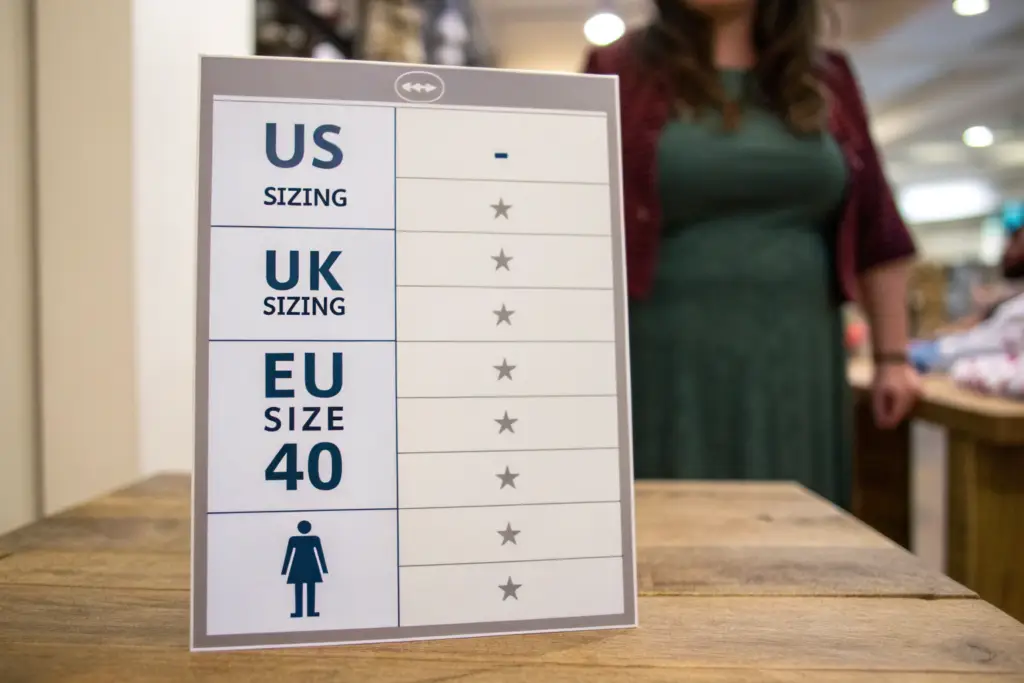
A conversion chart only changes the label, not the fit of the garment. If the underlying garment was graded for a US body, a UK customer wearing it will find it fits poorly, regardless of what the label says. The garment must be graded and cut from the start for the intended market. This is a fundamental truth of international apparel production.
How Do EU Body Proportions Differ from US Body Proportions?
While individual bodies vary immensely, aggregate data shows that EU grading often assumes a slightly narrower shoulder and a different hip-to-waist ratio compared to the US market. These subtle proportional differences mean that a perfectly graded US pattern will not fit an EU body optimally. This is why a specialized grader who understands these nuances is essential. This is a key part of our international market knowledge .
How Do You Ensure Consistent Fit Across All Sizes in a Single Run?
Creating a perfect grade rule is a theoretical exercise. The final, critical step is verifying that the rule works in the real world. A professional factory does not just grade the pattern and start cutting. They sew a full-size run of Fit Samples or PP Samples and then conduct a rigorous Grading Audit. This is the only way to confirm that the intended fit and proportions of the design have been maintained across every size, from the smallest to the largest.
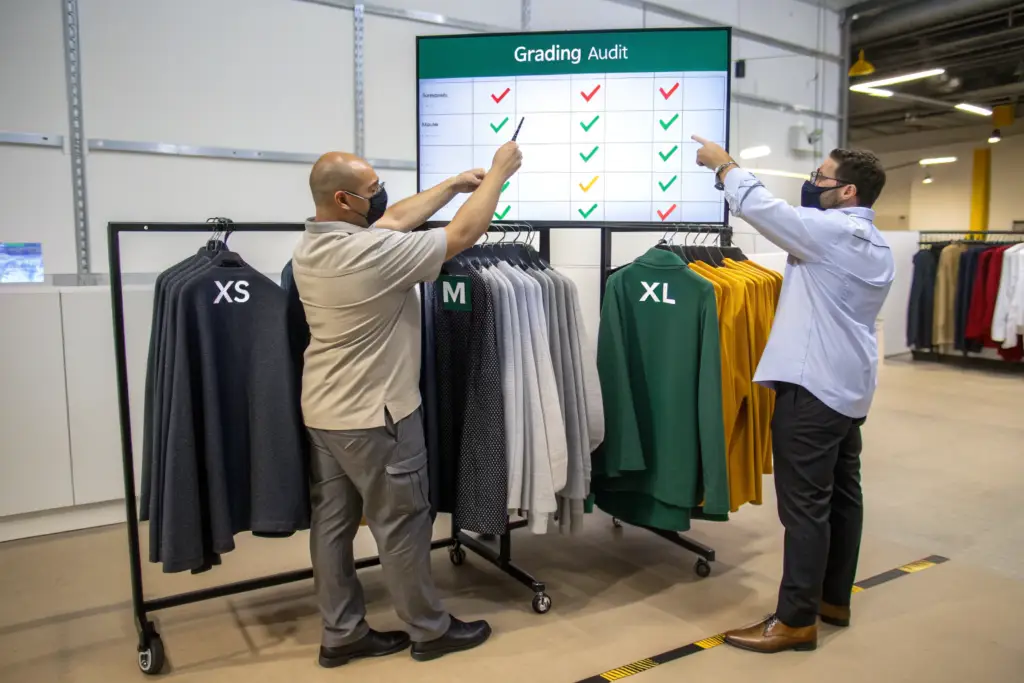
Ensuring consistent fit across all sizes requires a physical Grading Audit. We sew and measure a sample from both ends of the size spectrum (e.g., an XS and an XL) and from the middle (a Medium). Each sample is measured at every critical POM and compared against the target spec sheet. The fit is evaluated on a live model for each size to ensure the visual proportions and silhouette of the design are maintained. This verifies the mathematical grade in the real world.
A brand owner told me her previous factory's grading was "hit or miss." Sometimes the sleeves on the size Large were comically short. We implemented a mandatory Grading Audit on all her new styles. For a recent dress, we sewed and measured the size 2 and size 14. The audit revealed that the sleeve length on the size 14 was trending slightly short. Our pattern maker adjusted the grade rule for the sleeve before the bulk layout was finalized. The final size run was flawless. This is the proactive, data-driven approach that prevents costly grading errors. This is the standard of our grading and quality control .
What Is a "Grading Audit" and Why Is It Necessary?
A Grading Audit is the physical verification of the mathematical grade. You cannot just trust the software. You must sew and measure actual garments from key sizes to confirm that the grade rules work for that specific design, in that specific fabric. It catches errors that would otherwise be replicated across thousands of units. This is a non-negotiable step in our pre-production process .
How Do You Visually Check Proportions Across Sizes?
Measurements are critical, but the human eye is the final judge. We put the size XS, M, and XL samples on appropriately sized fit models. The designer then evaluates whether the visual essence of the design has been maintained. Does the sleeve proportion look correct on the larger size? Does the skirt still have the intended flare? This visual check ensures the grade preserves the creative intent, not just the math. This is a key part of our collaborative development .
How Does Fumao's Expertise in Grading Ensure Global Fit Success?
Grading for a global market is a complex technical challenge. It requires more than just a software program; it requires a deep, nuanced understanding of different body morphologies and international market expectations. Our in-house pattern makers and graders have years of experience developing and perfecting grade rules for the US, UK, and EU markets. We are your technical partners in ensuring your designs fit beautifully on the bodies of your customers, wherever they are in the world.
Fumao's expertise in grading ensures global fit success by providing market-specific, specialized knowledge. We maintain separate, proven grade rule libraries for US, UK, and EU markets. We can advise you on the best base size for your target demographic and work with you to develop a custom grade if your brand's fit is unique. We conduct rigorous Grading Audits to verify the math in the real world. Our goal is to make sure your customer in Paris and your customer in New York both feel that the garment was made just for them.
A brand expanding into the EU market for the first time came to us with their US-graded patterns. We did not just print new labels. We explained the need for an EU-specific base size and a different set of grade rules. We created a new, EU-graded spec sheet and produced a separate set of samples. They launched in Europe with a product that fit the local customer perfectly. Their success in that market was built on this technical foundation. This is the power of partnering with a manufacturer who understands the science of international garment sizing .

What Market-Specific Grade Rule Libraries Do You Maintain?
We have developed and refined grade rule libraries for the major markets we serve, including:
- United States (US)
- United Kingdom (UK)
- European Union (EU)
- Australia (AU)
These libraries are built on extensive industry data and our decades of experience. This allows us to hit the ground running with new partners targeting these markets. This is a key part of our technical service offering .
How Can You Help a Brand Develop a Unique, Proprietary Fit?
Your brand may not want to fit the "average" body. You may want to design for a specific customer—a more athletic build, a more petite frame, a curvier silhouette. Our pattern makers can work with you to create a proprietary set of base measurements and grade rules that define your brand's unique fit. This becomes a powerful and defensible part of your brand identity. This is the ultimate level of our product development partnership .
Conclusion
Understanding the grading process is fundamental to building a successful apparel brand that can scale across sizes and international markets. It is a precise, technical science of translating body growth into a pattern, with unique rules for every market. It is not a simple matter of adding inches or changing a label.
At Shanghai Fumao, we are masters of this science. We provide the technical expertise, the market-specific knowledge, and the rigorous verification processes to ensure your designs fit beautifully and consistently on your customers, whether they are in New York, London, or Berlin. We are the partner that makes your global brand vision a perfect reality.
If you are ready to build a brand with a flawless, internationally-scalable fit, let's talk. Our Business Director, Elaine, can connect you with our pattern-making team to discuss your specific grading needs. Please email Elaine at: elaine@fumaoclothing.com.