A brand owner from London called me at 10 PM Shanghai time three months ago. She was in a fitting session with her sales team. They had just realized the pocket flap on their bestselling women's blazer was too wide. It threw off the proportion. The bulk fabric was already cut for 800 units. She was panicking. She said, "I know this is my fault. But if this ships as is, my buyers will cancel next season." She expected me to say no. I said we would fix it by morning.
Shanghai Fumao handles last-minute design changes without delaying shipment by using a "frozen zone" production protocol, an in-house rapid sampling cell, and a modular production line system. We isolate the requested change to only the unprocessed components, immediately deploy our pattern correction team, and run a parallel test on 5 pieces before scaling across the line. This keeps the original ship date intact while absorbing the change.
This is not magic. It is a system built on the understanding that design is a living process. A sketch is a theory. A sample is a prototype. Sometimes, the truth only reveals itself when the brand owner sees the full size run or the sales team reacts to it. We do not punish our clients for having a better idea late in the game. We build our factory to support those insights. At Shanghai Fumao, we call this "agile production," and it is the single biggest reason brands stay with us year after year.
Why Is a "Frozen Zone" Protocol Critical for Late-Stage Changes?
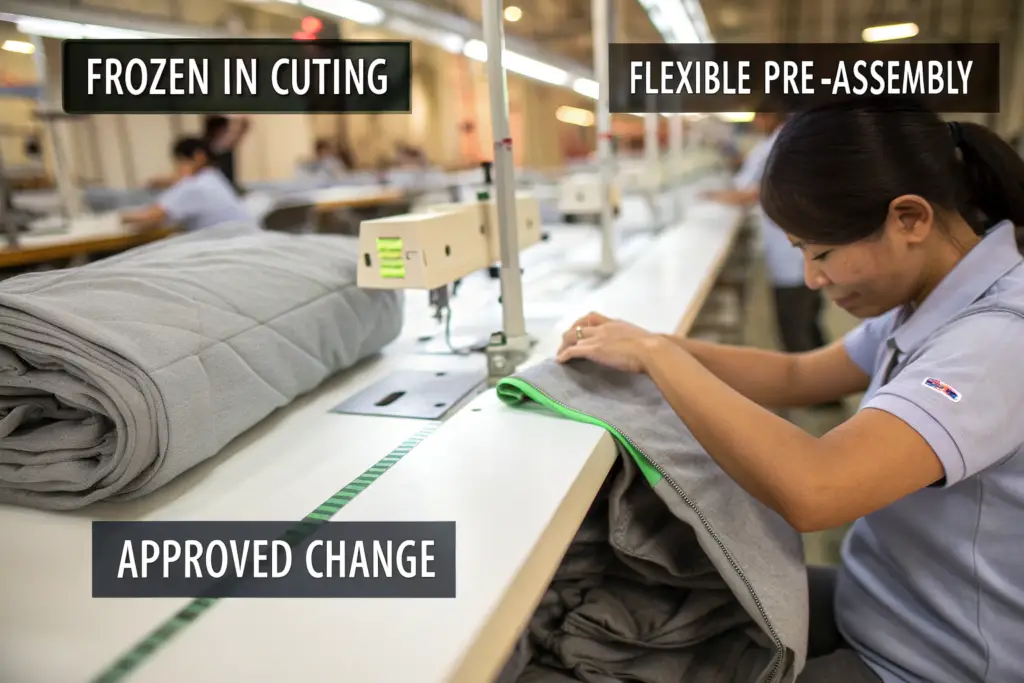
The worst thing you can do with a last-minute change is to apply it everywhere immediately. That creates chaos. The cutting team has already processed 500 units. If you tell them to stop and recut, you have destroyed your timeline and wasted material. The sewing team has already attached collars to 200 jackets. If you tell them to change the collar, you have created a massive rework pile. You need a system that knows exactly where every piece is in the factory and what has been done to it.
A "Frozen Zone" protocol is critical because it defines a clear point of no return for each garment component. Once a piece enters the frozen zone, like a cut panel that has been fused with interlining, it cannot be changed without a delay. But components still in the flexible zone, like unsewn pocket flaps or unattached buttons, can be modified rapidly. This protocol gives the client a realistic menu of change options with clear time and cost implications for each.
We map this visually for our production managers. Every order is tracked on a digital board. When a brand owner calls with a change request, we do not just say yes or no. We say: "The body panels are frozen because they are already cut and fused. But the sleeve cuffs are not yet attached. The buttons are not yet sewn. The embroidery file has not been loaded. Here is what we can change, and here is what it will cost." This turns an emotional crisis into a rational decision.
How Does Component-Level Tracking Enable Partial Changes?
You cannot manage what you cannot see. Traditional factories track the whole garment. "Order #4521 is in sewing." That tells you nothing useful. We track at the component level. The left front panel. The right front panel. The collar stand. The sleeve placket. Each piece has a status in our Production Control System.
When the London brand owner called about the pocket flap, our system showed that the body panels were cut but the pocket flaps were still flat pieces, not yet folded or attached. The flaps were in the flexible zone. We immediately issued a "Design Change Notice" (DCN) to the cutting room. The DCN contained the new, narrower flap pattern. The cutting team cut new flaps from the existing fabric reserve. The sewing line was instructed to stop attaching the old flaps. The old flaps were set aside and later recycled into pocketing material.
The changeover took 45 minutes. The 800 pocket flaps were recut and distributed to the sewing stations. The total material waste was a few meters of fabric for the test pieces. The ship date did not move. The brand owner flew to Shanghai a month later to personally thank the team. She told me that in her ten years of sourcing, she had never seen a factory handle a change that smoothly. This component-level visibility is powered by our internal tracking tools, similar in principle to lean manufacturing systems developed by companies like Toyota, adapted specifically for small-batch apparel.
What Is the Role of a "Buffer Yardage" Reserve in Absorbing Changes?
Last-minute changes almost always require extra fabric. If you design a new collar, you need material to cut it from. If a factory has ordered exactly the meterage required for the original pattern, any change will cause a fabric shortage. Then you are waiting for a new dye lot to be produced, and your shipment is delayed by three weeks.
We solve this with a "buffer yardage" reserve. For every fabric we source, we purchase an additional 5% to 8% beyond the calculated marker requirement. This is not wastage. It is insurance. It is budgeted into the initial costing, so the client pays for it transparently. The buffer covers cutting defects, end-of-roll losses, and, crucially, authorized design changes.
For a recent order of men's linen shirts, the client changed the collar shape after the body pieces were cut. The new collar pattern was slightly larger and required more fabric per unit. Without the buffer yardage, we would have run out of fabric. But we had the reserve. We pulled from it, cut the new collars, and proceeded without interruption. The client never even knew there was a material shortage risk. We absorbed the problem silently. This is the level of operational redundancy that keeps ship dates sacred. It is not an accident. It is a deliberate procurement policy that prioritizes delivery reliability over absolute minimum material cost.
How Does a Dedicated Rapid Sampling Cell Speed Up Approvals?
Standard sampling takes time. The sample room has a queue. Your change request goes to the back of the line, behind other brands' full collections. If you have to wait two weeks for a revised sample to be cut, sewn, finished, and shipped to you for approval, the production line sits idle. The ship date sails past. You need a sampling function that operates at the speed of the crisis, not at the speed of the normal queue.
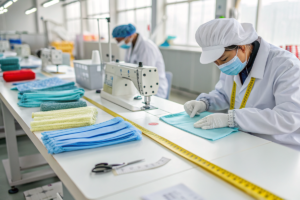
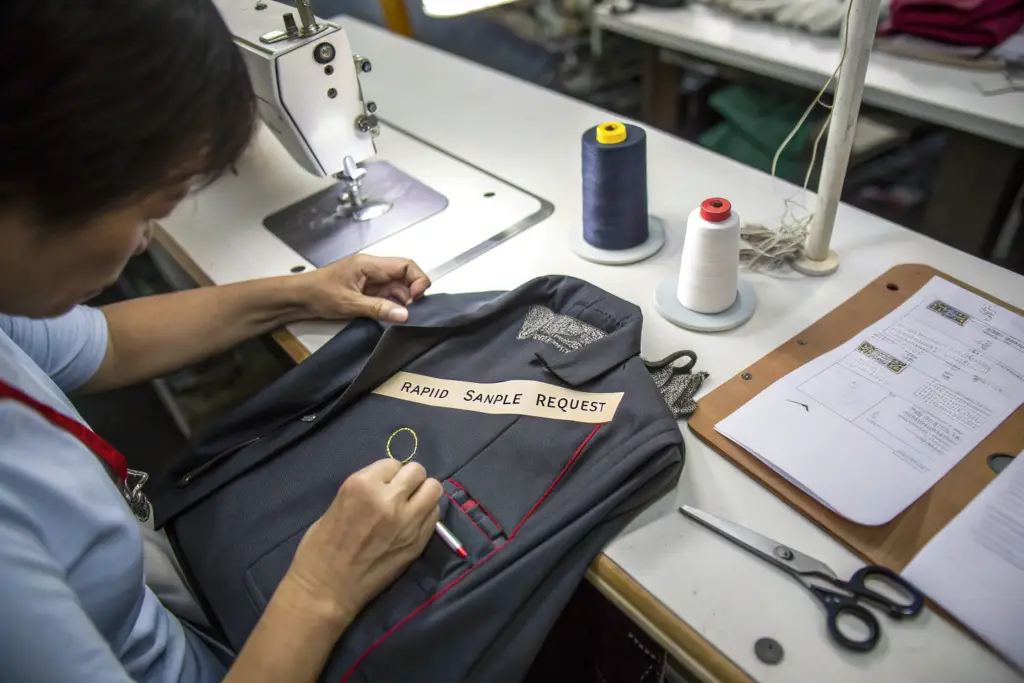
Shanghai Fumao operates a dedicated Rapid Sampling Cell that bypasses the standard sample room queue. This cell is staffed with a senior pattern maker and a specialized sewing technician who work exclusively on time-critical modifications. They can turn around a revised sample or a modified component within 24 hours, take high-resolution photos and videos for instant client approval, and release the change to the production line immediately.
This cell is our secret weapon. It is physically separated from the main sample room. It has its own small cutting table, sewing machines, and pressing equipment. The staff in this cell know they are the emergency room, not the general practice clinic. They thrive on pressure. They expect the unexpected. When a DCN hits their inbox, they drop everything and execute.
How Does a 24-Hour Photo Approval Process Work Across Time Zones?
The biggest killer of speed is not sewing. It is waiting. Waiting for the client to wake up. Waiting for them to check email. Waiting for them to make a decision. We compress this waiting time by running an asynchronous photo approval process designed for the time gap between China and Europe or the US.
The Rapid Sampling Cell finishes the modified sample. It might be a new collar, a different cuff, or an adjusted pocket placement. Within minutes of the final stitch, our merchandiser takes a series of high-resolution photos under calibrated daylight lamps. The photos show the change from multiple angles. Close-up, medium shot, on a dress form, and flat lay with a ruler for scale. These photos are uploaded to a shared online folder. A short video showing the drape and hand feel is recorded on a smartphone and uploaded alongside.
The client receives a notification. They can review the visuals immediately, whether they are in their office or at home. They reply with approval or a minor tweak. The time from the sample being sewn to the client approving it is often under 12 hours. This cuts the traditional "ship the sample and wait three days for courier delivery" loop entirely. We have found that 90% of last-minute changes can be approved via photo and video. The remaining 10%, which require a physical touch evaluation, we handle with an express courier shipment, but we proceed with production at risk while the sample is in transit, based on a written waiver from the client.
Why Is an On-Site Pattern Maker Faster Than an Outsourced One?
Many factories outsource their pattern making. It saves them the cost of a full-time salary. But when a client calls at 9 PM with a change, an outsourced pattern maker is asleep or working on another factory's project. You cannot reach them. You cannot control their schedule. You are stuck until they are free.
At Shanghai Fumao, we employ senior pattern makers directly on our payroll. They work on our factory premises. When the London brand owner called about the blazer pocket flap, our head pattern maker was on site. He was paged immediately. He came to the cutting table, reviewed the original pattern, and drafted the new, narrower flap. He graded it across the full size run within two hours. This speed is only possible because the pattern maker is an employee, not a contractor. He is invested in the factory's reputation and the client's success.
An on-site pattern maker also understands our specific production line capabilities intimately. He knows the machine tolerances. He knows which seam finishes our operators execute best. This means his patterns are production-ready the first time. An outsourced pattern maker might create a design that looks good on paper but is impossible to sew efficiently on our floor. The revision loop eats up precious time. Having the pattern skill in-house is a fixed cost, but it pays for itself many times over in saved delays and avoided rework.
How Do Modular Production Lines Absorb Disruption Without Stopping?
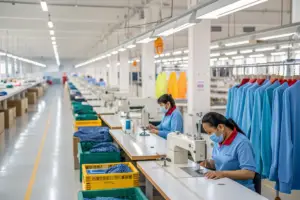
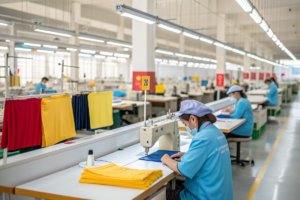
A traditional production line is a straight, rigid conveyor. Every operation is in a fixed sequence. If you stop one station, every station after it stops. There is no buffer. There is no flexibility. A last-minute change in a straight line is a catastrophic event. It requires stopping the entire line, retraining all operators, and then restarting. This can cost a full day of production. A full day of lost output is a day added to the delivery date.
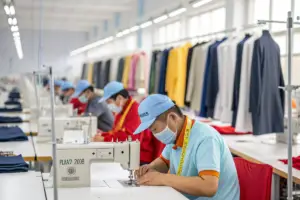
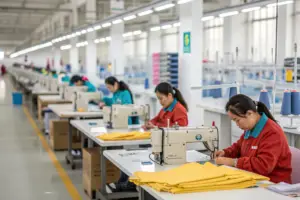
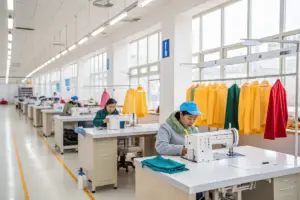
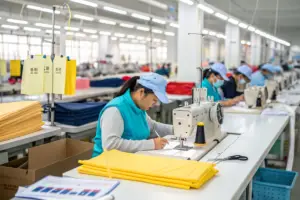
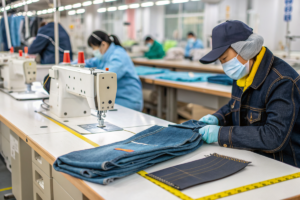
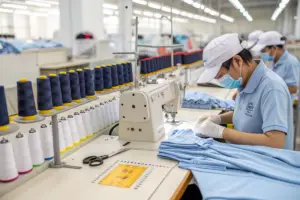
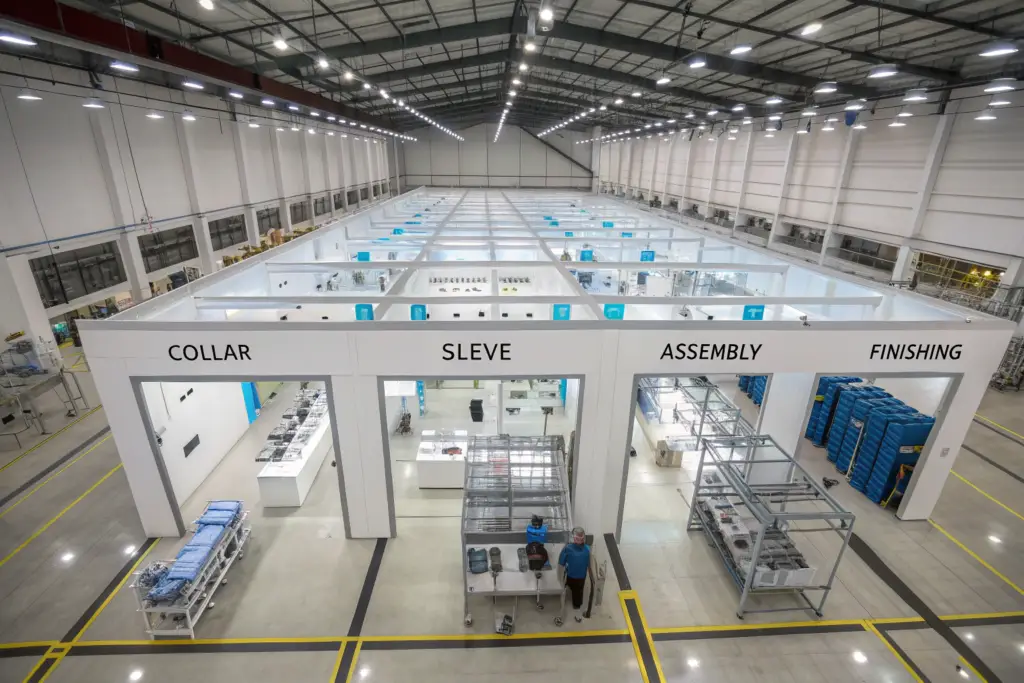
Modular production lines absorb disruption by organizing work into independent, self-contained teams that each build a complete garment. If a change affects only the collar module, the sleeve module and the assembly module continue working without interruption. The change is contained within one small team, retrained quickly, and the overall line output is maintained. This design turns a factory from a brittle domino chain into a resilient network.
We converted our five production lines to a modular system three years ago. It was a significant investment in retraining and reconfiguring the floor layout. But the first time we absorbed a major mid-production design change without missing a ship date, we knew it was worth it. The modular system is now central to our value proposition for brands that run fast fashion or multiple small collections.
Can "Mini-Line" Teams Be Retrained Mid-Production?
Yes, and this is the core advantage of a mini-line, or modular, setup. A mini-line consists of 5 to 8 cross-trained operators. They are not specialists who only know how to sew a sleeve hem. They can rotate between operations. They understand the entire garment construction. This versatility means that when a change instruction comes down, the supervisor can explain it once, and the whole team understands the context.
Retraining a modular team for a change like a new pocket style takes about 20 minutes. The supervisor demonstrates the new operation on a sample piece. Each operator practices on a scrap of the actual fabric. The first good piece becomes the new in-line standard. Because the team is small, the supervisor can watch every operator individually and correct any mistakes immediately. The quality of the first production pieces is stable within an hour.
In contrast, retraining a traditional straight line of 30 specialized operators takes much longer. The instruction must travel down the line. Some operators miss the nuance. The first few garments off the line are often inconsistent quality. This waste of time and material is what kills margins and deadlines. The modular system's ability to retrain quickly is not just about speed; it is about maintaining quality during disruption. This is a practical application of workforce agility principles often discussed in operational management literature, similar to concepts explored by the Harvard Business Review on building resilient teams.
What Happens to WIP Inventory During a Process Pivot?
Work-in-progress inventory is the half-finished garments sitting between operations. In a traditional line, when a change happens, all the WIP is suspect. You have 200 jackets with the old pocket flap, sitting in bins waiting for the next operation. What do you do? Do you rework them? Do you scrap them? The indecision creates a physical and mental blockage on the factory floor.
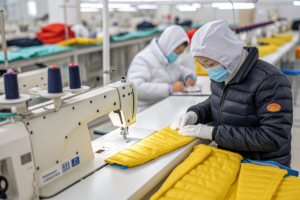
In our modular system, WIP is minimal. A mini-line operates with a "one-piece flow" or very small batch philosophy. There might be only 5 to 10 garments in process between the team members at any one time. When a change instruction arrives, we complete the current units with the old design. Then we switch over. There are no 200 units of ambiguous status. There are 5. Those 5 are finished as originally designed, and they are sold as samples or minor variants. The waste is negligible.
This lean WIP approach means the pivot is clean. The line does not drown in rework. The operators are not confused by mixing old and new components. The transition is sharp and definitive. The rest of the factory, the other modules working on the same order, are not affected. They continue their steady output. The overall production rhythm is maintained. This is the quiet engine of our on-time delivery promise.
What Communication Protocols Prevent Misunderstandings in Urgent Changes?
A miscommunication during a calm, routine order is annoying. A miscommunication during a last-minute change is a disaster. If you say "shorten the sleeve" and the factory hears "shorten the sleeve placket," you will get 2,000 shirts with a bizarrely narrow cuff opening. The pressure of the deadline makes everyone talk faster and assume more. This is where the most expensive mistakes are born.
Shanghai Fumao prevents misunderstandings during urgent changes by using a "Closed-Loop Confirmation" protocol. This protocol requires that every verbal or written change instruction is immediately translated into an annotated visual, sent back to the client for explicit sign-off, and then locked into a formal Design Change Notice before any production action is taken. No change is ever executed on a verbal order alone.
This might sound bureaucratic. It is the opposite. It is a speed protection mechanism. The 15 minutes it takes to generate a visual confirmation and get a written approval prevents 15 days of rework. I have learned this through painful experience. Early in my career, I accepted a verbal change from a client over the phone. I thought I understood. I was wrong. The entire order was made incorrectly. We had to remake it at our own cost. That lesson cost me thousands of dollars. I built the Closed-Loop Confirmation protocol the next week, and we have never had a repeat of that disaster.

Why Is Visual Annotation Superior to Written Descriptions?
Language is ambiguous. "Make the lapel slightly narrower." What is slightly? Two millimeters? Five millimeters? The word "slightly" means different things to different people. A written description of a design change is an invitation to misinterpretation. An annotated photograph leaves no room for doubt.
Our protocol requires that the client's instruction, whether received by email or voice call, is immediately translated into a visual mark-up. Our team takes the original sample photo or the tech pack sketch and digitally draws the change in red. A line showing the new seam. A dimension showing the new width. An arrow pointing to the component being changed. This annotated image is sent back to the client with a simple message: "Please confirm this red mark-up matches your request."
This process has caught countless potential errors. A client once asked us to "move the button up." Our visual annotation showed the button moved 2 centimeters up. She replied immediately, "No, I meant move it towards the center front, not up. Keep the vertical position." The words she used were "move up," but her mental image was horizontal movement. The annotation caught the disconnect in 10 minutes. Without it, we would have sewn 1,500 buttons in the wrong place. The visual checkpoint is the single most valuable step in our change management process.
How Does a Design Change Notice (DCN) Create Legal and Operational Clarity?
A Design Change Notice is a simple one-page document, but it carries enormous weight. It formalizes the change. It moves the decision from a chat thread into a controlled record. The DCN states the original specification, the new specification, the reason for the change, the components affected, and the cost implication, if any. It is signed by the client and by our production manager.
This document serves three purposes. First, it is an operational command. The DCN is the only document the cutting and sewing supervisors are authorized to act on for that order. If a change is not on a DCN, it does not exist on the factory floor. This eliminates the risk of an operator acting on a casual comment made during a factory video tour.
Second, it is a cost control tool. If the change requires additional fabric, trim, or labor, the DCN captures that cost. The client approves the cost before the work begins. There are no surprise charges on the final invoice. This transparency builds trust.
Third, it is a legal record. If a dispute arises later about whether a change was authorized, the DCN is the definitive proof. It protects both the factory and the client. It turns a stressful, high-pressure situation into a structured business transaction. We archive every DCN with the order file. This discipline, while simple, reflects a professional maturity that brand buyers consistently cite as a reason for their continued partnership with Shanghai Fumao.
Conclusion
Last-minute design changes are not a sign of a disorganized brand. They are a sign of a brand that cares deeply about getting the product right. The European market, in particular, is detail-oriented. A pocket flap that is off by a centimeter can affect the entire sell-through of a collection. The brands we partner with need to know that their factory will not punish them for pursuing perfection. They need to know that a late insight will not trigger a delayed shipment and a missed season.
We have built our entire operational model around this reality. The Frozen Zone protocol turns a factory-wide panic into a controlled, component-level decision. The Rapid Sampling Cell slashes approval timelines from weeks to hours, using photo confirmation to bridge the time zone gap. The modular production lines contain the disruption to a single team, keeping the rest of the order flowing steadily toward its ship date. And the Closed-Loop Confirmation protocol ensures that in the heat of an urgent change, every instruction is visually verified before a single stitch is altered.
At Shanghai Fumao, we do not just tolerate last-minute changes. We are designed for them. Our agility is not a happy accident. It is the product of deliberate investment in people, processes, and technology. We believe that the best factory partner is one that removes stress from the brand owner's life, not one that adds to it.
If you are tired of factories that say "no" to every mid-stream improvement or that say "yes" and then miss the ship date, I invite you to experience a different approach. Contact our Business Director, Elaine, at elaine@fumaoclothing.com. She can walk you through a recent case study of a design change we absorbed without delay and explain exactly how our protocol would apply to your specific product line. Let us show you that a factory can be both disciplined and flexible, both efficient and responsive. Your ship date is our promise. We will keep it.