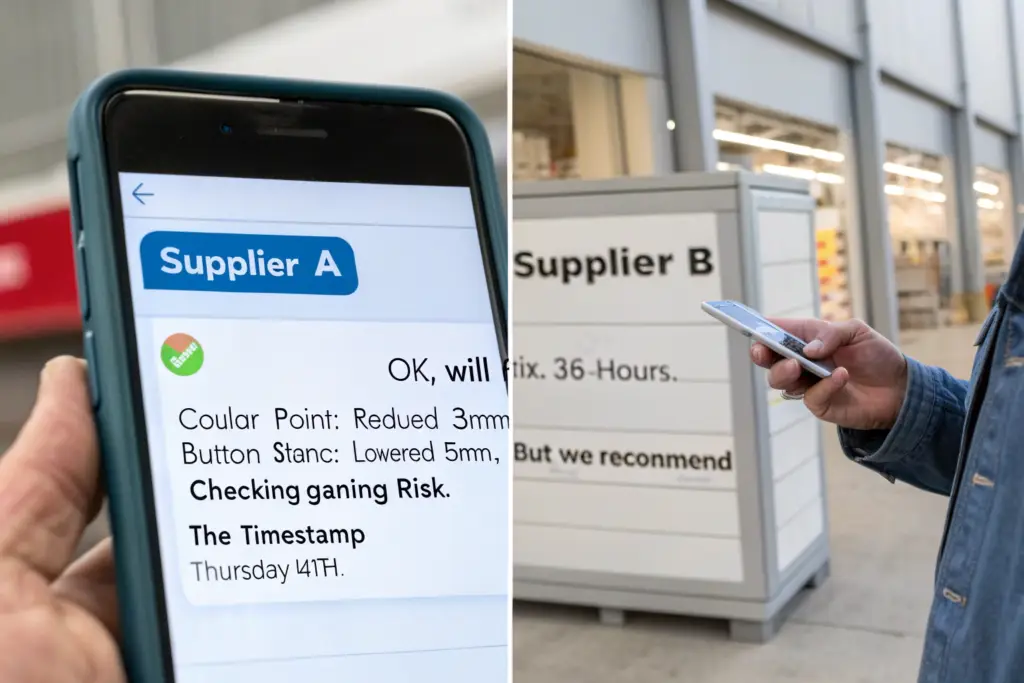
A brand owner from Copenhagen was evaluating two potential suppliers for a complex women's blazer. Both factories had passed the initial vetting. Both had competitive pricing. Both had submitted first samples of similar technical quality. The deciding factor, she told me, was how each factory handled her first revision request. Factory A replied within six hours with a detailed, itemized confirmation of each revision point, a clarification question on one ambiguous point, and a revised ship date for the second sample. Factory B replied after two days with a two-word email: "No problem." She chose Factory A. She told me, "Factory B's 'no problem' told me they didn't actually read my comments. They just wanted to close the ticket. Factory A's response told me they were thinking about my design, not just sewing it. I knew who I could trust with a $60,000 order."
You can predict a supplier's reliability based on their response to sample revisions by evaluating three specific behaviors. First, the speed and substance of their acknowledgment. A reliable supplier confirms receipt of the revision request within one business day and itemizes each revision point, demonstrating they have read and understood the request. Second, their willingness to question unclear instructions. A reliable supplier proactively flags ambiguities, contradictions, or potential quality risks in the revision request, rather than silently executing an instruction they know may produce a poor result. Third, their adherence to their own revised timeline. A reliable supplier delivers the revised sample on or before the date they committed to. Pattern breaks in any of these three behaviors, acknowledgment, questioning, adherence, during the sampling phase are highly predictive of pattern breaks in communication, problem-solving, and delivery during bulk production.
The sampling phase is a microcosm of the entire production relationship. The factory's behavior when the stakes are relatively low, a sample worth a few hundred dollars, is a reliable indicator of their behavior when the stakes are high, a bulk order worth tens or hundreds of thousands. The factory that is slow, vague, and uncommunicative during sampling will be slow, vague, and uncommunicative during bulk production. The factory that is fast, precise, and proactive during sampling will bring those same qualities to the bulk order. The sample revision process is the best free reliability test a brand owner will ever get. At Shanghai Fumao, we understand that our revision response is being judged, and we train our merchandisers to treat every revision request as an opportunity to demonstrate our reliability. Let me explain the specific signals to watch for.
What Does a Supplier's Revision Acknowledgment Speed Reveal About Their Internal Systems?
The speed of a supplier's acknowledgment of a revision request is not just a measure of the individual salesperson's responsiveness. It is a measure of the factory's internal communication and task management systems. When a revision email arrives, what happens to it inside the factory? Does it sit in the salesperson's inbox until they have time to deal with it? Or is it immediately logged into a system that assigns responsibility, tracks deadlines, and alerts the relevant departments?
A supplier's revision acknowledgment speed reveals the presence or absence of a structured sample management system. A factory that acknowledges within hours, and provides a specific, itemized confirmation, has a system. The revision request was received, logged, assigned a tracking number, reviewed by a technical person, and the acknowledgment was generated from that review. A factory that acknowledges after two days with a vague "OK" does not have a system. The salesperson read the email, made a mental note, and replied when they remembered. The factory with the system will manage your bulk order with the same structured discipline. The factory without the system will manage your bulk order through individual memory and ad-hoc reactions.
The revision acknowledgment speed is also a measure of the factory's respect for the brand owner's time and calendar. A fast acknowledgment allows the brand owner to confirm that the revision has been received and understood, and to update their own development timeline. A slow acknowledgment leaves the brand owner in uncertainty, wondering if the revision was even seen.
Why Is an "Itemized Confirmation" More Trustworthy Than a Simple "Received"?
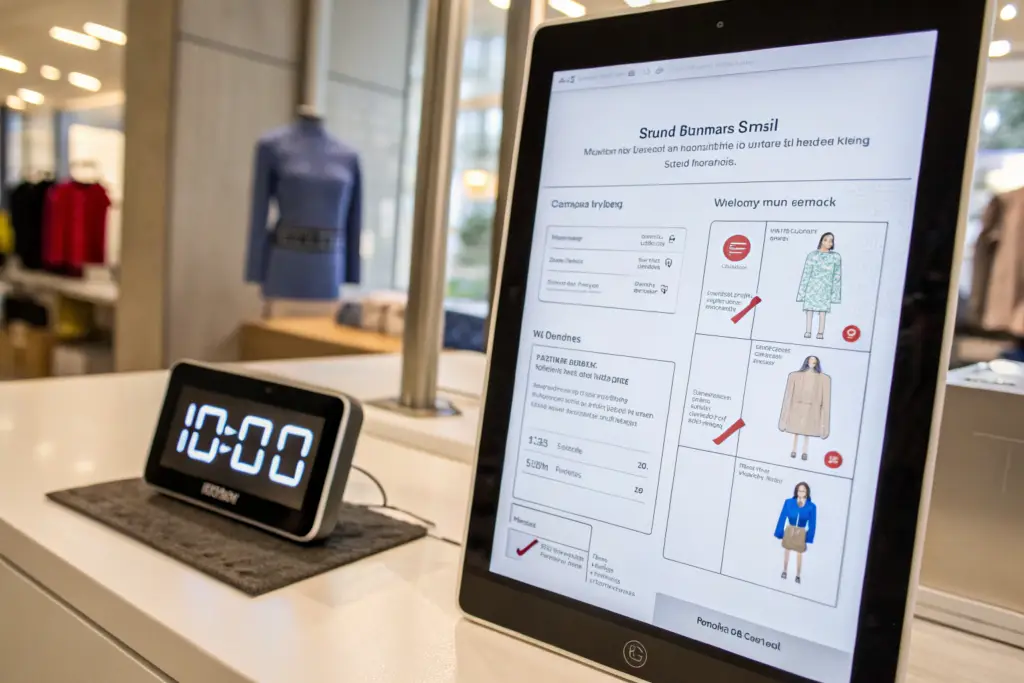
A simple "Received, thanks" acknowledgment tells the brand owner nothing about whether the factory has actually read and understood the revision request. The salesperson may have seen the email subject line and clicked reply without opening the attachment or reading the detailed comments. The brand owner has no evidence that the revision will be executed correctly.
An itemized confirmation lists each revision point and confirms the action to be taken. "1. Collar point: Reduced from 9cm to 8.5cm. 2. Front button stance: Lowered by 1cm. 3. Sleeve length: Increased by 1.5cm on all sizes per revised grade chart attached." The itemized confirmation demonstrates that a technically competent person, not just the salesperson, has reviewed the revision request against the existing pattern and tech pack, understood each point, and confirmed the intended action.
The itemized confirmation also serves as a written record of the agreed revision, preventing disputes later. The brand owner can review the itemized list and catch any misinterpretations before the sample is remade. The itemized list is a quality control document for the revision process itself.
We require our merchandisers to send an itemized confirmation within one working day of receiving a revision request. The confirmation is reviewed by the pattern maker before it is sent, ensuring technical accuracy. The brand owner receives a clear, verifiable record of what will be done to the sample.
How Can You Distinguish Between a "Salesperson's" Reply and a "Technical Team's" Reply?
A salesperson's reply is characterized by vague, non-technical language. "We will fix the collar." "We will make it better." "The sample will be perfect next time." These replies do not reference specific measurements, specific construction details, or specific pattern changes. They are reassurances, not confirmations.
A technical team's reply uses specific, technical language. "The collar point will be reduced by 5mm. The interlining at the collar band will be changed from a soft to a medium-firm fusible to improve the roll. The gorge line will be adjusted by 2mm to correct the lapel notch alignment." This reply references measurements, materials, and specific construction elements. It uses the vocabulary of garment engineering, not sales.
The difference matters because the person sending the reply is likely the person who will communicate your future revisions to the production team. A salesperson is a communication filter. The technical information must pass through them to the pattern maker and back. Each pass introduces the risk of distortion. A technical person, often a merchandiser with pattern making training or a dedicated sample coordinator, communicates directly with the technical team. The information path is shorter and cleaner.
The brand owner can probe this distinction by asking a follow-up technical question about a specific revision point. "When you reduce the collar point, will you also adjust the collar band length to maintain the correct neck circumference?" A salesperson will not know the answer and will need to check. A technical merchandiser will answer immediately. The response to the probe reveals who is on the other end of the email.
A brand owner I know always includes one slightly technical follow-up question in his first revision request, even if he already knows the answer. He told me it is his "technical litmus test." A supplier who answers the question directly and correctly has passed the test. A supplier who deflects or gives a vague answer has revealed that the communication channel is not technically direct.
How Should a Reliable Supplier Handle Ambiguity in Your Revision Instructions?
Revision instructions written by a brand owner, particularly a brand owner who is not a trained technical designer, often contain ambiguities. "Make the shoulder softer." "The collar needs more roll." "The fit should be more relaxed." These are aesthetic directions, not technical instructions. They describe the desired feeling or appearance, but they do not specify the pattern or construction changes required to achieve it.
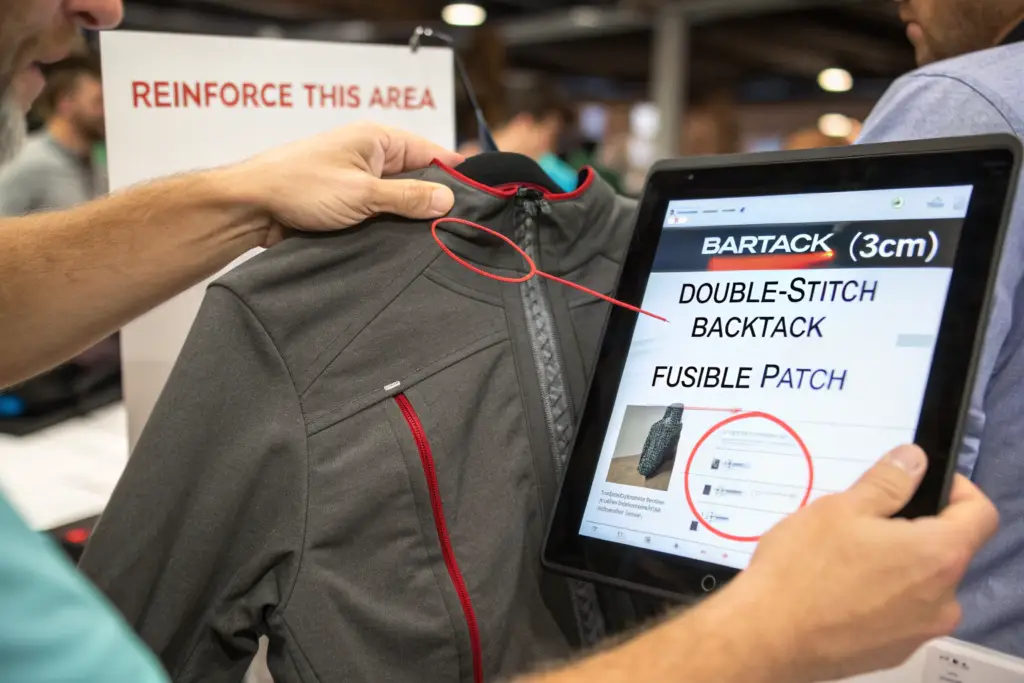
A reliable supplier handles ambiguity in revision instructions by proactively seeking clarification, not by silently guessing. The supplier's merchandiser or pattern maker reviews the revision request, identifies the ambiguous points, and responds with specific, technically-framed questions that narrow the ambiguity. "When you say 'make the shoulder softer,' do you want us to reduce the shoulder pad thickness, extend the shoulder point, or use a softer canvas? We recommend reducing the pad from 12mm to 8mm and softening the canvas. Please confirm." This response demonstrates that the supplier has the technical expertise to translate an aesthetic direction into specific pattern actions, and the integrity to seek confirmation before acting.
A supplier who silently guesses is dangerous. They will pick one interpretation of the ambiguous instruction, perhaps the easiest or cheapest one, and execute it. The revised sample arrives, and the brand owner says, "No, that's not what I meant." The sample was wasted. The time was wasted. The relationship is strained. The supplier who seeks clarification invests a small amount of time upfront in a question, and saves the much larger time cost of a mis-executed sample.
What Types of Proactive Questions Indicate a Deep Understanding of Your Brand?
Beyond simply clarifying ambiguities, a supplier with a deep understanding of the brand will ask proactive questions that anticipate downstream issues. These questions demonstrate that the supplier is not just thinking about the current sample, but about the bulk production, the cost, and the consumer's experience.
A proactive question about cost implications. "We can achieve the softer shoulder you want by switching to a higher-grade wool interlining. This will add approximately $0.80 to the unit cost. Do you want us to proceed, or should we explore a lower-cost alternative?" This question shows the supplier understands the brand's margin constraints.
A proactive question about production feasibility. "The revised cuff detail you requested is beautiful, but it requires a manual hand-stitching step that will add three days to the production lead time. Is this acceptable for your delivery timeline?" This question shows the supplier is connecting the sample decision to the bulk production schedule.
A proactive question about the consumer. "The softer shoulder you are requesting will give a more casual, unstructured look, which aligns with your brand's shift toward relaxed tailoring we discussed last season. We think it is the right direction. Do you want us to apply the same shoulder construction to the matching waistcoat?" This question shows the supplier remembers the brand's strategic direction and is thinking holistically about the collection.
A brand owner client received a proactive question from our merchandiser about a sleeve lining specification. The merchandiser noted that the specified lining was not breathable and might cause discomfort in the summer months when the blazer would be worn. She recommended a higher-cost, breathable lining and explained the cost impact. The brand owner had not considered the breathability issue. The proactive question improved the garment and demonstrated our commitment to the brand's end consumer.
How Should a Supplier Flag a Potential "Cost vs. Quality" Conflict in Your Request?
A revision request sometimes contains an inherent conflict. The brand owner asks for a change that will increase the quality or the complexity of the garment, but also expects the FOB price to remain the same, or even decrease. A reliable supplier flags this conflict transparently, rather than silently absorbing the cost and then cutting corners elsewhere, or simply ignoring the quality improvement.
The supplier's response should be a specific, itemized analysis. "The revised pocket construction you requested, with the bar-tacked corners and the self-fabric binding, adds three additional sewing operations and approximately 15 minutes of labor per garment. The labor cost increase is approximately $1.20 per unit. We can absorb a portion of this, but not all. Can we discuss either a small FOB adjustment, or a simplification of the pocket construction that achieves a similar visual effect at a lower labor cost?"
This response is professional, transparent, and collaborative. It does not say "no." It says "yes, and here are the implications, and here are some options for managing them." The supplier is treating the brand owner as a partner in solving the cost-quality equation.
A supplier who does not flag this conflict is either not paying attention to their own costs, in which case they will eventually become financially unstable and unreliable, or they are absorbing the cost and will compensate by cutting corners on something the brand owner will not notice. Neither is a reliable long-term partner.
A brand owner requested a complex pocket detail on a revision, assuming it was a minor change. Our costing team flagged that the detail added $0.95 per unit. We presented the cost impact and a simplified alternative that achieved 80% of the visual effect at 20% of the cost. The brand owner chose the simplified alternative. He later told me, "No other supplier has ever been that transparent with me about cost. I trust you more because of it."
What Is the Link Between Sample Revision Punctuality and Bulk Delivery Punctuality?
Punctuality is a habit, not a circumstance. A factory that delivers revised samples on time, consistently, across multiple revision cycles, is a factory that has an internal scheduling system that works. They can estimate the time required for a revision, allocate the sample room capacity, and manage the workflow to meet the committed date. This capability is not specific to samples. It is a general operational competence.
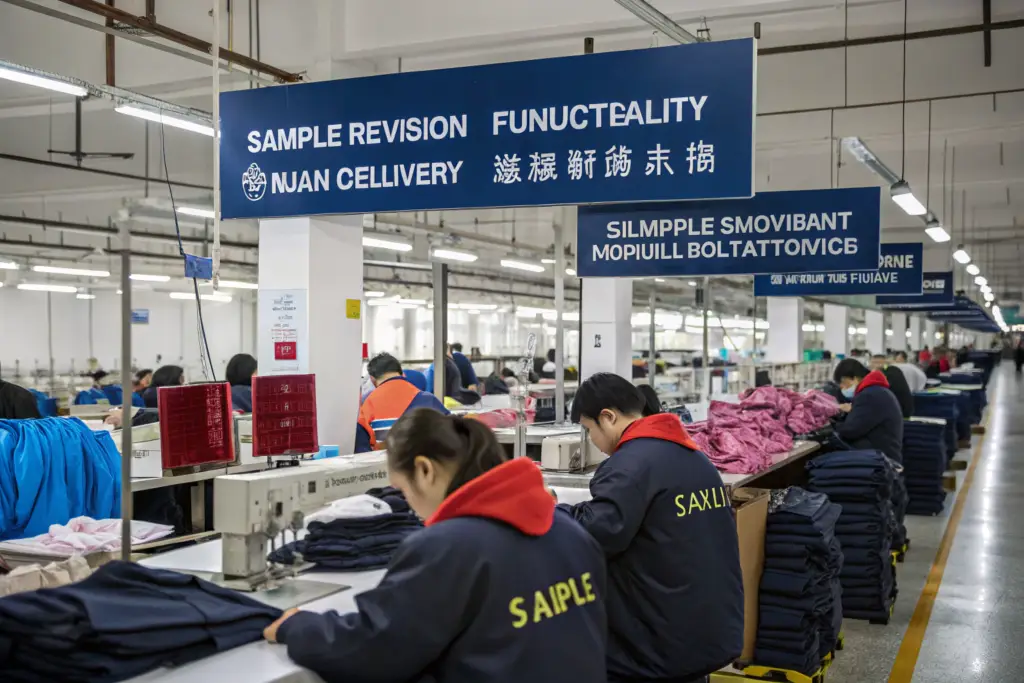
The link between sample revision punctuality and bulk delivery punctuality is strong and direct. The same internal systems that manage sample room scheduling, capacity allocation, workflow tracking, and deadline communication, are the systems that manage bulk production scheduling. A factory that consistently delivers revised samples on the date they commit to has demonstrated scheduling competence. A factory that consistently delivers revised samples late, with excuses, has demonstrated scheduling incompetence. The sample room is a small-scale model of the bulk production floor. The punctuality pattern established in the model will repeat in the full-scale system.
The brand owner can track this data simply. Create a spreadsheet. Log the date each sample revision was requested, the date the supplier committed to deliver the revised sample, and the date the sample actually shipped. After three or four revision cycles, a clear pattern will emerge. A supplier with a tight distribution of on-time or early deliveries is a reliable scheduling partner. A supplier with a wide distribution of late deliveries, with a new excuse each time, is a scheduling risk.
How Many Late Sample Deliveries Should You Tolerate Before Questioning the Relationship?
A single late sample delivery is not a pattern. It is a data point. Delays happen. A courier loses a package. A key sample sewer is sick. A fabric swatch is delayed from the mill. A single late delivery, accompanied by a credible explanation and a proactive communication before the deadline was missed, is forgivable.
Two consecutive late deliveries, or two late deliveries within a short span of a few revision cycles, is a warning sign. It suggests that the first delay was not an isolated incident, but a symptom of a systemic scheduling weakness. The brand owner should have a direct conversation with the supplier about the cause of the delays and the corrective actions being taken.
Three late deliveries is a pattern. The supplier has demonstrated that they cannot consistently manage their sample room scheduling. The probability that they can consistently manage bulk production scheduling, which is far more complex, is low. The brand owner should seriously consider whether to proceed to bulk production with this supplier, or to invest the remaining sampling time with a more punctual alternative.
The tolerance threshold should be stricter for time-sensitive projects. A brand developing a collection with a hard seasonal delivery deadline has less tolerance for sampling delays than a brand with a flexible launch date. The cost of a delayed bulk delivery is the context that determines the tolerance for sampling delays.
A brand owner I mentored kept a simple sample punctuality log. Her first supplier was late on two of the first three samples. She had a conversation. The supplier promised improvement. The fourth sample was late. She terminated the sampling relationship and moved to a new supplier, despite having invested time and sampling fees. The new supplier delivered all subsequent samples on time. The bulk order shipped on time. The decision to switch, based on the punctuality data, saved her season.
What Does a Supplier's "Buffer Communication" Reveal About Their Production Planning?
Buffer communication is the way a supplier communicates about timelines that include safety buffers. A sophisticated supplier builds buffer time into their committed dates and communicates transparently about it. A less sophisticated supplier either builds no buffer, leading to frequent delays, or builds excessive buffer and is unnecessarily slow.
A supplier who says, "We aim to ship the revised sample by Thursday the 14th, but our absolute latest ship date is Monday the 18th to keep your project on schedule," is demonstrating buffer communication. They have given a target date and a drop-dead date. They have shown their planning logic. The brand owner can plan around the target date, with the security of the drop-dead date.
A supplier who says, "We will ship it next week," and then ships it ten days later, has given an optimistic estimate, not a planned date. Their internal planning is based on hope, not on a capacity schedule. The same optimistic estimating will apply to bulk delivery dates.
A supplier who consistently delivers significantly early, more than a few days before the committed date, may be building excessive buffer into their timelines. This is less harmful than lateness, but it is a sign that the supplier's scheduling estimates are not precise. The brand owner cannot accurately plan their own calendar because the supplier's dates are artificially padded.
Our merchandisers are trained to provide a target date and a latest date for every sample shipment. The dates are based on the current sample room loading, not on a generic estimate. If the sample room is busy, the dates reflect that. If there is capacity, the dates are sooner. The transparency of the buffer communication builds trust even when the date is later than the brand owner hoped.
How Should You Stress-Test a New Supplier's Revision Process with a "Deliberate Ambiguity" Test?
The best way to evaluate a supplier's reliability is not to wait for problems to occur naturally. It is to create a controlled test that reveals the supplier's behaviors under conditions that simulate the challenges of a real production relationship. The sampling phase is the ideal time for this test because the stakes are low and the learning is high.
The deliberate ambiguity test involves inserting a carefully designed ambiguous instruction, a minor contradiction, or a slightly unrealistic request into an otherwise clear revision brief. The brand owner observes how the supplier responds. Do they ask for clarification on the ambiguous point? Do they flag the contradiction and seek resolution? Do they push back on the unrealistic request with a reasoned alternative? Or do they silently accept everything, ask no questions, and deliver a sample that reflects their best guess? The supplier who asks questions demonstrates engagement, technical understanding, and the confidence to challenge the client when necessary. The supplier who silently accepts everything is either not thinking critically, or is afraid to communicate honestly. Neither is the foundation of a reliable partnership.
The deliberate ambiguity test must be ethical. The ambiguity must be genuine enough that a reasonable person would need clarification. It should not be a trick designed to make the supplier fail. The purpose is to test the communication dynamic, not to trap the supplier.

What Specific Vague Phrase Tests Whether a Supplier Will Guess or Ask?
Certain phrases are reliably ambiguous in garment specifications. Inserting one of these phrases into an otherwise clear revision request creates a specific, observable test point.
"Make it more premium." This phrase has no technical meaning. It could refer to the fabric, the trims, the stitching, the pressing, or the packaging. A supplier who does not ask for clarification is guessing what the brand owner means by "premium." A supplier who asks, "Could you specify what aspects of the garment you would like to elevate? Are you thinking of a higher-grade button, a denser stitch, or a heavier interlining?" is demonstrating the right behavior.
"Match the reference." This phrase is ambiguous when the reference is a photograph or a competitor's garment without a specification sheet. The supplier does not know which specific attributes of the reference the brand owner wants to match. The color? The fit? The fabric hand? The overall vibe? A supplier who asks, "Which specific elements of the reference would you like us to match? The collar shape? The sleeve pitch? The fabric drape?" is thinking precisely.
"Soften it up a bit." This phrase, applied to a structured garment, is highly ambiguous. It could mean reducing the interlining stiffness, changing to a softer fabric, altering the silhouette to be less tailored, or simply washing the garment to relax the fibers. A supplier who asks clarifying questions about which specific element to soften is technically competent.
A brand owner I work with uses the "make it more premium" test with every new supplier. He told me, "One supplier came back with a gold button and a higher price. They didn't ask. They just guessed. The gold button was completely wrong for my brand. Another supplier asked me three specific questions about what 'premium' meant to my customer. I hired the one who asked questions."
How Can You Test a Supplier's Honesty with a Minor Contradiction in Your Specs?
A minor contradiction in a tech pack or revision request tests whether the supplier will silently choose one interpretation, perhaps the one that is easier for them, or will flag the contradiction and seek resolution.
A deliberate contradiction might be a measurement chart that specifies a sleeve length of 62cm, while a text annotation on the sketch says "lengthen sleeve by 2cm from previous sample." The previous sample had a 61cm sleeve. The text implies 63cm. The chart says 62cm. The supplier must notice the discrepancy and ask which number is correct.
Another contradiction might be a fabric specification that calls for a "soft, brushed finish" while a care label instruction says "Do Not Tumble Dry." A soft, brushed finish on a cotton garment often requires tumble drying to maintain the loft. The supplier with technical knowledge will flag the potential conflict between the desired finish and the care instruction.
An honest supplier will flag the contradiction, explain the conflict, and ask for guidance. A less honest, or less attentive, supplier will choose one interpretation silently. The brand owner will not know which interpretation was chosen until the sample arrives, and it may be the wrong one.
A brand owner inserted a deliberate contradiction into a revision request for a new supplier. The spec sheet said "lining: 100% viscose," but a note on the sketch said "please use breathable cotton lining for summer comfort." The supplier emailed back within hours: "We noticed the lining specification (viscose) and the note (cotton) do not match. Viscose is generally more breathable than standard cotton lining. Do you want us to proceed with viscose, which we recommend for this application, or switch to cotton?" The supplier had not only caught the contradiction but provided a technical recommendation. The brand owner told me this single response convinced him the supplier was a keeper.
Conclusion
The sampling phase is a predictive model of the bulk production phase. The factory's behavior when the financial stakes are low, a few hundred dollars in sample costs, is a remarkably accurate forecast of their behavior when the financial stakes are high, a bulk order worth tens or hundreds of thousands. The brand owner who pays close attention to the supplier's revision response is gathering free, high-quality predictive data.
We have identified the four key behavioral signals. The speed and substance of the acknowledgment reveals the presence or absence of a structured sample management system. The proactive clarification of ambiguities reveals the supplier's technical depth and their commitment to getting the design right, not just getting the sample done. The punctuality of sample deliveries reveals the supplier's scheduling competence, which will directly translate to bulk delivery punctuality. And the response to the deliberate stress tests, the ambiguous phrase, the minor contradiction, reveals the supplier's honesty, communication style, and problem-solving approach.
The brand owner who evaluates suppliers on price and first sample quality alone is making a decision based on incomplete data. The brand owner who evaluates suppliers on their revision behavior is making a decision based on a holistic view of the supplier's operational competence and partnership character. The revision behavior is the truer indicator of long-term reliability.
At Shanghai Fumao, we welcome the scrutiny of our revision process. Our merchandisers are trained to send itemized confirmations within one business day. Our pattern makers are trained to flag ambiguities and propose solutions. Our sample room is scheduled with transparent, realistic timelines. We see every revision request as an opportunity to demonstrate the reliability that will define the bulk production partnership.
If you are evaluating potential suppliers and want to incorporate revision behavior into your assessment, or if you have been disappointed by a supplier's bulk performance despite good initial samples, I invite you to contact our Business Director, Elaine. She can walk you through a sample of our revision communication process, share examples of how we handle ambiguous instructions, and discuss how our sampling phase protocols predict our bulk production reliability. Reach Elaine at elaine@fumaoclothing.com. Let's start with a sample revision and let our response speak for itself.