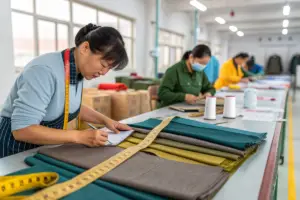
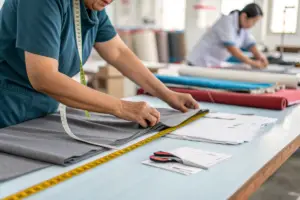
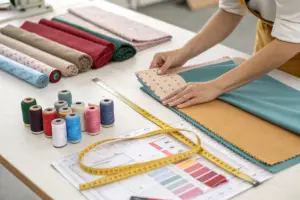
A children's wear brand owner from Denver sat in my office last year, holding a pair of toddler leggings that looked like they had survived a war. The knees were blown out. The fabric was pilled into a fuzzy mess. The seams were pulling apart. The leggings had been worn for approximately six weeks. The mother who returned them had included a note: "My daughter loved these. But they didn't survive my daughter." The brand owner was frustrated. He was spending his margin on returns and replacements. He asked me, "What fabric can actually survive a four-year-old?"
The best fabric compositions for high-turnover children's playwear combine a high percentage of synthetic fiber for abrasion resistance and shape recovery with a natural fiber for breathability and comfort against sensitive skin. The optimal blends are 60-80% cotton with 20-40% polyester for everyday play, cotton-spandex with reinforced knee panels for leggings and bottoms, and nylon-elastane blends for active, outdoor play that demands the highest tear strength and quick-drying performance. The durability is not just in the fiber content. It is in the fiber quality, the yarn twist, the knit or weave density, and the reinforcement construction at the high-stress points.
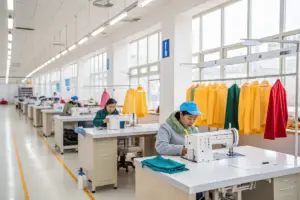
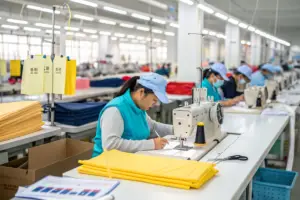
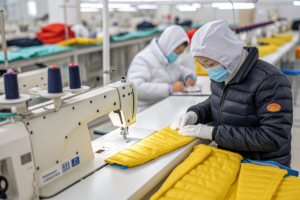
Children's playwear is the most demanding category in apparel. The garment must withstand abrasion from crawling, sliding, and tumbling. It must survive repeated washing at high temperatures, often with bleach or stain removers. It must resist tearing when snagged on playground equipment. And it must do all of this while being soft enough for sensitive young skin, breathable enough to prevent overheating, and affordable enough for parents who know the garment will be outgrown in months. Achieving all of these requirements simultaneously is a materials engineering challenge. At Shanghai Fumao, our children's playwear fabrics are developed specifically to meet this challenge. Let me walk you through the specific fabric compositions that work.
What Cotton-Polyester Blends Are Optimized for Abrasion Resistance?
Pure cotton is the traditional fabric for children's clothing. It is soft, natural, and hypoallergenic. But pure cotton has a fundamental weakness for playwear: poor abrasion resistance. Cotton fibers are short, especially in standard, non-premium cotton. When the fabric is rubbed repeatedly against a rough surface, a playground floor, a carpet, a sidewalk, the short fibers work their way out of the yarn and form pills. The fabric thins. Eventually, holes develop, particularly at the knees and elbows.
Cotton-polyester blends optimized for abrasion resistance use a high proportion of long-staple polyester fibers, typically 30% to 40%, intimately blended with the cotton at the yarn spinning stage. The polyester fibers are stronger and more abrasion-resistant than cotton. They act as a reinforcing skeleton within the yarn, holding the cotton fibers in place and preventing them from migrating to the surface and forming pills. The optimal blend for everyday children's playwear is 60-65% cotton for comfort and breathability, and 35-40% polyester for strength and surface durability. The polyester should be a high-tenacity, pill-resistant type, not a standard, low-cost polyester prone to pilling itself.
The blend ratio is not the only factor. The yarn spinning method is equally important. A tightly twisted yarn, produced with a high twist per inch, locks the fibers together more securely than a loosely twisted yarn. A compact spinning process, which eliminates short, loose fibers from the yarn surface, produces a cleaner, more pill-resistant fabric than a conventional ring-spun process.
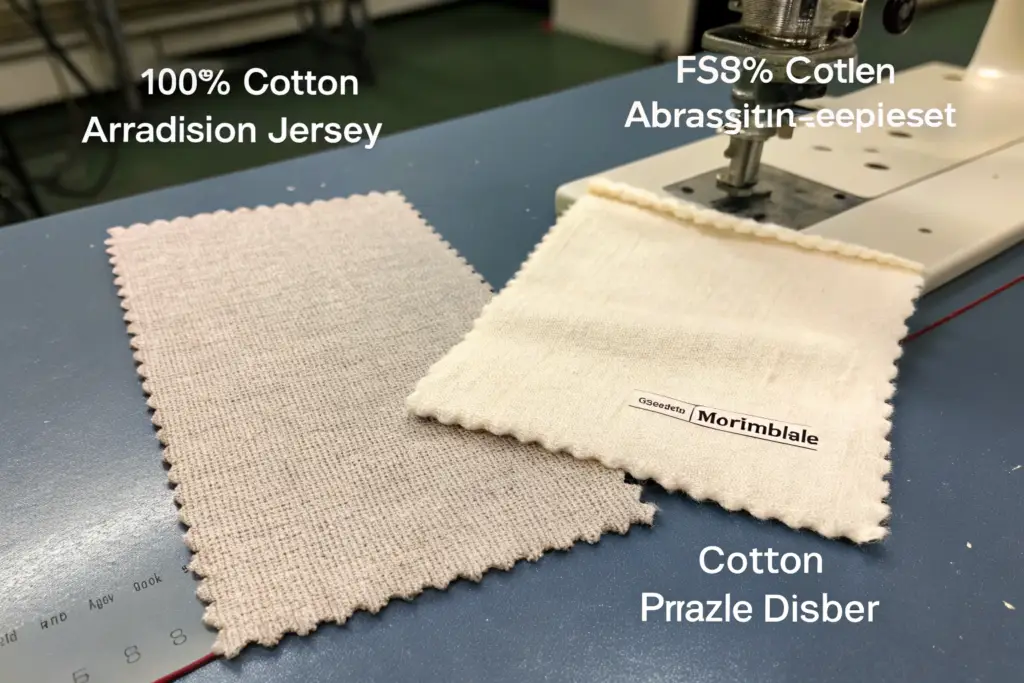
Why Does a 65% Cotton, 35% Polyester French Terry Outlast 100% Cotton Fleece?
French terry and fleece are both knit fabrics used for sweatshirts, hoodies, and joggers. Fleece is brushed on the inside to create a soft, fuzzy surface. French terry is unbrushed, with a smooth face and looped back. The difference in durability between a 100% cotton fleece and a 65/35 cotton-polyester French terry is dramatic.
The brushing process that creates fleece weakens the fabric structure. The mechanical brushing pulls cotton fibers to the surface, creating the soft pile. But it also breaks some fibers and loosens the yarn structure. The fabric becomes more susceptible to pilling and abrasion because the fibers are already partially pulled out of the yarn.
French terry skips the brushing step. The looped back provides absorbency and some cushioning, but the yarn structure remains intact. The fabric surface is cleaner and more resistant to pilling.
The addition of 35% polyester to the French terry further enhances durability. The polyester loops on the back are strong and resilient. They do not break or pill under abrasion. The cotton on the face provides the soft hand feel. The polyester in the body and the back provides the structural integrity.
A children's brand client switched their playwear hoodies from 100% cotton fleece to a 65/35 cotton-polyester French terry. The return rate for "worn out" or "pilled" fell by over 70% in the first season. The French terry hoodies cost $0.40 more per unit in fabric. The savings from reduced returns and replacements was over $3.00 per unit. The durability upgrade was profoundly profitable.
What Is "Compact Spinning" and How Does It Reduce Pilling in Kids' T-Shirts?
Compact spinning is a yarn production technology that dramatically reduces the hairiness of the yarn. In a conventional ring-spun yarn, many short cotton fibers protrude from the yarn surface. These loose fibers are the primary source of pilling. They work loose during wear, tangle together, and form pills on the fabric surface.
Compact spinning uses a pneumatic compression system during the spinning process. After the fibers are drafted and twisted, they pass through a perforated drum where air suction compresses the fiber strand, tucking the loose fiber ends into the yarn body. The resulting yarn is smooth, dense, and has very few protruding fibers.
A t-shirt made from compact-spun cotton-polyester yarn will pill significantly less than a t-shirt made from conventional ring-spun yarn of the same fiber composition. The difference is visible to the consumer after as few as five wash-and-wear cycles.
The cost premium for compact-spun yarn is approximately 10% to 15% over conventional ring-spun yarn. For a children's t-shirt, this translates to a fabric cost increase of perhaps $0.20 per garment. The reduction in returns and the improvement in customer satisfaction make this a high-return investment.
We recommend compact-spun yarns for all our children's playwear clients, especially for garments that will be worn directly against the skin, where pilling is not just unsightly but can cause skin irritation. The technology is a simple specification upgrade with a powerful durability impact.
How Do Nylon-Elastane Blends Provide Tear Strength for Active Play?
Cotton-polyester blends provide good abrasion resistance for everyday play. But for the most active play, climbing trees, scrambling over rocks, playing vigorous sports, a higher level of tear strength is required. Nylon is the fiber of choice for tear strength. Nylon's molecular structure gives it a higher tensile strength and a higher elongation at break than polyester. A nylon fabric will stretch further before tearing, and will absorb more energy in the process.
Nylon-elastane blends, typically 85-90% nylon and 10-15% elastane, offer the best combination of tear strength, stretch, and recovery for active children's playwear. The nylon provides exceptional durability. A nylon fabric can withstand two to three times the tearing force of a comparable-weight cotton fabric. The elastane provides the four-way stretch that allows the garment to move with the child's body through a full range of motion without binding, and then snap back to its original shape. The blend is lightweight, quick-drying, and retains its color and shape after repeated high-temperature washing. It is the fabric of choice for performance leggings, shorts, and tops for active children.
The hand feel of nylon-elastane blends has improved dramatically. Older nylon fabrics had a slick, synthetic feel. Modern nylon-elastane blends, particularly those using micro-denier nylon fibers, can have a soft, cotton-like hand feel while retaining their performance properties. The consumer gets the comfort of cotton with the durability of nylon.
Why Is Nylon Preferred Over Polyester for the Knees of Play Pants?
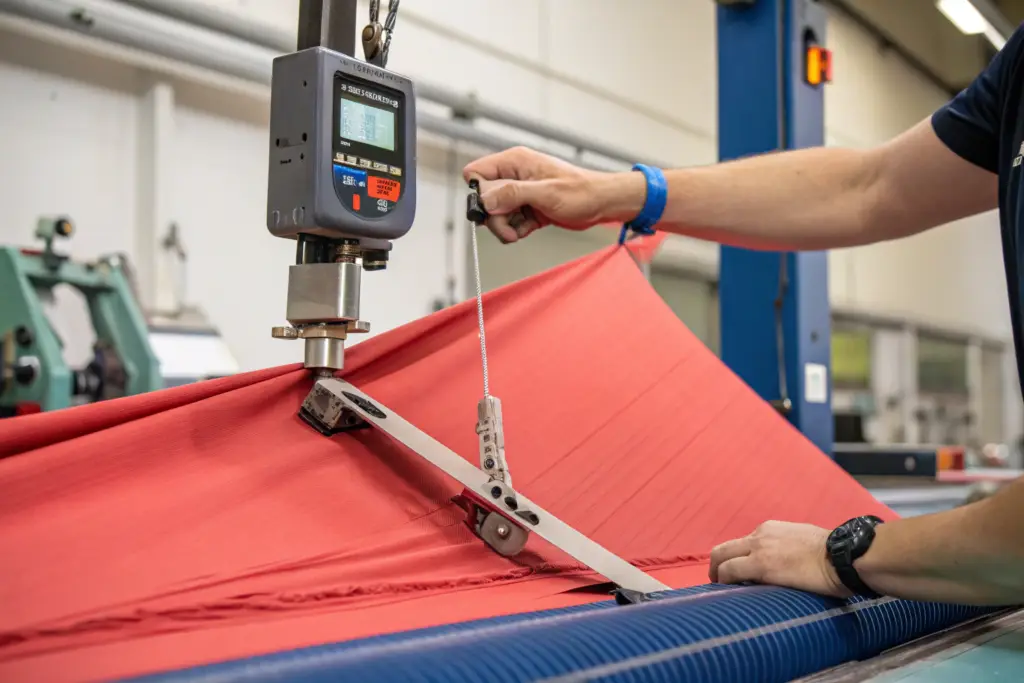
The knees of children's play pants are the highest-wear zone on any garment. They are subjected to intense, localized abrasion and repeated impact. The fabric on the knees is dragged across rough surfaces, stretched as the child kneels and crawls, and repeatedly ground into the dirt. This is a torture test for any textile.
Nylon outperforms polyester in this specific application for two reasons. First, nylon has a higher abrasion resistance. The standard test for abrasion resistance, the Martindale test, consistently shows nylon fabrics outperforming equivalent-weight polyester fabrics by 20% to 40% in cycles to failure. The nylon simply lasts longer under grinding abrasion.
Second, nylon has a higher elongation and recovery. When a child kneels, the fabric over the knee is stretched significantly. Polyester has good recovery, but nylon has better. A nylon-elastane knee panel will stretch with the knee and return to its original shape without bagging. A polyester-elastane panel may gradually lose its recovery over time, leading to saggy, baggy knees.
For the highest durability, we recommend a reinforced knee construction on children's play pants. A double-layer knee, with an outer layer of the main pant fabric and an inner layer of a nylon-elastane mesh or a second layer of the pant fabric, provides redundancy. If the outer layer eventually wears through, the inner layer provides continued coverage.
A children's outdoor brand client added a reinforced nylon-elastane knee panel to their play pants. The pants previously had a return rate of 8% for "worn through at the knees." The reinforced panel reduced this specific defect return by over 90%. The added fabric cost was $0.35 per pair. The reduction in replacements and the improvement in brand reputation for durability were worth many times that.
How Does a Flatlock Seam Construction Complement the Stretch of Nylon Blends?
The seam construction is as important as the fabric composition for a durable stretch garment. A standard overlock seam, used on most knit garments, creates a ridge of thread on the inside of the garment. When the fabric stretches, the overlock seam can restrict the stretch, causing the thread to break or the fabric to tear along the seam line. The ridge can also cause skin irritation on active children.
A flatlock seam is constructed differently. The two fabric edges are butted together, not overlapped, and the stitching passes through both edges and across the seam, creating a flat, smooth join on both the inside and the outside of the garment. The flatlock seam stretches with the fabric. It does not restrict movement. It does not create a ridge that can irritate the skin.
For a nylon-elastane play tight or legging, flatlock seams are essential. The garment is worn close to the skin. The child is moving constantly. The seams must stretch with the fabric and must not chafe. A flatlock construction is the technical standard for this application.
The flatlock machine is a specialized piece of equipment. Not all factories have them, or have operators trained to use them effectively. The brand owner must specify flatlock seams in the tech pack and verify during the sample review that the correct seam construction is used.
We use flatlock seam construction as standard for all our nylon-elastane children's activewear. The seam durability and comfort are non-negotiable quality points.
What Are the Best Fabric Weights for Balancing Warmth and Toughness in Outerwear?
Fabric weight, measured in grams per square meter or GSM, is the primary determinant of a fabric's warmth and, to a large extent, its toughness. A heavier fabric is generally warmer and more durable than a lighter fabric of the same fiber composition. But the relationship is not linear. A well-engineered, lighter fabric can outperform a heavier, poorly constructed fabric. The choice of fabric weight for children's outerwear is a balance between warmth, toughness, and the child's freedom of movement.
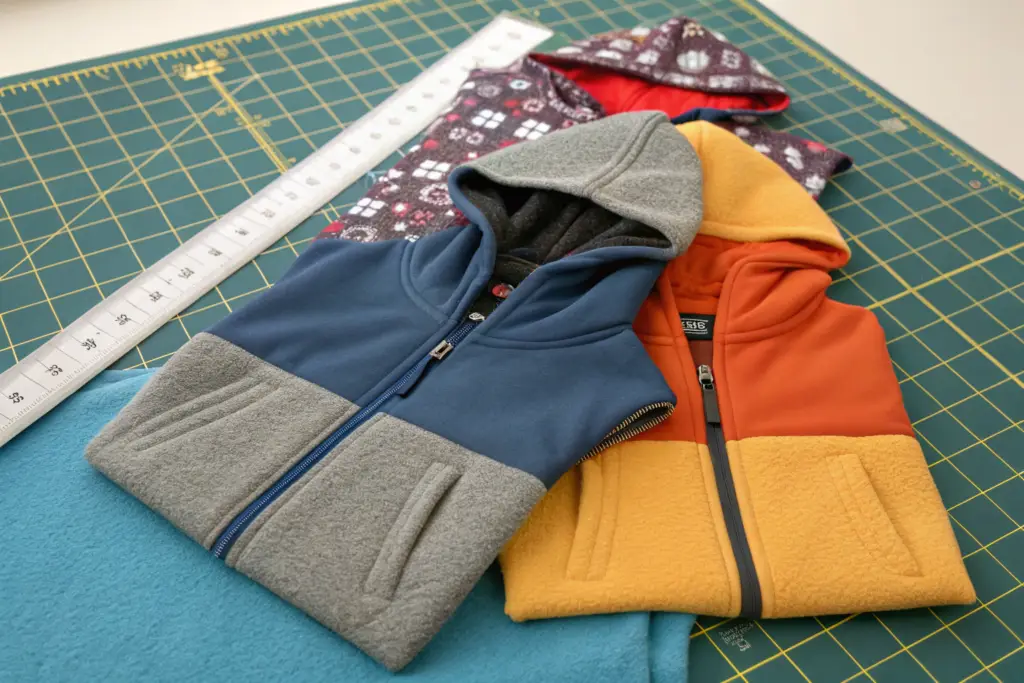
The optimal fabric weights for children's play outerwear are 280-320 GSM for fleece jackets and hoodies, providing substantial warmth and a durable, pill-resistant surface. For softshell jackets, a bonded fabric of 250-280 GSM offers a balance of wind resistance, water repellency, and breathability. For lightweight outer shells and windbreakers, a 180-220 GSM ripstop nylon or polyester provides tear strength and weather protection without bulk. The weight should be matched to the garment's intended use. A heavy fleece for winter play. A mid-weight softshell for spring and autumn. A lightweight shell for summer evenings and layering.
The fabric weight also affects the garment's drape and the child's comfort. A jacket that is too heavy and stiff will restrict movement. The child will resist wearing it. The most durable jacket in the world is useless if the child refuses to put it on. The fabric must be tough but pliable.
Why Does a 280 GSM Fleece with an Anti-Pill Finish Outperform Heavier Alternatives?
A common misconception is that heavier fleece is always more durable. A 350 GSM fleece has more fiber per square meter, and is therefore thicker and warmer. But if the fibers are short-staple and the yarn is loosely twisted, the heavy fleece will pill and degrade quickly. The weight is not a guarantee of durability.
A 280 GSM fleece made from compact-spun, long-staple polyester yarn, with an anti-pill finish applied, will often outperform a heavier, cheaper fleece. The anti-pill finish is a chemical or mechanical treatment that further reduces the tendency of fibers to work loose and form pills. The combination of a well-engineered yarn and an anti-pill finish creates a fleece that remains smooth and presentable after dozens of washes.
The 280 GSM weight is a sweet spot for children's fleece. It provides substantial warmth without being too bulky. The child can wear it as an outer layer in mild cold, or as a mid-layer under a shell in colder conditions. It provides a good balance of warmth and versatility.
A children's brand client tested a 280 GSM anti-pill polyester fleece against a 350 GSM standard polyester fleece for their winter hoodies. The 280 GSM hoodies showed significantly less pilling after an accelerated wash test of 20 cycles. The parent testers preferred the 280 GSM hoodies because they were lighter, more comfortable for the child to wear, and looked newer for longer.
How Do Ripstop Weaves Prevent Small Tears from Becoming Garment-Ending Holes?
A ripstop weave is a reinforcement technique in which thicker, stronger yarns are woven into the fabric at regular intervals, creating a visible grid pattern. The reinforced yarns act as barriers to tear propagation. If a sharp object, a twig, a nail, a piece of playground equipment, punctures the fabric and starts a tear, the tear will travel until it hits a ripstop yarn. The ripstop yarn absorbs the tearing force and stops the tear from spreading.
Without a ripstop weave, a small puncture in a lightweight nylon shell can quickly propagate into a long, garment-ending tear. The child catches the jacket on a branch. A small hole appears. The child continues to play. The hole grows. The jacket is ruined. With a ripstop weave, the same puncture remains a small, manageable hole that can be easily patched or simply ignored. The jacket remains functional.
Ripstop is standard in high-performance outdoor gear and is increasingly common in children's play outerwear. The weight penalty is minimal. The visual grid pattern can be an aesthetic feature, adding a technical, active look to the garment. The cost premium is modest, typically 5% to 10% over a standard plain weave of the same weight.
We recommend ripstop nylon or polyester for the outer shell of all children's play jackets intended for active outdoor use. The ripstop reinforcement is a small investment that dramatically extends the garment's functional life. A jacket that survives the first tear is a jacket that is worn for the full season, not discarded after the first playground incident.
How Do You Test Fabric Durability Beyond the Standard Lab Report?
Standard laboratory tests, the Martindale abrasion test, the Elmendorf tear test, the tensile strength test, provide valuable, standardized data on fabric durability. But they have limitations. They test a single stress in isolation. They do not replicate the complex, combined stresses of a child's real-world play. The lab test says the fabric survives 50,000 Martindale cycles. The parent wants to know if the leggings will survive a season of playground use.
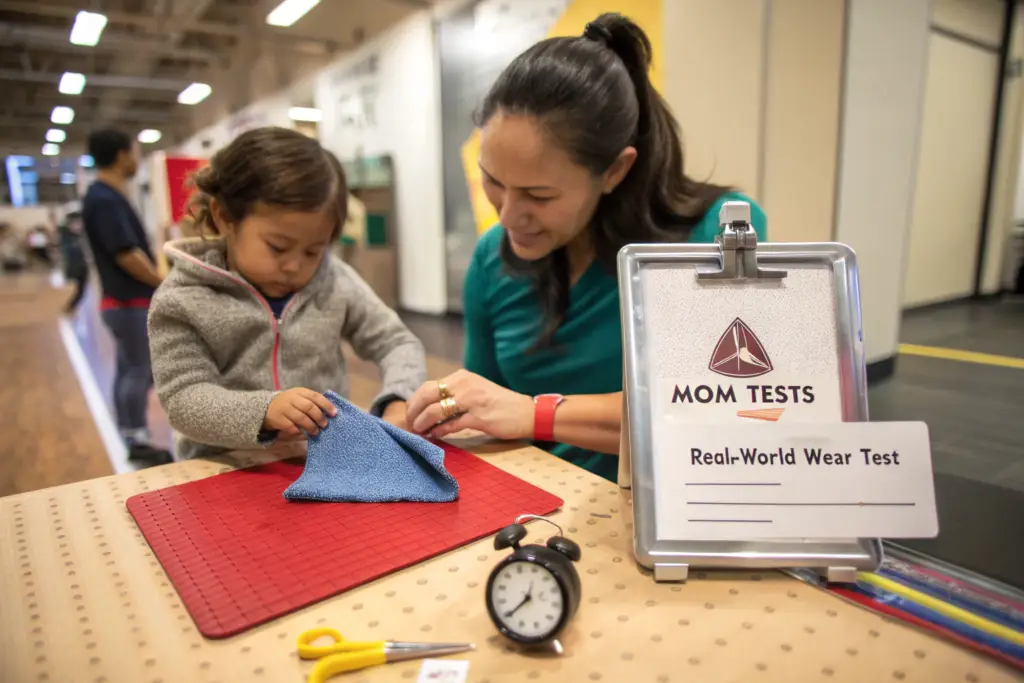
Testing fabric durability beyond the standard lab report involves real-world wear trials with actual children, a "mom wash test" that cycles garments through repeated home laundering and drying, and a post-wash inspection protocol that assesses pilling, seam integrity, color fading, and dimensional stability after 20, 30, and 50 cycles. The lab report is the foundation. The real-world testing is the validation. A fabric that passes the lab tests but fails the mom test is not a durable children's playwear fabric.
The real-world test captures failure modes that lab tests miss. The interaction of abrasion and washing. The effect of repeated stretching on seam integrity. The behavior of the fabric after being stained with grass, mud, and ketchup and washed at 60 degrees Celsius. These are the conditions that children's playwear actually endures.
What Is a "Mom Wash Test" and Why Do We Recommend 30 Cycles for Playwear?
The mom wash test is a practical durability test that replicates the care habits of a typical parent. The garment is laundered at home, not in a laboratory. It is washed with a standard consumer detergent, at 40 or 60 degrees Celsius, and tumble-dried on a medium heat setting. The cycle is repeated 30 times. After 30 cycles, the garment is inspected for pilling, seam failure, color fading, shrinkage, and overall appearance.
Thirty cycles is the recommended benchmark because it approximates one season of wear, assuming the garment is worn once or twice a week and washed after each wear. A garment that looks acceptable after 30 cycles has proven its seasonal durability. A garment that looks worn out after 10 cycles has failed.
The mom wash test is not a substitute for standardized lab testing. It is a complement. The lab test provides precise, comparable data on specific properties. The mom wash test provides a holistic assessment of the garment's real-world durability. Both are necessary.
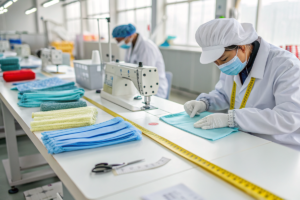
We conduct mom wash tests on all new children's playwear fabrics before offering them to our clients. The test garments are worn and washed by the families of our employees, who provide honest, unfiltered feedback. A fabric that survives the mom wash test earns its place in our children's fabric library.
How Should You Inspect a Sample for Seam Slippage After Repeated Stretch?
Seam slippage is a common failure mode in stretch children's playwear, particularly in tight-fitting garments like leggings and base layers. Seam slippage occurs when the stitching thread holds, but the fabric yarns pull apart along the stitch line, creating a gap or a hole. The seam does not break. The fabric fails around the seam.
The standard lab test for seam slippage is ISO 13936, which applies a fixed force to a seam and measures the resulting opening. But the lab test does not replicate the repeated, dynamic stretching that causes seam slippage in wear.
The practical test is to take the sample garment, hold the fabric on either side of a critical seam, the inseam, the crotch seam, the armhole seam, and stretch it firmly and repeatedly, 50 to 100 times. Then inspect the seam under a bright light. Look for any gaps between the fabric yarns along the stitch line. Check if the seam has opened up, exposing the thread. A durable seam will show no yarn separation. A failing seam will show visible gaps.
This simple manual test, performed by an experienced QC inspector, can identify a seam slippage risk that a lab report might miss. The test should be standard for all children's playwear samples that incorporate elastane and are intended for close-to-the-body fit.
We perform a manual stretch test on every children's playwear sample. The test is low-tech but highly effective. It has caught several potential seam slippage issues before bulk production, saving our clients from a season of returns.
Conclusion
The durability of children's playwear is not a single attribute. It is a system of attributes, fiber composition, yarn engineering, fabric construction, seam type, and reinforcement, working together to withstand the relentless punishment that children inflict on their clothes. The brand owner who understands this system can design playwear that survives the season and delights the parent.
We have explored the specific fabric compositions that deliver this durability. Cotton-polyester blends with compact-spun yarns provide the abrasion resistance and pill resistance for everyday play. Nylon-elastane blends with flatlock seams provide the tear strength and stretch for the most active outdoor play. Strategically weighted fleeces and ripstop shells provide warmth and toughness without restricting movement. And rigorous testing, both in the lab and in the real world, validates that the fabrics perform as promised.
The investment in durable fabric is not a cost. It is a profit center. The brand that produces playwear that survives a season of playgrounds and washing machines earns the parent's trust and the parent's repeat business. The brand that produces playwear that falls apart after six weeks earns the parent's disappointment and a one-star review.
At Shanghai Fumao, we treat children's playwear fabric development with the seriousness it deserves. Our fabric library for children's wear is curated for durability, safety, and comfort. We offer the specific blends, yarn types, and finishing treatments discussed in this article. We conduct the lab tests and the mom wash tests. We do this because we know that the child wearing the garment does not care about fiber composition. They care about playing. The parent cares that the garment survives the play.
If you are developing a children's playwear line and you want to ensure your fabrics can survive the toughest testers on earth, I invite you to contact our Business Director, Elaine. She can send you our children's fabric durability swatch pack with test data, discuss the optimal fabric composition for your specific product types, and arrange wear-test samples for your own evaluation. Reach Elaine at elaine@fumaoclothing.com. Let's build playwear that parents trust and children can't destroy.