A brand owner from Sydney called me last September, his voice tight with frustration and guilt. He had just enforced a late delivery penalty clause against a factory he had worked with for four years. The factory had delivered his summer linen shirts six weeks late, causing him to miss the peak selling window. He lost over $60,000 in sales. The contract allowed him to deduct a penalty from the balance payment. He did it. The factory owner, a man he considered a personal friend, was deeply hurt. The relationship, built over years of shared meals and mutual support, was damaged, perhaps irreparably. The brand owner asked me, "Was there a way to protect myself without destroying the relationship?"
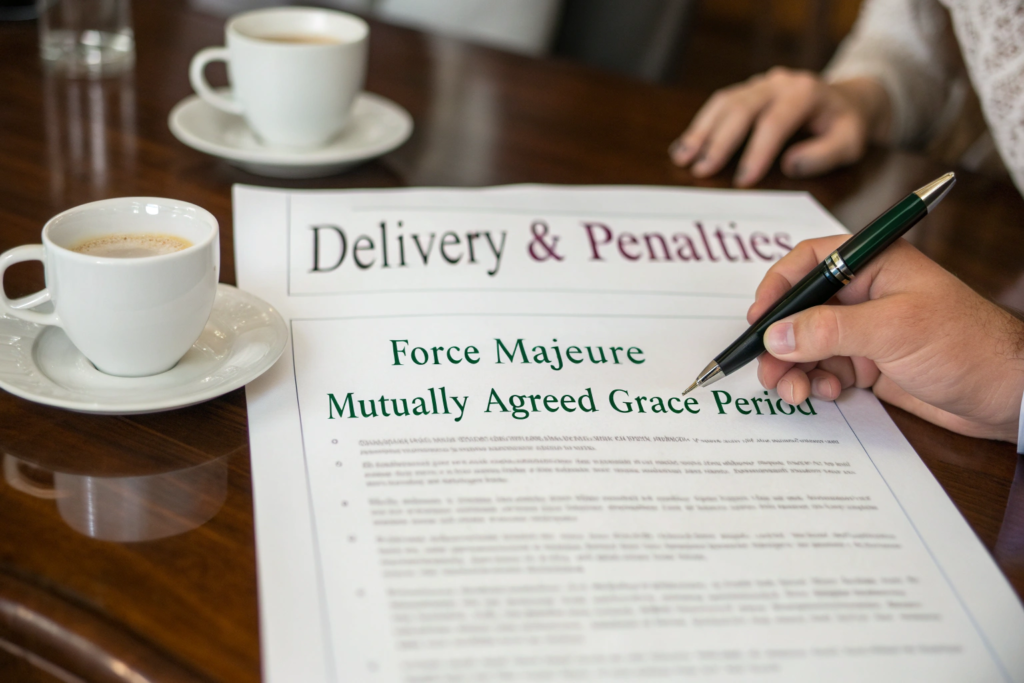
You negotiate penalty clauses for delayed shipments without straining relations by framing them as a shared risk management tool, not as a punishment mechanism. The clause should be structured collaboratively during onboarding, with graduated penalties that escalate only for severe or repeated delays, a clear and fair force majeure provision that protects both parties, and, most importantly, a "cure period" that gives the factory a chance to fix the delay before any penalty is triggered. The penalty clause should be the last resort in a relationship built on communication, not the first response to a problem.
The purpose of a penalty clause is not to punish the factory. It is to align incentives. The factory should feel the same urgency about the delivery date that the brand owner feels. Without a penalty, the factory's incentive is to prioritize orders from other brands that do have penalties. The penalty clause ensures that your order is not repeatedly pushed to the back of the queue. But the way the clause is introduced, worded, and enforced determines whether it functions as a business tool or as a relationship weapon. At Shanghai Fumao, we accept penalty clauses in our contracts because we understand they are a legitimate business protection, provided they are fair and reciprocal. Let me explain how to structure them so they protect you without alienating your manufacturing partner.
How Should a "Grace Period" Clause Be Structured Before Penalties Activate?
A penalty clause that triggers on the exact day after the contractual delivery date is a clause designed to create disputes. In garment manufacturing, a delay of one or two days is often caused by factors entirely outside the factory's control: a one-day port closure, a customs inspection that takes an extra 24 hours, a truck breakdown. Penalizing the factory for a one-day delay feels punitive and unfair. The factory will resent it. The relationship will suffer.
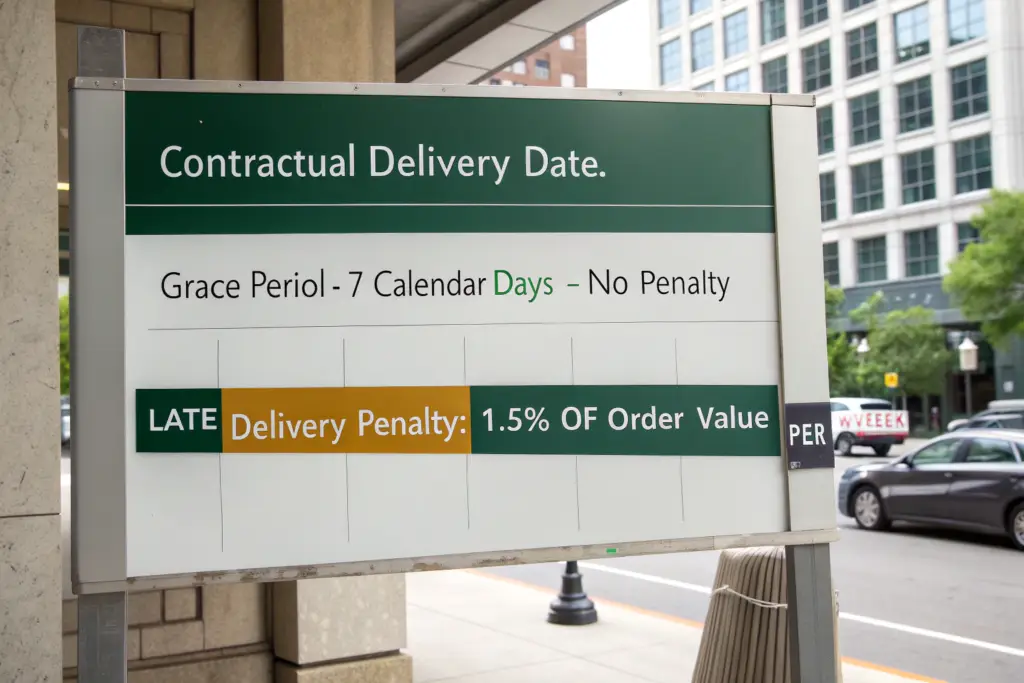
A well-structured grace period provides a buffer of 5 to 7 calendar days after the contractual delivery date during which no penalty applies. The grace period acknowledges the inherent variability in international logistics and demonstrates the brand owner's reasonableness. After the grace period expires, penalties begin to accrue. The grace period should be clearly defined in calendar days, not business days, to avoid ambiguity across different national holiday schedules. It should be a one-time buffer per order, not a rolling buffer that resets with each delay communication.
The grace period is not a license for the factory to be late. The contractual delivery date is still the target. The factory is still expected to deliver on that date. The grace period is an acknowledgment that the world is imperfect and that a reasonable business relationship absorbs minor deviations without immediately reaching for financial penalties.
Why Is a 7-Day Buffer Seen as "Fair" Versus a 14-Day Buffer?
The length of the grace period is a negotiation point. The brand owner wants a short grace period to maximize the penalty's protective effect. The factory wants a long grace period to minimize the risk of penalties. The fair middle ground depends on the garment type and the shipping method.
For sea freight shipments, a 7-day grace period is generally seen as fair because it represents approximately 20% of the typical sea freight transit time from China to Europe or the US West Coast. A delay of 7 days on a 35-day transit is a significant but not catastrophic deviation. It provides a meaningful buffer without undermining the delivery discipline.
A 14-day grace period, representing 40% of the transit time, is generally seen as excessive by brand owners. It effectively allows the factory to be two weeks late with no consequence. For a seasonal fashion item, two weeks can be the difference between full-price sell-through and the beginning of markdowns. A 14-day grace period shifts too much risk to the brand owner.
For air freight shipments, the transit time is 5 to 7 days. A 7-day grace period would be longer than the transit time itself, which is not reasonable. For air freight, a 3-day grace period is more appropriate.
The grace period should also reflect the complexity of the garment. A simple t-shirt has fewer potential sources of delay than a complex tailored jacket with custom trims. A longer grace period for a complex garment is a reasonable acknowledgment of the greater production risk.
We consider a 7-calendar-day grace period for sea freight shipments to be fair and commercially standard. It protects the brand from significant delays while demonstrating respect for the factory's operational realities.
How Do You Define the "Drop-Dead Date" Without Sounding Adversarial?
The drop-dead date is the date after which the buyer has the right to cancel the order entirely, not just claim a penalty. It is the ultimate protection against a catastrophically late delivery that renders the goods worthless, such as Christmas-themed merchandise arriving on December 27th.
The language used to define this date in the contract sets the tone for the entire penalty clause. "Drop-dead date" is an adversarial, aggressive term. It implies the factory is an opponent to be defeated. The term should be replaced with neutral, commercial language.
Use "Final Acceptance Date" or "Cancellation Effective Date." The clause can be worded as: "If the Goods are not delivered to the Carrier by the Final Acceptance Date of [Date], the Buyer reserves the right to cancel the Purchase Order in whole or in part by written notice to the Seller. Upon such cancellation, the Seller shall refund the deposit paid within 14 days."
The date itself must be realistic. It should be calculated based on the absolute latest date the goods can arrive and still have commercial value, minus the transit time. A Christmas order with a Final Acceptance Date of December 20th, after Christmas, is a pointless clause. A date of November 1st, allowing for four weeks of sea freight and two weeks of distribution before Christmas, is a realistic protection.
The conversation around the Final Acceptance Date should be framed as mutual risk management. "We both know that if these Christmas sweaters arrive after December 1st, I cannot sell them, and you will have produced goods that I cannot accept. Let's agree on a date that protects both of us from that worst-case scenario." The framing is collaborative, not confrontational.
How Do You Link Penalty Percentages to Verifiable, Incremental Losses?
A penalty clause that specifies an arbitrary, punitive percentage, 5% of the order value per week of delay, will be resisted by the factory and may be unenforceable in some legal jurisdictions. A penalty clause that is demonstrably linked to the brand owner's actual, verifiable losses from late delivery is more defensible, more negotiable, and more likely to be accepted by the factory.
The penalty percentage should be calculated based on the brand owner's likely financial harm from a late delivery. This harm typically includes the markdown costs if goods arrive after the peak selling window begins, the lost margin on canceled wholesale orders, and the storage and handling costs of receiving goods out of season. A common, defensible penalty is 1% to 1.5% of the order value per week of delay, capped at a maximum of 5% to 10% of the total order value. The cap prevents the penalty from becoming disproportionately large relative to the factory's margin on the order.
The brand owner should be prepared to explain the rationale behind the penalty percentage during the contract negotiation. "My wholesale contracts with my retail partners include a 2% markdown penalty if I deliver late. I am asking for a 1.5% penalty from the factory. I am absorbing part of the risk. The factory is absorbing part. The risk is shared." This explanation transforms the penalty from a demand into a logical business term.

What Is the Difference Between a Penalty and "Liquidated Damages" in a Manufacturing Contract?
The legal distinction between a penalty and liquidated damages is important and varies by jurisdiction. Under English common law, which influences many international commercial contracts, a penalty is a clause that imposes a punishment disproportionate to the actual loss and is unenforceable. Liquidated damages are a genuine pre-estimate of the loss likely to be suffered and are enforceable.
A clause that states "10% of the order value per week of delay" is likely to be considered an unenforceable penalty because it is punitive and not linked to actual loss. A clause that states "1.5% of the order value per week of delay, representing the Buyer's estimated markdown and lost margin costs" is likely to be considered enforceable liquidated damages because it is framed as a genuine pre-estimate of loss.
The contract should use the term "Liquidated Damages," not "Penalty." It should include a brief recital stating that the parties agree the amount represents a genuine pre-estimate of the Buyer's loss and is not a penalty. This recital is not legally determinative but is persuasive evidence of the parties' intent.
A brand owner who consulted a lawyer on his manufacturing contract changed the terminology from "Late Delivery Penalty" to "Liquidated Damages for Late Delivery" and added a recital explaining the calculation basis. The factory owner, who had previously objected to the "penalty," accepted the "liquidated damages" clause. The change in framing, from punishment to compensation, made the clause acceptable.
How Can You Offer a "Performance Rebate" Instead of Framing It as a Punishment?
The psychology of the clause matters as much as the legal wording. A clause framed as a penalty for failure creates a negative emotional dynamic. A clause framed as a rebate for success creates a positive emotional dynamic. The financial outcome can be identical, but the relational impact is entirely different.
The performance rebate model works as follows. The contract specifies a base FOB price that includes a small premium, perhaps 1% to 2%. The contract also specifies a "Delivery Performance Rebate" that is deducted from the balance payment if the goods ship on or before the contractual delivery date. The factory is not penalized for late delivery. It is rewarded for on-time delivery. The net price for on-time delivery is the same as the price under a penalty model. The net price for late delivery is also the same. But the framing is positive.
This model is particularly effective for long-term relationships. The brand owner says to the factory, "I value on-time delivery so much that I am willing to pay a small premium for it. If you deliver on time, you earn the rebate. If you don't, you don't. It's in your hands." The factory owner feels respected and motivated, not threatened.
A brand owner I work with uses the performance rebate model. His contract states a base FOB of $12.00 per unit, with a $0.25 per unit on-time delivery rebate. The factory consistently ships on time because the rebate is a tangible, positive goal. The factory's production manager told me, "We always prioritize his orders because we want to earn the rebate. It feels good to hit the target and get the reward." The rebate model achieved the same on-time delivery outcome as a penalty, but with a positive motivational effect.
What Force Majeure Provisions Are Reasonable for Both Sides?
Force majeure is the most abused and most disputed clause in garment manufacturing contracts. A factory that delivers late will almost always attempt to claim force majeure to avoid penalties. "The fabric mill was late, force majeure." "We had a power outage, force majeure." "A worker was sick, force majeure." A poorly drafted force majeure clause is a loophole through which all delivery accountability escapes.
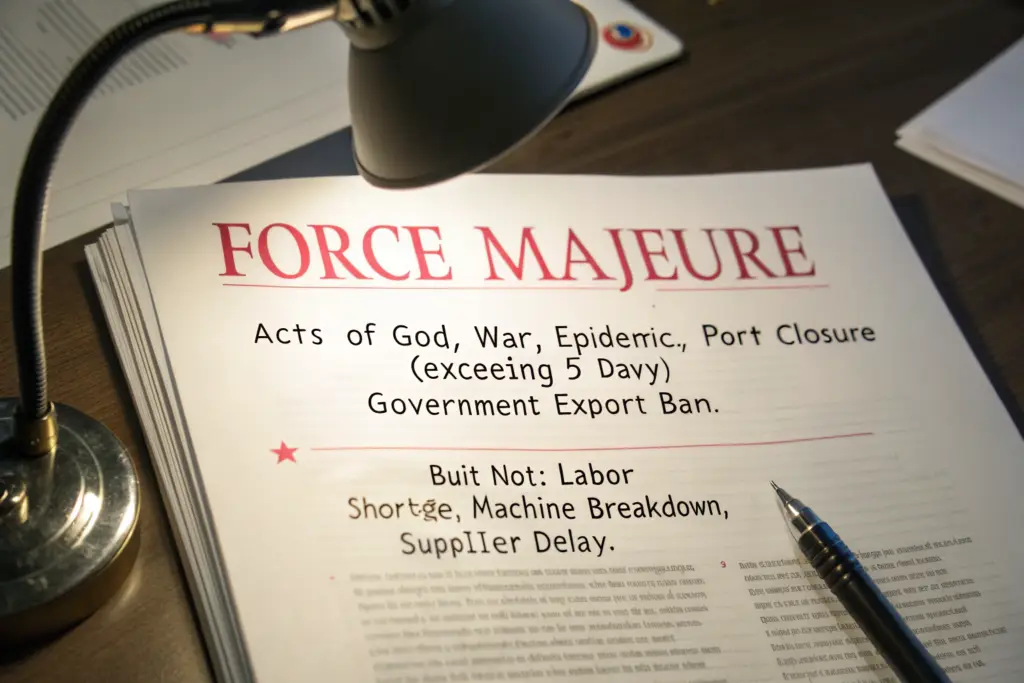
A reasonable force majeure provision must clearly define the specific events that qualify, explicitly exclude foreseeable operational risks like supplier delays and labor shortages, and require the party claiming force majeure to provide immediate written notice and credible evidence. The provision must also state that a force majeure event suspends, not extinguishes, the delivery obligation, and that the goods must be delivered within a reasonable time after the event ceases. The factory cannot simply cancel the order because of a temporary port closure.
The force majeure clause is a test of the contract's fairness. A one-sided clause that allows the factory to escape all accountability for any reason is not a contract. It is an option. A one-sided clause that gives the factory no protection against genuine catastrophes is also unfair. The balanced clause protects both parties from unforeseeable, uncontrollable events while leaving each party accountable for its own operational performance.
Why Should "Supplier Delays" Be Explicitly Excluded from Force Majeure?
The factory's most frequent force majeure claim is that a sub-supplier, the fabric mill, the trim supplier, the dye house, was late, and therefore the factory's delay is excused. This claim must be explicitly excluded from the force majeure clause. The factory chose its suppliers. Managing those suppliers is a core part of the factory's operational responsibility. The factory's supplier's delay is the factory's problem, not the brand owner's.
If the fabric mill is late, the factory should have a backup mill. If the trim supplier fails to deliver, the factory should have an alternative trim source. These are foreseeable operational risks. A well-managed factory mitigates them. A poorly managed factory uses them as excuses.
The force majeure clause should include a specific exclusion: "For the avoidance of doubt, the following events shall not constitute Force Majeure: delays or non-performance by the Seller's suppliers or subcontractors, labor shortages or strikes limited to the Seller's facility, machinery or equipment breakdown, and changes in market conditions or raw material prices."
The brand owner who accepts "supplier delays" as force majeure has effectively accepted that the factory's delivery commitment is meaningless. The factory can always blame a supplier. The brand owner has no way to verify the claim. The clause is a license for unaccountability.
How Should a Factory Compensate You If Force Majeure Persists Beyond 30 Days?
A genuine force majeure event, a major earthquake, a government-mandated factory shutdown, may persist for weeks or months. The delivery obligation is suspended. But at some point, the suspension must end, and the parties must have a clear path forward.
The force majeure clause should specify a maximum suspension period. If the force majeure event persists for more than 30 days, or a similar commercially reasonable period, either party may terminate the contract without penalty. The factory must refund any deposit paid within a specified period, usually 14 days. Neither party is in breach. The contract is simply dissolved due to an unforeseeable, uncontrollable event that has made performance impossible for an extended period.
The clause should also provide for partial termination. If the factory has completed 60% of the order before the force majeure event, the brand owner may choose to accept the completed 60% at a pro-rated price and terminate the remaining 40%. This is fairer than an all-or-nothing termination.
The termination for extended force majeure is a recognition that the brand owner cannot wait indefinitely. The season will end. The customer demand will pass. The brand owner must be free to find an alternative source, even if it is more expensive. The clause protects the brand owner from being trapped in a suspended contract while the selling window closes.
A brand owner's shipment of winter coats was delayed by a government-mandated factory shutdown. The force majeure clause specified a 30-day maximum suspension. On day 31, the shutdown was still in effect. The brand owner terminated the contract, received his deposit refund within a week, and placed the order with an alternative factory at a higher cost. The force majeure clause had protected his right to walk away when the delay became commercially untenable.
How Can On-Time Delivery Incentives Replace or Complement Late Penalties?
The most advanced approach to delivery assurance moves beyond the penalty paradigm entirely. It recognizes that a motivated, positively incentivized factory will perform better than a factory operating under the threat of punishment. On-time delivery incentives, cash bonuses for perfect or near-perfect delivery performance, create a positive cycle of reliability.
On-time delivery incentives complement or replace late penalties by offering the factory a financial bonus for achieving defined delivery performance targets. A typical structure pays a bonus of 1% to 2% of the order value for delivery within the contractual window. An additional bonus may be paid for zero quality defects. The bonuses are not large enough to distort the economics of the order, but they are meaningful enough to capture the factory owner's attention and motivate the production team. The incentive model transforms the delivery date from a source of anxiety into a shared goal.
The incentive approach works best in long-term, high-trust relationships. The brand owner and the factory have established a baseline of reliability. The incentive elevates performance from good to excellent. It is a partnership tool, not a transactional tool.

A shared savings model aligns the factory's financial incentive directly with the brand owner's logistics cost savings. When the factory delivers early, the brand owner can use slower, cheaper sea freight instead of expensive air freight. The savings are substantial. The shared savings model splits these savings with the factory.
The model works as follows. The brand owner calculates the standard sea freight cost and the air freight cost for the order. The difference is the potential saving. The contract specifies that if the factory delivers by the sea freight cut-off date, enabling the use of sea freight instead of air freight, the factory receives a share of the saved freight cost, typically 30% to 50%.
For example, an order has a sea freight cost of $2,000 and an air freight cost of $8,000. The potential saving is $6,000. The factory delivers on time, enabling sea freight. The factory receives 40% of the $6,000 saving, a bonus of $2,400. The brand owner saves $3,600 in freight costs. Both parties win. The factory is directly incentivized to meet the sea freight deadline because the bonus is transparently linked to a real, verifiable cost saving.
A brand owner who imports heavy, bulky winter coats implemented a shared savings model. His air freight bill had been crippling his margin on late orders. The first season under the shared savings model, his factory delivered all orders by the sea freight cut-off date. The brand owner's freight costs dropped by 60%. The factory earned significant bonuses. The model transformed the factory's scheduling priorities.
What Public Recognition Can Be More Valuable to a Factory Than a 2% Penalty?
Beyond financial incentives, public recognition is a powerful motivator for factory owners. The factory's reputation in the industry is a valuable asset. A brand owner who publicly recognizes a factory's delivery excellence is providing a marketing benefit that money cannot buy.
A brand owner can name the factory as a "Strategic Manufacturing Partner" on their website or in their sustainability report. They can provide a testimonial or a case study that the factory can use in its own marketing materials. They can recommend the factory to other brand owners in their network. These acts of recognition build the factory's reputation and generate new business leads.
The value of a strong reputation far exceeds the value of a single penalty payment. A factory that is known for on-time delivery attracts better clients and commands higher prices. The brand owner who provides public recognition is investing in the factory's long-term success, which deepens the relationship and motivates continued excellent performance.
We deeply value the public recognition our brand partners give us. A client recently featured our factory in a case study on his brand's sustainability page, highlighting our on-time delivery rate and our quality consistency. The case study has generated several serious inquiries from other brands. The recognition is more valuable to us than any single order's margin. It motivates us to maintain the standards that earned the recognition.
Conclusion
The negotiation of penalty clauses is a test of the relationship's maturity. A brand owner who demands punitive, one-sided penalties is signaling that they view the factory as a potential adversary to be controlled through fear. A brand owner who proposes fair, balanced, and transparently calculated liquidated damages is signaling that they view the factory as a partner with whom risks are shared and managed collaboratively.
We have explored the key elements of a relationship-preserving penalty structure. The grace period acknowledges that minor delays are a reality of manufacturing and should not trigger financial consequences. The liquidated damages calculation, linked to verifiable losses, transforms the penalty from an arbitrary punishment into a logical compensation. The performance rebate model reframes the entire conversation from negative to positive. The carefully defined force majeure clause protects both parties from genuine catastrophes while preventing the clause from being abused as an excuse for poor management. And the on-time delivery incentives and public recognition programs create a positive cycle of motivation that benefits both parties far more than a penalty ever could.
The ultimate protection against late delivery is not a penalty clause. It is a strong relationship with a factory that values your partnership and prioritizes your orders. The penalty clause is the backup system. The relationship is the primary system. Invest in both.
At Shanghai Fumao, we respect our brand partners who include penalty clauses in their contracts, provided the clauses are fair, reciprocal, and clearly linked to their genuine business risks. We also deeply appreciate our partners who complement their contracts with performance rebates and public recognition. Both approaches tell us the same thing: this brand owner is serious about their business, fair in their dealings, and committed to a long-term partnership.
If you are developing your supplier contracts and want to discuss how to structure delivery terms that protect your business while strengthening your factory relationships, I invite you to contact our Business Director, Elaine. She can share the contract frameworks that have worked well in our long-term partnerships and discuss how we align our delivery performance with our clients' commercial needs. Reach Elaine at elaine@fumaoclothing.com. Let's build a contract, and a relationship, that delivers on time.