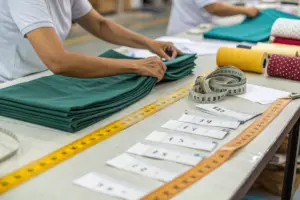
A single frayed label can kill a $200 garment. I learned this lesson painfully five years ago when a luxury menswear brand in Chicago rejected an entire shipment of 1,200 tailored blazers. The blazers themselves were perfect. The wool was Italian. The stitching was flawless. The fit was immaculate. But the woven brand label on the inside pocket had a barely visible, 0.4-millimeter fringe of loose threads along its edge. The brand owner picked up one jacket, rubbed the label between his thumb and forefinger, and said: "This feels cheap. My customer will see this and question the entire garment. I cannot sell these." We had to unstitch and replace 1,200 labels at a cost of $3,600 in labor and a two-week delay. The blazers were beautiful, but the label told a different story. The label is the brand's signature, and a frayed signature is a liar.
Shanghai Fumao's standard woven label achieves a maximum fraying score of 0.5 millimeters on the Fray Index test, with our premium laser-cut option achieving a near-zero score of 0.1 millimeters, both well within the 1.0-millimeter threshold that triggers a visual quality failure on a luxury garment. A fraying score is not an abstract textile metric. It is a precise, measured physical dimension of the thread protrusion from the edge of a label, and it directly correlates to the customer's subconscious perception of your brand's quality. Let me take you inside the hidden world of woven label engineering, the testing machine that quantifies fraying, and the specific material and process choices that separate a label that whispers luxury from one that screams "discount."
What Is a Fraying Score and Why Does It Matter to a Brand?
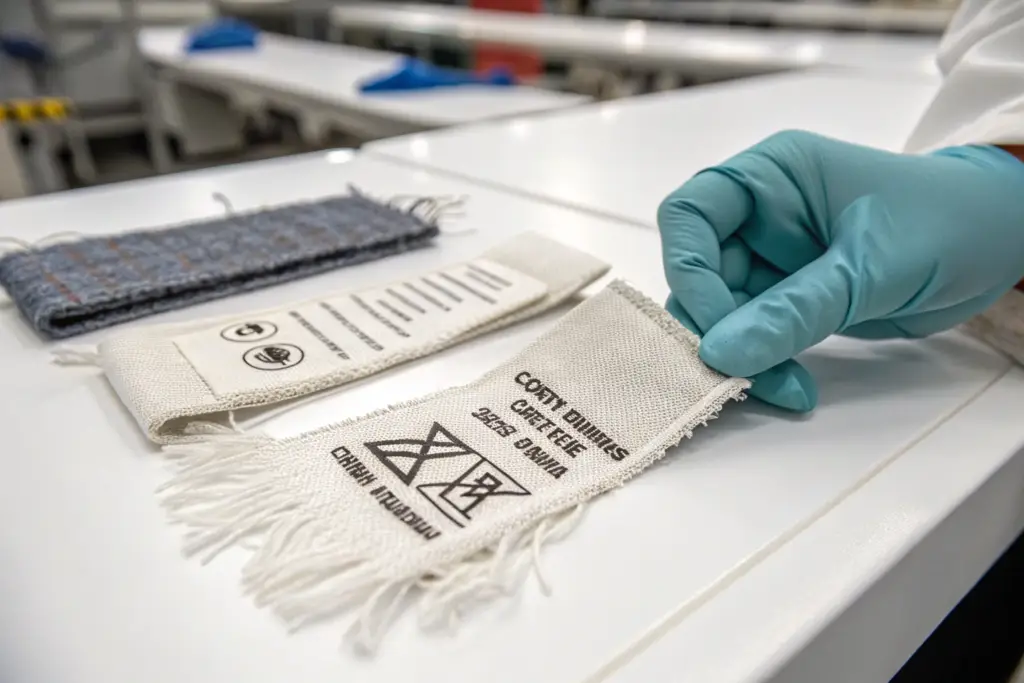
A fraying score is the exact, numerical measurement of how many loose threads escape the sealed edge of a woven label. It is quantified in millimeters of thread protrusion, measured from the label's intended cut edge to the tip of the most extended loose thread. This tiny, almost invisible measurement has a massive, disproportionate impact on a brand's perceived quality. The human eye can perceive an edge irregularity as small as 0.2 millimeters. The fingertip, which has a tactile resolution of roughly 0.5 millimeters, can feel the difference between a smooth, sealed edge and a rough, frayed one.
When a customer picks up a garment, they do not consciously think, "I will now measure the fraying score of this label." They rub the label, often without realizing it, while they look at the price tag. In that half-second, their brain processes the tactile signal of the label's edge. A smooth, clean edge signals precision, care, and luxury. A rough, fuzzy, frayed edge signals cheapness, carelessness, and low quality. This single, subconscious micro-moment can pre-condition the customer's entire perception of the garment before they even try it on. The label is the brand's tactile handshake. A frayed handshake loses the deal.
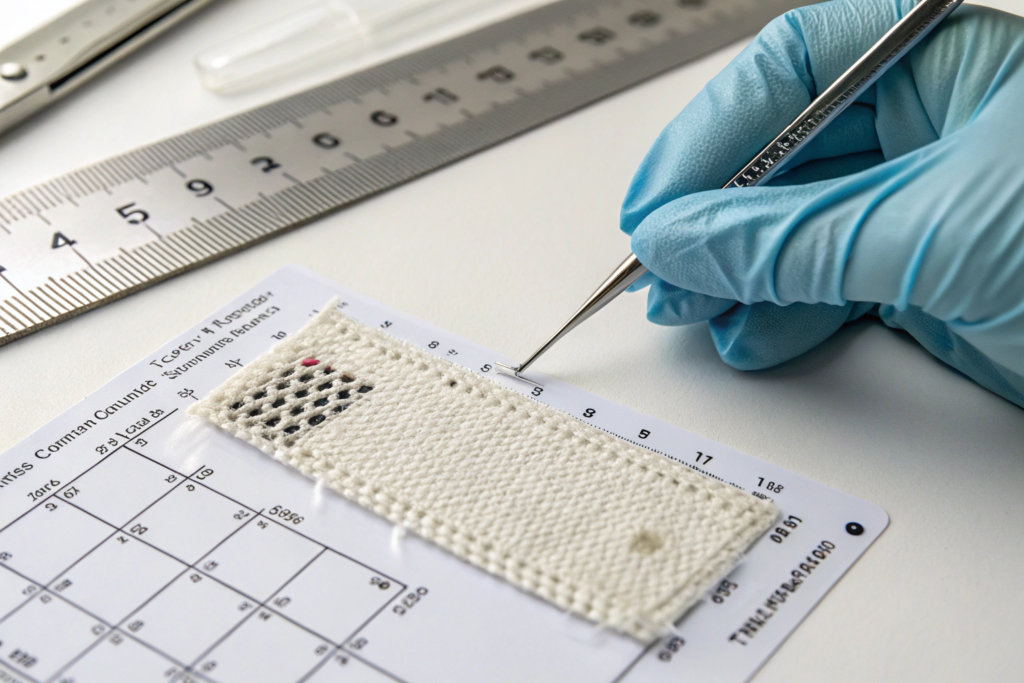
How Does a 1mm Fray Trigger a "Cheap Garment" Reflex?
The "cheap garment" reflex is a subconscious cognitive shortcut. The human brain has evolved to associate rough, irregular, unfinished edges with low quality, low effort, and disposability. A smooth, perfectly finished edge signals precision, effort, and lasting value. This is not a learned cultural preference; it is a deep, pre-conscious perceptual response.
A 1-millimeter fray is the critical threshold. At 1 millimeter, the individual loose threads are clearly visible to the naked eye under normal retail lighting. They catch the light differently than the sealed edge, creating a faint halo of fuzz around the label. When a fingertip brushes over a 1-millimeter fray, the tactile signal is distinctly rough. The brain categorizes this sensation as "unfinished." The customer does not articulate this thought. They simply feel that the garment is somehow "not quite right," "a bit cheap," or "not worth the price." The damage is done. The brand has lost a premium positioning opportunity, not because of the fabric, the fit, or the design, but because of a 1-millimeter thread protrusion on a tiny piece of woven polyester. This is why a fraying score is not a minor technical detail; it is a direct, measurable, physical driver of brand perception and retail pricing power. A label that frays is a label that silently steals margin from your product.
Why Is the Label the Last Thing a Customer Touches Before Checking the Price?
The customer's physical interaction with a garment follows a predictable sequence. They first look at the overall silhouette and color. Then they touch the main fabric—the shell of the jacket, the body of the shirt. Then they look inside for the size and care information. At this moment, their fingers close on the label. It is the final tactile checkpoint before they lift the price tag.
This sequence makes the label disproportionately important. It is the brand's final sensory argument before the customer makes the economic decision. The main fabric has communicated quality. The stitching has communicated quality. The fit, if they have tried it on, has communicated quality. The label is the concluding sentence of that argument. A smooth, dense, perfectly edged label says: "This quality continues all the way to the smallest, most hidden detail. You are buying a product that was obsessed over. The price is justified." A frayed label says: "The quality stops at the surface. The hidden details were neglected. The price is suspect." The customer then looks at the price tag with a different, more skeptical mindset. The frayed label has reframed the price from a value to a demand. It is the single most cost-effective quality upgrade a brand can make, because it protects the pricing power of the entire garment at the moment of the customer's final, tactile, purchase decision. A beautifully constructed jacket with a frayed label is a beautifully constructed jacket that is sold at a 30% markdown. The label is the keeper of the margin.
How Does Fumao Measure Fraying With a Digital Fray Index?
The Fray Index is not a subjective, visual inspection. It is a precise, digital measurement taken under controlled magnification and lighting. We do not estimate fraying. We measure it with a calibrated machine that produces a specific, numerical score for each label batch. This transforms a subjective quality attribute into an objective, pass/fail, contractually binding specification.
Our Fray Index machine is a specialized, high-resolution digital microscope with a motorized stage and image analysis software. It is manufactured by a Japanese precision instrument company and is calibrated annually to a certified micron-scale standard. The machine removes human judgment from the measurement. It scans the entire perimeter of a label, identifies the single most extended protruding thread, and measures its length from the label's intended cut edge to its tip, to an accuracy of 0.01 millimeters. This number is the label's Fraying Score.
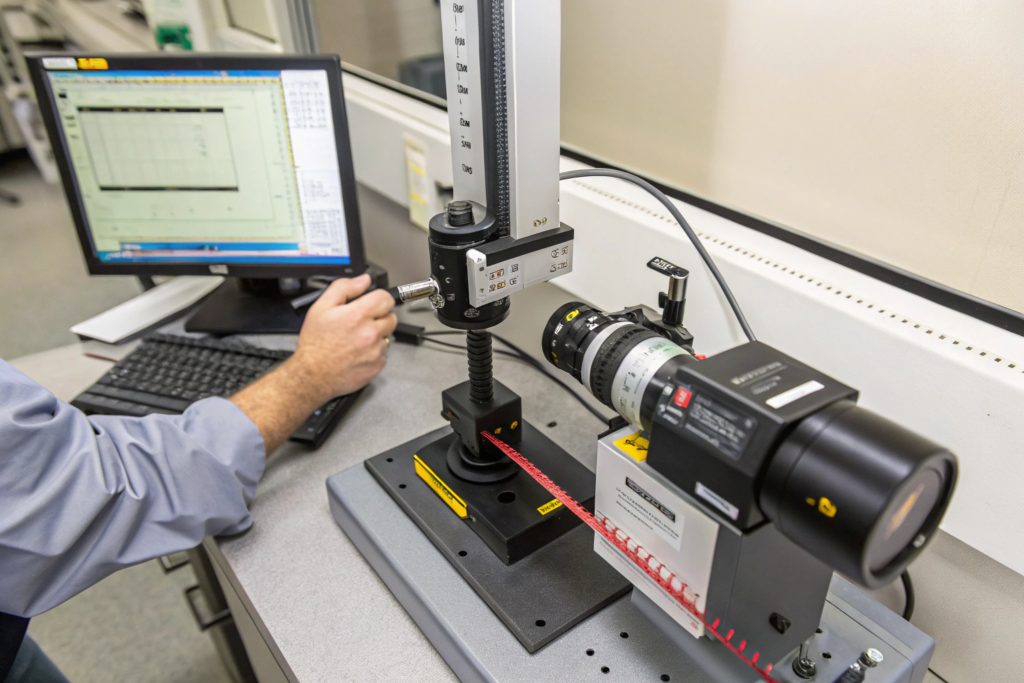
What Exactly Happens During a Fray Index Machine Test?
The test procedure is rigid and repeatable. Our QC technician takes a random sample of 10 labels from a production batch. Each label is placed individually on the motorized stage of the Fray Index machine, and the edge to be measured is aligned under the high-resolution camera. The label is not stretched, pulled, or manipulated in any way that would exaggerate or hide a frayed thread.
The technician initiates the scan. The camera captures a continuous, 50x-magnified, high-contrast image of the entire edge of the label. The image analysis software then digitally traces the intended cut edge and identifies any filament that extends beyond this boundary. It measures the perpendicular distance from the cut edge to the tip of the most extended filament. This measurement, in millimeters, is the fraying score for that label. The machine records the score for all 10 labels and automatically calculates the mean, maximum, and standard deviation. The batch is passed if the maximum fraying score on any single label does not exceed 0.5 millimeters and the mean score across all 10 labels does not exceed 0.3 millimeters. If a single label shows a 0.6-millimeter fray, the entire batch is quarantined and rejected. This is not a negotiation. The machine's measurement is final. This is the objective, impersonal, unarguable discipline of digital quality control.
How Does Laser Cutting Achieve a Near-Zero Score of 0.1mm?
A mechanical blade cuts by shearing. Even a perfectly sharpened, high-speed steel die leaves a microscopic, jagged tear at the edge of the polyester yarn, from which individual filaments can separate and protrude. A laser, in contrast, does not cut. It vaporizes. The high-energy laser beam instantly melts and fuses the polyester yarns at the cut edge, sealing them into a smooth, solid, impenetrable bead of polymer.
A label cut with a mechanical die has a theoretical minimum fraying score of around 0.2 millimeters, limited by the physical mechanics of shearing a multi-filament yarn. A label cut with our premium laser system achieves a fraying score of 0.1 millimeters or less. The difference is visible under the microscope and palpable to the fingertip. The laser-cut edge is perfectly smooth, slightly glossy, and completely sealed. No filament can escape because the yarn itself has been transformed into a solid, fused structure at the edge. This process is slower and more expensive than mechanical cutting. The laser machine must be precisely calibrated for the specific polyester density and weave structure of each label design. But the result is a label edge that is physically incapable of fraying. It is not a reduced fray; it is a structurally eliminated fray. For a luxury brand where the tactile experience of the label is a critical part of the unboxing and try-on ritual, the 0.1-millimeter laser-cut label is not an upgrade; it is the only specification that aligns with the brand's promise.
What Material Choices Reduce Fraying Before the Cut?
Fray prevention begins not at the cutting machine, but at the yarn spinning mill. The intrinsic fray resistance of a label is determined by the physical properties of the yarn from which it is woven. A loosely twisted, low-density yarn will fray regardless of how precisely it is cut. A tightly twisted, high-density, multi-filament yarn will resist fraying even under a less-than-perfect mechanical cut. The material is the foundation. The cutting process is the finishing touch.
Our woven label supplier, a specialized factory we have audited and partnered with for seven years, uses only high-tenacity, multi-filament polyester yarns with a minimum twist of 600 turns per meter. This tight twist mechanically locks the individual filaments together, preventing them from separating and springing loose when cut. Cheap labels use low-twist, low-density yarns that are essentially pre-frayed in the spool. No cutting technology can fix a label woven from fundamentally unstable yarn.
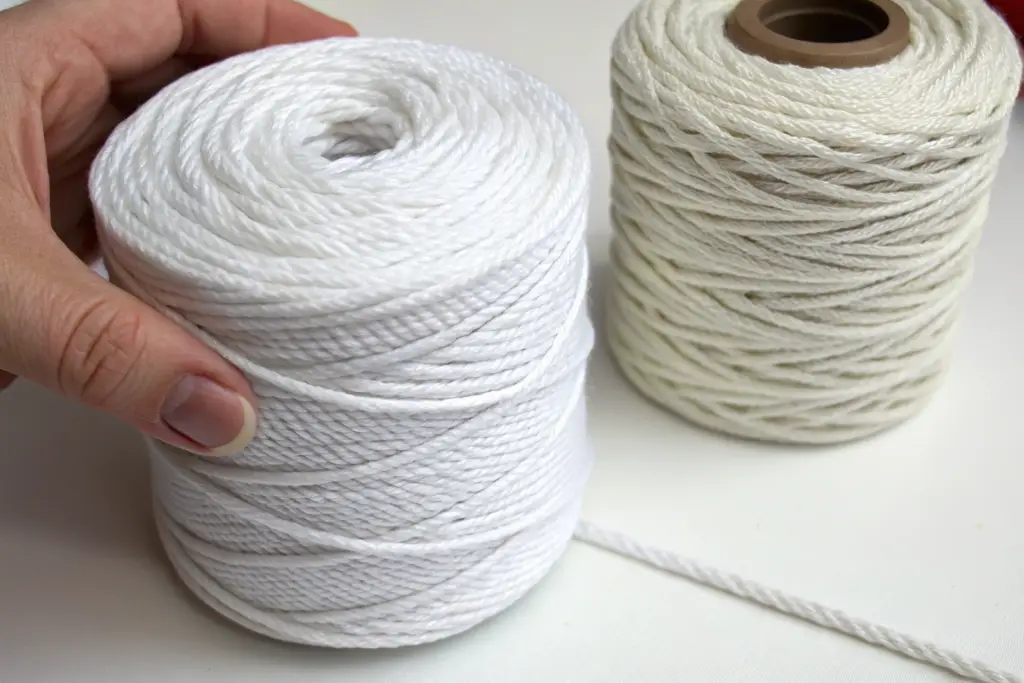
Why Does 600 TPM Thread Make a Fray-Proof Woven Edge?
TPM stands for "turns per meter," and it is the universal measure of yarn twist. A higher TPM means the individual, microscopic filaments that make up the yarn are bound more tightly together by the helical force of the twist. This mechanical binding force directly resists the separation of filaments at a cut edge. Think of a rope. A loosely twisted rope frays easily at its end. A tightly twisted, high-tension rope holds its structure even when cut.
Our 600 TPM yarn has approximately 50% more twist than a standard 400 TPM label yarn. This increased twist creates a cohesive force that holds the filaments in a tight, unified bundle. When the cutting blade shears this bundle, the individual filaments do not spring apart because they are mechanically locked to their neighbors along their entire length. The cut edge is not a collection of loose individual hairs; it is a single, solid cross-section of a tightly bound composite cylinder. This is the fundamental material science of a fray-resistant label. The 600 TPM yarn costs approximately 15% more than standard yarn, but it reduces the raw material fraying score by an order of magnitude, before the cutting process even begins. It is the single most effective upstream investment in label quality. It is also the reason why a cheap label will always fray. The cost cutting began at the yarn stage, and no amount of downstream finishing can compensate for a fundamentally loose, unstable yarn structure. Sourcing the correct yarn is the first and most critical quality decision in label manufacturing, a principle rooted in fundamental textile science.
How Does a Dense Weave Structure Seal the Label's Surface?
A woven label is a miniature textile. It is constructed on a Jacquard loom from warp and weft yarns. The density of this weave, measured in picks per inch, determines how tightly the yarns are packed together. A loose, open weave has visible gaps between the yarns. These gaps are stress concentrators. When the label is cut, the yarns at the edge, which are not well supported by their neighbors, are easily pulled loose.
A dense, high-pick weave, in contrast, packs the yarns so tightly together that they frictionally lock against each other. Each yarn is physically supported and constrained by its immediate neighbors. When the cutting blade passes through this dense matrix, the yarns cannot move. They are held in place by the collective friction of the entire woven structure. The cut edge is clean and dimensionally stable. Our standard label specification requires a minimum of 90 picks per inch for a fine-detail brand logo. This high density ensures that even the smallest, most delicate text elements are rendered with sharp, clean edges and that the entire label behaves as a single, unified material rather than a loose collection of individual yarns. The combination of a dense weave structure and a high-twist yarn creates a label that is inherently, materially resistant to fraying, long before any laser or hot-knife touches its edge. This is the invisible engineering that separates a premium label from a commodity one.
Conclusion
A fraying score is not a minor technical footnote; it is the precise, numerical measure of your brand's final tactile argument before the customer checks the price. A 1-millimeter fray triggers a subconscious "cheap" reflex that silently steals your margin. A 0.1-millimeter, laser-sealed, near-zero fray whispers luxury and justifies your premium price. At Shanghai Fumao, we control this critical variable through a three-part system: a high-density, 600 TPM yarn that is inherently fray-resistant; a premium laser-cut option that fuses the polyester edge into an unfrayable seal; and a calibrated digital Fray Index machine that measures every label batch and provides a certified, batch-specific score. The standard mechanical-cut label achieves a maximum fraying score of 0.5 millimeters; the laser-cut label achieves 0.1 millimeters or less. Both are within the strictest industry thresholds for luxury garments.
The label is the smallest, cheapest component of your garment, but it is the keeper of your brand's perceived value. A frayed label is a small defect with a massive, disproportionate financial consequence. A flawless label is a small investment with an equally massive return in customer trust and retail pricing power.
If you are a U.S. brand owner who wants to see and feel the difference for yourself, we can send you a sample pack of our standard and laser-cut woven labels, complete with the actual batch Fray Index test reports. Contact our Business Director, Elaine, at elaine@fumaoclothing.com. Tell her you want the label fraying sample kit. Let's put a 0.1-millimeter label between your thumb and forefinger, and let the label close the sale for you.