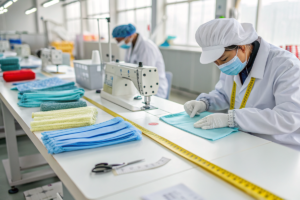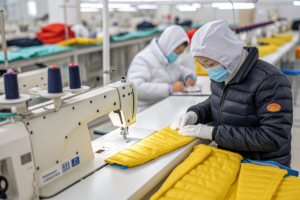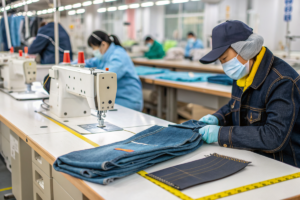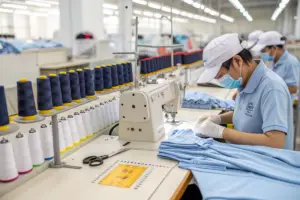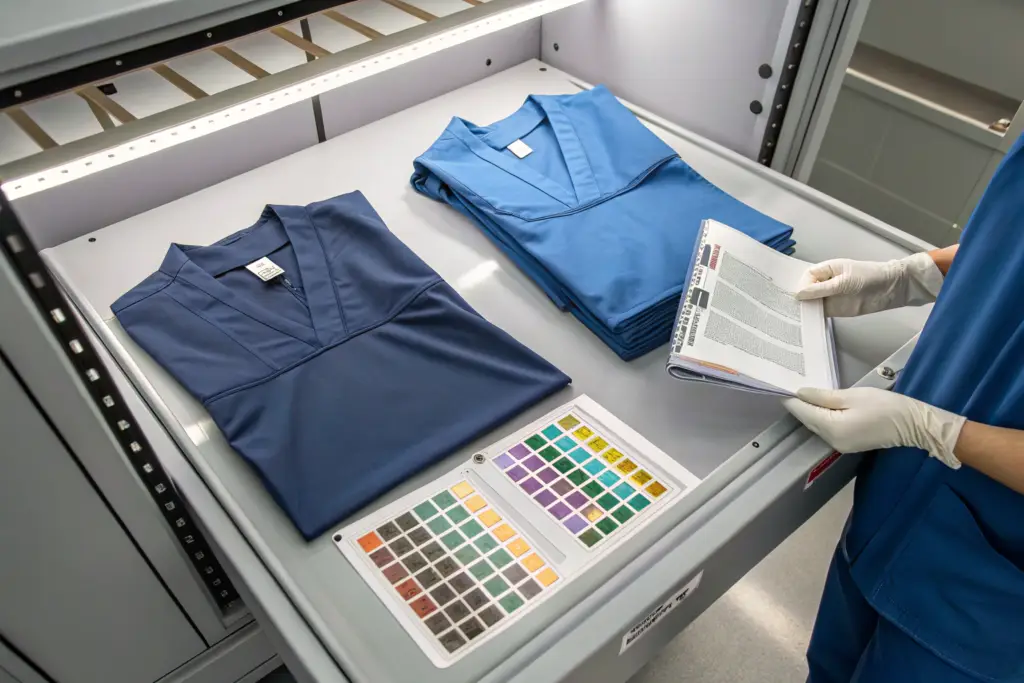
Two years ago, a national hotel chain in the United States placed a $120,000 uniform order with a supplier in Vietnam. The brand's corporate identity was built around a very specific shade of deep charcoal grey, Pantone 19-3909. The first shipment arrived, and the front-of-house blazers were a visibly different shade of grey than the back-of-house polo shirts. The blazers were slightly warm, with a brown undertone. The polos were cool, with a blue undertone. The staff looked like they were wearing mismatched uniforms from two different companies. The hotel's brand director rejected the entire shipment. The supplier had matched the Pantone on a cotton twill for the blazer, but used the same dye formulation on a polyester-cotton polo, and the color shifted dramatically between the two different fiber chemistries. The supplier understood the Pantone number. They did not understand the material science of color.
Yes, Shanghai Fumao achieves an exact, certified Pantone shade match across different fabric compositions by using a spectrophotometer-driven, fabric-specific dye formulation process, delivering a final Delta E CMC tolerance of less than 1.0 on every production batch. This is not a visual approximation. It is a quantified, measured, and certified physical property of the fabric, verified by an ISO-accredited third-party laboratory. A uniform is not a fashion garment. It is a physical expression of a corporate identity. A mismatched shade of grey is not a quality defect; it is a brand integrity failure. Let me walk you through the exact color science, the dye chemistry, and the verification protocol that guarantees a hotel's front desk blazer, a housekeeping polo, and a chef's apron all read as the identical, precise corporate color, regardless of their fabric composition.
Why Is Pantone Matching a Chemical Challenge Across Fibers?
A Pantone number is not a color. It is a color target printed with a specific ink on a specific paper under specific lighting. A fabric is a three-dimensional, textured, chemically reactive surface. Translating a Pantone ink-on-paper target into a dye-on-fabric result is an act of complex chemical and physical engineering, not a simple lookup in a recipe book. Every single fiber chemistry reacts with dye molecules in a fundamentally different way.
Cotton is a hydrophilic, cellulosic fiber that absorbs dye into its amorphous internal structure, reflecting light with a soft, matte, diffuse quality. Polyester is a hydrophobic, synthetic polymer that must be dyed at 130 degrees Celsius under high pressure, and the dye molecules are trapped within the polymer matrix, creating a brighter, more specular reflectance. Nylon dyes with acid dyes, wool with reactive dyes, and rayon with yet another chemistry. A single Pantone target—for example, a specific corporate navy—requires five completely different dye formulations to achieve the identical visual color on five different uniform fabrics. A supplier who uses a single, standard dye recipe across all fabrics will produce a mismatched, visibly discordant uniform program. A supplier who understands fiber-specific dye chemistry will produce a visually seamless, brand-consistent program. The difference is in the lab, not in the price quote.
How Does Cotton's Dye Absorption Differ From Polyester's?
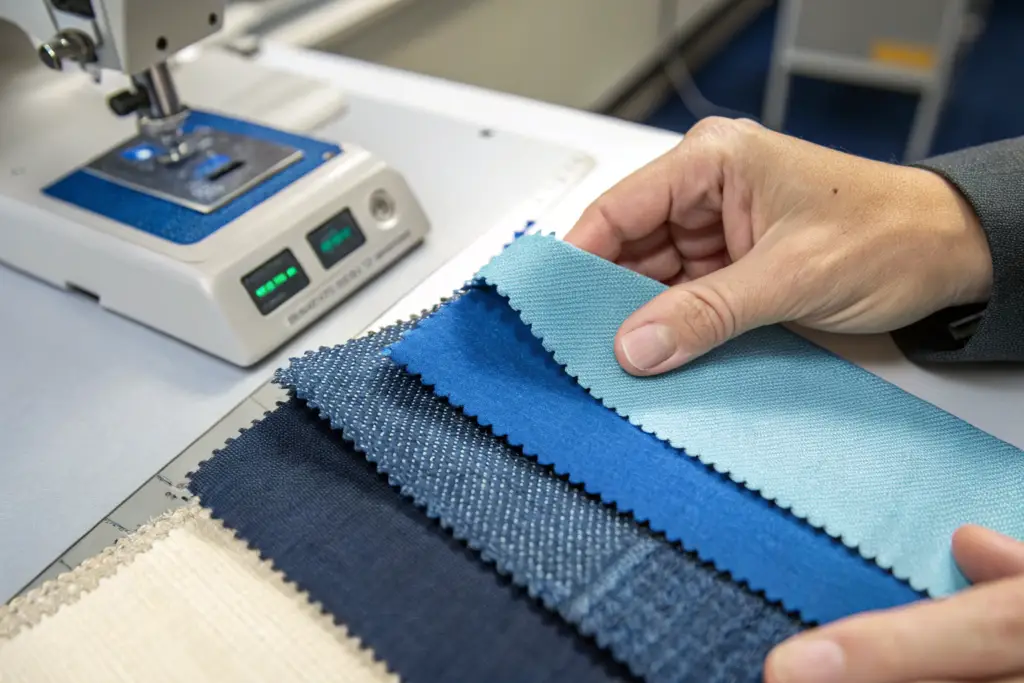
Cotton is a thirsty, absorbent fiber. It is made of cellulose, a natural polymer with a dense network of hydroxyl groups that attract and bond with water molecules. Reactive dyes, the standard for cotton, chemically bond to these hydroxyl groups, becoming a permanent part of the fiber itself. The dye penetrates deep into the fiber's core. When light hits the dyed cotton, it scatters through this saturated, three-dimensional structure, producing a deep, rich, but inherently matte and slightly muted color. The color is "inside" the fiber.
Polyester is a closed, plastic fiber. It has no internal voids and no hydroxyl groups. It is essentially a solid, clear rod. Disperse dyes, the only dyes that work on polyester, are tiny, insoluble pigment particles that must be forced into the fiber at high temperature and pressure. The dye particles lodge between the tightly packed polymer chains, near the surface of the fiber. The core of the fiber remains undyed, clear plastic. When light hits the dyed polyester, it reflects off the dyed surface layer and also off the undyed core, creating a brighter, more luminous, more specular color. The color is "on" the fiber. This fundamental physical difference means that a reactive dye recipe that perfectly matches a Pantone target on cotton will produce a visibly lighter, flatter color on polyester. A disperse dye recipe that matches the target on polyester will produce a duller, darker, less saturated color on cotton. The chemist must compensate for the fiber's own optical physics when building the dye formulation. This is the core challenge of cross-fiber color matching, and it is a skill that separates a genuine dyeing laboratory from a factory that simply follows a standard recipe card.
Why Does a Supplier Need a Spectrophotometer, Not Just a Pantone Book?
A Pantone book is a visual reference for a human eye under a specific light. A human eye is a subjective, variable, and easily fatigued color sensor. Two people looking at the same fabric swatch under slightly different lighting will report two different color assessments. A single person looking at the same swatch at 9 AM, fresh, and at 5 PM, after eight hours of color work, will see two different colors. The human visual system is not a measurement instrument.
A spectrophotometer is an objective, calibrated, unblinking measurement instrument. It illuminates the fabric with a precisely controlled, standardized light source and measures the spectrum of light reflected back across the entire visible wavelength range, from 400 to 700 nanometers. It quantifies the color as a set of precise, numerical coordinates in a three-dimensional color space, typically the CIELAB system. This numerical data is then compared to the Pantone target's master spectral data, and the difference is calculated as a Delta E value. A Delta E of less than 1.0 is a visually imperceptible match to the average human eye. A Delta E between 1.0 and 2.0 is a very close match, visible only to a trained colorist in a side-by-side comparison. A Delta E above 2.5 is a visible, commercially unacceptable mismatch. Our color lab uses a Datacolor 850 spectrophotometer, calibrated every morning against a certified white tile standard. Every single dye lot is measured, the spectral data is recorded, and the Delta E CMC tolerance is calculated and documented. This instrument is the only way to achieve a true, verifiable, and legally defensible Pantone match. The Pantone book is the target. The spectrophotometer is the proof. This is the standard practice in professional color management, and we apply it without exception.
How Does Fumao's Dye Lab Achieve a Delta E Under 1.0?
A Delta E CMC tolerance of less than 1.0 is not achieved by luck or by a single, bulk dye recipe. It is achieved through a rigorous, multi-stage, closed-loop process that begins with a small-scale laboratory formulation, scales up through a pilot sample, and is continuously verified during bulk production with in-line spectrophotometer readings. Every step is measured, recorded, and audited.
Our in-house dye laboratory is the heart of our uniform color matching capability. It is a dedicated, climate-controlled facility staffed by a senior color chemist with 22 years of experience. We do not outsource our color formulation to a third-party dye house. We formulate in-house, because controlling the color formula is controlling the brand's visual identity. When a uniform program requires an exact Pantone match, we start from first principles: the fiber composition of the specific fabric, the target Delta E tolerance, and the required lightfastness and washfastness performance for the garment's intended use.
What Happens During a Lab Dip Matching Process?
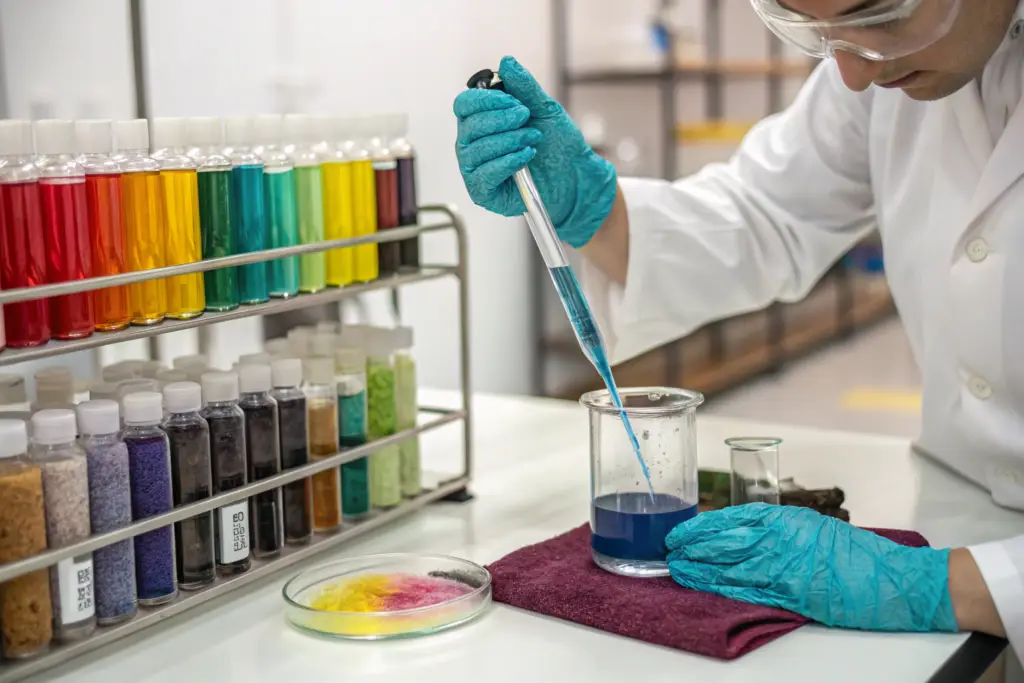
A lab dip is a small-scale, precise, experimental dyeing of a 10-gram fabric swatch. It is the color chemist's first physical attempt to match the Pantone target on the exact fabric specified for the uniform. The chemist begins by calling up the spectral reflectance curve of the target Pantone shade from the digital master database. The software then proposes a starting dye formulation based on the fiber type and the target color coordinates. The chemist does not simply trust this software prediction. She evaluates the specific dye combinations—a deep navy, for instance, might require a trichromatic combination of a blue, a red, and a yellow component to achieve the precise shade and undertone.
The chemist weighs the individual dyestuffs to a precision of 0.001 grams on a calibrated analytical balance. She then dyes the fabric swatch in a small, precision stainless steel dyeing machine that replicates the exact temperature, pressure, and liquor ratio of the bulk production machine. The dyed swatch is then dried, conditioned, and measured on the spectrophotometer. The measured color is compared to the target, and the Delta E is calculated. If the Delta E is greater than 0.8, the chemist adjusts the dye formulation—adding a fraction of a percent more yellow to correct a blue undertone, or reducing the red component to prevent a purple shift—and runs a second lab dip. This iterative process continues, typically requiring three to five lab dips, until the swatch measures a Delta E of less than 0.8 against the Pantone target. This final, approved lab dip, with its precise formulation, becomes the master production recipe. The physical swatch is signed, dated, and sealed in a light-proof envelope. It is the physical, legal standard for the bulk production run.
How Do We Control the Dye Bath Temperature to Prevent Shade Drift?
Shade drift is the slow, creeping change in the color of a fabric batch as the dyeing machine runs. It is caused by temperature fluctuations in the dye bath, which alter the rate at which the dye molecules are absorbed by the fiber. A temperature variation of just 2 degrees Celsius during the critical exhaustion phase of the dyeing cycle can shift the final shade by a Delta E of 1.5 or more, pushing it out of the acceptable tolerance.
Our bulk dyeing machines are controlled by a programmable logic controller with a temperature probe that is accurate to +/- 0.5 degrees Celsius. The dyeing cycle is not a simple set-it-and-forget-it process. For polyester, the bath is heated at a precisely controlled ramp rate of 1.5 degrees Celsius per minute from ambient to 130 degrees Celsius. This slow, controlled ramp prevents thermal shock to the fiber and ensures uniform dye uptake across the entire fabric roll. The bath is held at the peak temperature for a precisely timed period, typically 45 minutes, to allow the dye molecules to fully exhaust onto the fiber. For cotton reactive dyeing, the temperature profile is completely different, with a lower peak temperature and a carefully timed addition of the alkaline fixing agent to trigger the chemical bonding of the dye to the cellulose. Every temperature profile, ramp rate, hold time, and chemical addition sequence is pre-programmed and automatically controlled. A strip chart recorder prints a continuous, physical record of the actual temperature during the entire dyeing cycle. This chart is attached to the batch inspection report. If a final shade measurement is out of tolerance, the temperature chart is the first forensic tool we examine to trace the root cause. This automated, documented temperature control is what prevents the random shade drift that plagues suppliers who rely on manual valve operation and operator judgment.
How Is the Final Uniform Color Certified for the Corporate Client?
A verbal confirmation of a color match is worthless. A corporate uniform program requires a formal, signed, legally defensible color certification document that proves, with objective, third-party data, that the delivered uniforms match the corporate Pantone specification. This document is the final deliverable of our color matching process, and it is as important as the garments themselves.
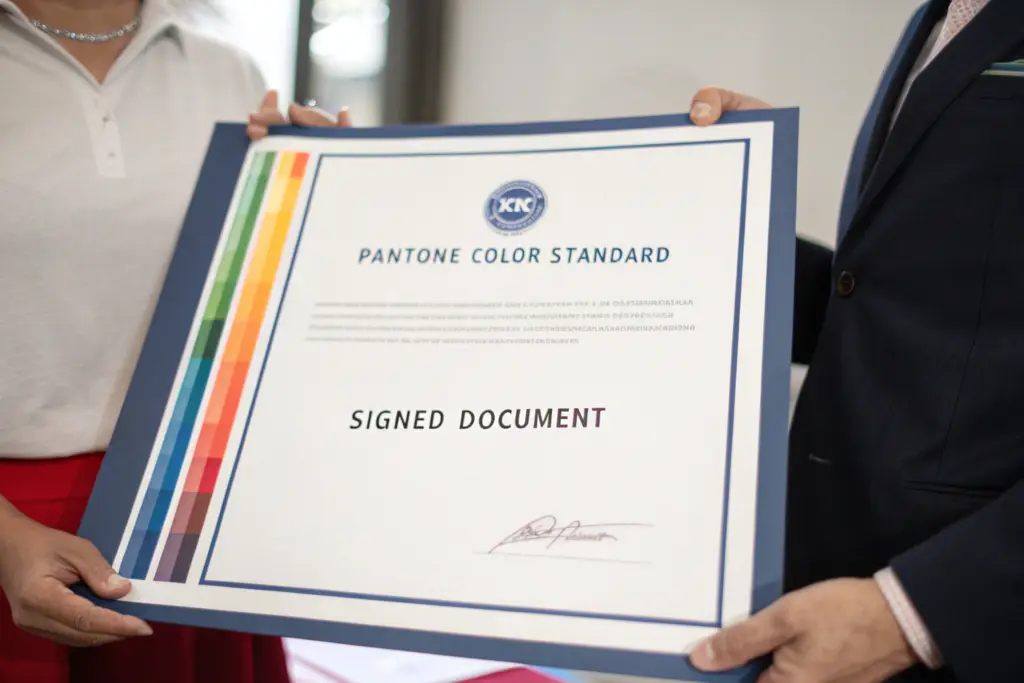
Our color certification package consists of three elements: a signed and dated spectrophotometer report, a set of sealed physical reference swatches, and a third-party validation certificate. This package is prepared for every single bulk production batch and is delivered to the corporate client alongside the shipment. It provides the brand with an objective, auditable proof that the color of their uniforms is correct, not just to a trained eye, but to the calibrated measurement of an ISO-accredited instrument.
What Is a Delta E CMC Report and Why Does It Eliminate Disputes?
A Delta E CMC report is a single-page, printed document generated by the spectrophotometer software. It contains a table of numerical color data that is the objective, unarguable truth of the fabric's color. The report lists the target Pantone reference, the measured Lab* coordinates of the fabric sample, the calculated Delta E CMC value, and a clear pass/fail statement against the agreed tolerance, typically a Delta E CMC of less than 1.0.
The power of this report is that it eliminates subjective, human language from a color approval conversation. A brand manager cannot say, "This looks a bit red to me." The report states, with mathematical precision, the exact spectral reflectance of the fabric. If the Delta E CMC is 0.6, the color is a certified match. The human eye's opinion is irrelevant against the instrument's measurement. If a color dispute should ever arise, this document is the legal arbiter. It transforms a subjective aesthetic argument into an objective, data-driven, and contractually binding verification. The report is signed and dated by our senior color chemist, and it forms a permanent part of the batch's quality dossier. This is the standard of evidence that a major corporate client demands, and it is the only language a professional color lab speaks.
How Does a Third-Party Lab Validate Our Pantone Certification?
For mission-critical uniform programs, we go one step further. We submit a random sample from the bulk production run to an independent, ISO 17025-accredited textile testing laboratory, such as SGS or Intertek. This third-party lab performs its own, fully independent spectrophotometer measurement against the Pantone master standard and issues its own, official test report on its own letterhead.
This third-party report provides an additional, legally robust layer of verification. It proves that our internal spectrophotometer was correctly calibrated and that our internal color chemist was not simply signing her own work. It is an impartial, external audit of our color matching claim. The third-party lab report, our internal Delta E CMC report, and the sealed physical swatch are collated into a single, bound "Uniform Color Certification Document." A physical copy is shipped with the garments, and a digital PDF is emailed to the brand's compliance department. This level of documentation is typically found only in the aerospace and automotive industries. We have adopted it for uniform programs because a corporate brand's color is a protected intellectual property asset. Mismanaging it is not a quality failure; it is a brand equity failure. The certification document is the proof that the asset has been accurately and faithfully reproduced, providing a defensible chain of custody from the Pantone book to the finished garment. This rigorous protocol is consistent with international standards for color measurement and certification.
Conclusion
Yes, Shanghai Fumao matches exact Pantone shades for uniforms, and we prove it with a spectrophotometer, not a pair of eyes. A uniform is not a garment; it is a physical expression of a corporate brand. A mismatched shade of grey between a blazer and a polo is a visible, public brand failure. We prevent that failure through a three-stage process: first, we formulate a unique, fiber-specific dye recipe in our in-house lab, recognizing that cotton, polyester, and nylon each require a completely different chemical path to the same visual target. Second, we use a calibrated Datacolor spectrophotometer to measure every lab dip and every bulk production batch against the Pantone master data, achieving a final Delta E CMC of less than 1.0, a tolerance that is visually imperceptible to the human eye. Third, we package the objective proof into a formal Uniform Color Certification Document, including an internal spectrophotometer report, a sealed physical swatch, and, for mission-critical programs, an independent, third-party SGS or Intertek validation report.
Your corporate client's brand color is a protected asset. We treat it with the same metrological rigor that an aerospace supplier treats a critical component tolerance. The result is a uniform program where the front desk blazer, the housekeeping polo, and the chef's apron all read as the identical, precise, and certified corporate color.
If you are a U.S. brand owner or a corporate uniform buyer who needs a guaranteed, certified, and documented Pantone shade match across multiple garments and fabric types, let's put our spectrophotometer to your Pantone target. Contact our Business Director, Elaine, at elaine@fumaoclothing.com. Send her your corporate Pantone numbers and the fabric specifications for each garment. She will have our color lab produce a cross-fiber lab dip card within seven days, complete with the measured Delta E CMC values. Let's build a uniform program where the color is not a hope, but a certified, documented physical fact.