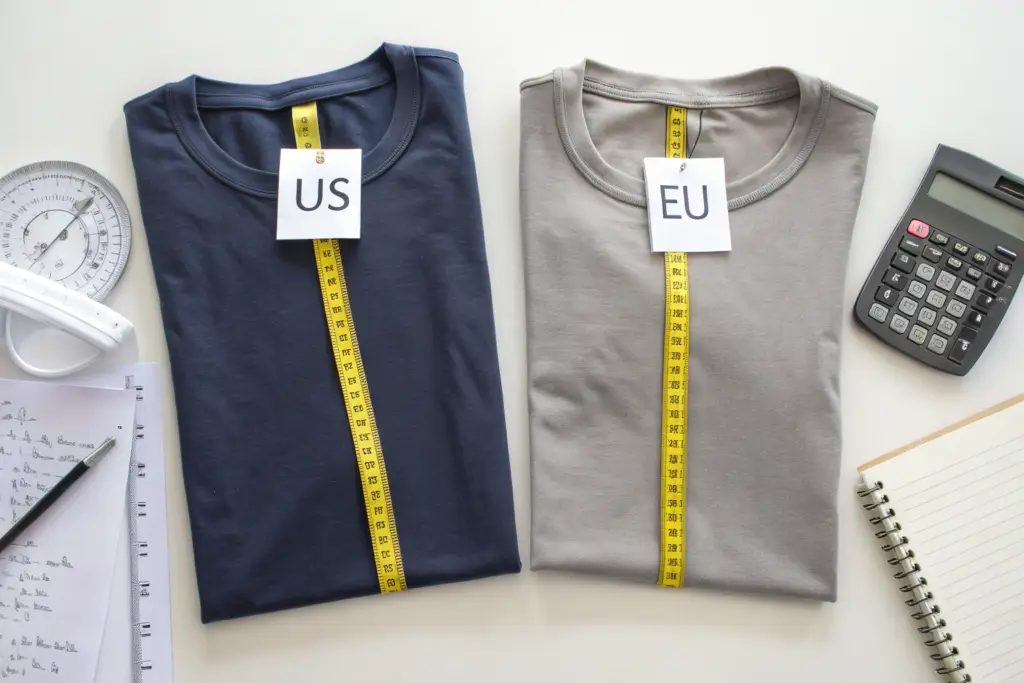
A brand owner once shipped 300 women's blouses from our Shanghai factory to her new wholesale account in Berlin. The order had been straightforward. Same style she sold in the US. Same fabric. Same production quality. The German boutique received the shipment and immediately emailed her. Every size was wrong. The US Small, which her American customers loved, fit like a European Extra Small. The US Medium fit like a European Small. Returns flooded in. The boutique cancelled their reorder. The brand owner lost a $12,000 account because she had assumed that a Medium is a Medium everywhere. That assumption is one of the most expensive mistakes a clothing brand can make when expanding internationally.
You navigate the exact sizing differences between US and European clothing markets by building a dual size specification table that translates every measurement point across both systems, not by adding two to the size number. A US women's size 6 is approximately a European size 36, but the relationship is not a simple formula. The grading between sizes differs. The body shape assumptions differ. The fit preference differs. The US market expects more ease and a more relaxed fit. The European market expects closer-to-body tailoring and less excess fabric. A brand that simply re-labels a US size chart with European numbers will produce garments that feel one to two sizes too small for the European consumer. The solution is a separate graded spec table for each market, built from anthropometric data specific to each population, and validated through fit sessions with target-market wear testers before bulk production begins.
This is not just a labeling exercise. It is a pattern engineering exercise. The garment that fits a customer in Chicago may not fit a customer in Paris, even if both customers have the same body measurements, because they expect the garment to interact with their body differently. I want to share the exact system we use at Shanghai Fumao to help our brand partners build size specifications that work in both markets without doubling their development costs or confusing their production team.
What Are the Exact Body Measurement Differences That Define US and European Size Grading?
A pattern maker at our factory once showed me something that perfectly illustrates the US-European sizing divide. She took a US size Medium dress pattern and a European size 38 dress pattern, both designed for the same target customer age range and both labeled as fitting a bust measurement of approximately 89 to 92 centimeters. She laid them on top of each other on the light table. The European pattern was narrower across the shoulders by 1.5 centimeters. The armhole was cut higher by 1 centimeter. The waist was suppressed by 2 centimeters. The hip curve was shaped differently. Same bust measurement. Fundamentally different garment. The pattern had been engineered for a different body shape distribution and a different fit expectation. That is why simply converting the size label fails.
The exact body measurement differences between US and European size grading start with the baseline body shape assumptions built into each system. The US market grading assumes a more rectangular body shape with less waist-to-hip differentiation. The European market grading assumes a more hourglass body shape with a more pronounced waist-to-hip ratio. The bust point position differs, with European patterns placing the bust point slightly higher and closer together. The shoulder slope differs, with European patterns assuming a more squared shoulder. These differences are not large individually. Cumulatively, they produce a garment that fits one population noticeably better than the other. A brand selling in both markets must either develop separate base patterns for each market or build enough adjustability into a single pattern to accommodate both body shape distributions.
The anthropometric data that underpins these differences comes from national sizing surveys. The US relies on ASTM International standards based on body measurement data collected from the US population. The EU relies on EN 13402 standards based on data collected from European populations. The populations are measurably different in their average body dimensions and their body shape distributions. A sizing system designed for one population will not accurately fit the other population at the same labeled size. The data exists. The brands that use it avoid the Berlin blouse disaster.
What Specific Bust, Waist, and Hip Measurement Grading Differences Exist Between ASTM and EN 13402 Standards?
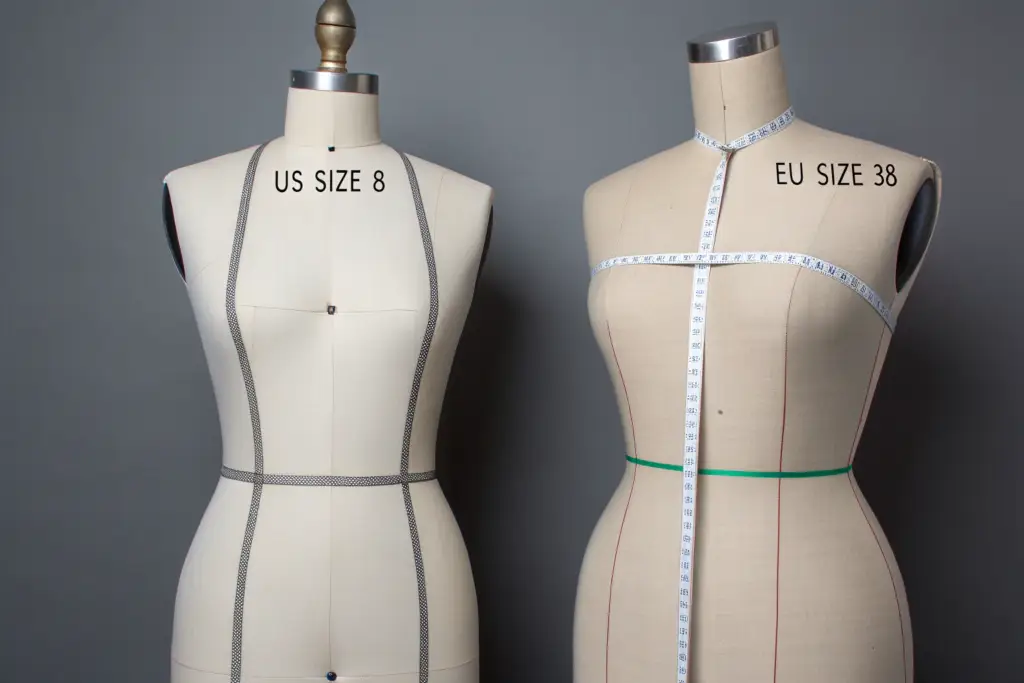
The ASTM D5585 standard for women's apparel sizing defines a size 8 as having a bust of 88.9 centimeters, a waist of 68.6 centimeters, and a hip of 93.9 centimeters. The EN 13402-3 standard defines a size 38 as having a bust of 88 to 92 centimeters, a waist of 69 to 72 centimeters, and a hip of 94 to 97 centimeters. At first glance, the measurements overlap. The bust range is similar. The waist and hip ranges, however, reveal the structural difference. The ASTM size 8 has a waist-to-hip difference of 25.3 centimeters. The EN 13402 size 38 has a waist-to-hip difference of approximately 23 to 25 centimeters. The difference in the standard is subtle, but the pattern application amplifies it. The US pattern is drafted with a straighter side seam from bust to hip. The European pattern is drafted with a more curved side seam that shapes the waist more aggressively. The ASTM versus EN size standards comparison also reveals differences in height assumptions. The US standard assumes an average height of approximately 165 centimeters for misses sizing. The European standard assumes an average height of approximately 168 centimeters. The 3-centimeter height difference affects torso length, arm length, and leg length grading. A brand that uses only US standards will produce garments that are slightly too short in the torso and limbs for the average European consumer.
How Do Shoulder Width and Armhole Depth Vary Between US and European Pattern Blocks?
Shoulder width is the single most impactful measurement difference between US and European fit. A US size Medium typically has a shoulder width of 38 to 40 centimeters measured across the back from shoulder point to shoulder point. A European size 38 typically has a shoulder width of 36 to 38 centimeters. The 2-centimeter difference means a European pattern sits closer to the neck and creates a more tailored shoulder line. The US pattern provides more coverage and a more relaxed shoulder line. The armhole follows the shoulder. A narrower shoulder pattern has a smaller armhole circumference and a higher armhole position. The European armhole sits approximately 1 to 1.5 centimeters higher than the US armhole for the same labeled size. A US consumer trying on a European-fit garment will feel restricted in the shoulder and underarm. A European consumer trying on a US-fit garment will feel like the shoulder is falling off and the armhole is gaping. These fit sensations are immediate and decisive. The consumer makes a keep-or-return decision within five seconds of putting the garment on. The shoulder and armhole fit differences are the most common source of cross-market fit rejection. The solution is a dedicated upper body block for each market, or a flexible block with adjustable shoulder width and armhole depth that can be modified during the pattern-making stage.
How Should a Brand Construct a Dual-Market Size Specification Table Without Doubling Development Work?
A brand owner I work with sells in both the US and the Netherlands. When she first expanded to Europe, she created two completely separate tech packs for every style. One tech pack with US sizing. One tech pack with EU sizing. Every measurement point was documented twice. Every pattern was drafted twice. Every sample was produced twice. Her development costs doubled. Her sample timeline doubled. Her confusion tripled because the two tech packs sometimes drifted out of sync. After two seasons, we helped her consolidate into a single dual-market tech pack. The document had one set of design specifications, one set of construction details, and two size specification tables side by side. The pattern maker used the US table to create the base pattern and then applied a documented set of adjustments to generate the EU pattern from the same base. The development time dropped back to nearly the single-market timeline. The cost increase was approximately 15% instead of 100%.
A brand constructs a dual-market size specification table by creating a single base size pattern for the brand's primary market and then documenting the specific grading and adjustment rules that convert the primary market measurements to the secondary market measurements. The base pattern is the foundation. The adjustment rules are the conversion engine. For each key measurement point, bust, waist, hip, shoulder width, armhole depth, sleeve length, body length, the spec table lists the primary market measurement, the adjustment amount, and the resulting secondary market measurement. The pattern maker follows the adjustment rules to generate the secondary market pattern from the base. This approach maintains a single source of truth for the garment design while accommodating the measurement differences required for each market. The brand does not design the garment twice. They design it once and adjust the fit for each market.
The dual-market spec table is a practical tool, not a theoretical document. It lives in the tech pack alongside the construction details, the fabric specifications, and the trim specifications. It is the reference that the pattern maker, the sample sewer, the quality inspector, and the brand owner all use to verify that the garment will fit the intended customer. When built correctly, it eliminates the ambiguity that causes cross-market sizing errors.

What Is the Most Efficient Base Pattern Strategy for Serving Both Markets from One Production Line?
The base pattern strategy starts with a decision. Which market is the brand's primary revenue driver? The primary market becomes the base pattern market. If 70% of the brand's sales are in the US and 30% are in Europe, the US pattern is the base. The European pattern is a derivative. The base pattern is drafted to the primary market's body measurements, fit preferences, and grading rules. The derivative pattern is created by applying a standard set of adjustments to the base pattern. The adjustments are documented in an adjustment matrix that the pattern maker references for every style. The adjustment matrix might specify: shoulder width reduced by 1.5 centimeters, armhole raised by 1 centimeter, waist circumference reduced by 2 centimeters, hip circumference increased by 1 centimeter, body length increased by 1.5 centimeters. These adjustments are applied to the base pattern to generate the derivative pattern. The base pattern derivative strategy works because the adjustments are consistent across styles within the same product category. A woven blouse and a knit top may have different adjustment matrices, but all woven blouses share the same matrix. The pattern maker learns the matrix once and applies it efficiently. The production line sees two patterns but understands they are variations of the same garment. The cutting, sewing, and finishing processes remain unified.
How Can a Brand Validate Its Dual-Market Specs Without Conducting Full Fit Sessions on Two Continents?
Full fit sessions with live models in multiple cities are ideal but expensive and time-consuming. A practical validation strategy uses a combination of remote fit testing and local wear-testing. The brand produces fit samples in the base size for both markets, typically US Medium and EU 38. The base market fit sample is evaluated through the brand's standard fit process. The secondary market fit sample is shipped to a trusted contact in the target market, a friend, a family member, a brand ambassador, a cooperative retail buyer, who tries on the garment and provides structured feedback via a video call. The brand watches the fit on a real body in the target market and makes adjustment notes in real time. The feedback is documented in the adjustment matrix for future styles. For brands with budget, professional fit validation services offer remote fit analysis using 3D body scanning and virtual try-on technology. The brand sends the pattern file and the physical sample. The service provides a detailed fit report with measurements, photographs on a standard dress form, and recommended adjustments. The cost is a fraction of an in-person fit session. The validation step is not optional. A spec table that has never been tested on a real body in the target market is a theory. A spec table validated through wear-testing is a proven tool.
What Fit Preference Differences Between US and European Consumers Must Sizing Strategies Accommodate?
A brand owner once sent the exact same dress to her US and UK wholesale accounts. Same style. Same fabric. Same production batch. The US accounts reported that customers loved the fit and were buying it in their usual size. The UK accounts reported that customers were sizing down because the dress ran large. Same garment. Same body measurements in both populations. Different fit expectations. The US customer put on the dress, felt the extra ease at the waist, and thought "This fits comfortably." The UK customer put on the same dress, felt the same extra ease, and thought "This is too big. I need a smaller size." The garment did not change. The perception of correct fit changed completely.
The fit preference differences between US and European consumers are not about body size. They are about the culturally conditioned expectation of how a garment should interact with the body. The US consumer generally prefers more ease, a more relaxed silhouette, and a fit that prioritizes comfort and movement. The European consumer generally prefers less ease, a more tailored silhouette, and a fit that prioritizes shape definition. These preferences affect every measurement point on the garment. The US consumer expects approximately 2 to 4 centimeters more ease in the bust and waist than the European consumer for the same garment category. A brand that ignores these preference differences and uses the same ease allowances for both markets will receive opposite fit complaints from each market. The US customer will say the garment runs small. The European customer will say the same garment runs large. Both are correct, measured against their own cultural fit standard.
Fit preference is the invisible variable in cross-market sizing. Body measurements are objective and can be tabled. Fit preference is subjective and must be learned through market exposure. The brand that has never sold in Europe will not intuitively know that a European customer expects a closer shoulder fit and a more defined waist. The brand that has never sold in the US will not intuitively know that a US customer expects more room in the upper arm and a longer body length. These preferences must be deliberately researched and incorporated into the adjustment matrix.

How Do Ease Allowances Differ Between the Two Markets for the Same Garment Category?
Ease allowance is the difference between the garment measurement and the body measurement. A blouse with a bust measurement of 96 centimeters designed for a body with a 90-centimeter bust has 6 centimeters of ease. The US market standard ease for a woven blouse is 8 to 12 centimeters at the bust. The European market standard ease for the same blouse category is 6 to 8 centimeters. The 2 to 4 centimeter difference is consistent across most woven categories. For knit tops, the difference is smaller but still present. US knit tops typically have 4 to 6 centimeters of ease. European knit tops typically have 2 to 4 centimeters. The ease difference extends to sleeve width, where the US consumer expects 6 to 8 centimeters of bicep ease and the European consumer expects 4 to 6 centimeters. The ease allowance standards by market are not arbitrary. They reflect decades of consumer feedback and retail return data. A brand that enters a new market with the wrong ease allowances will experience higher return rates, lower customer satisfaction, and ultimately lower wholesale reorder rates.
Why Does the Same Size Label Create Opposite Fit Complaints in New York and Paris?
The size label is a symbol. The consumer interprets the symbol through their cultural fit lens. A US size 8 consumer in New York tries on a dress with 10 centimeters of bust ease and says, "This fits true to size." A EU size 38 consumer in Paris tries on the same dress, which is labeled as a 38 on the European size tag, feels the 10 centimeters of ease, and says, "This runs large. I need a 36." The garment measurements are identical. The body measurements of the two consumers may be nearly identical. The fit perception is opposite. This phenomenon is called size labeling relativity. The consumer's perception of correct size is anchored to their experience with other brands in their market. A US consumer has years of experience with US brands that use generous ease allowances. A European consumer has years of experience with European brands that use tailored ease allowances. Each consumer's internal size reference is calibrated to their market's standard. When a brand deviates from that standard, the consumer perceives the deviation as a sizing error. The cross-cultural fit perception problem is solved by adjusting the garment measurements to match the target market's ease expectations, not by hoping the consumer will adapt to a foreign fit standard.
What Labeling and Size Conversion Strategies Prevent Customer Confusion and Returns?
A brand I manufacture for received a complaint from a customer who ordered a size Large online. The customer received a garment labeled Large on the hang tag and 42 on the interior care label. She was furious. She thought she had received a European size 42, which she understood to be a US size 12. She was a US size 10 and had intentionally ordered a Large. The garment fit her perfectly because the Large and the 42 were the same garment, labeled with both market sizes. The confusion was caused by the care label showing only the European size. The customer had no way to know that the 42 was the European equivalent of her US Large. She returned the garment. The brand lost a sale and a customer over a label that contained factually correct information presented in a confusing way.
Labeling and size conversion strategies prevent customer confusion and returns by presenting market-appropriate sizing information at every touchpoint where the customer makes a size decision. The e-commerce product page should display the size options in the customer's local sizing system and include a size guide that shows body measurements in both inches and centimeters. The hang tag should show the size in the market where the garment is being sold as the primary size, with the conversion size shown smaller. The interior care label should show both sizes in a format that clearly identifies which size belongs to which market. The goal is to make the size information unambiguous at every interaction point so the customer never doubts whether they ordered the correct size. Confusion is the enemy of conversion. Clarity is the ally.
The labeling strategy is the final mile of the sizing system. The brand can do everything right in pattern engineering, measurement specification, and fit validation, and still lose the sale if the size label confuses the customer. The labeling must be as carefully designed as the garment itself.
What Information Should a Dual-Market Size Label Include to Eliminate Ambiguity?
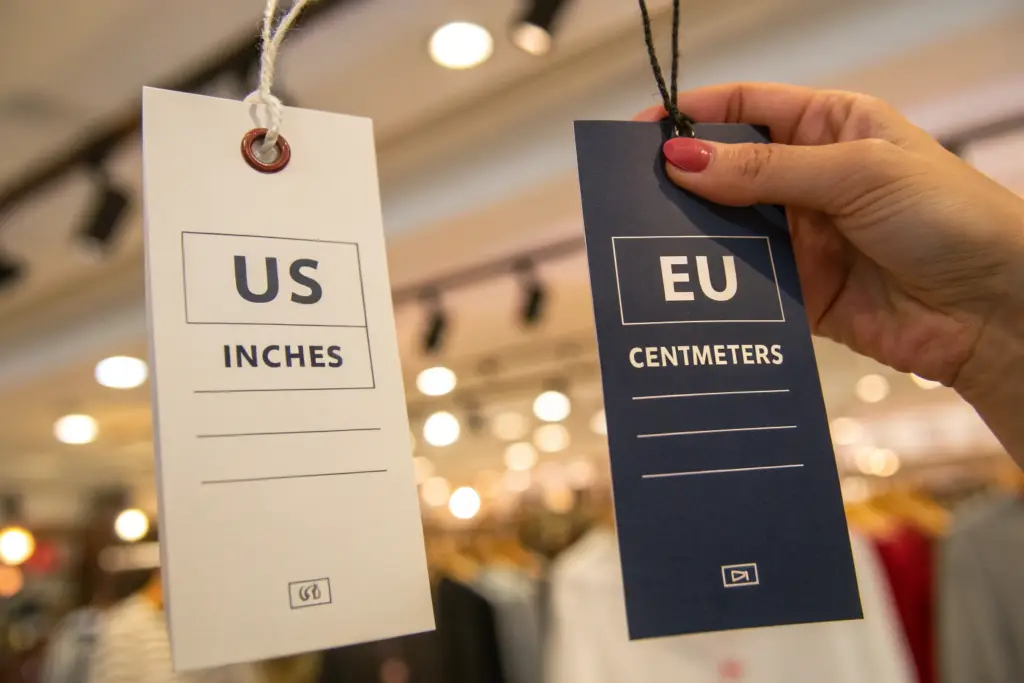
The dual-market size label should include three pieces of information: the primary market size, the secondary market size, and the market identifier for each. The format matters. A label that reads "M / 38" is ambiguous. The customer does not know if M equals 38 or if the garment fits both an M and a 38. A label that reads "US M / EU 38" eliminates the ambiguity. The customer immediately understands that the garment is a US Medium and a European 38. If the garment is sold in the US market, the primary size display is US M with EU 38 shown smaller. If the garment is sold in the European market, the primary size display is EU 38 with US M shown smaller. The interior care label follows the same format. The dual-market size label design should also include a QR code or URL that links to the brand's online size guide. The customer who wants additional measurement information can access it instantly from their phone. The size guide should show the body measurements for each size in both inches and centimeters, and should indicate whether the garment has a relaxed, regular, or tailored fit. The fit descriptor helps the customer interpret the measurements through the lens of ease allowance.
How Should E-Commerce Product Pages Handle Multi-Market Size Selection to Reduce Return Rates?
The e-commerce size selection experience must be market-aware. A customer browsing from a US IP address should see size options displayed in US sizing with US body measurements. A customer browsing from a French IP address should see size options displayed in EU sizing with centimeter body measurements. The platform should detect the customer's location and present the appropriate sizing system by default, with an option to switch manually. The product page should include a size recommendation tool that asks the customer for their height, weight, and typical size in a reference brand, and then recommends the correct size in the brand's sizing system. The size recommendation technology reduces return rates by 15% to 25% according to industry data. The tool translates the customer's self-reported measurements and preferences into a size recommendation specific to the garment they are viewing, accounting for the market-specific ease allowances built into the pattern. The customer who uses the size recommendation tool is making an informed choice rather than guessing based on a size label that may not match their expectations.
Conclusion
Navigating the sizing differences between US and European clothing markets is not about memorizing a conversion chart. A conversion chart is a starting point. It is not a solution. The solution is a systematic approach that addresses the body measurement differences between the populations, the fit preference differences between the cultures, and the labeling communication that prevents confusion at the point of purchase. The brand that builds a dual-market size specification table, validates it with target-market wear-testers, adjusts ease allowances to match each market's expectations, and labels the garment clearly at every customer touchpoint will sell successfully in both markets. The brand that simply adds two to the size number and hopes for the best will generate returns, complaints, and lost wholesale accounts.
At Shanghai Fumao, we have helped multiple brand partners expand from their home market into a second market without suffering the Berlin blouse disaster. We maintain current ASTM and EN 13402 size standard data. We build dual-market spec tables integrated into our standard tech pack format. We produce fit samples in both market sizes and support remote fit validation with target-market contacts. We print care labels and hang tags with clear dual-market size information. These capabilities are available to any brand partner who is planning a cross-market expansion or who has already experienced sizing issues in a new market.
If your brand is selling or planning to sell in both the US and European markets, we can help you build a sizing system that works in both markets without doubling your development work. At Shanghai Fumao, we will review your current size specifications and identify the specific adjustments needed for your secondary market. We can provide a dual-market spec table template and a pattern adjustment matrix specific to your product category. Contact our Business Director, Elaine, at elaine@fumaoclothing.com. She can share a sample dual-market spec table from a recent production order and discuss how our pattern engineering team can support your cross-market sizing strategy. Sizing differences are a solvable problem. Solve them before your customer tries to solve them in the fitting room.