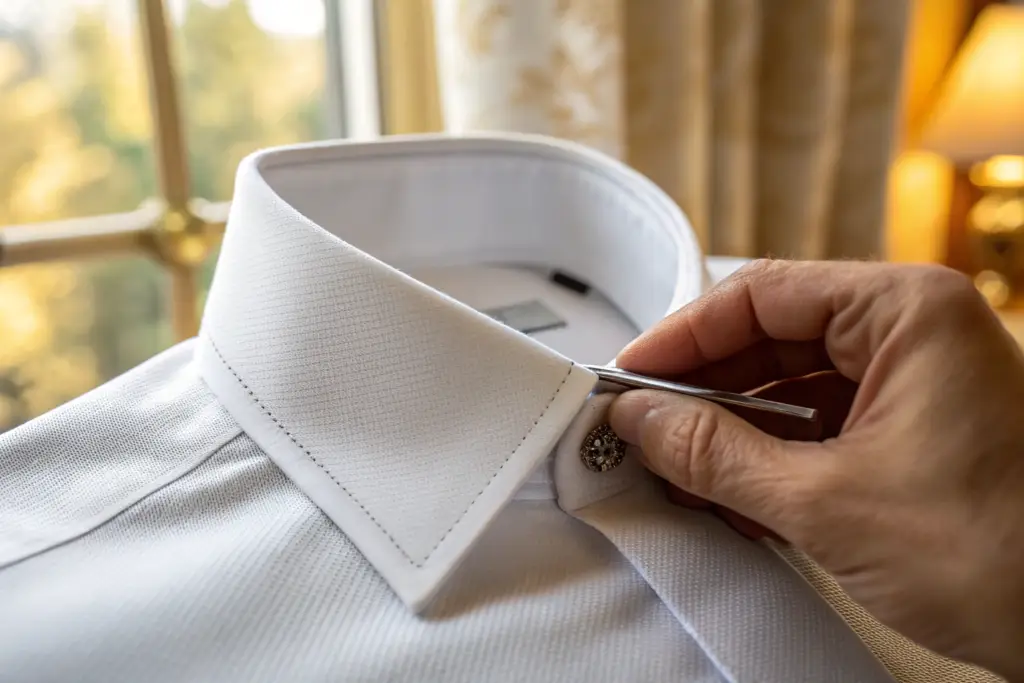
A few years ago, I sat in a Chicago steakhouse with the owner of a premium men's formal wear brand. He was a third-generation tailor, a man who could judge a suit's hand-stitching from ten feet away. Halfway through dinner, he pulled a crisp white dress shirt from his bag and laid it on the table. The collar points were curled upward, twisting slightly to the left. The fabric was beautiful. The stitching was perfect. But the collar looked tired and defeated. "This shirt retails for $185," he said, pointing at the curled point. "And it looks like a $40 shirt after two washes because of a ten-cent piece of plastic." He pulled out the transparent, flimsy, injection-molded collar stay that came with the shirt. It was bent into a permanent curve from the heat of a dryer. The collar's entire structure and perceived value had been destroyed by a component that cost less than the cardboard it was packaged with. This was not a fabric failure. It was a precision engineering failure, hiding in a tiny, overlooked pocket.
Shanghai Fumao's engineered collar stay system is a men's formal wear revolution because it replaces the disposable, deforming plastic stay with a spring-tempered, memory-retaining stainless steel stay, embedded in a reinforced, laser-sealed pocket, creating a collar that maintains its precise, architecturally sharp geometry for the life of the shirt. This is not a minor trim upgrade. It is a fundamental re-engineering of the collar's structural integrity, transforming it from a temporary, fragile promise into a permanent, high-performance asset. The collar is the frame of a man's face. A curled, deformed collar destroys the silhouette. A perfectly sharp, straight collar commands the room. This tiny piece of metal is the difference between a shirt that projects competence and a shirt that whispers neglect. Let me take you inside the material science, the failure analysis, and the manufacturing integration of the component that is quietly changing the value proposition of the formal dress shirt.
What Is the Structural Failure of a Traditional Plastic Collar Stay?
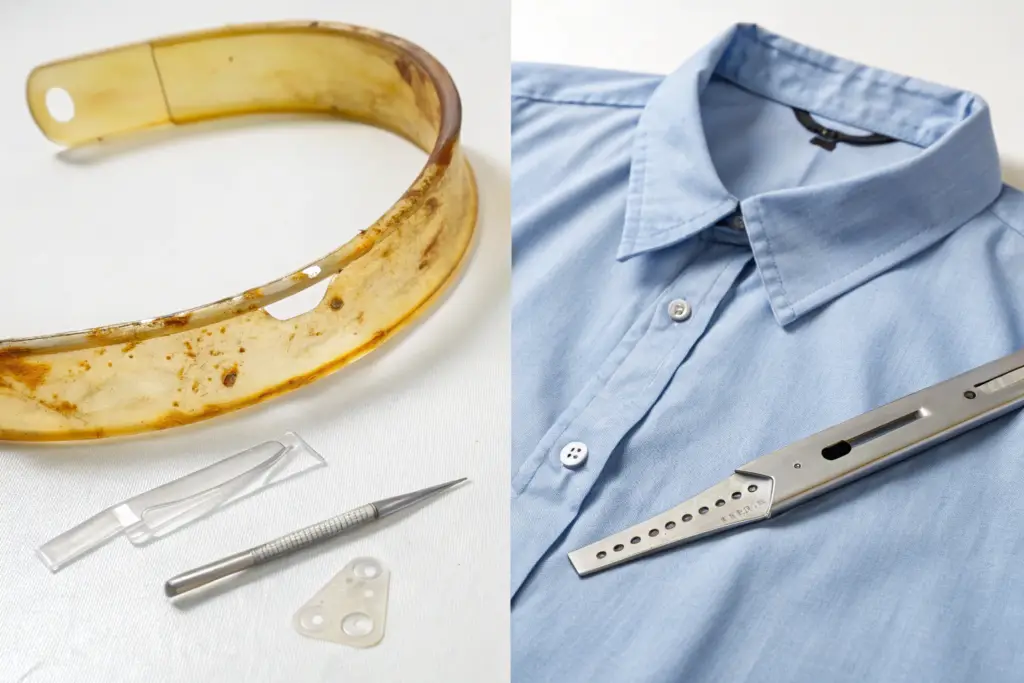
The traditional plastic collar stay is a mass-produced, injection-molded component made from low-density polyethylene or polypropylene. Its material properties are fundamentally unsuited to its structural purpose. It is designed to be cheap, not to perform. It fails predictably and catastrophically under the exact environmental conditions a dress shirt experiences in normal use: heat, moisture, and repeated mechanical flexing from the wearer's neck movement.
The failure mode is not a single, dramatic snap. It is a slow, cumulative deformation. Each wash cycle exposes the plastic to heat that is close to its glass transition temperature, the point at which the polymer softens and loses its internal molecular alignment. The tumbling action of the dryer bends the softened stay into a random, chaotic curve. As it cools, the plastic re-hardens in this deformed position. The collar point, now supported by a curved structural member, takes on a permanent, upward curl. The shirt is physically incapable of presenting a sharp, straight collar. The $185 shirt has been permanently downgraded by a 10-cent piece of plastic that cannot survive the very process designed to keep the shirt clean.
Why Does Polyethylene Soften and Deform in a Standard Dryer Cycle?
Polyethylene has a low glass transition temperature, typically between -20 and -130 degrees Celsius depending on its density, and a melting point of only 115 to 135 degrees Celsius. A standard household dryer operates at an internal air temperature of 50 to 70 degrees Celsius. This is well below the melting point of polyethylene, but it is dangerously close to its heat deflection temperature, the point at which a polymer under load begins to soften and lose its mechanical stiffness.
Inside a dryer, a collar stay is subjected to a simultaneous combination of heat and repeated, random mechanical flexing as the shirt tumbles. The heat softens the polymer. The flexing imposes a bending stress. The softened polymer's long molecular chains, which were aligned during the injection molding process, begin to relax and recoil into a lower-energy, more random configuration. This is called creep. When the dryer cycle ends and the stay cools, the polymer chains are locked into this new, deformed configuration. The stay has acquired a permanent set. It is now a spring that is permanently bent. Re-heating and straightening it by hand provides only a temporary fix; the polymer's "memory" of its deformed state remains, and it will re-curl with the very next wash. This is an irreversible material failure driven by the fundamental polymer physics of polyethylene. The component is simply not engineered for the thermal environment of a standard laundry cycle.
How Does a Curled Collar Point Destroy a Formal Silhouette?
The formal dress shirt collar is an architectural structure. Its purpose is to create a sharp, clean, symmetrical frame for the wearer's face. The two collar points should lie perfectly flat against the chest, creating a crisp, straight line that draws the eye upward to the face. This visual line communicates precision, discipline, and attention to detail.
A curled collar point destroys this geometry. It breaks the straight line and replaces it with an upward, chaotic curve. Visually, it disrupts the clean frame of the face. The asymmetry draws the eye not to the wearer's face, but to the defect. The curled point casts an unintended shadow on the shirt front, further emphasizing the irregularity. On a subconscious level, a curled collar signals neglect—the wearer did not take the time to ensure his appearance was perfect. In a professional context, where a suit is a uniform of competence, a curled collar is a small but powerful signal of carelessness. The damage is not just aesthetic; it is psychological. The wearer's authority is subtly diminished by a 10-cent piece of plastic that failed at its only job: to hold a piece of fabric straight. The entire suit—the jacket, the tie, the cufflinks—is visually undermined by a single, tiny, deformed plastic component. The collar stay is the most structurally critical component in a man's formal ensemble, and its failure is disproportionately catastrophic.
What Is the Material Science Behind Our Spring Steel Collar Stay?
The revolution is not the idea of a metal collar stay. Metal stays have existed for decades. The revolution is in the specific alloy, the precise heat treatment, and the manufacturing tolerances that transform a simple strip of metal into a high-performance, precision-engineered structural spring. We are not using stamped, soft stainless steel. We are using a custom-specified, hardened and tempered spring steel that is engineered to flex repeatedly without ever taking a permanent set.
Our collar stay is manufactured from AISI 301 stainless steel, a chromium-nickel austenitic alloy specifically designed for high-strength spring applications. The raw strip is cold-rolled to achieve a precise thickness of 0.4 millimeters, with a tolerance of +/- 0.01 millimeters. It then undergoes a controlled heat treatment process: heating to 1,050 degrees Celsius for full austenitization, followed by rapid quenching to lock the carbon atoms into a supersaturated solid solution. The resulting material has a hardness of 42 to 45 HRC on the Rockwell scale. It is stiff enough to hold a starched collar flat against the strongest neck movement, yet elastic enough to be bent 90 degrees and snap back to absolute, measured flatness. This is not a piece of metal; it is a precision spring.

What Is a "Memory Metal" and Why Does It Snap Back to Perfect Flatness?
"Memory metal" is a colloquial term for a material that exhibits superelasticity or a shape memory effect. True shape memory alloys, like Nitinol, return to a pre-set shape when heated. Our spring steel does not use thermal memory; it uses mechanical memory through its high yield strength. The yield strength is the amount of stress a material can withstand and still return to its original shape. Once the stress exceeds the yield strength, the material deforms permanently.
The key to our collar stay's "memory" is its exceptionally high yield strength, approximately 1,200 megapascals in its hardened condition. This is roughly four times the yield strength of the soft, annealed stainless steel used in cheap metal stays. When you bend our stay, you are applying a stress. As long as that stress is below the 1,200 megapascal yield point, the atomic lattice of the steel is stretching elastically. The atoms are displaced from their equilibrium positions, but the metallic bonds are not broken. When you release the stay, the stored elastic energy forces the atoms back to their original, lowest-energy positions. The stay snaps back to mathematically perfect flatness. A plastic stay has a yield strength of perhaps 20 to 30 megapascals. The heat of a dryer applies enough thermal stress to permanently deform the polymer chains, which is the equivalent of exceeding its yield strength. The spring steel stay, with its vastly higher yield strength, simply cannot be deformed by any stress it encounters inside a washing machine or a shirt collar. Its flatness is a material property, not a temporary condition.
How Does the Rounded Tip and Edge Polish Prevent Fabric Abrasion?
A sharp, burred metal edge is a fabric knife. A cheaply stamped metal stay often has a raw, sheared edge with microscopic burrs and a sharp, right-angled tip. These imperfections act as tiny saw blades, slowly cutting the cotton fibers of the collar pocket with every insertion and removal. Over time, the pocket develops small holes, the stay pokes through, and the collar is irreparably damaged.
Our stay undergoes a three-stage finishing process specifically designed to eliminate this abrasion risk. First, the tip is precision-ground into a smooth, elliptical radius of 2.5 millimeters, not a sharp point. This rounded profile slides into the pocket without snagging or concentrating stress on a single point of the fabric weave. Second, the entire edge profile is mechanically burnished using a ceramic media tumbling process. This process rolls over and smooths any micro-burrs left from the stamping operation, creating a completely smooth, rounded edge. Third, the stay receives a final electropolishing treatment. Electropolishing is an electrochemical process that selectively dissolves the microscopic peaks and valleys on the metal surface, leaving a mirror-smooth, passivated surface with zero coefficient of friction against cotton. The resulting stay slides into a fabric pocket with less resistance than a piece of silk. It physically cannot abrade the fabric because there is no sharp feature to do the cutting. This finishing protocol is what separates a premium, garment-safe component from a commodity metal part.
How Does Our Reinforced Pocket System Integrate With the Stay?
A perfect collar stay is worthless if it is housed in a weak, poorly constructed pocket. The stay and the pocket are a single, integrated structural system. The pocket must do three things: it must provide a tight, friction-fit channel that prevents the stay from migrating or falling out, it must be abrasion-resistant enough to withstand thousands of insertion and removal cycles without tearing, and its opening must not fray and degrade over time. The failure of any one of these three functions renders the stay useless.
In a standard shirt, the collar stay pocket is a simple, un-reinforced channel stitched directly into the collar point. The opening is raw, prone to fraying, and the fabric is the same single layer of cotton as the rest of the collar. This is a pocket designed to hold a disposable plastic stay for the retail display, not a precision steel component for the life of the shirt. Our system completely re-engineers this pocket.
Why Is a Laser-Sealed Pocket Opening Critical to Preventing Fraying?
A traditional stitched pocket opening is a raw fabric edge folded under and secured with a single line of lockstitching. Under the repeated friction of a rigid metal stay being inserted and removed, the cotton fibers at this folded edge begin to separate and unravel. The stitch line itself acts as a perforation, a line of weakness where the needle has pierced the fabric. After a few dozen cycles, the pocket opening frays, widens, and loses its structural integrity. The stay becomes loose, falls out, and is lost.
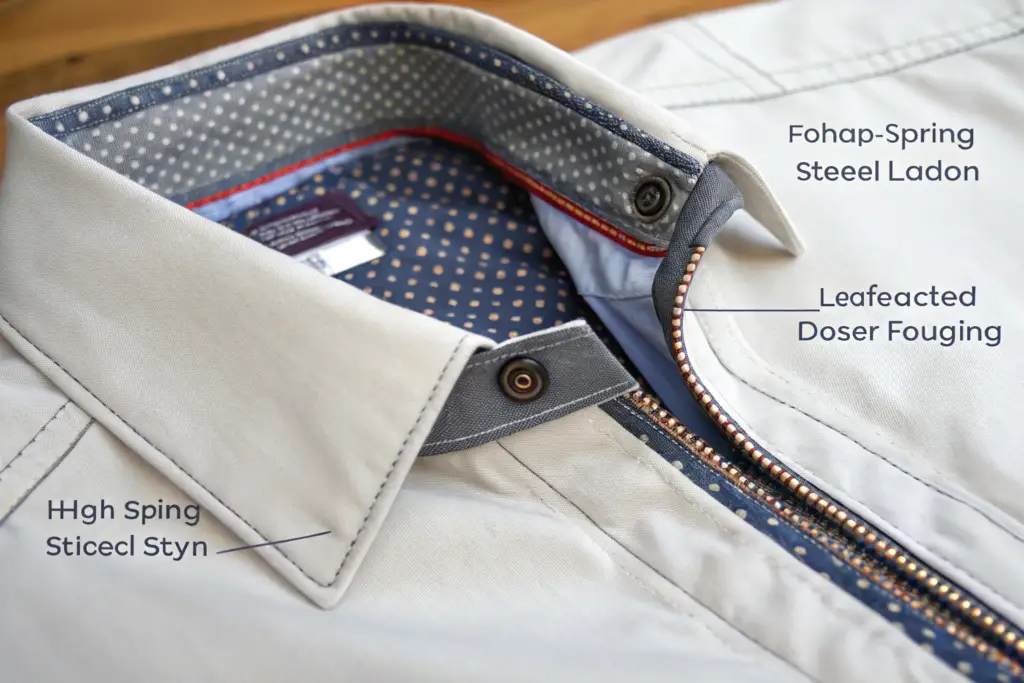
Our laser-sealed pocket opening eliminates this failure mode entirely. Instead of a folded and stitched edge, the fabric is cut with a high-precision CO2 laser. The laser's heat instantly fuses the cotton fibers along the cut line into a solid, sealed, polymerized edge. This edge is physically incapable of fraying because the individual fiber ends no longer exist; they have been melted into a continuous, smooth bead of cellulose char. The stay pocket is then constructed with this laser-sealed edge on the outside of the opening. When the stay is inserted, it slides against a smooth, hard, fused surface, not a raw textile edge. There are no loose fibers to catch, no stitch holes to tear, and no raw edge to unravel. The pocket opening remains dimensionally stable and perfectly smooth for the life of the shirt. This is a permanent structural solution to the fraying problem, and it is a manufacturing technology we have adapted from our premium woven label production line, where laser-sealing edges is our standard anti-fray protocol.
How Does a Stiffened Pocket Channel Prevent Stay Migration?
Stay migration is the slow, creeping movement of the stay out of the pocket during wear, driven by body heat, neck movement, and gravity. A loose pocket allows the stay to slide upward, protruding visibly above the collar point. This is a constant, irritating distraction for the wearer, who must repeatedly push the stay back down into place. It signals a poorly engineered garment.
Our pocket channel is engineered with a deliberate interference fit. The internal width of the pocket is laser-measured during construction to be exactly 0.2 millimeters narrower than the width of the steel stay. This creates a controlled, gentle, friction grip along the entire length of the stay. Additionally, the pocket fabric is reinforced with a high-density, woven polyester interfacing that is heat-fused to the inside of the cotton shell. This stiffened fabric does not relax or stretch over time, maintaining its precise internal dimension permanently. The combination of the interference fit and the dimensionally stable, stiffened pocket fabric creates a channel that mechanically locks the stay in place. It requires a deliberate, firm pull from the wearer to remove the stay. It will not migrate, vibrate, or fall out during normal wear, no matter how active the wearer is. The stay is a spring held in a precision channel, and the two components work as a unified, stable mechanical system.
Conclusion
The curl of a collar point is a small physical deformation with a massively disproportionate impact on a man's perceived authority and attention to detail. Shanghai Fumao's spring steel collar stay system is a revolution because it treats the collar stay not as a disposable packaging insert, but as a precision-engineered structural component that defines the architectural integrity of the shirt for its entire usable life. We replaced the thermally unstable, low-yield-strength polyethylene stay with a hardened, tempered AISI 301 stainless steel spring that has a yield strength of 1,200 megapascals and an elastic memory that snaps back to mathematically perfect flatness after being bent 90 degrees. We eliminated fabric abrasion with an electropolished, mirror-smooth surface and a rounded, elliptical tip. We solved pocket fraying with a laser-sealed opening, and we solved stay migration with a dimensionally stable, stiffened, interference-fit pocket channel. The result is a collar that stays sharp, straight, and architecturally precise through a hundred wash cycles, projecting the same crisp, commanding silhouette on the hundredth wear as it did on the first.
The collar is the frame of the face. A plastic stay is a broken frame. A spring steel stay is a permanent, unbreakable frame. The difference in component cost is a few cents. The difference in perceived garment quality is a hundred dollars. For a brand, this tiny piece of metal is the most powerful, cost-effective, and customer-loyalty-building upgrade you can specify.
If you are a U.S. brand owner or buyer who wants to permanently solve the curled collar problem and offer your customer a genuinely engineered, high-performance formal shirt, we can send you a sample shirt with our complete collar stay system installed. Contact our Business Director, Elaine, at elaine@fumaoclothing.com. Tell her you want the spring steel collar stay sample. Put the shirt through ten wash cycles. Bend the collar stay 90 degrees yourself. Watch it snap back to perfect flatness. Then let's build a formal shirt program where the collar is a permanent structure, not a temporary hope.