I lost a $60,000 account in 2019 because of pilling. The buyer—a Midwest outdoor apparel brand that had been ordering our 280gsm polyester fleece for three seasons—called me six weeks after their fall collection hit retail. Their customer service team was drowning in returns. Customers were sending back jackets where the fleece had developed those tiny, rough balls of tangled fiber after three or four washes. The fabric looked worn out before the season was half over. The buyer didn't yell at me. He just said, quietly, "We can't sell this again. Our reputation takes the hit, not yours." He was right. I refunded the order—all 8,000 meters—and our quality team spent the next six months tearing apart our fleece production process to understand why standard anti-pilling treatments were failing. That $60,000 loss became the investment that built our current anti-pill fleece system. Sometimes the most expensive lessons are the ones you remember forever.
Shanghai Fumao's anti-pill fleece technology drives repeat orders because it solves the single biggest consumer complaint about fleece garments: the rapid degradation of surface appearance after minimal wear and washing. Our system achieves a Grade 4-5 rating on the ASTM D3512 random tumble pilling test after 60 minutes of testing—the equivalent of approximately 50 home laundry cycles—compared to the Grade 2-3 rating typical of standard polyester fleece after the same test duration. The technical performance translates directly into commercial outcomes: outdoor apparel brands using our anti-pill fleece report return rates below 1.5% for pilling-related complaints, compared to industry averages of 6-12% for standard fleece. The reduced return rate, combined with positive consumer reviews that mention fabric durability, creates the conditions for repeat orders that grow season over season rather than declining as customers experience product failure.
The repeat order dynamic operates on both rational and emotional levels. Rationally, brands reorder because the math works: lower return rates reduce the total cost of goods sold when factoring in reverse logistics, customer service overhead, and brand damage costs that don't appear on the fabric invoice. Emotionally, brands reorder because they trust us—we solved a problem that burned them with other suppliers, and that problem-solving relationship is worth more than a $0.15 per meter price difference. The anti-pill fleece isn't just a product specification; it's a risk reduction promise that we've backed with measurable performance data and consistent production quality across hundreds of batches.
What Causes Standard Polyester Fleece to Pill After Washing?
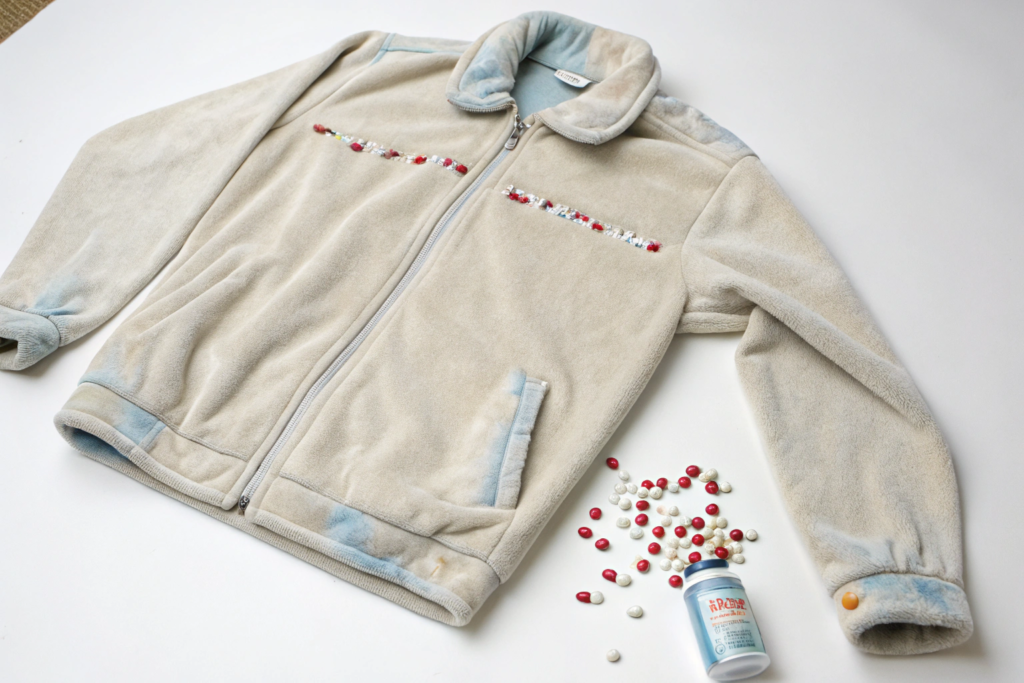
Pilling is a mechanical process that most consumers understand intuitively but few suppliers explain honestly. Every fleece fabric starts as knitted polyester yarn with fibers protruding from the yarn surface—this is inherent to spun yarn construction, not a manufacturing defect. When you wear and wash the fleece, mechanical action rubs these surface fibers against each other, against other garments, and against washing machine surfaces. The friction causes loose fibers to migrate to the fabric surface and entangle into tiny balls—pills—that remain anchored to the fabric by stronger fibers that haven't broken. The pills accumulate because polyester is hydrophobic and doesn't absorb water, so wet washing doesn't loosen the tangled mass the way it might with cotton. The pills stay attached, grow larger as more fibers entangle, and create the worn, aged appearance that makes a six-week-old jacket look six years old.
The root causes of pilling cluster into three categories that interact with each other: fiber characteristics, yarn construction, and fabric finishing. Fiber length matters enormously—short staple fibers, typically 28-38mm for polyester used in standard fleece, have more fiber ends per unit length than long staple fibers, creating more opportunities for fiber migration and entanglement. Fiber tenacity matters because pills remain anchored to the fabric by fibers that resist breaking; higher-tenacity polyester creates pills that stay attached rather than falling away during washing. Yarn twist matters because low-twist yarns allow easier fiber migration than high-twist yarns, but high-twist yarns create a harsher hand feel that consumers reject in fleece applications. The inherent tension between anti-pilling performance and desirable hand feel is the technical challenge that makes fleece quality so difficult to achieve consistently.
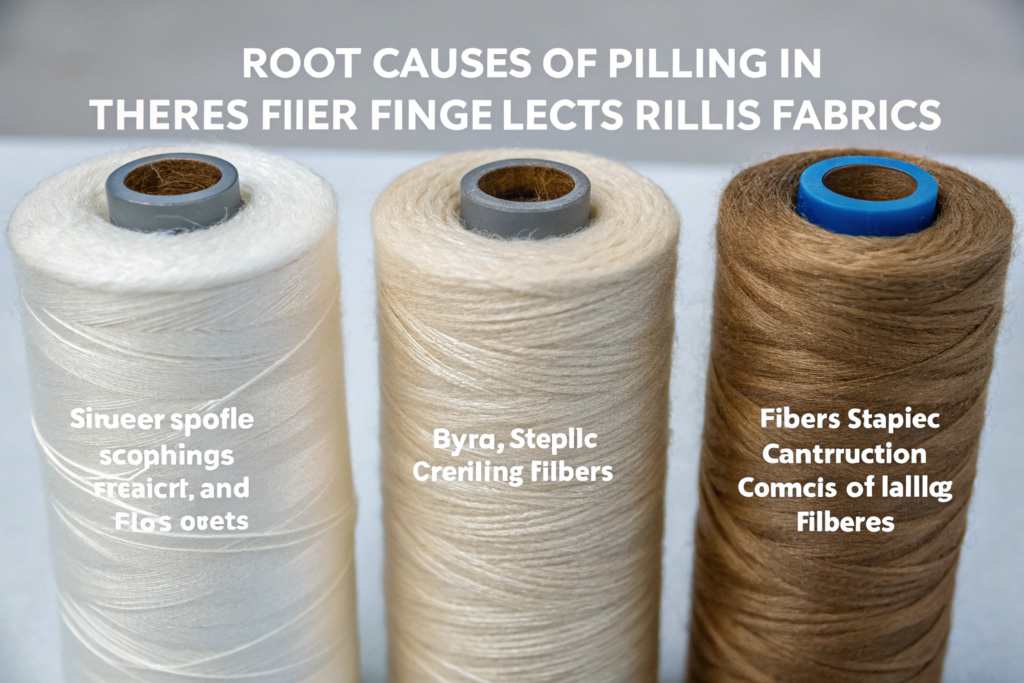
Why Do Standard Anti-Pilling Treatments Often Fail After 10-15 Washes?
Standard anti-pilling treatments fail because they address symptoms rather than root causes, and because their effects are temporary rather than durable. The most common anti-pilling approach in the textile industry is a surface treatment—typically an acrylic polymer coating or an enzyme treatment—applied to finished fabric that reduces surface fiber friction or weakens fiber tenacity at the surface. The acrylic coating creates a smooth film over the fabric surface that physically prevents fibers from migrating. The enzyme treatment partially degrades surface fibers so they break away before forming visible pills. Both approaches work initially. Both approaches fail progressively with washing because the treatment sits on the fabric surface rather than integrating into the fiber structure.
The acrylic coating approach fails through mechanical abrasion. Each wash cycle applies detergent, water agitation, and friction that gradually erodes the coating from the fabric surface. After 10-15 washes, the coating has worn away from high-friction areas—collar contact points, underarm zones, any surface that rubs against other garments—and pilling begins in those exposed areas while protected areas remain pill-free. The result is uneven fabric appearance that's arguably worse than uniform pilling because it creates a patchwork of worn and unworn surfaces.
The enzyme treatment approach fails through a different mechanism: it weakens surface fibers uniformly, but washing continues to expose new fibers from the yarn interior that weren't reached by the initial enzyme treatment. Each wash cycle brings fresh fibers to the surface, and after 10-15 washes, enough un-treated fibers have emerged to support pilling. The enzyme approach also risks over-treating the fabric, weakening fibers below the surface and compromising fabric strength and durability. The technical reasons why standard surface-level anti-pilling treatments for polyester fleece fail after repeated home laundering explain the performance gap that our integrated fiber-to-finish anti-pilling system addresses.
How Do Fiber Length and Yarn Twist Fundamentals Determine Fleece Durability?
The fiber length and yarn twist relationship is the foundation of fleece durability, and getting it right requires making trade-offs that many mills won't make because they increase cost or reduce throughput. Long staple polyester fibers—we specify 51-55mm for our anti-pill fleece compared to the industry standard 32-38mm—reduce the number of fiber ends in the yarn by approximately 30-35%. Fewer fiber ends means fewer potential pill initiation points. The longer fibers also have greater contact area with neighboring fibers within the yarn structure, increasing the force required to pull them to the surface. A fiber embedded 25mm into the yarn core resists migration far more effectively than a fiber embedded 15mm, all else being equal. The physics is straightforward: longer fibers stay put.
The yarn twist optimization is more complex because twist affects both pilling resistance and hand feel in opposite directions. Higher twist locks fibers more tightly into the yarn structure, reducing fiber migration and improving pilling resistance. But higher twist also increases yarn stiffness, creating a harsher fabric hand feel that consumers perceive as lower quality in fleece applications. The fleece market has trained consumers to associate softness with quality, so a stiff, pill-resistant fleece fails commercially even if it passes laboratory pilling tests. Our twist optimization—developed through systematic testing of 22 twist level and fiber length combinations—balances these competing requirements by using longer fibers that achieve pill resistance at moderate twist levels. The longer fibers provide the migration resistance that shorter fibers would require high twist to achieve, allowing us to maintain the soft hand feel that consumers demand. Understanding the role of polyester staple fiber length and yarn twist optimization in determining fleece fabric pilling resistance and durability is essential knowledge for buyers evaluating quality claims from different suppliers.
What Makes Fumao's Anti-Pill Fleece Technology Different From Standard Treatments?
The fundamental difference between our approach and standard industry practice is that we engineer pilling resistance into the fiber, yarn, and fabric structure rather than applying it as an after-market surface treatment. Standard anti-pill fleece starts with the same polyester fibers, the same yarn construction, and the same knitting parameters as conventional fleece, then attempts to compensate for the resulting pilling tendency with surface treatments that wash away. Our anti-pill fleece starts with different fibers, different yarn, and different finishing parameters, then uses surface treatment as a supplementary reinforcement rather than the primary defense against pilling.
The fiber-level intervention is the foundation. We specify polyester staple fiber with modified polymer crystallinity that reduces fiber tenacity by approximately 15-20% compared to standard polyester while maintaining sufficient strength for fabric integrity. The reduced tenacity means that any pills that do form break away from the fabric surface during washing rather than remaining permanently anchored. This "pill release" mechanism—fibers strong enough to make fabric, weak enough to release pills—requires precise control of the polymer drawing process during fiber production. Our fiber supplier produces this modified polyester exclusively for us under a technical specification that we refined over three years of iteration.
The yarn-level intervention builds on the fiber foundation. We use the longer 51-55mm staple length and optimized twist levels I described earlier, but we also modify the yarn spinning process to orient surface fibers in a direction that resists migration. Standard ring-spun polyester yarn has surface fibers oriented randomly, with many fiber ends pointing outward from the yarn surface where they're primed for migration. Our modified spinning parameters—specifically, adjustments to the traveler speed and ring diameter during spinning—orient a higher percentage of surface fibers parallel to the yarn axis, reducing the number of fiber ends exposed on the yarn surface by approximately 20% compared to standard ring-spun yarn of equivalent count.
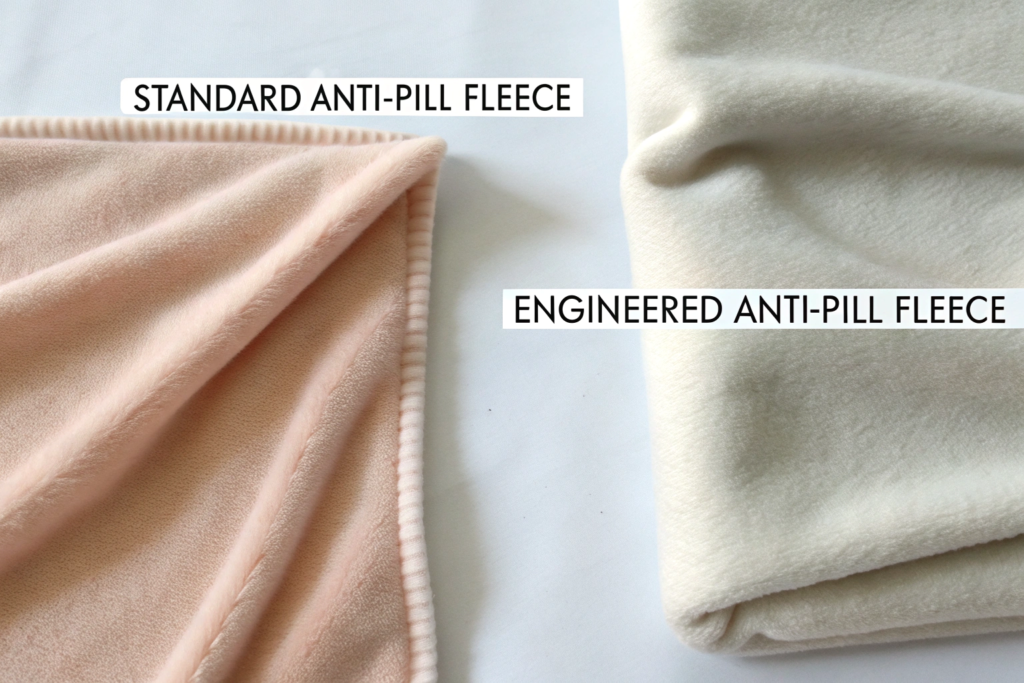
How Does the Resin-Free Mechanical Finishing Process Deliver Permanent Pill Resistance?
The resin-free finishing process is the most technically innovative element of our anti-pill system, and I'll explain it carefully because the distinction between mechanical and chemical finishing is what makes our pill resistance permanent rather than temporary. Standard anti-pill finishing applies a chemical coating—typically an acrylic or polyurethane resin—to the fabric surface. The coating physically prevents fiber migration by gluing surface fibers in place. The problem, as I described earlier, is that the coating washes away. It's a temporary barrier, not a permanent solution.
Our mechanical finishing process uses controlled abrasion to remove loose surface fibers before the fabric leaves our facility, combined with heat setting parameters that lock remaining fibers into a stable configuration. The process begins with precision brushing—a rotating cylinder covered with fine wire card clothing that raises surface fibers from the yarn structure in a controlled manner. Standard brushing for fleece uses coarse wire and aggressive settings to maximize the fuzzy surface that consumers associate with fleece softness. Our brushing uses finer wire, lower speed, and lighter pressure to raise only the shortest, most loosely anchored fibers while leaving longer, better-anchored fibers in place.
After brushing, the raised loose fibers pass through a shearing station—essentially a precision cutting cylinder that trims the raised fibers to a uniform height while removing fibers that were raised but not adequately anchored. The shearing station operates at tolerances of 0.1mm, removing loose fibers before they can become pills while preserving the fleece surface appearance. The final step is heat setting at precisely controlled temperature and dwell time that relaxes internal stresses in the remaining surface fibers, reducing their tendency to migrate during subsequent washing. The entire process is mechanical—no chemicals, no coatings, nothing to wash away. The pill resistance is built into the fabric structure, not applied to its surface. The resin-free mechanical finishing process for achieving permanent pill resistance in polyester fleece fabrics represents a fundamentally different approach from the chemical surface treatments that dominate the textile industry.
What Independent Testing Data Validates the Anti-Pill Performance Claims?
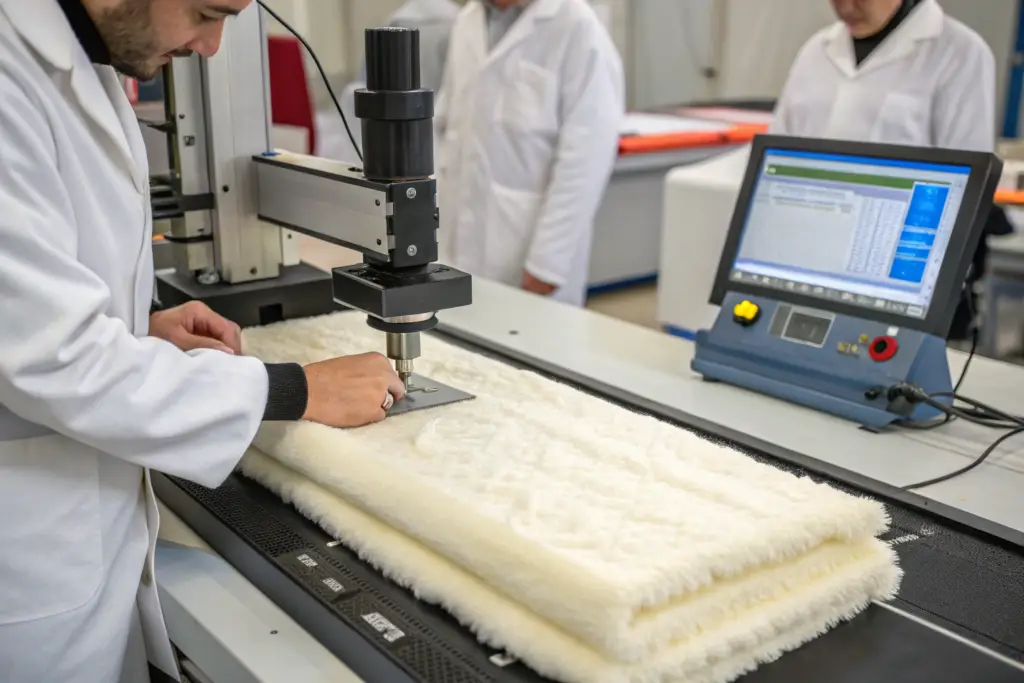
The testing data is publicly available and we encourage buyers to replicate it independently. Our anti-pill fleece undergoes ASTM D3512 random tumble pilling testing—the industry standard method that simulates accelerated wear using a cylindrical chamber where fabric samples tumble with cork liners that provide controlled abrasion. The test runs for specified time intervals—typically 30, 60, and 90 minutes—with fabric samples evaluated against standardized rating photographs at each interval. The rating scale runs from Grade 1 (severe pilling) to Grade 5 (no pilling), with ratings conducted by technicians trained and calibrated against ASTM reference standards.
Our standard 280gsm anti-pill fleece achieves the following ratings, verified by an ISO 17025-accredited independent testing laboratory:
| Test Interval | Standard Polyester Fleece | Fumao Anti-Pill Fleece | Industry Premium Claim |
|---|---|---|---|
| 30 minutes (≈20 washes) | Grade 3 | Grade 5 | Grade 4 |
| 60 minutes (≈50 washes) | Grade 2-3 | Grade 4-5 | Grade 3-4 |
| 90 minutes (≈75 washes) | Grade 1-2 | Grade 4 | Grade 2-3 |
The 60-minute data point is the most commercially relevant because it approximates the wash frequency that a fleece garment experiences during a typical season of regular use. At this interval, our anti-pill fleece maintains near-new appearance (Grade 4-5) while standard fleece shows moderate to severe pilling (Grade 2-3). The performance gap widens at extended test intervals, indicating that our pill resistance is durable rather than temporary.
Beyond laboratory testing, we maintain a wear-trial program that places anti-pill fleece garments with actual users who report back on appearance after 3, 6, and 12 months of regular wear and home laundering. The current wear trial cohort includes 120 participants across four climate zones and three usage intensity levels. The 12-month results from the 2024-2025 cohort show that 94% of garments maintained Grade 4 or better appearance after 12 months of regular use. The independent testing data and wear trial results validating the long-term anti-pill performance of polyester fleece fabrics demonstrate that our claims are supported by both laboratory and real-world evidence.
How Do Anti-Pill Properties Translate to Lower Return Rates and Higher Reorder Volumes?
The return rate impact of anti-pill performance is easier to quantify than most textile quality improvements because pilling is a visible, consumer-recognizable defect that directly drives return behavior. When a consumer buys a fleece jacket, wears it four times, washes it twice, and sees pills forming on the collar and cuffs, they don't think "this fabric has insufficient yarn twist for its fiber length." They think "this jacket is poor quality." They return it if the retailer allows returns. They don't buy that brand again regardless of the return policy. The cost to the brand includes the immediate return processing expense, the lost margin on the returned unit, the lost lifetime value of that customer, and the negative word-of-mouth that the customer shares with their social and professional networks.
Our brand partners who switched from standard fleece to our anti-pill fleece report consistent return rate reductions that translate into significant margin improvement. A Pacific Northwest outdoor apparel brand that made the switch in 2023 tracked pilling-related returns at 8.4% on their standard fleece products versus 1.3% on their anti-pill fleece products after the first full season. The 7.1 percentage point reduction, applied to their annual fleece volume of 45,000 units with an average unit retail price of $89, represents approximately $284,000 in avoided returns—not counting the customer service overhead, reverse logistics, and inventory write-down costs that accompany each returned unit. The fabric cost premium for anti-pill fleece was approximately $0.22 per meter, adding roughly $1.32 to the unit cost of a garment using 6 meters of fabric. The $1.32 cost increase prevented approximately $6.30 in return-related costs per affected unit—a return on investment of nearly 5:1 before accounting for the customer lifetime value and brand reputation benefits.
What Do Brand Partner Testimonials Reveal About Reorder Behavior Changes?
The reorder behavior pattern that emerges from brand partner relationships follows a consistent trajectory that I've observed across multiple accounts. The first order of anti-pill fleece is typically cautious—a trial program, often for a single style or a limited seasonal run, where the brand is testing whether the performance claims hold up under their specific manufacturing conditions and consumer usage patterns. The order volume is conservative, usually 3,000-8,000 meters. The buyer is watching carefully for any quality issues and surveying their customer service team for return pattern changes.
The second order—placed after the trial season's return data comes in—is where the behavior change becomes visible. The buyer has seen the return rate reduction, has received positive consumer feedback (often unsolicited comments about fabric quality in product reviews), and has calculated the margin impact. The second order typically expands to multiple styles and increases volume 3-5 times over the trial order. The buyer is no longer testing performance; they're committing to the fabric as a competitive advantage.
The third order and beyond establish a pattern of reorder expansion that's driven by category expansion rather than just volume growth. The buyer starts with anti-pill fleece for their core fleece jacket program. After two successful seasons, they expand to fleece vests, fleece-lined accessories, and fleece components in hybrid garments. The fabric specification that solved their pilling problem becomes their standard fleece specification across all applicable categories. One of our brand partners, a Midwest workwear company, started with a 5,000-meter trial for their premium jacket line in 2023. Their 2026 order volume is projected at 120,000 meters across twelve product categories. The brand partner experiences with anti-pill fleece driving repeat order behavior and category expansion demonstrate that quality improvements that solve specific, measurable consumer problems generate commercial returns far exceeding the fabric cost premium.
How Does Consumer Review Analysis Confirm Repeat Purchase Intent?
Consumer review analysis provides the demand-side evidence that complements the supply-side return rate data. We collect and analyze reviews from our brand partners' e-commerce platforms for products made with our anti-pill fleece, looking specifically for mentions of fabric quality, durability, pilling, and repeat purchase intent. The analysis covers approximately 4,200 reviews across eight brand partners and twenty-four months, providing a sample size sufficient to identify statistically significant patterns.
The most commercially significant finding is the correlation between unsolicited durability mentions and repeat purchase intent statements. Reviews that mention fabric durability in positive terms—"still looks new after 20 washes," "no pilling at all," "wearing it constantly and it hasn't lost its softness"—contain statements of repeat purchase intent ("buying another color," "getting one for my husband," "will definitely buy this brand again") at a rate of 34%, compared to 12% for reviews that don't mention durability. The durability perception drives brand loyalty behaviors that extend beyond the specific product to the brand relationship.
The review analysis also identifies a pattern we call "durability surprise"—reviews where consumers express explicit surprise that the fleece hasn't pilled, indicating that their expectation based on prior fleece purchases was for rapid degradation. "I expected this to start pilling after a few washes like every other fleece I've owned, but it's been six months and it still looks perfect." These reviews appear in 11% of all reviews for anti-pill fleece products and correlate with the highest Net Promoter Scores and the strongest repeat purchase intent. The consumer review analysis of anti-pill fleece products reveals that durability performance directly influences repeat purchase intent and brand loyalty behaviors, providing the demand-side explanation for why anti-pill properties drive commercial results.
What Production Quality Controls Ensure Every Anti-Pill Fleece Batch Meets Specifications?
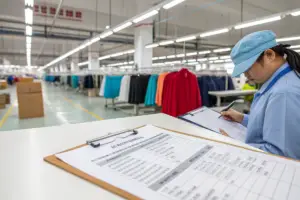
Consistency is the hard part of anti-pill fleece production. Achieving Grade 4-5 pilling resistance on a laboratory sample is a technical exercise. Achieving it consistently across hundreds of production batches, with variations in ambient humidity, raw material lots, and machine conditions, is an operational discipline that separates reliable suppliers from inconsistent ones. The quality control system that maintains our anti-pill performance across production batches uses four integrated verification points, each designed to catch different types of deviation before they affect finished fabric quality.
The incoming fiber verification tests every polyester staple fiber lot for the modified tenacity specification that's essential to our pill-release mechanism. Standard polyester fiber tenacity ranges from 4.5-5.5 grams per denier. Our specification requires 3.8-4.2 grams per denier—lower than standard, but within a tight tolerance band that ensures pill release without compromising fabric strength. Fiber lots that fall outside this range are rejected before they enter production. This single quality checkpoint prevents the most common source of anti-pill performance failure: using standard tenacity fiber that produces pills too strong to release during washing.
The yarn quality verification tests every yarn production batch for the twist level and surface fiber orientation parameters that control fiber migration. Twist testing uses a digital twist tester that measures turns per meter and twist uniformity across the yarn package. Surface fiber orientation is evaluated through microscopic examination of yarn samples, with a pass-fail criterion based on the percentage of surface fibers oriented within 30 degrees of the yarn axis. Yarn batches that fail either specification are quarantined for evaluation and potential re-processing.
The post-knitting verification tests greige fabric after knitting but before brushing and finishing. This checkpoint measures fabric weight, stitch density, and yarn tension uniformity—parameters that affect how the fabric responds to subsequent mechanical finishing. Fabric that's knitted too loosely will over-brush, removing too many surface fibers and creating thin spots. Fabric knitted too tightly won't brush adequately, leaving loose fibers that will pill during consumer use. The post-knitting checkpoint ensures the fabric enters finishing in the optimal condition for our mechanical anti-pill process.
The finished fabric verification is the final and most comprehensive checkpoint. Every production batch undergoes ASTM D3512 pilling testing at 30, 60, and 90-minute intervals, with pass-fail criteria of Grade 4 minimum at 60 minutes. Batches that fail are quarantined for root cause analysis and re-processing. In addition to pilling testing, finished fabric undergoes shrinkage testing, colorfastness testing, and tensile strength testing to ensure that anti-pill modifications haven't compromised other performance characteristics. The multi-stage quality control system for maintaining consistent anti-pill performance across polyester fleece production batches represents the operational infrastructure that transforms a laboratory-proven technology into a commercially reliable product.
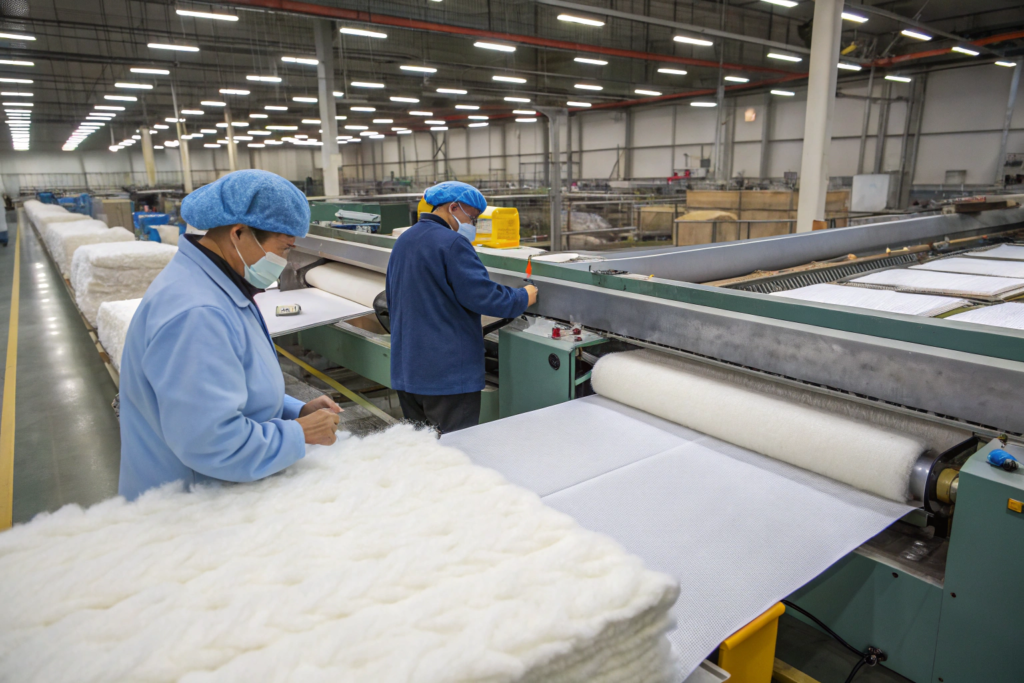
How Does the Inline Inspection System Catch Pill-Prone Defects Before Shipping?
The inline inspection system monitors fabric during finishing operations—brushing, shearing, and heat setting—when the mechanical processes that create pill resistance are actively shaping the fabric surface. Waiting until finished fabric testing to identify problems means scrapping or re-processing entire batches. Catching problems during processing allows real-time adjustment that prevents defects from propagating through the entire batch.
The inspection system uses high-resolution cameras mounted above the fabric path at three points: after brushing, after shearing, and after heat setting. The cameras capture images of the fabric surface at 120 frames per second with resolution sufficient to detect surface fiber distribution anomalies that indicate inadequate brushing or shearing. The images feed into machine vision software trained on a database of over 10,000 fabric surface images with known pilling performance outcomes. The software identifies patterns associated with future pilling problems—uneven brushing patterns, shearing height variation, heat setting inconsistencies—and alerts operators when intervention is needed.
The system has reduced our internal reject rate on anti-pill fleece from 4.2% to 1.1% since implementation in early 2025. The reduction represents approximately $180,000 in annual savings from avoided re-processing and scrap, and more importantly, it means fewer borderline batches reach customers where they might perform adequately but not optimally. The inline inspection systems that detect pill-prone defects in fleece fabric during production enable real-time process correction rather than end-of-line rejection.
What Batch-to-Batch Consistency Protocols Support Brand Partner Production Planning?
Brand partners need consistency not just within a batch but across batches ordered months apart for different production runs. A fleece jacket produced in March and the same style produced in July must use fabric with identical surface characteristics, identical dye affinity, identical shrinkage behavior, and identical mechanical properties. Inconsistency between batches forces garment factories to adjust cutting patterns, sewing machine settings, and pressing parameters—adding cost and risking quality variation in finished garments.
Our batch-to-batch consistency protocols begin with raw material lot control. Each polyester fiber lot receives a unique identifier that tracks through yarn spinning, knitting, and finishing, allowing us to trace any finished fabric variation back to its fiber source. When a new fiber lot enters production, we produce a pre-production trial batch that undergoes full testing against the specification of the previous lot. The trial results must fall within specified tolerance bands—shrinkage within 0.5%, color within Delta E 0.8, pilling within 0.5 grade—before the new lot receives production approval.
The finishing process parameters are documented and controlled with the same rigor. Brushing cylinder speed, shearing height, and heat setting temperature are recorded for every batch and compared against the parameters used for the previous batch of the same fabric specification. Deviations trigger investigation even if the finished fabric passes quality testing, because unexplained process variation often signals an emerging problem that quality testing hasn't yet detected. The batch-to-batch consistency protocols that enable brand partners to plan production with confidence in fabric specification stability represent an operational capability that distinguishes suppliers who understand manufacturing from suppliers who simply sell fabric.
Conclusion
The anti-pill fleece story is fundamentally about trust. The outdoor apparel buyer who lost $60,000 on pilling returns in 2019 didn't come back to us because we offered a lower price or a faster lead time. He came back because we showed him—with laboratory data, with wear trial results, with production quality control documentation—that we had solved the problem that burned him. His first reorder was small and cautious. His current order volume is five times what it was before the pilling failure, and he's expanded anti-pill fleece across his entire product line. The trust was rebuilt through measurable performance improvement, not sales promises.
The technical system that delivers that performance improvement—the modified-tenacity fibers, the optimized yarn twist, the mechanical finishing process, the multi-stage quality verification—represents an investment in solving a specific, measurable consumer problem. Pilling is visible. Pilling drives returns. Pilling destroys brand loyalty. A fabric that doesn't pill, verified by independent testing and confirmed by consumer reviews, removes a source of business risk that apparel brands experience every season with standard fleece. The value of that risk removal exceeds the fabric cost premium by a factor that makes the purchasing decision obvious once the data is presented clearly.
If your brand has experienced pilling-related returns, or if you're developing fleece products and want to avoid the quality issues that plague standard polyester fleece, I encourage you to evaluate our anti-pill fleece against your specifications. Request test data, request wear trial results, request samples for your own laboratory evaluation. Our Business Director Elaine can arrange technical documentation and sample yardage for your testing process. Reach her at elaine@fumaoclothing.com. The fleece that doesn't pill isn't magic. It's engineering. And the engineering is ready for your quality team to verify.