A Dallas-based children's wear brand once shipped 4,000 units of a beautiful organic cotton pajama collection to a major department store chain. The pajamas were beautifully constructed, the fabric was certified organic, and the prints were adorable. The shipment was rejected in its entirety at the retailer's distribution center. The reason was not the garment quality. The care label was missing the legally required children's sleepwear flammability warning. The brand had used a generic care label template that complied with the general Care Labeling Rule but was not compliant with the specific, stricter labeling requirements of the Flammable Fabrics Act for children's sleepwear. The entire order had to be re-labeled domestically at a cost of $1.80 per unit. The brand lost their wholesale margin on the order, and the relationship with the department store was damaged. A single missing sentence on a tiny piece of fabric had cost the brand $7,200 and a retail partnership.
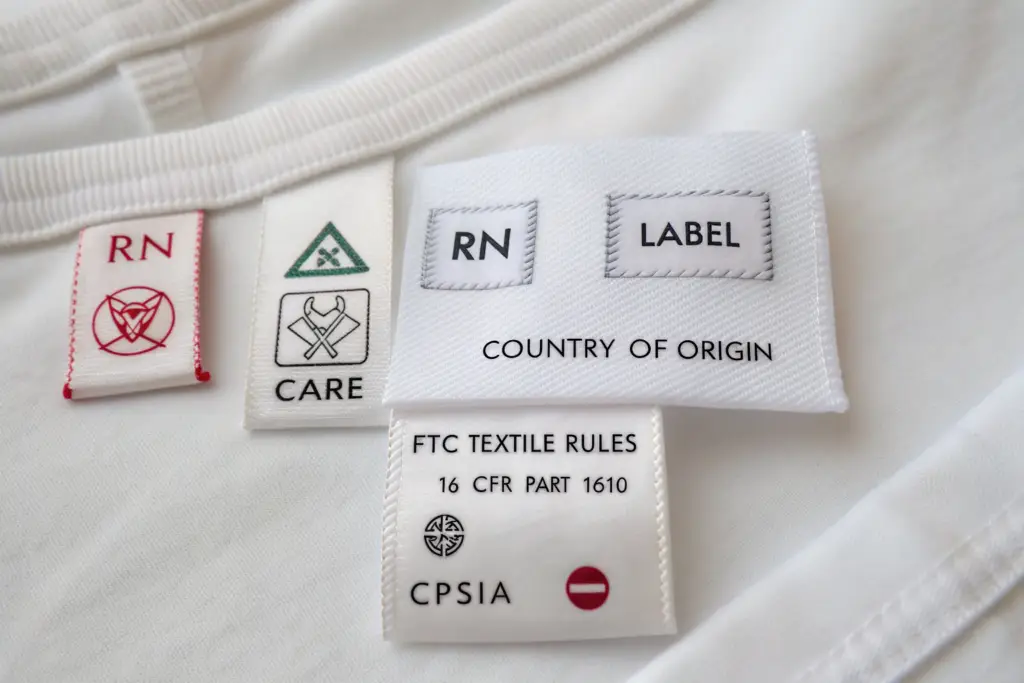
To ensure your custom clothing tags strictly comply with all North American regulations, every garment must carry three specific, permanently affixed labels that each satisfy a distinct legal requirement: a fiber content label that lists every fiber by its generic FTC-recognized name in descending order of weight percentage, with the country of origin clearly stated in English immediately adjacent; a care instruction label that provides complete washing, bleaching, drying, and ironing instructions using ASTM-standardized universal care symbols; and for specific regulated categories—children's sleepwear, down-filled garments, fur-trimmed garments, and leather goods—a supplemental warning or disclosure label that complies with the additional, category-specific FTC and CPSC regulations, all of which must be permanently affixed to the garment with the ability to withstand the useful life of the product.
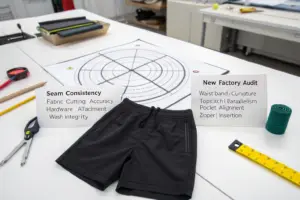
At Shanghai Fumao, I do not allow a single garment to leave my factory without a compliance review of every label. My QC team checks the fiber content against the fabric mill's test report, verifies the country of origin against the cutting and sewing location, confirms the care symbols match the fabric's tested performance, and ensures that any category-specific warning labels—children's sleepwear, down fill, fur—are present and correctly worded. A label is a legal document printed on fabric, and it must be treated with the same precision as a contract.
Why Does the "FTC Textile Fiber Products Identification Act" Require Every Fiber to Be Listed by Its Generic Name in Descending Order of Weight Percentage?
A Portland-based sustainable fashion brand once labeled their bestselling sweater as "100% Organic Cotton." The brand had sourced GOTS-certified organic cotton yarn for the body fabric. What the brand had overlooked was that the sweater's decorative embroidered logo on the chest used rayon thread, which constituted 4.2% of the garment's total fiber weight by mass. A competitor filed a complaint with the Federal Trade Commission. The FTC investigated, determined that the "100% Organic Cotton" label was false and misleading because it ignored the rayon decoration, and fined the brand $16,000. The brand had made an honest mistake based on an incomplete understanding of the FTC's fiber disclosure rules. The word "100%" is a legally binding claim, not a marketing term.
The FTC Textile Fiber Products Identification Act requires every fiber to be listed by its generic, FTC-recognized name in descending order of weight percentage because this is the only legally acceptable format for disclosing the fiber composition of a textile product sold in the United States, and the rule extends to every component of the garment—the shell fabric, the lining, the filling, and any decorative trim that exceeds 5% of the garment's total fiber weight—with fibers present at less than 5% disclosed as "other fiber" unless they have a functional significance, and any fiber claimed as "organic" must be certified to the USDA National Organic Program or an equivalent internationally recognized organic standard.
The FTC's Textile Rules are a consumer protection regulation, not a labeling guideline. A mislabeled fiber content claim is a deceptive trade practice under Section 5 of the FTC Act, enforceable by civil penalties of up to $50,120 per violation. Every percentage on the label must be supported by a fabric composition test report from an accredited laboratory. The word "100%" means exactly 100%, not 96% plus 4% decorative rayon that the brand considered insignificant.
How Does the "5% Trim Exclusion Rule" Work, and When Must Decorative Trim Actually Be Disclosed?
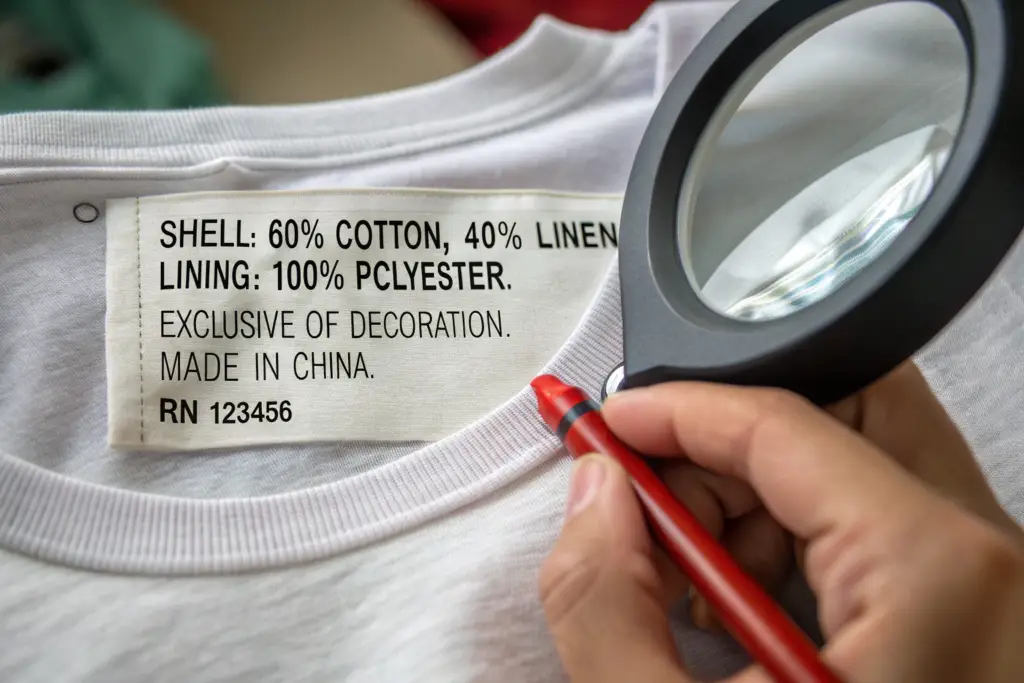
Fibers present in decorative trim—embroidery, lace, braids, appliqués—may be excluded from the fiber percentage calculation if they do not exceed 5% of the garment's total fiber weight. If the decorative trim exceeds 5%, the trim fibers must be disclosed separately or the label must state the fiber content "exclusive of decoration." The 5% threshold is calculated by weight, not by visual appearance.
Why Must the "Country of Origin" Be Stated "Immediately Adjacent" to the Fiber Content, in English, and in a Conspicuous Size?
The country of origin—"Made in China," "Made in Vietnam"—must be physically adjacent to the fiber content disclosure on the same label, in English, in a font size and color that is clearly legible and conspicuous. The FTC considers a country of origin that is hidden on a separate tag, printed in a tiny font, or buried in a multilingual block of text as a deceptive practice.
What Are the "ASTM Care Labeling Symbols" and Why Do They Provide a Safer Harbor Than Written-Only Instructions?
A Boston-based premium menswear brand once used a care label that stated, in English text only, "Hand wash cold, lay flat to dry, do not wring, cool iron on reverse side if needed." The brand sold a significant volume through a Canadian retail partner. The Canadian retailer rejected the shipment because the care label did not include the ASTM-standardized universal care symbols that Canadian regulations require. The brand argued that the written instructions were clear and complete. The retailer pointed to the regulation, which mandates the symbols as the primary communication method, with written instructions permitted only as a supplement. The brand had to re-label 3,500 shirts before the retailer would accept delivery.
The ASTM D5489 care labeling symbols provide a safer regulatory harbor than written-only instructions because both US FTC Care Labeling Rule and Canadian CA Number regulations recognize the ASTM-standardized universal care symbols as a compliant and sufficient method of communicating care instructions to consumers, and the symbols transcend language barriers, are universally understood across the North American market, and eliminate the risk of translation errors, missing instructions, or ambiguous wording that can cause a written-only label to be deemed non-compliant by a retailer or a regulatory auditor.
The FTC's Care Labeling Rule requires that the manufacturer provide complete care instructions for washing, bleaching, drying, and ironing. The rule does not mandate the use of symbols over words, but the ASTM symbols are recognized as a safe harbor—if a manufacturer uses the correct symbols in the correct sequence, the FTC will not challenge the label's compliance. The symbols are a legal shield, not just a visual convenience.
What Are the Five Mandatory Care Symbol Categories That Must Appear on a Complete Care Label?
The five categories, in the prescribed sequence, are: Washing (a washtub symbol with temperature), Bleaching (a triangle symbol), Drying (a square symbol—tumble dry or natural dry), Ironing (an iron symbol with temperature dots), and Professional Textile Care (a circle symbol for dry cleaning or wet cleaning). If a specific process is not recommended, the symbol must be shown with a cross through it.
Why Does "Canadian CA Number" Labeling Require the ASTM Symbols as the Primary Care Communication Method?
The Canadian CA Number regulations under the Textile Labelling Act mandate that care instructions be provided in a prescribed format that includes the ASTM-standardized symbols as the primary communication method, with any written text serving as a supplement only. A label with written instructions only, without the symbols, is non-compliant for the Canadian market.
What "Category-Specific Warning Labels" Are Legally Required for Children's Sleepwear, Down-Filled, and Fur-Trimmed Garments?
A Minneapolis-based outerwear brand once launched a beautiful line of down-filled parkas with a removable coyote fur ruff on the hood. The main garment label correctly listed the shell fabric, the lining, and the down fill content. The brand completely overlooked the fact that the fur ruff required its own separate label, mandated by the FTC's Fur Products Labeling Act, disclosing the animal species name, the country of origin of the fur, and whether the fur was natural or dyed. An FTC inspector purchased one of the parkas from a retail store, identified the missing fur label, and issued a formal complaint. The brand had to recall the unsold units, re-label the fur ruffs, and pay a civil penalty.
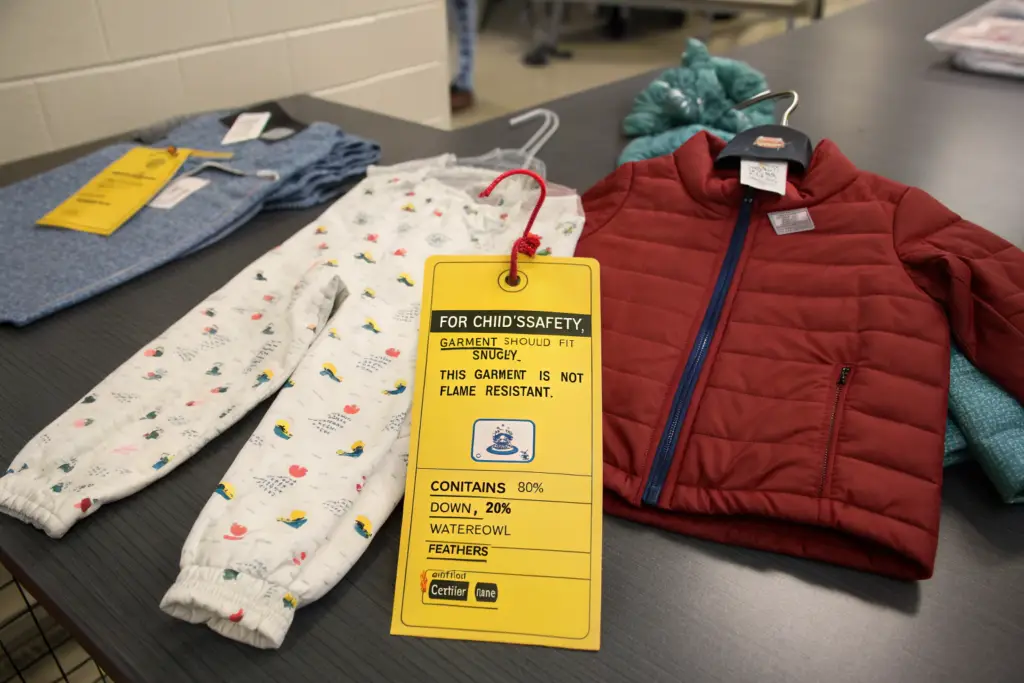
Category-specific warning labels are legally required for children's sleepwear under the CPSC's 16 CFR Parts 1615 and 1616, which mandate either a snug-fitting warning label with specific text for cotton sleepwear or a flame-resistant label for treated fabrics; for down-filled garments under various state laws and FTC guidelines, which require the disclosure of the species of bird, the percentage of down versus feathers, and the certifier's name; and for fur-trimmed garments under the FTC Fur Products Labeling Act, which requires the animal species name, the country of origin of the fur, the manufacturer's RN number, and a disclosure of whether the fur is natural or dyed, all on a separate label that is conspicuously attached to the fur product.
Each of these supplementary labeling requirements exists because a specific consumer safety or consumer deception issue was identified by regulators. Children's sleepwear flammability warnings exist because loose-fitting cotton sleepwear burns rapidly. Down fill disclosure laws exist because consumers cannot visually distinguish down from feathers. Fur labeling laws exist because consumers have a right to know the animal species. Each regulation is a specific legal obligation, and ignorance of the regulation is not a defense.
What Is the "Exact Mandatory Text" Required on a Children's Cotton Sleepwear Snug-Fitting Warning Label?
The label must state: "For child's safety, garment should fit snugly. This garment is not flame resistant. Loose-fitting garment is more likely to catch fire." The text must be in a specific font size, color, and placement that is clearly visible and legible.
How Does the "Fur Products Labeling Act" Requirement for a "Separate Label for Fur Trim" Differ From the Main Garment Label Requirement?
The main garment label covers the shell, lining, and fill. The fur trim—even a small ruff on a hood—requires a completely separate label that is attached conspicuously to the fur product, stating the animal species name, the country of origin of the fur, the RN number, and the natural or dyed status. The main garment label does not satisfy this obligation.
How Do You Verify That the Factory's Care Label Instructions Match the Fabric's Actual Tested Performance?
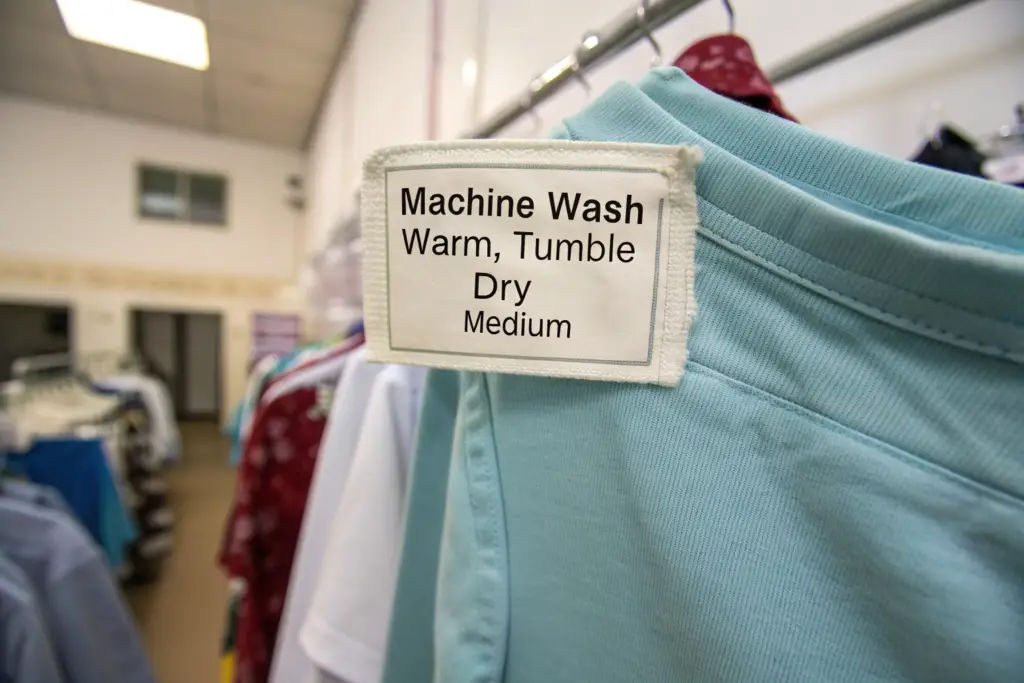
A Chicago-based contemporary brand once printed care labels that instructed "Machine Wash Warm, Tumble Dry Medium" based on the fabric mill's verbal recommendation. No independent fabric performance testing was conducted. The garments were produced, shipped, and sold. Customers washed the garments as instructed. The fabric shrank by 5%, and the color bled onto other garments in the wash. The brand had printed care instructions that the fabric could not withstand. The care label was legally required to provide accurate care instructions, and the brand had provided instructions that were demonstrably false. The brand faced chargebacks from wholesale accounts and a potential FTC complaint for providing inaccurate care instructions.
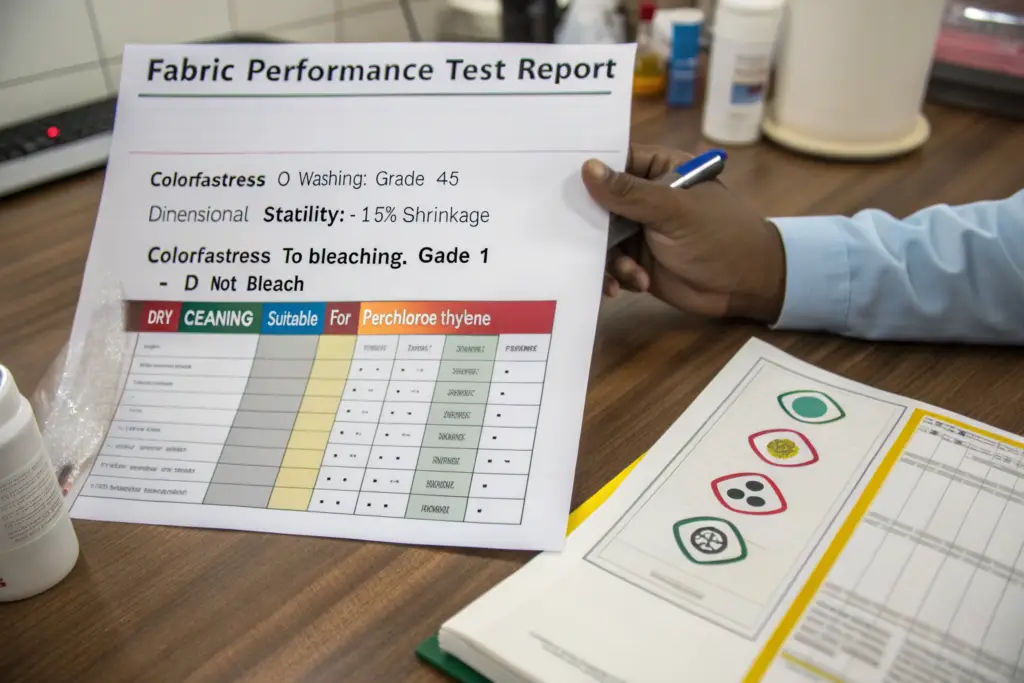
To verify that the factory's care label instructions match the fabric's actual tested performance, the brand must commission an independent fabric performance test package from an accredited laboratory—including wash fastness per AATCC 61, dimensional stability per AATCC 135, bleach fastness, dry clean fastness, and ironing fastness—and then translate the specific numerical test results into the corresponding ASTM care symbols and written instructions, ensuring that the care label instructs the consumer to use only the washing temperature, drying method, bleaching option, and ironing temperature that the fabric has been independently tested to withstand, never relying on the fabric mill's verbal recommendation or the factory's generic care label template.
A care label is a set of instructions to the consumer. The FTC's Care Labeling Rule requires that the manufacturer have a "reasonable basis" for those instructions before the labels are printed. A fabric mill's verbal recommendation is not a reasonable basis. An independent laboratory test report, showing that the fabric can withstand a specific wash temperature and drying method without unacceptable shrinkage or color loss, is the reasonable basis that satisfies the legal requirement.
How Does a "Wash Fastness Test Grade of 4-5" Translate to a Specific Care Symbol on the Label?
A wash fastness grade of 4-5 indicates excellent color retention during washing. The care label can recommend a normal machine wash cycle at the tested temperature with confidence that the color will not bleed or fade. A grade of 2-3 would require a "hand wash cold separately" instruction to warn the consumer of potential color bleeding.
Why Must the "Dimensional Stability Test Result" Dictate the Drying Instruction on the Care Label, Not the Mill's Recommendation?
If the dimensional stability test shows 1.5% shrinkage with tumble drying, the care label can instruct "Tumble Dry Low." If the test shows 5% shrinkage with tumble drying but only 1% shrinkage with line drying, the care label must instruct "Line Dry" or "Lay Flat to Dry" regardless of what the mill recommends.
Conclusion
Ensuring your custom clothing tags strictly comply with all North American regulations requires treating every label as a legal document that must be accurate, complete, and supported by verifiable test data. The FTC Textile Rules mandate that every fiber be listed by its generic name in descending order of weight percentage, with the country of origin immediately adjacent, and the word "100%" means exactly 100%—not 96% plus 4% decorative rayon. The ASTM care labeling symbols provide a recognized safe harbor that satisfies both US and Canadian regulations, transcending language barriers and eliminating the ambiguity of written-only instructions. Category-specific warning labels—children's sleepwear snug-fitting warnings, down fill disclosure, fur species and origin—are mandatory supplements to the main garment label, and their absence can result in shipment rejection, FTC fines, or product recall. The care instructions printed on the label must be backed by an independent laboratory test report that verifies the fabric can actually withstand the washing, bleaching, drying, and ironing processes the label instructs the consumer to perform.
At Shanghai Fumao, my QC team reviews every label on every order against a compliance checklist that covers fiber content disclosure, country of origin, care symbols, and any category-specific warning labels. I require a fabric composition test report and a fabric performance test report from an accredited lab for every new fabric quality. I do not print a care label until the test data confirms that the care instructions are accurate.
If you are a brand buyer preparing to order custom clothing with branded labels, and you want a manufacturing partner who treats label compliance as a legal obligation, not an afterthought, contact my Business Director, Elaine. She can share our label compliance checklist, our required lab test report specifications, and our approved care symbol template. Reach Elaine at: elaine@fumaoclothing.com. Your label is a legal document. Print it with precision.