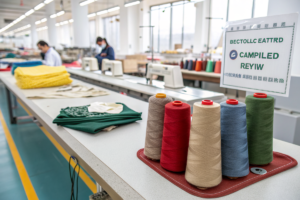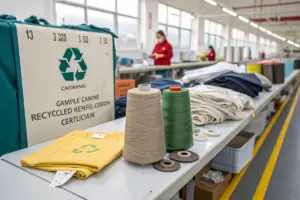
A Phoenix-based outdoor apparel brand once launched a line of "breathable" Summer hiking shirts that became their single highest-returned product. The shirts were made from a lightweight 100% polyester fabric with a smooth, tightly woven surface that looked cool and technical in product photos. The brand's marketing copy promised "superior ventilation for hot weather performance." On the trail, in 105-degree Arizona heat, the shirts were suffocating. The tight weave trapped body heat and water vapor against the skin. Hikers reported feeling like they were wearing a plastic bag. The fabric was lightweight in GSM, but lightweight does not equal breathable. The brand had confused fabric weight with air permeability, and their customers had suffered the consequences.
To ensure good air permeability in Summer outdoor clothes, the fabric must be engineered with three specific, measurable characteristics: an open, permeable weave or knit structure—such as a mesh, a leno weave, or an open single jersey—that physically allows air to flow through the fabric at a rate of at least 80-100 cubic feet per minute (CFM) when tested on a Frazier air permeability tester per ASTM D737; a lightweight construction of 100-160 GSM that minimizes thermal resistance; and a moisture-wicking, hydrophobic fiber composition or finish that prevents the fabric from becoming saturated with sweat and collapsing the ventilation openings, because a fabric that breathes well when dry can become an impermeable barrier when soaked with perspiration.
At Shanghai Fumao, I specify air permeability requirements on the tech pack for every Summer outdoor garment. The fabric is tested on a Frazier air permeability tester before it is released to the cutting table. A lightweight fabric that cannot move air is a portable sauna, not a Summer performance garment.
Why Does "Fabric Weight in GSM" Alone Not Guarantee Good Air Permeability?
A San Diego-based activewear brand once sourced a 110 GSM polyester microfiber fabric for their Summer running shirts. The fabric was exceptionally lightweight—one of the lightest they had ever sourced—and the brand assumed that "lighter equals more breathable." The fabric was woven in an extremely tight, dense microfiber construction that was nearly windproof. Despite its low weight, the fabric's air permeability measured only 22 CFM on the Frazier tester. The shirts were lightweight on a hanger but unwearable on a run. The brand had purchased the lightest possible fabric and achieved the worst possible breathability.
Fabric weight in GSM does not guarantee good air permeability because GSM measures only the mass of fiber per square meter of fabric, not the openness of the fabric's structure to airflow, and a low-GSM fabric with a tight, dense weave or knit can have significantly lower air permeability than a higher-GSM fabric with an open, porous structure, making the CFM reading from a Frazier air permeability test per ASTM D737 the only reliable, quantitative measurement of how much air can physically pass through the fabric.
GSM measures how much yarn is in the fabric. CFM measures how much air flows through the gaps between the yarns. Two fabrics can have identical GSM but radically different CFM because the openness of the structure is independent of the fabric's weight. The only way to know if a fabric breathes is to measure its air permeability directly with a Frazier tester, not to infer it from its weight.
How Does a "Frazier Air Permeability Test" Per ASTM D737 Quantitatively Measure Breathability?
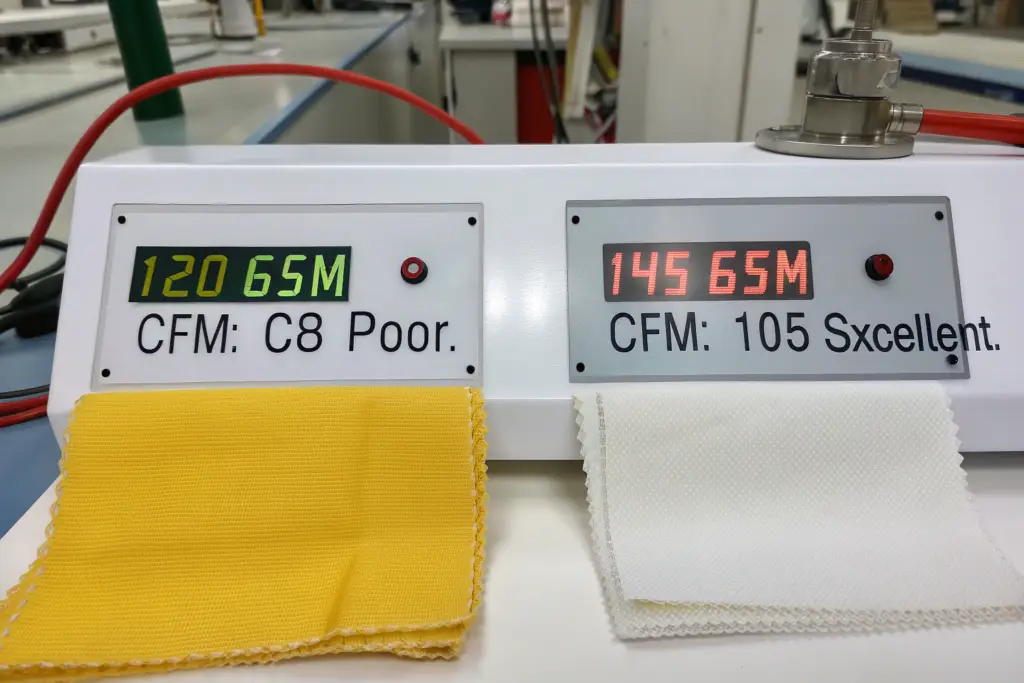
The test clamps a fabric sample over a standardized opening, draws a calibrated air flow through the fabric at a controlled pressure differential of 124 Pascals, and measures the volume of air passing through in cubic feet per minute per square foot of fabric. The result is a single, objective CFM number that allows direct comparison between any two fabrics, regardless of fiber content, weight, or construction.
What Minimum CFM Value Defines "Good Air Permeability" for a Summer Outdoor Garment Worn During Moderate to High Exertion?
For moderate exertion such as hiking or walking, a minimum of 60-80 CFM is recommended. For high exertion such as trail running, climbing, or active sports in hot conditions, a minimum of 80-120 CFM is recommended. A fabric below 40 CFM will feel noticeably stuffy during any physical activity in warm weather.
What Specific "Open Weave and Knit Structures" Physically Maximize Airflow Through Summer Fabrics?
A Denver-based outdoor brand once designed a Summer hiking shirt using a standard, smooth cotton jersey knit. The fabric was a reasonable 150 GSM, and the brand assumed the knit structure would be adequately breathable. On the trail, hikers found that the jersey, while not as oppressive as a tight woven fabric, still trapped a noticeable layer of warm air against the skin. The jersey's stitch structure, while technically a knit, was a relatively closed, continuous surface with only the microscopic gaps between individual yarn loops for ventilation. The fabric breathed, but barely.
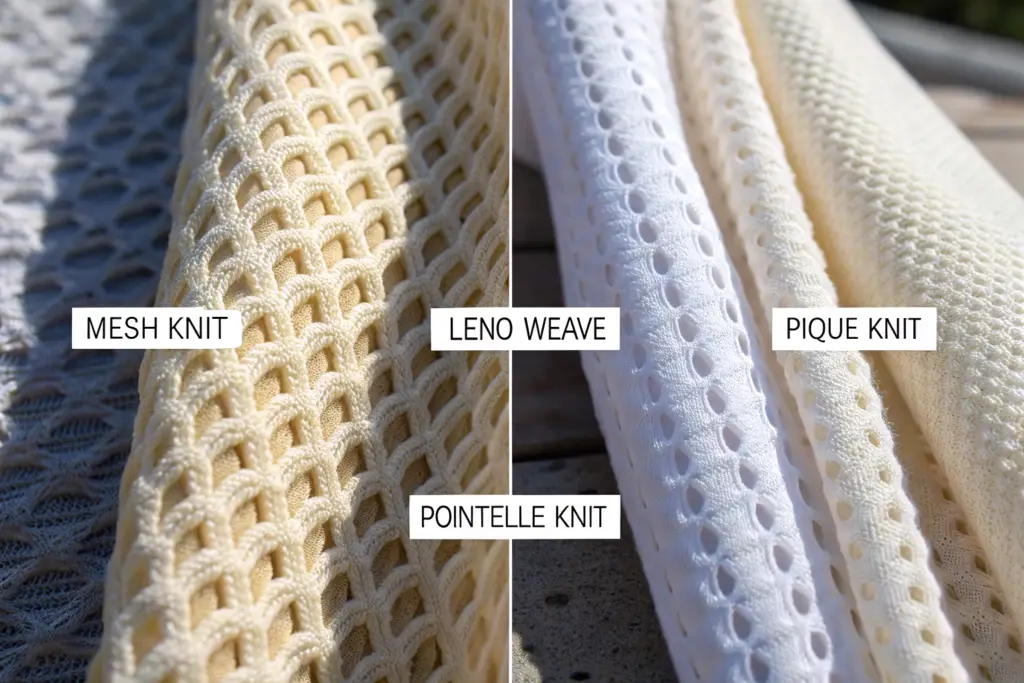
Specific open weave and knit structures physically maximize airflow by creating permanent, engineered openings in the fabric surface that allow air to pass through unimpeded: a mesh knit uses a specialized knitting program to create large, regularly spaced holes; a leno weave physically twists warp yarns around each other to lock open spaces permanently into the fabric structure; a pique knit creates a dimpled, textured surface with thin, recessed areas that ventilate; and a pointelle or eyelet knit creates a pattern of small, decorative openings, all of which provide dramatically higher CFM values than a standard, smooth single jersey or a tight plain weave of the same fiber and GSM.
A standard jersey knit breathes through the microscopic gaps between individual yarn loops—gaps that are small and easily collapsed when the fabric is stretched or wetted. A mesh knit breathes through engineered holes that are visible to the naked eye and remain open regardless of fabric tension or moisture. The difference in CFM is often a factor of three to five.
How Does a "Mesh Knit" Construction at 140 GSM Achieve a CFM of 120 While a "Single Jersey" at the Same GSM Achieves Only 35 CFM?
The mesh knit's programmed stitch pattern creates deliberate, regularly spaced holes that can measure 1-3mm in diameter. These holes are permanent features of the knit structure and provide a direct, unobstructed pathway for air. The single jersey's only ventilation pathways are the microscopic, irregular gaps between individual yarn loops, which provide significantly more resistance to airflow.
Why Is a "Leno Weave" Particularly Effective for Summer Woven Shirts Compared to a Standard Plain Weave?
In a plain weave, the weft yarn simply passes over and under the warp yarns, and the fabric's openness is determined by how tightly these yarns are packed together. In a leno weave, pairs of warp yarns are twisted around each other between each weft insertion, locking the yarns in place and creating permanent, stable open spaces that cannot close up through washing, stretching, or wear.
How Does "Moisture-Wicking and Hydrophobic Fiber Engineering" Prevent Sweat From Collapsing the Ventilation Structure?
A Portland-based trail running brand once launched a Summer running singlet made from an open, highly breathable cotton mesh. The fabric, when dry, tested at an excellent 95 CFM on the Frazier tester. On the trail, after twenty minutes of running in summer heat, the singlet became saturated with sweat. The cotton fibers absorbed the moisture, swelled, and expanded, physically closing the mesh openings. The dry CFM of 95 dropped to an effective wet CFM of approximately 15. The singlet that was beautifully breathable on the lab bench became an impermeable, sweat-soaked barrier on the runner's body. The fabric had been tested in the wrong condition.
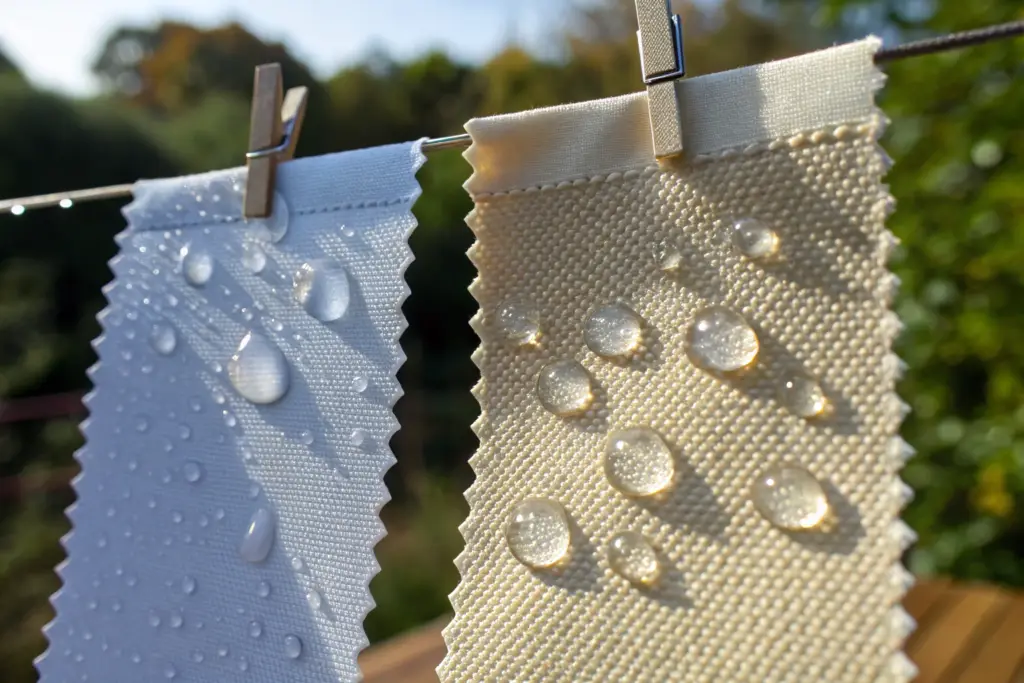
Moisture-wicking and hydrophobic fiber engineering prevents sweat from collapsing the ventilation structure by using synthetic fibers such as polyester or nylon that are inherently hydrophobic—they do not absorb water, and their fibers do not swell when wet—combined with a capillary-channel cross-sectional fiber shape or a hydrophilic surface treatment that actively wicks liquid sweat along the fiber surface and spreads it into a thin film that evaporates rapidly without saturating the fabric, ensuring that the engineered ventilation openings remain physically open and the fabric maintains its dry CFM level even when the wearer is sweating heavily.
Cotton absorbs water into its fiber structure, swelling and expanding. The swelling physically closes the gaps between yarns. Polyester does not absorb water; the fiber remains dimensionally stable, and the engineered openings remain open. The fiber choice is not just about drying speed; it is about maintaining the fabric's physical structure during use.
How Does a "Capillary-Channel Fiber Cross-Section" Accelerate Moisture Wicking Compared to a Standard Round Fiber?
A standard round polyester fiber has a smooth surface. A capillary-channel fiber is extruded with grooves, channels, or a multi-lobal shape that increases the fiber's surface area and creates physical channels along which liquid water can travel rapidly by capillary action, spreading sweat into a thin film over a larger surface area for faster evaporation.
Why Must Air Permeability Be Tested on "Wet Fabric" as Well as "Dry Fabric" for Any Garment Intended for High-Exertion Summer Use?
The dry CFM test measures the fabric's performance on the lab bench. The wet CFM test measures the fabric's performance on the sweating body of a runner, hiker, or cyclist. A fabric that maintains at least 80% of its dry CFM when wet is suitable for high-exertion Summer use. A fabric whose CFM collapses when wet—like cotton—is not suitable regardless of its dry test results.
How Do You Specify "Air Permeability" on a Tech Pack to Ensure the Factory Delivers a Truly Breathable Fabric?
An Austin-based outdoor brand once specified "breathable fabric" on their tech pack. The factory sourced a lightweight polyester woven that they considered breathable. The brand received the bulk fabric and found it unacceptably stuffy. The word "breathable" had been interpreted differently by the brand and the factory, and the resulting fabric did not meet the brand's unspoken expectation. The brand had provided a subjective adjective where an objective, measurable specification was required.
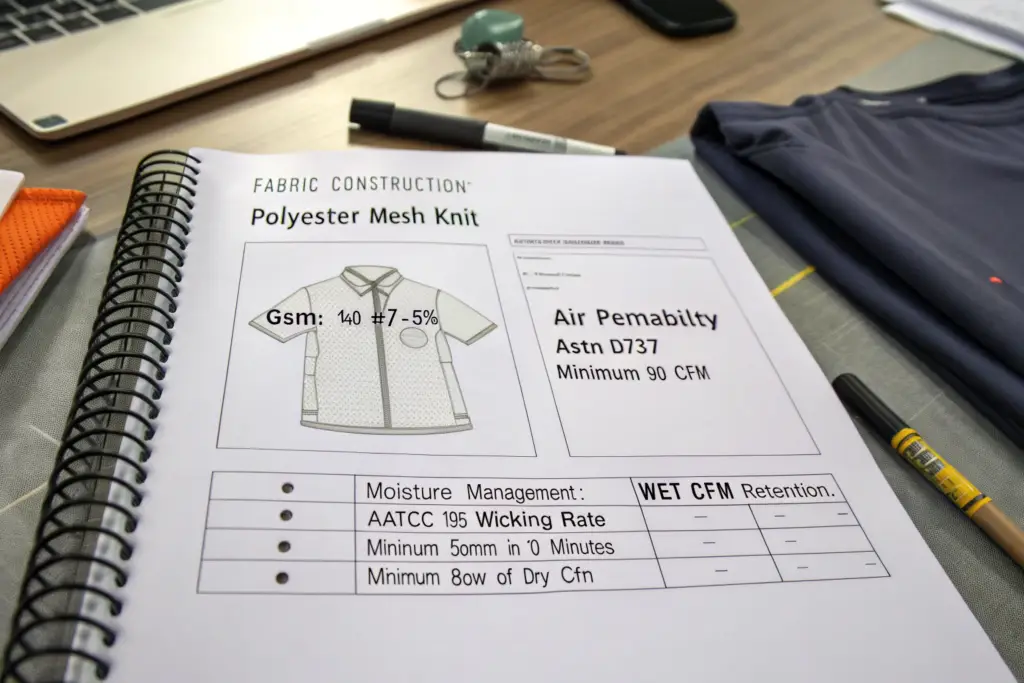
To specify air permeability on a tech pack and ensure the factory delivers a truly breathable fabric, the brand must include four specific, measurable values: the target fabric construction by type and name, the target GSM with a tolerance of +/- 5%, the minimum dry CFM as measured by ASTM D737 with a specified minimum value, and the minimum wet CFM retention percentage, supplemented by a requirement for a third-party Frazier test report on the actual bulk fabric lot before it is released to the cutting table, replacing the subjective word "breathable" with an objective, testable specification that can be verified with a Frazier air permeability tester.
"Breathable" is a marketing claim. "ASTM D737 - Minimum 90 CFM dry, minimum 72 CFM wet, with third-party test report from Intertek or SGS" is a manufacturing specification. The factory can send a fabric sample to the lab, receive a test report, and confirm that the CFM number on the report exceeds the specified minimum. The specification is enforceable, testable, and unambiguous.
How Does a "Third-Party Frazier Test Report Requirement" Prevent the Factory From Substituting a Non-Breathable Fabric?
The factory cannot simply claim the fabric is breathable. The brand requires a test report from an accredited, independent laboratory such as Intertek, SGS, or Bureau Veritas that states the exact CFM value measured. The report is reviewed and filed before the fabric is accepted. A fabric that fails to meet the specified minimum CFM is rejected.
Why Should the Tech Pack Specify Both "Dry CFM" and "Wet CFM Retention" for a Summer Outdoor Garment?
The dry CFM represents the fabric's ideal performance. The wet CFM retention represents the fabric's real-world performance when the wearer is sweating. Both numbers are necessary to fully define the fabric's breathability across the range of conditions the garment will experience.
Conclusion
Ensuring good air permeability in Summer outdoor clothes requires a shift from subjective language to objective, measurable engineering specifications. Fabric weight in GSM is not a measure of breathability; the Frazier CFM value per ASTM D737 is the only reliable quantitative measurement. An open weave or knit structure—mesh, leno weave, pique, or pointelle—physically creates the engineered openings through which air flows, achieving CFM values three to five times higher than a standard jersey or plain weave of the same weight. Hydrophobic, moisture-wicking fiber engineering prevents the fabric's ventilation structure from collapsing when the wearer sweats, maintaining breathability under real-world high-exertion conditions. The tech pack must specify the minimum dry CFM, the minimum wet CFM retention, and require a third-party Frazier test report on the actual bulk fabric.
At Shanghai Fumao, I specify air permeability requirements on every Summer outdoor tech pack and require a third-party Frazier test report on the bulk fabric lot before cutting. My fabric sourcing team selects open-structure mesh knits, leno weaves, and pique knits from mills that specialize in performance outdoor textiles. My QC team tests the wet CFM retention of every new Summer fabric quality.
If you are a brand buyer developing a Summer outdoor collection and you want a manufacturing partner who specifies air permeability in CFM, not adjectives, contact my Business Director, Elaine. She can share our air permeability specification template, our recommended Summer fabric constructions and CFM thresholds, and sample third-party Frazier test reports. Reach Elaine at: elaine@fumaoclothing.com. Specify the CFM, not the word "breathable."