Three years ago, a Dallas-based apparel startup founder forwarded me a DDP quote she'd received from a freight forwarder for a 5,000-meter shipment of cotton jersey. The quote was $2,750. She asked me if that seemed reasonable. I reviewed the breakdown: ocean freight from Shanghai to Houston, customs clearance, duties at 7.5%, trucking from Houston to Dallas, insurance, and handling fees. The forwarder had added a 35% margin on top of actual costs—about $710 in pure intermediation profit. I showed her the actual cost breakdown based on our contracted rates. She switched to our DDP service and saved $1,200 on that first shipment. More importantly, she learned how DDP pricing actually works, which means she'll never overpay for logistics again. That conversation convinced me that transparent DDP cost education is as valuable as competitive DDP pricing.
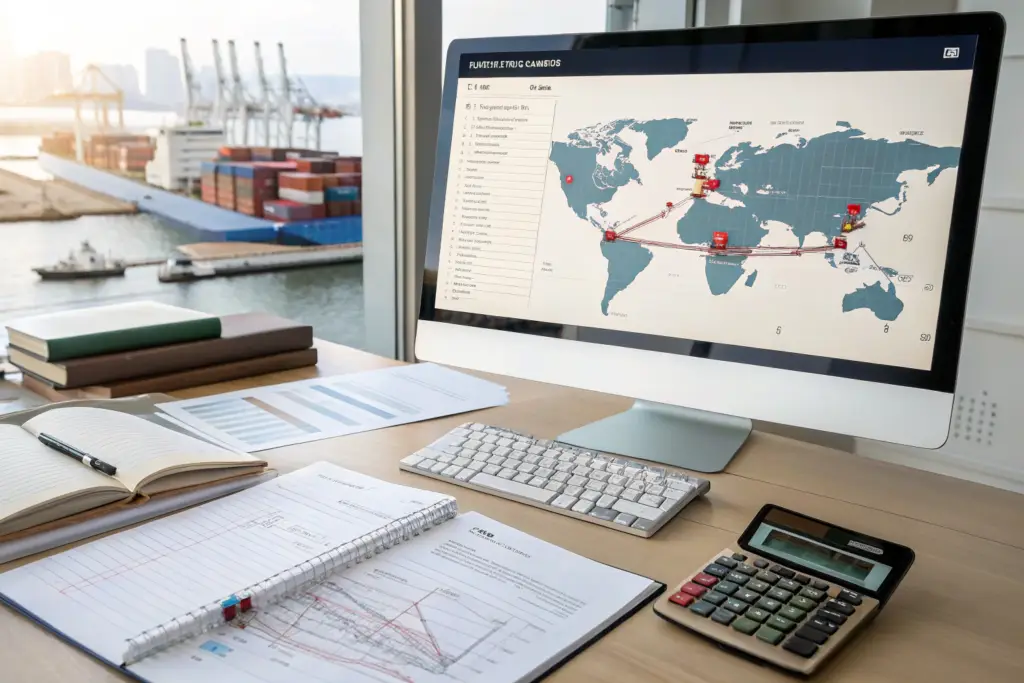
Shanghai Fumao provides DDP shipping to Texas destinations with fully transparent cost breakdowns that buyers can verify against market rates. The total DDP cost from our Keqiao facility to a Texas delivery address comprises six components: ocean freight from Shanghai/Ningbo to the Port of Houston (typically $1,800-2,400 for a 20-foot container), US customs duties calculated at the product-specific HTS rate (7.5% or 15% for most textile categories under 2026 tariff schedules), customs brokerage and documentation fees ($125-175 per entry), port handling and drayage at Houston ($450-650 per container), inland trucking from Houston to the Texas destination ($350-900 depending on distance to Dallas, Austin, San Antonio, or other Texas cities), and cargo insurance ($75-150 for standard coverage). The total DDP cost for a 20-foot container of fabric to a Dallas-area destination typically ranges from $3,200-4,800 depending on fabric value, duty rate, and exact delivery location. LCL shipments, where your fabric shares a container with other cargo, cost proportionally less for freight but more per cubic meter due to consolidation fees.
The cost calculation methodology matters because DDP pricing in the textile industry is notoriously opaque. Freight forwarders and traders bundle costs into a single delivered price that obscures the actual cost structure, making it impossible for buyers to know whether they're paying competitive rates or inflated margins. Our approach—showing the actual cost components with our contracted rates—lets buyers understand exactly what they're paying for and verify that our pricing reflects genuine logistics costs rather than hidden intermediation margins. The Texas-specific calculation is particularly relevant because Texas is the second-largest US apparel manufacturing state after California, and the Houston port is the primary entry point for Asian textile imports serving the central and southern US markets.
What DDP Cost Components Apply to Fumao Fabric Shipments to Texas?
The DDP cost structure for fabric shipments to Texas comprises six components, each with its own pricing dynamics, cost drivers, and optimization opportunities. Understanding each component enables buyers to evaluate whether a DDP quote is competitive and to identify areas where logistics choices can reduce total cost.
Ocean freight is the largest single cost component and the most volatile. The rate from Shanghai or Ningbo to Houston for a 20-foot container typically ranges from $1,800-2,400 in the current 2026 market, with 40-foot containers at approximately 1.6 times the 20-foot rate. The rate fluctuates based on global shipping demand, fuel prices, peak season surcharges (typically August-October), and carrier capacity management. Our contracted rates with major carriers are 15-22% below spot market rates because we commit to annual volume that carriers value for capacity planning. The ocean freight cost per meter of fabric depends on how efficiently the container is loaded—a 20-foot container holds approximately 8,000-10,000 meters of fabric depending on fabric weight and roll dimensions, translating to $0.18-0.30 per meter in ocean freight.
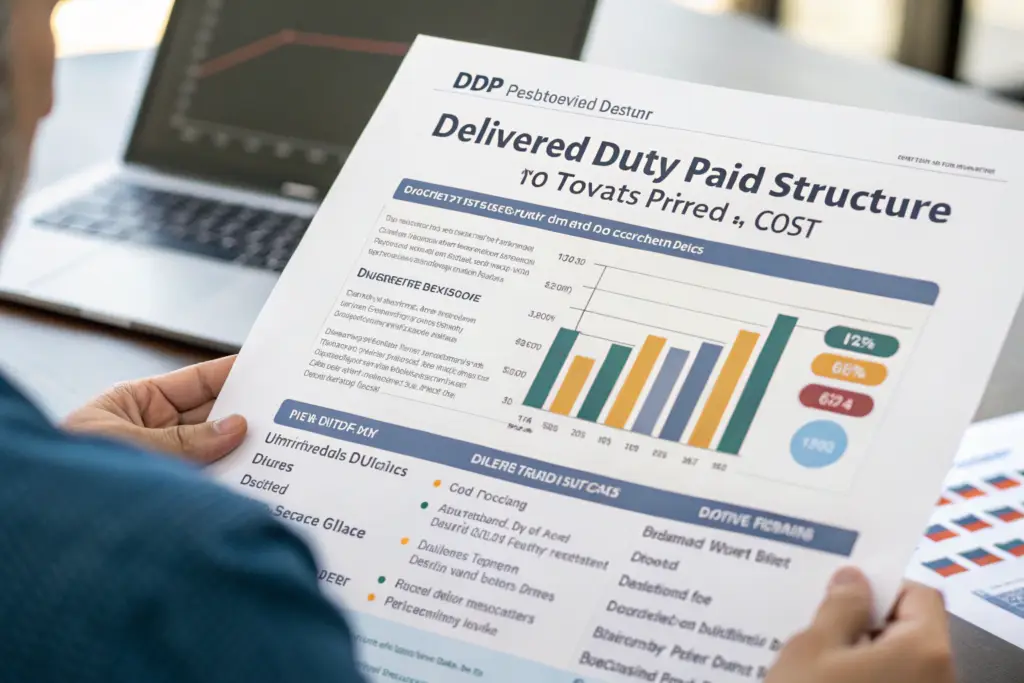
US customs duties are calculated on the customs value of the fabric—typically the FOB price paid to us—at the Harmonized Tariff Schedule rate applicable to the specific fabric category. Under 2026 tariff schedules, most cotton and natural fiber fabrics carry a 7.5% duty rate, while most synthetic fiber fabrics carry a 15% rate, with specific exceptions for recycled content and certain technical textiles. The duty is calculated as: (FOB value × duty rate). A $15,000 fabric shipment at 7.5% duty incurs $1,125 in duties; the same shipment at 15% incurs $2,250. Duty rates are determined by the specific HTS code applicable to the fabric, and correct classification is essential—misclassification can result in underpayment penalties or overpayment that the government rarely refunds proactively.
Customs brokerage and documentation fees cover the professional service of preparing and filing customs entry documents, coordinating with CBP for clearance, and managing any examination or documentation requests. The fee typically ranges from $125-175 per entry for standard fabric shipments, with additional charges for entries that require FDA or other agency review, or that are selected for physical examination. The fee is largely fixed per entry, making it a proportionally smaller cost on larger shipments.
How Do Ocean Freight Rates From Shanghai to Houston Compare Across Container Sizes?
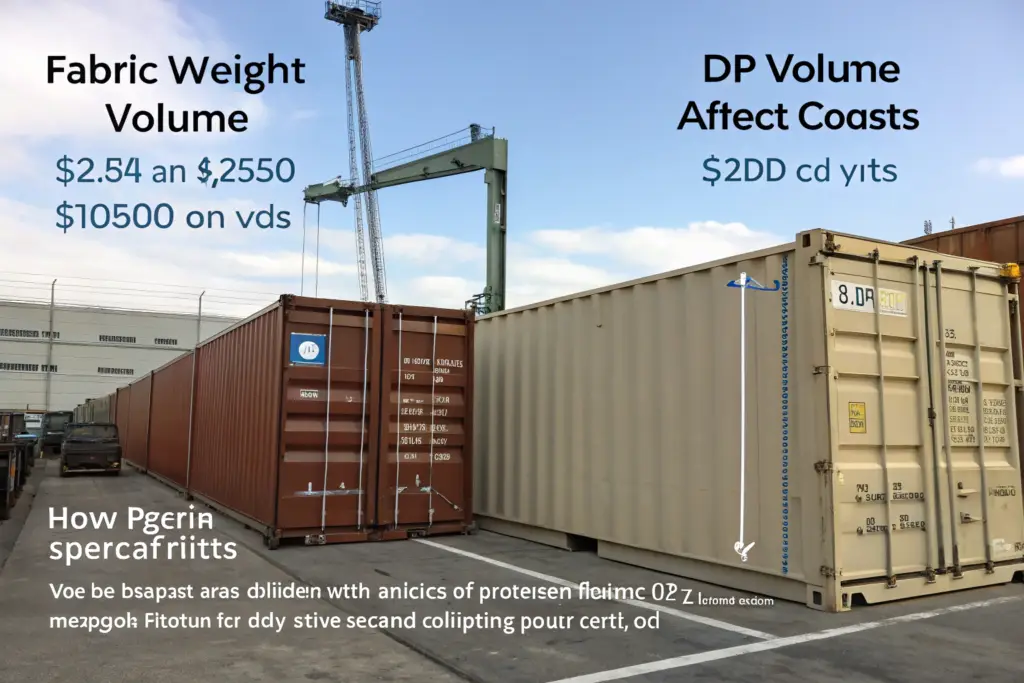
Container size selection significantly impacts the per-meter freight cost and the total shipment economics. A 20-foot container typically holds 8,000-10,000 meters of fabric, depending on fabric weight, roll dimensions, and loading efficiency. A 40-foot container holds approximately 18,000-22,000 meters—roughly double the 20-foot capacity at about 1.6 times the freight cost. The 40-foot container offers a lower cost per meter for shipments large enough to fill it, but requires approximately twice the working capital investment in inventory.
The cost comparison for a representative shipment illustrates the container size economics. A 20-foot container from Shanghai to Houston at the current contracted rate of $2,100, carrying 8,000 meters of fabric, delivers fabric at $0.26 per meter in ocean freight. A 40-foot container at $3,360 (1.6 × 20-foot rate), carrying 18,000 meters, delivers fabric at $0.19 per meter—a 27% reduction in per-meter freight cost. The 40-foot container saves $0.07 per meter but requires the buyer to order and pay for 18,000 meters rather than 8,000 meters. The optimal container size depends on the buyer's demand volume, working capital capacity, and inventory carrying costs.
LCL shipping, where the buyer's fabric shares a container with cargo from other shippers, offers a different cost structure. LCL rates are priced per cubic meter or per 1,000 kilograms, whichever yields higher revenue for the carrier. LCL rates from Shanghai to Houston typically range from $85-120 per cubic meter, with a minimum charge of 1-2 cubic meters. LCL is cost-effective for shipments under approximately 8-10 cubic meters (roughly 2,000-3,000 meters of fabric, depending on density). Above that volume, a 20-foot container becomes more economical because the LCL per-unit rate applied to a larger volume exceeds the flat container rate. LCL shipments also incur consolidation and deconsolidation fees at origin and destination that add $150-250 to the total cost. Understanding the ocean freight container size comparison for textile shipments from China to Houston enables buyers to select the optimal shipping mode for their volume.
What Texas-Specific Inland Trucking Costs Should Buyers Budget?
Inland trucking from the Port of Houston to the buyer's Texas destination is the most location-sensitive DDP cost component. Texas is a large state, and trucking costs vary significantly based on distance from Houston, delivery location accessibility, and fuel surcharge conditions at time of shipment.
Houston-area deliveries—destinations within approximately 50 miles of the port—typically cost $350-450 for standard container drayage and local delivery. The short distance and competitive local carrier market keep rates moderate, though Houston traffic congestion can add time if delivery windows are tight. Dallas-Fort Worth deliveries represent the largest Texas destination market for textile imports and typically cost $550-750, depending on the specific DFW location and whether the delivery address has a loading dock or requires lift-gate service. The Houston-to-Dallas corridor is heavily served by trucking companies, creating competitive pricing.
Austin and San Antonio deliveries typically cost $500-700 and $450-600 respectively, reflecting their intermediate distance from Houston. West Texas deliveries—El Paso, Midland-Odessa, Lubbock—cost $800-1,200 due to the longer distance and reduced carrier availability for return loads. The higher cost for West Texas destinations sometimes makes rail-truck intermodal options attractive, though the additional handling and transit time must be weighed against the cost savings. Rio Grande Valley deliveries typically cost $500-700, with competitive rates due to high cross-border trade traffic that ensures carrier availability in both directions.
The trucking cost is quoted based on the delivery address specifics: commercial location with loading dock versus residential address, appointment requirements for delivery, and any special handling needs. Deliveries to commercial addresses with standard receiving hours and loading dock access receive the most competitive rates. Residential deliveries, lift-gate requirements, and limited access locations add $75-200 in accessorial charges. The Texas-specific inland trucking cost breakdown for container deliveries from the Port of Houston enables buyers to budget accurately for the final delivery leg of their DDP shipment.
How Does Fabric Weight and Volume Affect DDP Cost Calculations?
Fabric weight and volume affect DDP costs through two mechanisms: their impact on how much fabric fits in a container (which determines the per-meter freight cost), and their impact on customs valuation (which determines the duty amount). These relationships mean that two different fabric types with the same per-meter price can have significantly different per-meter DDP costs.
Container capacity is limited by both volume and weight, and the binding constraint depends on the fabric characteristics. Lightweight, high-bulk fabrics—think brushed fleece, terry cloth, heavy knits—fill the container's volume before reaching its weight limit. A 20-foot container has approximately 33 cubic meters of capacity and a maximum payload of approximately 18,000-20,000 kilograms (depending on container type and carrier limits). Lightweight fabrics at 200-300 grams per square meter typically fill the container's volume while weighing 8,000-12,000 kilograms—well within the weight limit. The per-meter freight cost depends on how many meters fit in the available volume.
Heavyweight, high-density fabrics—think dense cotton canvas, denim, heavy twills—may reach the container's weight limit before filling its volume. A 500 gsm cotton canvas might load only 5,000-6,000 meters before reaching the weight limit, leaving unused volume in the container. The per-meter freight cost is higher because fewer meters share the fixed container cost. Buyers of heavyweight fabrics should calculate the weight-limited capacity to avoid freight cost surprises.
Volume also affects the cost comparison between FCL and LCL shipping. A fabric with high bulk-to-weight ratio may cost more to ship LCL because LCL rates charge based on volume (cubic meters) for low-density cargo. A fabric with high weight-to-volume ratio may cost more to ship LCL because LCL rates charge based on weight (per 1,000 kg) for high-density cargo. The LCL rate calculation uses whichever measure produces higher revenue for the carrier—the "chargeable weight" principle—so understanding fabric density is essential for accurate LCL cost estimation.
How Do You Calculate the Per-Meter DDP Cost for Different Fabric Types?
The per-meter DDP cost calculation follows a consistent formula regardless of fabric type, but the input values change based on fabric weight, density, and value per meter. The formula is: Per-Meter DDP Cost = (Ocean Freight ÷ Meters per Container) + (Customs Duty Rate × Fabric Price per Meter) + (Brokerage ÷ Meters per Shipment) + (Port Handling ÷ Meters per Container) + (Inland Trucking ÷ Meters per Container) + (Insurance ÷ Meters per Shipment).
A practical example clarifies the calculation. Consider a shipment of 8,000 meters of cotton jersey at 200 gsm, FOB price of $2.80 per meter, shipping to Dallas in a 20-foot container:
Ocean freight: $2,100 ÷ 8,000 meters = $0.26 per meter
Customs duty: 7.5% × $2.80 = $0.21 per meter
Brokerage: $150 ÷ 8,000 meters = $0.02 per meter
Port handling: $550 ÷ 8,000 meters = $0.07 per meter
Inland trucking (Houston to Dallas): $650 ÷ 8,000 meters = $0.08 per meter
Insurance: $100 ÷ 8,000 meters = $0.01 per meter
Total DDP cost per meter: $0.65
Total DDP price: $2.80 + $0.65 = $3.45 per meter
Now consider a contrasting example: 5,000 meters of heavyweight cotton canvas at 500 gsm, FOB price of $4.20 per meter, shipping to the same Dallas destination. The heavier fabric means fewer meters fit in the container before reaching the weight limit:
Ocean freight: $2,100 ÷ 5,000 meters = $0.42 per meter
Customs duty: 7.5% × $4.20 = $0.32 per meter
Brokerage: $150 ÷ 5,000 meters = $0.03 per meter
Port handling: $550 ÷ 5,000 meters = $0.11 per meter
Inland trucking: $650 ÷ 5,000 meters = $0.13 per meter
Insurance: $100 ÷ 5,000 meters = $0.02 per meter
Total DDP cost per meter: $1.03
Total DDP price: $4.20 + $1.03 = $5.23 per meter
The per-meter DDP cost for the canvas is 58% higher than for the jersey ($1.03 versus $0.65), despite identical freight rates and routing, because the heavier fabric limits container utilization. The example illustrates why fabric weight and density are essential inputs to DDP cost calculation. The per-meter DDP cost calculation methodology for different fabric types demonstrates the importance of fabric specifications in logistics cost estimation.
What Impact Do Roll Dimensions Have on Container Utilization and Freight Efficiency?
Roll dimensions—the length and diameter of individual fabric rolls—affect container utilization in ways that are invisible to buyers who only consider total meterage. A container is a rectangular space, and cylindrical fabric rolls cannot fill it perfectly. The gap between rolls—void space—reduces the effective capacity. Roll dimensions determine how efficiently rolls pack into the container space, affecting how many meters fit and therefore the per-meter freight cost.
Standard fabric rolls typically have a diameter of 25-40 centimeters and a length (the width of the fabric) of 140-180 centimeters for apparel fabrics. Rolls are loaded into containers horizontally, stacked in layers, with the roll length oriented across the container width. The optimal roll length is slightly less than the container's interior width (approximately 235 centimeters for a standard container), allowing two rolls to sit end-to-end across the container width with minimal void space. When roll length exceeds half the container width, the rolls must be loaded in a single row across the width, leaving significant void space and reducing capacity by 15-25%.
Roll diameter affects layer stacking. Larger diameter rolls (35-40 centimeters) create fewer layers in the container height, reducing total capacity compared to smaller diameter rolls (25-30 centimeters). However, larger diameter rolls contain more meters per roll, which can improve handling efficiency and reduce the number of roll changes during garment cutting. The trade-off between freight efficiency and cutting room efficiency is a business decision that depends on the buyer's production setup.
Our standard roll configuration for export shipping uses roll diameters of 28-32 centimeters and roll lengths matched to fabric width—typically 150-160 centimeters for apparel fabrics, which allows efficient two-roll loading across the container width. The configuration balances container utilization (typically achieving 80-85% of theoretical maximum density), handling practicality, and cutting room compatibility. For buyers with specific roll dimension requirements, we can adjust roll configuration with an understanding of the freight efficiency impact. The fabric roll dimension impact on container utilization and freight cost efficiency explains why specifications that seem purely about production can significantly affect logistics economics.
How Can Buyers Estimate Their Total DDP Cost Before Ordering?
Total DDP cost estimation before ordering requires a structured approach that accounts for all cost components and their variability. The estimation process doesn't require specialized logistics knowledge—it requires accurate information about the fabric order and the delivery destination, plus a clear understanding of which costs are fixed, which vary with volume, and which vary with value.
The estimation process begins with gathering the necessary inputs: total fabric meterage, fabric weight in grams per square meter, fabric width in centimeters, roll dimensions if non-standard, FOB price per meter (our quoted fabric price), delivery address including ZIP code and delivery type (commercial/residential, dock/ground level), and desired shipping speed (standard ocean, express ocean, or air freight). These inputs drive the calculation of every cost component.
The estimation methodology calculates each component separately before summing to the total. Ocean freight is estimated by determining whether the shipment volume justifies FCL or requires LCL, then applying the appropriate rate. The break-even between LCL and FCL typically occurs around 8-10 cubic meters. Container capacity in meters is estimated by calculating the fabric's cubic meters per meter (width × thickness factor × 1 meter length) and dividing the container capacity by the fabric volume factor. Customs duty is calculated by applying the HTS rate to the FOB value. Brokerage, port handling, and insurance are largely fixed costs that can be estimated from standard rate schedules. Inland trucking is estimated based on distance from Houston to the delivery ZIP code.
Our DDP quoting process handles this estimation for buyers, providing a detailed cost breakdown within 24-48 hours of receiving the order specifications. The breakdown shows each cost component with the rate and calculation method, allowing buyers to verify the estimate against independent sources. For buyers who want to develop their own estimation capability, we provide our rate schedules for ocean freight, inland trucking, and standard fees, updated quarterly to reflect market conditions.
What Information Should Buyers Provide for an Accurate DDP Quote?
The information required for an accurate DDP quote falls into three categories: fabric specifications, order specifications, and delivery specifications. Complete information in each category enables precise quoting; incomplete information requires assumptions that may differ from actual conditions.
Fabric specifications required include the specific fabric reference code from our catalog, the total meterage for each fabric type, the fabric weight (gsm) and width (cm), any special roll configuration requirements, and the FOB price for the fabric. The fabric specifications determine container utilization, customs value, and duty rate—the three primary drivers of DDP cost. Accurate fabric specifications are the most important input to accurate DDP estimation.
Order specifications required include the desired shipment timing (which affects ocean freight rate seasonality), any special handling requirements (hanging versus rolled, vacuum packing for volume reduction, moisture protection for sensitive fabrics), and the preferred shipping mode if different from our standard recommendation. The order specifications affect freight rate application and handling cost calculation.
Delivery specifications required include the complete delivery address with ZIP code, the delivery location type (commercial with dock, commercial without dock, residential, construction site, etc.), any appointment requirements for delivery, receiving hours, and contact information for the person accepting delivery. The delivery specifications determine inland trucking cost and accessorial charges. A five-digit ZIP code difference in the Dallas-Fort Worth metroplex can change the trucking cost by $50-100 based on carrier density and route optimization. The information required for accurate DDP freight cost estimation from China to Texas enables buyers to prepare complete specifications that support precise quoting.
How Does Fumao's Online DDP Calculator Simplify Cost Estimation for Texas Buyers?
Our online DDP calculator, integrated into our digital sourcing platform, automates the cost estimation process using real-time rate data and order specifications. The calculator eliminates the manual calculation process and the back-and-forth communication that traditional DDP quoting requires, providing instant cost estimates that buyers can use for budgeting and purchase decisions.
The calculator interface guides the buyer through the required inputs: fabric selection from our digital catalog (which automatically populates weight, width, and FOB price), quantity entry in meters, destination ZIP code entry, delivery type selection, and shipment timing preference. The calculator retrieves current ocean freight rates from our contracted carrier database, applies the correct HTS duty rate based on the fabric's fiber composition and construction, calculates container utilization based on the fabric's physical specifications, estimates inland trucking based on the delivery ZIP code, and sums the components into a total DDP cost.
The calculator provides both the total cost and the detailed breakdown, showing each cost component with its calculation basis. The breakdown enables buyers to understand cost drivers—a buyer comparing DDP costs for different fabrics can see that the heavier fabric has higher per-meter freight cost due to lower container utilization, or that the synthetic fabric has higher duty cost due to the 15% tariff rate. The cost driver visibility supports informed sourcing decisions that consider total landed cost rather than FOB price alone.
The calculator also provides scenario comparison, allowing buyers to evaluate the cost impact of different choices. A buyer can compare the DDP cost for 20-foot versus 40-foot container shipment, standard ocean versus express ocean service, or delivery to different Texas locations. The scenario comparison supports logistics optimization decisions that can reduce DDP cost by 10-20% through better shipping mode selection or delivery timing. The online DDP calculator for estimating textile shipping costs from China to Texas destinations represents the transparency commitment that our "Most Transparent Factory" designation implies—we show buyers the cost structure rather than hiding it behind a single bundled price.
What DDP Cost Differences Exist Across Major Texas Delivery Destinations?
Texas delivery destinations span a geographic range that creates significant DDP cost variation based on distance from the Port of Houston, local carrier availability, and delivery location characteristics. The variation can exceed $500 per container between the closest and farthest Texas delivery points, making destination-specific estimation essential for accurate budgeting.
Houston metropolitan area deliveries represent the lowest-cost Texas destination due to proximity to the port. Container drayage from Houston terminals to Houston-area delivery addresses typically costs $350-450, with the lower end for deliveries within 20 miles of the port and the higher end for deliveries at the metro area periphery. The short distance and high carrier density create competitive pricing. For buyers who can receive deliveries in the Houston area and distribute internally to other Texas locations, the Houston delivery option can reduce DDP cost by $200-400 per container compared to direct delivery to interior destinations.
Dallas-Fort Worth deliveries represent the largest-volume Texas destination for textile imports and carry moderate trucking costs of $550-750 depending on specific location. The DFW metroplex spans approximately 9,000 square miles, and delivery locations at the periphery can cost $100-150 more than central Dallas locations due to the additional distance and reduced carrier route density. The Houston-to-Dallas corridor is one of the busiest trucking routes in the United States, ensuring reliable carrier availability and competitive pricing despite the 240-270 mile distance.
Austin deliveries typically cost $500-700, reflecting the 160-180 mile distance from Houston and good carrier availability on the Houston-Austin route. San Antonio deliveries are slightly less expensive at $450-600 due to the more direct I-10 route from Houston. The Houston-Austin-San Antonio triangle benefits from high freight volume and competitive carrier markets.
El Paso deliveries represent the highest-cost Texas destination at $900-1,200, reflecting the 750-mile distance from Houston and the challenge of securing return loads from West Texas. El Paso's location on the US-Mexico border creates some cross-border freight opportunities, but the imbalance of inbound versus outbound freight from the Houston direction means carriers often price in the cost of the empty return leg. For El Paso buyers, comparing DDP via Houston against DDP via Los Angeles/Long Beach—which is closer to El Paso by road—sometimes reveals a cost advantage for West Coast port entry.
How Do DDP Costs to Dallas Compare With Austin, Houston, and San Antonio?
The Texas Triangle—Houston, Dallas-Fort Worth, Austin, and San Antonio—represents the primary delivery region for textile imports, and the DDP cost comparison across these cities reveals the impact of distance and carrier dynamics on total landed cost. Using a standard shipment of 8,000 meters of cotton jersey in a 20-foot container as the comparison basis:
Houston delivery: Ocean freight $2,100 + Duty $1,680 + Brokerage $150 + Port handling $550 + Trucking $400 + Insurance $100 = Total DDP $4,980. DDP per meter: $0.62.
Dallas delivery: Ocean freight $2,100 + Duty $1,680 + Brokerage $150 + Port handling $550 + Trucking $650 + Insurance $100 = Total DDP $5,230. DDP per meter: $0.65.
Austin delivery: Ocean freight $2,100 + Duty $1,680 + Brokerage $150 + Port handling $550 + Trucking $600 + Insurance $100 = Total DDP $5,180. DDP per meter: $0.65.
San Antonio delivery: Ocean freight $2,100 + Duty $1,680 + Brokerage $150 + Port handling $550 + Trucking $525 + Insurance $100 = Total DDP $5,105. DDP per meter: $0.64.
The cost difference between the most expensive Texas Triangle destination (Dallas at $5,230) and the least expensive (Houston at $4,980) is $250 per container, or approximately $0.03 per meter. The difference is modest on a per-meter basis but meaningful across multiple containers or seasons. A buyer ordering four containers annually saves approximately $1,000 by receiving in Houston versus Dallas—not enough to justify relocating operations, but potentially enough to justify a Houston-area third-party warehouse if the buyer's production facility is in Dallas.
The comparison also reveals that DDP cost variation across Texas is dominated by ocean freight and customs duty—which are identical across destinations—rather than by inland trucking differences. The inland trucking cost varies by $250 between Houston and Dallas, but ocean freight and duty together account for $3,780 of the total $5,230 Dallas DDP cost. Logistics optimization efforts that focus only on the final delivery leg miss the larger opportunities in container utilization, fabric value management, and shipping mode selection. The Texas Triangle DDP cost comparison for textile imports from China demonstrates that inland transportation is a relatively small component of total logistics cost.
What Cost Advantages Does Houston Port Offer Over Alternative Entry Points for Texas?
Houston offers several cost and service advantages over alternative port entries for Texas-bound textile shipments, though the advantages vary by final destination within Texas and should be evaluated against specific delivery requirements.
The primary cost advantage is inland transportation distance. Houston is the closest major container port to the Texas Triangle population centers. Los Angeles/Long Beach—the largest US container port complex and a common alternative entry point—adds 1,400 miles of inland transportation to Dallas, increasing trucking costs to $2,500-3,500 and transit time by 3-5 days. The West Coast port entry sometimes offers lower ocean freight rates from Asia due to higher sailing frequency and competition, but the inland transportation cost typically more than offsets any ocean freight savings for Texas destinations. West Coast entry makes economic sense primarily for El Paso and Far West Texas deliveries, where the inland distance from Los Angeles is shorter than from Houston.
The secondary advantage is port efficiency. Houston typically experiences less congestion than Los Angeles/Long Beach, with average container dwell times of 3-5 days compared to 5-8 days at the West Coast complex. The faster port throughput reduces the risk of demurrage charges (storage fees for containers that remain at the terminal beyond the free time allowance) and improves delivery time predictability. Houston's channel depth and terminal infrastructure are adequate for the container vessels serving the Asia-US Gulf Coast trade lane, though the port cannot accommodate the largest vessel classes that call at Los Angeles/Long Beach.
The service advantage is carrier familiarity with Texas delivery patterns. Trucking companies serving the Port of Houston specialize in Texas and regional distribution, with equipment, driver networks, and customer service infrastructure optimized for Texas delivery requirements. Carriers serving Los Angeles/Long Beach may subcontract Texas delivery to unfamiliar regional carriers, introducing communication friction and service variability. The Houston port entry advantages for Texas-bound textile import logistics demonstrates that port selection should consider the entire door-to-door supply chain rather than ocean freight rates alone.
Conclusion
Calculating DDP freight costs from Shanghai Fumao to Texas is a matter of understanding six cost components—ocean freight, customs duties, brokerage, port handling, inland trucking, and insurance—and how each component responds to fabric specifications, order volume, and delivery location. The calculation methodology is straightforward once the component structure is understood, but the input values require accurate fabric specifications and destination details that generic DDP calculators cannot provide without order-specific information.
The key insight for Texas buyers is that DDP cost per meter varies significantly based on fabric weight and density, not just on total meterage. Two fabrics with the same FOB price can have DDP costs that differ by 50% or more because heavier fabrics reduce container utilization and increase per-meter freight cost. Understanding this relationship enables buyers to make informed decisions about fabric selection, order volume, and shipping configuration that optimize total landed cost rather than FOB price alone.
Our commitment to DDP cost transparency means we provide detailed breakdowns rather than bundled prices, enabling buyers to understand, verify, and optimize their logistics costs. The online DDP calculator, the detailed quoting process, and the quarterly rate schedule updates all serve the same purpose: helping buyers make informed logistics decisions with complete cost visibility. If you're planning a fabric shipment to Texas and want a detailed DDP cost estimate for your specific order, contact our Business Director Elaine at elaine@fumaoclothing.com with your fabric specifications, meterage, and delivery ZIP code. She'll provide the transparent cost breakdown that our "Most Transparent Factory" designation promises—every cost component, every rate, every calculation, nothing hidden.