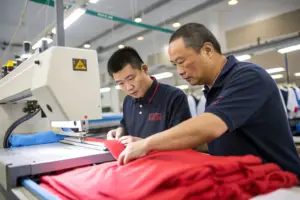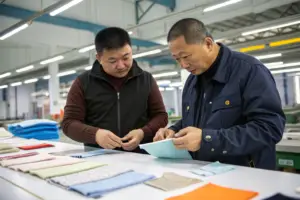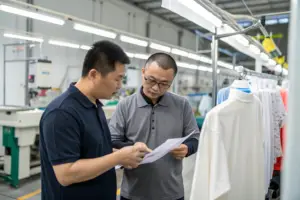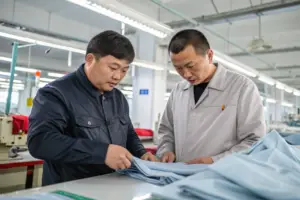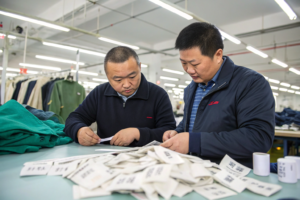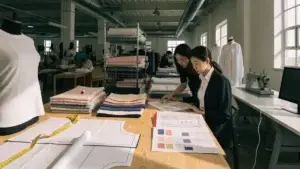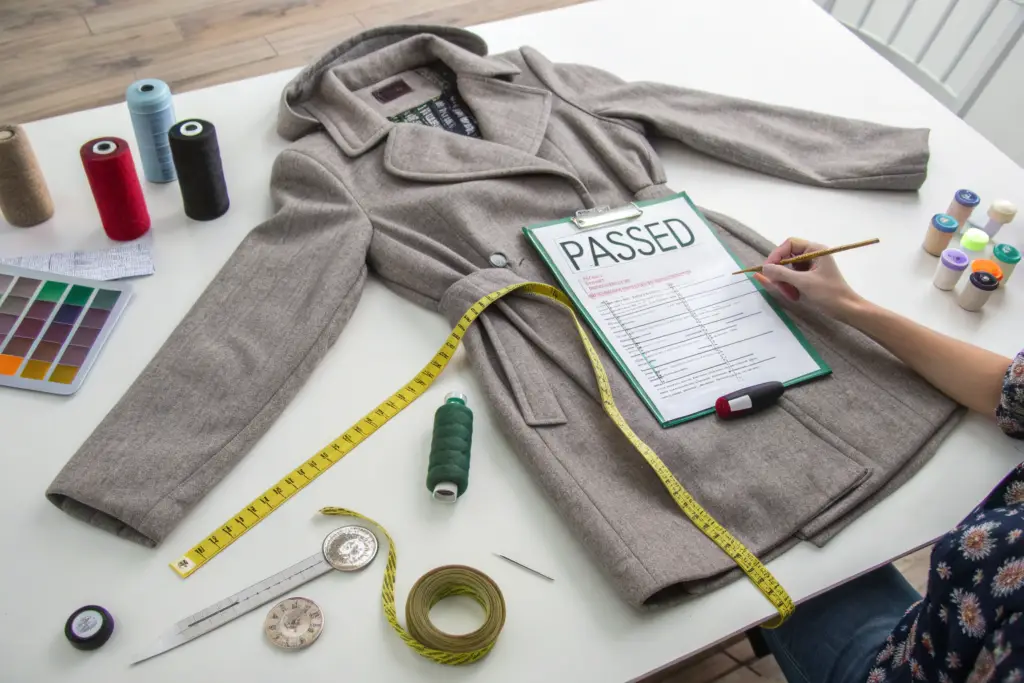
A brand owner from Chicago stood in our inspection room last December and watched one of our QC inspectors examine a wool wrap coat. The inspector measured the center back length. She checked the sleeve pitch. She ran a needle detector over every inch of the fabric. She turned the coat inside out and inspected every internal seam. She found a loose thread tail on an interior pocket—something the customer would never have noticed—and she flagged the coat for rework. The brand owner turned to me and said, "That is the first time I have ever seen a factory reject its own product for something I would not have caught." I told him that is the whole point. Our quality control does not exist to catch defects the customer can see. It exists to catch defects before they ever become visible.
Shanghai Fumao ensures quality in every women's coat type through a four-stage quality control system: incoming fabric and trim inspection against certified specifications, in-line production checks at each major construction station, a 100% end-of-line inspection with measurement verification and needle detection, and a final AQL 2.5 third-party inspection on the packed shipment, with each stage documented and traceable to the individual production lot.
A coat is the most complex garment in a women's apparel collection. It has more components than a dress, a shirt, or a pair of trousers. It has an outer shell, a lining, an interlining, multiple pocket constructions, a collar or hood assembly, a closure system, and often a belt or other accessory piece. Every one of these components must be cut, sewn, pressed, and inspected correctly. A quality failure in any single component ruins the coat. A factory that can make a good t-shirt cannot necessarily make a good coat. At Shanghai Fumao, we built our quality system specifically around the complexity of outerwear. Let me walk you through exactly how we ensure every coat that leaves our factory meets the standard your brand and your customer expect.
How Does Our Fabric and Trim Inspection Process Prevent Quality Issues Before Cutting?
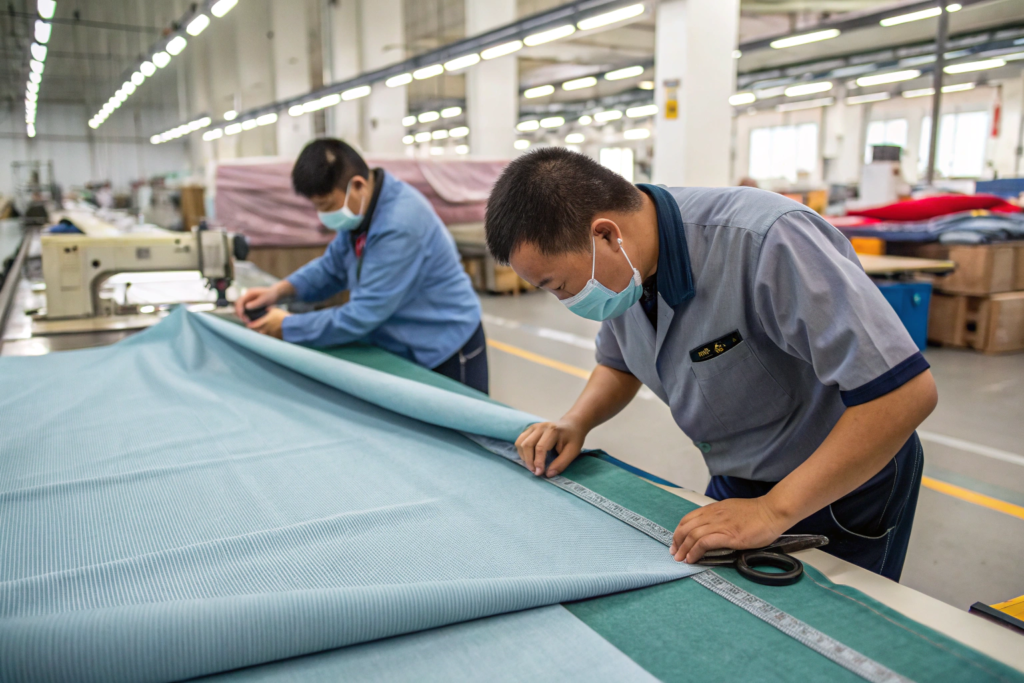
A coat is fabric first. If the wool coating has a subtle weave defect, a color inconsistency, or an incorrect weight, the finished coat will be defective no matter how well it is sewn. The quality of the finished garment is determined at the cutting table. The quality of the cutting is determined by the quality of the fabric that arrives at the factory. This is why our quality control process begins weeks before a single stitch is sewn. It begins when the fabric bolts arrive from the mill.
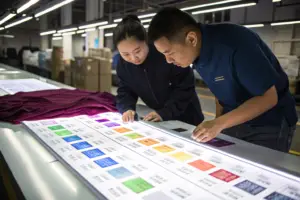
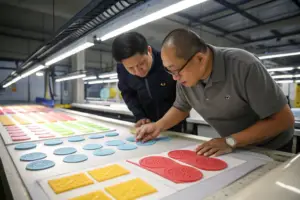
Every incoming fabric lot undergoes a four-point inspection for visual defects, a GSM weight verification against the approved specification, a shrinkage test that simulates three home laundry cycles, and a colorfastness assessment under a controlled lightbox, with any lot failing any single test rejected and returned to the mill before it reaches the cutting table.
I recall a fabric lot that arrived last October for a brand's oversized wrap coat program. The mill had sent 500 meters of a 520gsm wool-cashmere blend in camel. The color looked correct to the naked eye. Our incoming inspection team ran it through the lightbox against the approved lab dip standard. Under the D65 daylight simulation, the fabric had a slightly cooler undertone than the approved sample. The difference was subtle—barely visible in warm warehouse lighting but noticeable in the cold daylight of a retail store window. We rejected the lot. The mill re-dyed a new lot to match the standard. The delay cost us four production days. The alternative was shipping coats that looked slightly different in the store than they looked in the lookbook. The customer would have noticed. The brand would have faced returns. The four-day delay protected the brand's season.
What Specific Tests Do We Perform on Incoming Wool and Cashmere Fabrics?
Wool and cashmere fabrics are natural fibers with inherent variability. One lot from the same mill can behave differently from the previous lot. Our incoming inspection tests for three critical parameters. First, fabric weight in grams per square meter, measured with a precision GSM cutter and digital scale. The tolerance is plus or minus 5% of the specified weight. A fabric specified at 520gsm must measure between 494 and 546gsm. Second, dimensional stability, measured by marking a 50cm square on the fabric, washing it in a standardized cycle, drying it flat, and re-measuring. The shrinkage must be under 2% in both length and width. If shrinkage exceeds 2%, the fabric must be pre-shrunk in our industrial relaxation dryer before cutting. Third, colorfastness to light, measured by exposing a fabric swatch to a xenon arc lamp for a specified duration and assessing the color change against the blue wool scale. The fabric must achieve a rating of 4 or higher on a scale of 1 to 8. These tests follow the standardized methods published by AATCC and are documented in a fabric inspection report that is attached to the production order.
How Do We Verify That Trims Meet the Approved Specification?
A coat's trims—the buttons, zippers, labels, and lining—are small components with an outsized impact on quality perception. A button that cracks, a zipper that sticks, a label that frays, a lining that rips—these are the defects that generate customer complaints and returns. We test every trim component before it enters the production floor. Buttons are tested for impact resistance and colorfastness to dry cleaning. Zippers are tested for smooth operation across 500 open-close cycles. Labels are tested for wash fastness to ensure the text remains legible after repeated cleaning. The trim inspection is documented in a trim approval report. A sample of each trim is retained in the production file so the QC team can verify that the bulk trims match the approved samples. Trim testing standards are aligned with the requirements of major US retailers and are based on protocols from organizations like ASTM International.
How Do In-Line Quality Checks Catch Defects During the Sewing Process?
End-of-line inspection catches defects that have already been sewn into the garment. By that point, the fabric is cut, the seams are stitched, and the coat is nearly finished. Fixing a defect at the end of the line requires ripping out stitches, potentially damaging the fabric, and re-sewing. It is slow, expensive, and risks creating a secondary defect. In-line inspection catches defects as they occur. The problem is fixed immediately. The defective operation is corrected before it produces twenty more defective coats.
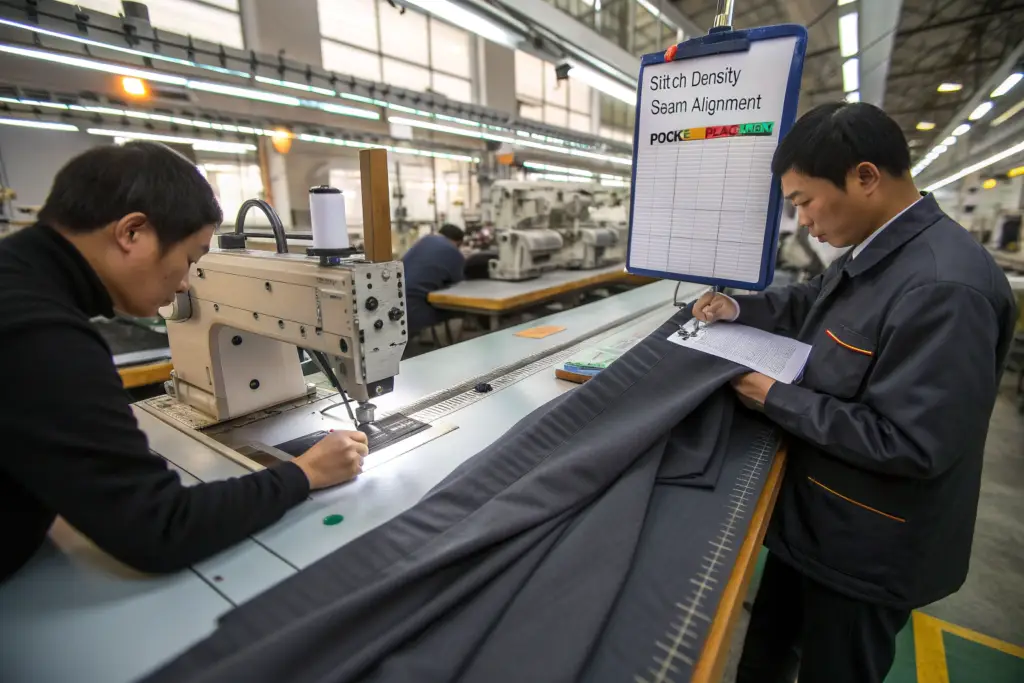
Our in-line quality system stations a roving QC inspector at every three sewing stations on the coat line, with the inspector checking the critical points of each operation—shoulder seam alignment, collar attachment, sleeve setting, pocket placement, and lining attachment—on a random sample of 15% of the pieces passing through the station each hour.
I walked a prospective client through our coat line last spring. At station seven, where the collar is attached to the body, the in-line inspector was checking the collar points on a wool overcoat. She measured the distance from the collar point to the shoulder seam on both sides. The left side was 12.2 centimeters. The right side was 12.4 centimeters. The tolerance is 0.3 centimeters. The right collar point was within tolerance, but at the edge. She noted it on her control chart. She did not stop the line, but she alerted the station operator to check the collar placement jig. The jig had shifted slightly. The operator re-calibrated. The next coat measured 12.1 on both sides. The in-line inspection caught a trend toward asymmetry before it became a defect.
What Are the Critical Control Points for Coat Construction?
A coat has five critical control points where in-line inspection is mandatory. The first is shoulder seam alignment—the left and right shoulder seams must be symmetrical, and the seam must sit at the correct pitch so the coat hangs without diagonal wrinkles. The second is collar or lapel attachment—the collar points must be identical in length and angle, and the lapel must roll smoothly without gaping. The third is sleeve setting—the sleeve head must have the correct amount of ease distributed evenly, with no puckers or tucks. The fourth is pocket placement—both pockets must sit at the same height and distance from the center front, and the pocket bags must be securely bar-tacked at the stress points. The fifth is lining attachment—the lining must be attached without twisting, the ease pleat at the center back must open freely, and the lining hem must hang 1 to 2 centimeters above the coat hem. Each control point has a documented measurement standard and tolerance. The in-line inspector records the measurements on a control chart. The chart is reviewed daily by the production manager.
How Does the Control Chart System Prevent Defect Trends?
A control chart is a simple statistical tool. The inspector records measurements on a graph with a center line representing the target measurement and upper and lower lines representing the tolerance limits. If three consecutive measurements trend in the same direction—even if all three are within tolerance—the inspector alerts the line supervisor. The trend indicates that a machine setting, a cutting blade, or an operator technique is drifting. The problem is investigated and corrected before a single measurement falls outside the tolerance. The control chart transforms quality control from a reactive process—find and fix defects—into a proactive process—identify and correct drift. The system is based on statistical process control principles widely used in manufacturing and documented by organizations like The Manufacturer.
What Does Our 100% End-of-Line Inspection Cover for Every Coat?
In-line inspection checks samples. End-of-line inspection checks every single coat. This is a 100% inspection, not a random sample. Every coat that comes off the production line is measured, visually inspected, needle-detected, and pressed before it is cleared for packing. This level of inspection is labor-intensive. It adds cost. It is also the reason our defect rate on shipped coats is consistently below 1%. The cost of the 100% inspection is less than the cost of returns, chargebacks, and lost wholesale accounts that result from shipping defective product.
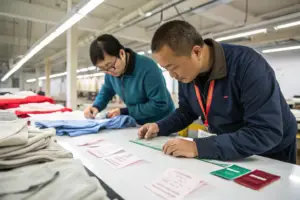
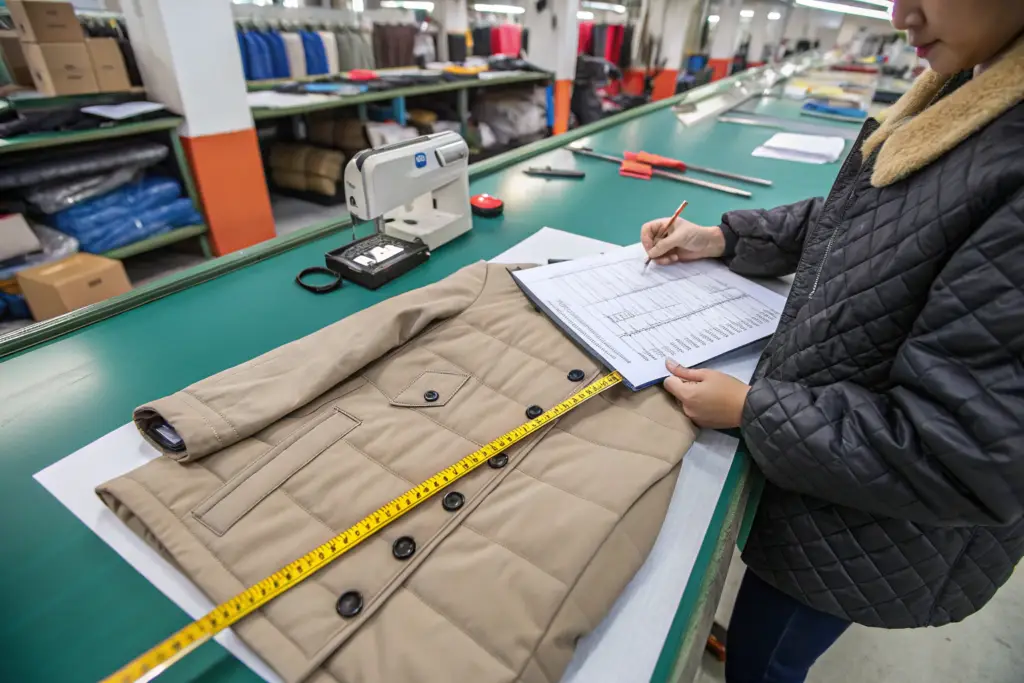
Every coat undergoes a 100% end-of-line inspection that includes measurement verification of all critical points against the sealed golden sample, a full visual inspection under standardized lighting for fabric flaws, stitching defects, and trim issues, a metal detector pass to ensure no broken needle fragments remain in the garment, and a final professional pressing that sets the shape and prepares the coat for packing.
A brand we manufacture for conducted an audit of their returns data. They found that our coats had a 3.2% return rate, compared to an 8.5% return rate for coats from their other supplier. The difference was our 100% end-of-line inspection. The other supplier performed AQL sampling inspection only—checking a random sample from the packed cartons and shipping the entire lot if the sample passed. AQL sampling is the industry standard, but it statistically allows a small percentage of defects to reach the customer. Our 100% inspection catches those defects before they leave the factory. The return rate differential saved the brand an estimated $45,000 in return processing costs and markdown losses across one season.
How Does the Measurement Verification Process Work?
The inspector places the coat on a flat inspection table. Using the sealed golden sample as the reference, the inspector measures every point of measure on the specification sheet: center back length, shoulder width, chest circumference, sweep, sleeve length, bicep circumference, cuff opening, collar height, pocket placement, and belt length if applicable. Each measurement is compared to the specification and the tolerance. For critical fit points like center back length and chest, the tolerance is plus or minus 0.5 centimeters. For non-critical points like pocket placement, the tolerance is plus or minus 1.0 centimeters. If any measurement falls outside the tolerance, the coat is placed on the rework rack. The rework tailor fixes the issue—re-hemming, re-setting a sleeve, or re-attaching a pocket—and the coat is re-inspected. The measurement data is recorded on the coat's individual inspection ticket. The ticket travels with the coat to packing. This creates traceability from the final inspection back through the production line to the individual sewing operator who constructed the coat.
What Does the Needle Detection Process Involve?
Broken sewing machine needles are a rare but catastrophic quality failure. A needle fragment left inside a coat can injure a customer. The legal and reputational consequences are severe. Every coat passes through a conveyor needle detector after the final inspection. The machine uses a magnetic field to detect any metal fragment larger than 1.2 millimeters. If metal is detected, the machine stops and an alarm sounds. The coat is removed from the line and manually inspected with a handheld wand detector to locate and remove the fragment. The incident is logged in the needle detection record. The machine is tested at the start of every shift with a calibration card containing a metal fragment of known size. The calibration test is documented. Needle detection is not a value-added step from a fashion perspective. It is a safety-critical step from a liability perspective. No coat leaves our factory without passing through the needle detector.
How Does the Final AQL Inspection Validate the Entire Production Lot?
The 100% end-of-line inspection is our internal quality gate. The AQL third-party inspection is the external quality gate that protects the buyer. We do not ship a coat order until an independent inspection company—selected and paid for by the buyer or arranged by us at the buyer's request—has pulled a random sample from the packed cartons and verified that the shipment meets the agreed quality standard. This is not our preference. It is our requirement. We want the independent verification because it protects us from disputes as much as it protects the buyer from defects.
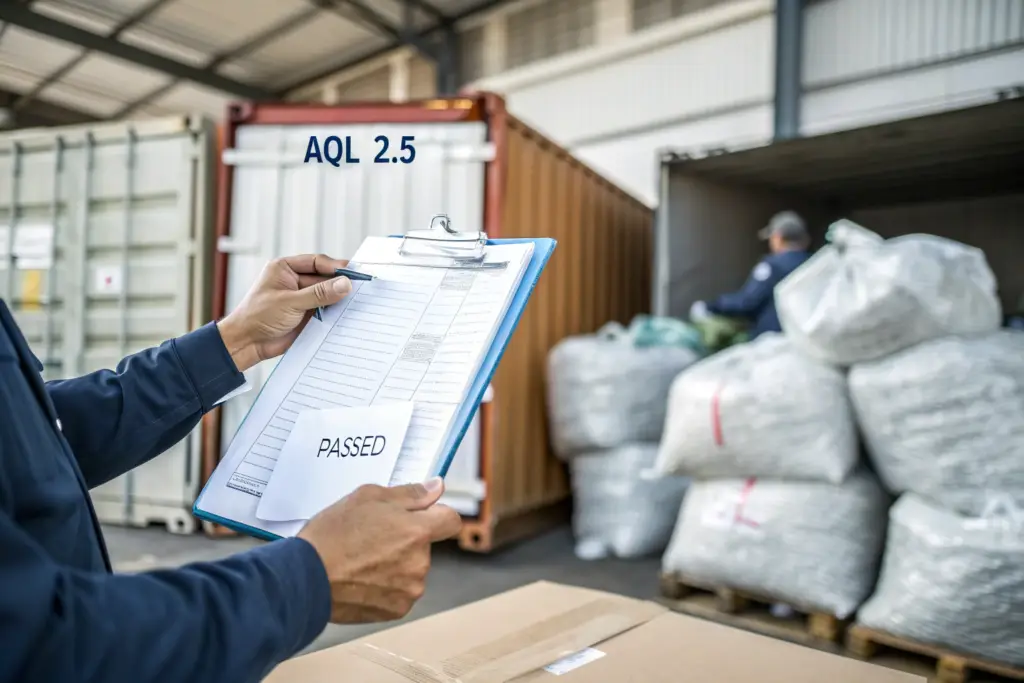
The final AQL 2.5 inspection is conducted by an accredited third-party company on the packed, ready-to-ship cartons, with the inspector pulling a statistically valid random sample, measuring every critical point against the spec sheet, checking for visual and construction defects, verifying packaging and labeling, and issuing a pass or fail report that determines whether the shipment is released or reworked.
A brand we work with sends their own inspector from an international testing company to our facility for every shipment. The inspector arrives unannounced on the day the shipment is scheduled for packing completion. He pulls 125 coats at random from the 3,000-unit order. He measures every critical point on every coat. He checks every seam, every button, every label. He checks the carton packing, the polybag sealing, the carton markings. He issues his report directly to the brand. In four years and over forty inspections, our shipments have passed every single one on the first inspection. This is not luck. It is the predictable outcome of the incoming, in-line, and end-of-line quality system that precedes the AQL inspection. The AQL inspection is not where we catch defects. It is where we prove that we already caught them.
What Is the AQL 2.5 Standard and How Does It Apply to Coat Orders?
AQL stands for Acceptable Quality Level. AQL 2.5 is the standard most commonly specified in apparel purchase agreements. For a shipment of 3,000 coats, AQL 2.5 Level II requires a sample size of 125 coats. The standard allows a maximum of 7 major defects in the sample. A major defect is something that would cause a customer to return the coat or demand a discount: a measurement outside tolerance, a visible fabric flaw, a broken button, a stuck zipper. If the inspector finds 7 or fewer major defects, the shipment passes. If the inspector finds 8 or more, the shipment fails. A failed shipment cannot be released. The factory must sort and rework the entire lot and submit for re-inspection. The AQL system is a statistically valid method for making a quality decision about an entire lot based on a sample. It is the industry standard because it balances inspection cost with quality assurance. The AQL tables and procedures are published by organizations like the International Trade Centre.
How Do We Handle a Failed Inspection or a Quality Dispute?
In four years, we have not had a failed AQL inspection on a women's coat shipment. But we have a documented procedure for the scenario. If an inspection were to fail, the shipment would be immediately quarantined. The entire lot would be sorted and re-inspected by our internal QC team. The defective units would be reworked or replaced. The lot would be re-submitted for a third-party re-inspection. The cost of the rework and the re-inspection would be borne by us. The buyer would not pay the final balance until the re-inspection passed. If a quality dispute arose after the shipment was delivered—for example, the buyer claimed the coats did not match the golden sample—the golden sample would be retrieved from its sealed storage. The disputed coat would be compared to the golden sample in the presence of a third-party inspector or an agreed-upon mediator. The golden sample is the legal and physical reference. Its measurements and construction are the standard. The procedure is defined in the purchase agreement. Disputes are rare because the quality system prevents them, but the procedure exists to resolve them fairly if they occur.
Conclusion
Quality in a women's coat is not a single checkpoint at the end of the line. It is a system that begins when the fabric arrives at the warehouse, continues through every sewing station, culminates in a 100% inspection of every finished garment, and is validated by an independent third-party audit before the shipment leaves the dock. The incoming fabric inspection prevents defective raw materials from ever reaching the cutting table. The in-line control charts catch production drift before it produces defective units. The 100% end-of-line measurement, visual, and needle detection check ensures no defective coat reaches the packing carton. The AQL third-party inspection provides independent statistical verification that the entire shipment meets the buyer's specification.
This four-stage system is expensive to operate. It requires dedicated inspection staff, testing equipment, and a cultural commitment to reject work that does not meet the standard. But the system costs far less than the returns, chargebacks, and lost wholesale accounts that result from shipping defective coats. A brand that sources from a factory with a robust quality system pays a slightly higher FOB. The brand that sources from a factory without one pays in returns, markdowns, and damaged reputation. The quality system is an investment in the brand's long-term profitability.
If your brand is sourcing women's coats and wants a manufacturing partner whose quality system you can trust, we welcome your inspection. At Shanghai Fumao, our quality control records, inspection reports, and factory floor are open to our brand partners. Contact our Business Director, Elaine, at elaine@fumaoclothing.com to request our quality manual, schedule a video tour of our inspection stations, or arrange a third-party audit. Let us show you what quality looks like before the coat reaches your customer.