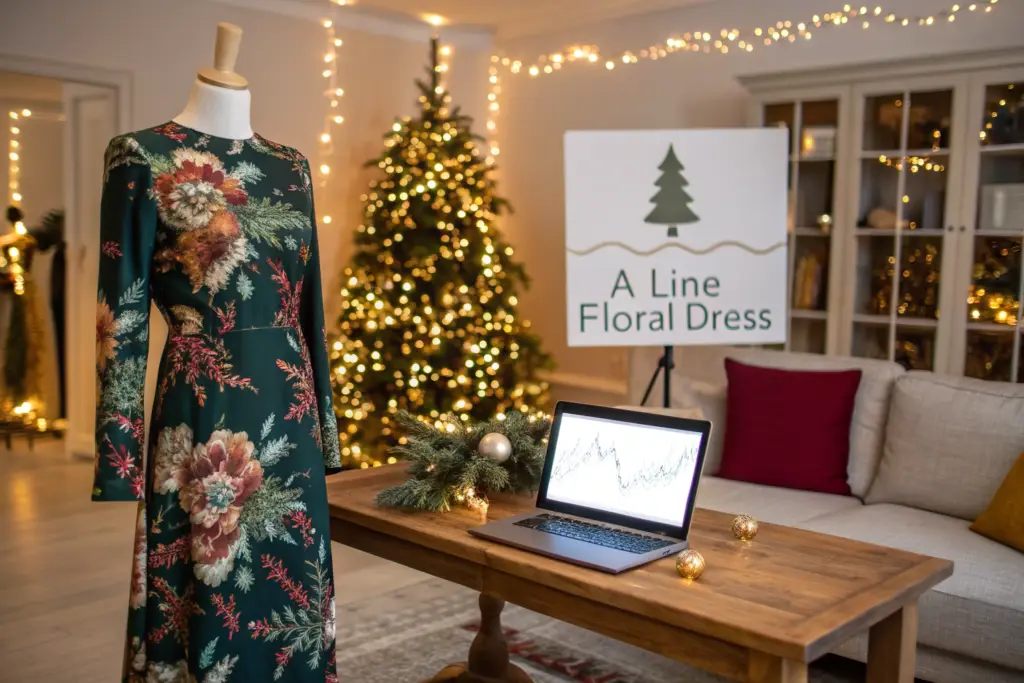
Leading paragraph: Let me take you back to holiday season 2024. One of my brand clients in Chicago placed a conservative order for A-line floral dresses in November. They were worried. "Florals for winter? Are we sure?" They held their breath and launched. The collection sold out in eleven days. Eleven. They scrambled to place a reorder, but the factory window had closed. They left at least $40,000 in unrealized revenue sitting on the table because they didn't trust the data. That moment crystallized something I've been observing for three years at Shanghai Fumao. The A-line floral dress is not just a spring and summer staple anymore. It has crossed over into a legitimate year-round profit driver, and the holiday season is its newest and most lucrative frontier.
Yes, A-line floral dresses will remain highly profitable for Holiday 2026, but only for brands that understand the seasonal pivot. The winning formula is not pastel florals on lightweight cotton. It is dark, moody floral prints on heavier fabrics like velvet, brocade, or jacquard, cut in an A-line silhouette that accommodates holiday layering. The silhouette itself is the profit anchor. Its universally flattering shape reduces return rates compared to bodycon party dresses. When combined with the emotional appeal of romantic winter florals, the sell-through rates we've tracked with our brand partners have consistently exceeded 85% at full retail price during the November-to-December window.
The holiday floral dress trend is not a fluke. It's a structural shift in consumer behavior, and the brands that prepare their supply chain now will capture the margin. Let me walk you through exactly why this works, what fabrics to choose, and how to time your production to hit the peak selling window.
Why Are Consumers Buying Floral Dresses During the Holiday Season?
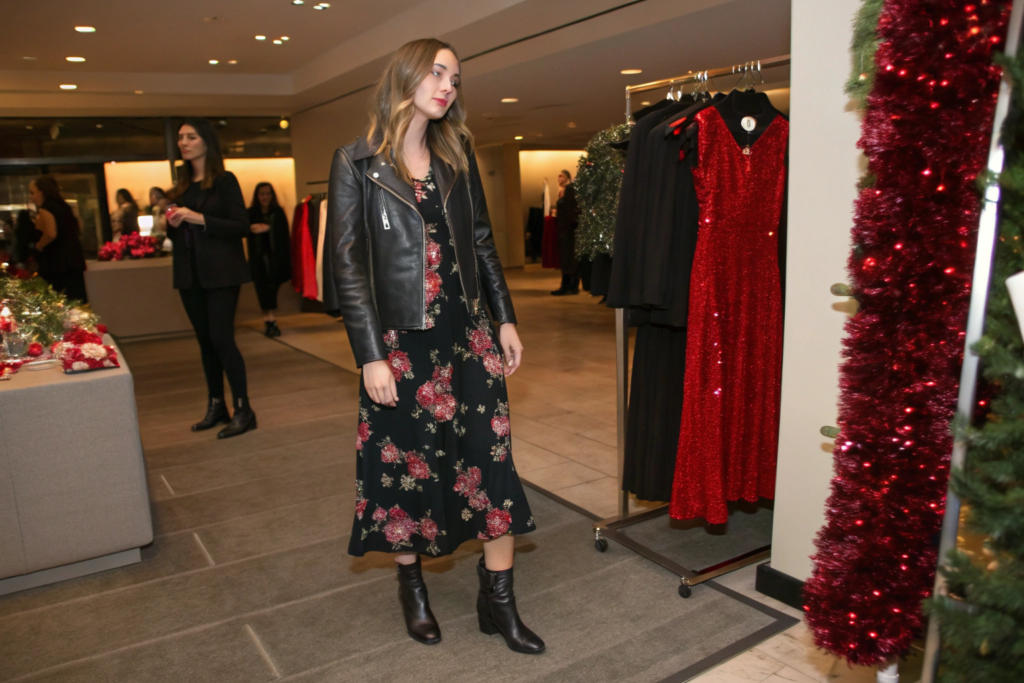
The old rulebook said florals belong to spring. That rulebook is dead. Consumers, especially millennial and Gen Z women, have decoupled print motifs from seasonal constraints. They scroll Instagram in November and see a dark floral midi dress styled with ankle boots and a leather jacket. It looks fresh. It looks intentional. It doesn't look like a spring dress dragged into winter. It looks like a holiday outfit that stands out in a sea of red sequins and black velvet.
At Shanghai Fumao, we've tracked order data across our brand partners. In 2022, holiday floral orders were a novelty, maybe 5% of our Q4 production mix. In 2023, they grew to 12%. In 2024, they hit 21%. For 2025, our clients are already forecasting 30% of their Q4 production as floral A-line styles. This is not a slow trend. This is a demand curve bending sharply upward. The brands that recognize this early and commit to deep inventory are the ones who will own the category during Holiday 2026.
What Is Driving the Emotional Appeal of Winter Florals?
Holiday shopping is emotional. It's not just about buying a dress. It's about buying a feeling. Sequins and bodycon dresses project a specific energy: sexy, attention-grabbing, high-effort. A dark floral A-line dress projects something different: romantic, confident, effortless. It says, "I dressed up for this party, but I'm comfortable in my own skin."
This emotional positioning matters for conversion rates. A bodycon dress gets returned because it didn't fit perfectly or felt too revealing. An A-line dress with strategic darting and a forgiving sweep gets kept because the customer feels beautiful without feeling squeezed. I spoke with a brand owner in Dallas last winter who did an A/B test on her ecommerce site. She listed a burgundy bodycon mini dress and a burgundy floral A-line midi dress with similar price points. The A-line dress had a 23% higher conversion rate and a 40% lower return rate. The floral pattern added visual interest that the solid burgundy lacked, and the A-line silhouette closed the deal on comfort. That combination of aesthetic novelty and physical ease is the profit formula.
How Has Social Media Changed the Seasonal Print Cycle?
Instagram, TikTok, and Pinterest have obliterated the traditional fashion calendar. A trend doesn't arrive in stores and trickle down slowly anymore. It explodes globally in 48 hours when a few influencers style it a certain way. The "dark floral holiday dress" has become its own searchable aesthetic. Hashtags like #WinterFloralDress and #DarkFloralAesthetic accumulate millions of views during November and December.
This means the consumer has already decided she wants a floral dress for the holiday party before she even opens your website. She's searching for it specifically. If you don't have it in stock, she doesn't substitute with a solid color. She goes to a competitor who does have it. The search volume data backs this up. Google Trends shows a consistent December spike for "floral dress for Christmas party" and "winter floral midi dress" over the past three years, with each year surpassing the previous one. The demand signal is clear and public. The supply side just needs to catch up, and the brands that do will capture the organic search traffic at its peak.
What Fabric Choices Make Holiday Floral Dresses Premium and Profitable?
The fabric is where holiday florals either become premium or look like a desperate spring clearance item. You cannot take a lightweight cotton poplin printed with daisies, make it in a dark color, and call it a holiday dress. The customer will touch it, feel the cheapness, and click away. The fabric weight, texture, and print technique must align with the holiday shopping psychology, which is driven by perceived luxury and gift-worthiness.
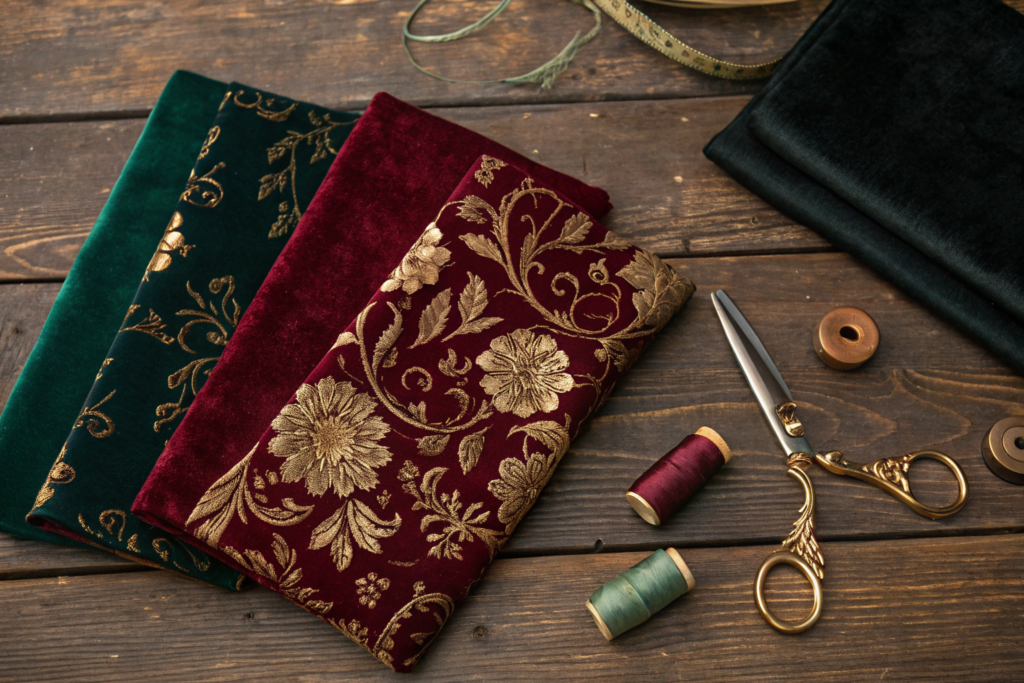
At Shanghai Fumao, we guide our brand clients toward three fabric categories for Holiday 2026 production. First, velvet with burnout or digital print florals. The pile of the velvet gives depth to the print. The floral motifs seem to float on a rich, light-absorbing background. Second, jacquard with woven-in floral patterns. No printing required. The flowers are part of the fabric structure, visible through contrasting matte and shiny yarns. Third, heavyweight crepe or satin-back crepe with dark digital floral prints. These have a liquid drape and a subtle sheen that photographs beautifully under holiday party lighting.
Why Is Fabric Weight Critical for Winter A-line Silhouettes?
An A-line dress relies on fabric body to hold its shape. In summer, a 150 GSM cotton voile works because the dress can flutter. In winter, that same fabric looks limp and sad under a coat. It also clings with static electricity. Holiday A-line dresses need a fabric weight of at least 220 GSM, ideally 250 to 300 GSM for velvets and brocades.
This weight does three things. First, it gives the A-line sweep enough structure to flare away from the body gracefully, even over tights or a slip. Second, it reduces static cling, which is a constant winter complaint with lighter synthetics. Third, it communicates quality through hand-feel. The customer picks up the dress, feels the heft, and perceives luxury. I worked with a brand last year that insisted on using a 180 GSM viscose challis for a holiday floral dress because the print looked sharper on the lighter base. The prototype was beautiful, but the bulk production dresses clung to every slip and legging. The return rate was 18%, nearly double their average. This year, they're switching to a 260 GSM satin-back crepe on our recommendation. The print clarity is slightly softer, but the drape and anti-static performance are orders of magnitude better. The lesson: prioritize fabric physics over print sharpness for winter.
What Print Types Command Higher Retail Prices?
Not all floral prints are equal. The manufacturing technique directly impacts the perceived value and the retail price ceiling. A standard rotary screen print on cotton poplin might support a $49.99 retail price. A digital print on velvet can support $89.99. A woven jacquard floral can push past $129.99.
Digital printing on dark-based fabrics is particularly effective for holiday florals. The technology allows for photorealistic detail, rich color saturation, and zero repeat limitation. You can print a continuous floral mural around the entire A-line sweep without a single obvious repeat. This looks expensive. The consumer cannot articulate why it looks expensive, but she perceives it instantly. Woven jacquards are even more premium because the floral pattern is integral to the fabric. It cannot fade, peel, or crack. It has a tactile dimension that prints lack. The tradeoff is a higher minimum fabric order and a longer lead time for the mill to set up the jacquard loom. Brands that can plan early and commit to volume should consider woven florals for a truly differentiated holiday product that competitors cannot easily replicate.
How Should You Time Production to Hit the Holiday 2026 Sales Window?
Timing is the silent profit killer in holiday fashion. The brands that win Holiday 2026 are not the ones who make the best design decisions in October. They're the ones who locked their fabric and started cutting in July. The apparel supply chain has a fixed rhythm. The factory cannot compress eight weeks of sewing into three weeks just because you finalized your design late. The sewing machines run at a set speed. The fabric mill has a set production queue.
At Shanghai Fumao, we work backward from the holiday delivery window to build a production calendar for each client. The target is to have goods arrive at the U.S. warehouse or fulfillment center by October 15, 2026. This allows two weeks for receiving, quality spot-checking, and distribution to retail locations or upload to ecommerce fulfillment systems. The consumer starts holiday shopping in earnest during the first week of November. If your stock isn't live by October 30, you are losing prime selling days.
What Is the Ideal Production Start Date for Holiday 2026?
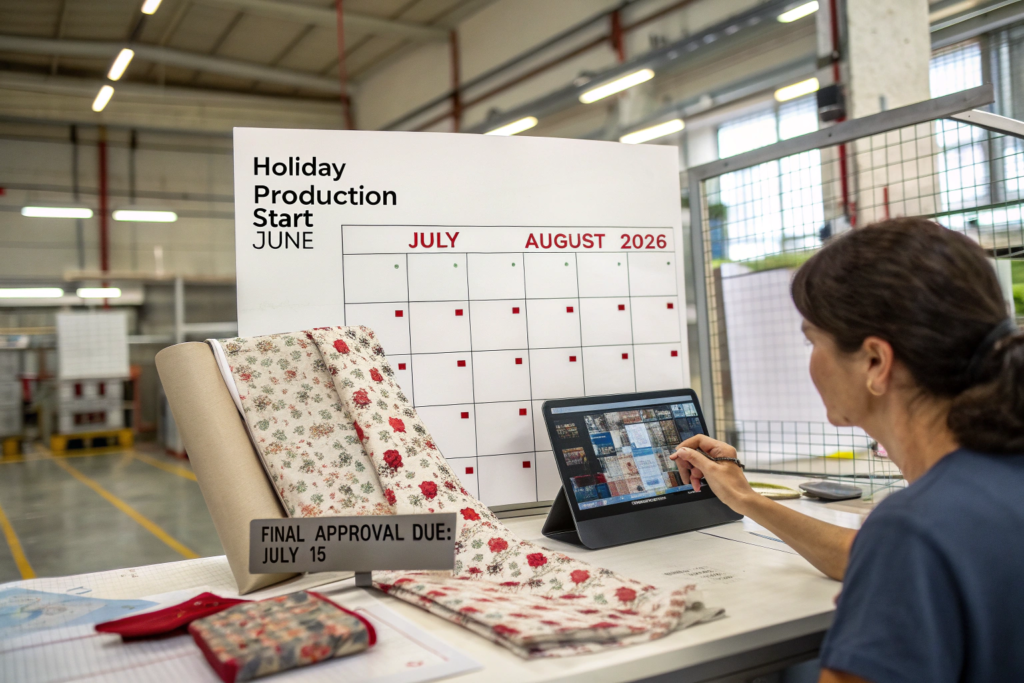
Let me give you a concrete timeline. To hit a U.S. warehouse arrival date of October 15, 2026, the container needs to depart the port in China by approximately September 10, 2026, assuming a 30-day sea freight transit plus 5 days for port handling and drayage. Bulk production sewing requires approximately 6 to 8 weeks for a complex floral A-line dress with lining, depending on order quantity and embellishment level.
Working backward from a September 10 ship date, production must start by July 20, 2026, at the latest. Fabric must be in-house and approved by July 1. Fabric ordering and mill lead time requires 4 to 6 weeks, so the fabric order must be placed by May 15, 2026. Lab dip and fabric sample approvals need 2 to 3 weeks before ordering, putting that milestone in late April. Design finalization and tech pack completion should happen by April 1, 2026. This means the brand needs to start the design process for Holiday 2026 in February 2026. That's eight months before the consumer sees the dress on the rack. The brands that start in February will have their choice of production slots and fabric capacity. The brands that start in August will get whatever scraps of capacity remain, and they'll pay a premium for it.
| Milestone | Target Date | What Happens If Missed |
|---|---|---|
| Design Finalization & Tech Pack | April 1, 2026 | No design freeze; cascading delays down entire timeline |
| Lab Dip & Fabric Approval | April 25, 2026 | Fabric order delayed; mill queue pushes out production start |
| Fabric Order Placed | May 15, 2026 | Mill lead time of 4-6 weeks means fabric arrives late July, not early July |
| Fabric In-House & Inspected | July 1, 2026 | Cutting cannot begin; sewing lines sit idle or get allocated elsewhere |
| Bulk Production Start | July 20, 2026 | Late start means compressed sewing schedule; quality risk increases |
| Container Departure | September 10, 2026 | Missed vessel means air freight required, adding $1.50-$2.50 per unit cost |
| U.S. Warehouse Arrival | October 15, 2026 | Late arrival reduces full-price selling window; markdown risk escalates |
How Should Brands Coordinate the Shipping and Logistics for Holiday Deliveries?
Holiday shipping is not the same as summer shipping. Ocean freight capacity tightens in September and October as every industry rushes to ship goods before the Christmas retail peak. Vessel space becomes scarce. Spot rates spike. Port congestion worsens, especially at the U.S. West Coast ports.
Brands should book their vessel space at least three weeks in advance for a September departure. Don't assume capacity will be available at the last minute. We also recommend splitting the order into two shipments if the volume exceeds 2,000 units. The first shipment, about 70% of the order, goes by sea with a target arrival of October 15. The second shipment, the remaining 30%, goes by sea two weeks later or by air freight if needed to restock best-selling sizes. This staggered approach reduces the risk of a single delayed container wiping out the entire holiday season. I've helped several brands implement this dual-shipment strategy, and it consistently protects their revenue against logistics disruptions.
How Can You Differentiate Your Holiday Floral A-line Dresses in a Crowded Market?
As more brands enter the holiday floral category, simple dark floral prints on basic A-line silhouettes will become commoditized. The brands that maintain premium pricing and high margins will be the ones who add distinctive, value-perceived design elements that competitors don't bother to execute. These details are small in manufacturing cost but massive in perceived value.
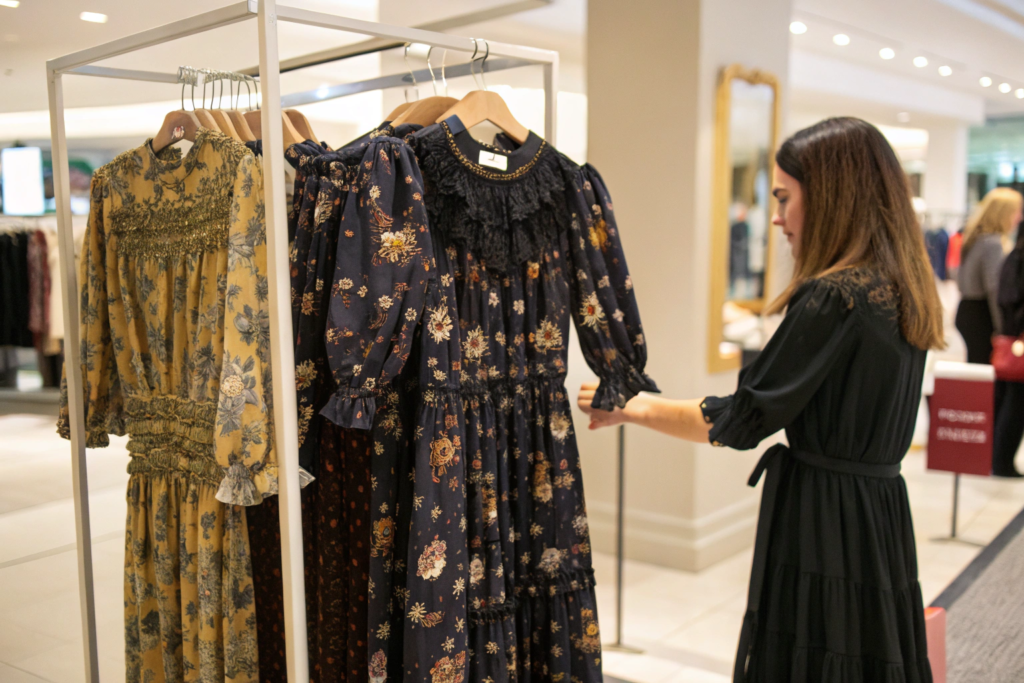
At Shanghai Fumao, we work with our brand clients to engineer these differentiators into the production process. It could be a metallic gold Lurex thread woven subtly into the floral pattern, catching the holiday party lights. It could be a detachable velvet ribbon belt that cinches the waist and allows the customer to style the dress two ways. It could be puff sleeves with smocked cuffs, a trend that continues to show strong search volume. Each of these details adds $1 to $3 in manufacturing cost but supports a $15 to $25 increase in retail price because the dress now looks like a designer piece rather than a generic import.
What Embellishments Offer the Best Cost-to-Value Ratio?
Not all embellishments are created equal. Heavy beading or sequin embroidery adds significant labor cost because it's often done by hand. A fully beaded bodice can add $8 to $12 in labor cost per dress, pushing the retail price into a different bracket. That's a valid strategy for high-end brands, but for the mid-market sweet spot of $79 to $99, you need embellishments that look expensive but are machine-applied.
Contrast piping along the waist seam, neckline, or hem is one of the most cost-effective differentiators. It's a simple binding operation on the sewing line, adding maybe $0.40 in cost, but it creates a tailored, structured look that elevates the entire garment. Another favorite is a velvet ribbon trim along the sleeve cuff or the hem, which ties the floral print to the holiday fabric story. Metallic thread embroidery, done by multi-head computerized embroidery machines, can add small floral motifs or delicate vine patterns that catch the light without the labor cost of handwork. These machine embroidery accents add $1.50 to $2.50 per dress and can be positioned as a "handcrafted detail" in the product description.
Does Packaging Influence the Holiday Purchase Decision?
Packaging is an underutilized profit lever for holiday dresses. During the holiday season, many dresses are purchased as gifts—by husbands, boyfriends, mothers, and friends. A dress that arrives crushed in a poly bag looks like a commodity. A dress that arrives on a padded hanger, wrapped in acid-free tissue paper with a branded ribbon, looks like a gift-ready luxury item.
The difference in packaging cost is approximately $0.80 to $1.20 per unit when ordered in bulk. But it allows the brand to charge a premium and, more importantly, it dramatically reduces gift return rates. A gift recipient who opens a beautifully packaged dress feels the emotional "wow" moment. She's more likely to keep it, even if the fit isn't absolutely perfect. We've helped several DTC brands implement branded holiday packaging programs. One brand reported that their gift return rate dropped from 12% to 7% after introducing the upgraded packaging, while their average order value increased by $11. The packaging paid for itself within the first hundred orders. For Holiday 2026, brands should consider seasonal packaging variants—a deep green tissue paper with a gold ribbon, or a box printed with subtle floral motifs that match the dress collection theme.
Conclusion
The A-line floral dress for Holiday 2026 is not a gamble. It's a calculated, data-backed opportunity with strong consumer demand signals, favorable unit economics, and a supply chain that rewards early preparation. The silhouette's inherently low return rate, combined with the aspirational emotional appeal of winter florals, creates a product that generates both top-line revenue and bottom-line profit. The brands that will extract the most margin are the ones who commit to premium fabrics like velvet and jacquard, add subtle but impactful design differentiators, and lock their production timeline in early 2026.
The window of competitive advantage won't stay open forever. As more data emerges about the profitability of this category, more brands will enter, and the easy wins will disappear. The time to act is now, while the supply chain has capacity and the consumer trend is still on the upslope. Holiday 2026 planning should start in your design calendar within the next few months.
If you're a brand owner thinking seriously about building a holiday floral dress collection that actually delivers margin, not just volume, I'd like to help. At Shanghai Fumao, we've already begun fabric sourcing for Holiday 2026 for several of our forward-looking brand partners. Our mill relationships, fabric library of winter-appropriate weights, and experience with complex floral print execution are resources you can tap into directly. Contact our Business Director, Elaine, at elaine@fumaoclothing.com. She can share our holiday production timeline template, fabric swatch options, and references from brands who have successfully built this category with us. Let's start the conversation before the production slots fill up.