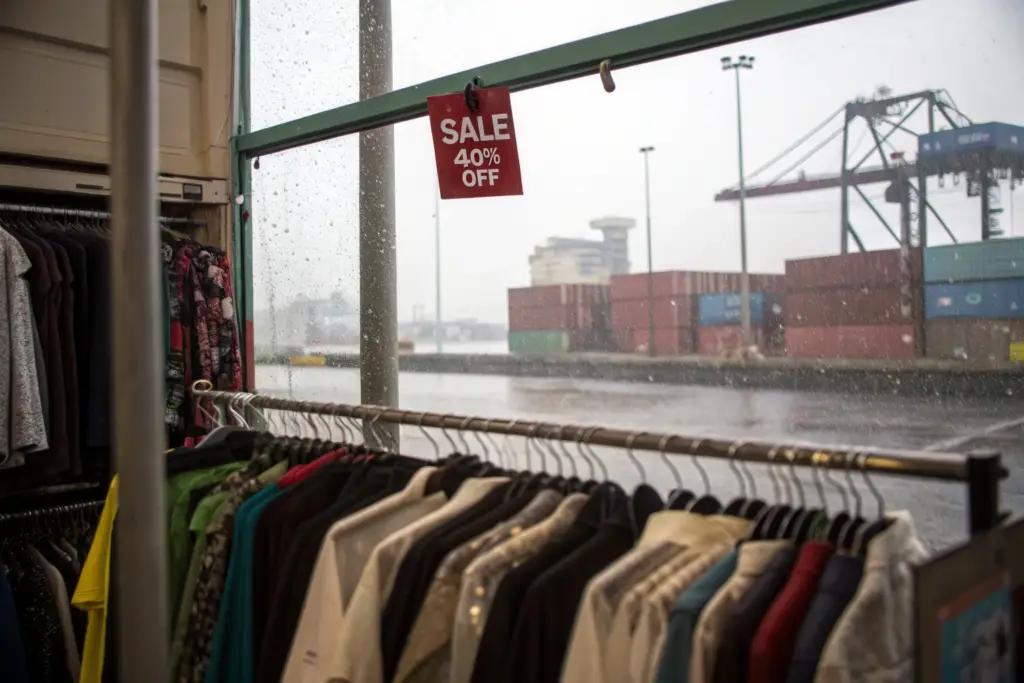
I got a call last October from a client in Chicago. He was supposed to receive 8,000 units of heavyweight winter coats by September 15th. The vessel was delayed. Then the port was congested. Then the trucker couldn't get an appointment. The coats arrived on November 12th. Black Friday was two weeks away. His retail buyers had already filled their coat budgets with his competitor. He had to dump those 8,000 units at 55% off just to clear warehouse space. He didn't make a profit on that order. He lost money on every single coat.
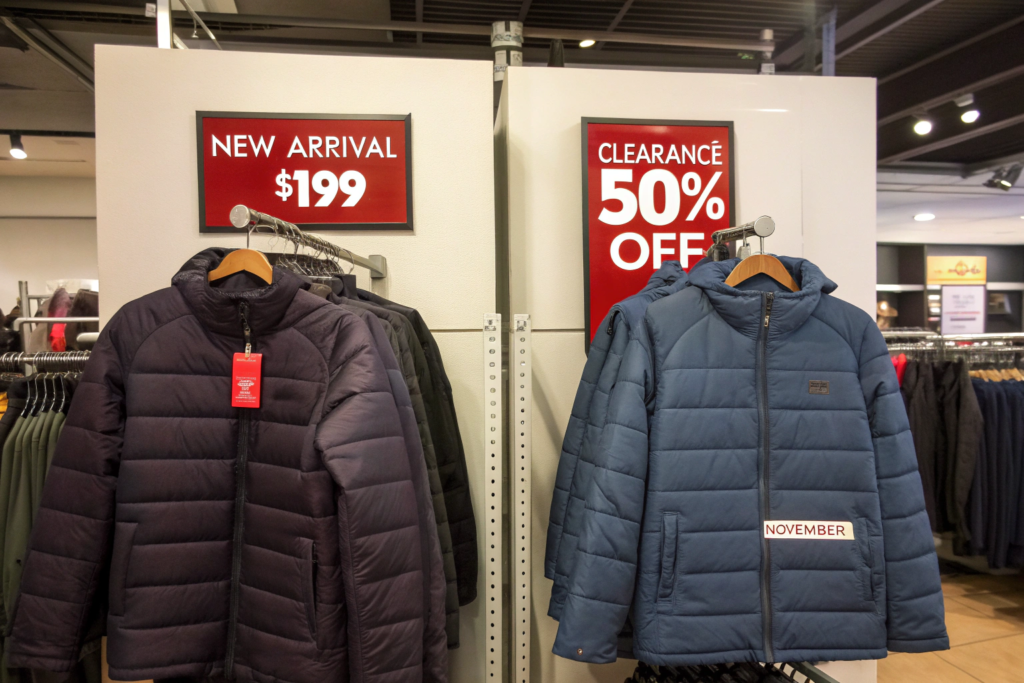
Delayed clothing shipments destroy seasonal retail profit margins because they trigger a cascading financial penalty that compounds with each passing week. First, you lose the full-price selling window when consumer demand is at its peak. Second, you incur markdown costs to clear aging inventory that arrives after the season has already started. Third, you damage your relationships with retail buyers who rely on you for on-time delivery, causing them to reduce future orders or cancel reorders entirely. Fourth, you tie up working capital in goods sitting on a boat or in a warehouse instead of converting it back to cash. In the apparel business, a late shipment is not just an inconvenience. It is a mathematical destruction of the margin you spent months engineering.
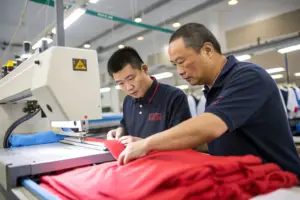
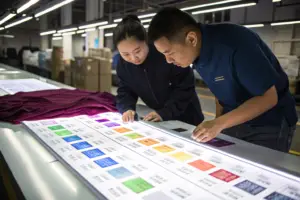
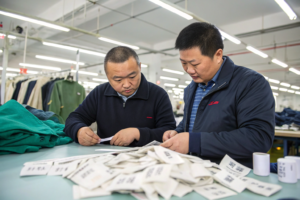
I run Shanghai Fumao, and I have watched this tragedy play out dozens of times from my side of the production floor. I see the frantic emails. I hear the stress in the voice on the Zoom call. I want to show you exactly why timing is more important than price per unit, and how a three-week delay can turn a profitable collection into a balance sheet disaster.
How Much Markdown Pressure Does a Four-Week Delay Actually Create?
You have a spreadsheet at the start of the season. It shows a beautiful curve: Sell 30% of inventory at full price in weeks 1-3. Sell another 40% at a 20% discount in weeks 4-6. Sell the final 30% at 40% off to clear. This is the plan that generates your target margin.
Now introduce a four-week shipping delay. Your "Week 1" of selling is now four weeks closer to the end of the season. The consumer's willingness to pay full price for a winter jacket drops significantly after the first cold snap passes. They know the sales are coming. You have lost your premium window.
I analyzed the sales data with a brand owner from Boston last year. His outerwear shipment arrived four weeks late. Here is what happened to his sell-through compared to his original plan:
| Selling Period | Planned Price | Actual Scenario (4-Wk Delay) | Revenue Impact (Per Unit) |
|---|---|---|---|
| Weeks 1-3 | Full Price ($120) | Missed Window (Goods on Water) | -$120 per unit |
| Weeks 4-6 | 20% Off ($96) | First Weeks of Selling ($120) | +$24 per unit (temporary) |
| Weeks 7-9 | 40% Off ($72) | Forced 30-40% Off ($84) | -$36 per unit |
| End of Season | Clearance ($50) | Deep Clearance to Clear Bulk ($45) | -$75 per unit |
The weighted average selling price dropped from a planned $86 to an actual $71. That is a 17.4% erosion of top-line revenue on the same exact product. The cost of goods, the fabric, the custom logo, the freight—all those costs were fixed. The only thing that changed was the arrival date. That 17% came directly out of his net profit. For a $100,000 order, that is $17,000 of pure profit that vanished into the air.
Why Do Retail Buyers Cancel Reorders When Initial Shipments Are Late?
You are not just selling direct-to-consumer. You are selling wholesale to boutiques and department stores. These buyers operate on a strict Open-to-Buy budget. They have a calendar that tells them exactly when they need fresh inventory on the floor.
If your women's wear collection arrives on October 1st instead of September 1st, the buyer has a problem. They have already filled that floor space with another vendor's goods. They may accept the late shipment because they have a contract. But here is what happens next:
- The Reorder is Canceled: The buyer planned to place a reorder in week 3 if the style sold well. But because it arrived late, they only had two weeks of selling data. They don't have enough confidence to commit to more units. The reorder—which is often pure profit because the sampling and development costs are already amortized—disappears.
- Next Season's Order is Cut: When they write orders for Spring, they remember the headache. They remember the angry calls from their own store managers. They reduce your order by 20% and give that shelf space to a clothing manufacturer who delivered on time.
I had a brand buyers client who lost a 2,000-unit reorder from a major department store because his initial shipment of knitwear was 10 days late. Ten days. The buyer's automated system flagged the style as "Late Delivery" and it was excluded from the reorder algorithm. That one delay cost him more than the margin on the entire initial order. The relationship damage is often more expensive than the markdown damage.
How Does Late Delivery Increase Your Warehousing and Holding Costs?
You finally get the goods. They are in your warehouse. But the season is half over. You cannot just push 10,000 units out the door in a week. They sit.
Every day a garment sits in your 3PL warehouse, you are paying storage fees. More importantly, you are paying the cost of capital. You paid the factory 30 days ago. You paid the freight forwarder. That cash is gone from your bank account. It is now sitting on a shelf in the form of unsold clothing. If that inventory sits for 90 days instead of 30 days, your effective cost of goods sold increases because of the interest you are paying on your line of credit or the opportunity cost of not investing that cash elsewhere.
Let's look at the math on a $50,000 bulk order:
| Holding Period | Storage Fees (Est.) | Cost of Capital (10% APR) | Total Added Cost |
|---|---|---|---|
| 30 Days (On-Time) | $300 | $410 | $710 |
| 90 Days (Delayed) | $900 | $1,230 | $2,130 |
That is an extra $1,420 in hidden costs. That money comes straight off the bottom line. You did not budget for it. You cannot charge the customer for it. You just absorb it.
What Are the Hidden Logistics Bottlenecks That Cause Apparel Shipment Delays?
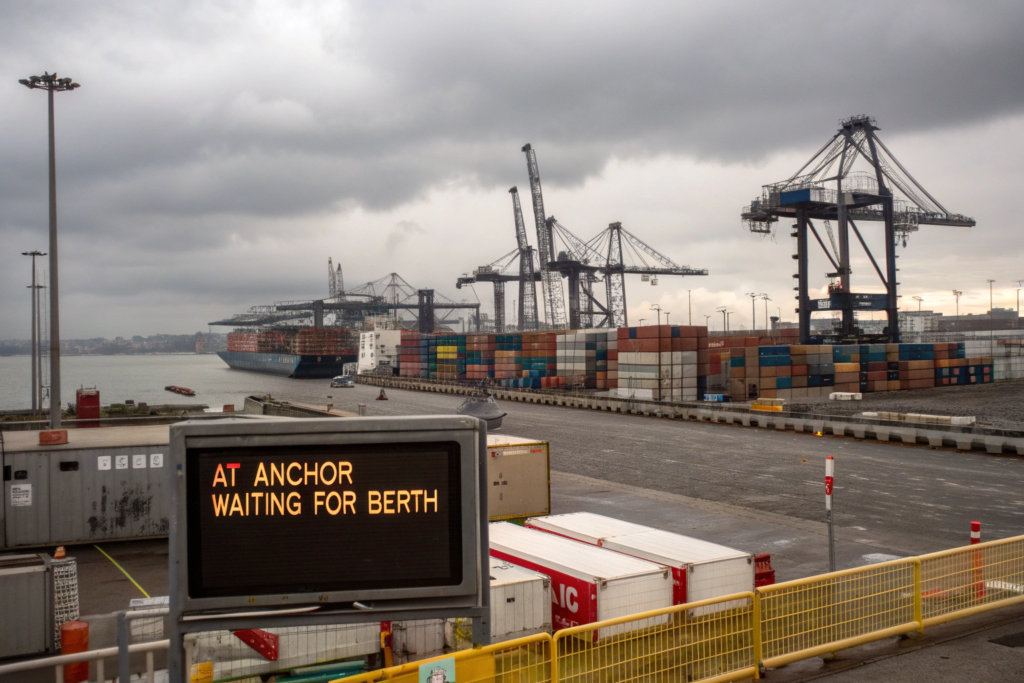
You track the vessel on MarineTraffic. You see it sitting outside the Port of Long Beach. The ETA says "Arrived." But the container is not moving. You think, "Why is it just sitting there?"
This is the black box of international apparel sourcing. The ocean voyage is the predictable part. The chaos happens at the ports and the inland rail ramps. Understanding these bottlenecks helps you plan realistic timelines instead of optimistic fantasies.
I have shipments on the water right now. I watch these bottlenecks choke the supply chain every single week. The problem is rarely the factory's production speed. It is almost always the handoff points in the logistics chain.
Why Do Transshipment Ports Like Singapore or Busan Add Unpredictable Delays?
You book a vessel from Shanghai to New York. The carrier says "28 days transit." But the vessel stops in Busan, South Korea, for 18 hours. Then it stops in Singapore for 24 hours. These are transshipment hubs.
The problem is not the stop itself. The problem is the connection. Your container might be unloaded in Busan and wait for a "feeder vessel" to take it to the main mother vessel. If the feeder vessel is late, or if the mother vessel is full and "rolls" your container to the next sailing, you just added 7 days to your transit. And nobody proactively tells you this happened. You only find out when you check the tracking and see the vessel name has changed.
For bulk apparel orders going to the East Coast, I strongly recommend using direct services whenever possible, even if the quoted transit time is slightly longer. A direct service from Shanghai to Savannah via the Panama Canal might take 32 days on paper. But it has zero transshipment risk. A service that transships in Busan might quote 28 days but has a high probability of becoming 35 days. The reliable 32-day option is better for your margin planning than the unreliable 28-day option.
How Do Chassis Shortages and Trucker Appointments Grind Delivery to a Halt?
The ship docks. The container is unloaded. You think the hard part is over. Then you get an email: "Container available, but no chassis available."
A chassis is the wheeled frame that the container sits on so a truck can pull it. In the U.S., there is a chronic shortage of chassis at major ports. Without a chassis, your container sits on the terminal ground. And it accrues demurrage fees—storage fees charged by the terminal. These fees can be $150-$300 per day after the free time expires.
The Appointment Nightmare
Even if a chassis is found, the trucker needs an appointment to pick up the container from the terminal. Appointments are often booked 3-5 days out. If the trucker misses the appointment window because of traffic, the appointment is canceled, and they have to rebook for another 3 days later.
I had a shipment of activewear arrive in Long Beach on a Monday. Due to chassis issues and appointment availability, the container was not delivered to the customer's warehouse in Los Angeles—only 20 miles away—until the following Wednesday. That is 9 days of waiting after the ship docked. This "last mile" delay is the most common and most frustrating part of garment logistics. At Shanghai Fumao, we use DDP terms with a dedicated trucking coordinator who fights for those appointments. But even we cannot eliminate the structural problems at the ports.
How Does Late Delivery Erode Your Brand Reputation with Wholesale Buyers?
You might think a one-time delay is forgiven. In the world of brand and retail, it is not forgiven. It is recorded. Major retailers use Vendor Compliance Scorecards. Every shipment is graded. On-Time Delivery is usually the heaviest weighted category.
If your score drops below a certain threshold—usually 95% on-time—you are penalized. Penalties include chargebacks (fines deducted from your invoice), loss of preferred vendor status, and reduction in future order volume. You spent years building the apparel brand. You spent thousands on marketing and samples to get into that retailer. One late container can undo all of that goodwill.
What Are the Financial Penalties for Violating Retailer Delivery Windows?
This is the part that new clothing brand owners often miss. They see the purchase order value and calculate their margin. They forget to read the Routing Guide and the Vendor Compliance Manual.
Here are real-world penalties from major North American retailers for late delivery:
| Violation Type | Typical Penalty | Impact on Your Invoice |
|---|---|---|
| Late to DC (Distribution Center) | 3-5% of Cost of Goods | Deducted automatically from payment. |
| Early to DC | 2-3% of Cost of Goods | Yes, early is also bad. The DC has no space for you. |
| Missing ASN (Advanced Ship Notice) | $250-$500 per PO | Deducted for administrative non-compliance. |
| Incorrect Carton Labeling | $50 per carton | Chargeback for labor to re-label. |
I had a client who shipped a $40,000 order of men's wear to a department store. The truck arrived 2 days late. The retailer deducted $1,200 (3%) for the late fee. They also deducted $500 for a missing ASN. Then they deducted $300 because the cartons were not palletized exactly as specified. That $2,000 in chargebacks represented 5% of the invoice value. In a business where net margins are often 10-15%, losing 5% to compliance fees is devastating. This is why on-time delivery is not just about selling the goods. It is about keeping the money you already earned. For a detailed look at these requirements, see the vendor compliance resources from Retail Compliance Council.
Why Do Delays Kill Your Ability to Test and Reorder Winning Styles?
You designed a collection of 20 styles. You don't know which one will be the hero. You place a conservative initial order of 500 units per style. The plan is: Ship in August. Sell in September. Identify the top 3 sellers by October 1st. Place a fast reorder to catch the holiday rush.
If the initial shipment is delayed until late September, your entire test-and-reorder model collapses. By the time you identify the winner, the factory's production window for holiday delivery is already closed. You cannot get more units. You are stuck with 500 units of the style everyone wants, and 500 units of the styles nobody wants.
This is the silent killer of growth for emerging wholesale brands. They survive on identifying winners and scaling them quickly. A delayed shipment doesn't just hurt the current order. It prevents the next order from ever existing. The opportunity cost of the lost reorder is often larger than the profit margin on the initial delayed shipment.
What Proactive Strategies Can Mitigate Seasonal Shipping Risk in 2026?
You cannot control the weather in the Pacific. You cannot control port labor negotiations. But you can control your own planning and your choice of logistics partners. The goal is not to eliminate all risk—that is impossible. The goal is to build a buffer into your timeline that absorbs the predictable delays.
I work with brand buyers who never have a "crisis" shipment. They are not lucky. They are disciplined. They operate on a timeline that looks conservative to outsiders but is actually just realistic. They treat the ship date as a hard deadline, not a suggestion.
How Can You Build a "Buffer Week" Strategy into Your Production Calendar?
Most brands work backward from the "In-Store Date" and only account for the minimum possible transit time. This is a recipe for disaster.
The Correct Backward Planning Method:
- Target In-Store/In-Warehouse Date: October 1st.
- Subtract Inland Trucking & DC Processing: 10 Days (not 5). (Arrive Port: Sept 20th).
- Subtract Ocean Transit Time (Including Buffer): 35 Days to East Coast (not 28). (Depart Port: August 15th).
- Subtract Factory Production Lead Time: 45 Days. (Start Production: July 1st).
- Subtract Fabric Sourcing & Sampling: 30 Days. (Finalize Order: June 1st).
This timeline includes a "Buffer Week" in the ocean transit assumption and a buffer in the inland assumption. When the inevitable 3-day delay happens in Busan, the shipment is still on track to hit the October 1st date. You have absorbed the delay before it became a problem.
At Shanghai Fumao, we help our clients build these timelines. We are honest about realistic lead times. We don't promise a 30-day production window if we know the fabric mill takes 20 days just to dye the greige goods. We would rather under-promise and over-deliver on the calendar.
Why Is DDP Shipping a Critical Tool for Controlling the Last Mile?
I have said this before, but it bears repeating in the context of seasonal margins. Delivered Duty Paid is the single most effective tool for eliminating the hidden, margin-destroying delays of the last mile.
When you buy FOB (Free on Board), you own the container the moment it leaves Shanghai. But you don't control the freight forwarder. You don't control the customs broker. You don't control the trucker. You are managing three separate vendors in a different time zone, and if any one of them drops the ball, your container sits.
When you buy DDP from a clothing manufacturer like us, we own the problem until the goods are at your door. We have volume contracts with carriers that give us priority. We have a customs broker who clears hundreds of our containers a month and knows exactly how to classify apparel to avoid holds. We have a trucking coordinator who fights for the appointment.
This service costs more on the invoice line item. But it saves you the unpredictable costs of demurrage, chassis splits, and lost sales. For seasonal goods, the predictability of DDP is worth far more than the slight premium in the freight quote. It protects your margin by protecting your delivery date. To understand the full legal transfer of risk under these terms, review the official ICC Incoterms 2020 definitions.
Conclusion
A late shipment is not just a logistical failure. It is a financial failure. It takes a product you designed, sourced, and paid for, and it devalues it before it ever reaches the customer. The margin you carefully built into your cost sheet is systematically dismantled by markdowns, storage fees, compliance penalties, and lost reorders.
We walked through the specific math of how a four-week delay forces you into deeper discounts and erodes your average selling price. We looked at the hidden bottlenecks in the logistics chain—from transshipment ports to chassis shortages—that are outside the factory's control but inside the realm of smart planning. We discussed how retail buyers use scorecards to penalize late deliveries, and how a single delay can damage a relationship that took years to build. Finally, we explored the proactive strategies of building buffer weeks into the calendar and using DDP shipping to control the chaotic last mile.
In the garment business, timing is a quality metric. A perfect jacket that arrives in December is a liability. A good jacket that arrives in August is an asset. At my factory, we measure our success not just by the number of units we ship, but by the date they arrive at your door.
If you want to structure your next production run to protect your seasonal margins and ensure on-time delivery, we can help you build a realistic timeline. Reach out to our Business Director Elaine at elaine@fumaoclothing.com. She can walk you through our production calendar availability and our DDP logistics options for the upcoming season.