Three months ago, a brand owner from Denver sent me a frustrated email. The subject line was "My $8 shirt just cost me $14." He had found a factory on Alibaba quoting $7.80 per unit for a custom T-shirt. He did the math: $7.80 times 2,000 units equals $15,600. He budgeted $17,000 total to be safe. When the container finally hit his warehouse door, his actual out-of-pocket cost was $28,400. He had missed freight, duty, brokerage fees, port handling, trucking, and a customs exam. His $8 shirt cost him $14.20 landed. His profit margin disappeared into a dozen line items he never saw coming.
The true cost of importing custom apparel into the United States is the sum of seven distinct cost layers that extend far beyond the factory unit price. These layers are: Ex-Factory Price, Export Packaging and Handling, International Freight, Marine Insurance, U.S. Customs Duty and Merchandise Processing Fee, Customs Bond and Brokerage Fees, and Inland Trucking to Final Destination. Each layer contains hidden variables and potential surcharges that can add 35% to 55% to the initial factory quote. The only way to accurately forecast your landed cost and protect your margin is to demand a Delivered Duty Paid (DDP) quote or to build a detailed cost model that accounts for every single handoff point between the factory cutting table and your warehouse receiving dock.
I run Shanghai Fumao, and I see the invoices. I see the freight bills. I see the duty statements. I want to pull back the curtain on every single charge you will face when importing custom apparel from China, Vietnam, or anywhere else. This is the financial literacy that separates the brands that scale profitably from the ones that drown in hidden fees.
What Are the Seven Hidden Cost Layers Beyond the Factory Unit Price?
The factory sends you a quote: "FOB Shanghai: $10.00 per piece." You think, "Great, I am paying $10 for this garment." That is incorrect. FOB means Free on Board. It means the factory has delivered the goods to the port in Shanghai and loaded them onto the ship. That is it. Every single thing that happens after that moment is your financial responsibility.
I have seen importers lose thousands of dollars because they confused FOB with "Delivered." You must understand the journey of your money as clearly as you understand the journey of your container.
Here is the complete cost stack for a typical clothing import from China to a warehouse in the Midwest:
| Cost Layer | Description | Typical Range (of FOB Value) | Who Gets Paid? |
|---|---|---|---|
| 1. Ex-Factory Price | Cost of goods, labor, factory margin. | Base (100%) | Factory. |
| 2. Origin Charges | Trucking to port, terminal handling, export clearance. | 3-6% | Chinese trucker, port, broker. |
| 3. Ocean Freight | Cost of the container space on the vessel. | 8-18% (volatile) | Shipping line or forwarder. |
| 4. Marine Insurance | Coverage for loss or damage at sea. | 0.5-1% | Insurance company. |
| 5. U.S. Customs Duty | Tariff based on HTS classification. | 0-32% (apparel avg. 16-20%) | U.S. Customs and Border Protection. |
| 6. MPF & HMF | Merchandise Processing Fee & Harbor Maintenance Fee. | 0.5-0.6% | U.S. Customs. |
| 7. Destination Charges | Port unloading, chassis fee, customs exam (if any), trucking to door. | 5-12% | Terminal operator, trucker, broker. |
When you add up layers 2 through 7, you are typically looking at an additional 25% to 55% on top of the ex-factory price. For a $10 custom logo shirt, the true landed cost in your warehouse is likely between $12.50 and $15.50. This is why the Denver brand owner's math failed. He budgeted for Layer 1 and ignored Layers 2 through 7.

How Do Origin Charges and Export Handling Fees Accumulate Before the Ship Sails?
You focus on the ocean crossing. But significant costs hit your wallet before the ship even leaves Chinese waters. These are the Origin Charges.
Breakdown of Pre-Sailing Costs:
- Inland Trucking: Moving the container from the factory (often inland, like our location near Shanghai) to the port. This is a fixed cost per container, roughly $400-$700 depending on distance.
- Terminal Handling Charge (THC): The fee the port charges to receive the container and load it onto the vessel. This is paid by the shipper (the factory) but is always included in the freight quote you pay. It is not free.
- Export Declaration: A fee (usually $50-$100) for the customs broker in China to file the export paperwork.
- Bill of Lading Fee: A fee ($50-$80) just to issue the document that proves you own the cargo.
These fees are small individually, but they add up to $600-$1,000 per container. If you are shipping a small batch of wholesale apparel, say only 1,000 units in a shared container (LCL), these origin fees are spread across fewer units, increasing your per-unit landed cost significantly.
Why Is U.S. Customs Duty the Largest Variable in Your Landed Cost Model?
The factory price is fixed. The freight rate is quoted. The duty rate is where the biggest financial surprises hide. Apparel is one of the most complex and highly taxed categories in the U.S. Harmonized Tariff Schedule.
You cannot guess the duty rate. You must know the exact HTS code. And the code depends on three things: Fabric Type (Cotton? Polyester? Wool?), Gender (Men's? Women's? Unisex?), and Garment Type (Knit? Woven?).
Here is the stark difference in duty rates for similar clothing items:
| Garment Description | HTS Code (Example) | General Duty Rate |
|---|---|---|
| Men's Cotton Knit T-Shirt | 6109.10.00 | 16.5% |
| Women's Cotton Knit T-Shirt | 6109.10.00 | 16.5% |
| Men's Polyester Knit T-Shirt | 6109.90.10 | 32% |
| Men's Cotton Woven Dress Shirt | 6205.20.20 | 19.7% |
| Women's Silk Blouse | 6206.10.00 | 6.9% |
Look at the difference between a cotton knit tee (16.5%) and a polyester knit tee (32%). That is a 15.5% swing in your cost of goods. If you incorrectly classify a poly-blend activewear top as a cotton tee to save on duty, and Customs catches it during an audit, you will pay back duties plus penalties and interest. At Shanghai Fumao, we provide the exact fabric content breakdown so your broker can classify correctly. We want you to pay the correct duty, not the lowest duty, because the correct duty keeps you out of trouble. For the official tariff database, you must consult the U.S. International Trade Commission HTS Search.
How Do Shipping Terms Like FOB, CIF, and DDP Change Your Financial Risk?
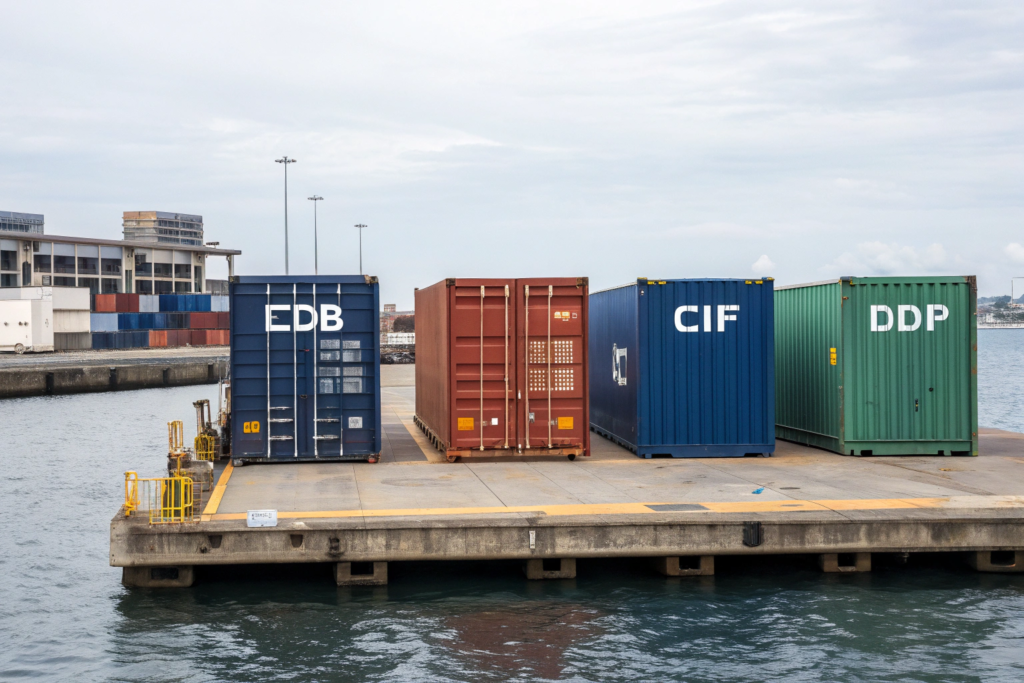
You cannot compare two factory quotes unless they use the same Incoterm. A quote of $10 FOB Shanghai is completely different from a quote of $13 DDP Los Angeles. The $13 quote might actually be cheaper once you factor in all the costs you would have to pay yourself under the $10 FOB quote.
This is where most first-time importers make a critical error. They choose the factory with the lowest FOB price, thinking they are saving money. Then they get crushed by freight and duty costs they did not anticipate. Understanding these three-letter codes is the difference between a predictable margin and a financial guessing game.
What Costs Are Actually Covered in a CIF Quote vs. a DDP Quote?
CIF (Cost, Insurance, and Freight)
This is a common quote from factories. It means the factory pays for the goods, the insurance, and the ocean freight to the U.S. port.
- What it COVERS: Factory cost, origin charges, ocean freight, marine insurance.
- What it DOES NOT COVER: U.S. Customs Duty, MPF, Customs Bond, Destination Terminal Handling, U.S. Trucking.
Under CIF, the factory's responsibility ends when the ship touches the dock in Long Beach. You are now the Importer of Record. You must find a customs broker. You must pay the duty bill before the cargo is released. You must arrange the truck to pick it up. If you don't have a broker lined up, your container sits at the terminal and you pay demurrage fees of $150+ per day.
DDP (Delivered Duty Paid)
This is the all-inclusive quote. The factory pays for everything until the goods are inside your warehouse door.
- What it COVERS: Everything. Factory cost, all origin fees, ocean freight, U.S. Duty, U.S. Customs clearance, U.S. Inland Trucking.
I strongly advocate for DDP terms, especially for brand buyers who are new to importing or who value predictability over micromanaging logistics. With DDP, the per-unit landed cost is fixed in the purchase order. There are no surprises. You can price your custom apparel for retail with confidence because you know exactly what it cost to get it to your door. The DDP price is the true cost.
Why Do "Destination Charges" at U.S. Ports Create Unpredictable Spikes?
You have a CIF quote. The ship arrives. You think the hard part is over. Then you get the Destination Charges invoice from the steamship line or the port terminal.
These charges are not included in the ocean freight quote. They are separate. And they are non-negotiable.
Common Destination Charges:
- Terminal Handling Charge (Destination): The fee for unloading the ship. ($300-$500)
- Chassis Split Fee: If the chassis is at a different location. ($50-$150)
- Pier Pass / Traffic Mitigation Fee: A fee for moving containers during peak hours in LA/LB. ($80-$120)
- Customs Exam Fee: If CBP pulls your container for inspection. ($500-$1,500+)
- Demurrage: Storage at the terminal after free time expires. ($150-$300 per day).
I had a client shipping bulk apparel orders of jackets. The container arrived on a Friday. The broker didn't clear it until Tuesday. The trucker couldn't get an appointment until Friday. That was 7 days of waiting. The terminal free time is usually 4 days. He paid 3 days of demurrage at $180/day = $540. That fee was not in his CIF budget. It came straight out of his pocket. Under a DDP agreement with Shanghai Fumao, that demurrage cost is our problem, not yours. We build buffer time into our logistics to avoid it.
How Can You Accurately Forecast Your Total Landed Cost Per Unit?
You cannot run a profitable clothing brand by guessing. You need a spreadsheet. You need to build a Landed Cost Model that takes the factory FOB price and automatically calculates every additional layer down to the per-unit cost.
This is the exercise I walk my new wholesale clients through. It is not difficult math. It is just addition and division. But it requires you to gather the right input numbers. Once you build this model, you can compare quotes from different factories on an apples-to-apples basis.
What Is the Correct Formula for Calculating Duty and MPF?
Duty is calculated on the FOB Value of the goods, not the CIF value. This is a common point of confusion. You pay duty on the value of the garment itself, plus the cost of packing, but not on the international freight and insurance.
The Duty Calculation Formula:
Duty Amount = (FOB Value of Goods) x (Duty Rate %)
Example:
- FOB Value of T-shirt manufacturing order: $10,000 (for 1,000 units at $10/unit).
- HTS Code Duty Rate: 16.5%.
- Duty Amount = $10,000 x 0.165 = $1,650.
MPF (Merchandise Processing Fee):
This is a fee CBP charges for processing the entry. It is 0.3464% of the FOB value, with a minimum fee of about $32 and a maximum of about $635 per entry.
- MPF Amount = $10,000 x 0.003464 = $34.64.
HMF (Harbor Maintenance Fee):
This is 0.125% of the FOB value. It applies to ocean freight only.
- HMF Amount = $10,000 x 0.00125 = $12.50.
These fees are small on a $10,000 order, but they matter. More importantly, you must include them in your model so you are not surprised by the line item on your broker's invoice.
How Do You Factor in Customs Bond and Brokerage Fees?
You cannot import apparel valued over $2,500 without a Customs Bond. A bond is an insurance policy that guarantees CBP will get their duty money even if you disappear.
- Single Entry Bond: Good for one shipment. Costs roughly $50-$100 per entry.
- Continuous Bond: Good for unlimited shipments for one year. Costs roughly $500-$600 annually.
If you plan to import more than 3-4 times a year, get a Continuous Bond. It is cheaper per shipment and much less administrative hassle.
Brokerage Fees: Your customs broker charges a fee to file the entry paperwork. This is typically a flat fee per entry, ranging from $75 to $150. They may also charge extra for things like "ISF Filing" ($25-$50) or "Courier Fees" ($15).
Here is a sample calculation of fixed entry costs for a single shipment:
| Fee Type | Estimated Cost |
|---|---|
| Customs Broker Clearance Fee | $125 |
| Single Entry Bond | $75 |
| ISF Filing Fee | $35 |
| Total Fixed Entry Costs | $235 |
You must add this $235 to the total landed cost of the shipment and then divide by the number of units to get the per-unit impact. If you are shipping 5,000 units, the impact is $0.05 per unit. If you are shipping only 500 units, the impact is $0.47 per unit. This is why small customization runs have a much higher per-unit landed cost. The fixed fees eat you alive on small volume.
Conclusion
The true cost of importing custom apparel is never the number on the factory quote. It is the sum of a dozen smaller numbers that accumulate as your goods travel across the ocean and through the complex machinery of U.S. Customs and logistics. Ignoring these costs is not an option. They will find you. They will appear on invoices you did not expect. And they will take a bite out of the margin you thought you had locked in.
We walked through the seven distinct cost layers, from the origin charges in China to the destination fees at U.S. ports. We examined the critical differences between FOB, CIF, and DDP shipping terms, and why DDP is often the smartest choice for brand owners who value financial predictability. We built the formula for calculating duty and MPF, and we looked at the fixed costs of bonds and brokerage that hit small orders especially hard.
Importing is a business of details. The winners are the ones who account for every dollar before they spend it. At my factory, we believe in transparency. We provide DDP quotes that show you the final, all-in number. We want you to know your true cost so you can price your products correctly and build a sustainable brand.
If you are ready to move beyond guessing and want a clear, all-in landed cost for your next collection, we can provide a detailed DDP quotation. Reach out to our Business Director Elaine at elaine@fumaoclothing.com. Send her your tech pack, and she will return a cost model that includes the factory price, the freight, the duty, and the truck to your door. No surprises. Just the math you need to make a smart decision.