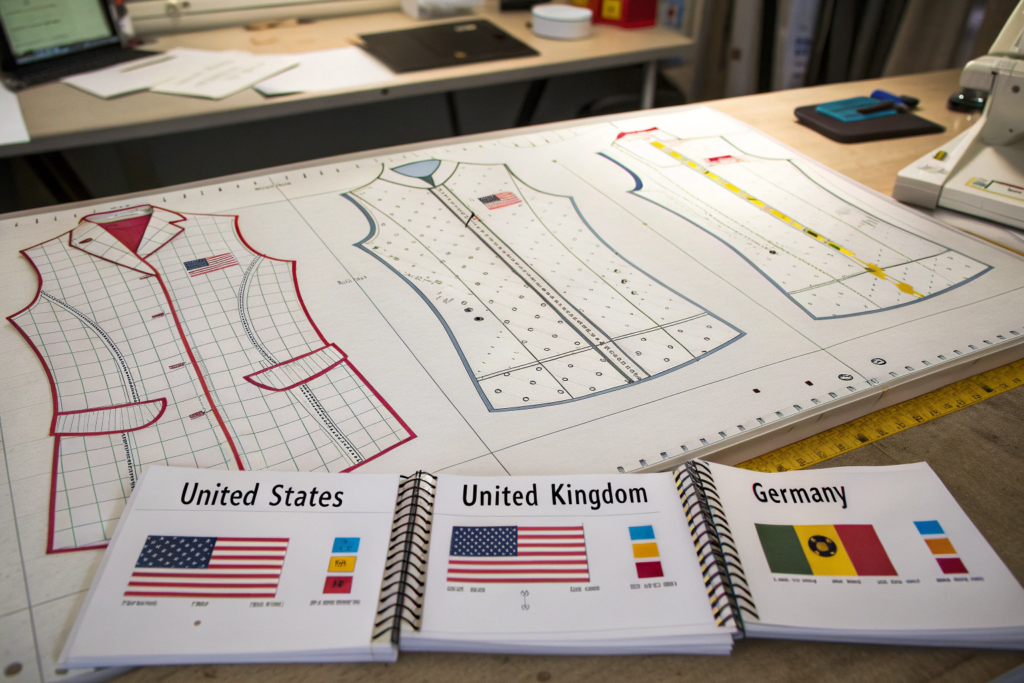
A distributor from Chicago learned a $30,000 lesson about sizing grading three years ago. He had a bestselling men's casual shirt in the US market. The fit was perfect for his American customers. The shoulder was relaxed. The chest had room. The body was generous without being boxy. He decided to launch the same shirt in the UK through a new wholesale partner. He sent his US graded spec sheet to the factory and ordered 1,500 units for the UK market using the exact same measurements. The shirts arrived in London. The UK wholesale buyers rejected them. "Too baggy," they said. "The shoulder is too wide. The chest is too full. Our customer wants a trimmer cut." He had to liquidate the entire shipment at a 60% discount. He did not understand that a US size Medium is not a UK size Medium. The grade rules are different.
The key differences in sizing grading between the US, UK, and German markets are driven by the anthropometric reality that the average body shapes in these populations differ measurably. The US grade rule features a broader shoulder, a fuller chest, and a more relaxed waist for a given labeled size. The UK grade rule is trimmer in the chest and shoulder, with a closer fit through the torso. The German grade rule, often aligning with the broader Central European market, features a taller frame with a longer back length and sleeve length, and a build that accommodates a broader ribcage. These differences are not marketing preferences. They are statistical differences in body measurement data.
A factory that applies a single "Western" grade rule to all three markets will produce garments that fit one market well and the other two markets poorly. The distributor who understands these differences can specify the correct grade rule for their target market and avoid the costly fit rejection that my Chicago client experienced. At Shanghai Fumao, we maintain separate grade rule libraries for the US, UK, and German markets, and we guide our distributor clients to select the correct one for their customer. Let me walk you through the specific differences.
How Do the Base Size Measurements Differ Across the Three Markets?
The grade rule is the mathematical formula that scales a garment from the base size to the full size range. But before the grade rule is applied, the base size itself must be correct for the target market. The base size, typically a Medium or a Size 10 or a 38/40 depending on the market convention, is the anchor point for the entire size range. If the base size measurements are wrong for the population, the grading cannot fix the problem. Grading scales proportionally. It does not correct fundamental fit errors.
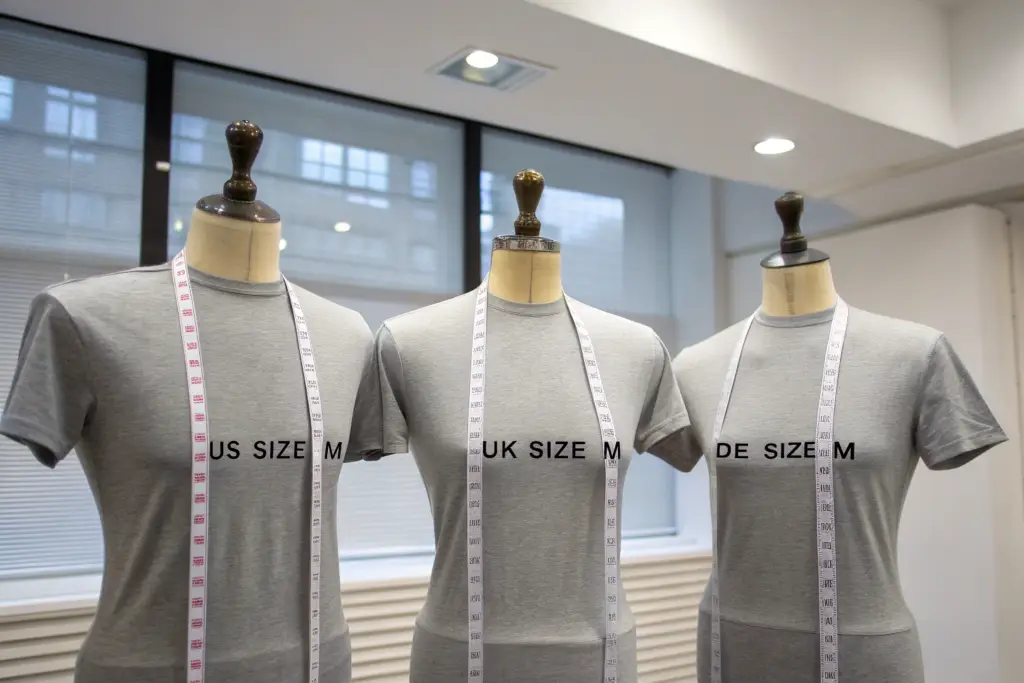
The base size measurements for a men's Medium shirt differ significantly across the three markets. The US base size has a chest circumference of approximately 40 to 42 inches, a shoulder width of 18.5 to 19 inches, and a relaxed waist. The UK base size has a chest of 38 to 40 inches, a shoulder of 17.5 to 18 inches, and a trimmer waist. The German base size has a chest of 40 to 41 inches, a shoulder of 18 to 18.5 inches, and a longer body length to accommodate a taller average frame. For women's wear, the differences are equally pronounced. A US Size 8 has different bust, waist, and hip measurements than a UK Size 12 or a German Size 38, even though these are the "equivalent" labeled sizes.
These differences are not arbitrary. They are derived from national anthropometric surveys, large-scale measurement studies of the population conducted by government or industry bodies. The US uses data from the ASTM International and the CDC's National Health and Nutrition Examination Survey. The UK uses data from Size UK, a national sizing survey. Germany uses data from Size Germany and the Hohenstein Institute. Each survey measures thousands of people and calculates the statistical averages and distributions.
What Is the "Fit Model" Difference Between an American and a British Consumer?
The fit model is the physical embodiment of the target customer. A brand develops its base size on a fit model, a person whose body measurements match the brand's target. The fit model for a US brand will typically have a different body shape than the fit model for a UK brand, even if both are labeled "Medium."
The American fit model, statistically speaking, has a broader shoulder girdle, a fuller chest, and a wider upper back. The shoulder slope may be slightly less angled. The arm is often fuller in the bicep. The torso shape is more rectangular or slightly tapered, with a less dramatic drop from chest to waist.
The British fit model has a narrower shoulder width, a trimmer chest, and a more defined waist relative to the chest. The shoulder slope may be slightly more angled. The arm is leaner. The torso shape is more V-shaped or tailored, with a more pronounced drop from chest to waist.
These differences are not about weight or body mass index. They are about skeletal frame and body fat distribution, which are influenced by genetics, diet, and lifestyle. A fit model in both markets can be healthy and fit, but their bone structure and shape will differ.
A distributor who develops a shirt on a US fit model and then sends that spec to the UK market is sending a shirt designed for a broader, more rectangular body to a market that expects a trimmer, more V-shaped fit. The UK customer tries on the US shirt. The shoulders droop over the edge of their natural shoulder. The chest fabric billows. The waist is too loose. The shirt feels "too big." The distributor's UK launch fails, not because the shirt is poorly made, but because it was designed for a different body.
Why Does the German Market Often Require a Taller, Broader Ribcage Block?
The German market, and the Central European market more broadly, has distinct anthropometric characteristics. The average German male is taller than the average American or British male. The torso length, the distance from the base of the neck to the waist, is longer. The sleeve length, from the shoulder point to the wrist, is longer. The ribcage is often broader and deeper, giving a larger chest circumference for a given level of body fat.
These characteristics require specific adjustments to the base size block. The body length must be extended by 2 to 4 centimeters compared to a US block for the same labeled size. The sleeve length must be extended proportionally. The armhole must be cut slightly deeper and wider to accommodate the broader ribcage and fuller upper arm. The shoulder width is intermediate between the US and UK, broader than the UK but narrower than the US.
The German market also has a different expectation of fit. The German consumer often prefers a more generous, comfortable fit than the closely tailored British preference. The garment is expected to allow freedom of movement, particularly in outerwear and casual clothing. The base size block reflects this preference with slightly more ease added to the chest and waist measurements.
A distributor producing men's outerwear for the German market must adjust the base block accordingly. A jacket cut to a US block will have sleeves that are too short for the German consumer, exposing the wrist. The body length will be slightly short, creating an unflattering proportion. The chest might be adequate, but the armhole might feel tight across the broader ribcage. The German customer will perceive the garment as "not fitting correctly," even if they cannot articulate the specific measurements that are off.
What Are the "Grade Rule" Variations in Shoulder, Chest, and Length Gradients?
The grade rule is the increment by which each measurement point changes from one size to the next. When a pattern is graded from a Medium to a Large, the shoulder width increases by a certain number of millimeters, the chest circumference increases by a certain number, and the body length increases by a certain number. These increments are the grade rules. They are not standardized globally. Each market has its own conventions.
The US grade rule typically uses larger increments between sizes than the UK grade rule. A US grade might add 1.5 inches to the chest circumference per size, while a UK grade adds 1.25 inches. The shoulder width increment is larger in the US grade, often 0.5 inches per size versus 0.375 inches in the UK. The German grade rule uses chest increments similar to the US, but the body length and sleeve length increments are larger to accommodate the taller frame. These differences compound across the full size range. An XXL garment graded with US rules will have significantly different measurements than an XXL garment graded with UK rules, even if both started from the same base size Medium.
The grade rule differences reflect the different body shape distributions in the populations. The US population has a wider variance in body size, requiring larger increments to cover the range from the smallest to the largest consumer. The UK population has a narrower variance, allowing smaller increments. The German population has a variance pattern that requires specific length adjustments.
How Does a 1.5" vs. 1.25" Chest Grade Compound Across Five Sizes?
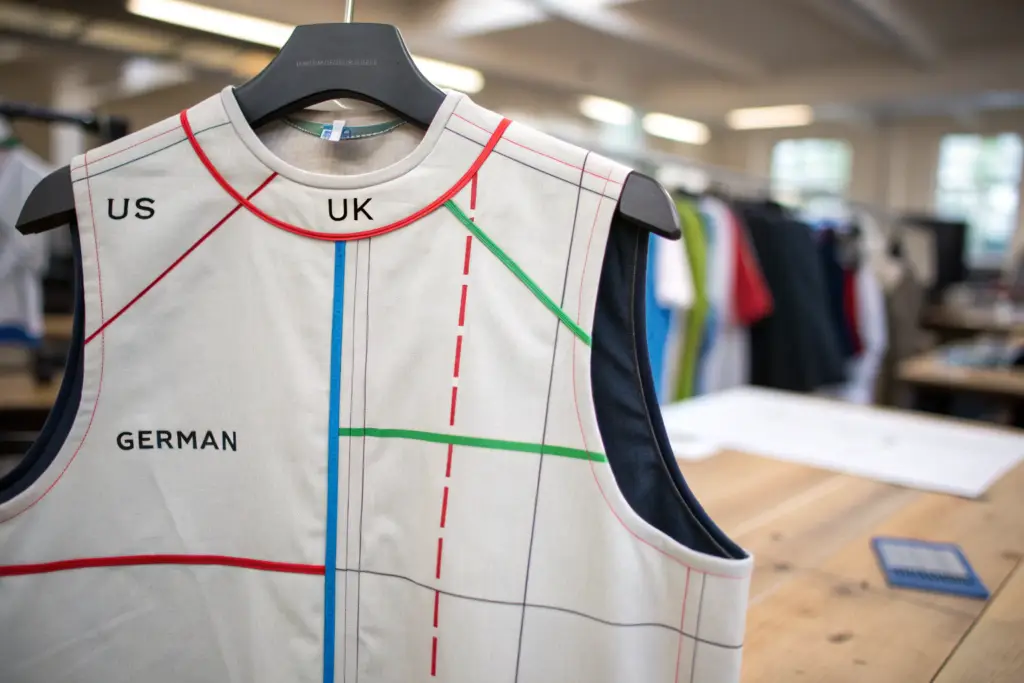
The compounding effect is powerful. A difference of 0.25 inches per size, seemingly trivial on a single size jump, becomes a difference of 1.25 inches across five sizes, from Small to XXL. That is a significant fit difference.
Consider a men's shirt graded from Medium to XXL. The US grade rule adds 1.5 inches to the chest circumference per size. The UK grade rule adds 1.25 inches. Both start with a Medium chest of 40 inches.
The US Large chest is 41.5 inches. The UK Large is 41.25 inches. The difference is 0.25 inches. Barely noticeable. The US XL chest is 43 inches. The UK XL is 42.5 inches. The difference is 0.5 inches. Noticeable to a discerning customer. The US XXL chest is 44.5 inches. The UK XXL is 43.75 inches. The difference is 0.75 inches. A significant fit difference. The UK XXL customer trying on the US XXL shirt will find it noticeably roomier in the chest than expected. The shirt will feel "oversized" rather than "my size."
The same compounding effect applies to the shoulder, the waist, the sleeve width, every graded measurement point. The difference between a US XXL and a UK XXL is not just a label difference. It is a measurable, feelable garment difference. The distributor who uses the wrong grade rule is systematically producing garments that are too large or too small for the target market at the size extremes.
A distributor client producing a men's casual shirt line for both the US and UK markets initially used a single grade rule. His UK customers in the XL and XXL sizes consistently returned the shirts for being "too baggy." We analyzed the returns data and identified the grade rule as the cause. We switched the UK production to a UK-specific grade rule. The return rate on the larger sizes dropped by 40%. The fix was a 0.25-inch per size adjustment that compounded into a significant fit improvement.
Why Do Sleeve Length Gradients Require Extra Attention for the German Market?
The sleeve length grade rule is a linear increment added per size. In the US and UK, the sleeve length increment is typically 0.75 to 1 inch per size. In Germany, the increment is often 1 to 1.25 inches per size. The larger increment reflects the taller average height of the German population, which correlates with longer arm length.
The critical distinction is not just the increment size, but the starting point. The German base size sleeve length is already longer than the US or UK base size by 2 to 4 centimeters. Then the increment per size is larger. The combined effect is that a German Large shirt sleeve is significantly longer than a US or UK Large shirt sleeve.
A factory that uses a US sleeve length spec for a German market order will produce shirts with sleeves that are too short. The deficit is most pronounced on the larger sizes. A German XXL customer, already tall, will find the US-graded sleeve ending well above the wrist bone. The shirt is unwearable for that customer.
The sleeve length issue is compounded by the fact that sleeve length is difficult and expensive to alter. A customer can shorten a sleeve that is too long relatively easily. Lengthening a sleeve that is too short is often impossible because there is insufficient seam allowance. A shirt with too-short sleeves is a return. A shirt with too-long sleeves might be kept and altered. When in doubt, a slightly longer sleeve grade is safer than a slightly shorter one.
We advise our German market clients to invest in a German-specific graded spec for sleeve length, not simply to translate the labeled size. A "Large" in Germany is not the same set of body measurements as a "Large" in the US. The sleeve length spec must be based on the German body measurement data, not on a conversion from the US size label.
How Can You Translate a US Tech Pack into a UK or German Size Run Without Errors?
The translation of a tech pack from one market's sizing system to another is a task that requires more than a simple size label conversion chart. A US Size 10 is not a UK Size 14, even though many conversion charts say it is. The relationship between the sizes is not a simple linear shift. The body shapes are different. The ease allowances may need adjustment. The grade rules must be changed.
Translating a US tech pack into a UK or German size run without errors requires a three-step process. First, define the target market's base size body measurements, not just the size label. Second, apply the target market's grade rule to scale the base size to the full size range. Third, adjust the ease allowances, the difference between the body measurement and the garment measurement, to reflect the target market's fit preference. The US market often prefers more ease for a relaxed fit. The UK market prefers less ease for a tailored fit. The German market may prefer more ease in the chest and shoulder but a closer fit in the waist. The ease adjustments are separate from the grade rule, but equally important.
A simple size label conversion is a recipe for fit failure. The distributor who sends a US Medium spec to the factory and says "call it a UK Large" has ignored the body shape differences. The UK Large customer will try on the garment and find that it does not fit their body, even if the chest circumference is numerically correct for a UK Large. The shoulder is too wide. The sleeve is the wrong length. The ease is wrong. The garment fails.
What Is the Difference Between a Size Conversion Chart and a True Market-Specific Grade?
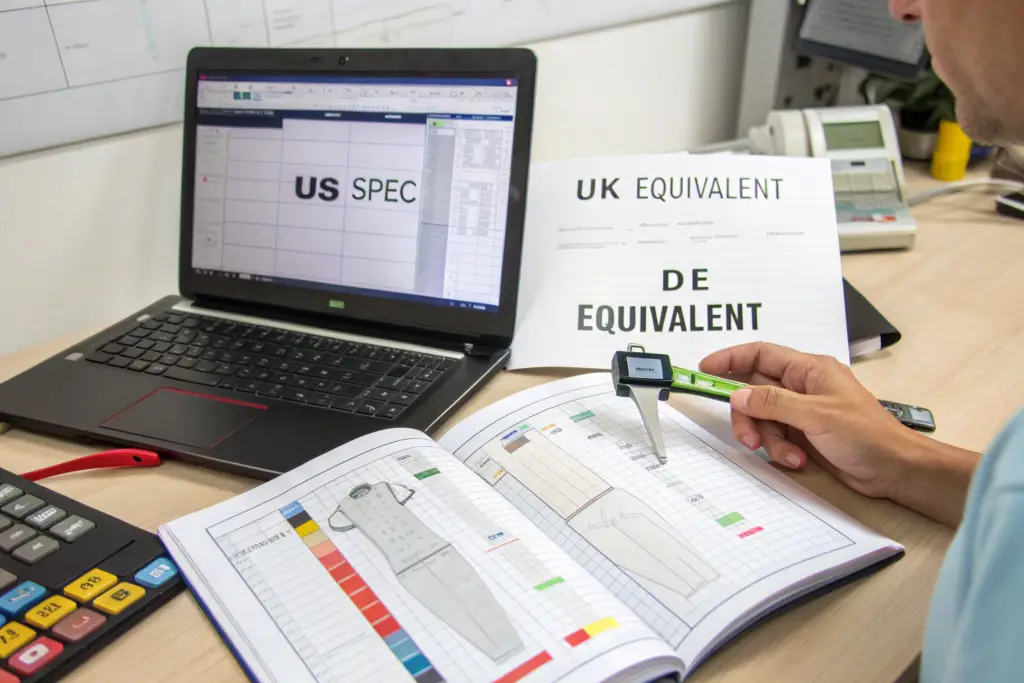
A size conversion chart is a simple lookup table. It says, "US 8 = UK 12 = DE 38." This chart is useful for a consumer shopping online who wants to know which size to order from a foreign brand. It is not useful for a manufacturer producing garments for a foreign market. The conversion chart does not address the body shape differences, the grade rule differences, or the ease differences.
A true market-specific grade is a complete set of measurement specifications for every size in the range, developed from the anthropometric data for that specific market. The base size body measurements are derived from the population data. The grade rule increments are derived from the population data. The ease allowances are applied based on the market's fit preference. The result is a garment that is proportionally correct for the target population at every size.
The distributor must decide whether to invest in a true market-specific grade or to attempt a size label conversion. For a low-volume test of a new market, a conversion might be an acceptable first step, provided the distributor understands the fit risks. For an ongoing commitment to a market, a true market-specific grade is essential. The cost of developing the grade is a fraction of the cost of a failed shipment.
A distributor who successfully launched his men's shirt brand in Germany invested in a German-specific grade from the start. His factory developed the base block on a German fit model. The grade rules were applied according to the Hohenstein Institute's recommendations. The shirts fit the German consumer correctly at every size. His return rate for fit issues in Germany is under 3%, compared to an industry average of over 10% for brands that use converted sizing.
How Do You Verify a Factory's Grade Rule with a "Nested Pattern" Check?
The nested pattern check is a physical verification that the factory has applied the correct grade rule. The factory provides a plot of the full size range pattern, with all sizes nested together. The pattern pieces are printed on paper, with each size line drawn in a different color. The distributor, or a third-party technical auditor, can measure the increment between the size lines at key points and verify that they match the specified grade rule.
The check is performed at the shoulder point, the chest line, the waist line, the hem line, the armhole curve, and the sleeve cap. For each measurement point, the increment from the base size to the next size up is measured with a ruler or a digital caliper. The measured increment is compared to the specified grade rule increment. A deviation of more than a millimeter or two is flagged for correction.
The nested pattern check is the single most effective quality control step for sizing accuracy. It verifies that the grading was done correctly before a single garment is cut. Errors caught at the pattern stage are corrected with a pen and a pattern notcher. Errors caught after cutting require recutting fabric. Errors caught after sewing require rework or a rejected shipment.
We provide nested pattern plots to all our clients who specify a market-specific grade rule. The client's technical designer reviews the plot, checks the increments, and signs off before the pattern is released to the cutting room. This simple verification step has prevented countless sizing errors.
A distributor client who had experienced sizing inconsistencies with a previous factory asked for a nested pattern check on his first order with us. His technical designer reviewed the plot, found a 2mm deviation in the shoulder grade on the XL size, and flagged it. Our pattern maker corrected the deviation before cutting. The production run was perfect. The client later told me that the nested pattern check gave him confidence in our grading process that he had never had with his previous supplier.
What Are the Ease and Fit Preference Nuances for Each Regional Consumer?
Beyond the body measurements and the grade rules lies the most subjective but equally important variable: ease. Ease is the difference between the garment measurement and the body measurement. A shirt with a 42-inch chest circumference and 4 inches of ease is designed for a 38-inch chest. The same 42-inch shirt on a 40-inch chest has 2 inches of ease and fits closer to the body. Ease determines the garment's silhouette and the wearer's comfort and freedom of movement.
The ease preferences differ significantly across the three markets. The US consumer generally prefers more ease, a relaxed, comfortable fit that does not restrict movement and forgives body variations. The UK consumer prefers less ease, a tailored, closer-to-the-body fit that looks sharp and structured. The German consumer occupies a middle ground, preferring more ease in the shoulder and chest for freedom of movement, but a cleaner, less billowy fit through the torso than the US preference. These ease preferences are independent of the size label and the grade rule. They are applied as additions to the body measurements to create the final garment measurements.
The ease preference is a cultural and climatic factor. The US preference for relaxed ease may be influenced by a culture that values casual comfort and by climate-controlled environments where a slightly looser garment is not uncomfortable. The UK preference for tailored ease may be influenced by a culture that values sharp dressing and by layering, a closer-fit shirt is easier to layer under a sweater or jacket. The German preference for functional ease may be influenced by a culture that values practicality and outdoor activity.
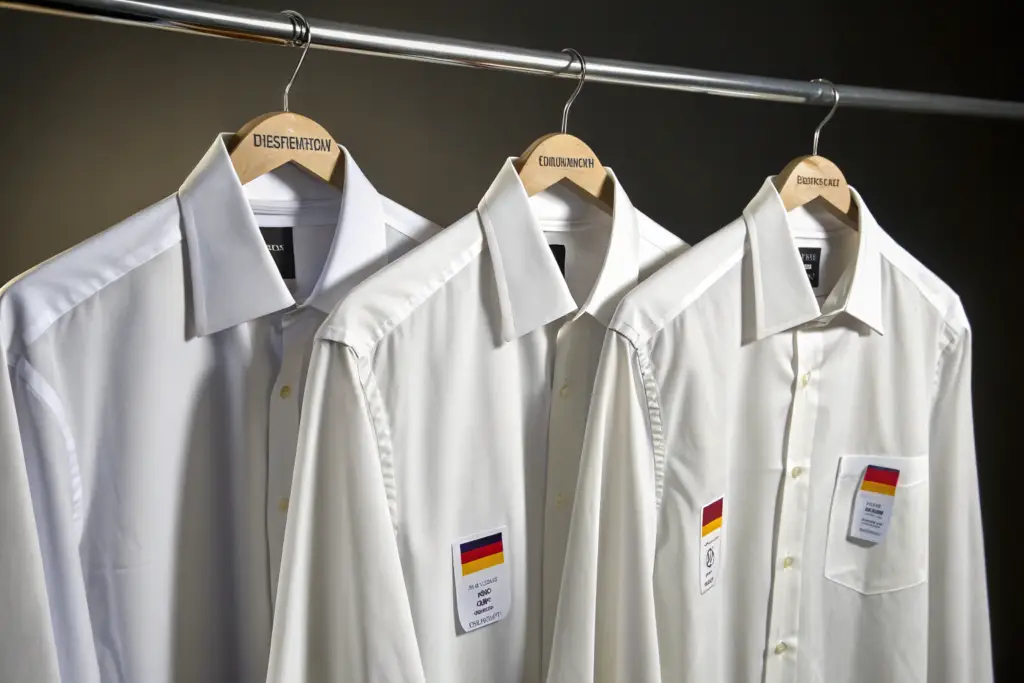
Why Does the UK Market Demand Less Ease in Formal Shirts Than the US?
The British formal shirt tradition is rooted in Savile Row tailoring and Jermyn Street shirtmaking. The shirt is expected to fit close to the body, with a clean line through the torso. Excess fabric is considered sloppy. The British consumer, particularly in the formal and businesswear segments, has a trained eye for fit. They expect the shoulder seam to sit precisely on the shoulder point. They expect the chest to be smooth without billowing. They expect the waist to be shaped.
The American formal shirt tradition is more relaxed. The shirt is expected to be comfortable for all-day wear in an office environment. A slightly looser fit is accepted and even preferred by many consumers who do not want to feel constrained. The shoulder seam might sit slightly off the shoulder. The chest might have a gentle fold of fabric. The waist might be less shaped.
These different expectations translate into different ease allowances. A UK formal shirt might have 4 inches of chest ease and 5 inches of waist ease. A US formal shirt might have 6 inches of chest ease and 7 inches of waist ease. The UK shirt, on the same body, will look trimmer and more tailored. The US shirt will look more relaxed and comfortable.
A distributor selling men's formal shirts in both markets must not simply change the size label. He must change the ease allowance. The UK consumer trying on the US-ease shirt will perceive it as "too big" or "poorly fitting," even if the labeled size is correct for their neck and sleeve measurements. The ease is the invisible variable that determines the customer's fit perception.
How Does the German Preference for "Functional Ease" Affect Outerwear Grading?
The German outerwear market has a specific requirement that is less pronounced in the US and UK: the garment must allow for layering and for active movement. A German consumer buying a winter parka expects to be able to wear a thick sweater or a fleece jacket underneath it. They also expect to be able to move their arms freely, to reach forward, to lift their arms overhead, without the jacket pulling tight across the back.
This functional ease requirement translates into specific adjustments to the outerwear block. The armhole is cut deeper and wider to accommodate the layered arm circumference. The back width is increased, and the sleeve cap is cut with more ease to allow forward arm movement without the back panel pulling. The chest ease is generous, often 8 to 10 inches for an insulated parka.
The German outerwear block, compared to a US or UK block for the same garment type, will have a roomier upper body and a more articulated sleeve. The silhouette might look slightly less sleek than the UK version, but it will perform better in active use. The German consumer values this performance. A jacket that restricts movement will be returned, even if it looks good on the hanger.
A distributor developing a men's technical outerwear line for the German market must specify these functional ease allowances in the tech pack. A factory using a standard US outerwear block will produce a jacket that is too tight in the upper back and armhole for the German consumer. The sales floor feedback will be, "It fits too small in the shoulders," even if the chest measurement is numerically correct. The problem is not the size. It is the ease distribution.
Conclusion
Sizing grading across the US, UK, and German markets is not a simple matter of translating size labels. It is a complex interplay of base size body measurements, grade rule increments, and ease allowances, each of which differs measurably between the three markets. The US body is broader in the shoulder and fuller in the chest. The UK body is trimmer and more V-shaped. The German body is taller with a broader ribcage. The grade rules that scale from the base size to the size range use different increments, compounding into significant fit differences at the size extremes. The ease preferences, the cultural expectation of how a garment should fit, add another layer of market-specific adjustment.
The distributor who understands these differences and specifies them correctly in the tech pack will produce garments that fit the target consumer. The distributor who ignores them will produce garments that feel "off" to the consumer, generating returns, markdowns, and damaged brand reputation. The cost of developing market-specific grading is a small fraction of the cost of a failed market entry.
At Shanghai Fumao, we maintain separate grade rule libraries and base size blocks for the US, UK, and German markets. Our pattern makers are trained in the specific grading requirements of each market. Our quality control process includes a nested pattern check for every new style, verifying that the grade rule has been applied correctly before cutting begins.
If you are a distributor planning to enter a new market, or if you are experiencing fit-related returns in an existing market and suspect a grading issue, I invite you to contact our Business Director, Elaine. She can provide our market-specific sizing charts, walk you through the nested pattern verification process, and connect you with our pattern team to develop a grade rule that is right for your target customer. Reach Elaine at elaine@fumaoclothing.com. Let's ensure your garments fit your customer as perfectly as your brand promise.