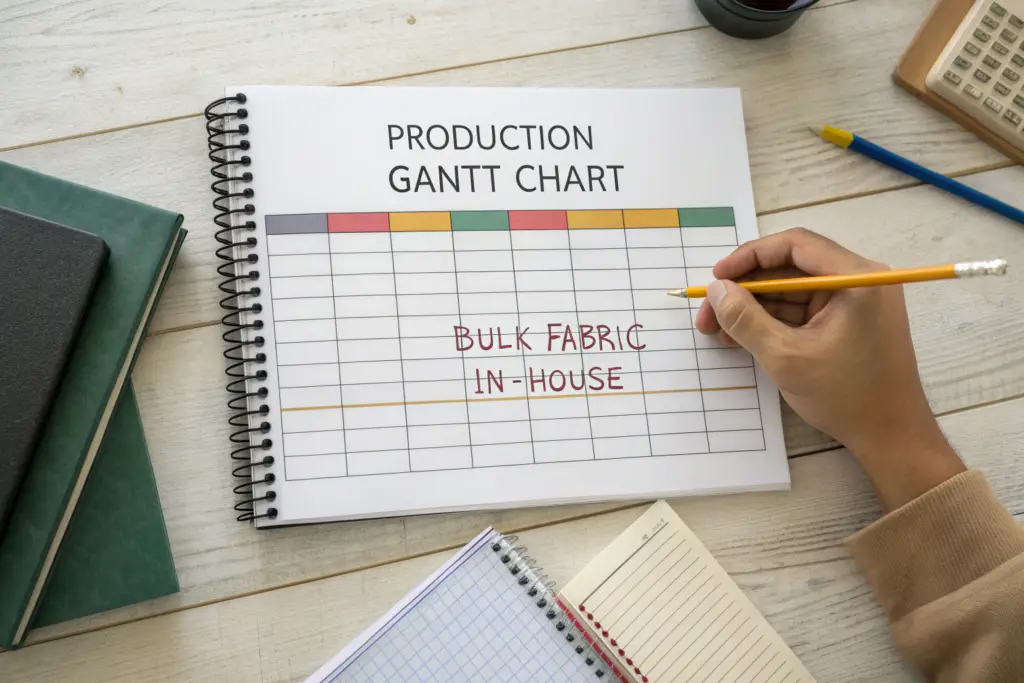
You have placed your bulk order. The factory sends you a document titled "Production Schedule." It is a complex-looking Gantt chart with multiple bars, dates, and acronyms like "PP," "TOP," and "PCD." You nod, assume it looks fine, and file it away. Two weeks later, a delay you didn't see coming blindsides you. A seasoned production manager once told me, "A factory's production schedule is not a polite promise; it's a complex blueprint of their internal commitments. You don't just read the final ship date; you must learn to read the dependencies and identify the three or four critical milestones that govern the entire timeline. If you can't read the map, you can't navigate the journey."
Reading a complex production schedule requires moving beyond the final delivery date and identifying the "Critical Path." You must look for three key milestone dependencies: 1) The "Anchor Milestone" of Bulk Fabric In-House (nothing can start until the material is physically present and approved), 2) The Final Quality "Go/No-Go" Gate (the PP or TOP Sample approval, which must happen before bulk finishing), and 3) The two-way "Client Approval Dependencies" (where the schedule can be delayed by your own response times). A professional schedule will make these explicit; an amateur one will hide them in a single, vague bar.
At Shanghai Fumao, our B2B partnership is built on transparent, detailed, and accountable production planning. We provide a phased Gantt chart with every order, and we teach our partners how to use it as a management tool, not just file it away. Let me explain the specific lines you must scrutinize, the questions you must ask, and how to transform a complex schedule from a source of anxiety into a map of predictable certainty.
Why Is "Bulk Fabric In-House" the Single Most Important Line on the Entire Chart?
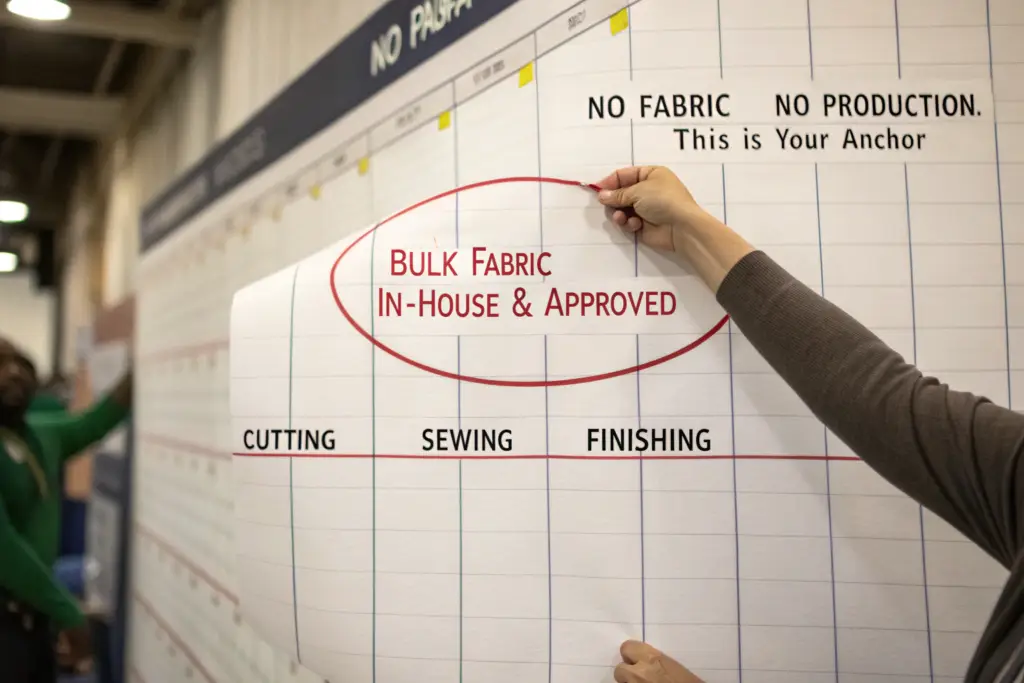
The most common cause of a delayed shipment is not a problem on the sewing floor; it's the fabric not arriving on time. The entire production process is a house of cards built on the foundation of the raw material. A smart production manager does not first ask, "When will my order ship?" They ask, "When is the bulk fabric physically in your warehouse and approved for cutting?" This is the true anchor of the entire timeline.
"Bulk Fabric In-House & Approved" is the true anchor of the entire schedule. Every subsequent phase—cutting, sewing, finishing—is entirely dependent on this single, critical event. You must ask your factory to explicitly identify this date on the Gantt chart. Is the fabric being custom-dyed (which takes 3-5 weeks) or is it in-stock (a few days)? Any delay to this milestone will push every other date on the chart by an equal number of days. A schedule that doesn't explicitly call out this dependency is hiding a major risk from you.
A brand we work with was tracking their order against a single, nebulous "production" bar on their previous factory's schedule. The order was delayed by three weeks, and the reason was a late fabric shipment. The factory's schedule hadn't separated the material phase from the sewing phase, so the brand had no visibility into the root cause. On our Gantt charts, the "Bulk Fabric In-House" date is a distinct, hard milestone. We track it and report on it weekly. This single data point gives our partners more control than a vague, all-in-one promise. This is the power of a granular production schedule .
How Does a Custom-Dyed vs. Stock Fabric Order Radically Change This Milestone's Date?
This is the single biggest lever you can pull. A custom-dyed fabric requires a 3-5 week production and finishing process at the mill. An in-stock "greige" or pre-dyed fabric can be at the factory within days. If the schedule shows a "Bulk Fabric In-House" date that is only one week from the order confirmation, they are using stock fabric . If it is 5 weeks out, you are waiting on a custom dye lot. You must align your material choice with your timeline needs. This is a key part of our production planning consultation .
What Does "Shade Banding Approval" Mean and Why Is It Part of the "In-House" Gate?
The fabric arriving at the dock is not enough. It must be formally inspected and approved for use. A critical part of this is Shade Banding: our QC team checks every roll for color consistency under a lightbox, groups them into matching lots, and gets your approval on the bulk shade against the lab dip standard. This process is part of the "In-House" gate and must be completed before a single cut is made. This is a core part of our incoming quality control .
How Do the "PP" and "TOP" Samples Act as the Final Quality Speed Bumps on the Critical Path?
Between the completion of sewing and the final packing of your order, there are critical, non-negotiable quality gates. These are the Pre-Production (PP) Sample and the Top of Production (TOP) Sample approvals. These steps add a few days to the timeline, but skipping them is a massive risk. A professional schedule makes these gates explicit, and it also makes it clear that they are a two-way commitment. The factory's timeline depends on your prompt approval.
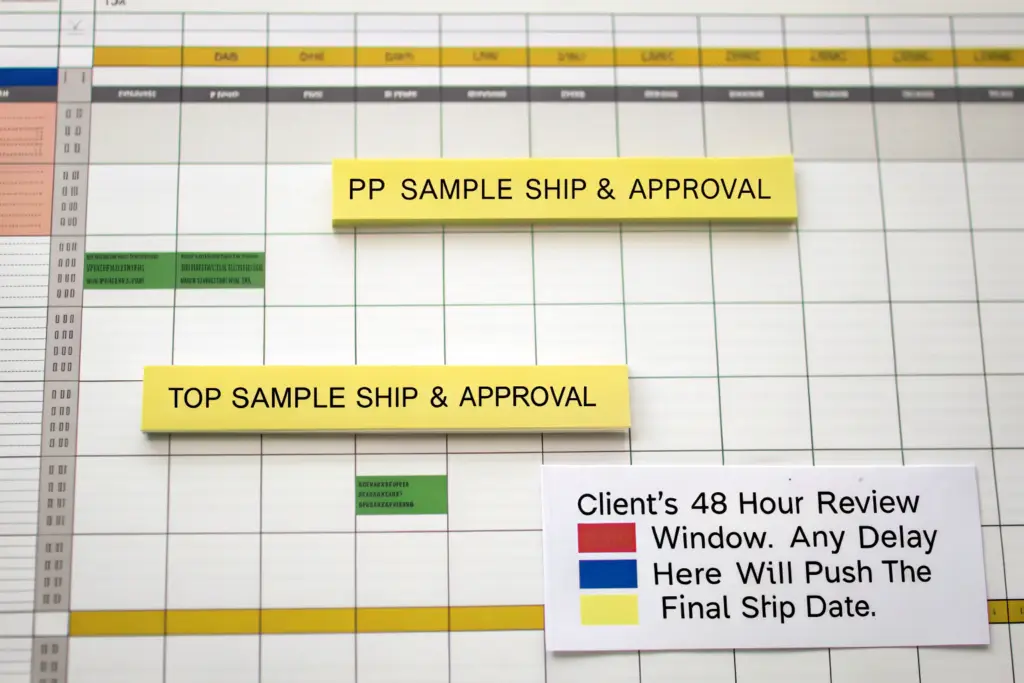
The PP and TOP Sample approvals are non-negotiable quality gates that sit on the critical path. A professional schedule will explicitly show a "Ship and Approval" window for these samples, usually 2-3 days. This is the period where the sample is in your hands, and the entire factory floor is waiting for your written sign-off. This timeline is not just the factory's commitment; it is also an expectation of your response time. If you take 5 days to approve the TOP sample instead of the allocated 48 hours, the final ship date will slip by 3 days. Accountability for this milestone is two-way.
We make this explicit on our schedules. For a recent order, our Gantt chart clearly stated: "TOP Sample Shipped to Client: Oct 5. Client Approval Required: Oct 7." The brand owner knew his deadline. He prioritized the review, sent his approval on Oct 6, and the bulk finishing began exactly on schedule. This clarity of two-way expectation is what keeps a partnership running smoothly. This is the discipline of a collaborative production timeline .
What Is the Difference Between the "PP Sample" and the "TOP Sample" on the Timeline?
- PP (Pre-Production) Sample: This is the final, perfect prototype made from the actual bulk fabric. Its approval is the trigger for the bulk cut. This milestone sits just before the main "Cutting" phase.
- TOP (Top of Production) Sample: This is a piece pulled from the very first batch off the bulk sewing line. Its approval is the final "go" signal for the factory to complete and pack the entire order. This milestone sits after "Sewing Start" but before "Finishing & Packing."
Both are critical, non-negotiable quality gates that require your prompt attention.
How Much "Buffer" Should You Mentally Add for Your Own Internal Review Time?
A professional schedule will assume you can review a sample within 24-48 business hours. Before you approve the overall project plan, honestly assess your own capacity. If you know you will need 3 business days for your review process, tell the factory upfront so they can build that more realistic timeline into the plan from the beginning. Pretending you can review in 48 hours when you cannot is a self-inflicted delay. This is the importance of honest planning communication .
How Can Tracking These Milestones on a Weekly Basis Turn a Hope into a Certainty?
A Gantt chart is a map. Your weekly check-in with the factory is how you follow the map. Instead of asking a vague, open-ended question like, "How is my order going?", you must train yourself and your team to ask focused, milestone-specific questions. This transforms the weekly call from a passive, hopeful conversation into a rigorous, 5-minute, data-driven accountability session.
To turn a schedule into a certainty, you must track the 3-4 critical milestones weekly, not just the final date. In every communication with your Project Manager, your first question should be: "Are we on track against the Bulk Fabric In-House date?" Then, "Is the PP sample still scheduled to ship on time?" This focused, milestone-driven communication eliminates ambiguity and provides early warning of any potential delay. It is the difference between passive hope and active schedule management.
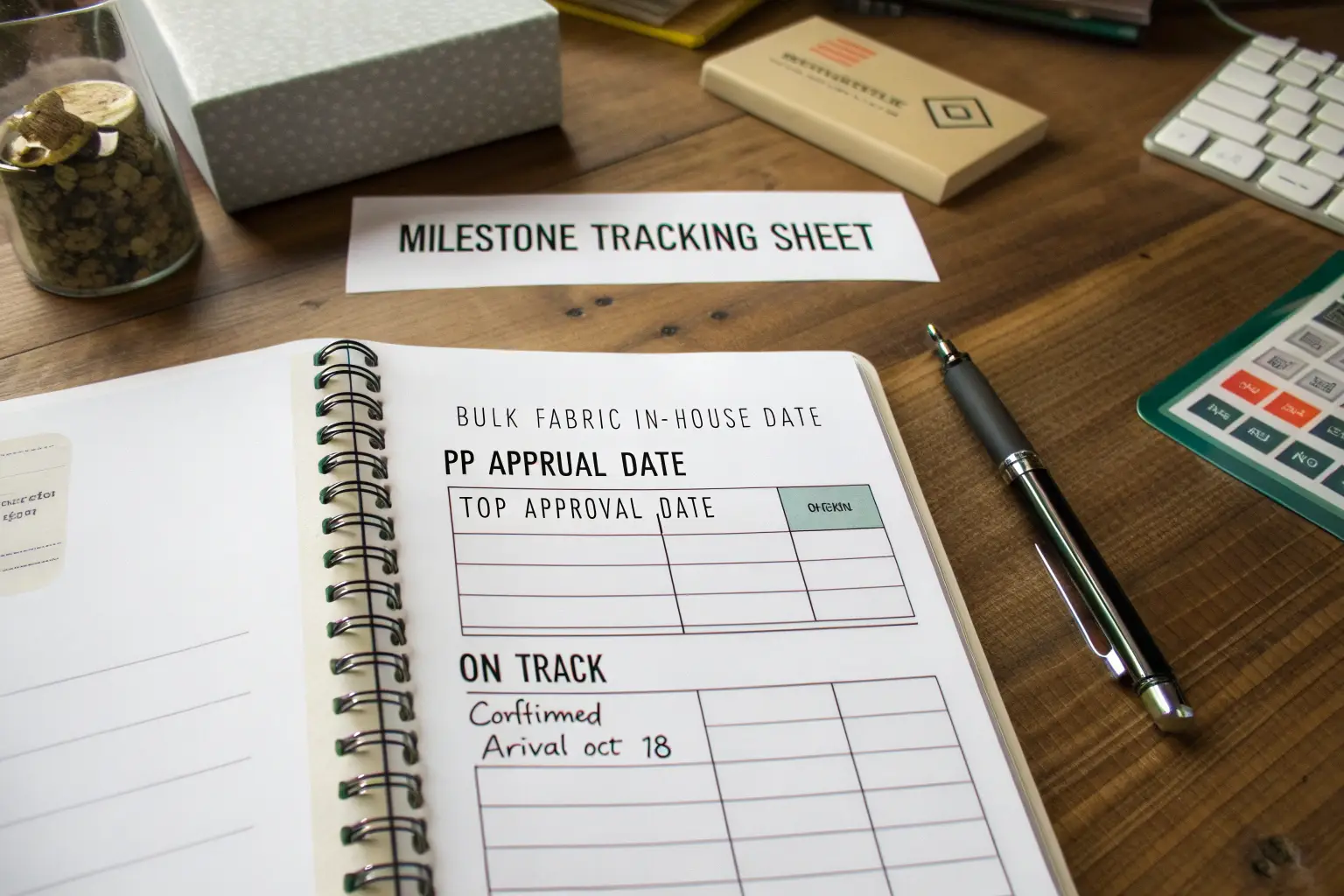
The most efficient brands we work with have mastered this discipline. They have a simple spreadsheet that lists the three key milestone dates for each of their open orders. On every Tuesday call with us, they go down their list: "Style #123: Bulk fabric confirmed? Yes. PP sample on track? Yes. Good. Style #456..." The entire accountability check-in takes 90 seconds per style. They are never surprised by a delay because they are tracking the critical path, not just a final date. This is the power of a milestone-driven partnership .
What Is the Most Effective Way to Word Your Weekly Check-In Question?
Never ask: "Is everything on track?" This is a leading question that invites a vague "yes." Instead, ask a specific, milestone-driven question: "Can you confirm that the bulk fabric is still on schedule to arrive at your facility by Date, as per our Gantt chart?" This forces a specific, factual answer and demonstrates that you are actively managing the plan. This is the standard of our transparent client communication .
What Is an "Exception Report" and How Does It Differ from a Standard Update?
A standard update is "everything is fine." An Exception Report is a specific communication that only happens when a milestone on the critical path is at risk of slipping, and it comes with a proposed mitigation plan. This is the highest form of proactive supplier communication. A factory that sends you an exception report has a world-class planning culture. This is our internal standard for proactive project management .
How Does Fumao's Transparent Scheduling System Make This Process Easy?
We do not just hand you a Gantt chart and hope you can decipher it. Our entire communication and project management system is designed to make the complex simple, the opaque transparent, and the critical path obvious. Our Project Managers are trained to speak the language of your business, proactively flagging the dependencies that matter and ensuring you are never surprised by a hidden delay.
Fumao's transparent scheduling system makes mastery of your production timeline a simple, integrated process. Our Project Managers are trained to walk you through the Gantt chart, explicitly highlighting the critical path milestones. Our weekly updates are structured specifically around the status of those 3-4 key dates, providing visual proof (photos of your actual fabric in the cutting room). We do not just send a schedule and hope; we teach you how to read the map and partner with you to navigate it.
A new brand partner told us, "I used to dread the production schedule. It was a confusing document that I just ignored. Your team made it so simple. My Project Manager walked me through the three dates I needed to watch, and now my weekly update email just confirms that we are on track against those dates. I finally feel in control of my own supply chain." That is our goal. To provide the tools, the transparency, and the expert human partnership that turns a complex schedule into a simple, manageable, and predictable reality. This is the value of a true manufacturing partnership .
How Do Your Weekly "Milestone Update" Emails Help Me Track the Critical Path?
Our weekly email is not a generic status report. It is explicitly structured around the agreed critical path milestones. The email clearly states: "Milestone 1: Bulk Fabric In-House - On Track (confirmed arrival Oct 18). Milestone 2: PP Sample Shipment - On Track (scheduled Oct 22)." This forces both our team and yours to constantly focus on the dependencies that matter. This is the discipline of our accountability-driven communication .
How Can Our Project Manager Help You Create a Custom "Milestone Tracker"?
If you are managing multiple styles, your Project Manager can help you create a simple, custom spreadsheet that lists the 3-4 critical milestone dates for every single one of your orders. This becomes your personal "Supply Chain Command Center," providing a single, at-a-glance view of the health of your entire production pipeline. We are not just a factory; we are your partner in building your operational excellence. This is the value of a strategic service partnership .
Conclusion
Reading and understanding a complex clothing manufacturer's production schedule is not about deciphering jargon; it is about identifying the critical path. By locating the anchor of the "Bulk Fabric In-House" date, respecting the quality gates of the PP and TOP samples, and tracking these key milestones with focused, weekly discipline, you transform a confusing document into your most powerful tool for supply chain predictability.
At Shanghai Fumao, our transparent, milestone-driven scheduling system and our proactive Project Management model are designed to make this mastery a seamless, collaborative, and stress-free process. We do not just manufacture your clothes; we give you the tools and the partnership to confidently manage your business.
If you are ready to take control of your production pipeline with a partner who provides true transparency, let's talk. Our Business Director, Elaine, can walk you through a sample Gantt chart and our milestone tracking process. Please email Elaine at: elaine@fumaoclothing.com.