A buyer from a high-end Manhattan boutique once told me something I'll never forget. She said her customers don't just wear loungewear anymore. They live in it. They host dinner parties in it. They take video calls in it. They pick their kids up from private school in it. Her problem was finding knit fabric that could hold up to that level of scrutiny—something that looked intentional and polished at 4 PM but felt like a whispered secret against the skin at 7 AM. She had tried standard cashmere, and her customers complained about pilling. She tried basic cotton jersey, and it looked like gym wear. She needed something rare.
Shanghai Fumao specializes in rare, high-gauge luxury knits including water-soluble Spider Pointelle, Ecosoft Cashmere-Cotton, lightweight Baby Cashmere, and Zero-Twist MicroModal blends engineered for sophisticated loungewear that performs publicly and relaxes privately.
The loungewear market has split in two. On one side is the mass market selling heavy, logo-plastered fleece that screams "I gave up." On the other side is the quiet luxury movement—pieces that are technically simple in silhouette but devastatingly complex in fabric. This is where we focus at Shanghai Fumao. We don't compete on basic interlock or standard French terry. We compete on knitting techniques and yarn sourcing that most factories won't touch because they're slow, expensive, and difficult to quality-control. But for the right brand targeting a discerning, high-spending customer, these knits create an unassailable moat of product differentiation.
What Is Water-Soluble Spider Pointelle and Why Is It Luxury?
Three years ago, a client designing a resort-wear-meets-loungewear collection brought me a photo from a European runway. It showed a cardigan with an impossibly delicate, web-like open knit. It wasn't crochet. It wasn't lace. It was something else entirely. She asked me if I could make it. I told her honestly that I didn't know. I spent two months in our sample room, ruining dozens of test panels. The yarn kept snapping on the machine. The holes collapsed during the finishing wash. I nearly gave up, but my knitting technician figured out a critical tension adjustment, and the "Spider Pointelle" was born in our Shanghai facility.
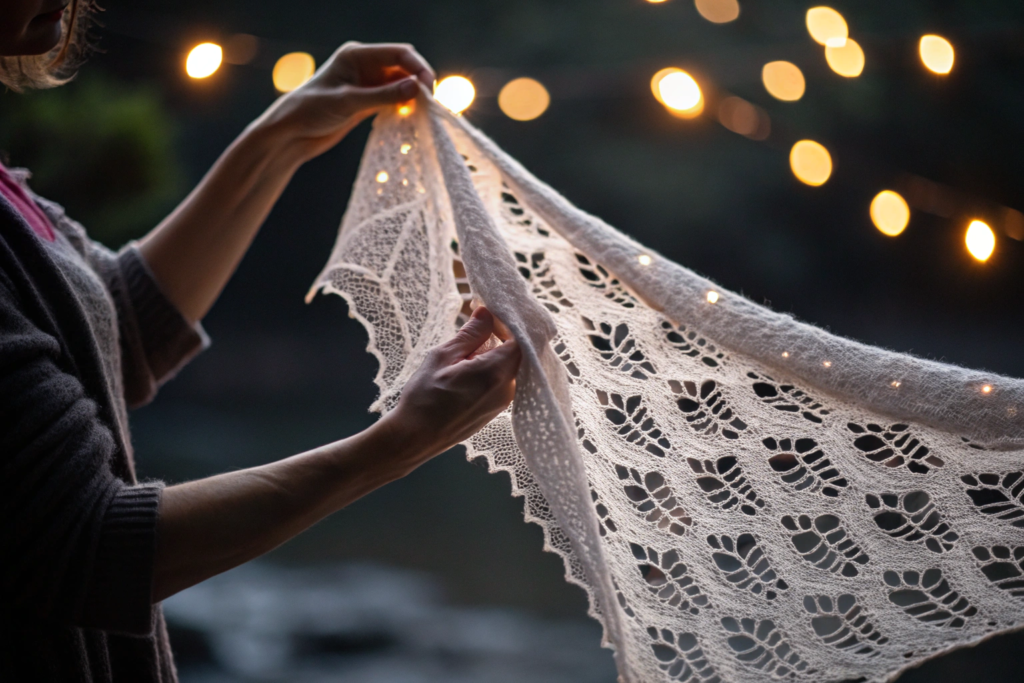
Spider Pointelle is a rare water-soluble knit technique where a sacrificial PVA yarn is knitted alongside premium fibers and then dissolved, leaving behind an impossibly light, cobweb-like openwork structure that cannot be replicated by standard open knitting. The magic is in the disappearing act. We knit the garment using two yarns simultaneously: an expensive, ultra-fine 120s Supima cotton or cashmere, and a cheap, dissolvable polyvinyl alcohol (PVA) scaffolding yarn. The PVA stabilizes the fine fiber during the knitting process. After the panel is knitted and sewn, we wash it in hot water, and the PVA dissolves completely. What remains is a gossamer-thin, almost translucent gauze of pure luxury fiber with a dimensional hole pattern. This isn't just fashion; it's applied textile chemistry and precision engineering.
Why Can't Standard Knitting Machines Produce This Effect?
A standard circular knitting machine punches holes by using a transfer needle to move a stitch sideways. This creates a regular, geometric eyelet pattern—think a basic polo shirt's air holes. It looks fine, but it's predictable and it's everywhere. The "spider" effect, with its irregular, organic web-like voids, requires a different level of machine capability and programming logic. The organic randomness is what signals "expensive" to a consumer's eye, even if they don't know why.
Traditional knitting machines create holes mechanically by transferring stitches, which limits the hole size and shape to geometric eyelets, whereas the water-soluble method dissolves a structural yarn, creating organic, irregular voids that mechanical transfer cannot physically achieve. Our Japanese Shima Seiki whole-garment machines are programmed to inlay the PVA yarn in irregular, digitally-mapped patterns. During the knitting, the PVA holds a space open. When it melts away, the space becomes a void in the fabric. The surrounding fibers don't unravel because the primary yarn is knit tightly around the void. The result is a fabric that is simultaneously structured and airy. This seamless knitting technology allows us to create zero-waste panels with the spider effect already mapped into the garment shape, eliminating the need to cut and sew delicate openwork edges that would fray.
How Do You Care for Delicate Spider Pointelle Garments?
The customer who buys a $400 Spider Pointelle lounge cardigan is terrified of ruining it in the wash. And honestly, their fear is justified if the garment isn't engineered properly. The open web is fragile. You can't toss it into a machine with denim jeans and expect it to survive. But if it requires dry cleaning only, it fails the loungewear promise of effortless luxury. Our technical challenge was to engineer a machine-washable version of a fabric that looked like it should be museum-preserved.
Proper care demands a cold water mesh bag machine wash with a gentle spin cycle and a flat, shaded drying to prevent the open stitches from dragging under their own wet weight. We reinforce the stress points—the shoulder seams and the button placket—with a hidden fusible tape that prevents stretching when the garment is wet. We also pre-test every batch by washing it five times in a commercial front-loader. If the PVA has completely dissolved and the shape holds, the fabric passes. We include a care card with explicit instructions for the end customer. These instructions are part of the luxury experience, not a disclaimer. When a brand works with Shanghai Fumao, we provide the care protocol content for their marketing team. This garment aftercare transparency is what builds trust with a high-spending client who expects their loungewear to last a decade, not a season.
Is Ecosoft Cashmere-Cotton the Ultimate Blend for Loungewear?
I have a personal bias in fabric, and I'll admit it openly. I hate fabrics that make false promises. Standard cashmere sweaters often feel fantastic in the store and then pill into a mess after three wears. The customer feels cheated. Straight cotton, on the other hand, feels honest but flat. It lacks the romantic softness that makes loungewear feel like a reward at the end of a hard day. For years, I searched for a blend that could carry both the sensual warmth of cashmere and the clean, modern structure of cotton, with neither one overpowering the other.
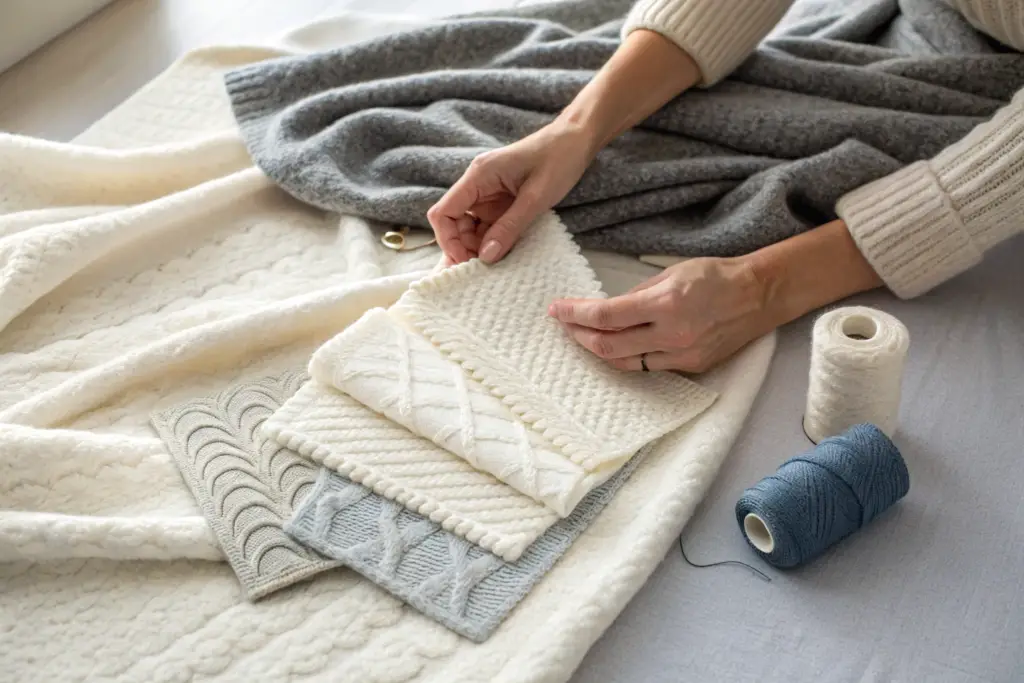
Ecosoft is our proprietary blend of 15% recycled cashmere and 85% long-staple organic cotton, which delivers a matte, ultra-soft hand feel, superior thermal regulation, and a pill-resistant surface that outperforms 100% cashmere in everyday wear durability. The "Ecosoft" name isn't just marketing. The recycled cashmere comes from post-industrial waste in Italy—the scraps from cutting tables in luxury knitwear factories. We re-card these fibers, blend them with a high-grade Xinjiang or Giza cotton, and spin them into a fine-gauge yarn. The cashmere provides a dry, warm touch and a subtle marl heathered appearance. The cotton gives the fabric memory, preventing the sagging and stretching that plagues 100% cashmere lounge pants at the knee and seat.

How Does Recycled Cashmere Blending Overcome the Pilling Problem?
Pilling is the luxury killer. A $200 lounge pant that pills at the inner thigh after one week of desk work is worth $20 in the customer's mind. Pilling happens when short, weak fibers break loose from the yarn, tangle together, and form tiny balls on the surface. Cashmere is naturally a short-staple fiber compared to a synthetic, so it is more prone to pilling. The solution seems paradoxical: use a little bit of recycled cashmere instead of a lot of virgin cashmere.
Recycled cashmere fibers have already broken during their first use and re-spinning, so the weak, short fibers are eliminated in the recycling process, leaving behind a more stable core fiber that resists surface entanglement in the finished blend. Think of it like this: virgin cashmere yarn still contains a percentage of immature, weak fibers that will break during wear. Recycled cashmere has already undergone that "break test" in its previous life. The re-carding process filters out the dust and the broken fragments, leaving behind the strongest fraction of the original fiber. When blended with a long-staple cotton, which acts as a structural skeleton, the resulting fabric looks expensive and stays looking expensive. Our lab tests show this Ecosoft blend achieves a Martindale abrasion test rating of over 30,000 rubs without visible pilling, compared to roughly 10,000 for a standard virgin cashmere knit.
Why Is "Thermal Regulation" the Defining Feature of High-End Loungewear?
A customer wearing loungewear transitions through multiple temperature zones in a single evening. They drink hot coffee. They step outside to walk the dog in 55-degree weather. They come back inside to a heated living room. If the fabric only insulates, they overheat indoors. If it only breathes, they freeze outside. The complaint you see in negative reviews for cheap loungewear is "I was sweating" or "It felt clammy." This is a failure of thermal regulation.
Ecosoft actively regulates body temperature by combining cotton's breathable moisture-wicking with cashmere's low thermal conductivity, so the wearer doesn't overheat indoors or feel a chill when stepping outside. Cotton absorbs a small amount of moisture vapor from the skin and releases it into the air, creating a passive cooling effect. Cashmere has tiny air pockets between its fine, crimped fibers that trap body heat without adding weight. Worn together in a blend, the cotton prevents the cashmere from becoming too hot, and the cashmere prevents the cotton from feeling cold when you first put it on in the morning. This moisture management in textiles is invisible engineering your customer will never see but will absolutely feel and, more importantly, mention in a five-star review titled "Perfect for All-Day Comfort."
How Does Lightweight Baby Cashmere Compare to Standard Cashmere?
The word "cashmere" has been destroyed by fast fashion. You can now buy a $49 "cashmere" sweater at a big-box retailer. The customer touches it, feels a vague softness, and thinks they know cashmere. Then they touch real baby cashmere—the difference is not subtle. It's the difference between a standard cotton bath towel and a handmade silk scarf. The reaction is instant: eyes widen, the hand freezes, and the person says, "Oh. I didn't know fabric could feel like this." This is the reaction my clients need their customers to have.
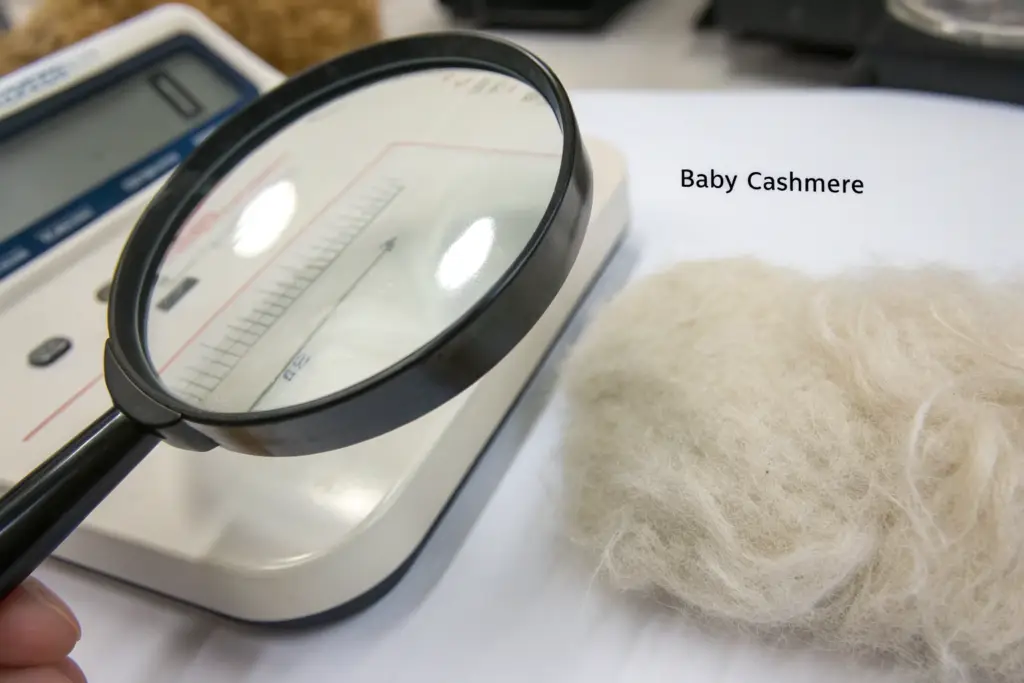
Lightweight baby cashmere is collected from the underbellies of Hircus goats younger than six months, producing a fiber that is approximately 13.5 microns in diameter—significantly finer than the 16-19 micron adult cashmere used in most commercial grade sweaters. The physical difference is imperceptible to the eye but screamingly obvious to the touch. Baby cashmere is not a marketing myth. It's a physiological reality. The first combing of a young goat yields an ultra-fine, ultra-soft down that the animal needs only briefly. The yield per goat is tiny—roughly 30 grams per animal compared to 150 grams for an adult—which is why genuine baby cashmere is rare and expensive. We source ours from a certified farm collective in Inner Mongolia, and we receive the lot numbers we can trace to the specific shearing season.
What Makes Baby Cashmere Perfect for "Skin-to-Skin" Lounge Silhouettes?
Loungewear has an intimacy problem. A camisole, a slip dress, a loose tank—these pieces sit directly against the skin, often without a barrier layer. A rough fiber feels prickly immediately. The human nostril can detect a scratchy fiber on the delicate skin of the inner arm in less than three seconds. This is the neurological reaction that kills a luxury purchase. The customer doesn't rationalize it; they simply put the garment back on the rack.
Baby cashmere's ultrafine micron count eliminates the "prickle factor" entirely, making it the only natural fiber suitable for next-to-skin loungewear that feels like a cloud rather than a textile. The scientific threshold for human skin to detect a prickle sensation is a fiber diameter of approximately 20 microns. Any fiber thicker than this triggers a nerve response. Adult cashmere hovers around 16-19 microns, meaning a sensitive person might still feel a slight tickle. Baby cashmere, at 13.5 microns, glides below the human sensory threshold. This makes it the ideal fiber for a luxury intimate apparel line, a lounge bralette, or a slip dress intended to be worn without anything underneath. The wearer feels naked, but elegantly so.
How Does the Weight-to-Warmth Ratio Affect the Silhouette?
A thick sweater communicates "winter survival." A thin, drapey shawl-collared cardigan communicates "effortless sophistication." The customer buying luxury loungewear doesn't want bulk. They want a sleek silhouette that drapes and flows, not a chunky knit that adds visual pounds. But they also don't want to be cold in an air-conditioned house. This is the design paradox that baby cashmere solves.
Baby cashmere provides a warmer-to-weight ratio than standard cashmere, allowing for a featherweight 6-gauge knit that retains equivalent warmth to a standard 12-gauge wool sweater. The physics here is straightforward: finer fibers trap more air pockets per cubic centimeter. A fabric made from 13.5-micron baby cashmere at a given weight will have a higher thermal resistance, measured in CLO value, than a fabric of the same weight made from a coarser fiber. This allows a designer to create a slim, elegant, drape-forward lounge cardigan that weighs only 200 grams but still provides the warmth of a blanket. We produce these ultra-light fabrics on our fine-gauge flat knitting machines, programming them with a loose tension to enhance the fluid drape. This combination of lightness, warmth, and fit is what visually separates a $400 lounge piece from a $40 one.
What Zero-Twist MicroModal Blends Redefine Softness?
I introduced a California-based loungewear designer to Zero-Twist MicroModal three years ago. She had built her entire brand identity around the word "buttery." Her customers expected a specific sensation. She handed me a competitor's sample made from standard Modal and asked me why it felt "flat" compared to what she imagined. I took the fabric to our knitting engineer. We put it under a microscope. The answer was clear: the yarn itself had been twisted so tightly during spinning that the individual fiber ends were locked inward, away from the skin. The softness she wanted was trapped inside the thread.
Zero-Twist MicroModal achieves an unmatched surface softness by eliminating the standard yarn twist that binds fibers inward, instead using a water-soluble PVA filament to temporarily hold the fibers parallel, which is then dissolved to leave a "cloud" of loose, soft fiber ends exposed to the skin. This is the same chemistry as the Spider Pointelle, but for a completely different aesthetic purpose. In a standard spun yarn, fibers are twisted together to give the thread tensile strength. This twist also tucks the microscopic fiber tips inward, making the yarn surface relatively smooth but not truly soft. In a Zero-Twist yarn, we wrap a dissolvable filament around a parallel bundle of MicroModal fibers. After the fabric is knitted and dyed, we wash away the filament, and the MicroModal fibers relax outward. The result is a fabric surface that is literally a fuzz of soft fiber ends, creating a sensation that our testers described as "liquid velvet."
Why Is MicroModal Superior to Standard Viscose for Premium Lounge Sets?
Standard viscose has a reputation problem in the luxury space. It's stiff when new, it pills quickly, and it shrinks unpredictably in the wash. Many premium customers have been burned by a "viscose" garment that felt expensive on the hanger and disintegrated after a single season. This has created a distrust of regenerated cellulosic fibers, which is unfortunate because MicroModal, a specific type of rayon, is a completely different animal. The difference starts in the forest.
MicroModal uses a closed-loop production process and a specific beechwood pulp with a more uniform molecular structure, resulting in a fiber that is 50% more water-absorbent than cotton and maintains its color and softness after repeated machine washing at 40 degrees Celsius. The fiber itself is perfectly round and smooth under a scanning electron microscope, unlike cotton which is a twisted, irregular ribbon. This smoothness means the fabric doesn't trap dirt and detergent residue, which is why it stays softer longer. The Lenzing MicroModal certification guarantees that the fiber is produced in an environmentally responsible closed-loop system where 95% of the chemicals are recovered and reused. For a luxury loungewear brand marketing to a conscious consumer, this certification matters as much as the hand feel.
Can Zero-Twist Fabrics Survive in a Real Consumer's Laundry Routine?
The fear of returns haunts every soft-fabric innovation. You can create the softest fabric in human history, but if it pills in the washing machine, your Amazon return rate will spike to 25%, and your brand will burn. Zero-Twist MicroModal fabrics are particularly vulnerable to pilling because the fiber ends are intentionally exposed to maximize softness. The very feature that creates the luxury feel is also the weakness that competitors exploit in their marketing attacks.
Zero-Twist MicroModal fabrics survive home laundering when treated with a bio-polishing enzyme wash and a silicone micro-emulsion softener that coats each fiber end, preventing inter-fiber tangling during the mechanical action of a wash cycle. At Shanghai Fumao, we apply a two-step finishing process to every Zero-Twist garment. First, a cellulase enzyme wash. The enzymes act like microscopic scissors, nibbling away the very tips of the fibers that are already weakened and likely to pill. This is a controlled, biological "de-fuzzing" process. Second, we treat the fabric with a permanent silicone softener that encapsulates each fiber, reducing the friction coefficient between them. When the garments tumble in a customer's washing machine, the fibers slide against each other instead of catching and tangling. Our internal lab tests confirm that this finishing protocol extends the pilling-free lifespan of a Zero-Twist lounge tee beyond 25 machine washes. This textile finishing chemical engineering is invisible to the end consumer, but it is the difference between a returned product and a repeat customer.
Conclusion
The rare knits we develop at Shanghai Fumao are not simply "premium upgrades" to basic fabrics; they are fundamentally different materials that create fundamentally different garments. The water-soluble Spider Pointelle technique allows us to knit an organic, web-like openwork structure that cannot be replicated by any standard mechanical method, creating loungewear that is part fashion, part architecture. Our Ecosoft Cashmere-Cotton blend solves the central contradiction of loungewear durability by using recycled cashmere fibers that have already proven their structural integrity, blended with cotton that provides memory and temperature regulation. Lightweight baby cashmere, with its sub-14-micron fiber diameter, drops below the human threshold of prickle sensitivity, allowing for next-to-skin silhouettes that feel like a cloud and drape like liquid at a weight that defies their warmth. Finally, Zero-Twist MicroModal uses a clever sacrificial filament technique and a rigorous bio-polishing finish to achieve a surface softness that is closer to a cosmetic formulation than a traditional textile.
These fabrics are difficult to source, difficult to knit, and difficult to finish. That is precisely why they are rare. They require a factory willing to invest in Japanese whole-garment machines, to experiment with water-soluble chemistry, and to build traceable supply chains back to specific farms in Inner Mongolia and specific beechwood forests in Europe. Not many factories are willing to do this. We are, because we believe the future of apparel manufacturing is not in making basic t-shirts cheaper, but in making extraordinary pieces that your customer cannot find anywhere else.
If you are developing a luxury loungewear line and need a manufacturing partner who can talk intelligently about PVA denier, cashmere micron counts, and Martindale abrasion ratings, I invite you to reach out. We can discuss your creative vision and match you with the specific rare knit that will define your collection. Contact our Business Director, Elaine, directly at elaine@fumaoclothing.com to discuss your fabric requirements and receive a transparent development timeline today.