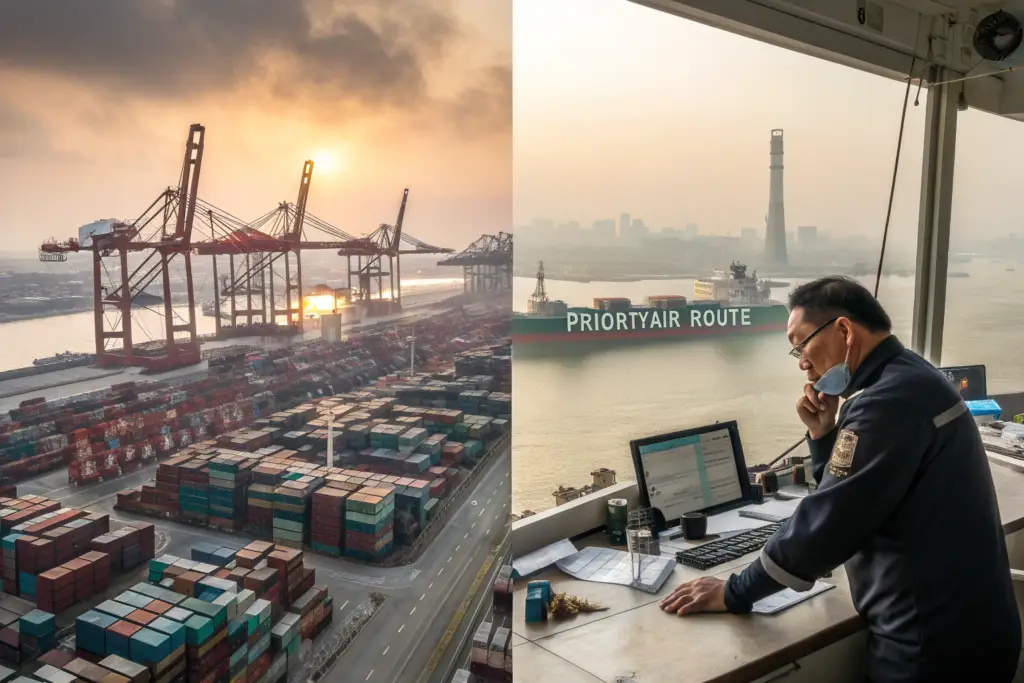
In October 2021, a men's performance wear brand owner from Seattle called me at 6:30 AM Shanghai time. His voice was shaking, and not from caffeine. His entire winter collection—2,000 units of technical jackets and vests—was sitting in a container aboard a vessel anchored off the coast of Long Beach. The ship had been waiting for a berth for 23 days. The retail launch was scheduled for November 1st, and the inventory for his biggest wholesale account, a national outdoor chain, was inside that container. The buyer had told him bluntly: "If the goods aren't on our distribution center's dock by October 28th, the order is canceled, and we'll source from another vendor next season." He had built his entire annual revenue forecast around this one delivery, and it was floating helplessly in the Pacific.
Shanghai Fumao helped the brand survive by immediately activating a backup air-freight production run, splitting the P.O. into "Save the Season" and "Stock the Backend" streams, and navigating the container retrieval through a less congested alternative port with pre-cleared customs.
This crisis was not unique to one brand. The global supply chain seizure of 2021-2022 crushed hundreds of small and mid-sized apparel companies. But the ones who survived were those whose manufacturing partners treated the crisis as their own emergency, not as an "act of God" clause to hide behind. At Shanghai Fumao, we didn't just watch the port congestion news and send sympathetic emails. We restructured the entire production and logistics plan within 12 hours of that phone call, effectively manufacturing time when there was none left to buy.
What Causes Port Congestion and Why Is It Deadly for Apparel Brands?
I need to explain why a ship sitting still on the ocean is so financially lethal to a clothing company. Apparel is not like furniture or electronics. A sofa is timeless. A laptop has a two-year product cycle. But a winter jacket has a selling window of approximately 90 days. If those 90 days pass while the jacket is in a shipping container, the product becomes a liability. The retailer cancels the order. The brand owner is left holding inventory they must liquidate at a loss, assuming they can even get it into a warehouse. The cost of the goods is sunk, the freight is sunk, and the revenue is gone. This is how a single port delay can kill an otherwise healthy apparel business.
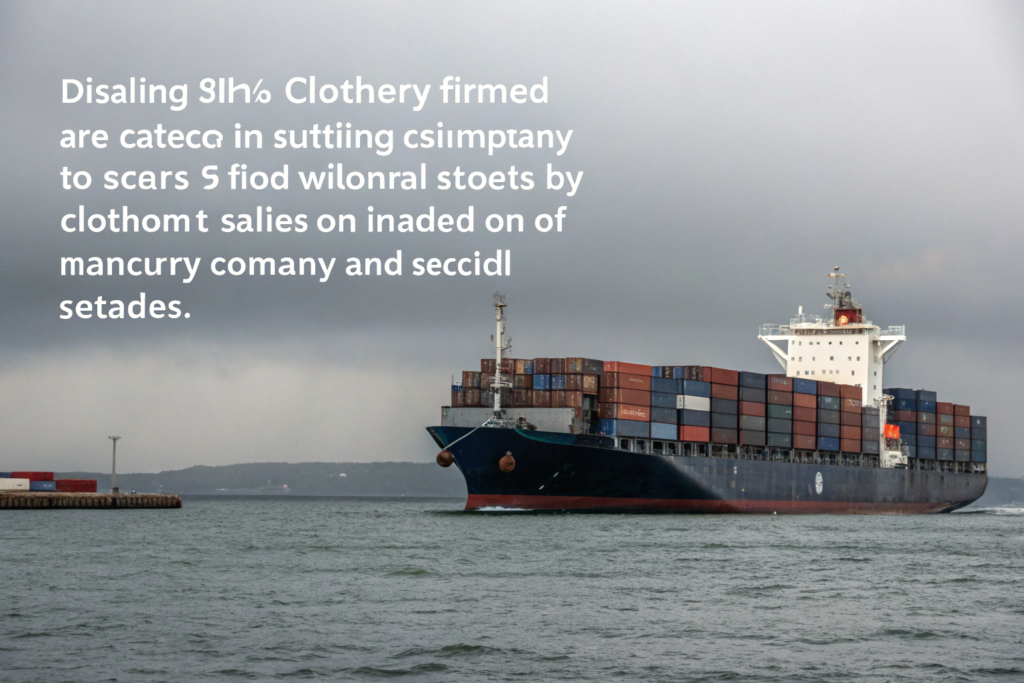
Port congestion occurs when vessel arrivals exceed a port's capacity for unloading, driven by labor shortages, chassis scarcity, warehouse overflow, and sudden demand surges, and for apparel brands, it creates a fatal misalignment between product arrival and the rigid seasonal selling calendar. A jacket that arrives on December 15th is not late by one month; it is late by one full year. The Spring/Summer buying cycle starts in January. No buyer is looking at heavy outerwear in January. So the brand owner must either pay to store the goods for nine months until the next winter season or sell them to an off-price liquidator for 30 cents on the dollar. This is the brutal mathematics of seasonal goods meeting an unreliable logistics infrastructure.
Why Don't Standard Shipping Contracts Protect Against This?
I have a client who learned the hard way that the term "Force Majeure" is a factory's shield and a brand's sword. His purchase order stated that the factory was not liable for delays caused by "unforeseeable events beyond reasonable control." The ship anchor dropping outside Los Angeles was, legally, such an event. He couldn't sue the factory. He couldn't sue the shipping line. He couldn't sue the port. The legal system had perfectly distributed the risk away from every party with power and concentrated it entirely on him, the smallest player in the chain.
Standard shipping contracts and force majeure clauses protect carriers and factories from financial liability, leaving the brand owner to absorb 100% of the revenue loss from a missed seasonal window. The bill of lading from the carrier includes fine print that essentially says, "Sailing schedules are estimates, not guarantees." The factory's contract says, "We are not responsible for delays beyond our factory gate." This creates a gap in accountability. The factory did its job. The carrier claims they did their best. The brand owner, who did nothing wrong, bears the entire consequence. This is why a manufacturing partner who actively helps solve the problem, even when not contractually obligated, is worth more than a cheaper unit price. This supply chain contractual risk allocation structure is fundamentally unfair, and the only defense is a partner who ignores the contract and acts on the relationship.
How Did the "Chassis Shortage" Specifically Crash Apparel Deliveries?
The chassis is the wheeled metal skeleton that a container sits on to be trucked away from the port. Without a chassis, the container is just a heavy metal box stuck on the ground. During the 2021 crisis, this simple piece of equipment became the bottleneck that broke thousands of supply chains. I had another client whose container was physically unloaded from the ship within three days. Success, he thought. Then the container sat on the terminal ground for another 19 days because there was no chassis available to move it. He could see his inventory on the terminal's tracking app. It was 20 miles from his warehouse. He could not touch it.
The chassis shortage, a secondary effect of container imbalances, paralyzed trucking because loaded containers couldn't leave the port, creating a domino effect where ships couldn't unload because the terminal yard was already full of waiting boxes. The root cause was a systemic imbalance. Empty containers were piling up in US ports because it was more profitable for shipping lines to rush empty boxes back to Asia for the next high-paying eastbound voyage than to wait for US exports to fill them. The chassis were stuck under those empty containers, waiting to be returned. Meanwhile, full containers of apparel sat on the ground, chassis-less and immobile. This intermodal equipment logistics failure was a textbook case of a fragile system breaking at its weakest physical link.
How Did the Dual-Stream Production Save the Winter Collection?
The phone call at 6:30 AM ended with a decision, not a debate. The Seattle brand owner had 2,000 units on the stuck vessel. He needed at least 500 units in the retailer's hands by October 28th, three weeks away. I called my production manager, my fabric warehouse supervisor, and my logistics coordinator into a conference room. We didn't discuss what was fair. We discussed what was physically possible. Within two hours, I called the client back with a plan that involved a second, accelerated production run, paid for by Shanghai Fumao as a bridge until his insurance claim on the original cargo settled. This is the kind of partnership that either breaks a factory-client relationship or forges it in steel.
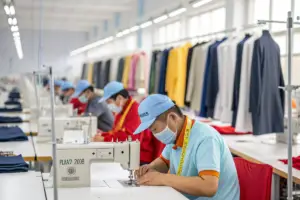
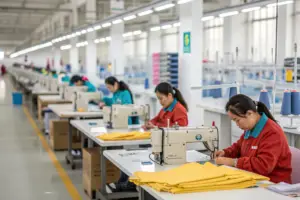
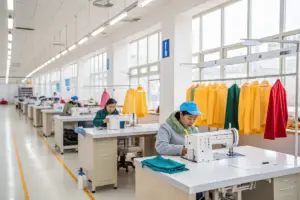
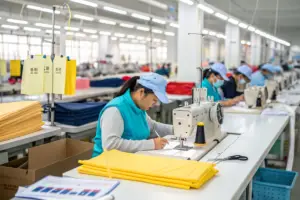
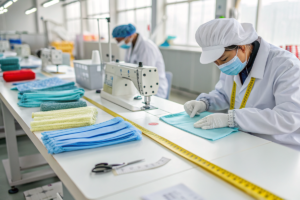
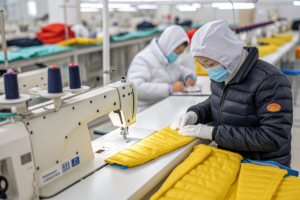
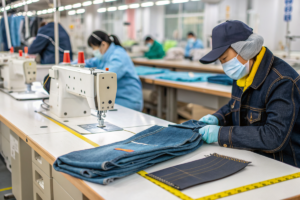
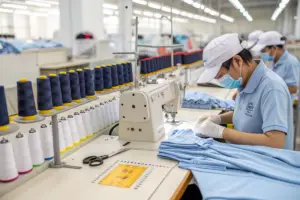
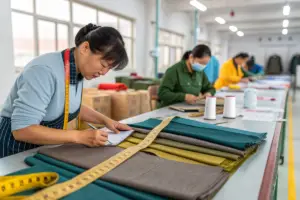
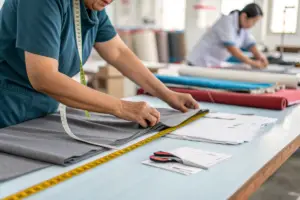
We immediately launched a "Dual-Stream" response, using an accelerated split production run of 500 rescue units manufactured in five days and air-freighted directly to the retailer, while the original 2,000 ocean units were eventually redirected to a secondary East Coast port with a pre-cleared customs entry. The "Stream A" rescue mission required pulling raw materials from our Grey Fabric Bank. We had the exact same performance stretch woven fabric in stock, un-dyed. We dyed it to the brand's specific charcoal and navy color specifications in 36 hours. The cutting started on day three. The sewing lines were re-allocated, and our best technicians worked overtime to finish the 500 jackets by day five. They were air-freighted from Shanghai Pudong to Los Angeles, clearing customs under a broker we had on standby, and arrived at the retailer's distribution center on October 26th, two days before the deadline.
How Was the "Air-Freight Rescue" Batch Physically Possible in Five Days?
Five days to produce 500 technical jackets sounds impossible to most people in the apparel industry, where eight to twelve weeks is considered normal. The secret is not magic; it's the elimination of waiting time. In a standard production timeline, the fabric sits in a queue waiting to be cut, the cut panels sit in a queue waiting to be sewn, and the finished garments sit in a queue waiting to be packed. The actual "touch time" of making a jacket might be only three hours. The rest is waiting. To hit a five-day deadline, we had to eliminate every minute of waiting.
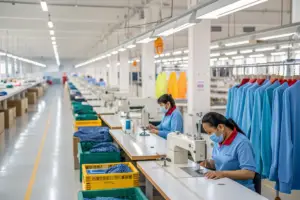
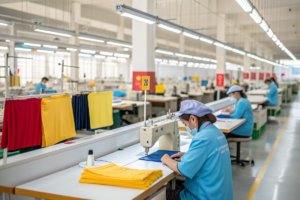
We prioritized this order to "Red Line" status, meaning it jumped every queue, our dyeing partner ran the color on an emergency 24-hour cycle, and we used our multi-skilled special projects team who can handle the entire garment start-to-finish instead of the standard segmented assembly line. On a normal day, our factory operates on a progressive bundling system where one worker sews collars, another attaches sleeves, and the garment moves station to station. For the Red Line rescue batch, we assigned a team of 12 multi-skilled technicians, each capable of constructing a complete jacket from a bundle of cut panels. They worked in parallel, not in sequence. This lean manufacturing rapid response cell structure is a capability we built specifically for crisis moments like this, and that day it paid for itself a hundred times over.
What Happened to the Original Container Stuck at Long Beach?
The original 2,000 units were not abandoned. They were still valuable inventory, but they were now a "Stock the Backend" asset rather than a "Save the Season" requirement. The immediate pressure to deliver before October 28th was gone because the rescue batch had already satisfied the retailer. But the brand still owned those 2,000 jackets, and they had a strong direct-to-consumer business that could absorb replenishment inventory. The question was how to get them out of the Long Beach purgatory without waiting another month.
We worked with the freight forwarder to reroute the container’s final delivery from the congested West Coast to a less congested port, eventually trucking the goods to the brand's backup warehouse in New Jersey, where they were processed for D2C fulfillment. This required changing the customs entry port after the vessel had already docked, which is a complex paperwork maneuver. Our logistics coordinator filed an immediate permit to transfer (PTT) to move the container in-bond from Long Beach to a bonded warehouse near Newark. From there, the goods cleared customs and were delivered to the brand's 3PL partner on the East Coast. This customs bonded transportation maneuver converted a trapped liability into sellable inventory, and the brand was able to offer these jackets to their email list as a "Just Landed" release, capturing full margin on the late-arriving stock.
What Pre-Shipment Strategy Prevents Port Delays Before They Happen?
After the 2021 crisis, I made a company-wide change to how we approach shipping for every single client. We stopped treating freight as a post-production task. We started treating it as a pre-production design parameter, just as important as the fabric choice or the seam construction. The lesson from the Seattle brand's near-death experience was not "air freight can save you." That's reactive and expensive. The lesson was: the shipping plan must be designed before the cutting ticket is printed. We now build a logistics calendar into every purchase order, and we game out "What If" scenarios before any fabric is even dyed.
We implemented a mandatory Peak Season Buffer System for all US-bound shipments, which shifts the production schedule forward by three weeks and pre-books vessel space at two alternative port gateways before the P.O. is even confirmed. This is not a suggestion; it's our standard operating procedure for any brand with a hard seasonal deadline. We look at the historical congestion data for Los Angeles/Long Beach. We observe that September and October are reliably the worst months. Therefore, any order with an October 1st retail launch date must be finished and ready to ship no later than August 10th. This creates a three-week buffer. Even if the vessel sits at anchor for two weeks, the goods still arrive by late September. This supply chain risk mitigation strategy costs nothing except discipline.
How Does "Pre-Booking Alternative Ports" Work as an Insurance Policy?
When you book ocean freight, you typically book a single vessel from Port A to Port B, for example, Shanghai to Los Angeles. If Los Angeles is congested, you are stuck on that vessel, waiting to unload. You have no alternative because the ship's route is set. The only way to create optionality is either to book multiple vessels—which is expensive—or to book a service that offers a Port of Discharge optionality, which some forwarders provide during peak season for a premium.
We secure an option on a secondary vessel headed to an alternative port gateway, such as Savannah or Houston, as a "hot backup" that allows us to redirect the container mid-journey if the primary port's congestion index exceeds a pre-set trigger. During the worst of the crisis, we worked with a freight forwarder who offered a "Port of Call Swap" service. If the vessel was approaching Long Beach and the anchorage wait time exceeded ten days, they could discharge the container at the previous port of call, such as Seattle or Oakland, and truck it inland. This cost an extra 15% in logistics but saved a 100% margin loss from a missed season. We discuss these options with our clients at Shanghai Fumao during the freight contract negotiation, not after the ship has already sailed.
Why Does Early Production Sequencing Eliminate Last-Minute Panic?
Panic is caused by hope. A brand owner hopes the factory will deliver on time. Hopes the port won't be busy. Hopes the trucker will be available. Each of these hopes is a potential failure point. When you pull production forward, you are not "early." You are on time for a realistic supply chain, not a theoretical one. The old standard lead time assumed a perfect world. We now assume an imperfect world and schedule accordingly.
By moving the factory completion date forward, we convert the fixed overseas shipping time from a "constraint" into a "buffer," so that minor port hiccups are absorbed without the end customer ever noticing a delay. If a jacket is finished on July 20th instead of August 10th, the sea transit time of 30 days becomes a relaxed window. If the vessel is three days late departing, the goods still arrive by August 23rd, long before the September retail floor-set date. This early sequencing requires the brand owner to commit to design finalization and material approval earlier, but the trade-off is the elimination of the annual "Will it arrive?" anxiety attack. This production planning and scheduling discipline is one of the most valuable services a factory can offer a brand that lacks a dedicated supply chain department.
How Did the Brand Turn a Disaster Into a Loyalty Story?
The story of the Seattle brand doesn't end with the successful October 26th delivery. That was the operational win. The strategic win happened in the weeks that followed, when the founder turned a supply chain disaster into a brand loyalty event. He didn't hide the crisis from his customers. He didn't send a generic "Due to global supply chain issues, orders may be delayed" email that everyone was sending. He wrote a radically transparent newsletter to his email list, explaining exactly what happened, what he did to fix it, and how the factory in Shanghai had built a rescue batch from scratch. The email was raw, specific, and grateful. The response shocked him. Customers who had never written a review suddenly replied to thank him for being honest. They became more loyal, not less, because the brand had shown them the human stress behind the product.
The brand owner turned a near-fatal logistics failure into a marketing asset by transparently communicating the rescue effort to his customer base, which deepened trust, generated organic social media engagement, and turned the "survived port congestion" story into a core part of his brand's origin narrative. The jackets themselves became physical proof of resilience. He even created a limited "Against the Current" hangtag for the rescue batch, telling the story of how these specific 500 jackets were flown across the ocean in five days to keep a promise. The batch sold out at full price within two weeks, and the direct-to-consumer brand storytelling campaign won him a feature in a popular D2C newsletter, driving thousands of new subscribers to his site.
What Should You Communicate to Wholesale Buyers During a Delay?
The Seattle brand owner had to face the retailer's buyer, a seasoned veteran who had heard every excuse in the book. His instinct was to apologize profusely and beg for leniency. I advised him to do the opposite: walk in with a document, not an apology. A printed, one-page recovery plan with specific dates, specific units, and specific backup measures. Buyers are problem-solvers. They respect other problem-solvers. An apology without a plan sounds like weakness. A plan without an apology sounds like competence.
You must present the wholesale buyer with a concrete recovery plan, including specific new arrival dates and the exact SKU breakdown of the air-freight rescue batch, rather than an emotional apology, because the buyer needs to reassure their own planning team with hard data, not sympathy. The Seattle client sent the buyer a PDF titled "Winter Collection Recovery Schedule" within 24 hours of the crisis. It listed the 500 units by style number, color, and size curve. It listed the air waybill number. It listed the expected delivery date. The buyer forwarded that PDF to her regional manager with a one-word comment: "Solid." The order was not just saved; the brand's reputation for reliability, paradoxically, increased because their crisis response was more professional than many vendors' normal operations.
Can a Logistics Crisis Actually Strengthen Your Brand Identity?
Most brands treat their supply chain as a backstage operation, invisible to the customer. The product simply appears on the website. But the 2021 crisis revealed something interesting: customers are fascinated by how things are made and how problems are solved. When the Seattle brand sent that transparent email, they were not just providing a delivery update; they were telling a story of craftsmanship and commitment that most brands keep hidden behind a polished storefront.
A logistics crisis, when handled with transparency and grit, can become a differentiator that proves the brand's values are not just empty marketing slogans but operational commitments backed by real, costly action. The message to the customer was implicit but powerful: "We cared enough to lose money flying these jackets to you. We keep our promises." This is a value demonstration that no advertising budget can buy. The authentic drama of a near-miss disaster, resolved by a dedicated team working overtime in a Shanghai factory, is a far more compelling narrative than "We make nice jackets." This supply chain transparency in marketing approach has since been adopted by several of our clients as a permanent strategy, not just a crisis tactic.
Conclusion
The Seattle brand's survival of the Long Beach port congestion crisis is not an isolated miracle story; it is a repeatable blueprint for how a fashion brand and a manufacturing partner should operate together when a global supply chain seizes up. It started with a relationship that was strong enough to handle a 6:30 AM emergency call, and it was executed through three specific, decisive actions. First, we launched a Dual-Stream production rescue, manufacturing 500 units in five days from our Grey Fabric Bank inventory and flying them directly to the retailer, meeting the hard deadline and saving the wholesale account. Second, we used an in-bond transfer to reroute the original trapped container from a choked West Coast port to a clear East Coast port, converting the late inventory into profitable D2C replenishment stock instead of liquidated dead freight. Third, the brand owner took the raw facts of this operational rescue and wove them into a transparent, authentic communication to both his wholesale buyer and his retail customers, which deepened trust and created a brand story that marketing dollars could never have bought.
This crisis taught us at Shanghai Fumao that a factory's job does not end at the loading dock, and a brand's resilience does not come from a cheap unit price. It comes from a partner who treats your seasonal deadline as their own, who has pre-positioned raw materials ready to surge into production, and who has relationships with freight forwarders capable of creative routing maneuvers when standard lanes fail. We now build these lessons into every client relationship: the Peak Season Buffer for production scheduling, the optionality of secondary port gateways for ocean freight, and the pre-agreed "Red Line" protocol that can activate an emergency air-freight batch within hours if a ship drops anchor in the wrong place at the wrong time. Port congestion will happen again, because global logistics is a fragile system prone to periodic shocks. But a brand that plans for the shock with a prepared manufacturing partner will not just survive the next crisis; they will use it to separate from competitors who are still hoping for smooth sailing.
If you have inventory currently trapped in transit, or if you want to build a pre-shipment logistics buffer into your next production order so you never face a missed season, I invite you to start that conversation now, before the peak season begins. We can review your current shipping plan, identify single points of failure, and design a dual-stream production and backup port strategy that protects your revenue. Contact our Business Director, Elaine, directly at elaine@fumaoclothing.com to discuss your logistics contingency planning and schedule a production timeline with realistic delivery guarantees today.