I once sat across the table from a startup brand owner at a trade show in Las Vegas. He was paying $18.50 per unit for a basic 180gsm cotton t-shirt with a simple chest print. He believed his supplier was the factory because the email signature said "Jason, Production Manager." I looked at the shirt. I knew the exact knitting mill that made that fabric, and I knew their ex-factory price for that blank was $3.80. I knew the screen-printing cost was $0.65 per print. The cutting and sewing labor was $2.20. The total factory cost was around $6.65. Jason wasn't a production manager. Jason was a trading agent working from a WeWork office, pocketing an $11.85 per unit margin for forwarding emails and adding zero manufacturing value. The brand owner wasn't buying shirts; he was funding Jason's lifestyle.
Direct factory apparel prices are always significantly better than trading company prices because a legitimate manufacturer calculates the price from the raw material cost, the labor minute rate, and the production efficiency, applying a single manufacturing margin, whereas a trading company takes the factory's already-marked-up price and layers a second 15-35% intermediary commission on top without adding any physical value to the stitching, fabric quality, or production timeline.
At Shanghai Fumao, I do not charge a commission for access to my own sewing lines. We are not a sourcing office. We are the source. The cost sheet I hand you shows the yarn cost, the dyeing cost, the CM (Cut-Make) cost, and our transparent margin. There is no hidden second layer.
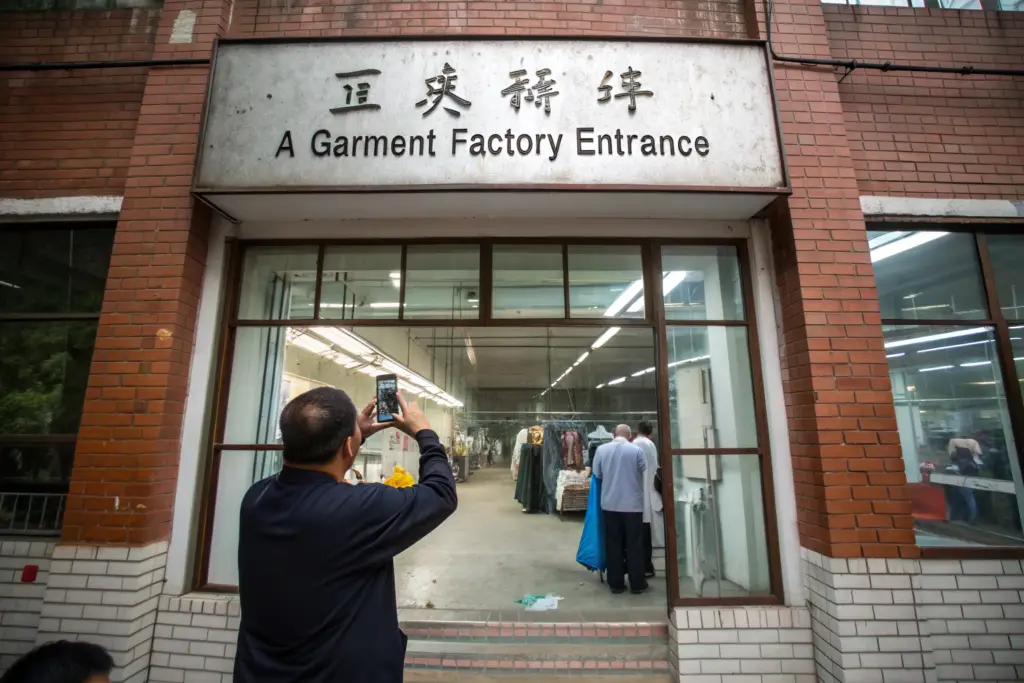
How Can You Tell a Real Factory From a Virtual Trading Company in China?
A trading company sold a Texas brand owner a batch of "premium" organic sweatshirts. The salesman had sent photos of a bright, modern factory floor. The samples were perfect. When the bulk order arrived, the fabric was thinner, the stitching was loose, and the organic certificate was a Photoshopped fraud.
The brand owner flew to the address listed on the certificate. It wasn't a factory. It was a tea shop. The digital photos he had received were stolen from a legitimate factory's WeChat moments. The trading company had just brokered the order to the cheapest back-alley workshop they could find and pocketed 40%. You cannot verify a factory by its PDF brochure or its pre-recorded video walkthrough. You need to sniff-test the physical reality.
Why Is the Business License Scope the Single Most Important Document?
Every registered Chinese company has a unified social credit code and a specific business scope approved by the local Administration for Market Regulation. A trading company cannot legally declare itself as a manufacturer on a US customs form. If they do, they are committing document fraud that CBP can trace. Before I sign any partnership, I personally send my Chinese team to pull the full business registration docket from the National Enterprise Credit Information Publicity System. We verify the scope, the registered capital, and the physical address. For my own apparel partners, I insist they look at this government public record, not the factory's glossy "About Us" page.
Can a Live Video Call Showing the Cutting Table Prove Real Ownership?
Yes. But you cannot just ask "show me the cutting table." You must ask for a specific, unscripted interaction. I tell my clients to ask: "Walk to the cutting table right now and flip over a piece of the marker paper. Read the lot number sticker aloud." A trading company agent standing in a borrowed factory might find a table, but they won't know the internal lot number system. A real production manager will instantly read "Batch #2406-BLK-002" and explain it. At Shanghai Fumao, we do this live-line walk for prospective partners. We show the raw material shelf with the genuine cotton roll tags, the cutting table with the physical pattern cards, and the sewing lines running your brand's actual customizable logo labels.
What Is the Exact True Price Breakdown of a Custom Garment From Raw Fiber?
A fashion buyer once said to me, "My budget is $7.00 per unit for this woven shirt. Can you make it?" I didn't say yes or no. I pulled out a blank sheet of paper and drew the physical materials. The shell fabric was 1.6 yards of 100% cotton poplin at $1.95 per yard: $3.12. The fusing for the collar and cuffs added $0.25. The buttons were genuine mother-of-pearl, 11 pieces at $0.08 each: $0.88. The sewing thread was polyester core-spun, $0.18. The brand label and hangtag were $0.40. Just the raw physical components cost $4.83, before a single electricity bill or human hand touched the fabric. A trading company would have just said "No" or, worse, said "Yes" and secretly swapped the mother-of-pearl for cheap plastic buttons, hiding the cost in degraded quality.
The exact true price breakdown of a custom garment starts with the Fabric Cost (yarn price + knitting/weaving cost + dyeing cost + finishing cost, multiplied by the consumption per unit including a 3-5% cutting waste factor), adds the Trims and Accessories direct purchase cost, adds the Cut-Make-Trim (CMT) labor cost calculated per minute of sewing time, and finally applies a transparent factory operating margin of between 8-18% depending on order complexity and volume.
How Does the Shipping Method for Raw Fabric Influence the Final Price?
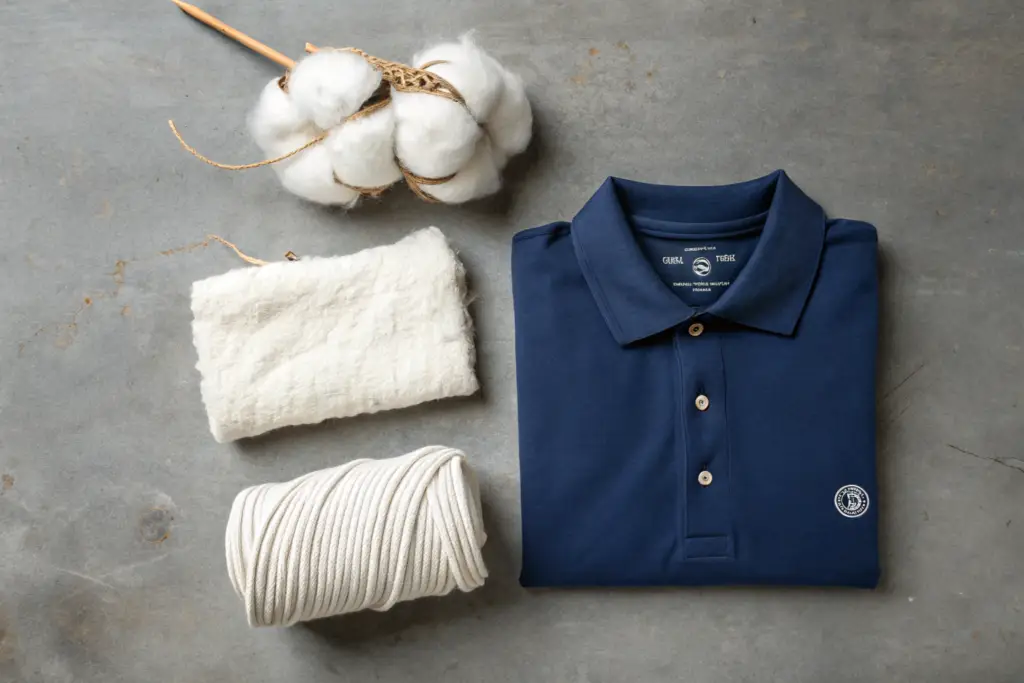
This is a hidden line-item many brands never consider. If you order a specific Italian-milled wool suiting, the raw fabric must be imported into China under a "processing trade" customs bond. The Chinese factory doesn't pay duty on it if the finished suit jacket exits China within a set time window. But the shipping cost of that fabric—often air-freighted in a small roll to meet development deadlines—lands on your cost sheet. A trading company will mark up this fabric freight by 20% as a hidden fee. At Shanghai Fumao, we show the actual DHL or FedEx invoice for the incoming fabric roll. We also advise on domestic alternatives: a Chinese worsted wool mill in Jiangsu can often reproduce a Italian Super 110s handle for 40% less raw material cost, with zero import logistics.
What Sewing Minutes Define the True Cost of Stitch Complexity?
A basic t-shirt has about 12 minutes of sewing time. A tailored five-pocket jean has 38 minutes. A fully lined, double-breasted overcoat has 95 minutes. The factory's internal cost is calculated on a "Cost per Minute" basis. My production line cost is $0.08 per sewing minute. The CMT cost for that t-shirt is $0.96. The overcoat is $7.60. A trading company won't show you this. They'll just say "The jacket is expensive because it's complicated." I show the actual time-study board. We explain: "The curved princess seams are adding 8 extra minutes. If we switch to a straight seam, we save $0.64, but lose the fit shape." That is an informed, collaborative clothes decision, not a blind price negotiation.
How Does Removing a Trading Agent from the Supply Chain Shorten the Critical Path?
A time-sensitive Los Angeles brand needed a restock of their bestselling dress for a Black Friday pop-up event. The trading company they used sat in the middle of the communication. The brand owner would email the agent on Monday. The agent would message the factory on WeChat on Tuesday. The factory would clarify a measurement question on Wednesday. The agent would forget to forward the answer until Thursday. The brand owner would reply on Friday. A single measurement query consumed a full working week. When they switched to us directly, our merchandiser received the question instantly on Slack, walked to the sample room, measured the garment on video, and replied with a timestamped photo within 45 minutes. Removing the agent didn't just cut the cost; it compressed the critical path timeline by 5 calendar days.
Removing a trading agent from the supply chain removes the latency of sequential message forwarding, eliminates the data corruption risk of technical specifications being paraphrased by a non-technical intermediary, and allows the brand owner's revision instruction to land directly in the patternmaker's work queue, turning what normally is a 72-hour feedback loop into a same-day response and single-cycle sample approval.
Why Does a Direct Line to the Patternmaker Save an Entire Fit Iteration?
A trading agent rarely has a pattern-making background. When you say "the armhole is binding," the agent writes "make the armhole looser." The patternmaker interprets this generic looseness as increasing the circumference. The real fix, as diagnosed by my senior patternmaker instantly on a video call, was lowering the armhole depth by 0.75cm while keeping the circumference the same because the client's axilla point was higher than our base block. The direct conversation between the brand owner looking in the mirror and the patternmaker holding the ruler solved it in 7 minutes. An agent would have translated it, lost the anatomical precision, and produced a second sample with the same binding problem plus a new, baggy bicep. This technical friction burns a sample budget.
How Does a Direct Factory Handle Urgent Revisions Without "Agent Disappearance"?
Trading agents operate during business office hours. Agents go on vacation. Agents switch jobs and take your production history with them. A factory is a physical place that continuously operates. Last December 23rd, a New York brand partner discovered a misprint on the inner neck label of a run destined for a Christmas Eve pop-up. Their previous agent's phone was off for the holidays. Because we operate a full direct production floor, our line supervisor stayed back, we opened a single sewing head, we cut 500 corrected labels from our in-house digital transfer machine, and we replaced them within 3 hours, loading the goods onto the truck the same night. A physical garment factory solves problems with hands and overtime pay, not with an automated out-of-office email.
Why Are Factory-Linked QC Labs More Rigorous Than Third-Party Inspectors?
A trading company once showed a brand proof of a "pre-shipment inspection" from a well-known international third-party firm. The report graded the shipment as "AQL 2.5, Passed." The brand released the balance payment. The goods arrived with inconsistent sleeve lengths, thread unraveling at the hem, and a chemical smell that made the warehouse staff dizzy. Why? The third-party inspector spent 90 minutes at the factory, checked 125 randomly pulled pieces from already-prepared "clean" cartons, and never walked the cutting room to see the actual cloth cutting in progress. The inspectors didn't catch the dye lot variance because the factory had already filtered the bad product into a locked room. A real, factory-embedded QC team doesn't just check the final box; they live inside the process.
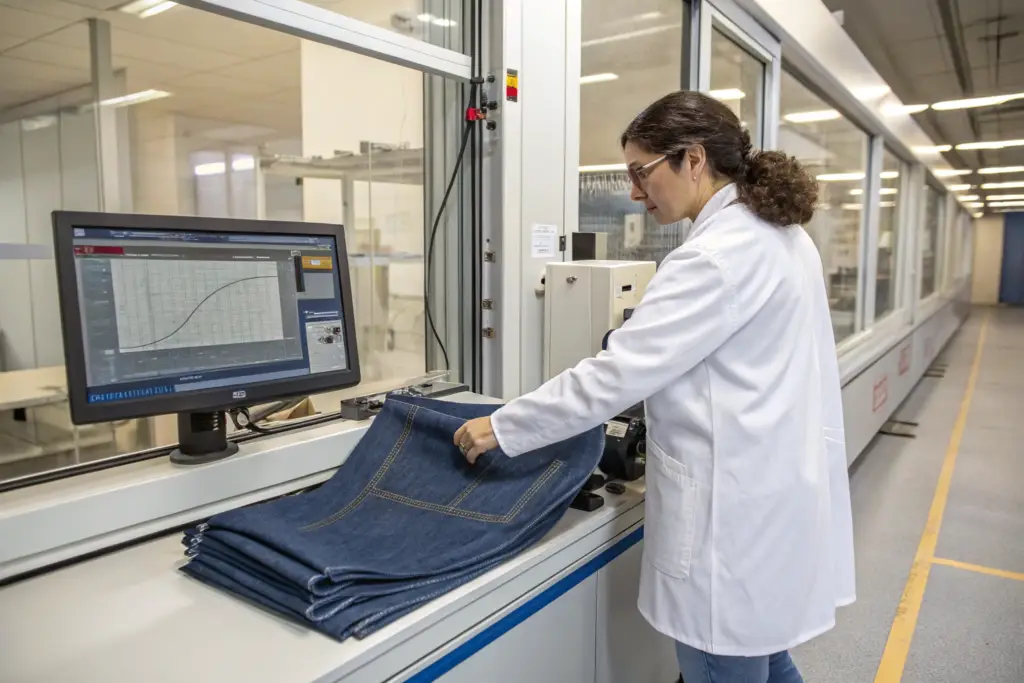
Factory-linked QC labs are more rigorous than third-party inspectors because they perform inline inspection at every production node—from incoming fabric relaxation to sewing to finishing—catching defects when they can still be corrected cheaply, whereas third-party inspectors only perform a final, statistically limited AQL audit on the packed goods when the fabric is already cut, sewn, and packed, making a container-level rejection an economically devastating scenario for both sides.
What Is an Inline Fabric Inspection and Why Does It Stop a Lot Dye Problem?
When raw fabric rolls arrive at Shanghai Fumao, we immediately put them on a backlit inspection table. We run 100% of high-risk fabric through this light panel. A third-party inspector only checks the finished shirt, often in a poorly lit room. I caught a shade banding issue on a roll of green poplin during our inline check. The dye lot had a subtle, rolling cloud variation. The third-party report later missed it because the cut pieces had been scattered across 800 units. But we had already flagged the roll, rejected the defective section, and only cut the clean, matching portion. The brand owner never knew there was a problem because our embedded QC caught it at the raw material stage, preserving the shipment.
Can an AQL 1.5 Certification Pass a Shipment That Customers Will Actually Hate?
AQL (Acceptable Quality Limit) is a statistical agreement on how many defects you accept, not what kind of defects you accept. An AQL 1.5 for "Major" defects means you accept that up to 15 units per 1000 might have a broken stitch line. But an embedded factory QC team defines the boundary of a "Major" defect more strictly. My internal standard defines a "twisted sleeve seam" as a Major defect even when the AQL manual calls it a "Minor" aesthetic issue. A generic inspector follows the manual's lowest bar of liability. The lab attached to a factory whose business depends on the brand buyer re-ordering next season defines the bar higher because our reputation is attached to the product, not just the report.
Conclusion
The price difference between a direct factory and a trading company is not a discount. It is the removal of a redundant economic layer that adds cost, distorts communication, and dilutes quality accountability. A trading agent does not sew, cut, weave, dye, or inspect. It reads emails and forwards them with a markup. I have seen too many American brand owners burn their capital funding a middleman's commission instead of investing that same money into better fabric, finer stitching, or faster shipping—the actual things that make a garment sell on the retail floor.
At Shanghai Fumao, I operate a pure, transparent factory model. Our five production lines, our in-house QC lab, our patternmakers, and our logistics desk are all under one roof, with no intermediary observing the process from a remote office. The cost sheet we provide traces the yarn, the labor, and the logistics to the penny. There is no "agent fee" hidden in the freight line because there is no agent.
If you suspect your current "manufacturer" might actually be a middleman, I invite you to run a quick forensic test on your next quote. Reach out to our Business Director, Elaine. She will walk you through a true factory cost breakdown for your specific garment. She speaks fluent English, manages the entire supply chain directly from our Shanghai headquarters, and can show you a live line tour within an hour's notice. You can reach her at: elaine@fumaoclothing.com. Let's cut out the middleman and invest that margin back into your product, where it belongs.