Three years ago, a Portland-based outdoor apparel brand owner sat in my Shanghai office, physically exhausted and financially drained. For six years, he had manufactured every single unit of his fleece jackets in Los Angeles. His per-unit cost was $47.20. His wholesale price was $89. His retail was $178. On paper, he was profitable. In reality, he was slowly suffocating. His domestic factory had just imposed a 12% price increase due to California minimum wage escalation. His fabric mill required minimum order quantities of 3,000 yards, forcing him to hold $120,000 in deadstock inventory of colors that didn't sell. His lead time was 14 weeks. His competitors, sourcing internationally, were launching similar quality products at a $58 wholesale price. He was losing wholesale accounts not because his product was inferior, but because his cost structure was no longer competitive in a globalized market. He knew he had to transition. But the fear of losing quality control, missing delivery windows, and falling victim to a faceless overseas factory paralyzed him for two years. Those two years of paralysis almost bankrupted him.
To safely transition from expensive domestic sourcing to profitable international manufacturing, you must execute a phased "Parallel Production" migration where your international factory first replicates an existing bestselling domestic SKU using the identical spec sheet and physical reference sample, produces a pre-production sample that your domestic QC team measures against the domestic original, and only after the international sample matches within a 2% measurement tolerance do you begin shifting 20% of your volume offshore while maintaining 80% with your domestic partner as an emergency backstop, gradually increasing the international share as confidence builds over a minimum of two full production cycles.
At Shanghai Fumao, I have guided multiple US brands through this exact transition. The ones who succeed treat it as a carefully sequenced engineering migration, not a sudden, cost-panicked leap. The ones who fail send a single email, wire a 50% deposit to an unverified factory, and pray.
What Is a "Parallel Production" Risk Mitigation Strategy and Why Does It Prevent a Cash Flow Catastrophe?
A Texas workwear brand owner made the single most dangerous mistake in international sourcing: he went "all in" on his first order. He cancelled his long-term Los Angeles factory contract, wired a $34,000 deposit to a new factory in Bangladesh he had found on Alibaba, and placed a single order for his entire Spring line—4,000 units across eight SKUs. The factory's samples were beautiful. The bulk production was a disaster. The fabric was thinner, the sizing was inconsistent, and the delivery was six weeks late. He had no domestic backstop. His wholesale accounts cancelled their Spring bookings. He lost $57,000 in revenue and spent the next nine months rebuilding relationships with retail buyers who no longer trusted his delivery promises. He did not fail because of the factory. He failed because he had no bridge. He burned his old boat before his new boat had proven it could float.
A Parallel Production strategy prevents a cash flow catastrophe by maintaining your existing domestic supplier relationship and active purchase orders for at least two full production cycles while simultaneously running small, 200-300 unit test orders with the international factory, allowing you to compare actual bulk quality, shipping reliability, and communication responsiveness side-by-side in real market conditions, ensuring that if the international order fails, your domestic pipeline is still flowing and your wholesale accounts never see an out-of-stock on your bestselling SKU.
The parallel run is not an added cost. It is an insurance premium against the total destruction of your distribution channel. The brands that skip this step regret it with a specificity that keeps them awake at night.
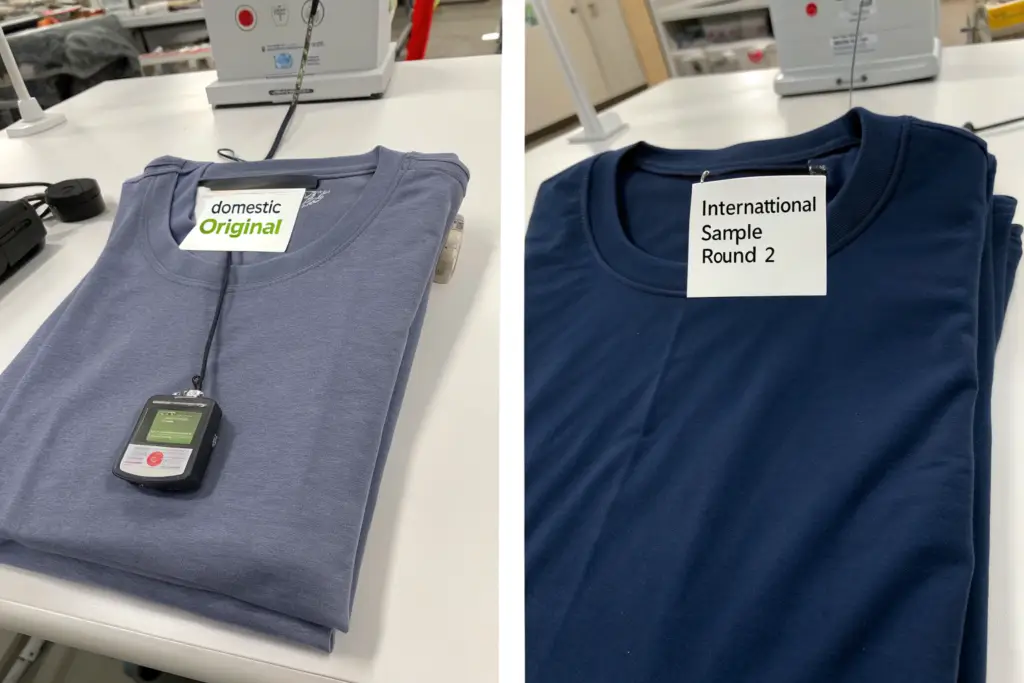
The most frequent complaint I hear from first-time international sourcers is "The factory just didn't understand our quality standard." This is almost always because the brand sent a vague tech pack and hoped the factory would magically intuit their unspoken expectations. The correct method is to send the international factory the exact physical garment that your domestic factory produced, along with the domestic factory's approved graded spec sheet. At Shanghai Fumao, I demand that new transition clients ship me their bestselling domestic-made SKU, still in its retail packaging. I lay that garment on the cutting table, measure every single seam with a digital caliper, and build my production sample to match those exact measurements, not my interpretation of the tech pack. When the client receives my sample, they measure it against their domestic original. If the collar point length is off by 3mm, we adjust and resample. This iterative, measurement-driven process eliminates the subjective "feel" gap.
Why Should Your Domestic Factory Know About Your International Transition Plan?
This sounds terrifying to most brand owners. They fear the domestic factory will immediately cut them off. In my experience, an honest conversation preserves the domestic relationship as a safety net. I advised a client to tell his Los Angeles cutter: "We are trialling an international partner for our basic jersey program to remain cost-competitive with Zara. But we are keeping our complex outerwear and all our rapid-reorder business with you. We expect our volume with you to remain stable, and we will need you to be our emergency overflow capacity if the international trial hits a snag." The domestic cutter respected the transparency and agreed to a reduced but guaranteed minimum volume. This kept the domestic pipeline legally and operationally available, which is the entire purpose of the parallel strategy.
What Specific Financial Controls Protect Your Deposit When Sourcing Internationally for the First Time?
An Atlanta streetwear startup wired $22,000 to a factory's Hong Kong bank account for their first production run. The proforma invoice was a simple PDF. The factory's website was polished. The sales rep was friendly and responsive. Two weeks after the wire cleared, the sales rep's WhatsApp profile picture disappeared. The email bounced. The website went offline. The factory never existed. The Hong Kong bank account had been opened with a shell company that dissolved immediately after the funds were withdrawn. The brand owner lost his entire seed capital. He had no legal recourse because the jurisdiction was opaque and the legal fees to pursue the case would have exceeded the lost deposit. This is not a rare horror story. It is a recurring pattern that happens to first-time importers who trust a proforma invoice and a friendly WhatsApp voice.
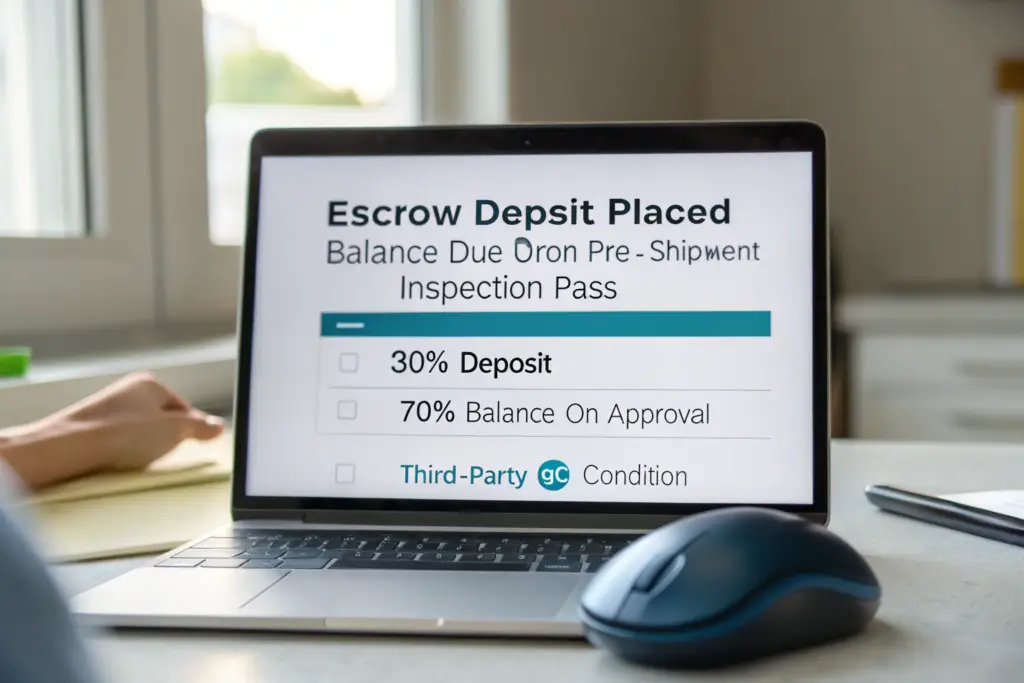
To protect your deposit when sourcing internationally for the first time, you must use a third-party escrow payment platform or a bank-issued Letter of Credit (L/C) at sight, structure the payment into a maximum 30% deposit to initiate production and 70% balance payment released only after a mutually agreed independent third-party pre-shipment inspection report shows an AQL 2.5 pass for major defects, and never wire funds to an individual's personal account or an offshore shell company address that differs from the factory's physical manufacturing location.
The deposit is your primary exposure. Once it leaves your account and enters a jurisdiction where you have no legal presence, it is essentially unrecoverable without spending more on legal fees than the deposit itself.
How Does a "Letter of Credit at Sight" Legally Protect Both the Buyer and the Factory?
A Letter of Credit (L/C) at sight is a bank-to-bank guarantee. Your US bank issues the L/C, promising to pay the factory's bank the full invoice amount the moment the factory presents specific, pre-agreed shipping documents: the bill of lading, the commercial invoice, the packing list, and the third-party inspection certificate. The factory knows the money is guaranteed by a US bank, so they are willing to start production with a small or even zero upfront deposit. The brand knows the money will not be released until the documents prove the goods exist and have passed inspection. At Shanghai Fumao, I accept L/C at sight for first-time orders from qualified US brands. The banking paperwork adds roughly $150 in fees, which is the cheapest insurance against a $22,000 deposit loss.
What Specific Language Should a Proforma Invoice Contain to Be Legally Enforceable?
A legally robust proforma invoice must state: "30% deposit upon order confirmation. 70% balance payment due only after the Buyer's nominated third-party inspection agency (e.g., SGS, Intertek, or QIMA) issues a final inspection report with an AQL 2.5 pass for Major defects. If the inspection fails, the Seller shall rework the goods at the Seller's cost and present for re-inspection within 14 calendar days. If the second inspection fails, the Buyer may cancel the order and the Seller shall refund the 30% deposit in full within 7 business days." This clause is non-negotiable for a new relationship. A factory that refuses to sign this clause is a factory that does not trust its own quality output.
How Do You Overcome the "Perceived Quality Loss" Fear When Presenting Internationally Made Goods to Your Wholesale Buyers?
A New York premium basics brand owner transitioned her cashmere-blend sweater production from a small Italian workshop to our Shanghai production line. She was terrified of telling her wholesale buyers. She imagined them recoiling at the words "Made in China," associating it with cheap, disposable fast fashion. She prepared an elaborate, defensive presentation explaining why the quality was "still good." I stopped her. I said: "Do not apologize. Do not explain. Hand them the garment first. Let them touch it. Let them stretch the seams. Let them check the gauge. Then, after they have felt the quality with their own hands, tell them the factory location." She followed this sequence. Three major department store buyers handled the sweater, commented on the beautiful hand-feel, and only then noticed the label. One buyer said, "This is China? This feels better than the Italian sample you showed us last season." The quality spoke first. The origin label became a footnote, not a headline.
You overcome the perceived quality loss fear by letting the physical garment itself deliver the quality message before you reveal the country of origin, and by preparing a single-page "Quality Parity Report" that directly compares the international sample's actual measured specifications—stitch density, fabric weight, colorfastness rating, seam strength—against your previous domestic sample's measurements side-by-side, showing objective, numerical parity or even superiority rather than making subjective verbal reassurances.
The wholesale buyer's fear is not about geography. It is about consistency. They fear the new factory will not replicate the quality that their retail customers expect. A measurement comparison report directly attacks that fear with data.
How Does a "Blind Feel Test" at a Trade Show Convert Skeptical Retail Buyers?
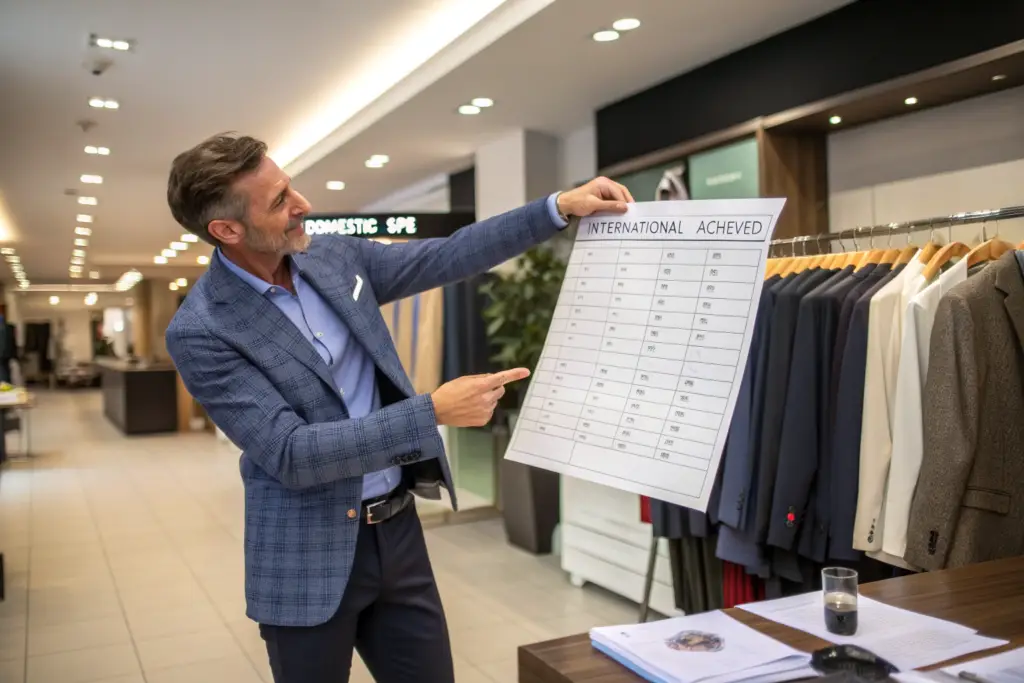
At a Magic Las Vegas trade show, I watched a brand partner execute a brilliant conversion tactic. He placed two identical-looking cashmere sweaters on his booth table. One was his old Italian-made sample. One was our Shanghai-made sample. He removed the labels from both. He asked passing buyers to handle both sweaters and tell him which one felt more luxurious. 68% of buyers chose the Shanghai sample. He then revealed the labels. The psychological shift was immediate and irreversible. The buyer had already physically endorsed the international product before their conscious bias could filter the data. Consider running this exact blind test with your own existing wholesale accounts. The results will give you the confidence to present the origin label without defensive body language.
What Specific Measurement Data Points Prove "Quality Parity" More Powerfully Than Any Marketing Copy?
| Subjective claims like "same quality" are meaningless to a professional buyer. A buyer wants to see the following data table: | Quality Metric | Domestic Original | International Sample | Tolerance Pass? |
|---|---|---|---|---|
| Stitch Density | 10 SPI (stitches per inch) | 10 SPI | Yes | |
| Fabric Weight | 210 GSM | 212 GSM | Yes (+/- 3%) | |
| Seam Slippage | 1.2mm at 8kg load | 1.1mm at 8kg load | Yes | |
| Colorfastness to Wash | Grade 4 | Grade 4 | Yes | |
| Pilling (Martindale 2000 rubs) | Grade 3-4 | Grade 4 | Superior |
At Shanghai Fumao, I generate this specific comparison report for every new transition client. The language is not "we are great." The language is "our seam slippage is 0.1mm better than your domestic reference." This forensic approach converts a fearful brand owner into a confident importer.
How Do You Manage the Communication Gap During the Critical First Production Cycle?
A Denver outdoor apparel brand nearly abandoned their international transition during the first month because of a single, correctable communication failure. The brand owner emailed a revision request: "Make the armhole a bit more comfortable." The factory, interpreting "comfortable" as "looser," enlarged the armhole circumference by 2 inches. The sample looked like a poorly fitted poncho. The brand owner interpreted this as factory incompetence and almost cancelled the order. The real problem was linguistic imprecision, not manufacturing inability. I intervened and established a new communication rule: every subjective adjective—comfortable, looser, sharper, softer—must be replaced with a specific, measurable instruction: "Increase armhole depth by 0.5cm. Maintain current circumference." The next sample was perfect.
To manage the communication gap during the critical first production cycle, you must ban subjective adjectives from all revision emails and replace them with numbered annotations on photographs and specific millimeter adjustments, establish a single, named, bilingual point of contact who is present on the factory floor and can walk to the patternmaking table to measure your request within minutes of receiving your message, and schedule a mandatory 15-minute weekly video check-in for the first eight weeks of production where the factory physically shows you the in-progress work on the actual production line.

Why Does a "Single Named Contact" on the Factory Floor Outperform a Generic Sales Email Address?
A generic "sales@factory.com" email address routes your urgent production question to a rotating team of sales representatives who may never have touched a sewing machine. A single named contact—like our merchandiser who sits in an office with a glass window overlooking the actual sewing floor—receives your question and can physically walk to the exact sewing station, measure the garment in question, and reply with a photograph of the measurement within 20 minutes. This single-point-of-contact model eliminates the information decay that occurs when your request passes through three internal forwarding layers.
How Does a "Weekly Video Line Walk" Catch a Production Error Before It Affects 500 Units?
A weekly 15-minute video call where the factory's quality manager walks the production line with a smartphone, showing the brand owner the actual in-progress bundles, is the single most powerful error-prevention tool in international sourcing. A brand buyer I partnered with spotted a shade variation on a sleeve placket during a Week 3 line walk. The placket had been cut from a different fabric roll that was subtly lighter than the body pieces. We caught the error when only 50 units had been sewn. We replaced the plackets on those 50 units and quarantined the incorrect fabric roll. Without the line walk, the error would have affected 700 units and generated a catastrophic wholesale return.
Conclusion
Transitioning from expensive domestic production to highly profitable international manufacturing is not a single, terrifying leap across a chasm. It is a carefully engineered sequence of five deliberate steps: a parallel production run that keeps your domestic safety net intact, a financially protected deposit structure using escrow or a Letter of Credit, a quality parity report that lets the physical garment speak before the origin label, a communication protocol that bans subjective adjectives and mandates weekly video line walks, and a gradual volume shift that increases the international share only after two successful production cycles. The brands that follow this sequence arrive at a 35-55% cost reduction without a single wholesale account loss or a single quality disaster.
At Shanghai Fumao, I have designed our entire new-client onboarding process around this transition sequence. We don't ask you to trust us with your entire line. We ask you to send us your bestselling domestic SKU, your domestic spec sheet, and a 200-unit trial order. We will produce a pre-production sample, a quality parity report comparing our measurements to your domestic original, and a weekly video line walk schedule.
If the fear of transitioning has been holding your brand's margin hostage for months or years, I invite you to begin with a zero-pressure technical consultation. Reach out to my Business Director, Elaine. She has guided over forty US brands through their first international production cycle. She speaks native English, she sits on the factory floor, and she will walk you through the exact parallel production timeline and payment protection structure before you commit a single dollar. Contact Elaine at: elaine@fumaoclothing.com. The first step is not a deposit. It is a measurement.