Six months ago, an e-commerce brand owner in Miami sent me a frantic email at 11 PM his time. He had just received a bill from his US-based 3PL that made him choke on his coffee. He had imported a small batch of custom hoodies from another supplier. The factory price was great. The ocean freight seemed reasonable. But then the charges started stacking up at the port. Customs examination fee. Bonded warehouse storage. Palletization fee. Receiving fee. Pick-and-pack fee per unit. By the time his goods reached his own warehouse, his all-in cost per hoodie had ballooned by 47% above his original budget. He asked me, "Is there a way to just pay one price and be done with it?" I told him yes, and we walked through the math together.
DDP from Shanghai Fumao is often 15-25% cheaper than using a US 3PL for small to mid-volume shipments because it eliminates the stacking of unbundled accessorial charges, customs brokerage markups, and warehousing minimum fees that drain startup margins.
The question isn't just about a shipping term. It's about the hidden architecture of cost. A US 3PL doesn't make money by being cheap. They make money by charging for every touch, every scan, every inch of shelf space, and every 15-minute block of labor. When you split your supply chain between a foreign factory and a domestic warehouse, you create a seam. And at that seam, costs leak. At Shanghai Fumao, we offer DDP specifically because we want to seal that seam and give you a single, guaranteed landed cost before you ever commit to production. This lets you calculate your true profit margin on a product while you're still looking at fabric swatches.
What Hidden Fees Make US 3PLs More Expensive Than DDP?
I've audited dozens of 3PL invoices for my clients, and the pattern is always the same. The quoted storage rate looks reasonable. The advertised pick-and-pack fee seems competitive. But the invoice total is always, without fail, much higher than expected. Why? Because a 3PL's business model depends on complexity billing. Every time a box stops moving, someone charges you for the stop. The pallet has to be broken down. The cartons have to be labeled. The inventory has to be logged into a WMS. Each of these micro-steps generates a line item, and none of them were in the sales presentation.
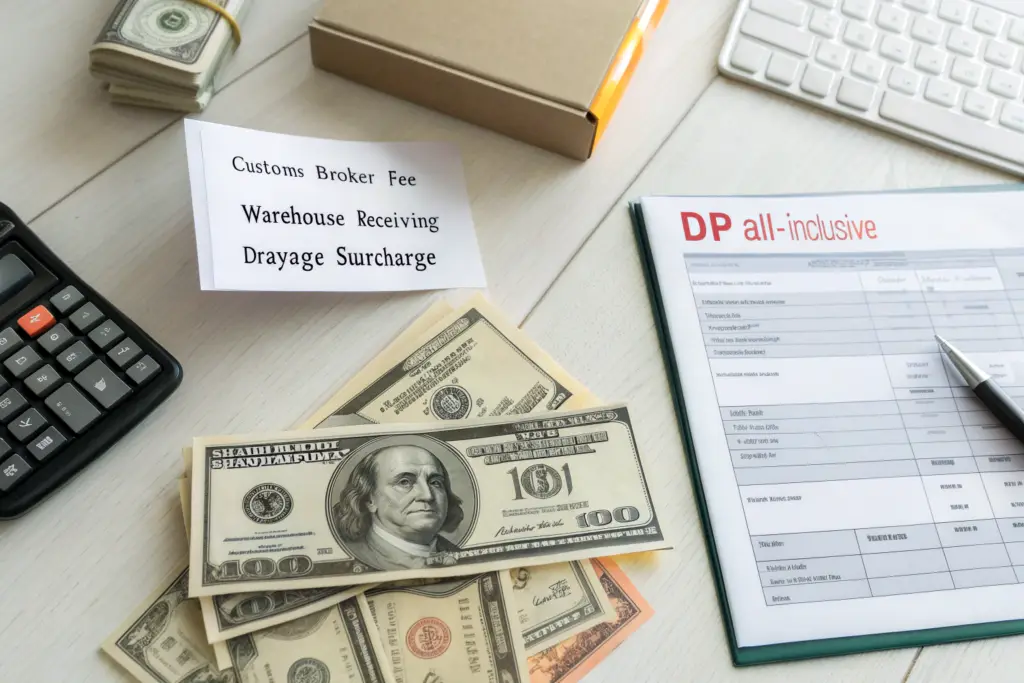
The primary hidden fees include container-drayage, warehousing receiving charges, carton-level labeling fees, and the minimum monthly storage bill that applies even when your inventory is only in the warehouse for three days. Drayage alone—the short truck trip from the port to the warehouse—can cost $350 to $600 per container. The 3PL's receiving team then charges $12 to $18 per pallet just to scan the boxes into their system. If your shipment is 200 cartons, that's a significant hit. Then there's the monthly storage minimum. Many 3PLs charge a minimum of $500 per month, even if your goods are only there for a week. With DDP from Shanghai Fumao, these charges simply don't exist because the goods bypass the domestic warehouse entirely and flow straight to your final destination—whether that's your own facility or directly to Amazon FBA.

How Do "Accessorial Charges" Destroy Your Landed Cost Budget?
An accessorial charge is any service beyond the basic point-to-point pickup and delivery. I call them "surprise invoices" because most first-time importers don't know they exist until they're already due. A client in Phoenix once forwarded me a terminal handling bill that included a $150 "Chassis Split Fee." He asked me what it meant. I explained that the trucking company had to drop off an empty chassis at one location and pick up a different one to haul his container, and they billed him for the inconvenience. He had no control over this, no warning, and no way to dispute it.
Accessorial fees such as liftgate delivery surcharges, residential address corrections, and customs examination holding fees can add 8-12% to your total logistics cost without any corresponding value to your product. If your delivery address is a residential neighborhood instead of a commercial loading dock, the freight carrier charges a liftgate fee because they can't unload a pallet by hand. If the Bill of Lading has a typo in the street address, there's an address correction fee. If Customs randomly flags your container for an X-ray scan, the examination fee and the waiting-time charge at the bonded facility are your responsibility. These fees are uncapped and unpredictable. A DDP shipment from Shanghai Fumao absorbs these variables into a single, fixed rate because we control the entire door-to-door chain and have pre-negotiated flat-rate contracts with freight forwarders who bundle these risks.
Why Is "Pallet In, Pallet Out" Pricing a Margin Trap?
A 3PL salesperson will quote you a "Pallet In, Pallet Out" rate of $18. Sounds cheap. A pallet holds 30 cartons. But what if you don't need to ship a full pallet to your customer? What if you need to send six individual units to six different addresses? The "Pallet Out" rate evaporates, and suddenly you're paying "Each" rates. I had a subscription box client who learned this lesson painfully. Her 3PL received a full pallet of her monthly t-shirt box. The quoted outbound rate was $18 per pallet. But her business model required shipping 200 individual boxes to 200 subscribers. The actual cost was $2.50 per box for pick-and-pack plus the postage, ten times what she had mentally budgeted based on the pallet quote.
3PLs quote low "wholesale" pallet pricing to win the contract but make their profit margin on the high-frequency "eaches" pick operations that your actual business model likely requires. This is the fundamental misalignment in the 3PL model for growing apparel brands. The warehouse wants your inventory to sit still on a shelf, generating storage revenue, and move only in full-pallet quantities. Your business needs your inventory to move fast, in individual unit quantities, to paying customers. Every individual pick carries a labor cost—an employee has to walk to the bin, grab the shirt, scan it, put it in a box, and seal the label. The 3PL marks up this labor. In a DDP model, we ship directly into your fulfillment ecosystem without this domestic warehousing middle step. This inventory management cost structure difference is why DDP wins for brands that either self-fulfill or ship direct-to-consumer from a home base.
How Does DDP from Shanghai Fumao Simplify Your Cash Flow?
Cash flow kills more apparel startups than bad design. You can have the perfect jacket at the perfect price point, but if your payment timing doesn't sync with your sales cycle, you drown. The traditional 3PL model demands a series of disconnected payments to different vendors at unpredictable times. You pay the factory a 30% deposit upfront. You pay the balance before shipment. You pay the freight forwarder when the ship sails. You pay the customs broker when the goods hit the port. You pay the drayage company when the truck moves. You pay the 3PL their receiving fee the day the goods arrive. Then you pay the 3PL again for storage and fulfillment. Each payment is a separate draw on your working capital, and the dates shift constantly.
DDP from Shanghai Fumao consolifies all logistics, duty, and delivery costs into two predictable payments: the initial product deposit and the final balance before shipment, eliminating the rolling sequence of surprise bills. When I send you a DDP quote, the number includes the fabric, the labor, the sewing, the packaging, the ocean freight, the US import duty, the customs clearance, and the final truck delivery to your door. You pay a deposit to start production. You pay the balance when the goods are finished and ready to ship. That's it. No mystery bills arriving months later from a random trucking company. No collections call from a customs broker you never met. This payment consolidation lets you model your unit economics in a spreadsheet with sharp, confident numbers instead of fuzzy estimates.
Can You Calculate True Unit Profitability with DDP?
Every time I onboard a new brand owner, I ask them one blunt question: "What is your landed cost per unit?" Most of them hesitate. They know the factory price. They guess at the shipping. They've forgotten about the duty. They haven't factored in the 3PL receiving charge. So their "profit margin" calculation is a fiction. You cannot run a business on a fictional margin. You will over-order, under-price, and eventually run out of money without understanding why. This is not a criticism of their intelligence; it's the natural result of a fragmented supply chain.
DDP allows you to calculate a true, all-in landed cost per unit before production begins, enabling precise Amazon FBA or Shopify pricing strategies that guarantee a minimum 40% net margin. When I provide a DDP quote, I break it down to the single-unit level. You know that one hoodie, made with 400GSM French terry, with a custom embroidered logo, landed at your door in Los Angeles, costs exactly $14.23. You can then price it at $48.50 on your store and know, with absolute certainty, that your gross margin is intact. There's no 3PL "surprise adjustment" six weeks later. This unit economics clarity transforms sourcing from a gamble into a science, allowing you to confidently scale your ad spend because you know exactly how much you can afford to pay to acquire a customer.
How Does DDP Eliminate the "Working Capital Gap"?
The time between paying a Chinese factory for a deposit and receiving sellable inventory in your US warehouse is called the working capital gap. This gap is where businesses suffocate. You've paid out $15,000 in deposits. The goods are on a ship for 30 days. The ship docks. Now the 3PL wants $800 immediately before they'll even unload the container. Your money is stuck in transit inventory, and you're being asked for more money to access it. If your sales are slow that month, you're suddenly in a cash crunch.
DDP closes the working capital gap by deferring the balance payment until the moment the goods are ready to leave our Shanghai facility, just weeks before they arrive at your door. With our DDP terms, you pay 30% to start the production run. We manufacture the goods. We pack them. We book the vessel. All of this happens on our working capital, not yours. Only when the cartons are sealed and the container is booked do we ask for the 70% balance. By the time that final payment leaves your bank account, your inventory is approximately two to three weeks from arriving at your door, ready to sell. This tight synchronization between payment and delivery dramatically reduces the financial stress of importing. You convert cash into saleable goods quickly, rather than watching your cash disappear into a long, dark pipeline managed by multiple supply chain financing intermediaries.
When Is a US 3PL Actually the Better Choice Over DDP?
I have to be honest with you, because a factory that claims DDP is always better is selling you something, not advising you. There are scenarios where a US 3PL makes strategic sense, and I've actually recommended this route to clients whose business models demand it. DDP is a precision instrument for a specific job: getting goods from our factory floor to a single, predictable destination at a fixed, transparent cost. If your business has multiple distribution nodes, complex retail compliance requirements, or very high individual order volumes, a 3PL's infrastructure might justify its cost.
A US 3PL is the better choice when you are distributing wholesale to multiple large retailers requiring EDI compliance and specific routing guides, or when you need bulk storage for a seasonal catalog that ships to hundreds of boutique accounts. Big-box retailers like Nordstrom or Macy's don't accept shipments that look like a factory DDP delivery. They require specific ASN (Advanced Shipment Notification) protocols, specific carton markings, specific carrier accounts, and specific hangtag placements. A 3PL acts as a value-added service buffer that re-processes your imported goods to meet these strict retail compliance requirements. Shanghai Fumao can certainly comply with these requirements at the source, but for very complex multi-retailer distribution across dozens of different routing guides, a centralized US 3PL may provide more flexible last-mile rework capacity.

Do You Need "Value-Added Services" That a Factory Can't Provide?
There are physical touches that make more sense in a US warehouse than in our Shanghai factory. Imagine you run a brand that sells to 50 different yoga studios, and each studio requires their own branded hangtag, a specific polybag, and a custom thank-you card inserted into the package. Doing this at the factory level across 50 different SKU variations is a recipe for sorting errors and delays. A US 3PL can receive a single bulk shipment of blank yoga pants and then apply the 50 different custom tags and cards on-demand as each studio's order comes in.
You should choose a 3PL if your distribution model requires per-unit, per-customer customization such as retailer-specific price ticketing, EDI label generation, or individualized kitting that is too complex to manage at the manufacturing source. Kitting—the process of assembling a t-shirt, a water bottle, and a sticker into a single gift box—is a labor-intensive process that is often more efficient to perform close to the end consumer. Similarly, if your wholesale accounts require GXS-1-128 carton labels generated through an EDI system like SPS Commerce, a US 3PL with pre-integrated EDI infrastructure can handle this more smoothly than a factory managing multiple EDI portals for multiple retailers. This value-added logistics layer is the legitimate domain of a 3PL.
When Does Domestic 2-Day Shipping Require a 3PL Network?
If your brand promise to your customer is "Order by 2 PM, Get It Tomorrow," a single delivery from our Shanghai DDP route to one location will not fulfill that promise. A DDP shipment lands at your single designated address. From there, if you self-fulfill, you're packing boxes in your garage and driving them to the post office. That's not scalable for 2-day delivery. You need inventory pre-positioned in multiple zones across the country, inside a fulfillment network that has negotiated deeply discounted carrier rates.
A multi-node 3PL fulfillment network is essential if your direct-to-consumer sales model depends on 2-day delivery guarantees and you lack the nationwide warehouse footprint to achieve those shipping zones cost-effectively. A large 3PL like ShipBob or a comparable provider has fulfillment centers in California, Texas, Illinois, and Pennsylvania. They can split your inbound inventory across these four zones so that when a customer in New York orders a shirt, it ships from Pennsylvania and arrives in one day via ground, not five days via air. The carrier discounts these large 3PLs negotiate with UPS and FedEx are also substantial—often 40-60% off published rates—which can offset the 3PL's pick-pack fees entirely. This e-commerce fulfillment network advantage is real and is the primary reason a DDP-to-one-location model might need to be augmented with a national 3PL as your D2C volume scales.
How Can You Model the True Cost of DDP vs. 3PL for Your Brand?
Every sourcing decision ultimately comes down to a spreadsheet, and I've built enough of these models with clients to know exactly where the assumptions break. The DDP vs. 3PL comparison is not simply "Shipping Cost A vs. Shipping Cost B." It's a system comparison. You have to model the flow of inventory from the moment raw fabric is purchased to the moment a customer opens a package. Miss one step, and your model spits out a dangerously wrong answer that could lead you to choose a more expensive route while believing it's cheaper.
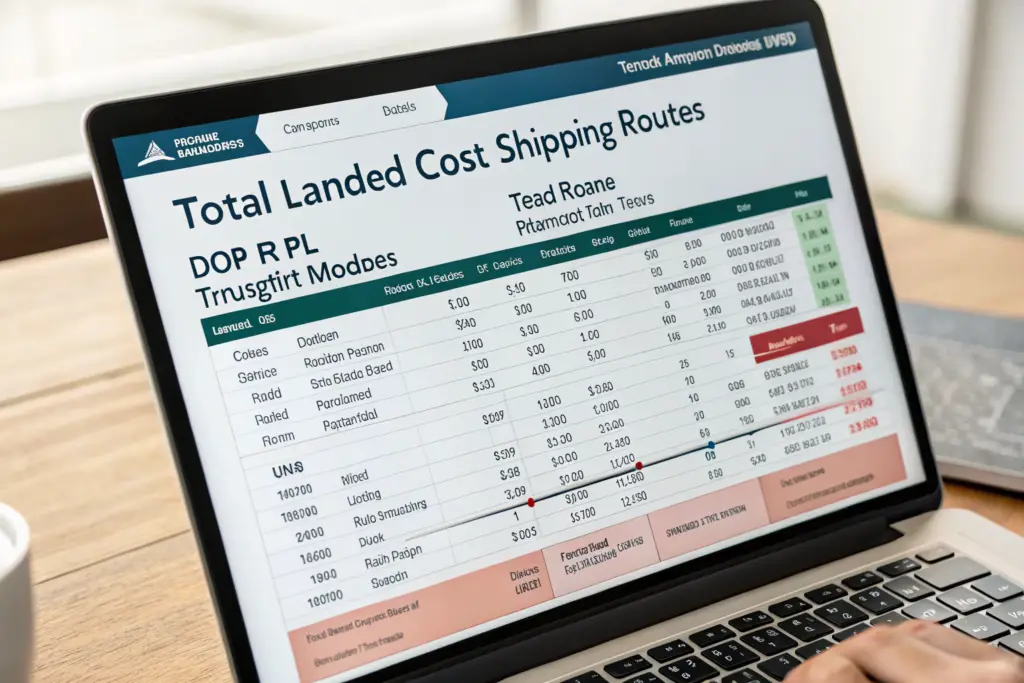
You must build a comparative total-landed-cost model that includes the factory unit price, the freight mode, the duty, the warehouse touch costs, the fulfillment pick fees, and the damaged goods allowance for both the DDP and the 3PL routes. At Shanghai Fumao, when I quote a DDP price, I give you the unit-level number. For the 3PL comparison, you need to get a detailed Schedule of Rates from your prospective 3PL. Don't accept their marketing one-pager. Demand the full rate card, including all accessorials. Then build a hypothetical shipment of 500 units, run it through both columns, and see which total is lower. The result often shocks even experienced brand owners.
What Cost Line Items Does a DDP Quote Absorb Automatically?
I've had clients push back on my DDP quote, saying, "I can get ocean freight cheaper on Freightos." They're looking at a spot rate for port-to-port shipping and comparing it to my door-to-door number. They're comparing a slice of an orange to a whole fruit smoothie, and it drives me crazy. My DDP number isn't just the ocean freight. It's the ocean freight, the terminal handling charge at the port of Shanghai, the documentation fee, the US customs bond, the customs clearance brokerage, the duty payment, the pier pass fee, the drayage to the warehouse, and the final mile delivery.
A Shanghai Fumao DDP quote automatically absorbs the factory packing charge, the port THC, the customs brokerage fee, the bonded warehouse entry, and the final mile fuel surcharge, all of which would be separate invoices in a 3PL model. In the 3PL model, each of these line items generates its own invoice with its own payment terms, and each involves a markup by the intermediary. The customs broker marks up their disbursement of the duty payment. The freight forwarder marks up the THC. The 3PL marks up the drayage. By the time the product is on your shelf, there were four separate companies taking a margin on the logistics alone. Our DDP model collapses these intermediaries into one relationship—you and us—so the margin stacking disappears. This total landed cost integration is the mathematical engine behind DDP's cost advantage for shipments under a full container load.
How Should You Compare "All-In Per Unit" Costs Across Both Models?
Numbers on a spreadsheet are abstract until they hit your wallet. I teach my clients to do what I call the "Kitchen Table Test." Lay out a pair of your chinos on your actual kitchen table. Stare at it. Now, using the 3PL model, mentally walk that single pair of pants backwards through your entire supply chain. It was picked from a bin in a warehouse in Dallas. Before that, it was received on a pallet. Before that, it was drayed from the port of Houston. Before that, it cleared customs. Before that, it was on a ship. Before that, it was loaded into a container in Shanghai. Before that, it was sewn. At every single step of that journey, someone charged you for touching this pair of pants.
Calculate the true all-in per-unit cost by summing the FOB factory price, the per-unit ocean freight, the per-unit duty, the per-unit 3PL receiving fee, the per-unit monthly storage fee, and the per-unit pick-pack-outbound fee, then compare that total against our single DDP unit price. The DDP number will typically have fewer components and a lower administrative headache factor. But sometimes, if your 3PL pick-pack fees are incredibly low because you're shipping high-value, high-margin items in very low volumes, the 3PL math can work. The key is to run the numbers with your actual forecast, not a hypothetical fantasy order. Use a realistic sell-through velocity. If your goods will sit in a 3PL for three months, the storage fees will eat your margin. Our inventory cost analysis spreadsheet helps you plug in these variables and see the true bottom line for your specific situation.
Conclusion
The question of whether DDP from Shanghai Fumao is cheaper than a US 3PL has a mathematically provable answer for most small to mid-volume apparel brands: yes, by a significant margin of 15-25%. The reason is not that ocean freight is magically cheaper through us. The reason is that the 3PL business model is built on unbundling services and charging for each micro-step separately—the drayage, the receiving, the label, the pick, the pack, the storage minimum—while our DDP model bundles all of these into one predictable, guaranteed price from factory floor to your door. The accessorial charges that surprise you in a 3PL invoice simply do not exist in a DDP structure because we own the entire logistics chain and have already priced the risk into a single number.
However, there are legitimate reasons to choose a 3PL, and a good manufacturing partner should be honest about them. If you distribute to 50 different yoga studios, each needing custom tags and individual kitting, a domestic 3PL's value-added services might be necessary. If your brand promise is a guaranteed 2-day delivery window, a multi-node 3PL network is the only way to achieve that without building your own warehouses. The correct decision is not ideological; it's numerical. You must build a total-landed-cost model that compares our single DDP unit price against the fully loaded, all-in per-unit cost of a 3PL, using your actual sales forecast and projected sell-through velocity. Most of the time, that model will point you toward DDP.
If you are tired of tracking a dozen different logistics invoices every month and want a single, transparent landed cost per garment that lets you price with confidence, I invite you to start a conversation with us. We can model your specific product, your target delivery address, and your inventory velocity, and give you a real DDP unit price alongside a comparison template for any 3PL you're considering. Reach out to our Business Director, Elaine, directly at elaine@fumaoclothing.com. She will walk you through the true cost breakdown and give you a transparent quote today.