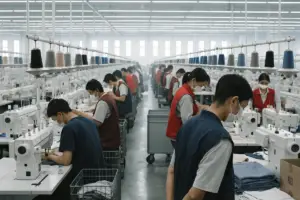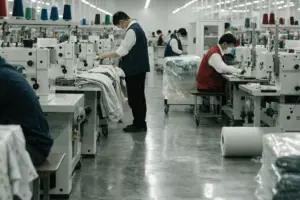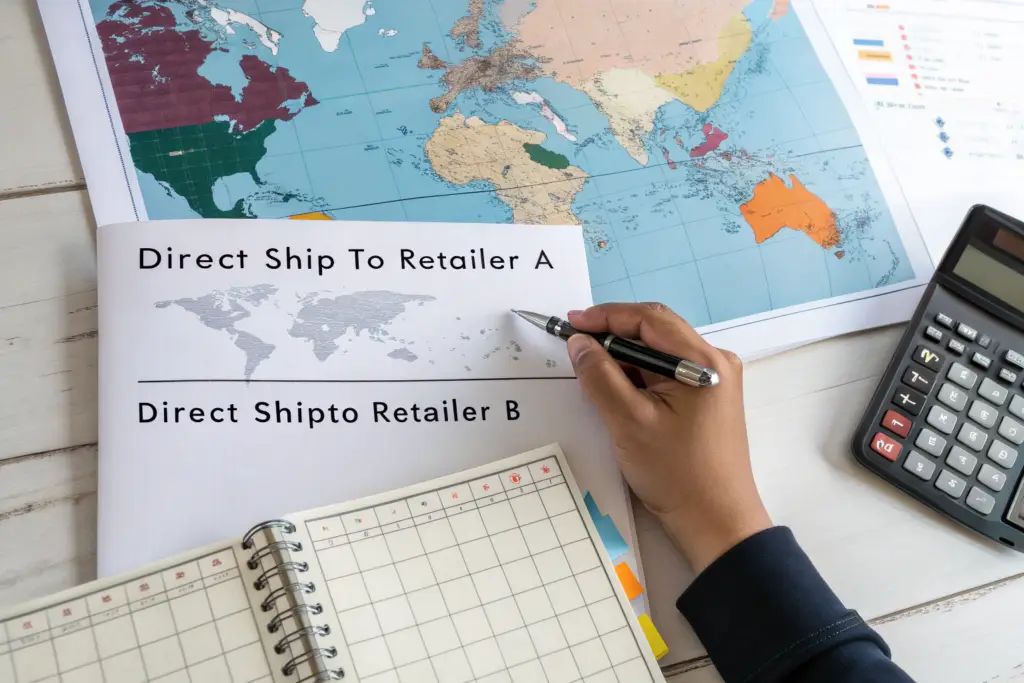
You just landed the order. The big one. 15,000 units. One of the largest retailers in your niche. You celebrate. Then you read the fine print in the Vendor Compliance Guide. "Shipments must be split. 3,000 units to Chicago Distribution Center. 4,000 to Dallas. 5,000 to Los Angeles. 3,000 to Atlanta. All must arrive within the same 3-day delivery window. Late fees: 5% of invoice." Your celebration stops. You realize you have no idea how to execute this. You email your factory: "Can you split the shipment?" They reply: "Yes, extra cost." You have just walked into a logistics negotiation blind. If you do not understand the cost drivers of split shipping, you will either lose your margin on freight or you will miss the delivery window and lose the retailer.
Negotiating split shipping for massive wholesale orders requires understanding the difference between “Factory Split” and “Port Split.” The factory can only do one of these cost-effectively. The four critical negotiation points are: (1) Factory-Level Carton Splitting vs. Container-Level Splitting. True factory splitting means the factory packs separate cartons for each destination on the sewing floor. This is labor-intensive and costs more. Container-level splitting means shipping full containers to a US 3PL warehouse and splitting them there. This is often cheaper for freight but adds handling time. (2) MOQ Per Destination. You must negotiate a minimum quantity per split location. A factory cannot efficiently pick and pack 50 units for one store. They need a threshold (e.g., 500 units per destination). (3) SKU-Level Packing Requirements. Retailers require specific ASN (Advanced Ship Notice) and UCC-128 label formats. The factory must be capable of generating these exact labels per carton per destination. If they cannot, the split must happen at a US prep center. (4) Cost Allocation. The negotiation must clarify who pays for the extra handling, the extra cartons, and the separate Bill of Lading documents.
At Shanghai Fumao, we handle split shipments for major retail partners monthly. We have learned exactly where the costs hide and how to keep them fair for everyone. Let me show you how to structure this deal.
What Is the Difference Between “Factory Floor Splitting” and “Destination Splitting”?
You ask the factory for a “split shipment.” They give you a price. You accept. Later, you find out they packed everything into one container going to Los Angeles. When it arrives, you have to pay a trucking company to haul it to a cross-dock facility, pay warehouse labor to break it down, and pay separate truckers to take it to the final destinations. Your “cheap” factory split just cost you $3,000 in US domestic fees. You need to know where the split happens. A “Factory Floor Split” means the cartons for each destination are labeled and segregated at the factory and loaded onto separate containers or separate house bills of lading. A “Destination Split” means the goods travel as one bulk shipment to a central hub and are divided there.
Factory Floor Splitting involves the factory organizing production so that goods destined for Location A are cut, sewn, and packed into cartons specifically marked for Location A. The cartons are then palletized by destination. This allows them to be loaded onto separate containers or, if LCL, tendered to the forwarder as separate shipments with distinct House Bills of Lading. This minimizes US domestic handling. Destination Splitting involves shipping everything in bulk (often a full container) to a single US entry point, usually a 3PL or a retailer’s consolidation center. The 3PL then unpacks the master cartons (if necessary) and re-distributes the goods. Factory Splitting saves US domestic costs but increases factory labor and material costs (more cartons used). Destination Splitting minimizes factory complexity but adds US warehousing and cross-dock fees. The optimal choice depends on the size of the splits and the retailer’s compliance requirements.
At Shanghai Fumao, we offer both models. We help the client run the cost analysis to see which path results in the lowest total landed cost per unit.
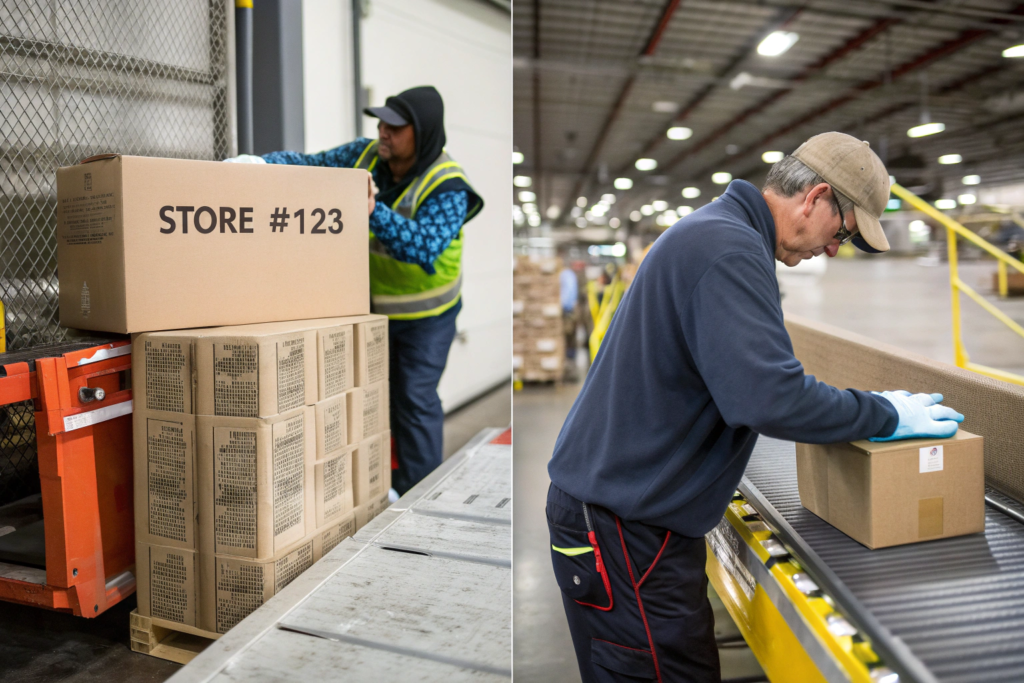
How Does “Carton Utilization” Change When You Split at the Factory?
This is the hidden cost that surprises most brands. When you ship a full container of one style to one place, you can pack the cartons tight. You can mix sizes to make the carton heavy and dense.
When you split at the factory, you must pack separate cartons for each destination. If Dallas only orders 50 units of Size Small, those 50 units need their own carton. That carton will be light and half-empty. You are paying freight on air inside that carton. You are paying for more cartons overall.
The cost of cartons goes up by 10-20% on a split shipment. The volumetric weight (the space the boxes take up) increases, sometimes bumping you into a higher freight rate.
I recall a client who insisted on factory splitting for a 5-way split. The total carton count went from 120 cartons (bulk) to 180 cartons (split). The ocean freight cost increased by $600. The factory charged an extra $250 for the handling labor. The client was upset about the extra costs until we explained the alternative: a $1,200 cross-dock fee in the US. The factory split was still the cheaper overall option. But you must be prepared for the higher factory invoice.
When Does Destination Splitting (Using a 3PL) Make More Sense?
If the splits are very small (e.g., 50 units to a boutique location) or if the retailer requires complex ticketing that the factory cannot do, a US 3PL is the answer.
The 3PL receives the bulk container. They have the automated systems to apply price tickets, security tags, and repack into individual store-ready cartons.
The cost is a per-carton handling fee plus storage. But it saves the retailer from having to do it at their own DC (which they charge back to you).
I worked with a brand that sold to a large department store chain. The store required Vendor Stock Replenishment (VSR) cartons—small, shelf-ready boxes of exactly 6 units. The factory was not set up to pack VSR cartons. We shipped bulk pallets to the brand’s 3PL in New Jersey. The 3PL did the final repack and labeling. The cost was $1.85 per carton. It was a necessary cost of doing business with that retailer. Trying to force the factory to do it would have resulted in errors and chargebacks.
| Feature | Factory Floor Split | Destination Split (3PL) |
|---|---|---|
| US Handling Cost | Low | High |
| Factory Labor Cost | High | Low |
| Carton Utilization | Low (More wasted space) | High (Bulk packing) |
| Complexity | High for factory | Low for factory |
| Best For | Large splits (>500 units per dest) | Small splits, complex ticketing |
How Do You Negotiate the “Handling Fee” for Split Picking and Packing?
The factory quotes you a “Split Shipment Fee.” It seems arbitrary. You do not know if it is fair. You need to understand what this fee actually pays for. It is not a penalty. It is the cost of extra labor. When a factory does a bulk order, the packer takes the garment, folds it, puts it in a poly bag, and puts it in the big carton. Repeat. When they do a split order, they must check the destination of each garment. They must ensure the Chicago carton does not get a Dallas piece. They must label the cartons with different addresses. This slows down the packing line. It requires a supervisor to check the segregation. This time is the fee.
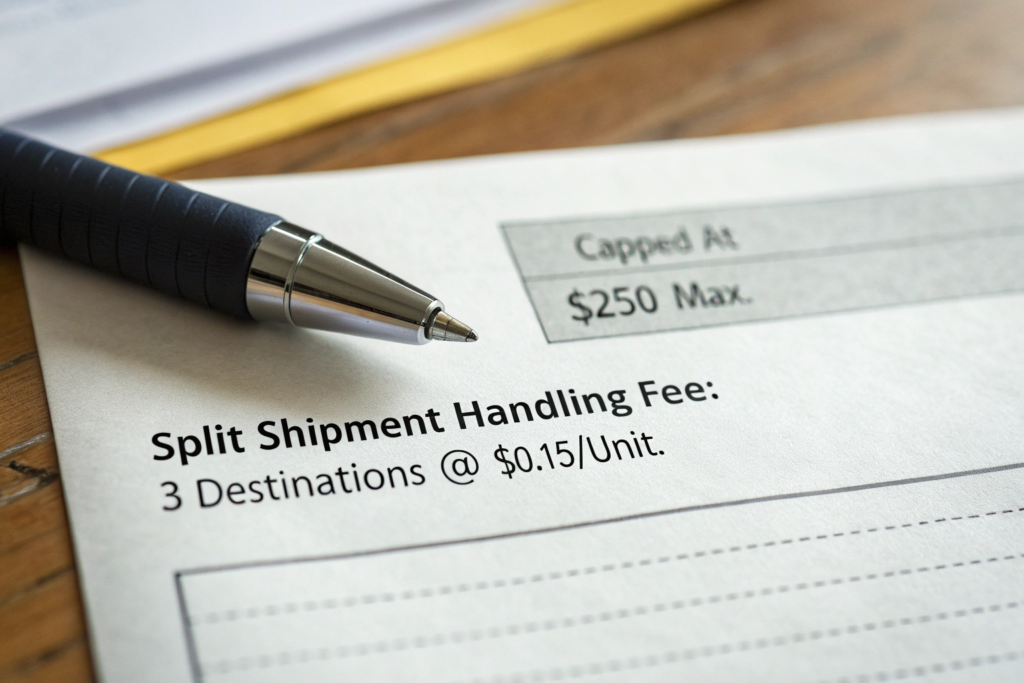
The handling fee for split picking and packing is negotiable when you understand the specific labor components. Break the fee down into three parts: (1) Line Segregation Labor. The cost of having workers sort by destination during final inspection and packing. This is typically quoted as a flat fee per destination (e.g., $50 per split location) or a per-unit surcharge (e.g., $0.05 – $0.15 per unit). (2) Carton Marking and Documentation. The cost of generating separate packing lists, commercial invoices, and carton labels for each destination. This is administrative time. (3) Pallet Building. The cost of building separate pallets for each destination instead of one mixed pallet. To negotiate this fee effectively, ask for a breakdown of the per-unit surcharge. Offer to provide “Pre-Packed by Destination” instruction in the PO format to reduce their data entry time. Cap the fee at a reasonable total for the project.
At Shanghai Fumao, we charge a transparent per-destination fee for splits. We explain that it covers the extra supervisor time to ensure the ASN labels match the physical cartons.
What Is a “Fair” Per-Unit Surcharge for Splitting?
This depends on the complexity. For a simple 2-way split (50/50), the surcharge should be minimal, maybe $0.05 per unit or a flat $75 admin fee.
For a complex 5-way split with varying percentages, $0.10 – $0.20 per unit is reasonable. The packers must constantly switch label rolls and verify addresses.
You can negotiate a cap. If the order is 10,000 units at $0.10/unit, that is $1,000. You might say, “Can we cap the split handling fee at $500 total?” This is a fair compromise. The factory covers their labor, and you protect your margin.
I always advise clients to ask: “Is there a setup fee per destination, or just the per-unit fee?” Sometimes the factory charges a $100 “Setup Fee” per destination plus a per-unit fee. You want to negotiate that down to just one of those, not both.
How Do You Provide “Clean Data” to Reduce Factory Splitting Costs?
The biggest cause of split shipment errors is messy data from the buyer. You send a spreadsheet with store numbers, but the addresses are in a separate email. The factory has to manually copy and paste. This takes time. You pay for that time.
You can reduce the fee by providing a “Split Shipment Matrix” in a standardized format.
Columns should be:
- PO Number
- Style Number
- Size
- Quantity
- Destination Code (e.g., DC01)
- Full Shipping Address
- UCC-128 Label Required (Y/N)
When you provide this, the factory’s shipping department can import it directly. They reduce their data entry risk. They are often willing to waive or reduce the admin portion of the split fee.
I have a client who provides this matrix perfectly formatted every time. We charge her a lower split fee than other clients because her orders take half the time to process. Clean data saves money.
How Do You Handle ASN, UCC-128, and Retail Compliance in a Split Shipment?
You think the hard part is making the clothes. Then you get the retailer’s “Routing and Compliance Guide.” It is 90 pages long. It specifies the exact format of the UCC-128 label. It specifies how the ASN (Advanced Ship Notice) must be transmitted via EDI. If the carton label is off by one millimeter, the retailer’s automated receiving system rejects the shipment. You are charged a “Non-Compliance Fee” of $500 per PO. If the ASN is late or wrong, another $250. This is the minefield of split shipping to major retailers. You must confirm that your factory can generate these labels before you promise the retailer a direct split.
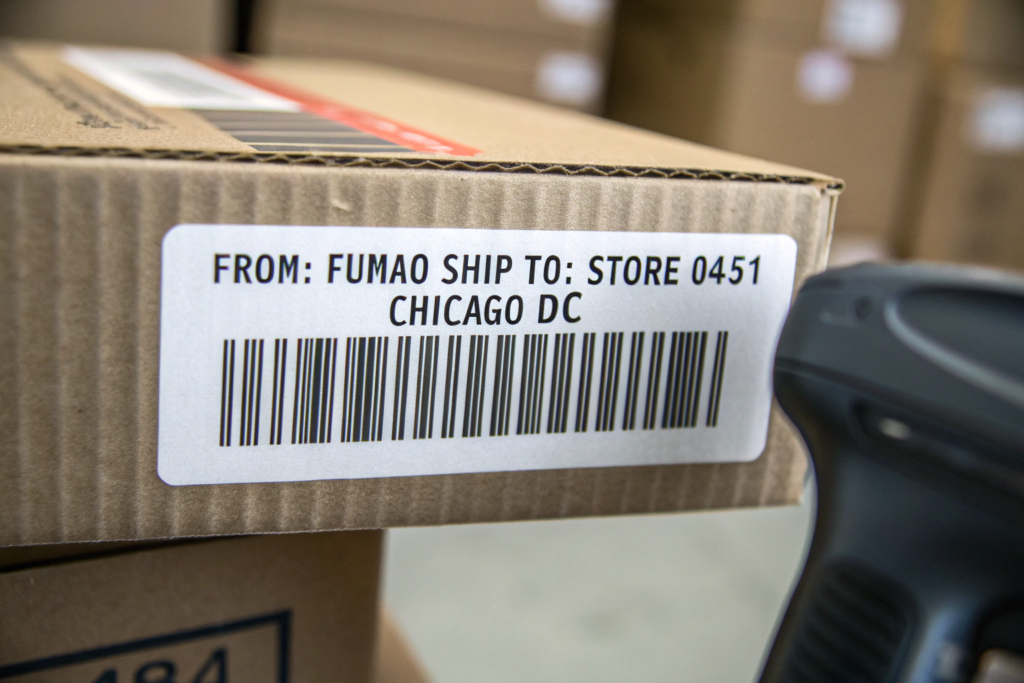
Handling ASN and UCC-128 compliance for split shipments requires a factory that has EDI capability or a partnership with a compliant consolidator. The specific requirements are: (1) UCC-128 Carton Labels. Each carton must have a unique serialized barcode label that identifies the contents (PO, Style, Size, Quantity) and the destination. For a split shipment, the “Ship To” postal code on the label must be correct for that specific carton’s destination. (2) Advanced Ship Notice (ASN 856). Before the ship sails, the factory must electronically transmit a manifest to the retailer detailing exactly what is in each carton. For a split shipment, separate ASNs must be sent for the cartons going to Chicago vs. Dallas. (3) Compliance with Routing Guide. The cartons must be palletized according to the retailer’s specs (e.g., “No mixed PO pallets,” “Max pallet height 52 inches”). Failure in any of these areas results in chargebacks that wipe out your profit on the order.
At Shanghai Fumao, we generate UCC-128 labels in-house and transmit ASNs via our EDI partner. We do this specifically so our clients can sell to major department stores without getting crushed by compliance fines.
What Happens If the Factory Puts the Wrong UCC-128 Label on a Carton?
This is a disaster. The carton for Dallas gets the label for Chicago. The Dallas DC scans it. The system says “Carton not expected.” The carton is set aside in a “Problem Freight” area.
It may take weeks to reconcile. The retailer might return the carton to you at your expense. Or they might just issue a chargeback for “Carton Content Mismatch” and donate the goods to charity. You lose the inventory and the revenue.
This is why factory splitting requires a disciplined packing team. The supervisor must scan each carton label and verify the destination before it leaves the packing station.
I recall a brand that tried to save money by using a small factory for a split denim order. The factory did not understand UCC-128. They just taped handwritten labels on the boxes. The shipment was refused at all four DCs. The brand had to pay return freight to a salvage warehouse. They lost $15,000 on that order. The “savings” from the cheap factory evaporated.
How Do You Verify the Factory’s ASN Capability?
Do not just ask, “Do you do ASN?” Ask: “Do you have an EDI VAN provider? Can you send a test 856 transaction to [Retailer Name] before we go live?”
A competent factory will say, “Yes, we use [Name of EDI Provider] and we can send a test transmission.” They will know the retailer’s specific EDI qualifier codes.
If the factory says, “We just email the packing list,” they cannot handle retail compliance for direct splits. You must route the shipment through a US-based EDI-compliant 3PL.
This is a hard filter. If the factory fails this test, you cannot do a factory floor split for a major retailer. You must use a Destination Split model.
How Do You Structure the Purchase Order and Payment for Split Deliveries?
You agree on the splits. You agree on the fees. Now you need to document it. A standard Purchase Order is for one shipment to one place. A split shipment requires a different financial structure. You need to decide if you are paying for the goods based on production completion or per shipment arrival. This affects your cash flow. You also need to define what happens if one split shipment is delayed or damaged. Does that hold up payment for the entire order?
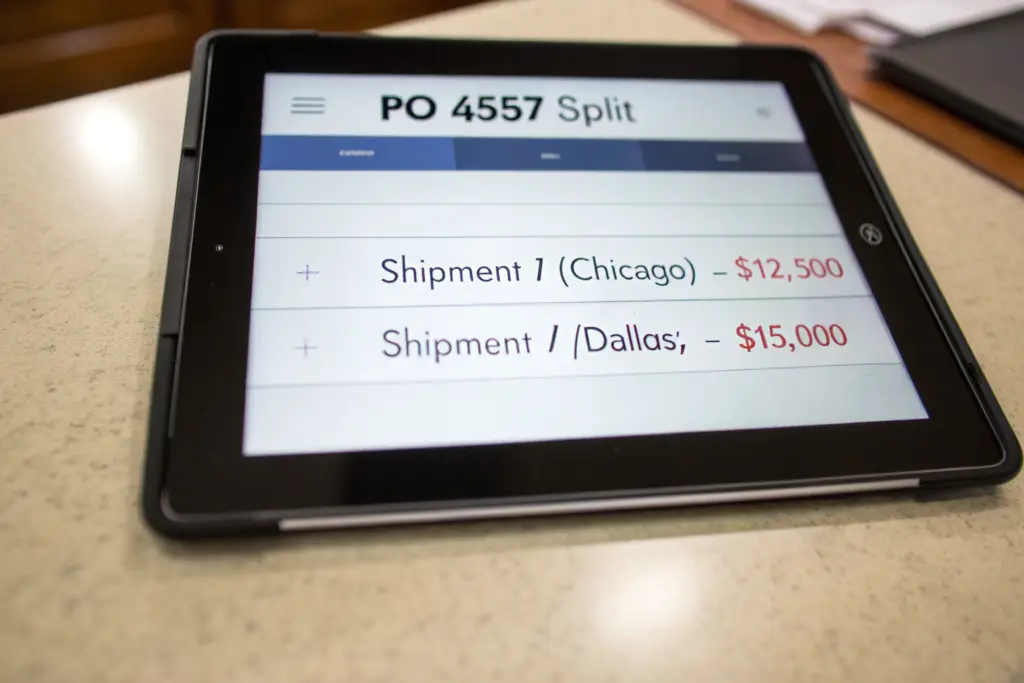
Structuring the PO and payment for split deliveries requires creating a “Master PO with Release Schedules” or separate sub-POs for each destination. The specific considerations are: (1) Payment Terms. Negotiate “Payment per Shipment” rather than “Payment against Full Order.” If 30% of the goods have shipped to Chicago, you should only be liable for payment on that 30%, not the full 100% waiting to ship to Dallas. (2) Invoicing. The factory must issue a separate commercial invoice for each split destination. This is required for customs and for the buyer’s accounts payable department to reconcile receiving. (3) Risk of Loss. Define whether the factory’s responsibility ends when the goods leave their dock (FOB Factory) or when they arrive at the retailer’s dock (DDP). For split shipments, DDP is often safer for the buyer to avoid multiple surprise accessorial charges at different ports. (4) Cancellation Clause. If the retailer cancels one of the split destinations, define the restocking fee or cancellation penalty for those specific units.
At Shanghai Fumao, we recommend a structure of “One Master Contract, Multiple Invoices” for split orders. It keeps the accounting clean for both sides.
Should You Pay the Full Deposit If Only Half the Order Is Shipping Now?
This is a negotiation point. The factory needs to purchase fabric for the entire order, even the half shipping later. So they will ask for a deposit on the full order value.
You can negotiate a compromise. Pay the full deposit (e.g., 30% of total PO) upfront. But for the balance payment, negotiate “Balance Due per Shipment.”
Example:
- Total PO: $50,000.
- 30% Deposit: $15,000 (Paid upfront).
- Shipment 1 (Chicago): Value $20,000. Balance Due: $14,000 (The portion of deposit applied to these goods is $6,000).
- Shipment 2 (Dallas): Value $30,000. Balance Due: $21,000.
This protects the buyer’s cash flow. They are not paying for goods that are still sitting in the factory waiting for the next vessel.
I always include this payment schedule in the PO terms. It prevents the factory from demanding full payment before the second split is ready. It also incentivizes the factory to get the second shipment out the door quickly.
How Do You Handle a “Short Shipment” on One Split Destination?
The factory ships 500 units to Atlanta. But the retailer says they only received 480 units. The carton count was correct, but 20 units are missing.
Who is responsible? The factory? The forwarder? The retailer’s receiving team?
This is why Packing Lists per Carton are essential. The factory must provide a detailed packing list showing exactly what is in each carton.
If the carton shows 20 units were packed, and the retailer scanned 20 cartons, but the pieces are missing, it is likely theft or loss in transit. This is an insurance claim.
If the packing list is vague (“Carton 1: Assorted Shirts”), you cannot prove the 20 units were ever there. The retailer will deduct the value from the invoice. You will eat the loss.
The lesson: Require “Scan Pack” verification for split retail orders. This means the factory scans each garment barcode as it goes into the carton. The carton label is generated from that scan data. The carton contents are 100% verified. This prevents shortages and protects you from chargebacks.
Conclusion
Negotiating split shipping for massive wholesale orders is a test of your operational maturity as a brand. It is the moment you transition from “Maker of Clothes” to “Reliable Vendor Partner.” The retailers demand precision. The factories require clear instruction. Your job is to be the bridge.
We have mapped the terrain. You understand the critical difference between splitting cartons on the factory floor and splitting pallets at a US warehouse. You know that “Carton Utilization” is the hidden cost that inflates freight when you split at the source. You are armed with the language of UCC-128 labels and ASN transmissions, the compliance gauntlet that separates professional suppliers from amateurs. And you have the framework to structure a Purchase Order that protects your cash flow across multiple delivery dates.
At Shanghai Fumao, we have navigated these waters with brands selling to Nordstrom, Target, and specialty boutiques alike. We have the EDI infrastructure, the trained packing teams, and the transparent fee structures to make split shipping a manageable part of your growth, not a crisis.
If you are facing your first large retail order with complex routing requirements, do not guess. Lean on a factory partner who has done it before. We can help you interpret the Routing Guide, estimate the true landed cost of different split strategies, and execute flawlessly.
To discuss your specific split shipment requirements and to get a transparent cost estimate, please reach out to our Business Director, Elaine. She can walk you through our retail compliance capabilities.
Email: elaine@fumaoclothing.com