A brand owner from Texas once told me his logistics horror story, and I still remember the exact dollar figure. He ordered 1,500 custom denim jackets from a supplier who quoted him FOB. The factory price was great. The nightmare started when the ship docked in Houston. He got a call from a freight forwarder he had never spoken to. Terminal handling fee: $475. Customs bond: $350. Exam fee: $600. Demurrage because he could not clear the paperwork fast enough: $1,200. Storage at a bonded warehouse while he found a trucker: $800. The jacket that looked like a $22 unit cost on his spreadsheet ended up costing him $29.50 by the time it reached his warehouse. And it arrived two weeks late. He told me, "I did not know I was buying a second job as a logistics coordinator. I just wanted jackets." This is the exact pain I designed our logistics offering to eliminate.
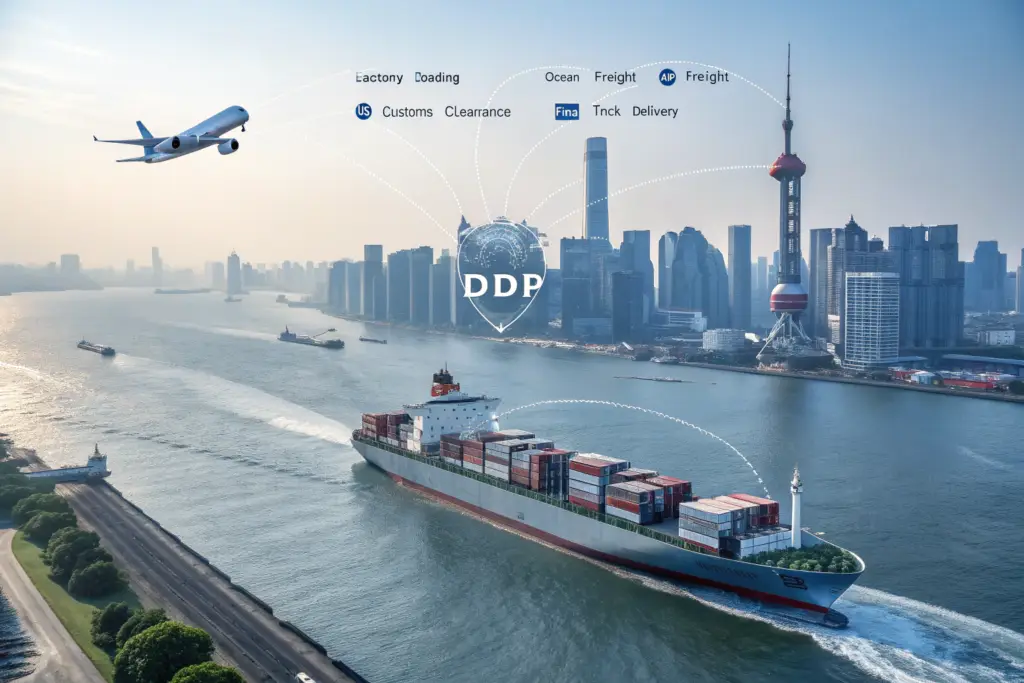
Shanghai Fumao provides three primary logistics options for the US market: standard sea freight DDP for cost-efficient bulk orders, express air freight DDP for time-sensitive and high-value shipments, and hybrid sea-air solutions that balance speed and cost. All three are offered on a Delivered Duty Paid basis, meaning we handle the entire journey from our factory floor to your specified US address, including freight, insurance, US customs clearance, and all import duties and taxes. You pay one agreed price, and you receive the goods at your door with zero surprise fees.
You are not a logistics expert. You are a brand owner, a buyer, or a CEO. Your job is to design, market, and sell apparel, not to become an expert in Incoterms, customs bonds, and demurrage disputes. Our logistics model is built on a simple principle: you should know your total landed cost to the penny before you even place the order. No asterisks. No "port charges not included" buried in the fine print. I want to walk you through each option, when to use it, and how to avoid the traps that have burned so many US importers.
What Is DDP Shipping and Why Is It the Best Option for US Buyers?
I had a conversation with a boutique owner from Miami last year that perfectly captures the DDP value proposition. She was comparing our quote to another supplier's FOB quote. She said, "Elaine, your price is about $2.40 higher per unit. I want to go with you, but I need to understand why." I pulled up a spreadsheet. I asked her to get me a full breakdown of the FOB supplier's estimated door-to-door costs. She did. The ocean freight estimate they gave her was low. They did not include the customs bond. They did not include the Merchandise Processing Fee. They completely omitted the cost of trucking from the port to her store. When we added up all the real numbers, our DDP price was actually $0.85 cheaper per unit. And we guaranteed the delivery date. The other supplier did not.
DDP shipping transfers the entire logistics burden from the buyer to the seller. It is not just a shipping method. It is a risk-transfer mechanism and a pricing transparency tool. For US buyers who do not have a dedicated import department, it is the single most important term in the contract.

What Hidden Costs Does DDP Eliminate Compared to FOB?
FOB (Free On Board) pricing is the classic "cheap headline, expensive reality" trap. The FOB price covers only the cost of the goods and the transport to the port of departure in China. Everything after that is your financial and operational problem.
Here is a comparison of the costs involved in a typical shipment of 1,000 woven shirts from Shanghai to Chicago, comparing an FOB quote against our DDP service:
| Cost Category | FOB (You Pay Separately) | DDP with Shanghai Fumao |
|---|---|---|
| Ex-Factory Unit Price | $5.80 | $8.90 |
| Ocean Freight (LCL) | $850 (estimated) | Included |
| Marine Insurance | $120 (optional, risky to skip) | Included |
| US Customs Bond (Single Entry) | $90 | Included |
| US Import Duty (20% on wovens) | $1,160 | Included |
| Merchandise Processing Fee (MPF) | $35 | Included |
| Terminal Handling at US Port | $280 | Included |
| Customs Exam (if flagged) | $450 (unpredictable) | Our Risk |
| Trucking to Chicago Warehouse | $520 | Included |
| Total Landed Cost | $8.95/unit (without exam) | $8.90/unit (fixed) |
The FOB price is a mirage. The real landed cost, even without a customs exam, is slightly higher. With an exam, it blows out significantly. The DDP price is a contractual guarantee. You budget $8.90 per unit. You pay $8.90 per unit. You sell based on an $8.90 cost. There is no midnight phone call from a port authority demanding money. There is no scrambling to find a customs broker. At Shanghai Fumao, we handle customs clearance through our established US broker network. We have a standing continuous customs bond, so we do not need to purchase single-entry bonds for each shipment. We have negotiated rates with trucking companies. We absorb the risk of customs exams because our paperwork is meticulous and our HS codes are correct. DDP is not just convenient. It is financially predictable. For a small or mid-sized brand, predictability is often more valuable than a theoretical saving that evaporates at the port.
Is There a Minimum Order Value for Our DDP Service?
We do not impose a rigid minimum order value for DDP service, but there are practical thresholds where the economics make sense. For very small shipments, under roughly 100 units of lightweight garments, the fixed costs of customs brokerage and trucking can become disproportionately high on a per-unit basis.
For these micro-shipments, we offer consolidated shipping options. If we have multiple small orders heading to the same US region, we can consolidate them into a single container or air freight pallet, splitting the fixed costs across several clients. This allows a brand testing a new style with a 50-unit sample run to still benefit from the DDP model. We also offer an express courier DDP service for sample orders and very small production runs of 20-50 pieces. We use carriers like DHL and FedEx, and the DDP price includes the express freight, the customs clearance, and the duties. The unit cost is higher than sea freight, but it is perfect for a market test, a photoshoot sample run, or an urgent restock. The key is that the price is still fixed and all-inclusive, even for small packages. I always recommend that a new client do a small DDP shipment first, even if it is just a sample order. This lets you experience the door-to-door service, test the speed, and build confidence in the logistics chain before committing to a large container order. A small-batch DDP trial is the lowest-risk way to onboard with a new manufacturing partner.
When Should You Choose Air Freight Over Sea Freight for Your US Order?
A streetwear brand in Los Angeles taught me the most important lesson about air freight. They had a limited "drop" model. Every three months, they released a small batch of highly designed, trend-driven pieces. Their customers expected the drop on a specific announced date. A delay was brand-damaging. For one collection, a production hiccup pushed the completion date ten days past the planned sea freight cutoff. Sea freight would mean arriving three weeks after the announced drop date. The brand owner called me, panicked. I told him we had two choices: delay the drop and lose fan trust, or switch to air freight.
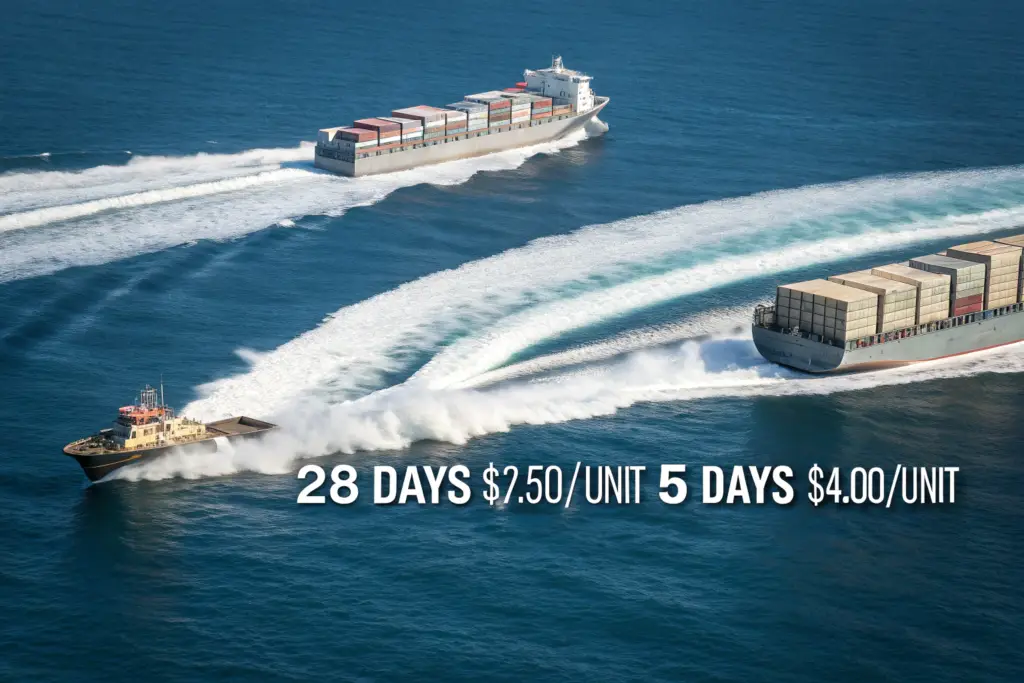
Air freight is often framed as an expensive emergency option. This is the wrong framing. Air freight is a strategic inventory profit tool. The decision is not "cheap slow boat versus expensive fast plane." The decision is a calculated equation: the extra freight cost versus the value of earlier selling time, fresher trend relevance, and zero missed-season markdown risk.
What Is the True Cost Equation for Air Freight vs. Sea Freight?
The superficial cost comparison is the freight line item. Sea freight for 500 lightweight jackets might be $1,200. Air freight might be $3,600. The air freight looks $2,400 more expensive. This analysis ignores the hidden balance sheet costs of sea freight.
Sea freight ties up your capital for an additional three to four weeks. If those 500 jackets cost you $15,000 to manufacture, that money is frozen on a boat, not available for marketing, reorders, or paying your team. More critically, sea freight delays your revenue. If you can sell those 500 jackets for $60 wholesale each, generating $30,000 in revenue, the three weeks of delayed sales represent a cash flow gap. For the LA streetwear brand, their drop model meant a predictable sell-out within 48 hours of the announcement. A three-week sea freight delay would push their revenue recognition into the next month, violate their customer promise, and potentially cause chargebacks from frustrated fans. The $2,400 air freight premium was not a cost. It was an insurance policy on their brand promise and an acceleration of $30,000 in revenue by three weeks. They paid the air freight. The drop happened on time. It sold out in six hours. The air freight cost was forgotten. The brand trust was reinforced. For high-margin, trend-sensitive, or time-critical orders, air freight is often the correct financial decision, even though the line-item cost looks higher.
How Do We Handle Customs Clearance for Air Freight to the US?
Air freight customs clearance is faster than sea freight, but it is also more detail-sensitive. The manifest must be precise. The commercial invoice must exactly match the physical contents. The HS codes must be correct to the 10-digit level for US customs. Any discrepancy triggers a hold, and a hold at an air freight hub can generate storage charges that accumulate by the hour, not by the day.
Our logistics team pre-files the customs entry electronically while the plane is still in the air. We use a dedicated air freight customs broker who is familiar with apparel classifications. For a recent shipment of 300 silk-cotton blend dresses, our broker correctly classified them under the specific HS code for women's woven silk-blend dresses, not the generic "women's apparel" catch-all. The correct classification had a lower duty rate. The pre-filing meant the goods were cleared within two hours of landing at JFK. They were on a truck to the client's Manhattan showroom the same afternoon. The client was amazed. We also prepare a detailed packing list with fabric content, gender, and end-use clearly stated. This transparency makes the customs officer's job easier and reduces the probability of a random exam. Our customs compliance process is identical for air and sea, but the speed of air freight amplifies the value of getting it right. A one-day delay in sea freight is a minor annoyance. A one-day delay in air freight can mean missing a fashion week deadline or a major retail delivery window. We treat air freight with the operational precision it demands.
Can You Track Your Shipment in Real-Time While It Is in Transit?
A CEO of a corporate uniform company told me about his previous tracking experience with another factory. He said, "They gave me a container number. That was it. I had to Google how to track a container. I ended up on some shipping line website, staring at a status that said 'Discharged at Long Beach' and I had no idea what that meant or what to do next." He felt abandoned at the exact moment he needed the most information. The goods were physically closer than ever, but informationally, they were in a black hole.
We provide a different experience. From the moment your goods leave our factory gate to the moment the truck backs into your receiving dock, you have a clear, human-readable status trail. We do not just give you a tracking number and wish you luck. We interpret the logistics milestones for you and proactively alert you to what is coming next and what you need to prepare.
What Information Is Included in Our Shipment Tracking Updates?
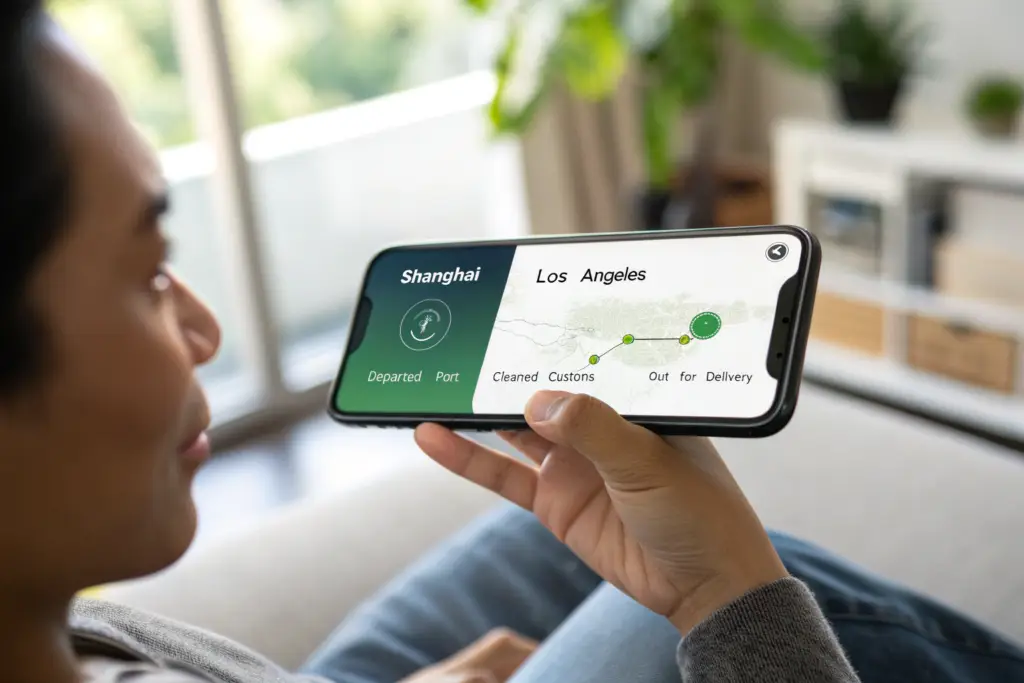
We provide a layered tracking system. First, you receive a direct tracking link from our freight forwarder that shows the real-time location of your shipment on a map. Second, and more importantly, your dedicated Business Director sends you a weekly logistics update email during transit.
This email is not an automated bot message. It is a human summary written by someone who understands your order. It includes: the vessel name and voyage number, the estimated date of arrival at the US port, the current customs clearance status, and the expected date of final truck delivery to your address. For a shipment of 800 fleece pullovers to a brand in Portland, the update read: "Your goods are on vessel EVER FORTUNE, voyage 045E. Currently passing through the Panama Canal. ETA Long Beach is March 28. Customs entry will be filed on March 26. Estimated delivery to your Portland warehouse is April 2." The client knew exactly when to schedule his receiving team. He knew when to expect the customs clearance. He was not guessing. If there is a port congestion delay, which happens frequently at major US ports, we alert you immediately with a revised ETA and the reason for the delay. During the post-pandemic port congestion, we informed a client that Long Beach was experiencing a 5-day berthing delay. We gave them the updated delivery window three weeks before the original date, allowing them to adjust their wholesale shipping schedule. A real-time logistics dashboard combined with a proactive human summary turns the passive anxiety of waiting into an informed, managed process.
How Do We Handle Delivery to Residential or Commercial Addresses?
The final mile of delivery, from the port to your specific door, is where many logistics providers fail. A commercial warehouse with a loading dock is straightforward. A residential address, a small boutique, or an urban location with limited truck access requires careful coordination.
Our DDP service includes final delivery to any physical address in the contiguous United States. We use a network of regional trucking companies. For a standard commercial delivery, we schedule a liftgate truck appointment. For a residential or small boutique delivery, we ensure the truck has a liftgate and a pallet jack, and we confirm with you that someone will be available to receive and sign for the goods. We recently delivered 200 custom blazers to a home-based business owner in a suburban neighborhood. The standard 18-wheeler could not access her street. We arranged a smaller box truck for the final leg, at no extra cost to her. She received a phone call from the driver 30 minutes before arrival. The delivery was smooth. This level of final-mile care is not automatic. It requires a logistics team that asks the right questions before the truck is dispatched: Is there a loading dock? Do you need a liftgate? Is there an appointment required? Are there any access restrictions? We collect this information from you at the shipping confirmation stage. We do not assume. We verify. The goal is that the last interaction you have with your order is a delivery driver handing you a clean, undamaged pallet of goods at the exact location and time you expected.
Conclusion
Your logistics experience defines your final impression of a manufacturing order. You can have a perfect garment, made to spec, on time, and still have a disastrous experience if the shipping process is opaque, expensive in hidden ways, and delayed by customs chaos. We have built our US logistics offering around three core principles: total cost transparency through DDP, strategic flexibility between sea and air freight based on your brand's cash flow and speed requirements, and proactive, human-managed tracking from factory gate to your doorstep. The goal is not just to move boxes across the ocean. The goal is to remove logistics as a source of anxiety, surprise, and unbudgeted cost from your business. You should be worrying about your sell-through, your marketing, and your next design, not about demurrage fees and customs bonds.
If you are ready to experience logistics that feels like a reliable internal department rather than a chaotic external gamble, reach out to our Business Director, Elaine, at elaine@fumaoclothing.com. Send her your next order details and your delivery address. She will provide a single, all-in DDP quote that covers every dollar from our floor to yours, along with a clear timeline and the tracking protocol. Let us handle the ocean, the customs, and the final truck. You just open the door.