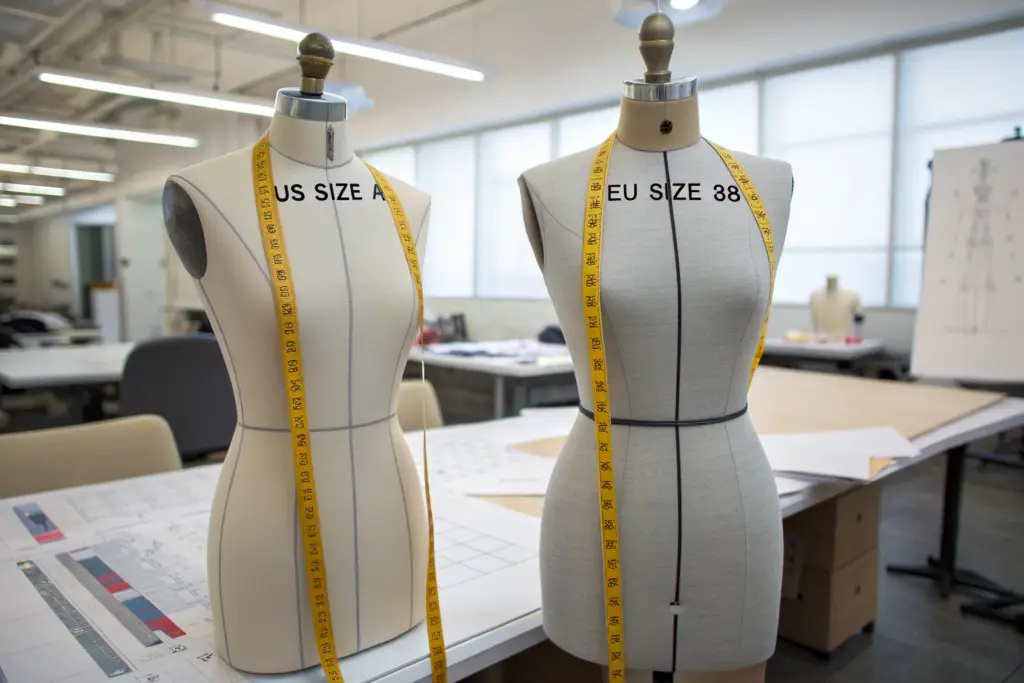
I watched a brand owner open an email from her new German wholesale account and physically deflate. She had shipped 200 units of her best-selling dress, the one that flew off the racks in Los Angeles. The Berlin boutique had returned 40 of them in the first week. The complaint was universal: "Runs very small." She had assumed a US Medium was a European Medium. She had simply changed the hang tags. The garment that fit a size 8 customer in California was squeezing a size 38 customer in Germany. The dress was identical. The bodies were different. The expectations were different. The brand lost a $12,000 account because of an assumption.
To flawlessly navigate the complex differences between US and European clothing sizes, you must abandon the idea of a simple "size conversion chart" and instead build a dual-market grading system based on the different anthropometric baselines and fit preferences of each population. The US market grading, based on ASTM standards, assumes a more rectangular body shape with a straighter waist-to-hip ratio and a preference for more ease. The European market grading, based on EN 13402 standards, assumes a more hourglass shape with a more defined waist and a preference for a closer, more tailored fit. A successful dual-market brand does not just add two to the size number. It develops a separate base pattern for each market, or applies a documented adjustment matrix that changes the shoulder slope, the armhole height, and the ease distribution. The size label is just the final, visible step in a much deeper engineering process.
The size difference is not a marketing problem. It is a pattern engineering problem. If you solve it with a hang tag, you will fail. If you solve it with a pattern, you will win. I want to share exactly how Shanghai Fumao helps our brand partners build patterns that fit both markets, and how you can avoid the $12,000 Berlin mistake.
What Are the Exact Anthropometric Baseline Differences Between ASTM and EN 13402 Size Standards?
A brand owner once told me she thought a size 8 was a size 8 everywhere. She had never seen the actual anthropometric data. I showed her the ASTM standard for a US size 8: bust 88.9cm, waist 68.6cm, hip 93.9cm. Then I showed her the EN 13402 standard for a EU size 38: bust 88-92cm, waist 69-72cm, hip 94-97cm. At first glance, they looked similar. The critical difference was in the relationship between the measurements. The US standard had a 25.3cm waist-to-hip differential. The EU standard had a 23-25cm differential, but the waist was higher on the torso. The EU pattern was drafted for a more defined, higher waist. The US pattern was drafted for a longer, straighter torso. The numbers were close. The body shapes were different.
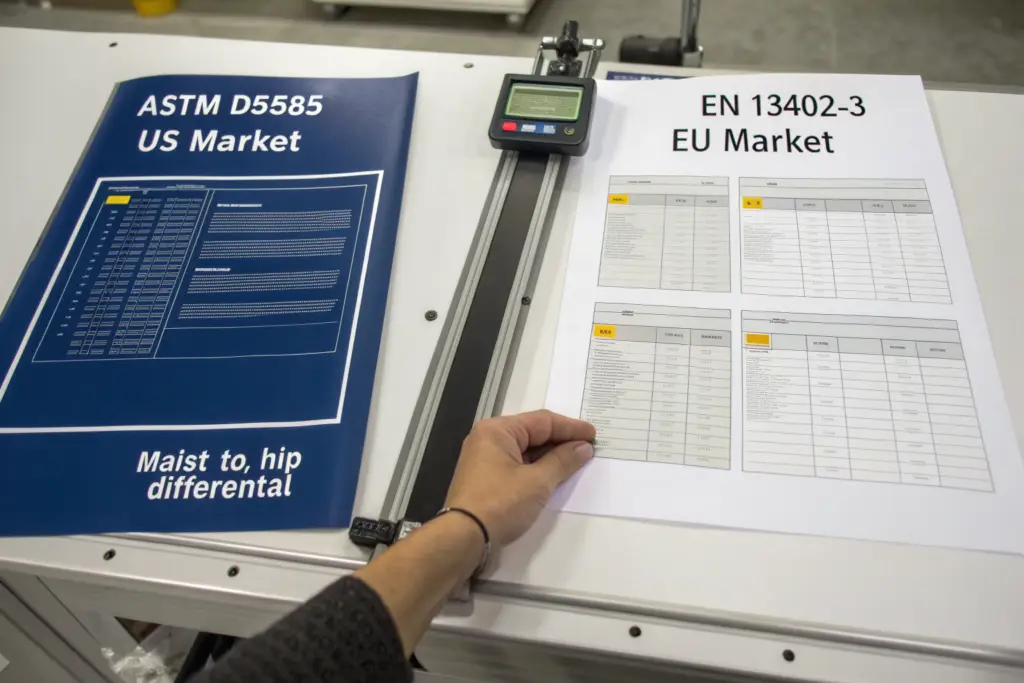
The exact anthropometric baseline differences are rooted in the national sizing surveys that underpin each standard. The ASTM standards are built from US population body measurement data. The EN 13402 standards are built from European population data. The key differences are in three areas. First, the waist-to-hip ratio: the European standard assumes a more pronounced curve. Second, the shoulder slope: the European standard assumes a more squared, less sloped shoulder. Third, the torso length: the European standard assumes a slightly longer torso relative to the leg length. These differences mean that a pattern drafted for the ASTM baseline will fit a European body poorly at the shoulders, the waist, and the overall length. A simple size label swap does nothing to address these fundamental fit issues.
The size chart is a map of a population's body. The US map and the European map are different. You cannot navigate Berlin with a map of Los Angeles.
How Does the "Bust Point" Position Differ in US Versus EU Pattern Blocks?
The European bust point is positioned slightly higher and closer together than the US bust point. This affects the placement of darts and the overall drape of the fabric over the chest. A US pattern on a European body will have darts that point too low and too wide, creating a matronly, sagging appearance.
Why Does the "Shoulder Slope" Angle Require a Different Pattern Draft for the Two Markets?
The average European shoulder is slightly more squared, with a shallower slope, than the average US shoulder. A US pattern with a steep shoulder slope will gap at the armhole on a European body. The pattern must be adjusted to reduce the slope angle.
How Does the "Fit Preference" Culture Radically Alter Ease Allowances for the Same Garment Category?
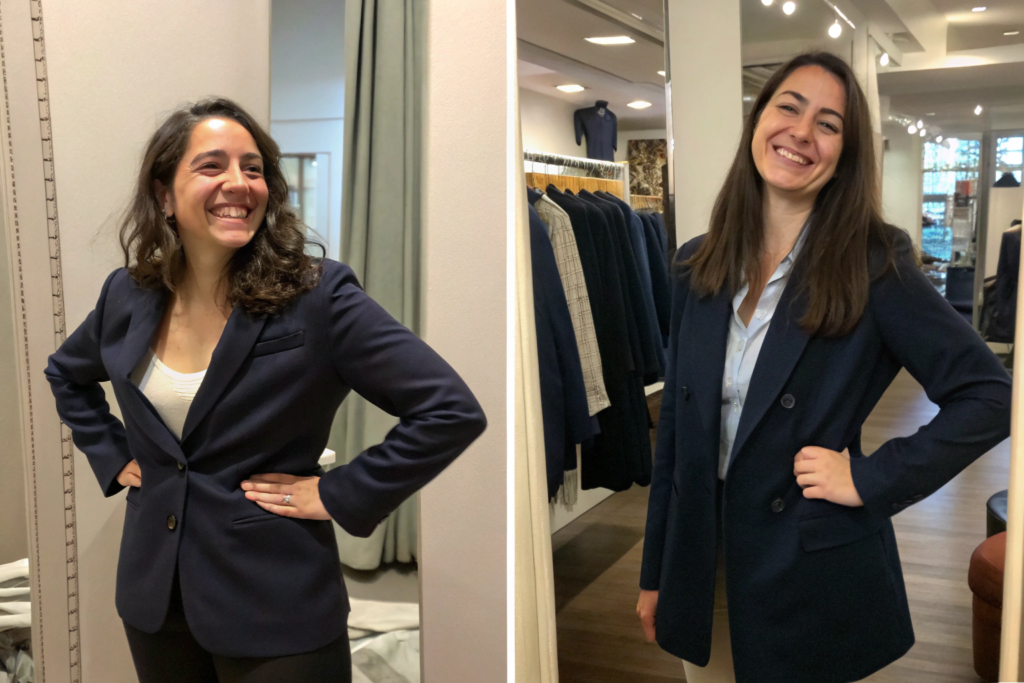
I have seen the exact same garment receive opposite fit complaints from US and European customers. The US customer put on a woven blouse with 10 centimeters of ease and said, "This fits perfectly." The European customer put on the same blouse, felt the same 10 centimeters of ease, and said, "This is too big. I need a smaller size." The garment was identical. The body measurements of the two women were nearly identical. The difference was in their expectation of how a blouse should fit. The US expectation is for comfort and movement. The European expectation is for tailoring and shape.
The fit preference culture between the US and European markets is a measurable difference in ease allowances. For a woven women's blouse, the US market standard ease is 8 to 12 centimeters at the bust. The European market standard ease is 6 to 8 centimeters. This 2 to 4 centimeter difference is the gap between a "comfortable fit" and a "too big" complaint in Europe, and between a "tailored fit" and a "too tight" complaint in the US. A brand selling the same garment in both markets must either choose a middle ground that satisfies neither perfectly, or develop two separate ease specifications. The dual specification approach produces a garment that feels correct to both customers, even though the measurements are different.
Ease is the invisible variable that determines a customer's first impression of fit. It is not written on the size label. It is felt in the dressing room. The customer who feels too much fabric assumes the size is wrong. The customer who feels the right amount of fabric assumes the size is right.
How Should the Ease Allowance Differ Between a US and EU Market Woven Blouse?
A woven blouse for the US market should have 10-12cm of ease at the bust and 8-10cm at the waist. The same blouse for the EU market should have 7-9cm at the bust and 5-7cm at the waist. The pattern pieces are slightly narrower for the EU version.
Why Does the US Consumer Expect More Room in the Upper Arm (Bicep Ease) Than the European Consumer?
The US consumer generally expects more room in the bicep for freedom of movement. A bicep ease of 6-8cm is standard. The European consumer expects a slimmer sleeve with a bicep ease of 4-6cm. A US-cut sleeve on a European garment feels baggy. A European-cut sleeve on a US garment feels restrictive.
How Do You Build a "Dual-Market Size Specification Table" Without Doubling Your Development Budget?
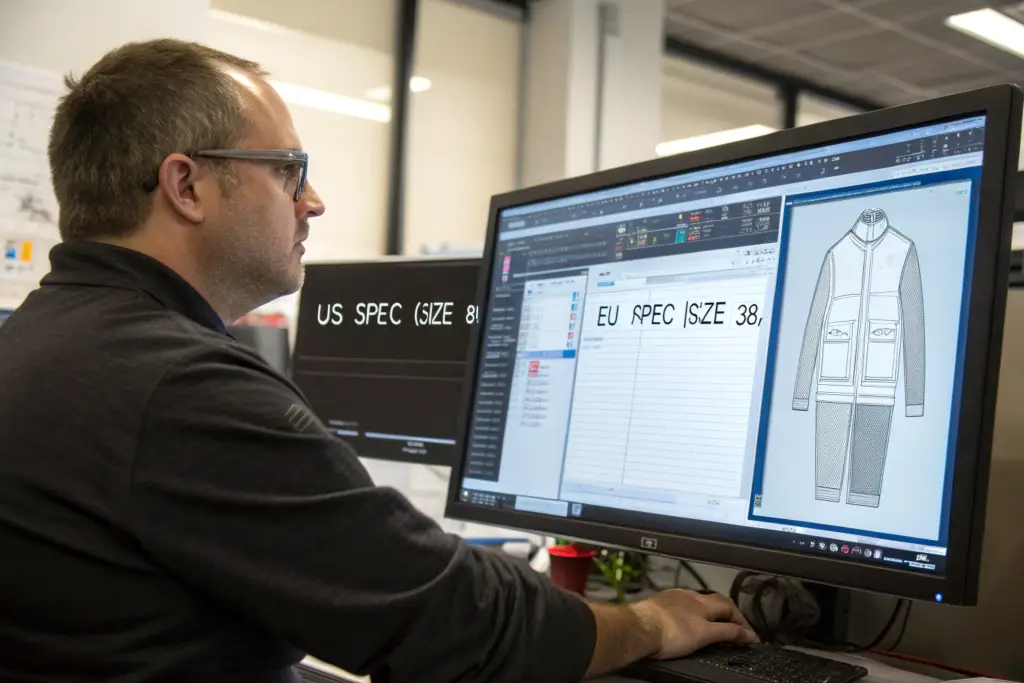
A brand owner once told me she had two separate tech packs for every style. One for the US, one for Europe. Her development costs were double. Her sample timeline was double. Her confusion was constant because the two tech packs sometimes drifted out of sync. She was burning money. We helped her build a single, dual-market tech pack. The design, the construction, and the materials were specified once. The measurement table had two columns. The pattern maker used the US column for the US pattern and applied a standard adjustment matrix to generate the EU pattern. Her development cost dropped back to nearly single-market levels.
You build a dual-market size specification table by creating a single, master tech pack with a two-column measurement table. The left column lists the finished garment measurements for the US market, based on your ASTM-derived grade rules. The right column lists the finished garment measurements for the EU market, calculated by applying a documented adjustment matrix to the US measurements. The adjustment matrix specifies the changes for key points: shoulder width reduced by 1.5cm, armhole raised by 1.0cm, waist circumference reduced by 2.0cm, bicep circumference reduced by 1.5cm. The pattern maker follows this matrix to generate the EU pattern from the US base pattern. You are not designing the garment twice. You are designing once and applying a set of known, repeatable adjustments for the second market.
The adjustment matrix is the key efficiency tool. It is developed once, validated through fit sessions, and then applied to every subsequent style in the same product category. The matrix turns a two-pattern problem into a one-pattern plus adjustments problem.
What Is an "Adjustment Matrix" and How Do You Create One for a Specific Garment Category?
An adjustment matrix is a table that lists every critical measurement point and the specific amount by which it must be changed to convert a US pattern to an EU pattern. It is created by comparing the ASTM and EN 13402 grade rules and validating the differences through fit sessions on live models from both target markets. The matrix is a living document that is refined over multiple seasons based on fit feedback and return data.
How Can You Validate Your Dual-Market Specs Using Remote Fit Testing on Local Brand Ambassadors?
Ship a sample in each market's base size to a trusted contact in the target market, a friend, a brand ambassador, or a cooperative retail buyer. Conduct a live video fit session. Watch the garment on a real body and mark the adjustments directly onto the pattern file. The cost is a fraction of a full international fit trip.
Conclusion
Flawlessly navigating the differences between US and European clothing sizes is a pattern engineering discipline, not a labeling exercise. The anthropometric baselines are different. The fit preferences are different. The solution is a dual-market measurement table built on an adjustment matrix, validated through real fit sessions, and applied consistently across the entire collection.
The $12,000 Berlin mistake was not a sizing error. It was an assumption error. The brand assumed a size was a size. The pattern knew otherwise. The brands that invest in the dual-market pattern system win customers in both New York and Paris. The brands that invest in a hang tag alone win returns and lost accounts.
At Shanghai Fumao, we maintain up-to-date ASTM and EN 13402 grade rule tables. We help our brand partners develop adjustment matrices for their specific product categories. We produce fit samples in both market sizes and support remote fit validation. We ensure that the size label matches the pattern reality.
If you are expanding into a new market, or if you are struggling with cross-market size complaints, we can help. At Shanghai Fumao, we will review your current size specifications and build a dual-market measurement table for your collection. Contact our Business Director, Elaine, at elaine@fumaoclothing.com. She can provide a sample dual-market spec sheet and an adjustment matrix template. Fit the body. Respect the culture. Sell in both markets with confidence.