I remember a call with a childrenswear brand owner from Chicago. She was venting about her previous factory experience, not the quality, not the price, but the sheer mental exhaustion of communication. She told me, "I would send a detailed email with five questions. I’d get a reply three days later that said, ‘Dear, okay.’ Just one word. Okay to what? Which question? I’d chase again. Another two days. Another vague answer. I lost weeks of my life just trying to get a simple yes or no on a button color." She showed me the thread. It was 47 emails long and the original issue, a snap button versus a sewn button on a baby romper, was still not resolved. She was a professional, running a business. But this communication black hole was making her feel like an incompetent, anxious mess.
Fumao Clothing’s communication is fundamentally better because we operate on a “Single Point of Radical Accountability” model. Instead of passing you between a silent sales agent and an invisible factory floor, you work directly with a senior, English-fluent Business Director who has technical manufacturing authority. This person responds within hours with specific answers, photographic evidence, and proactive problem-solving, not just delayed, vague reassurances. We treat communication not as a customer service cost, but as the core operational software that prevents expensive mistakes before they happen.
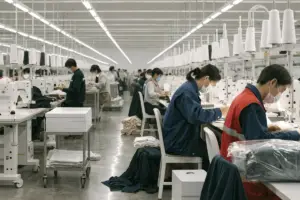
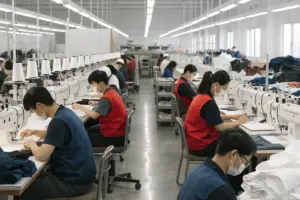
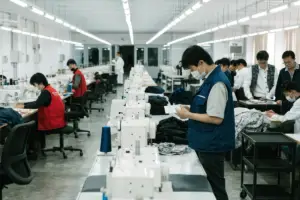
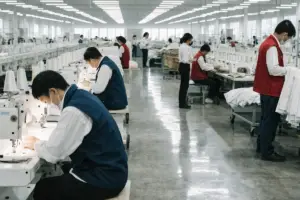
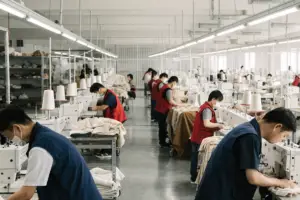
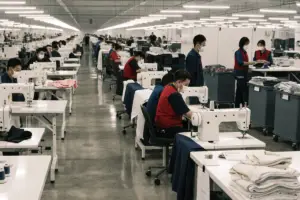
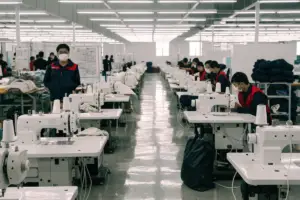
Most factory communication failures are not language problems. They are structural problems. The person emailing you has no authority, no technical knowledge, and no incentive to tell you the truth. They are a human buffer, paid to absorb your anxiety and feed you pleasant lies while the real factory operates in chaotic silence behind them. We have ripped out that buffer layer. The person you talk to at Shanghai Fumao walks onto the production floor, picks up your garment, and sends you a photo of the specific issue, all within the same working day. This article explains the exact mechanics of how we do this, and why it transforms the entire sourcing experience from a source of dread into a competitive advantage.
What Does a ‘Single Point of Contact’ Really Mean for Your Order?
The phrase “single point of contact” is used so often in sales that it has become almost meaningless. Most factories assign you a “sales rep.” But that sales rep is just a messenger. They do not sit in the production meeting. They do not know why the fabric delivery is delayed. They do not have the authority to stop a shipment if the quality is wrong. They are a human autoresponder. Their job is to keep you calm, not to keep you informed.
Our single point of contact is a different role entirely. We call them Business Directors, and they are structurally embedded in our operations, not isolated in a sales department. When you speak to your Business Director, you are speaking to the person who is directly accountable for your order’s technical and logistical execution from raw material to container loading.

Who Exactly Is Your Contact and What Authority Do They Have?
Your contact is a senior professional, typically with over ten years of experience in garment manufacturing and export. They are not a fresh graduate working from a script. They understand pattern-making terminology, fabric dyeing processes, and international logistics Incoterms.
Their authority is the critical difference. Your Business Director, such as Elaine at Shanghai Fumao, has the power to pause a production line. If she receives a quality concern from you, she does not “escalate it to management.” She walks to the QC department herself. She pulls the sample and the bulk garment. She compares them. If there is a genuine deviation, she has the authority to hold the shipment, rework the goods, and communicate the revised timeline to you, all within a few hours. In a recent order for a sportswear brand, a client emailed at 9 a.m. Shanghai time, worried that the logo placement on 800 zip-up jackets looked 1cm too low in a batch photo we had sent. Elaine had the line stopped by 9:30. She compared the batch sample to the approved PP sample with the QC manager. They measured. The placement was actually correct; the photo angle had created a parallax distortion. She took a new photo with a ruler aligned against the logo from a flat, overhead angle, and replied to the client by 10 a.m. The line restarted after a 30-minute pause. The client’s anxiety was resolved with hard evidence, not a dismissive “trust us.” This level of embedded authority is vanishingly rare. Most factory reps would have ignored the email for two days, then replied “checked, all okay” without any proof. The authority to act, combined with the technical knowledge to judge, transforms a communication channel into a genuine risk management tool.
Can One Person Really Handle Fabric, Trims, and Shipping?
A legitimate concern is whether a single person can be an expert in fabric sourcing, trim engineering, and freight forwarding simultaneously. The answer is no, and we do not expect them to be. The Business Director is not a solo expert in everything. They are a highly skilled project manager who sits at the center of a specialized internal team.
They operate like a conductor, not a one-person band. When you ask a fabric-specific question, your Business Director pulls in our Head of Fabric Sourcing for a technical answer. When you have a logistics question, she consults our in-house shipping coordinator. The crucial difference is that you do not talk to these specialists directly. You talk to one person, in clear English, who synthesizes the specialist’s input into a coherent, actionable answer. You are spared the chaos of managing multiple, non-English-speaking technical contacts. For a client launching a complex outerwear program, the Business Director coordinated with the down-filling specialist, the YKK zipper supplier, and the DDP freight forwarder. The client received a single weekly update that integrated all three streams into a simple traffic-light status: fabric (green), trims (yellow, slight delay on custom puller), logistics (green). The yellow trigger included a specific reason, a revised in-house date, and a photo of the corrected zipper pull sample. The client did not need to know the zipper supplier’s name or email. They just knew the status, the impact, and the solution. This model protects your mental bandwidth. You are buying garments, not a second job as a supply chain coordinator.
Why Do We Send Weekly Production Updates with Real Photos?
I once heard a sourcing agent describe the “communication diet” of a typical factory relationship. He said, “You start with a feast of promises during the sales phase. Then you enter a famine of silence during production. Then, right before the ship date, you get force-fed a crisis you didn’t see coming.” This feast-famine-crisis cycle is the direct result of reactive, verbal-only communication. The factory only talks when there is good news to sell, or catastrophic bad news that can no longer be hidden. The long, anxious middle, where production is actually happening, is a black box.
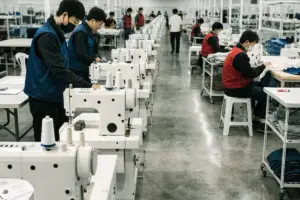
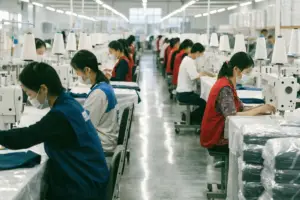
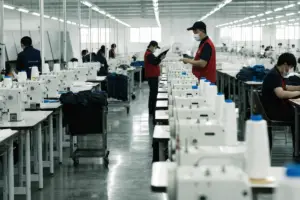
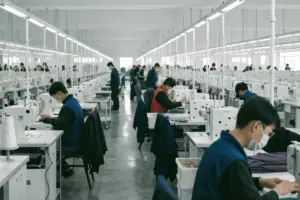
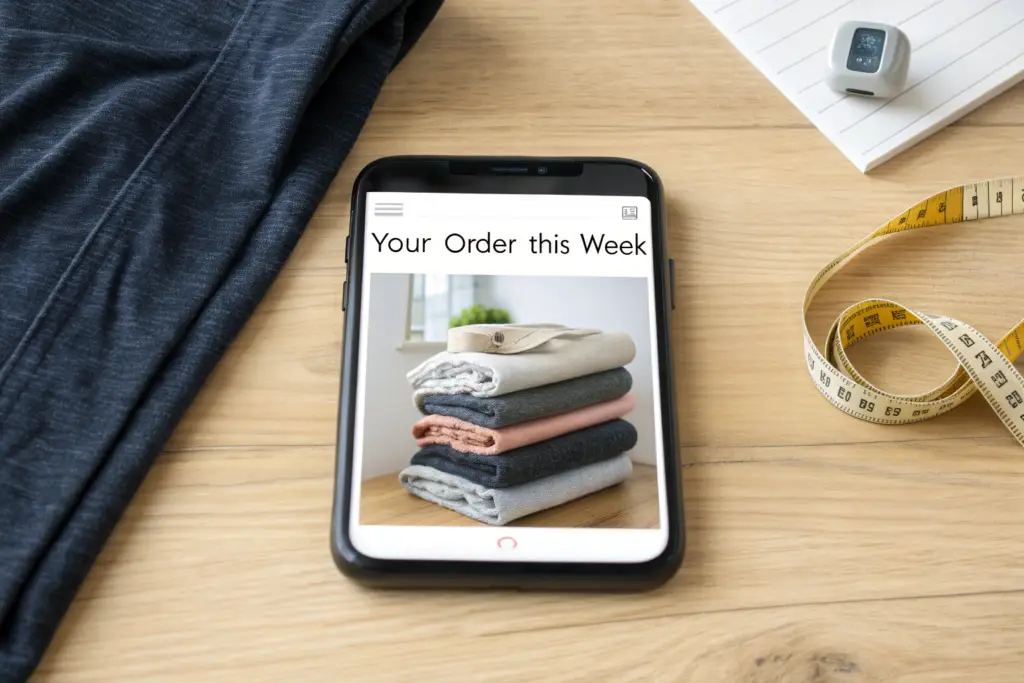
We broke this cycle with a simple, non-negotiable discipline: a weekly visual update for every active order. This is not a marketing service we offer to premium clients. It is standard operating procedure for every order, regardless of size. The update is designed to take you 60 seconds to read and to leave zero ambiguity about the status of your goods.
What Information Is Included in a Standard Weekly Update?
A standard weekly update is a single, concise email containing three specific elements: a visual progress tracker, a photo of your actual goods at their current stage, and a forward-looking alert section.
Here is a breakdown of what our weekly update looks like in practice:
| Update Element | Description | Client Benefit |
|---|---|---|
| Visual Progress Bar | A simple graphic showing stage: Sourcing/Cutting/Sewing/Finishing/Packed. | Instant, intuitive status. No reading required. |
| Real-Time Photo | A photo of your actual fabric roll, cut panels, or sewn garments on our line. | Visual proof of progress. Eliminates “trust me” anxiety. |
| Alert Section | A brief note if anything is tracking ahead, behind, or requires a decision. | Proactive heads-up. No surprises at the shipping deadline. |
For an order of 500 linen dresses, a recent update included a progress bar at 60% (Sewing), a wide-angle shot of the sewing line with their specific sage green fabric visible on the machines, and an alert note: “Button delivery delayed by 2 days. We will overnight air-freight them. No impact on final ship date.” That one sentence prevented a panic. If we had stayed silent, the client might have noticed the delayed ship date later, assumed we were lying about the entire timeline, and started a stressful email chain. The update process forces internal accountability on us. If production is falling behind, we must surface it immediately. The discipline of taking a photo every Friday means we cannot hide. The client sees the same factory floor I see. This radical transparency builds a deep, resilient trust that survives the inevitable small hiccups of manufacturing. A client once replied to a photo with, “I can see my dresses being sewn. I’m going to stop worrying and go to my kid’s soccer game now.” That is the emotional outcome we are engineering: a return of your mental peace.
How Does Proactive Problem-Solving Replace ‘Sorry for the Delay’ Emails?
The most toxic phrase in factory communication is “Sorry for the delay.” It means the delay has already happened. The damage is done. The selling season is now threatened. Proactive communication flips this. It catches a potential delay at the embryo stage and presents you with a solution simultaneously.
I will give you a specific example from last autumn. We were producing 2,000 brushed fleece hoodies for a Midwest university’s homecoming order. The dye house called our production manager on a Wednesday. The specific shade of “cardinal red” had a slight color drift in the bulk dye lot. It was within a Delta-E of 1.8, which many factories would ship without comment. Our internal tolerance is 1.5. The dye house needed five extra days to re-dye. This was a time-sensitive order. A standard factory would have stayed silent, shipped late, and then sent a “sorry, unavoidable delay” email after the deadline had passed. We did not do that. Our Business Director immediately called the client and explained the situation. She gave three clear options: Option A, accept the current batch with a 3% discount, but the color would be slightly more orange-toned. Option B, wait five days for re-dyeing, but we would upgrade the entire shipment to air freight at our cost to make up the time. Option C, split the shipment, air-freight 500 units from an earlier batch to cover the immediate event, and sea-freight the rest. The client chose Option B. The goods arrived two days before the original deadline because air freight is faster than sea. The client later wrote to me and said, “You turned a disaster into a demonstration of competence.” That is the power of proactive problem-solving. It reframes a manufacturing hiccup as a managed, resolved issue. It proves that someone on the other side is actively protecting your business, not just passively processing an order.
How Do We Handle Technical Discussions Without Losing Nuance?
The biggest lie in sourcing is that “conversational English” is enough to manage a complex garment order. It is not. Conversational English works for ordering coffee or checking into a hotel. It fails catastrophically when you need to discuss the differential feed setting on a coverstitch machine to fix a wavy hem on a stretch jersey. You need technical English. You need a contact who understands that “puckering,” “grinning,” and “seam slippage” are three completely different defects with three completely different root causes.
We have invested heavily in closing the technical language gap. Our client-facing team is not just fluent in social English. They are fluent in the specific, jargon-heavy dialect of garment engineering. This allows for granular, efficient problem-solving without a translator who strips out the engineering meaning.
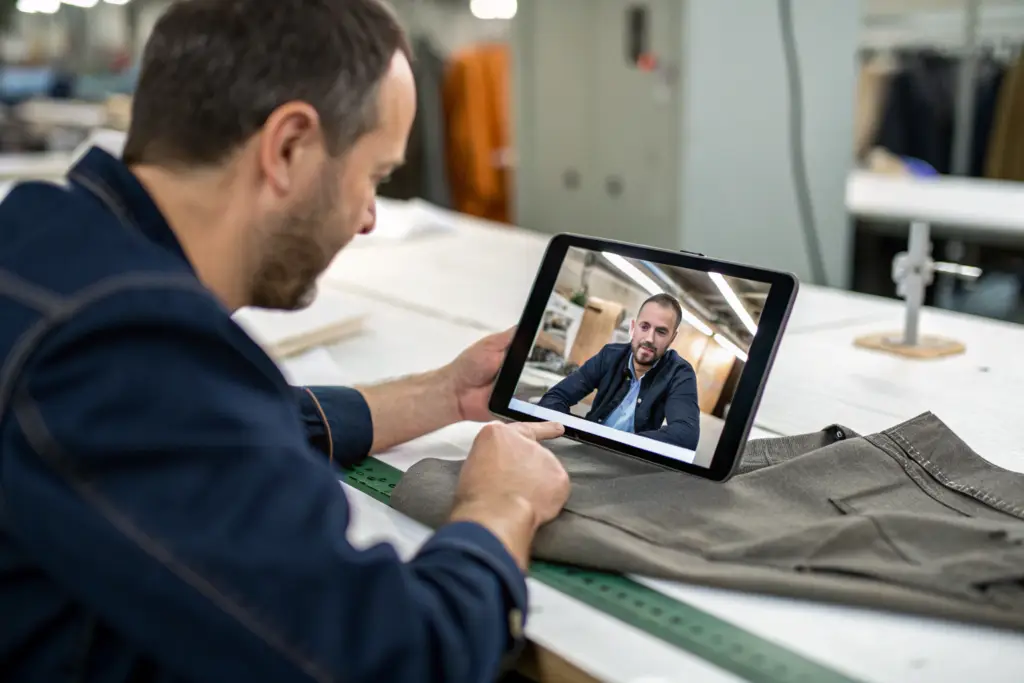
What Is a ‘Technical Video Call’ and How Does It Save Time?
A technical video call is a live, camera-to-garment inspection session. Instead of sending a long, ambiguous email describing a fit issue, you get on a call with our pattern maker and the physical sample.
We recently had a technical video call with a swimwear brand. They had received the first fit sample and were unhappy with the leg opening. They had emailed, “the leg opening feels too tight and digs in.” This description is subjective. Does it mean the elastic is too short? The fabric cut is too narrow? The stitch is not stretching enough? A typical factory would guess, adjust one variable, and send a second sample in three weeks, probably still wrong. We scheduled a 20-minute technical video call. Our pattern maker put the sample on a mannequin, zoomed in on the leg opening with a high-definition camera, and stretched the elastic with his fingers. The brand’s designer watched and said, “No, the cut is fine. It’s the elastic tension. See how it’s pulling the fabric into a ripple? We need less tension on the elastic, but a slightly wider elastic width for a flatter feel.” Our pattern maker understood instantly. He took notes, showed a sample elastic card with different widths, and they agreed on the spec live. The revision was correct on the next sample. The video call compressed what would have been a three-week, two-sample back-and-forth into a 20-minute collaborative engineering session. It preserved the designer’s nuanced tactile intent, which email language had failed to capture. We use technical video calls as a standard tool, not a special request. It is simply the most efficient way to converge on a complex technical specification across a language barrier.
Can You Really Prevent Defects Through a Communication Protocol?
Yes. Many defects are not sewing errors. They are communication errors. A buyer assumes a certain seam construction. The factory assumes a different one. Neither clarifies because the communication channel is too thin, too slow, or too linguistically vague. The garment is made perfectly to the wrong specification.
We prevent these assumption-based defects with a mandatory “Pre-Production Confirmation Protocol.” Before cutting bulk fabric, we send a digital confirmation package that includes: a photo of the actual bulk fabric with a ruler for weight/thickness reference, a photo of the actual trims (buttons, zippers, labels) placed on the fabric, a close-up video of a critical seam construction on the pre-production sample, and a one-page checklist of key specifications to confirm. The client must explicitly approve this package via email. We do not cut a single meter until we receive that written approval. For a client’s unisex linen shirt, this protocol caught a critical misalignment. The client had noted “shell buttons” on the original tech pack. Our sourcing team found beautiful, sustainable corozo nut buttons, technically a shell substitute with an identical look and better durability. The confirmation package highlighted the substitution with a note: “We recommend corozo buttons (photo attached). More durable than real shell for linen’s wash requirements. Please confirm.” The client was thrilled. They had not known corozo existed. But if we had just substituted without the confirmation protocol, the client might have opened the box, seen “not shell,” and rejected the shipment. The confirmation protocol closed the assumption gap. It forced an explicit, documented agreement on every substitution or specification point before we committed the client’s money to bulk. This is not a guarantee of zero defects. Manufacturing is a human process and errors occur. But it is a systematic elimination of the most common and costly type of defect: the defect born from unspoken, mismatched expectations.
Conclusion
The single biggest differentiator between an anxiety-inducing sourcing experience and a calm, predictable partnership is communication architecture. It is not about a factory’s sewing machines. It is about the structural way information flows from the production floor to your inbox. We have rebuilt that architecture from the ground up at Shanghai Fumao, centered around a single, technically fluent Business Director who has the authority to stop a line, the knowledge to discuss seam engineering, and the discipline to send you a weekly photo of your actual goods with a clear status and proactive alerts. We replaced the feast-famine-crisis cycle with a steady rhythm of visual updates. We replaced vague “Dear, okay” emails with specific, option-based problem-solving. And we replaced lost-in-translation technical guesswork with live video calls and written pre-production confirmation protocols that eliminate the assumption gap.
If you are tired of feeling like you are shouting into a void, or managing a supply chain on guesswork and delayed apologies, I invite you to experience a different model. Contact our Business Director, Elaine, at elaine@fumaoclothing.com with your current project or even just a painful past experience. Ask her a technical question about your garment. See how fast, how specific, and how honest the reply is. Let the communication speak for itself before you commit to anything. You deserve a manufacturing partner who treats your time, your anxiety, and your brand’s technical nuance with the same seriousness you do.