A brand owner once asked me why her factory of six years had suddenly gone bankrupt, taking her $35,000 deposit with it. The factory had beautiful samples, a charming sales manager, and a showroom full of happy client photos. What it did not have was a healthy balance sheet. The factory owner had been funding one client’s production with the deposits from the next. His current ratio, a measure of short-term assets versus short-term debts, was 0.6. He had more bills due than cash to pay them. When one large client delayed payment by 30 days, the entire operation collapsed. The brand owner never saw her deposit again. She had evaluated the factory on its samples. She should have evaluated it on its financial ratios.
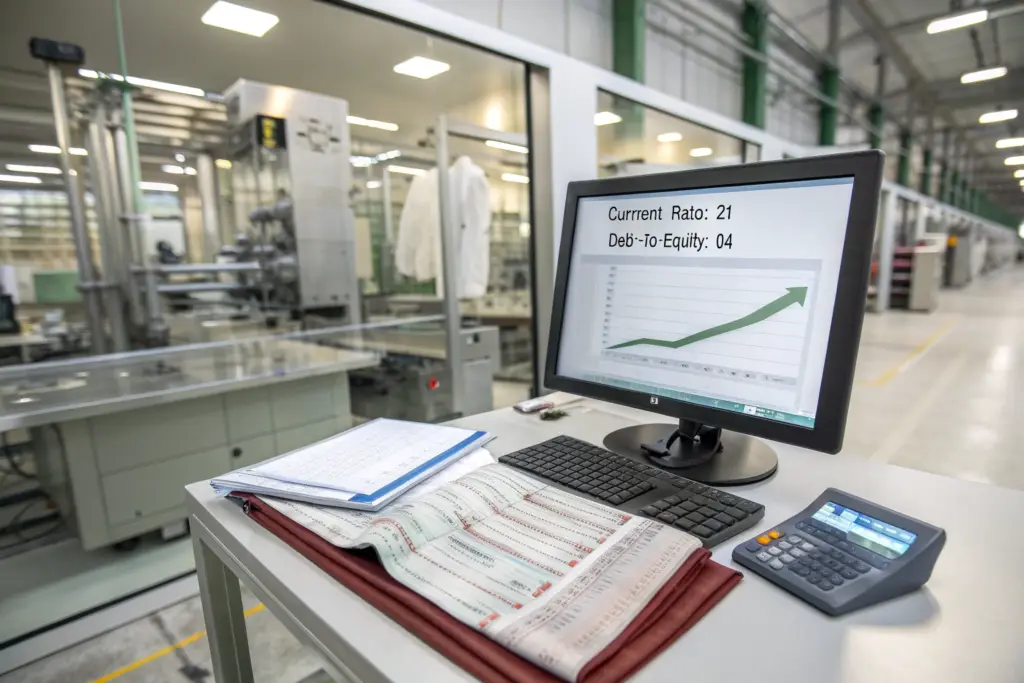
The absolute most important key indicators of a financially stable and reliable clothing manufacturer are a current ratio above 1.5, a debt-to-equity ratio below 1.0, and at least three consecutive years of positive operating cash flow. A current ratio above 1.5 proves the factory has enough short-term assets—cash, receivables, and inventory—to cover its immediate bills without using your deposit to pay last month’s fabric supplier. A debt-to-equity ratio below 1.0 proves the factory is primarily funded by owner equity, not aggressive bank loans that can be called in during a downturn. Positive operating cash flow over multiple years proves the factory’s core business generates enough cash to sustain itself without relying on new client deposits or emergency loans. These three numbers, verified by reviewed financial statements, reveal more about a factory’s reliability than any sample or sales pitch ever could.
A factory’s financial health is your brand’s financial health. You are about to send a significant deposit to a company in another country. You have a fiduciary duty to your own business to verify that the company will still exist when your goods are ready to ship. I want to share exactly how to evaluate these indicators, what questions to ask, and how Shanghai Fumao provides this transparency to our brand partners.
Why Is the “Current Ratio” the Single Most Honest Signal of a Factory’s Short-Term Survival?
I once asked a factory owner for his current ratio. He looked confused. He said he did not know it. He told me his business was "doing well, very busy." I asked to see his balance sheet. After some hesitation, he produced a document. The current ratio was 0.8. His short-term debts exceeded his short-term assets. The "busy" factory was busy because it was chasing cash to pay overdue bills. The brand owners who had placed orders with him did not know that their deposits were being used to pay for the previous season’s fabric.
The current ratio is calculated by dividing the factory’s current assets by its current liabilities. Current assets include cash, accounts receivable from clients, and inventory that can be converted to cash within one year. Current liabilities include supplier payments due, short-term bank loans, and wages payable. A ratio of 1.5 means the factory has $1.50 in short-term assets for every $1.00 in short-term debts. This is the minimum healthy level. Below 1.0 is a red flag. The factory is operating on the financial edge. Any unexpected delay in client payments or a supplier demanding cash upfront can push the factory into insolvency. A factory with a current ratio above 1.5 has a cash buffer. Your deposit goes into a segregated account. The factory pays its current bills from its own working capital, not from your order. This is the single most important number you should ask for before signing a production contract.
The current ratio is not a secret. A financially healthy factory will share it proudly. A factory that refuses to share it, or claims it is "confidential," is signaling that the number is not good.

How Can You Independently Verify a Factory’s Claimed Current Ratio?
Ask for a copy of the most recent reviewed or audited balance sheet. Look for the "Current Assets" and "Current Liabilities" lines. Perform the division yourself. A factory that provides a self-prepared, unaudited spreadsheet may be presenting an optimistic version of reality. A reviewed financial statement prepared by an external accountant carries more weight.
What Is the “Quick Ratio” and Why Does It Reveal If a Factory Is Hiding Poor Liquidity Behind Unsold Inventory?
The quick ratio is a stricter version of the current ratio. It removes inventory from current assets because inventory can be difficult to sell quickly. It reveals whether the factory can pay its immediate bills without relying on selling its fabric stock. A healthy quick ratio is above 0.8. A factory with a strong current ratio but a weak quick ratio is carrying a lot of unsold inventory, which is a risk in a fashion downturn.
How Does the “Debt-to-Equity” Ratio Predict a Factory’s Long-Term Resistance to Global Economic Shocks?
During the 2021 energy crisis in China, many factories that had borrowed heavily to expand during the post-pandemic boom collapsed. Their debt-to-equity ratios were above 2.0. When the power rationing hit, their production stopped, but their loan payments did not. The factories with debt-to-equity ratios below 1.0, those funded primarily by their owners’ own capital, tightened their belts and survived. They did not miss a single delivery.
The debt-to-equity ratio measures how much of the factory’s operations are funded by bank debt versus owner investment. A ratio of 0.5 means the factory has $0.50 of debt for every $1.00 of owner equity. This is a conservative, stable capital structure. A ratio above 2.0 means the factory is heavily leveraged. The debt payments consume a significant portion of the factory’s monthly cash flow. In a global economic shock—a spike in cotton prices, a drop in demand, a rise in interest rates—the leveraged factory is forced to cut costs to service its debt. Cost-cutting in manufacturing means cheaper materials, faster sewing speeds, and reduced quality control. The brand’s product quality erodes not because the factory is dishonest, but because the factory is drowning in debt payments. The debt-to-equity ratio predicts this erosion before it happens.
A factory that owns its machinery outright, with little bank debt, has the financial freedom to invest in quality. A factory that is making large monthly loan payments has no such freedom. The debt structure dictates the quality culture.
Why Does a Factory with High Debt Pressure Often Substitute Cheaper Raw Materials?
The loan payment is due on the 5th of the month. The cash is short. The fabric supplier offers a cheaper, lower-quality fabric that looks similar. The factory substitutes the fabric, ships the order, and uses the client’s payment to make the loan. The brand receives a garment that looks correct but fails after three washes. The debt created the incentive to cheat.
What Is the Ideal Debt-to-Equity Ratio Range for a Growing but Stable Apparel Factory?
A ratio between 0.3 and 0.8 is ideal. It indicates the factory is using some debt for growth but is primarily funded by retained earnings and owner equity. This structure allows the factory to invest in new equipment and training without being vulnerable to interest rate shocks.
What Positive Operating Cash Flow Trends Prove a Factory Is Not a Ponzi Scheme?
A factory can show a net profit on its income statement and still go bankrupt. Profit is an accounting opinion. Cash is a fact. I once reviewed the financials of a factory that a brand was considering. The income statement showed a healthy 10% net profit margin. The cash flow statement told a different story. The factory had negative operating cash flow for two consecutive years. The profit was all tied up in accounts receivable from clients who were delaying payment. The factory was paying its own suppliers with new client deposits. It was a Ponzi scheme in slow motion.
Positive operating cash flow, sustained over at least three consecutive years, is the heartbeat of a stable factory. Operating cash flow measures the cash generated by the factory’s core production activities, after paying for materials, labor, and overhead. A positive number means the business generates more cash than it consumes. A negative number means the business is burning through cash and must rely on external funding—new deposits, bank loans, or investor capital—to keep the doors open. Three consecutive years of positive operating cash flow proves the factory’s business model works across different market conditions. It survived a year when cotton prices were high, a year when a major client reduced orders, and a year when freight costs spiked. The consistency is the proof of stability.
The cash flow statement is the most under-requested document in apparel sourcing. Brands ask for samples and certifications but rarely ask for the cash flow statement. The brands that ask for it are the ones that avoid the Ponzi scheme factories.

How Can a Brand Detect a Factory That Is Using Client Deposits as Operating Capital?
Ask directly: "Do you hold client deposits in a segregated account?" A factory that does will answer immediately and confidently. A factory that does not will hesitate or give a vague answer. A segregated account is the structural protection against deposit misuse.
Why Should You Ask for Three Consecutive Years of Cash Flow Statements Instead of Just One?
A single year can be manipulated. A factory can delay supplier payments in December to make the year-end cash balance look healthier. Three years of data reveal the pattern. One good year surrounded by two bad years is a red flag.
Conclusion
The absolute most important key indicators of a financially stable and reliable clothing manufacturer are the current ratio, the debt-to-equity ratio, and the operating cash flow trend. These three numbers, verified by reviewed financial statements, reveal the factory’s ability to survive short-term shocks, resist long-term pressures, and fund its operations honestly.
The brand owner who lost her $35,000 deposit had evaluated the factory’s samples and showroom. She had not evaluated its balance sheet. The financial ratios would have revealed the impending collapse. The samples were beautiful. The numbers were terminal.
At Shanghai Fumao, we provide our current ratio, debt-to-equity ratio, and cash flow summary to any serious brand partner who requests them. We believe that financial transparency is the foundation of a trusting manufacturing partnership. A factory that hides its numbers is hiding something.
If you are evaluating a new factory, or if you want to conduct a financial health check on your current supplier, we can share the framework we use. At Shanghai Fumao, we will provide a sample financial transparency report and a checklist of the key ratios to request from any factory. Contact our Business Director, Elaine, at elaine@fumaoclothing.com. She can send you the checklist and discuss our own financial stability. Do not gamble your deposit on a beautiful showroom. Demand the numbers.