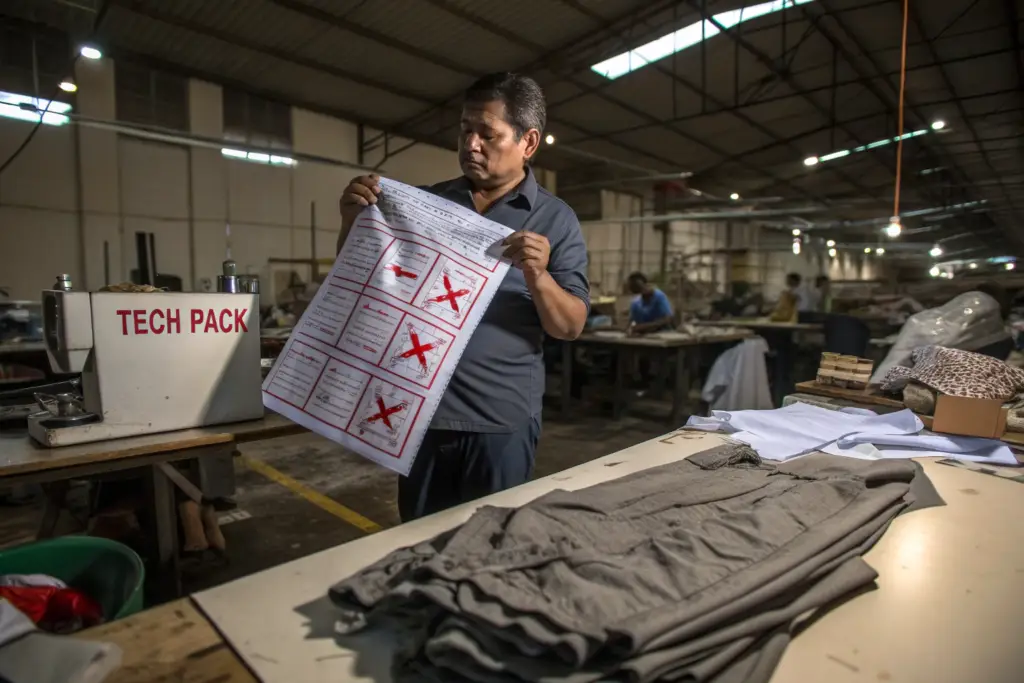
I stood beside a brand owner in our finishing room as he stared at 850 men’s dress shirts. They were supposed to have a classic spread collar. They had a narrow point collar. He was silent for a moment. Then he asked, "Why?" I opened the tech pack he had sent. It said "Collar: Standard Spread." Below the text was a sketch of a point collar. The pattern maker had followed the sketch. The brand owner had written the words. The translation between the words, the sketch, and the factory’s standard collar library had failed. The 850 shirts were perfectly sewn. They were also perfectly wrong. The cost of reworking the collars was $6,200. The cost of the delay was two weeks. The root cause was not a lack of skill. It was a tech pack that spoke three different languages.
Poorly translated and highly confusing tech packs always ruin expensive bulk garment production runs because they force the factory to interpret ambiguity instead of executing precision. A tech pack is a legally binding construction contract. When it contains vague terminology like "standard fit," contradictory specifications like a measurement that does not match the sketch, or untranslated jargon that the factory’s pattern maker cannot understand, the factory must make a decision. Different operators on the production line will make different decisions. The pattern maker interprets one way. The cutting room supervisor interprets another way. The result is a production run where the sleeves from one batch do not match the bodies from another, the fit varies between sizes, and the finished garment does not match the approved sample. The brand pays for the entire production run. The factory sewed what they understood. The brand pays for the misunderstanding.
A tech pack is not a design suggestion. It is the single source of truth for every person who touches the garment. When the truth is unclear, the garment is unclear. I want to share exactly where tech packs break down, how the breakdown translates into specific, costly defects, and how Shanghai Fumao works with brands to build tech packs that eliminate ambiguity before the cutting table is touched.
What Specific Translation Errors in a Tech Pack Force a Pattern Maker to Make a Dangerous Guess?
I have seen a tech pack specify "Fabric: Good Quality Cotton." Four words. The factory’s sourcing team had to guess. They sourced a 160 GSM cotton jersey with a standard finish. The brand owner had envisioned a 220 GSM interlock cotton with a brushed finish. The samples arrived, and the brand owner was confused. "This is not what I specified." But she had specified nothing specific. The words "Good Quality" have no objective meaning. They are a wish, not a specification.
**The most dangerous translation errors are those that replace quantifiable specifications with subjective adjectives. "Soft hand feel," "standard fit," "nice drape," and "warm fabric" are not specifications. They are opinions. A pattern maker forced to interpret "standard fit" will apply their own factory’s internal standard, which may be completely different from the brand’s intention. The factory’s "standard fit" might have 6 centimeters of ease. The brand’s "standard fit" might have 10 centimeters. The resulting garment is a size too small, and the bulk production is a loss. A tech pack must use the language of numbers: "Ease: 10cm at chest," "Fabric: 220 GSM, 100% Cotton Interlock, Brushed Finish." Numbers cannot be mistranslated. Adjectives can.
The pattern maker’s job is to build the garment from the tech pack. If the tech pack is a poem, the pattern maker must guess at the meter and rhyme. The guess is expensive.
How Should You Specify “Color Matching” to Avoid a Bulk Run Where the Sleeves and Body Are Different Shades?
Specify the exact color standard, such as "Pantone 19-4023 TCX." For multi-component garments, add a note: "All self-fabric components must be cut from the same dye lot. Trim and shell color must match within a Delta E of 1.0 under D65 lighting." This eliminates the "close enough" interpretation.
Why Must “Trims and Notions” Be Specified with Exact Supplier Codes, Not Just “YKK Zipper”?
"YKK Zipper" is a brand, not a specification. YKK produces hundreds of zipper types. You must specify the exact product code, such as "YKK #5 Metal Zipper, Antique Brass Finish, Single Slider, Auto-Lock." The product code is a unique, unambiguous identifier.
How Do Contradictory Measurements Between a Sketch and the Spec Table Lead to Irreversible Cutting Errors?
A brand owner once sent a tech pack with a beautiful sketch of a dress with an asymmetrical hem. The spec table, filled in by an assistant, listed the front and back lengths as 90 centimeters. The pattern maker saw the numbers were identical and cut both panels the same length. The sample had a straight hem. The brand owner was furious. The pattern maker had followed the spec table. The sketch was inspirational. The numbers were the contract. The numbers were wrong.
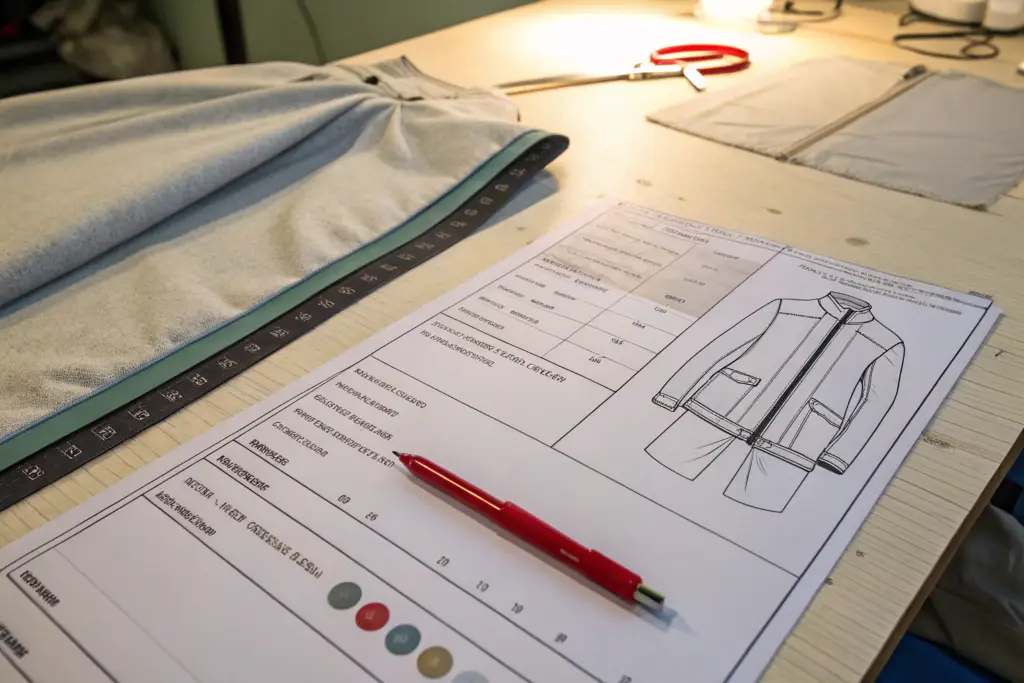
Contradictory measurements between the sketch and the spec table are a guaranteed cutting error. The factory’s cutting room works from the spec table, not the sketch. The spec table is the source of the digital marker and the cutting instructions. If the spec table contradicts the sketch, the spec table wins. The cut fabric will match the spec table. The finished garment will not match the designer’s vision. The resolution is a pre-production "Measurement Reconciliation Audit." Every measurement on the sketch must be checked against the spec table. Any discrepancy must be resolved and the spec table updated before the pattern is graded. The sketch is the design intent. The spec table is the manufacturing contract. They must agree.
The spec table is not an administrative form. It is the most important document in the tech pack. An error in the spec table is an error in the physical dimensions of the garment. The error is cut into the fabric and cannot be undone.
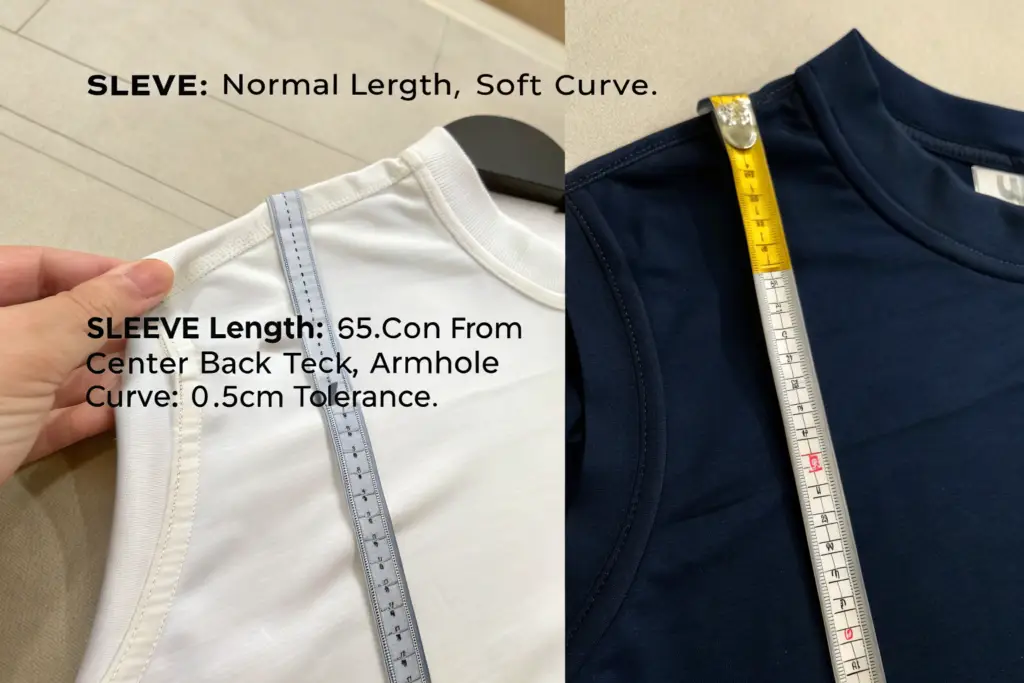
What Is a “Measurement Point of Origin” Discrepancy and Why Does It Create Sleeves That Are Too Short?
The brand measures sleeve length from the center back neck. The factory measures sleeve length from the shoulder seam. The spec table says "Sleeve Length: 85cm" but does not specify the point of origin. The factory cuts the sleeve at 85cm from the shoulder seam. The finished sleeve is 5cm too short. The point of origin must be diagrammed and labeled on every measurement in the tech pack.
How Should You “Reconcile” a Tech Pack Before Sending It to Ensure the Sketch, Specs, and BOM All Tell the Same Story?
Assign one person to audit the tech pack before it leaves your office. They must physically lay the sketch next to the spec table and the bill of materials. Every measurement on the sketch must have a corresponding entry in the spec table. Every trim in the sketch must appear in the bill of materials. Any discrepancy is a red flag that must be resolved before the document reaches the factory.
What Construction and Finishing Terminology Causes a Sewing Line to Produce a Completely Wrong Finish?
A brand owner specified "Blind Hem" on a pair of silk trousers. The factory produced a hem that was indeed stitched blind, but the stitch tension was too tight, creating a puckered, rippled hem. The brand owner had assumed "Blind Hem" included an understanding of the required tension for lightweight silk. The factory had followed the literal instruction. The result was technically correct and aesthetically unacceptable.
Construction terminology is a minefield because the same word can mean different things in different factories. "Clean Finish" to one factory means a French seam. To another, it means a simple overlocked edge. "Edge Stitch" can mean stitching 1 millimeter from the edge or 3 millimeters. You must replace all subjective construction terms with specific ISO stitch numbers and millimeter distances. Instead of "Blind Hem," specify "ISO 103 Blindstitch, Stitch Density 8 SPI, Tension: Loose to prevent puckering on silk." The ISO stitch number is an international standard. It cannot be misinterpreted. The combination of the ISO number and the millimeter measurement locks the construction into an objective, verifiable specification.
The sewing operator is not a mind reader. They are a technician executing a specification. If the specification is ambiguous, they will default to the fastest, easiest interpretation. The fast interpretation is rarely the luxury interpretation.
Why Is “Topstitch Edge” Ambiguous and How Should It Be Replaced with a Millimeter Distance?
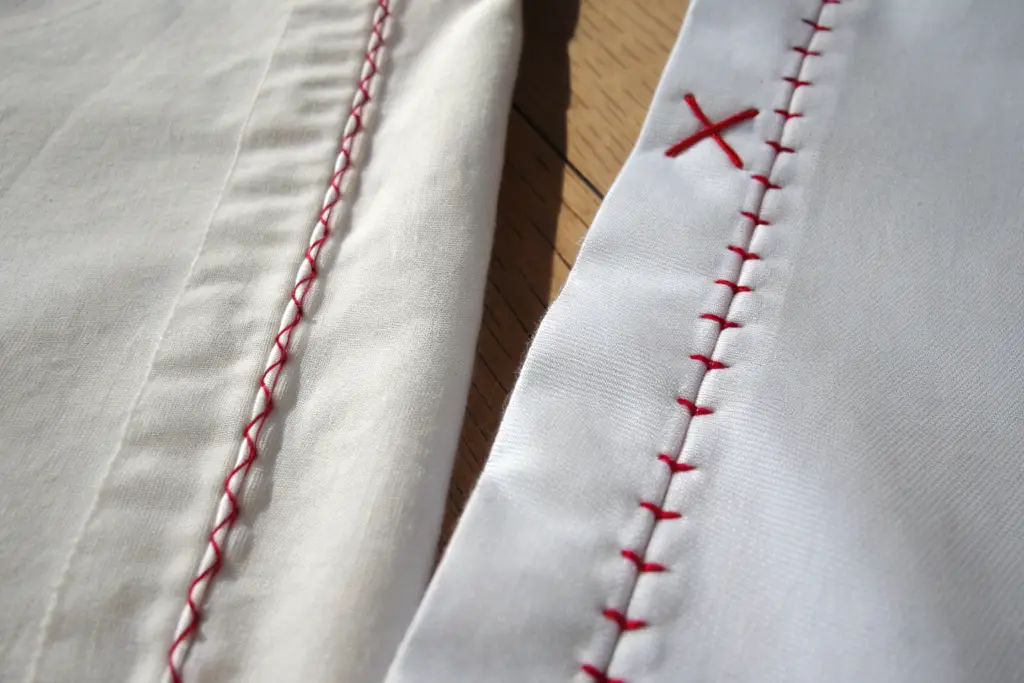
"Topstitch Edge" does not specify the distance from the seam. Is it 2 millimeters? 5 millimeters? 10 millimeters? The visual difference is significant. Specify "Topstitch 5mm from Seam."
How Do You Specify Pressing and Creasing to Prevent a “Home-Made” Wrinkled Look on a Delicate Summer Blouse?
Specify the pressing method, temperature, and tool. "Press collar flat using vacuum steam table, 110°C, with protective press cloth. Do not crease lapel." The specificity eliminates the "I thought it looked fine" response.
Conclusion
Poorly translated and confusing tech packs ruin expensive bulk production runs because they replace objective, measurable specifications with subjective, interpretable language. The $6,200 collar disaster was not caused by a bad factory. It was caused by a tech pack that contained a word sketch conflict. The factory made the wrong choice. The brand paid for the wrong choice.
The tech pack is the most important document in your manufacturing process. It is the legal, technical, and creative contract between your brand and your factory. Investing the time to write it in the language of precise, verifiable numbers is not a bureaucratic exercise. It is the most profitable use of your pre-production time.
At Shanghai Fumao, we work with our brand partners to audit tech packs before sampling begins. We flag ambiguous language, contradictory measurements, and missing specifications. We provide a standardized tech pack template that prompts for the specific, objective details that eliminate guesswork. We do this because we know that our sewing line can only produce what the tech pack specifies. A clear tech pack produces a clear garment.
If you want to ensure your next tech pack is a precise manufacturing contract, not a creative writing exercise, we can help. At Shanghai Fumao, we will review your current tech pack and provide a gap analysis with specific recommendations for improvement. Contact our Business Director, Elaine, at elaine@fumaoclothing.com. She can send you our standard tech pack template and a checklist for a pre-production measurement reconciliation audit. Build your garment on a foundation of clear numbers, not vague adjectives.