A Charlotte-based lifestyle brand once ordered their bestselling cotton crewneck sweatshirt in exactly two colors—black and oatmeal—for the Fall season. The logic seemed sound. Black had been a top seller for three consecutive seasons. Oatmeal was the seasonal neutral that their wholesale buyers had requested. The order was 600 units in black and 400 units in oatmeal. By week three of the season, black was 85% sold through, and oatmeal was 28% sold through. The black reorder would take five weeks to arrive. The oatmeal was heading toward a 60% clearance markdown. The brand had bet heavily on two colors, one of which the market had quietly rejected. Two months later, a competitor launched a similar crewneck in five colors—black, charcoal, navy, burgundy, and sage green. Their black sold out. Their charcoal and navy performed strongly. Their burgundy was moderate. Their sage green was the slowest seller, but they only had 200 units of it, and the strong performance of the other four colors absorbed the minor loss on the fifth.
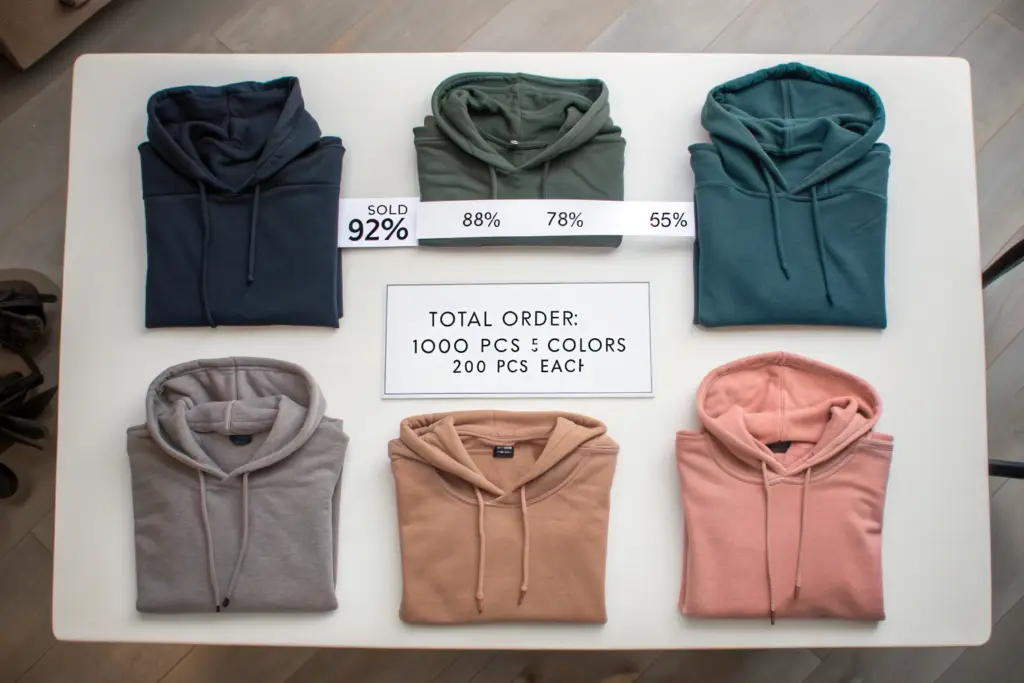
Dividing a 1000-piece apparel order into five colors at 200 pieces per color is the optimal inventory strategy because a five-color distribution provides sufficient market variety to attract a broad customer base and generate sell-through data across multiple color preferences, creates a statistically safer portfolio where the strong sell-through of the top two to three colors compensates for the moderate or slow performance of one or two weaker colors, maintains a per-color quantity large enough to cover the factory's small-batch dyeing setup cost without excessive surcharges, and ensures that if one color severely underperforms, only 20% of the total inventory investment is exposed to markdown risk rather than 50% or 100%.
At Shanghai Fumao, I have observed the sell-through data of hundreds of brand orders across multiple seasons, and the five-color, equal-split model consistently produces the healthiest blend of full-price sell-through, customer acquisition, and minimized end-of-season markdown liability.
Why Is a "Five-Color Portfolio" Statistically Safer Than a "Two-Color Concentration" for an Unproven Seasonal Palette?
A Denver-based outdoor lifestyle brand once placed their entire Fall order of 2,000 fleece vests in two colors: a "seasonal" burnt orange that their designer loved and a safe charcoal grey. The designer's burnt orange was a personal passion, not a market-tested preference. The charcoal grey sold out. The burnt orange sold 18 units across all channels. The brand was forced to mark down the remaining 982 burnt orange vests to below cost, and the loss on the orange inventory wiped out the profit from the charcoal sell-out. The brand had gambled 50% of their seasonal inventory on an untested color, and they had lost.
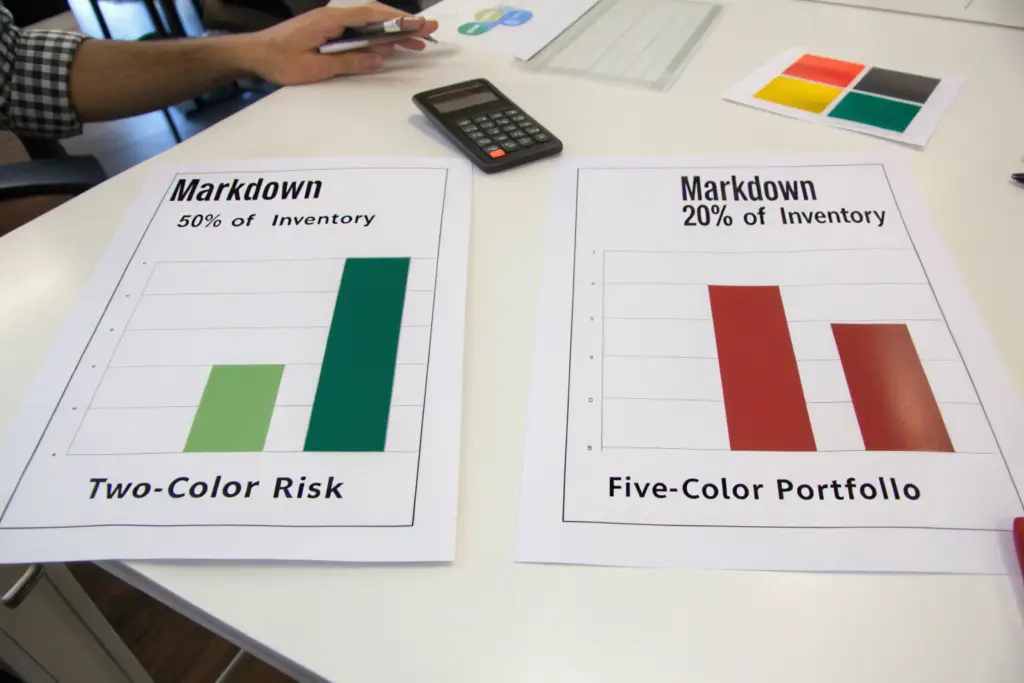
A five-color portfolio is statistically safer than a two-color concentration because it distributes the brand's inventory investment across five independent consumer preference bets, where the probability that all five colors will simultaneously underperform is dramatically lower than the probability that one of two colors will miss the market, and the typical sell-through pattern—where two colors achieve 85-95% sell-through, two colors achieve 65-80% sell-through, and one color may achieve 40-60% sell-through—produces a blended, full-price sell-through rate that is consistently 10-18 percentage points higher than the blended rate of a two-color order where one color's failure drags down half the total investment.
Consumer color preference is inherently unpredictable at the individual color level. A brand's internal color preference, or even a single wholesale buyer's preference, is a sample size of one. A five-color launch is a market research experiment with five independent variables, where the strong performers mathematically dilute the impact of the weak performers.
How Does the "Portfolio Diversification" Principle From Financial Investing Apply to Apparel Color Allocation?
In finance, diversifying a portfolio across multiple uncorrelated assets reduces the overall volatility and risk of catastrophic loss. In apparel, diversifying an order across multiple colors reduces the risk that a single unpopular color will destroy the season's margin. A 20% allocation to a losing color is absorbable; a 50% allocation is often fatal.
What Is the Statistical Probability That Three Out of Five Colors Achieve a Sell-Through Above 70%?
Based on historical sell-through data across multiple brands and categories, approximately 60-70% of colors in a well-selected seasonal palette achieve a sell-through above 70%. The five-color model provides enough variety that the statistical average asserts itself, while a two-color model is dominated by the unique, unpredictable fate of each individual color.
How Does the "200 Pieces Per Color" Quantity Balance the Factory's Dyeing Minimums With the Brand's Inventory Risk?
A Brooklyn-based contemporary brand once requested a split of their 1,000-piece sweatshirt order across ten colors at 100 pieces per color. The factory's dye house quoted a setup surcharge of $45 per color, totaling $450 in dyeing setup fees across the ten colors—$0.45 per unit. The brand accepted. When the order arrived, the per-color quantities were so small that the brand could not generate statistically meaningful sell-through data, and the reorder minimum of 200 pieces per color meant they could not economically replenish the three colors that sold well. The brand had over-optimized for variety and under-optimized for economic replenishment.
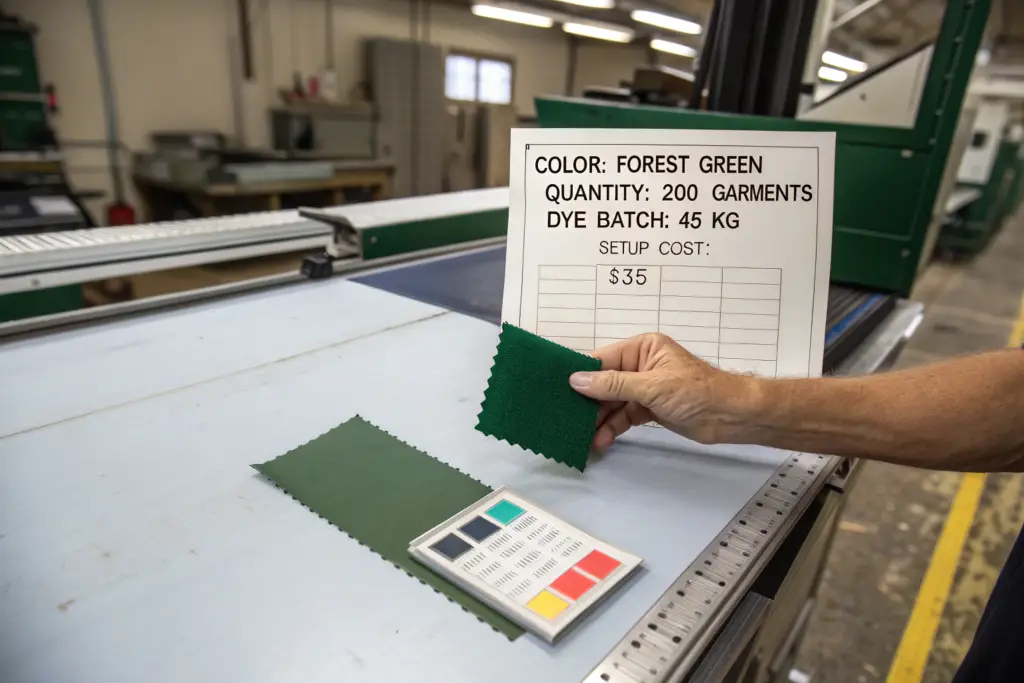
The 200-piece per color quantity balances the factory's dyeing minimums with the brand's inventory risk because a typical small-batch garment dyeing vessel has a minimum economic load of approximately 40-60 kilograms, which translates to roughly 150-250 medium-weight garments depending on the fabric weight, and an order of 200 pieces per color reaches this minimum threshold without incurring an excessive per-unit surcharge—typically keeping the per-color setup cost to $0.15-$0.30 per unit—while also providing enough units per color to generate statistically readable sell-through data and to economically justify a replenishment order if a color sells well.
Below 150 pieces per color, the dyeing setup cost per unit rises sharply because the fixed setup cost is amortized over too few units. Above 300 pieces per color, the brand's exposure to a single color's failure becomes uncomfortably high. The 200-piece quantity sits precisely at the intersection of factory economics and brand risk management.
How Is the "Per-Color Dyeing Setup Cost" Calculated, and Why Does It Decrease Per Unit as the Batch Size Increases?
The setup cost includes the dye formulation labor ($15-$25), the machine cleaning between colors ($20-$35), and the color sorting labor ($10-$15). This fixed cost of approximately $45-$75 per color is divided by the number of units in the batch. At 100 pieces, the cost is $0.45-$0.75 per unit. At 200 pieces, it drops to $0.23-$0.38 per unit. At 500 pieces, it drops further to $0.09-$0.15 per unit.
Why Is "200 Pieces Per Color" the Minimum Quantity for a Statistically Meaningful Sell-Through Reading?
A sell-through percentage based on only 100 units is highly sensitive to random noise—a single wholesale order of 20 units can shift the apparent sell-through by 20 percentage points. A sell-through based on 200 units is more stable and provides a more reliable signal for reorder decisions.
How Does a "Lead Color Plus Support Colors" Model Use a 1000-Piece Order to Generate Reorder Data for the Following Season?
A San Diego-based resort wear brand once treated every season as an independent, isolated decision. They selected new colors for the linen shirt every season based on the founder's intuition and the latest trend reports. They never used the previous season's sell-through data to inform the next season's color allocation. The result was a perpetual guessing game, with wild swings between runaway sell-outs and deep markdowns, and no systematic learning from the market's actual preferences.
The "Lead Color Plus Support Colors" model uses a 1000-piece, five-color order as a real-time market research instrument, where the current season's sell-through data for each color is recorded weekly, and at the end of the season, the top-performing color—the one that achieved the highest full-price sell-through with the lowest return rate—is promoted to "Lead Color" status for the following season, receiving a 35-40% allocation of the next order, the second and third performers are designated as "Support Colors" and receive 20-25% each, the fourth color is maintained at a reduced 10-15% allocation, and the worst-performing color is dropped entirely and replaced by a new, untested color, creating a continuous, data-driven cycle of color portfolio optimization.
The 1000-piece, five-color order is not just inventory; it is a market research panel. The 200 customers who buy the charcoal hoodie this season are voting with their wallets for charcoal. The brand listens, and next season, charcoal gets a larger allocation. The color that received only 85 purchases is quietly retired.

How Does a "Weekly Sell-Through Tracker" Feed Directly Into the Following Season's Color Allocation Plan?
The brand's operations team maintains a simple spreadsheet that tracks, for each color, the number of units sold each week, the cumulative sell-through percentage, and the current weeks of inventory remaining. At the end of the season, the final sell-through percentages become the primary input for the next season's color allocation quantities.
Why Is It Critically Important to "Replace the Worst Performer, Not Add a Sixth Color"?
Adding a sixth color increases the total order quantity to 1,200 pieces, which increases the brand's total inventory investment and may exceed the factory's greige fabric buffer capacity. Replacing the worst-performing color with a new, untested color keeps the total order at 1,000 pieces, maintains the manageable five-color structure, and continuously refreshes the color palette without increasing inventory risk.
What Specific "Greige Fabric Reservation" Strategy Enables Rapid Replenishment of the Best-Selling Colors Without Overcommitting on the Slower Colors?
A Chicago-based streetwear brand once experienced a frustrating and costly reorder failure. Their black hoodie sold out in three weeks. The customers were demanding more. The wholesale accounts were requesting restock. The brand placed a reorder with the factory, only to be told that the specific greige fleece fabric was out of stock at the mill, and the next production run was six weeks away. The brand lost six weeks of peak season sales on their best-selling product. The demand was there, the customers were there, but the fabric was not.
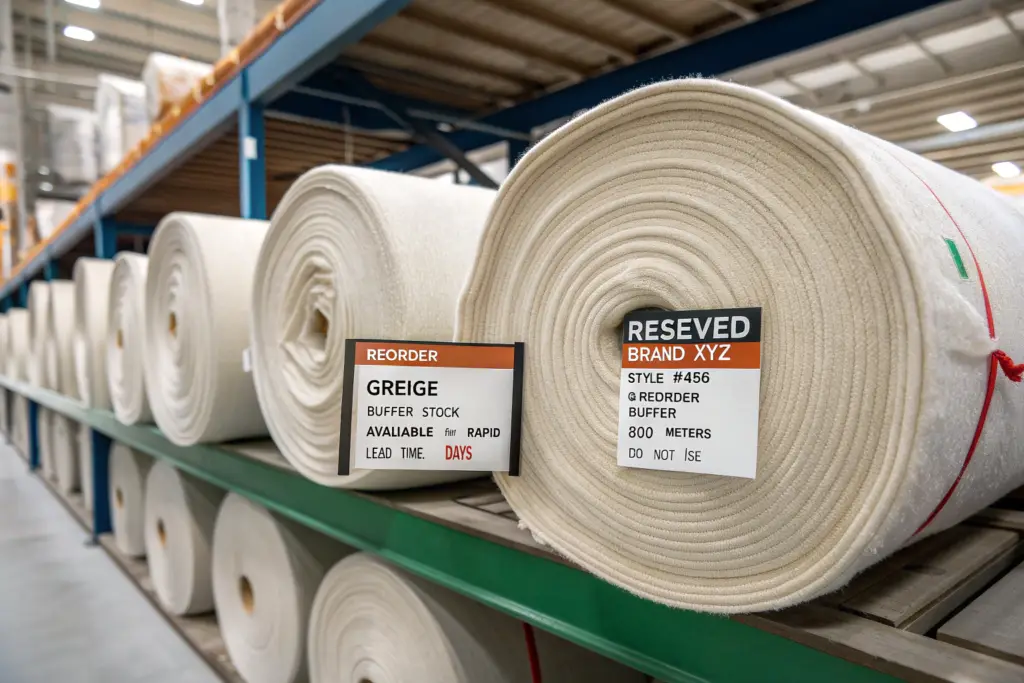
The greige fabric reservation strategy for rapid replenishment involves pre-negotiating with the factory, at the time of the initial 1000-piece order, a "Replenishment Buffer Stock" of an additional 30-40% of the greige fabric yardage that is physically reserved in the factory's warehouse under the brand's PO number but is not dyed or cut until the sell-through data from the initial order identifies the top two performing colors, at which point the reserved greige fabric is rapidly dyed to those specific winning colors and sewn into a replenishment order within 10-14 days, while the reserved greige for the slower colors is either returned to the mill's general stock or reallocated to the winning colors.
The greige buffer is an insurance policy against the best-case scenario—a sell-out. The brand pays a small reservation fee or commits to a minimum annual volume in exchange for the factory holding the undyed fabric in reserve. When the black hoodie sells out, the greige buffer is immediately activated.
How Is the "Replenishment Buffer Stock" Quantity Calculated as a Percentage of the Initial Order?
The buffer stock is typically calculated as 30-40% of the total initial order yardage. For a 1,000-piece order, the buffer stock might be sufficient for an additional 300-400 units. This quantity is large enough to capture the upside of a sell-out but small enough that the brand is not committed to purchasing fabric for colors that may not sell.
Why Does a "Pre-Negotiated Replenishment Price" Lock in the Margin on the Reorder Before the Initial Order Even Ships?
The brand and factory agree on the replenishment unit price—including the dyeing and sewing costs—at the time of the initial contract. This prevents the factory from raising the price on the best-selling color after the brand is dependent on rapid restocking, a situation known as "demand ransom."
Conclusion
Dividing a 1000-piece apparel order into five colors at 200 pieces per color is not an arbitrary symmetry. It is a financially optimized strategy that balances factory production economics with brand inventory risk management. The five-color portfolio diversifies the brand's color risk, reducing the probability that a single unpopular color will destroy the season's margin. The 200-piece per-color quantity sits at the intersection of reasonable dyeing setup costs and statistically meaningful sell-through data. The lead color and support color model transforms each season's order into a market research panel that continuously optimizes the following season's color allocation. The greige fabric reservation strategy prepares the supply chain for the best-case scenario—a rapid, profitable replenishment of the winning colors.
At Shanghai Fumao, I actively encourage brand partners to adopt the five-color model for their initial orders on a new style. My garment dyeing facility can economically process color batches as small as 150-200 pieces. My greige fabric reservation system allows brands to hold buffer stock for rapid replenishment. My production planning team is experienced in managing multi-color orders with transparent, itemized color-split surcharges.
If you are a brand buyer planning your next seasonal order and you want to implement the five-color inventory strategy, contact my Business Director, Elaine. She can share our color-split cost breakdown, our greige reservation agreement template, and our seasonal sell-through tracker format. Reach Elaine at: elaine@fumaoclothing.com. Diversify your colors, protect your margin, and let the market tell you what it wants.