A Seattle-based contemporary womenswear brand once ordered 2,000 units of a bestselling wrap dress in a new seasonal color. The brand's designer emailed the factory a single sentence: "Make the waist tie a little longer this season, and use a slightly warmer shade of blush pink." The factory's project manager read the email, extended the waist tie by three inches, and selected a pink fabric that was noticeably peach-toned rather than blush. The dresses arrived. The waist tie was too long, dragging awkwardly below the knee. The pink clashed horribly with the brand's existing blush-toned collection pieces. The entire order was marked down by 55%. The brand owner blamed the factory. The factory project manager pointed to the email and said, "I did exactly what you asked." Neither party was lying. The communication itself was the defect.
To completely avoid miscommunication when ordering custom wholesale women wear, you must eliminate every subjective, interpretable word from your order communication and replace it with a numbered, measured, physically referenced system: every design detail is linked to a numbered callout on a technical sketch, every measurement is specified in both inches and centimeters with a defined measurement method diagram, every color is specified by a Pantone code and a physical, signed lab dip swatch, every trim component is physically attached to a signed specimen card, and every revision is documented in a single, sequential, timestamped cloud-based revision log that both parties formally acknowledge before production begins.
At Shanghai Fumao, I have learned that the most expensive word in women's apparel manufacturing is "slightly." Slightly longer. Slightly warmer. Slightly looser. Every "slightly" is a $10,000 guessing game. My production team is trained to stop and request a numerical specification the moment they encounter any subjective adjective in a brand's communication.
Why Does "Subjective Adjective Elimination" Prevent 90% of Custom Order Miscommunications?
An Austin-based boutique brand once asked their factory to "make the fit a little more relaxed through the hip" on their bestselling trouser. The pattern maker, interpreting "relaxed," added 6cm to the hip circumference. The resulting trousers were comically oversized, with a dropped crotch and a silhouette that looked nothing like the original design. The brand owner was furious. The pattern maker was confused. The phrase "a little more relaxed" meant +1.5cm to the brand owner, who had a specific, unspoken reference point in her mind. It meant +6cm to the pattern maker, who had a different, equally valid interpretation. Neither person realized their internal reference points were different until the trousers arrived.
Subjective adjective elimination prevents 90% of custom order miscommunications because adjectives like "looser," "softer," "warmer," "drapier," and "more fitted" describe a sensory experience that exists only in the speaker's mind, and when these words are transmitted across linguistic, cultural, and experiential boundaries to a factory project manager who has never worn the brand's clothing or met the brand's customer, the words are translated into a physical action—adding fabric, changing a dye formula, adjusting a seam—based on the project manager's own, different sensory reference points, creating a physical output that matches neither the brand's unspoken expectation nor the factory's well-intentioned interpretation.
The designer has been fitting the brand's signature trouser on the same fit model for four seasons. Her "relaxed" is a very specific, minor adjustment to a known, proven fit block. The factory's pattern maker has never seen the fit model, has never worn the trouser, and does not know the brand's fit philosophy. His "relaxed" is a generic, safe interpretation that applies a standard ease addition. The solution is not better translation; it is the complete elimination of translatable words.
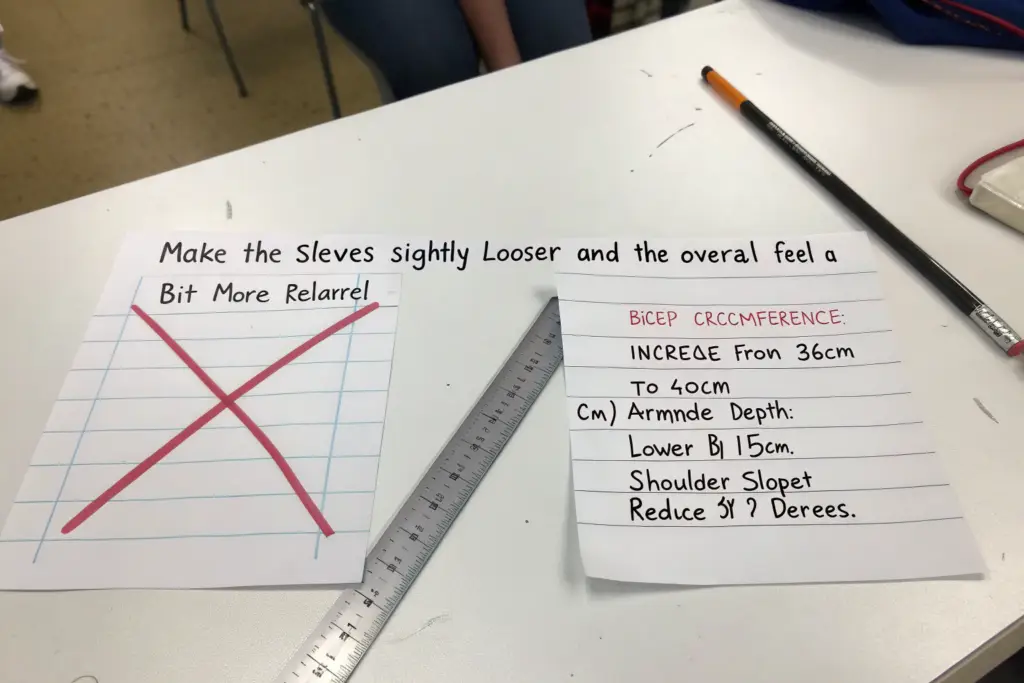
How Does a "Before and After Measurement Table" Replace the Word "Looser" in a Fit Revision Request?
Instead of writing "Make the hip looser," the brand provides a table with two columns: "Current Measurement" and "New Target Measurement." The row reads: "HIP CIRCUMFERENCE (MEASURED 20CM BELOW WAIST): Current 96cm, New Target 98.5cm (+2.5cm)." The pattern maker adjusts the pattern by exactly 2.5cm. There is no interpretation, no guesswork, and no error.
Why Should a Brand Provide a "Maximum Acceptable Measurement" Alongside a "Target Measurement"?
Fabric has inherent production variance. Providing a target of 98.5cm with a maximum acceptable of 99.5cm defines a clear range of acceptability. The factory's QC team can measure the bulk production and immediately know whether each unit passes or fails, without needing to contact the brand for clarification.
How Does a "Physical Reference Sample Kit" Communicate Feel, Drape, and Color Far More Accurately Than Any Digital File?
A New York luxury womenswear brand once approved a fabric color digitally via a calibrated photograph and a Pantone code. The digital approval was technically perfect—the spectrophotometer reading showed a Delta-E of 0.8. When the bulk fabric arrived, the brand owner immediately rejected it. The color, under the brand's specific boutique lighting, had a subtle cool undertone that the digital photograph had not captured and the spectrophotometer had measured as statistically insignificant. The color was objectively correct by every measurable standard. It was subjectively wrong to the designer's eye. A physical lab dip swatch, held under the boutique's actual lighting, would have revealed the undertone discrepancy immediately.
A physical reference sample kit communicates feel, drape, and color more accurately than any digital file because the tactile and visual experience of a fabric—its hand feel against skin, its drape under gravity, its color under specific retail lighting, its sound when rustled—cannot be fully captured by a photograph, a spectrophotometer reading, or a written description, and a sealed, signed physical sample provides a three-dimensional, multi-sensory reference standard that the factory's production team can physically touch, hold against the bulk production, and compare directly, eliminating the sensory gap that digital communication inherently creates.
A customer does not experience a garment through a screen. She touches it, holds it up to the light, tries it on, and moves in it. The factory must have a physical reference that captures all of these sensory dimensions. A PDF cannot be touched.
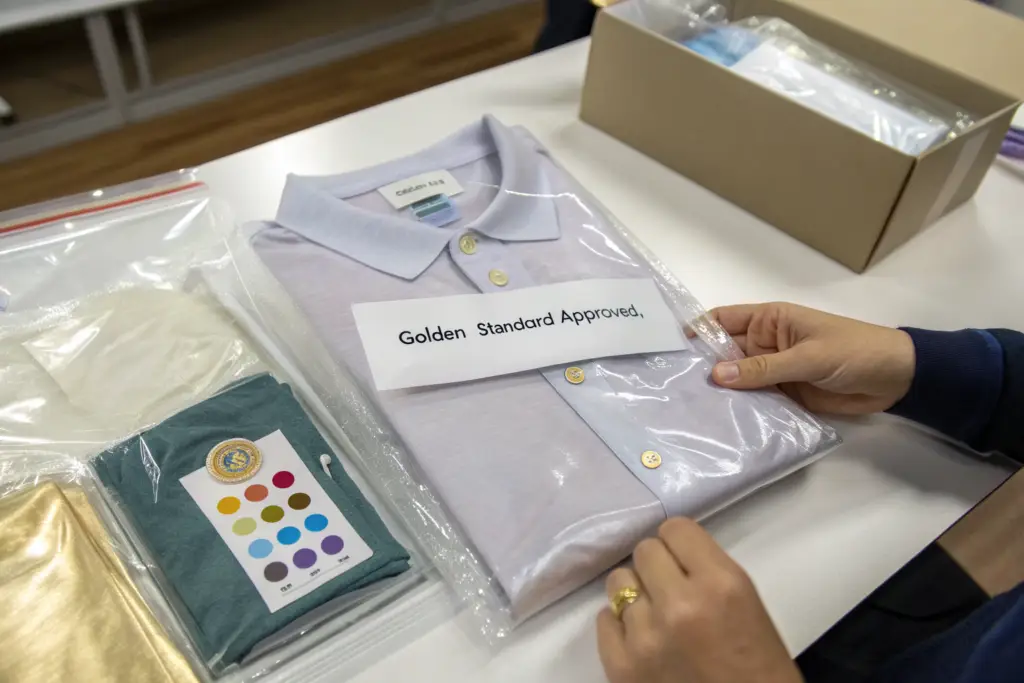
How Does a "Sealed and Signed Golden Sample" Differ From a Standard Pre-Production Sample in a Quality Dispute?
A standard pre-production sample can be swapped, damaged, or disputed. A Golden Sample is sealed inside a tamper-proof plastic evidence bag with a holographic security seal signed across the seal by both the brand owner and the factory director. If a quality dispute arises, the seal is broken in the presence of both parties, and the Golden Sample is the legally binding reference standard.
Why Should a "Trim Specimen Card" Include a Burn-Tested Thread Sample?
A thread that looks identical to the specified thread on a digital screen may be a cheaper, weaker alternative. A physical thread sample on the Trim Specimen Card allows the factory's QC team and the brand's inspector to perform a simple flame test: cotton burns to soft ash, polyester melts into a hard bead, nylon melts and shrinks. The physical thread sample provides an unforgeable reference for material authenticity.
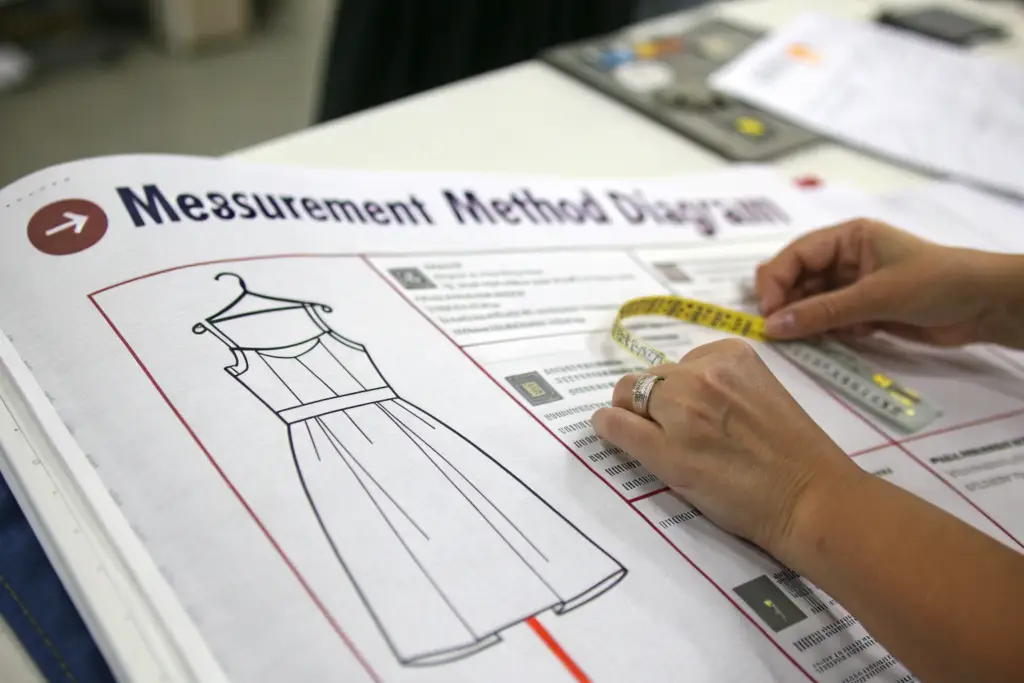
What Is a "Measurement Method Diagram" and Why Does It Prevent the "Curve Versus Straight" Dispute on Every Garment?
A San Diego-based resort wear brand once specified a "Chest Circumference" measurement on their tech pack. The factory measured the chest circumference with the garment lying flat, measuring from side seam to side seam and doubling the number. The brand measured the chest circumference with the garment on a dress form, measuring the full circumference around the body. The two measurement methods produced a 3cm difference. The factory's measurement was technically correct within their standard operating procedure. The brand's measurement was also correct within theirs. The 3cm gap was not a manufacturing error; it was a measurement method mismatch that neither party had recognized until the bulk order arrived.
A Measurement Method Diagram prevents the curve versus straight dispute by visually defining, for every numbered measurement point on the tech pack, exactly where the tape measure is placed, whether the measurement is taken flat or on a body, whether the tape follows a curve or measures in a straight line, and whether the garment is stretched or relaxed during measurement, replacing the written measurement name—which is subject to interpretation—with a visual, unambiguous instruction that a sewing operator or QC inspector can replicate precisely, regardless of their native language.
"Armhole Depth" is a measurement name. A diagram showing a tape measure following the curved armhole seam, starting at the shoulder point and ending at the underarm intersection, is a measurement method. The name is ambiguous. The diagram is not.
How Does a "Flat Versus On-Body" Measurement Definition Prevent a 3cm Discrepancy on a Stretch Garment?
A measurement taken with the garment lying flat on a table will differ from a measurement taken with the garment on a body or a dress form, especially on a stretch fabric. The measurement method diagram must specify: "Measured flat, unstretched, on a calibrated grid mat."
Why Should Every Measurement Point Include a Small "Tape Measure Placement" Diagram?
The diagram eliminates the need for language. The factory operator looks at the diagram, sees exactly where the tape measure is placed and how it follows the seam, and replicates the action. She does not need to read English, Chinese, or any written instruction.
How Does a "Single Revision Thread" Protocol Prevent the "Which Email Is the Latest?" Version Disaster?
A Chicago-based dress brand once changed the sleeve length specification on their bestselling midi dress three times during a single production cycle. The first change was sent via email. The second change was communicated during a WhatsApp call. The third change was a handwritten note on a PDF that was emailed back to the factory. The factory's project manager, managing thirty simultaneous orders, missed the third change entirely. The dresses were produced with Revision 2 sleeve lengths. The brand rejected the shipment. The factory pointed to the WhatsApp message as the latest approved version. The brand pointed to the annotated PDF. Neither had a single, acknowledged, sequential record of truth.
A Single Revision Thread protocol prevents version control disasters by establishing one shared, cloud-based document as the exclusive communication channel for all order revisions, where every change is added as a new, dated, timestamped, and sequentially numbered entry at the top of the document, all previous specifications are visibly struck through but never deleted, both the brand representative and the factory project manager formally acknowledge each revision with a digital timestamp, and the production floor is contractually prohibited from acting on any revision that does not appear in this single document, regardless of what was discussed in any email, phone call, or messaging app.
Email is a conversation. WhatsApp is a chat. A phone call is a memory. The single revision thread is the legal record. The production floor is trained to check one place and one place only for the current, authorized specification. Any instruction that arrives through any other channel is ignored.
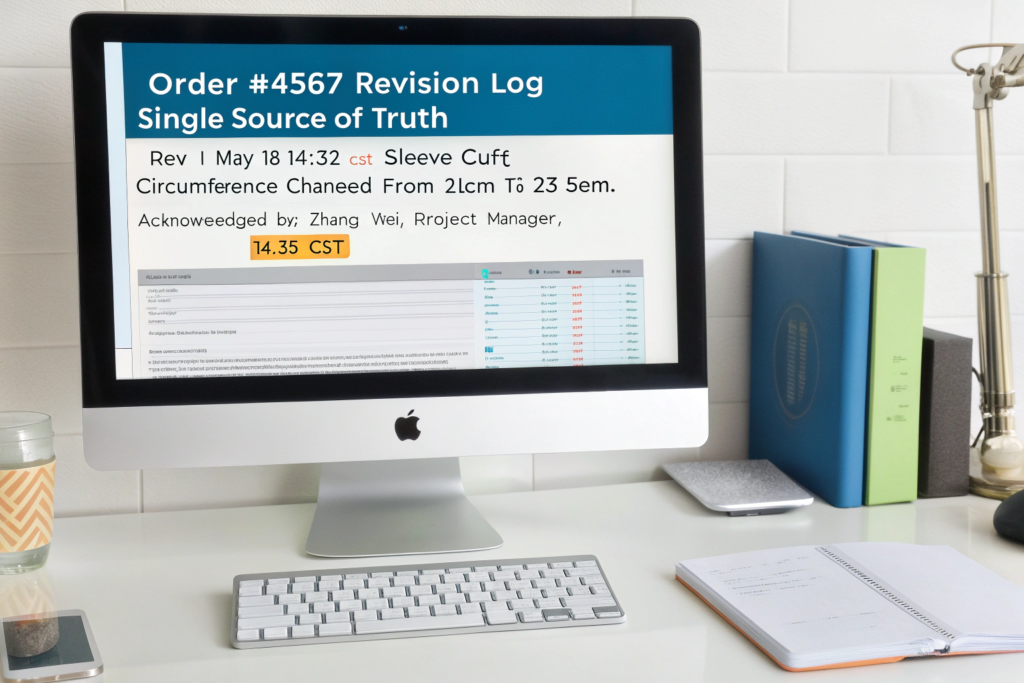
Why Must "Both Parties Formally Acknowledge" Each Revision With a Timestamped Digital Signature?
An unacknowledged revision is legally ambiguous. The brand can claim they sent the change; the factory can claim they never saw it. A digital acknowledgment—a click, a timestamp, an IP address log—closes this loophole. The factory project manager clicked "Acknowledged" at 14:35 on May 18. The legal record is complete.
How Does the "Production Floor Prohibition" Clause Enforce the Single Revision Thread as the Only Valid Instruction Source?
The manufacturing agreement includes a clause: "The production floor is authorized to act only on specifications contained in the cloud-based Revision Log document. Any instruction communicated via email, messaging app, or verbal conversation that is not subsequently entered into the Revision Log is not authorized for production." This clause legally protects both parties from informal, unrecorded changes.
Conclusion
Completely avoiding miscommunication when ordering custom wholesale women wear is achieved by building a communication system where subjective adjectives do not exist, physical references replace digital approximations, measurement methods are visually diagrammed, and every revision lives in a single, acknowledged, sequential thread. The brand that writes "make it slightly looser" will lose money. The brand that writes "Increase hip circumference from 96cm to 98.5cm, measured flat, 20cm below waist seam, maximum acceptable 99.5cm" will receive exactly the garment they intended. The brand that approves a color from a digital photo will be surprised. The brand that approves a physical, sealed, signed lab dip swatch will receive the color they touched with their own hands.
At Shanghai Fumao, my production team is trained to request a numerical specification, a physical reference, or a measurement method diagram the moment they encounter any ambiguity in a brand's communication. We do not guess. We do not interpret. We verify, we measure, and we confirm. This discipline protects both the brand and the factory from the costly consequences of miscommunication.
If you are a brand buyer preparing to place a custom wholesale women's wear order and you want a manufacturing partner who will force the elimination of every ambiguous instruction before it reaches the cutting table, contact my Business Director, Elaine. She can share our Measurement Method Diagram template, our Physical Reference Sample protocol, and our Single Revision Thread document format. Reach Elaine at: elaine@fumaoclothing.com. Communicate in numbers, physical references, and diagrams, not in adjectives.