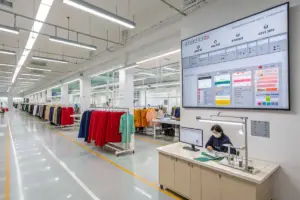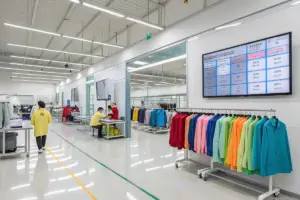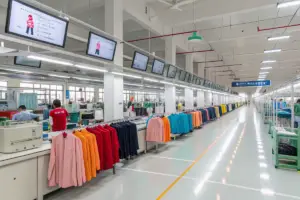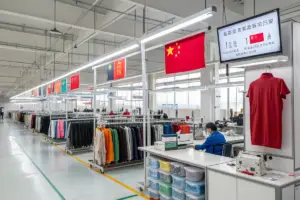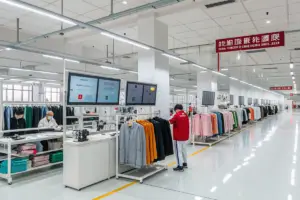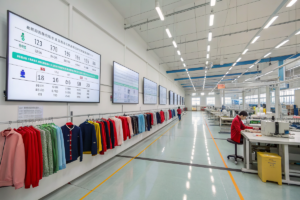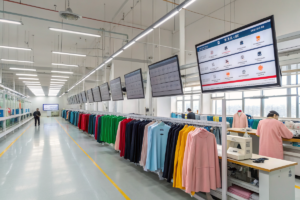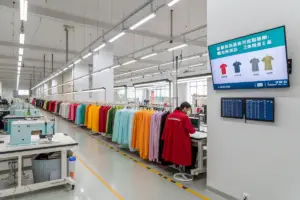
Two years ago, a Los Angeles-based contemporary womenswear brand sent a 28-page tech pack for a complex, multi-layered silk dress to their new factory in China. The tech pack was beautifully designed, with detailed sketches, Pantone color references, and construction notes written in fluent fashion-design terminology. The factory’s project manager—a skilled technician with fifteen years of experience but limited exposure to Western design vocabulary—misinterpreted the phrase "soft, fluid drape" as a request for a lighter, cheaper silk. She substituted a 10mm silk habotai for the specified 16mm silk charmeuse. The brand received 1,500 dresses that looked correct in photographs but felt completely wrong to the touch. The brand lost $42,000 on that order. The tech pack was not wrong. It was communicated in a language the factory’s project manager did not speak.
To effectively communicate complex tech packs to overseas garment project managers, you must translate subjective design language into objective, measurable manufacturing specifications—replacing words like "soft" and "fluid" with exact fabric weight in GSM, fiber micron diameter, and drape coefficient—include a physical reference sample sealed and signed as the tactile standard, annotate every sketch with numbered callouts that link directly to a shared bilingual measurement chart, and establish a "Single Revision Thread" communication protocol where every design change is documented in one sequential, timestamped document rather than scattered across multiple email chains and WhatsApp messages.
At Shanghai Fumao, my project managers have worked with tech packs from brands across North America, Europe, and Australia. I have learned that the most expensive phrase in garment manufacturing is "I thought you meant." Every single word in a tech pack that can be interpreted in more than one way will be, and the factory’s interpretation will rarely match the designer’s intention unless the communication has been deliberately structured to eliminate ambiguity.
Why Does “Subjective Design Language” Cause 80% of Tech Pack Miscommunications?
A Chicago-based premium basics brand once specified a "luxuriously soft, brushed interior" for their cotton sweatpants. The factory’s project manager, reading this phrase in isolation, selected a heavily brushed, thick fleece that was indeed extremely soft but also added significant bulk and weight to the garment. The sweatpants arrived feeling plush and comfortable, but the silhouette was completely wrong—bulky where the designer had intended a streamlined, refined shape. The factory had delivered exactly what was asked for: a luxuriously soft, brushed interior. The designer had failed to specify that the softness should not compromise the slim silhouette.
Subjective design language causes 80% of tech pack miscommunications because words like "soft," "fluid," "sturdy," "crisp," and "premium" describe a sensory experience that is interpreted differently by every individual based on their personal experience and cultural context, and when these words are the only specification provided—without an accompanying numerical measurement like fabric GSM, yarn count, stitch density, or a physical reference sample—the factory’s project manager must guess at the designer’s intention, and in a manufacturing environment driven by cost efficiency, that guess will default to the cheapest available material or process that vaguely matches the subjective description.
A designer in New York has been touching premium Italian silks and Japanese selvedge denims for ten years. Her "soft" is a 16mm silk charmeuse. A project manager in a factory has been sourcing cost-effective materials for mass production. Her "soft" is a chemically softened polyester. Both interpretations are valid within their respective contexts, and neither person realizes the gap exists until the bulk order arrives.
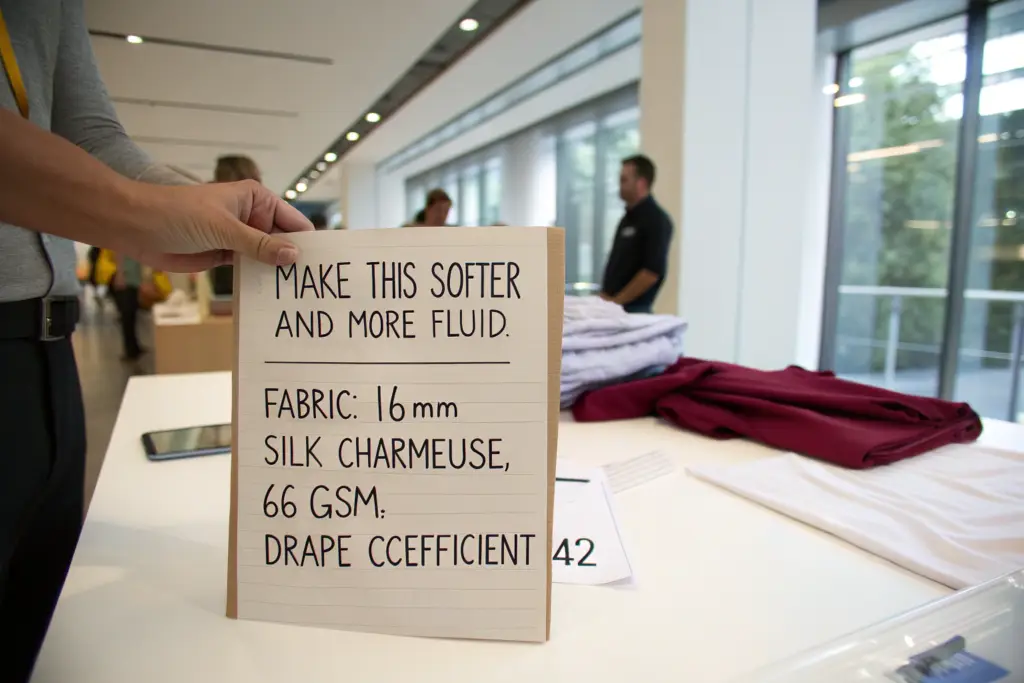
How Does a “Drape Coefficient” Number Replace the Word “Fluid” in a Tech Pack?
The drape coefficient is a numerical measurement, typically on a scale from 1 to 5 or as a percentage, that quantifies how a fabric hangs under its own weight. A drape coefficient of 4.2 on a specific scale indicates a fabric that is highly fluid and drapes closely. Specifying "drape coefficient 4.0-4.5" tells the fabric sourcing team exactly which fabric qualities to select, without any subjective interpretation.
Why Should a “Comparative Reference” to a Widely Available Garment Replace Abstract Texture Descriptions?
Instead of writing "soft like a vintage t-shirt," the tech pack should reference a specific, widely available, measurable garment: "Hand feel to match Hanes ComfortSoft tagless crewneck tee, size Large, purchased Q1 2024." This gives the factory a physical, commercially available reference point that can be sourced, touched, and measured, eliminating the ambiguity of "vintage softness."
What Is a “Physical Reference Sample Hierarchy” and Why Must It Include a “Golden Standard” and a “Boundary Sample”?
A Denver-based technical outerwear brand once approved a single, perfect pre-production sample and released the bulk order. When the bulk arrived, the seam sealing on the shoulders was subtly thinner than the approved sample—not defective enough to fail a standard AQL inspection, but visibly different from the sample the brand had approved. The factory argued that the bulk production was within tolerance. The brand argued that it did not match the approved sample. Neither party was wrong, because the acceptable deviation boundary had never been defined.
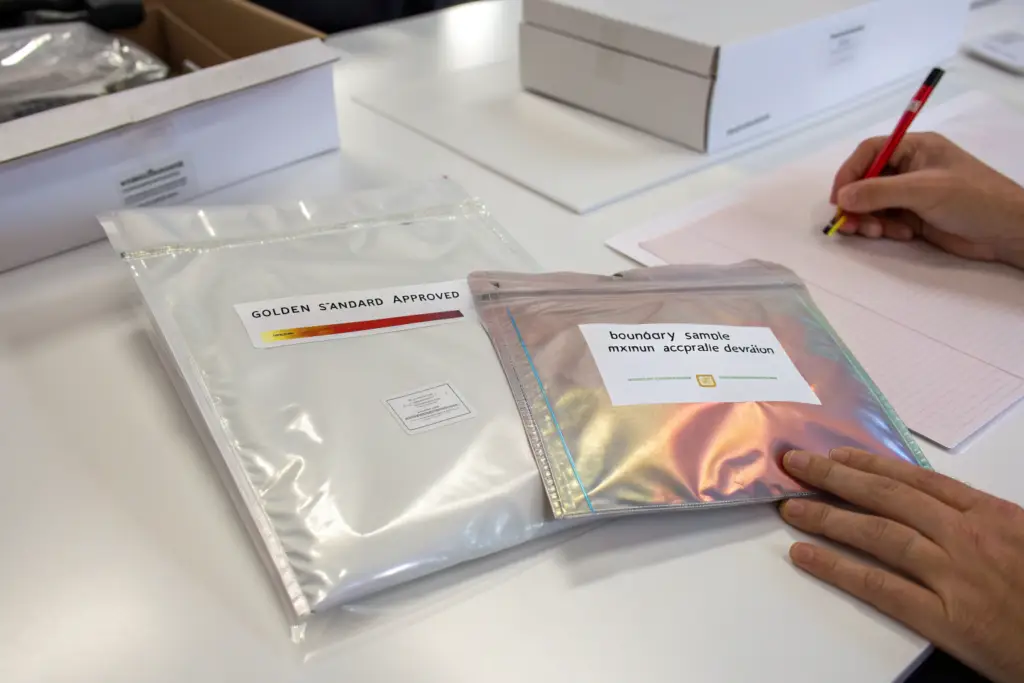
A physical reference sample hierarchy eliminates ambiguity by providing the factory with two physical garments: the "Golden Standard," which is the perfect, approved sample that represents the exact target quality for every specification, and a "Boundary Sample," which is a deliberately selected garment that exhibits the maximum acceptable level of a specific deviation—such as a slightly thinner seam seal, a fractionally lighter dye shade, or a minimally looser stitch—creating a tangible, visual, and tactile range of acceptability that a written tolerance like "+/- 2mm" cannot fully communicate to a sewing operator whose primary language is physical touch, not written English.
A written specification states that the seam allowance tolerance is +/- 2mm. A boundary sample physically shows the sewing operator exactly what a +2mm deviation looks and feels like in three dimensions, on an actual garment, under actual factory lighting. The operator can hold the boundary sample next to her work and instantly know whether her seam is acceptable or not.
How Does a “Golden Standard” Sample Differ Legally From a Pre-Production Sample?
A pre-production sample is an inspection tool. A Golden Standard is a sealed, signed, and contractually referenced legal document in physical form. If a quality dispute arises, both parties agree to measure the disputed bulk garment against the Golden Standard, and the measurement difference is the legally binding evidence. The seal prevents sample swapping.
Why Must the “Boundary Sample” Be Created by the Factory, Not the Brand, to Be Effective?
The factory’s sewing operator needs to see a boundary sample that was produced on her actual production line, by her actual colleagues, using her actual machines. A boundary sample created by the brand’s sample room in Los Angeles may exhibit a deviation that is physically impossible to replicate on the factory’s specific machinery, making it an unrealistic and demotivating standard.
How Does a “Single Revision Thread” Protocol Prevent the “Which Email Is the Latest Version?” Disaster?
A New York luxury streetwear brand once managed their tech pack revisions across seventeen separate email threads, five WhatsApp conversations, and three PDF attachments with filenames like "TechPack_FINAL_v3_REVISED_USE_THIS_ONE.pdf." The factory’s project manager, overwhelmed and confused, used an outdated version from an early email thread. The bulk order was produced with the incorrect pocket placement from Revision 2, while the brand had approved Revision 5. The brand refused the shipment. The factory refused a refund, pointing to the email thread where the brand had approved Revision 2. Both parties were acting in good faith, but the communication system had failed.
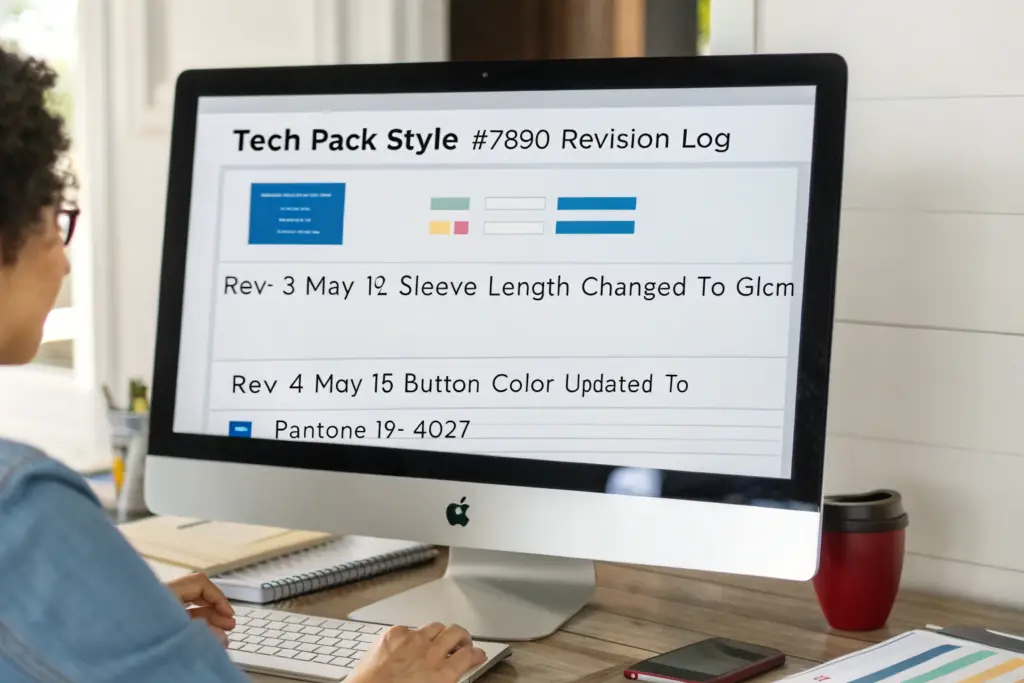
A Single Revision Thread protocol prevents version control disasters by establishing one shared, cloud-based document—not an email chain—as the single source of truth for all tech pack revisions, where every design change is added as a new, dated, and sequentially numbered entry at the top of the document, all previous specifications are visibly struck through but never deleted, and both the brand and the factory project manager formally acknowledge each revision with a digital signature or a timestamped confirmation before the change is released to the production floor.
Email is a conversation. A shared cloud document with a sequential revision log is a legal record. The revision log answers the question "What changed, when did it change, and who approved the change?" in under ten seconds. An email inbox requires thirty minutes of searching and still leaves doubt.
Why Must “Superseded Specifications Be Struck Through, Not Deleted”?
A deleted specification is invisible. A struck-through specification remains visible, showing the complete history of the design’s evolution. If a dispute arises about whether the sleeve length was ever specified as 60cm, the struck-through entry proves that it was, and that it was deliberately changed to 62cm on a specific date.
How Does a “Digital Signature or Timestamped Acknowledgment” on Each Revision Prevent the “I Never Saw That Change” Defense?
The shared document platform records the exact time and the specific user account that opened and acknowledged each revision. If the factory project manager later claims "I never saw the button color change," the platform log shows that she opened Revision 4 at 14:32 on May 15 and clicked "Acknowledged."
Why Does a “Bilingual Measurement Chart With Visual Callouts” Bridge the Final Communication Gap Between Designer Intent and Operator Execution?
A Portland-based activewear brand once sent a tech pack where the measurement chart listed "Armhole Depth" as a critical measurement. The factory’s pattern maker, working from a Chinese-language measurement guide, interpreted "Armhole Depth" as the vertical measurement from the shoulder point to the underarm. The brand’s designer had intended the curved measurement along the armhole seam. The resulting garment had an armhole that was 3cm too shallow, causing binding at the underarm. Both the pattern maker and the designer were measuring "Armhole Depth" correctly according to their own training. The word was the same; the measurement method was different.
A bilingual measurement chart with visual callouts bridges the final communication gap by numbering every measurement point on the technical sketch and linking each number to a row in the measurement table that provides the measurement name in both English and Chinese, the exact measurement method described in simple, unambiguous language with a small diagram showing where to place the tape measure, and the target measurement in both inches and centimeters, ensuring that the factory operator who speaks only Chinese and the brand designer who speaks only English are both looking at the same numbered callout, measuring from the same defined point, and aiming for the same numerical target.
Language translation alone is insufficient. The phrase "Armhole Depth" can be translated perfectly into Chinese, but if the measurement method is not visually defined, the translation is still ambiguous. A numbered callout linked to a small diagram of a tape measure placed on the exact seam curve eliminates the ambiguity at the level of physical action.
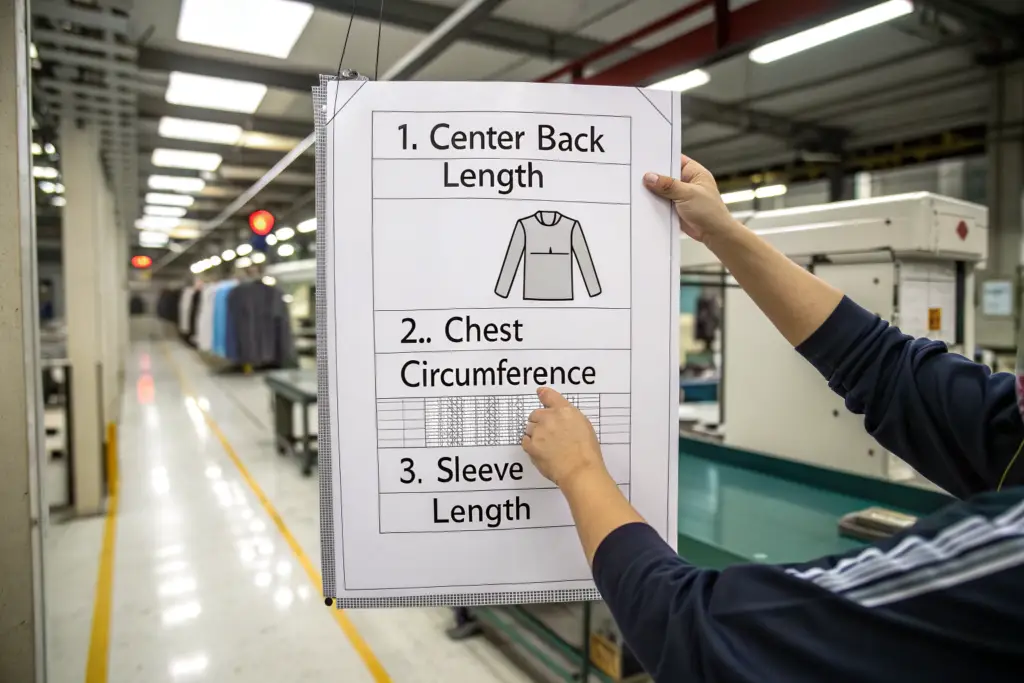
How Does a “Measurement Method Diagram” Next to Each Callout Number Prevent the “Curve Versus Straight” Measurement Dispute?
Next to callout number 3, a small diagram shows a flexible tape measure standing on its edge, following the curved armhole seam. The diagram visually defines that this is a curved measurement, not a straight vertical measurement. The operator does not need to read English or Chinese; she looks at the diagram and replicates the measurement method.
Why Should Measurements Be Provided in Both Inches and Centimeters on the Same Chart?
US brands typically design in inches. Chinese factories measure in centimeters. Providing both numbers on the same chart eliminates the risk of conversion errors, where a designer’s 15.5 inches is incorrectly converted to 39.37 centimeters instead of the intended 39.4 centimeters. The factory uses the centimeter number directly, without performing any mathematical conversion.
Conclusion
Effectively communicating complex tech packs to overseas garment project managers is a discipline of translation—not between English and Chinese, but between subjective design language and objective manufacturing specifications. The word "soft" is replaced by a fiber micron diameter, a fabric GSM, and a drape coefficient. The Golden Standard and Boundary Sample hierarchy replaces abstract tolerance ranges with tangible, physical garments that a sewing operator can hold in her hands. The Single Revision Thread protocol replaces chaotic email chains with a single, sequential, timestamped source of truth. The bilingual measurement chart with visual callouts replaces ambiguous measurement names with numbered diagrams that show exactly where to place the tape measure.
At Shanghai Fumao, I have trained my project management team to work within this structured communication system. We do not interpret subjective adjectives. We read numerical specifications, measure physical reference samples, follow the single revision thread, and use the bilingual measurement chart with visual callouts. When a tech pack arrives that still contains vague language, my project managers are trained to pause the sampling process and request the specific numerical specification or physical reference before proceeding.
If you are a brand buyer preparing a complex tech pack for overseas production, and you want a partner who will help you identify and eliminate every ambiguous instruction before it reaches the cutting table, contact my Business Director, Elaine. She can share our standard tech pack review checklist, our physical reference sample protocol, and our bilingual measurement chart template. Reach Elaine at: elaine@fumaoclothing.com. Communicate in numbers and physical references, not adjectives.