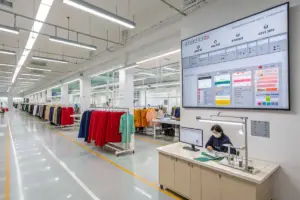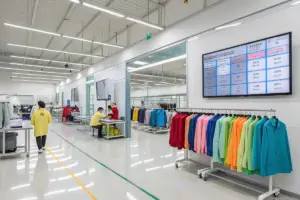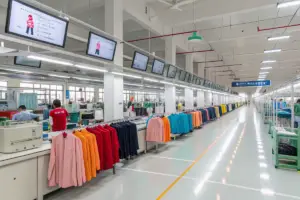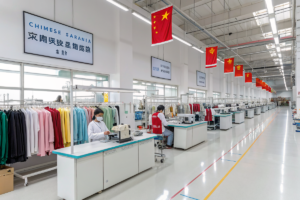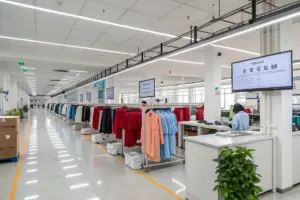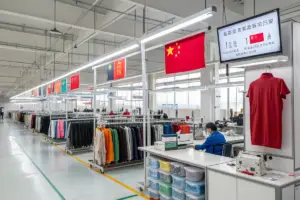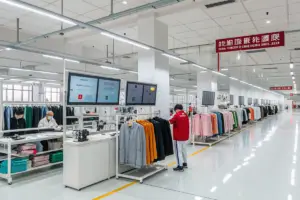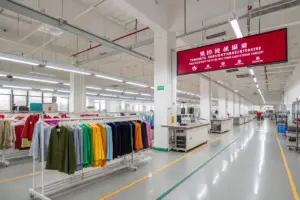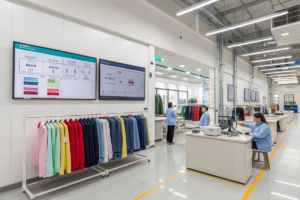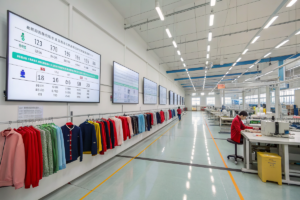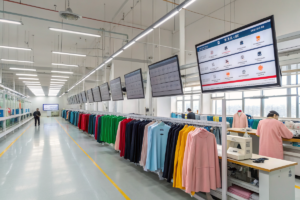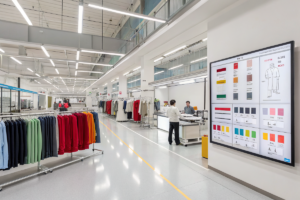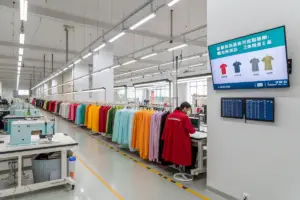
I was on a call with a brand owner from Los Angeles last March. She had just received a purchase order from a major department store for 800 units of her signature linen trench coat. The order was a breakthrough for her brand. The delivery window was tight. The store needed the coats in their distribution center by May 15th, ready for the summer floor set. She asked me the question that every brand owner asks when an opportunity appears: "Can you make this deadline?" I did not answer immediately. I pulled up our production schedule on my second screen. I checked the fabric inventory. I checked the cutting queue. I checked the shipping calendar. Then I gave her the real answer, not the answer she wanted to hear, but the answer that was true. "We can do it, but we need to start cutting by March 20th, and you need to approve the pre-production sample by March 18th. If either date slips, we miss the ship window, and the coats arrive in June." She approved the sample on March 17th. The coats shipped on April 22nd. They arrived in Long Beach on May 12th. The store floor set happened on schedule. The lead time was not a guess. It was a calculated sequence of operations with defined durations and defined dependencies.
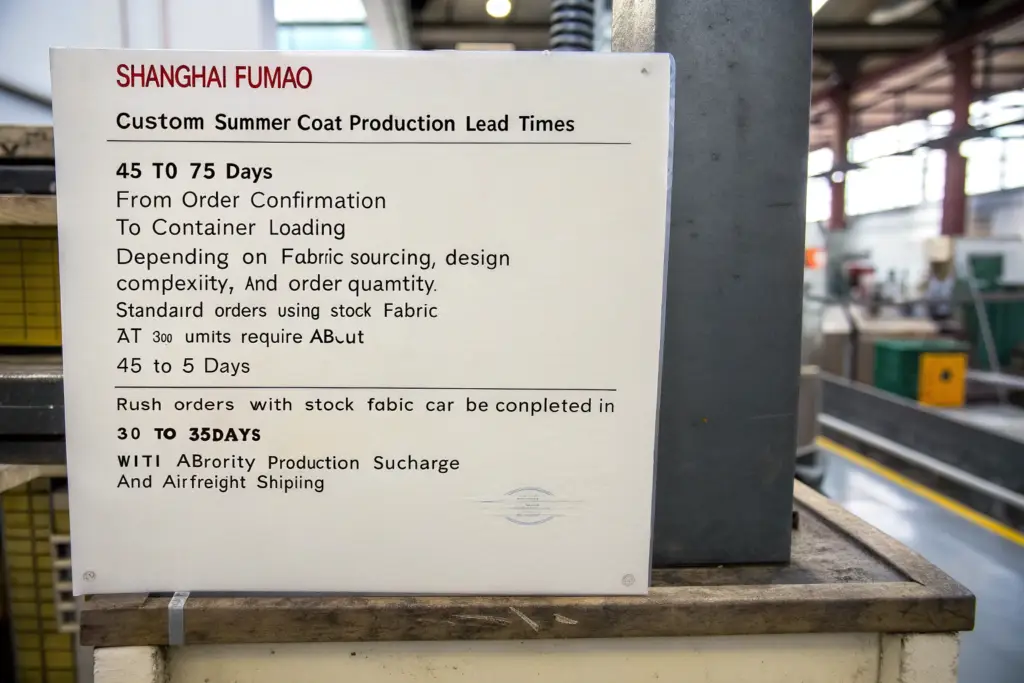
Custom summer coat production lead times from Shanghai Fumao typically range from 45 to 75 days from order confirmation to container loading, depending on fabric sourcing strategy, design complexity, and order quantity. A standard order using stock fabric at 300 units per style requires approximately 45 to 55 days. A custom fabric order at 500 units per style requires approximately 60 to 75 days, with the additional time consumed by fabric weaving, dyeing, and finishing at the mill level. Rush orders using stock fabric can be completed in 30 to 35 days with a priority production surcharge and air freight shipping.
Lead time is not a single number. It is a chain of sequential and parallel operations, each with its own minimum duration and its own vulnerability to delay. Understanding the chain allows you to plan your production calendar realistically, identify the critical path operations that cannot be compressed, and distinguish between a factory that quotes an honest lead time and a factory that tells you what you want to hear and then delivers late. At Shanghai Fumao, I have built our production planning system around transparency. I want our brand partners to understand exactly where their time is going and why certain steps cannot be rushed. Let me walk you through the full lead time breakdown, the variables that can shorten or lengthen it, and the strategies we use to meet tight seasonal deadlines without compromising quality.
The Standard Lead Time Breakdown: From Order to Delivery
The 45 to 75 day lead time I quote to brand partners is not a buffer-padded estimate designed to manage expectations. It is the sum of actual production operations, each measured and verified over hundreds of orders. When a brand owner understands the component durations, they can make informed trade-offs. They can choose to pay a premium for faster fabric sourcing or accept a longer lead time for a lower cost. They can identify the approval gates that require their prompt attention and avoid delays caused by their own internal processes. The transparency transforms the lead time from a black-box promise into a manageable project plan.
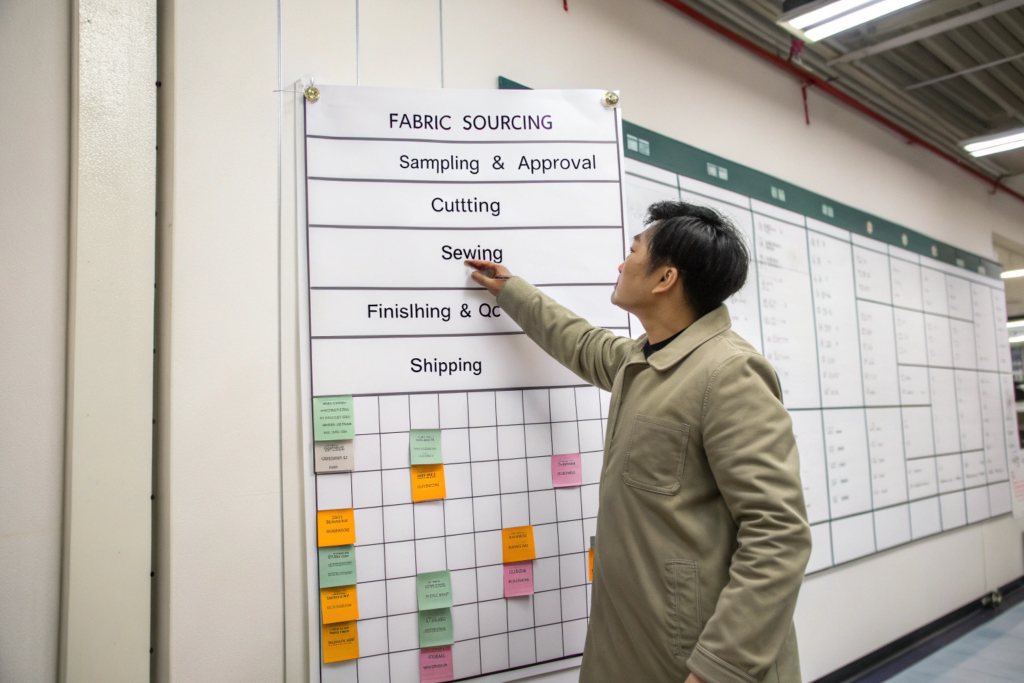
A standard 55-day lead time for a 300-unit stock fabric summer coat order breaks down into six sequential phases: pre-production sampling and approval takes 7 to 10 days, fabric preparation and inspection takes 3 to 5 days, cutting and bundling takes 3 to 5 days, sewing and assembly takes 15 to 20 days, finishing, pressing, and quality control takes 5 to 7 days, and packing, container loading, and export documentation takes 3 to 5 days. Ocean freight transit to the US West Coast adds 20 to 25 days to the total door-to-door timeline, but this transit time is not part of the production lead time.
The sewing phase is the longest single phase and the most variable. A complex belted trench coat with epaulettes, storm flaps, buttonholes, and a partial lining requires significantly more sewing labor than a simple open-front kimono with French seams and a rolled hem. A 300-unit order of trench coats might require 18 to 20 sewing days. A 300-unit order of kimonos might require 12 to 14 sewing days. The difference is the number of operations per garment and the standard minute value for each operation. We calculate the sewing duration based on the measured time per operation multiplied by the order quantity, divided by the number of operators assigned to the order, adjusted for the learning curve during the first 10% of the production run. This calculation produces a realistic sewing schedule, not an optimistic one. A factory that quotes the same lead time for a trench coat and a kimono is not doing this calculation.
How Long Does the Pre-Production Sampling Phase Actually Take?
The pre-production sampling phase is the most underestimated source of lead time delay. A brand owner assumes that sampling takes a week. The reality is that sampling takes as long as the approval cycle takes, and the approval cycle involves the brand owner’s internal review process, which the factory does not control. The factory-side portion of sampling, which includes cutting and sewing the pre-production sample, takes 5 to 7 days for a standard summer coat. This assumes the fabric is available in our inventory. If the fabric must be sourced or dyed, sampling fabric must be ordered separately, adding 7 to 10 days. Once the sample is complete, we ship it by express courier. Transit to the US takes 3 to 5 business days. The brand owner receives the sample, reviews it internally, perhaps shows it to their sales team or a wholesale buyer, and provides feedback. This internal review takes anywhere from 2 days to 3 weeks, depending on the brand’s decision-making process. If revisions are required, a second sample is made, shipped, and reviewed, adding another 10 to 14 days. The pre-production sampling phase, if not actively managed, can consume 30 days of the lead time before bulk production even begins. I manage this phase aggressively. I request that brand partners designate a single decision-maker for sample approvals with a 48-hour response commitment. I ship samples with a pre-populated approval form that requires a simple yes/no checkmark and a signature. I follow up by email if approval is not received within 48 hours of the delivery confirmation. This active management compresses the sampling phase from an unpredictable variable into a controlled 7 to 10 day process.
What Happens During the Finishing and Quality Control Phase?
The finishing phase is the stage where the coats transition from sewn garments to retail-ready products. This phase includes thread trimming, where every loose thread on every seam is cut flush with the fabric surface, pressing, where each coat is steam-pressed on specialized forms to set the shape, remove wrinkles, and create the crisp appearance expected by the retail customer, final inspection, where 100% of coats are visually inspected under bright light for any remaining defects, the AQL random inspection, where a statistically selected sample is inspected against the full defect checklist, and polybag packaging, where each coat is folded, inserted into a protective polybag with a silica gel packet, and sealed. The pressing operation is particularly time-sensitive for summer coats. Linen and cotton-linen blends require a specific temperature and steam level to achieve a smooth finish without creating pressing sheen. Chiffon and georgette require a low-temperature press with a protective pressing cloth to prevent heat damage. Each coat receives individual attention from a trained presser. A presser can finish approximately 40 to 50 lightweight summer coats per hour. A 300-unit order requires 6 to 8 hours of pressing time. The final inspection adds another 8 to 10 hours. The finishing phase cannot be compressed by adding more workers because the pressing stations and inspection tables are fixed assets. The phase duration is determined by the throughput capacity, which is built into our production planning.
Custom Fabric Lead Time: The Mill Variable Explained
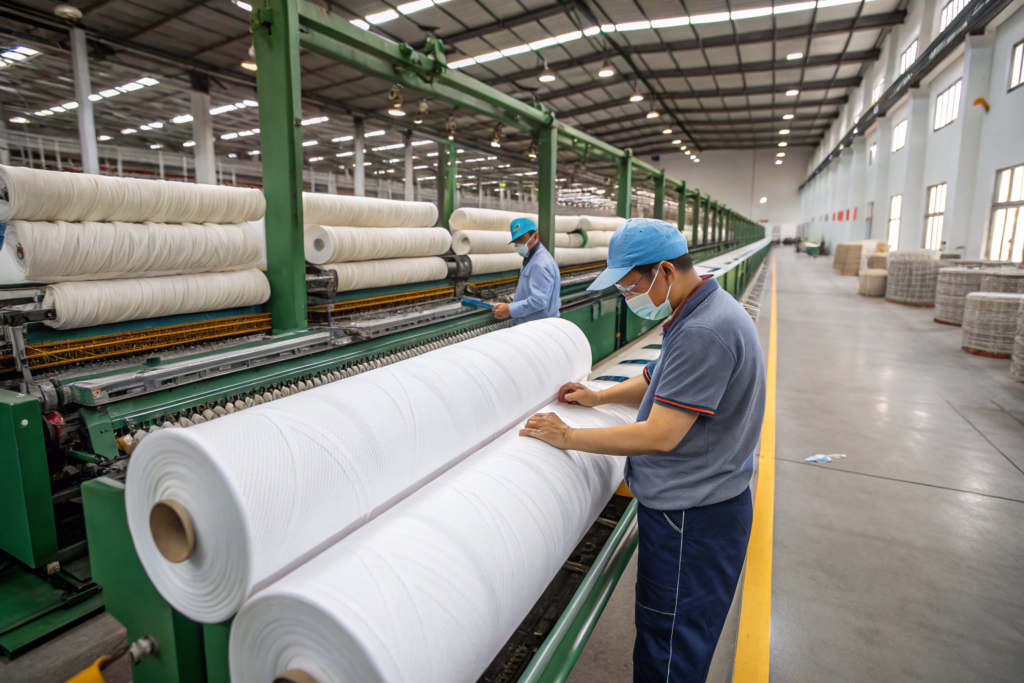
The single largest variable in custom summer coat lead time is the fabric. When a brand uses our stock fabric inventory, the fabric is already sitting in our warehouse, tested, and ready for cutting. The fabric-related lead time is zero days. When a brand commissions a custom fabric, meaning a specific weave, a specific fiber blend, and a specific color that is not in our inventory, the mill must produce that fabric to order. This process consumes 20 to 30 days and is outside our direct control. The mill is a separate business with its own production schedule, its own queue of orders, and its own vulnerability to raw material delays, equipment breakdowns, and quality issues. Understanding the mill timeline is essential for any brand planning a custom fabric summer coat collection.
Custom fabric production at the mill level involves four sequential stages: yarn sourcing and preparation, which takes 3 to 5 days if the yarn is a standard stock item and 10 to 15 days if a custom yarn blend is required, weaving or knitting, which takes 5 to 10 days depending on the mill’s loom allocation and the complexity of the weave structure, dyeing and finishing, which takes 7 to 10 days including lab dip approval, bulk dyeing, and mechanical finishing such as brushing or sanding, and final inspection and shipping to our factory, which takes 2 to 3 days. The total custom fabric lead time from order to delivery at our cutting table is 20 to 30 days for a standard fiber blend and 30 to 45 days for a custom fiber blend.
Lab dip approval is the most common bottleneck in the custom fabric timeline. The lab dip is a small sample of fabric dyed to match the brand’s requested color. The mill produces the lab dip, ships it to the brand, and waits for approval. If the first lab dip is approved, the delay is minimal. If the first lab dip is rejected and a second or third lab dip is required, each round adds 5 to 7 days. A brand that rejects three lab dips adds three weeks to the fabric lead time. I advise brand partners to approve a lab dip from the mill’s existing color library whenever possible. The library dip has already been formulated and tested. It can be produced immediately without the iterative approval process. If a custom color is essential to the brand identity, I recommend starting the lab dip process two months before the intended bulk fabric order date. This decouples the color development from the production timeline and prevents the lab dip from becoming a critical path delay.
Can You Rush Custom Fabric Production for a Tight Deadline?
Rushing custom fabric production is possible, but it is expensive and limited in its effectiveness. A mill can prioritize a specific order and move it to the front of the weaving and dyeing queue. This priority service typically adds a 20% to 30% surcharge to the fabric cost and reduces the lead time by 5 to 10 days, not by 20 days. The physical processes of weaving and dyeing have minimum durations that cannot be compressed beyond a certain point. A loom weaves at a fixed speed. A dye bath requires a fixed cycle time. The priority service eliminates queue waiting time, not processing time. The maximum rush reduction on custom fabric is approximately 30% of the standard lead time. If the standard lead time is 25 days, a rush order might deliver in 17 to 20 days. The remaining days are the physical minimum. I have ordered rush custom fabric for brand partners who were facing a lost selling season. The surcharge was painful. The alternative, which was a season with no product to sell, was more painful. Rush fabric is an emergency tool, not a planning strategy. A well-planned collection orders custom fabric in October for a February production start, allowing the mill to run the order in a standard queue without surcharges and without schedule pressure that can lead to quality shortcuts.
How Does Stock Fabric Inventory Reduce Lead Time?
Our stock fabric inventory is a lead time compression asset that I have deliberately built over the last decade. We currently hold over 800 active fabric articles in our warehouse, covering the full range of summer coat fabrics: lightweight linen blends, cotton twills, Tencel blends, recycled nylons, chiffons, georgettes, and quilted fabrics. These fabrics are pre-tested, pre-priced, and available for immediate sampling and cutting. When a brand partner designs their collection using our stock fabrics, the fabric-related lead time drops from 20 to 30 days to zero. The fabric is already in the building. The sampling phase begins within 48 hours of design confirmation. The cutting phase begins within 5 days of sample approval. The total production lead time compresses by 35% to 40%. The trade-off is fabric exclusivity. Stock fabrics are available to multiple brands. Your coat may be made from the same fabric as a competitor’s coat. For brands in different market segments or different geographies, this overlap is rarely a problem. For brands that compete directly in the same niche, exclusivity may matter. I recommend stock fabrics for first collections, test orders, and replenishment runs where speed and low MOQ matter more than exclusivity. I recommend custom fabrics for core collection styles that define the brand identity and justify the longer lead time and higher minimum order investment.
Rush Orders and Peak Season: Lead Time Variables to Anticipate
Lead times are not constant throughout the year. The apparel manufacturing industry operates on a seasonal cycle. The summer coat production season in China runs from January through May, delivering goods for the US and European spring and summer retail windows. The peak demand period for factory capacity is February through April. During this peak, our production lines are at full capacity, our fabric suppliers are managing high order volumes, and our logistics partners are handling increased container traffic. Lead times stretch. A standard 45-day production order placed in March may require 55 to 60 days because every operation has a queue. An order placed in September for the following summer season may complete in 35 to 40 days because the factory has available capacity.
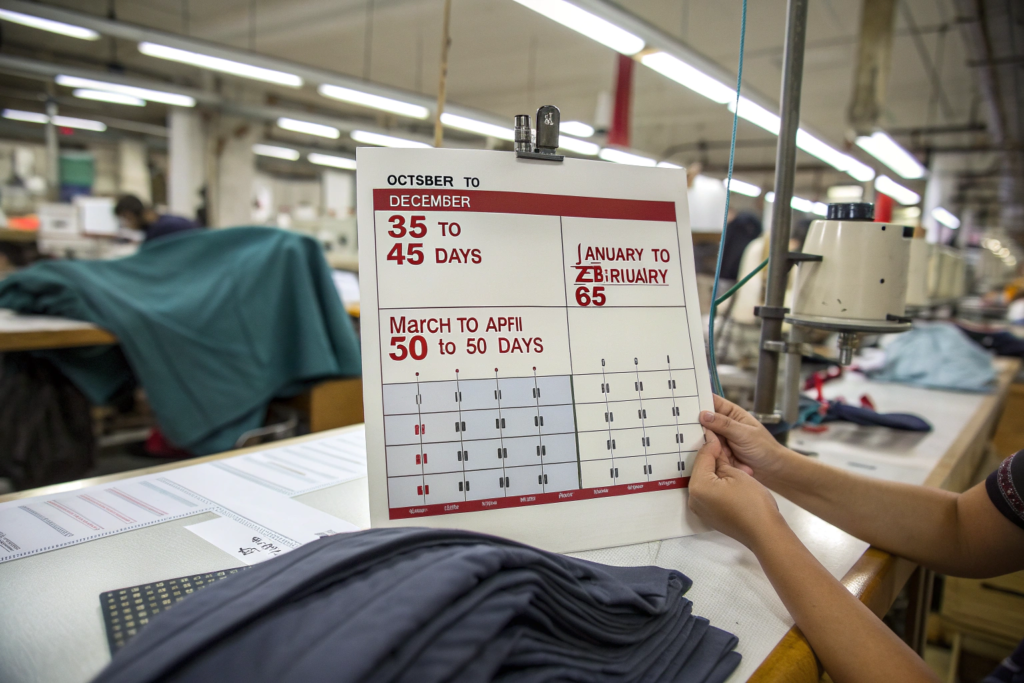
The seasonal lead time variation for custom summer coat production follows a predictable pattern. Orders placed from October through December have a lead time of 35 to 45 days, the fastest of the year due to available capacity. Orders placed from January through February have a lead time of 45 to 55 days as the summer production season begins and lines fill. Orders placed from March through April have a lead time of 55 to 65 days, the slowest of the year due to peak demand across all production resources. Orders placed from May through September have a lead time of 40 to 50 days for the following year’s summer collection development.
The Chinese New Year holiday, which falls in late January or February depending on the lunar calendar, is a critical lead time factor. The factory closes for 10 to 14 days for the holiday. Workers travel to their hometowns and return gradually. The two weeks before the holiday are chaotic as factories rush to complete orders before the closure. The two weeks after the holiday are slow as production lines ramp back up to full staffing. A production order that intersects with Chinese New Year will experience an effective delay of 3 to 4 weeks. I advise all brand partners to avoid scheduling critical production milestones within two weeks of the Chinese New Year date. Plan your order to be completed before the holiday or to begin after the post-holiday recovery period. The exact Chinese New Year date for 2026 is February 17th. Plan accordingly.
What Is the Fastest Possible Rush Order Lead Time?
The absolute fastest rush order we can execute is 21 days from order confirmation to container loading. This is not a standard service. It is an emergency capability reserved for existing brand partners with stock fabric designs and a genuine business crisis, such as a sold-out bestseller that needs immediate replenishment. A 21-day rush order requires the following conditions: the design must use stock fabric available in our warehouse, the pattern must already be graded and approved from a previous production run, no new sampling is required, the order quantity must be 200 units or fewer to fit within a single cutting and sewing batch, the production must be assigned to our most experienced line with overtime authorization, and a 30% rush surcharge is applied to cover the overtime labor costs, the disruption to scheduled production, and the priority logistics handling. A 21-day rush order is a stress test of the factory’s production management system. It requires the production planner to reschedule existing orders, the fabric warehouse to issue material immediately, the cutting room to prioritize the rush markers, the sewing line to switch styles mid-shift, and the finishing department to process the rush order out of sequence. I accept rush orders only from existing partners because the relationship trust and the order history are prerequisites for the operational disruption a rush order causes.
How Does Order Quantity Impact Lead Time Beyond the Obvious?
Order quantity impacts lead time in ways that are not immediately obvious to a brand owner. A 500-unit order does not take twice as long as a 250-unit order. The cutting phase is roughly the same duration for both quantities because the cutting table setup and the marker spreading time are similar. The sewing phase scales roughly linearly with quantity, assuming the same number of operators are assigned. A 500-unit order requires approximately 20 sewing days. A 1,000-unit order requires approximately 40 sewing days if the number of operators is fixed. However, a 1,000-unit order of a simple kimono may sew faster than a 300-unit order of a complex trench coat. The order quantity impact on lead time is always mediated by the garment complexity and the available operator capacity. A more subtle impact is the learning curve effect. The first 10% of any production run is sewn more slowly as the operators learn the specific construction sequence. For a 300-unit order, the learning phase is 30 units, which is sewn in approximately one day. For a 1,000-unit order, the learning phase is 100 units, which is sewn in approximately three days. The absolute time lost to the learning curve is longer for larger orders, but the percentage impact on the total lead time is smaller. The practical implication is that very large orders of 1,000 units or more benefit from a dedicated training session where operators practice on sample garments before the bulk run begins, compressing the learning curve into a pre-production phase that does not delay the bulk schedule.
How We Manage and Communicate Lead Times at Shanghai Fumao
I know that a lead time promise is only as valuable as the communication system that supports it. A factory that quotes a 55-day lead time and then goes silent for 50 days has not earned the brand owner’s trust. The silence forces the brand owner to send anxious follow-up emails, wonder if the order is on track, and prepare contingency plans for a late delivery. The anxiety is unnecessary and avoidable. A reliable lead time is accompanied by reliable communication. At Shanghai Fumao, we provide weekly production status updates to every brand partner with an active order. The update is not a one-line email that says "everything is on schedule." It is a structured report with specific information about each production phase.
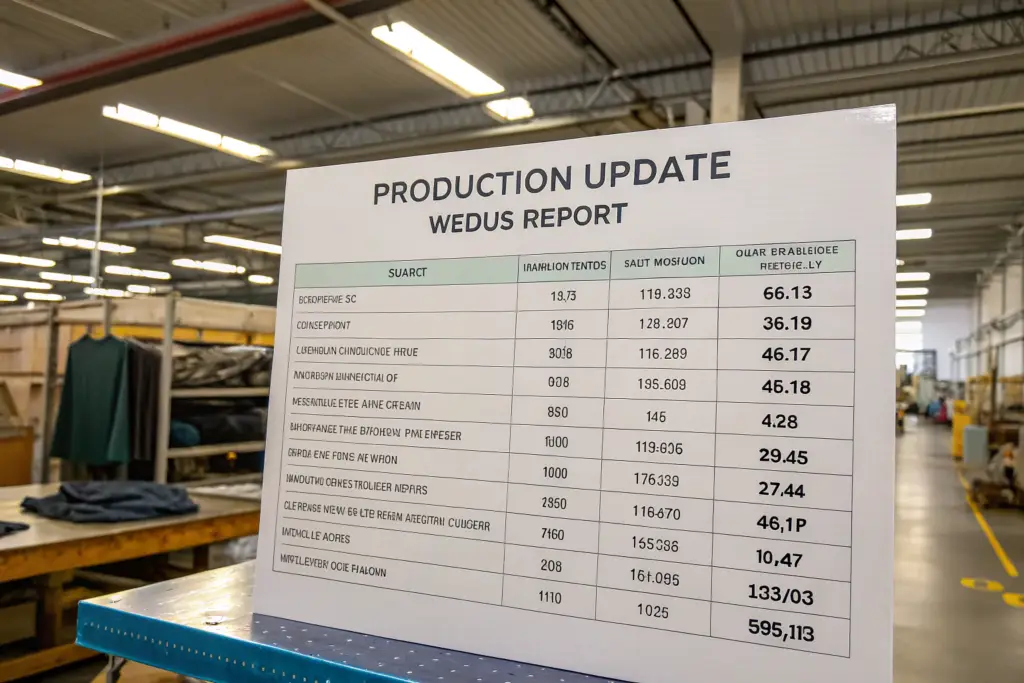
Our weekly production update includes: the current production phase with percentage completion, the number of units completed in the current week and the cumulative total completed, a photo of the actual production, either the fabric on the cutting table, the coats on the sewing line, or the finished goods in the QC area, any issues encountered during the week and how they were resolved, and an updated estimated completion date based on actual progress. If the actual progress is ahead of schedule, the completion date moves earlier. If the actual progress is behind schedule, the completion date is adjusted, and the delay is explained.
This weekly update is not a burden. It is a 15-minute task for the account manager. It replaces the 2 hours per week the account manager would otherwise spend responding to individual status inquiry emails from anxious brand partners. The structured communication builds trust, reduces anxiety, and allows the brand owner to plan their own marketing, sales, and logistics activities with confidence in the production timeline. If a delay does occur, the brand owner learns about it on Friday in the weekly update, not on the planned shipping date when the container does not load. The early warning allows them to adjust their launch calendar, communicate proactively with their wholesale buyers, and manage their own customer expectations. The communication system transforms the lead time from a binary on-time or late outcome into a managed, transparent process.
What Happens If a Lead Time Deadline Is Missed?
Despite our best efforts, lead time delays happen. Fabric mills deliver late. A key operator falls ill. A customs inspection delays an incoming trim shipment. The question is not whether delays will ever occur. The question is how the factory responds when a delay occurs. Our delay response protocol has three steps. First, we communicate the delay immediately, not at the original delivery date. The brand partner learns about a potential delay in the weekly update, as soon as the production tracker shows a schedule variance of more than 2 days. Second, we present a recovery plan with specific actions and a revised delivery date. The recovery plan may include overtime shifts, reallocation of operators from a lower-priority order, or a switch from ocean freight to air freight for all or part of the shipment. Third, we absorb the cost of the recovery actions that are within our control. If the delay was caused by a factory scheduling error, we pay for the overtime or the air freight upgrade. If the delay was caused by a brand-side approval delay, we present the cost of the recovery options and let the brand decide which investment makes sense for their business. A delay that is communicated early and managed transparently is a recoverable problem. A delay that is hidden until the last minute is a relationship-ending betrayal. We choose transparency.
How Can a Brand Partner Help Keep Production on Schedule?
The production schedule is a partnership. The factory controls the internal operations. The brand owner controls the external approvals and the design stability. Three brand-side actions have the most significant positive impact on lead time adherence. First, provide complete, accurate tech packs at the order confirmation stage. A tech pack that is missing measurements, construction details, or trim specifications will generate questions that delay the sampling process by days. Invest in a professional tech pack before engaging the factory. Second, consolidate feedback into a single round of revisions. Multiple rounds of sample feedback, each with small, incremental changes, destroy the production schedule. Review the pre-production sample thoroughly, gather all internal feedback, discuss it with your team, and provide one consolidated revision request. Third, approve lab dips, strike-offs, and pre-production samples within 48 hours of receipt. The 48-hour approval commitment is the single most powerful contribution a brand owner can make to lead time reliability. A 48-hour approval cycle keeps the project moving. A two-week approval cycle, often caused by the sample sitting on a decision-maker’s desk while they attend to other priorities, injects two weeks of idle time into the schedule that the factory cannot recover. If you are the decision-maker, prioritize sample approvals. If you have delegated approvals to a team member, hold them accountable to the 48-hour standard.
Conclusion
Custom summer coat production lead times in Shanghai are a function of fabric strategy, design complexity, order quantity, and seasonal capacity. A standard stock fabric order at moderate quantity can be produced in 45 to 55 days. A custom fabric order with a complex design can require 60 to 75 days. Rush orders can compress the timeline to 21 days for existing partners with stock fabric designs, at a premium cost. The key to successful lead time management is not hoping for the shortest possible timeline. It is understanding the component durations, building a realistic production calendar backward from the in-stock date, and maintaining a partnership with a factory that communicates progress transparently and responds to delays honestly.
The summer coat selling season in the US and Europe has a hard deadline. Goods that arrive after August 15th are clearance inventory, not full-price inventory. The lead time from the factory determines whether your coats sell at 65% margin in June or 25% margin in September. The time invested in production planning, fabric strategy, and partner selection returns a multiple in preserved margin and captured sales.
At Shanghai Fumao, our lead time commitment is backed by a documented planning process, a weekly communication protocol, and a delay response system that has been tested and refined over hundreds of orders. We know how long each operation takes. We track actual versus planned progress on every order. We communicate variances early and manage them transparently. We offer stock fabric options that compress lead times and custom fabric options that deliver exclusivity with a longer timeline. Whatever your summer coat production needs, we can provide a realistic, detailed lead time estimate and a production schedule you can trust.
To discuss your specific production timeline and receive a detailed schedule for your summer coat designs, contact our Business Director, Elaine. She can provide a production calendar with milestone dates for sampling, fabric, cutting, sewing, and shipping based on your order details and your target in-stock date. Reach Elaine at: elaine@fumaoclothing.com.