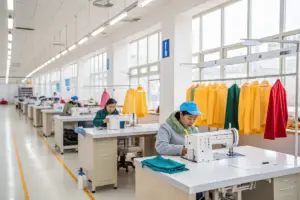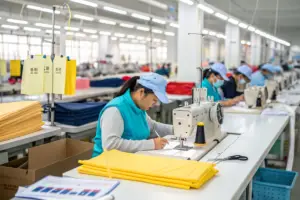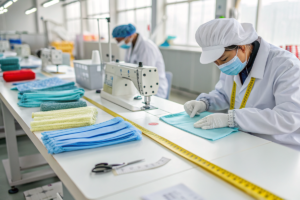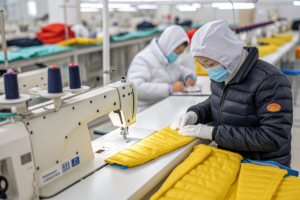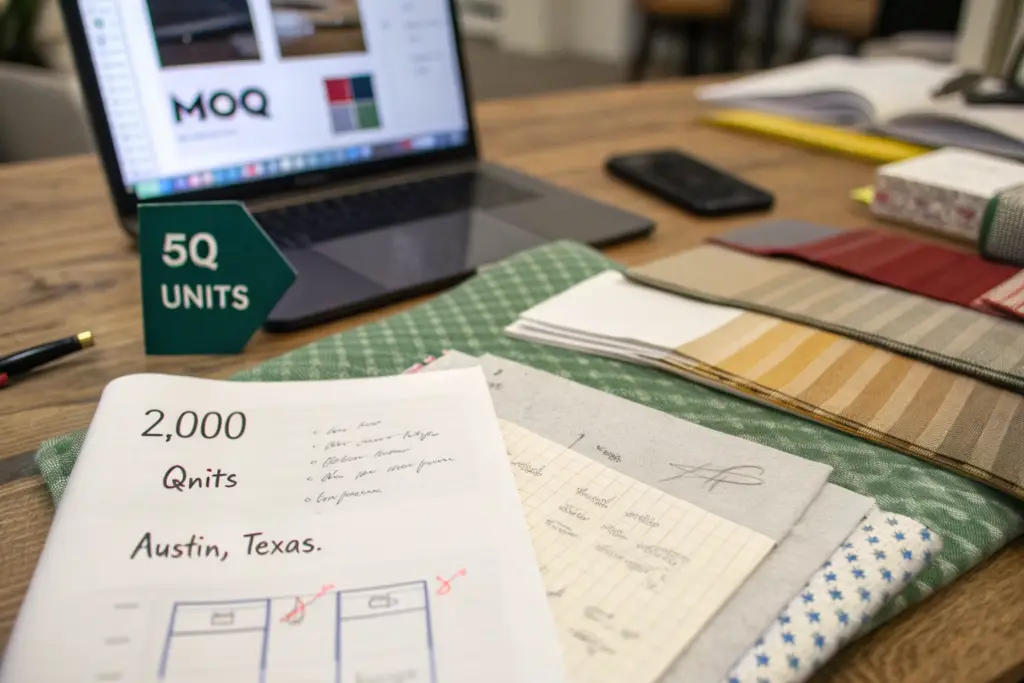
I received a WhatsApp message last March from a brand owner in Austin, Texas. She had been designing a collection of linen dusters and quilted shackets for six months. She had her tech packs ready. She had her fabric swatches selected. She had her launch marketing plan mapped out. She was ready to go. Then she asked the question that nearly derailed her entire launch. "What is your MOQ?" I replied honestly: "It depends on the fabric, the style, and the customization level." She was frustrated. She had heard MOQ numbers from other factories that ranged from 50 units to 2,000 units. She did not know what to believe. She did not know if her brand, which needed 200 units across three styles, could even access a quality factory. This confusion is the single biggest barrier that prevents emerging brands from entering the custom summer coat market. The MOQ number is not a fixed rule. It is a negotiation shaped by fabric sourcing, production setup costs, and the factory's business model. If you do not understand the variables behind the number, you will either overpay for a small order or get rejected from factories that could actually serve you.
The minimum order quantity for custom women's summer coats from a reputable Chinese factory typically ranges from 100 to 300 units per style, per color. This range is driven primarily by fabric minimums at the mill level. Most woven fabric mills require a minimum order of 500 meters per color, and a single summer coat consumes approximately 1.5 to 2 meters of fabric. The math pushes the MOQ to around 250 to 300 units per color. However, several strategies can reduce the effective MOQ to as low as 50 to 100 units per style, including using stock fabrics, combining colorways across styles, and paying a small-order surcharge.
The MOQ conversation is not a yes-or-no question. It is a problem-solving discussion. At Shanghai Fumao, I have worked with brand owners to find creative solutions that allow them to launch with manageable quantities while still accessing quality manufacturing. Let me break down exactly where MOQ numbers come from, why they exist, and how you can navigate them to get your custom summer coat collection produced without ordering more inventory than your business can absorb.
Understanding Where MOQ Numbers Actually Come From
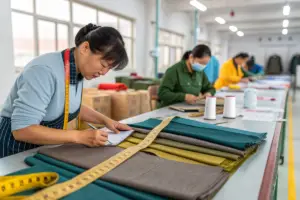
The MOQ number that a factory gives you is not an arbitrary gatekeeping rule designed to exclude small brands. It is a direct mathematical consequence of the factory's own purchasing constraints. Every factory sits in the middle of a supply chain. Upstream, there are fabric mills, trim suppliers, and dyeing houses. These upstream suppliers have their own minimums. The factory must meet those minimums before they can produce a single garment. If a woven cotton-linen fabric mill requires a minimum order of 500 meters per color, and your summer coat design consumes 1.8 meters of fabric at the average size medium, then 500 meters produces approximately 270 coats. That is your theoretical minimum per color. The factory cannot order 100 meters from the mill because the mill will not process an order that small. The dyeing process requires a minimum batch size to be economically viable. The weaving process requires a minimum warp length to set up the loom. These physical and economic constraints cascade down the supply chain and land on the brand owner's desk as the MOQ.
The three upstream minimums that determine your coat MOQ are: fabric mill minimums, typically 300 to 500 meters per color for woven fabrics and 200 to 300 kilograms per color for knit fabrics, dyeing house minimums, typically 50 to 100 kilograms per color if dyeing greige fabric to order, and trim supplier minimums, which can be as low as 500 pieces for standard buttons or as high as 5,000 pieces for custom-engraved metal hardware.
I learned the hard truth about trim minimums six years ago. A brand owner wanted custom engraved horn buttons for her summer trench coat collection. The design was beautiful. The button supplier in Yiwu quoted a minimum of 3,000 pieces for the custom engraving die. Her order of 400 coats required only 2,400 buttons, 6 buttons per coat. She had to order 600 extra buttons that would sit in storage or pay a die charge of $200 to offset the supplier's setup cost. We split the difference. She paid a $100 die surcharge, and we stored the extra buttons in our trim library for potential future use. This is a small example of the negotiation and problem-solving that happens behind every MOQ conversation. The upfront number is never the final number if both parties are willing to find a middle path.
What Are the Real Fabric Minimums at Chinese Mills?
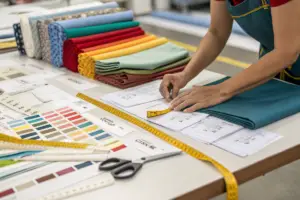
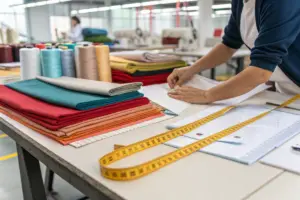
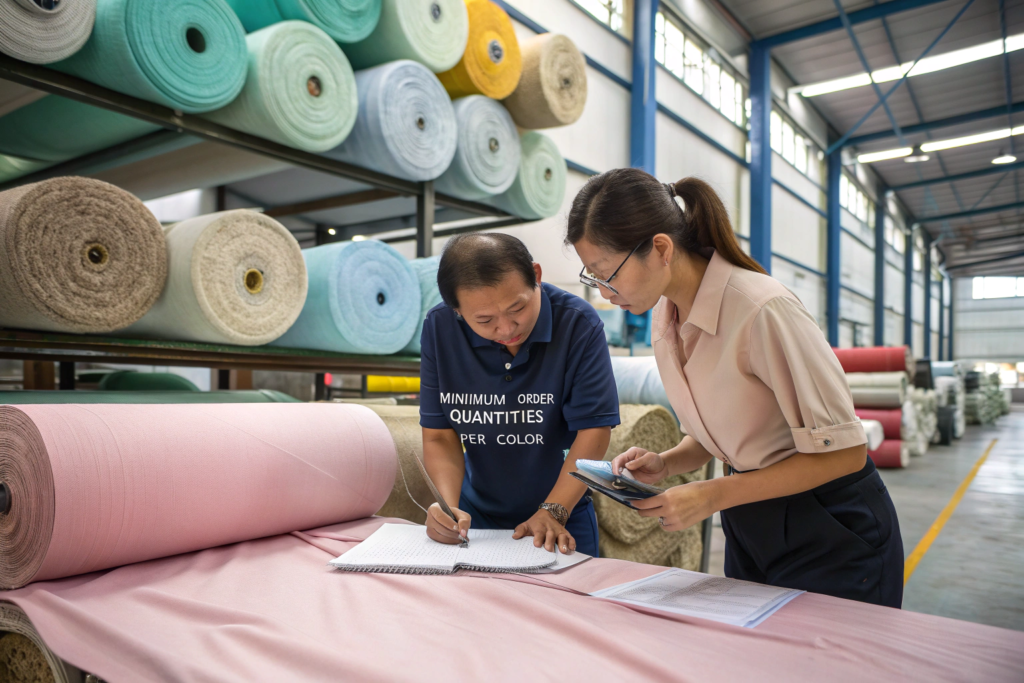
Fabric minimums vary significantly by fabric type and by mill size. A large, high-volume mill in Shaoxing that supplies fabric to Zara and H&M will have minimums of 1,500 to 3,000 meters per color. They are not interested in a 300-meter order. A medium-sized mill that works with boutique brands and mid-tier factories will have minimums of 300 to 800 meters per color. This is the mill category we work with most frequently. A small, flexible mill or a fabric trading company may accept orders as low as 100 meters per color, but at a 20% to 30% price premium. Here is a practical breakdown of fabric minimums by category based on our current mill relationships in Jiangsu and Zhejiang provinces. Lightweight cotton and linen blends for summer blazers and dusters typically have a minimum of 500 meters per color, which translates to roughly 250 to 300 coats. Recycled nylon and polyester taffeta for packable anoraks and windbreakers typically have a minimum of 800 meters per color, or about 400 to 500 coats. Chiffon and georgette for kimonos and evening layers typically have a minimum of 300 meters per color, or about 150 to 200 coats. Quilted fabric with pre-laminated fill typically has a minimum of 500 meters per color, or about 250 to 300 coats. Knit jersey for unstructured blazers typically has a minimum of 200 kilograms per color, or about 150 to 200 coats. These numbers are not secrets. They are the economic reality of textile manufacturing. A mill cannot set up a dye bath for 50 meters of fabric because the dye bath has a minimum fill level that requires 200 liters of water and 5 kilograms of dye regardless of whether you dye 50 meters or 500 meters.
Why Do Different Coat Styles Have Different MOQs?
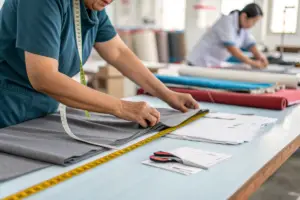
The fabric consumption per garment varies dramatically across summer coat styles, and this variation directly affects the MOQ calculation. An oversized, floor-length chiffon duster with wide sleeves may consume 3 meters of fabric per unit. A cropped, fitted denim jacket may consume 1.2 meters. If the fabric mill minimum is 500 meters, the duster MOQ is approximately 160 units, and the jacket MOQ is approximately 400 units. The same mill minimum produces wildly different garment MOQs. This is why a factory cannot give you a single, universal MOQ number without knowing the specific style and fabric you want. I have had brand owners ask for an MOQ quote over email with no style information. "What is your MOQ for summer coats?" I cannot answer that question accurately. I need to know the fabric. I need to know the garment length. I need to know the sleeve type. I need to know if the coat has a lining, because a lining doubles the fabric consumption and potentially introduces a second fabric minimum. A lined trench coat consumes shell fabric and lining fabric. If the shell fabric minimum is 500 meters and the lining fabric minimum is 500 meters, the production MOQ is determined by the fabric that yields fewer units. If the shell yields 250 coats and the lining yields 350 coats, the MOQ is 250 coats, and you will have 100 coats' worth of excess lining fabric that we will either store for your re-order or charge to the order cost. These calculations are not obstacles designed to frustrate you. They are the actual math that determines whether your order is producible at a price that makes sense for your retail margin.
Strategies to Reduce MOQ for Small and Emerging Brands
If the standard MOQ math does not work for your brand's current stage, you have options. You do not have to accept a 300-unit minimum and risk overstocking. You do not have to abandon quality manufacturing and settle for a low-quality supplier who offers low MOQs by cutting corners on fabric and construction. There is a middle path. At Shanghai Fumao, we have developed specific MOQ reduction strategies that allow emerging brands to access our production quality at quantities that match their inventory risk tolerance. These strategies require flexibility on your part, either in design, timeline, or cost, but they make quality manufacturing accessible to brands that are not yet ready to place 300-unit orders.
The four most effective MOQ reduction strategies are: using stock fabrics from the factory's existing inventory, consolidating multiple styles into the same fabric to share the mill minimum, accepting a small-order surcharge of 10% to 20% per unit, and participating in a phased production program where your order is combined with other brands' orders using the same fabric. Each strategy has trade-offs in terms of exclusivity, cost, and timeline.
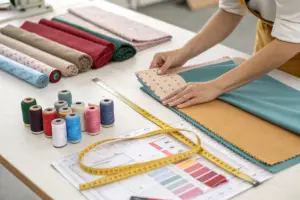
Stock fabric is the most powerful MOQ reduction tool available. We maintain an inventory of over 800 active fabric articles in our warehouse. These fabrics are already tested, already priced, and already purchased in bulk quantities that meet mill minimums. If you design your summer coat using one of our stock fabrics, your MOQ drops to our internal minimum, which is 100 units per style, per color, because the fabric minimum has already been met at our level. The trade-off is that other brands may also use the same fabric. You lose fabric exclusivity. However, for a first collection or a test run, stock fabric is the smartest path. You prove the design. You generate sales data. You build the brand's cash position. Then, on the second order, you invest in a custom fabric that is exclusive to your brand. This phased approach to fabric development protects your capital in the early stages while building toward the exclusivity that differentiates your brand later.

How Does Consolidating Colorways Reduce Total Order Quantity?
Colorway consolidation is a math-based strategy that many brands overlook. Suppose you want to launch a linen duster in four colors, and the fabric mill minimum is 500 meters per color. The total MOQ is 4 colors multiplied by 250 coats per color, or 1,000 coats total. That is a large order for a small brand. Now suppose you reduce the launch to two colors. The total MOQ drops to 500 coats. You still meet the mill minimum per color. Your inventory risk is cut in half. Your cash outlay is cut in half. You can introduce the additional two colors as a second delivery wave after the first two colors sell through. This strategy does not reduce the per-color MOQ. It reduces the total order quantity by limiting the number of colors in the initial order. I recommend this approach to first-time brand partners consistently. Launch with two strong, core colors. Prove the demand. Re-order the winning colors and introduce new colors based on customer feedback and sell-through data. The data-driven approach protects your margin and builds a track record with the factory that will give you more negotiation leverage on future orders. A factory that sees a brand sell through 85% of their initial order at full price is far more willing to flex on MOQs for the re-order than a factory looking at a first-time buyer with no track record.
What Is a Small-Order Surcharge and When Is It Worth Paying?
A small-order surcharge is exactly what it sounds like. If your order falls below the factory's standard MOQ, the factory may accept the order at a higher per-unit price to cover the inefficiency of running a short production batch. The surcharge compensates the factory for the setup time, the machine changeover time, and the operator learning curve that are amortized over fewer units. The surcharge typically ranges from 10% to 25% per unit, depending on the style complexity and the gap between your order quantity and the standard MOQ. An order of 150 units on a 300-unit standard MOQ might incur a 15% surcharge. An order of 50 units might incur a 25% surcharge. Is the surcharge worth paying? The answer depends on your retail price and margin structure. If your summer coat retails for $120 and your standard landed cost is $28 per unit, a 20% surcharge increases your landed cost to $33.60. Your margin drops from 76% to 72%. That is a meaningful but manageable reduction if the alternative is not producing the coat at all or producing it at a low-quality factory where the defect rate will destroy your margin through returns and brand damage. I advise brands to calculate the "margin cost of not launching" against the surcharge cost. If delaying the launch by six months to build capital for a full MOQ means missing the summer selling season entirely, the surcharge is worth paying. If waiting three months and combining the order with another brand's production run eliminates the surcharge, waiting is the better financial decision. The key is to have the conversation openly with your factory. A transparent factory will show you the surcharge math and help you make the right call for your business, not just for their production schedule.
The Relationship Between MOQ, Price, and Quality
The MOQ conversation is fundamentally a price conversation. The reason factories set MOQs is that production has fixed setup costs that must be amortized across the order quantity. A lower MOQ means those fixed costs are spread across fewer units, resulting in a higher per-unit cost. A higher MOQ means the fixed costs are diluted across more units, resulting in a lower per-unit cost. This relationship is predictable and consistent across every manufacturing industry, not just apparel. Understanding it allows you to make strategic decisions about when to accept a higher unit cost in exchange for lower inventory risk, and when to commit to a larger order to capture the per-unit cost savings.
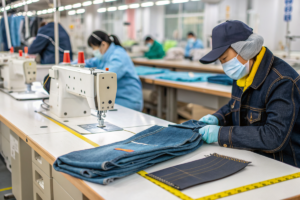
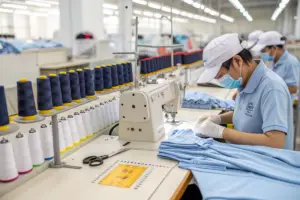
The production setup costs that drive the MOQ-price relationship include: pattern grading across sizes, typically a one-time cost of $80 to $150 per style, fabric cutting setup, which consumes the first meter of every fabric roll in the cutting table alignment, machine changeover time, which requires 30 to 60 minutes of non-productive time when switching between styles, and the learning curve of the first 10 to 20 units, which are sewn more slowly as the operators internalize the new construction sequence.
These setup costs are real labor hours and real material waste. A factory that absorbs them on a 100-unit order loses money. A factory that charges a higher per-unit price for a 100-unit order covers its costs and earns its margin. This is not price gouging. It is the economics of production. I explain this to every brand owner who expresses frustration about MOQ requirements. The factory is not saying "your brand is too small for us." The factory is saying "at this order quantity, the per-unit price must be X for us to produce the order sustainably." If X fits your margin model, the order works. If X does not fit, you either increase the quantity to reduce X, adjust your design to use lower-cost materials, or increase your retail price to absorb the higher landed cost. There is always a path. The path requires flexibility on one of the three variables: quantity, cost, or design.
What Is the Price Difference Between a 100-Unit and 500-Unit Order?
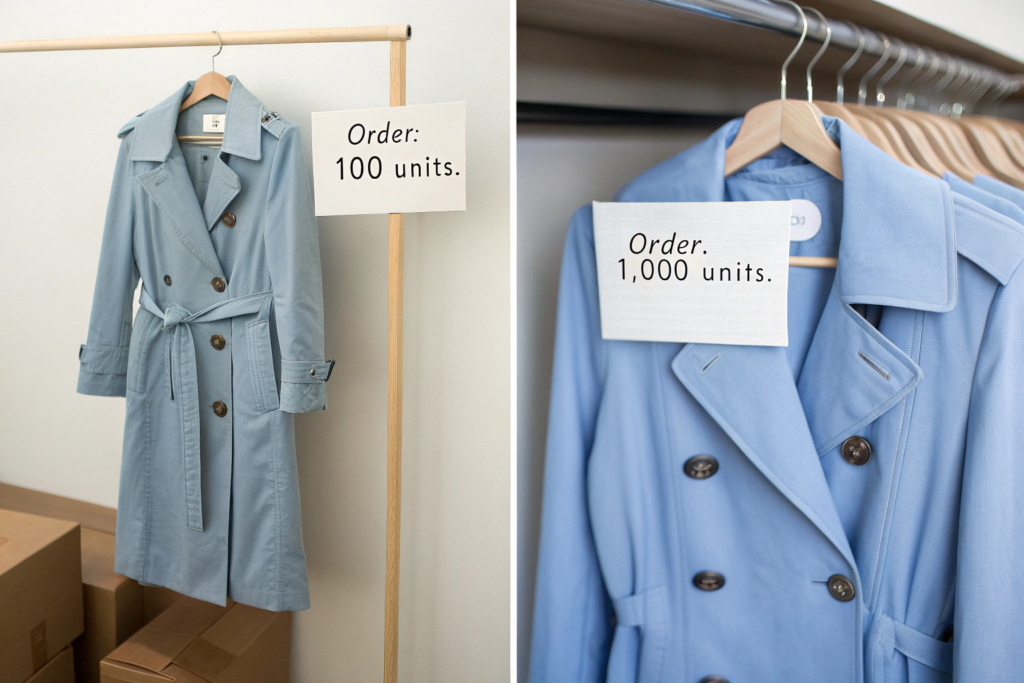
The price difference is substantial and measurable. Using a standard women's linen-blend trench coat as an example, with a medium-complexity design, partial lining, and standard buttons, here is a realistic cost comparison based on our current production data. For a 100-unit order, the per-unit FOB cost is approximately $24 to $28. The premium over the baseline is driven by the fabric surcharge for a below-minimum order, the amortization of pattern grading and cutting setup over only 100 units, and the lower operator efficiency due to the short production run. For a 300-unit order, the per-unit FOB cost drops to approximately $18 to $22. The fabric cost drops to standard pricing. The setup costs are spread across three times as many units. The operators achieve full speed and the defect rate drops as the learning curve flattens. For a 500-unit order, the per-unit FOB cost drops further to approximately $16 to $19. The fabric cost may drop slightly if the volume qualifies for a mill quantity discount. The production efficiency is maximized. The unit cost is now within 10% of the absolute floor cost achievable at much higher volumes. The key insight in this data is that the biggest price jump occurs between 100 and 300 units. Moving from 300 to 500 units yields a smaller marginal saving. I recommend brands target 300 units per style as a sweet spot. The per-unit cost is competitive with larger orders. The inventory risk is manageable for an established small-to-medium brand. The production run is long enough for the operators to achieve quality consistency. This 300-unit target is not a rigid rule, but it is a useful planning benchmark.
How Does Fabric Sourcing Strategy Impact the MOQ-Cost Equation?
Fabric sourcing is the single largest variable in the MOQ-cost equation. If you insist on a custom-developed fabric that requires a mill to create a new weave and a new dye formulation, your MOQ will be high and your per-meter cost will be high. The mill must recover its development cost over your order. If you select a stock fabric from the factory's library, your MOQ drops and your per-meter cost drops. The mill has already recovered its development cost. The factory has already purchased the bulk fabric. You are essentially buying fabric from inventory rather than commissioning new production. The cost difference between custom-developed fabric and stock fabric can be 30% to 50% at low volumes. A custom linen blend developed for your brand might cost $6.50 per meter at a 500-meter minimum. The same quality linen blend from our stock inventory might cost $4.80 per meter with no minimum. The stock fabric was purchased at a 2,000-meter volume by combining orders from multiple brands. The volume discount is baked into the stock price. A third option is deadstock fabric, which is unused fabric from a previous production run, sold by the mill at a significant discount. Deadstock is the lowest-cost option, but it is limited in quantity and non-repeatable. Once the deadstock bolt is gone, you cannot re-order the same fabric. Deadstock is ideal for limited-edition capsule collections where scarcity is part of the marketing story. It is not suitable for a core collection style that you plan to re-order across multiple seasons.
How We Handle MOQ at Shanghai Fumao
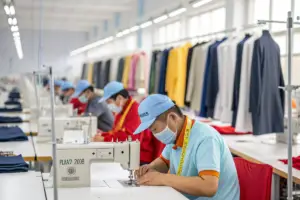
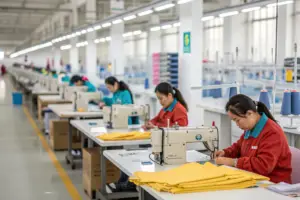
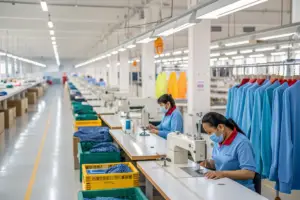
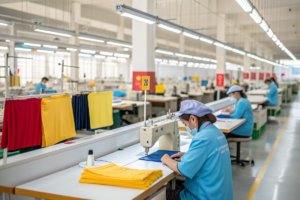
I structured Shanghai Fumao to serve the emerging and mid-size brand market. Our standard MOQ is 300 units per style, per color for custom-developed fabrics. This is consistent with the industry norm for quality manufacturing. However, I recognize that 300 units per color is a significant commitment for a brand that is testing a new design or entering the summer coat category for the first time. For this reason, we have built a parallel MOQ pathway that allows brands to start at 100 units per style, per color when using our stock fabric library. This pathway is not a compromise on quality. The stock fabrics are the same quality as our custom fabrics. They come from the same mills. They meet the same testing standards. The only difference is that they are not exclusive to your brand. For brands that eventually want exclusivity, we offer a transition path. You start with stock fabric at a 100-unit MOQ. You prove the design. You build your customer base. Then, on your re-order, you commission a custom fabric with your specifications, your exclusive color palette, and your branded hang tag. The MOQ for the custom fabric order is 300 units, but by that point, you have sales data to support the larger commitment. This phased approach has successfully launched dozens of summer coat collections.
We also offer a "shared production run" program where multiple brands with similar fabric needs are combined into a single mill order. The fabric minimum is met collectively. Each brand orders their own cut-and-sew production at their own quantity, as low as 50 units per style. The per-unit cost is higher than a standard production run due to the smaller cutting batches, but the fabric cost is at the standard rate, not the small-order surcharge rate.
This shared program requires coordination and patience. We batch orders quarterly. If you submit your design in January, your production may be scheduled in March alongside other brands using the same fabric. The timeline is less flexible than a dedicated production run. The trade-off is access to quality fabric at quality production standards at an MOQ that works for a micro-brand. This program is not advertised widely because it is more complex to manage than standard production. We offer it to brands that demonstrate seriousness through a clear design concept, a realistic sales plan, and a commitment to building a long-term partnership. If you come to us with a half-formed idea and no business plan, the shared program is not the right fit. If you come to us with a completed tech pack and a clear understanding of your target customer, we can almost certainly find an MOQ solution that works for your current scale.

What Information Do You Need for an Accurate MOQ Quote?
To provide a precise MOQ and price quote, I need six pieces of information from you. First, the design sketch or tech pack showing the coat style, length, sleeve type, and construction details. Second, the target fabric type and weight. If you do not know the exact fabric, I need a description of the desired hand feel and visual appearance. Third, your size range and the quantity breakdown by size. Fourth, your colorway plan, meaning how many colors and whether the colors are custom-developed or can be selected from our stock palette. Fifth, your desired order quantity per style, even if it is an estimate. Sixth, any special trim or embellishment requirements, such as custom buttons, embroidery, or printed linings. With these six data points, I can calculate the fabric consumption per unit, identify the appropriate fabric source, determine the production setup costs, and give you a detailed quote with specific MOQ numbers rather than a generic range. A quote that takes two days to prepare is more valuable than a price that arrives in two minutes.
Can You Split an MOQ Across Multiple Sizes and Styles?
Yes, with some important limitations. The MOQ per color applies to the fabric, not to a single style. If you have two coat styles that use the same fabric in the same color, the combined quantity across both styles counts toward the fabric minimum. For example, if the fabric minimum is 500 meters and your duster style consumes 2 meters per unit while your cropped jacket style consumes 1.2 meters per unit, you could order 150 dusters and 200 jackets to meet the 500-meter minimum. The production run is more complex because the cutting room must handle two separate pattern sets, but the fabric minimum is met, and the per-meter fabric price is standard. Size splits are handled within the style quantity. If your style MOQ is 200 units, you can split those 200 units across your size range according to your size curve. We do not impose minimums per size. If you need only 10 units of XS and 15 units of XXL, and the remaining 175 units distributed across S, M, and L, that is fully acceptable. The only practical constraint is that very small size runs at the extremes of the size curve may have slightly higher per-unit cutting costs because the marker efficiency drops when laying out a small number of pattern pieces. But this cost difference is usually less than $1 per unit and is absorbed into the overall price unless the size split is extremely unbalanced.
Conclusion
The MOQ for custom women's summer coats from a Chinese factory is not a fixed number. It is a variable that depends on your fabric choice, your colorway plan, your style design, and your chosen factory's business model. The standard range for quality manufacturing with custom fabric is 200 to 300 units per style, per color. This standard exists because fabric mills have minimum order quantities that cascade down the supply chain. However, several proven strategies can reduce the effective MOQ to 50 to 100 units. Using stock fabrics, consolidating colorways, accepting a small-order surcharge, and participating in shared production runs are all viable paths to lower-quantity production without sacrificing manufacturing quality.
The most important advice I can offer is to have the MOQ conversation early and honestly with your potential manufacturing partner. Bring your design details. Share your quantity constraints. Ask about flexibility options. A factory that is genuinely interested in your brand's long-term success will work with you to find a solution that balances production economics with your inventory risk. A factory that responds to your MOQ question with a rigid, take-it-or-leave-it number is signaling that they are not interested in a partnership. They are interested in a transaction. Keep searching until you find a partner who sees your brand's potential and is willing to invest in your growth through flexible production terms.
At Shanghai Fumao, we built our MOQ flexibility programs specifically for brands like yours. Whether you are placing your first order of 100 units from our stock fabric library or scaling to a 500-unit custom fabric run, we will give you honest, transparent numbers and work with you to structure an order that makes financial sense for your business stage. We want your re-order. We want your long-term success. The first order is the beginning of that journey, not the end of the negotiation.
To receive a detailed, no-obligation MOQ and price quote for your specific summer coat designs, reach out to our Business Director, Elaine. Send her your design sketches or tech packs, your target fabric ideas, and your ideal order quantity. She will return a comprehensive quote that includes multiple MOQ scenarios so you can compare the cost implications of different order sizes and choose the path that best fits your brand's current needs. Email Elaine at: elaine@fumaoclothing.com.