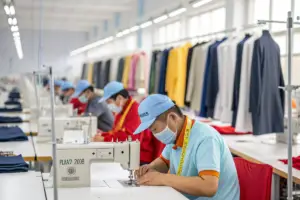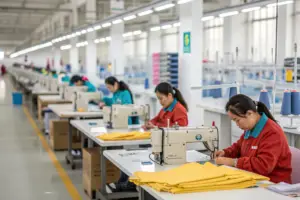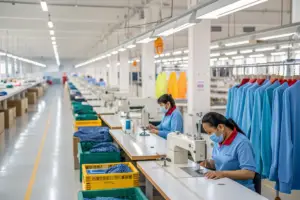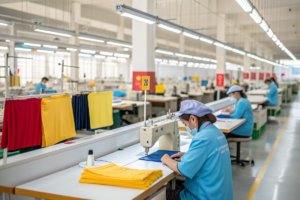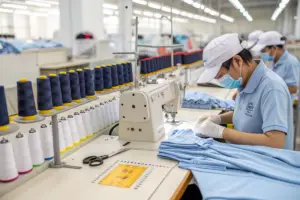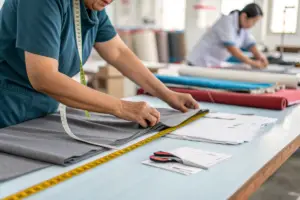
Last April, a brand owner from San Diego placed a 5,000-unit order for linen-blend summer dusters. Her factory in China promised a late May ex-factory date. She calculated the ocean transit, added a week for customs clearance, and marked June 15 on her calendar as the warehouse delivery date. The goods left the factory on May 28. They arrived at the Port of Los Angeles on June 14. Then the port congestion hit. The container sat on the terminal for 11 days waiting for a chassis. Customs took another 4 days to process the entry. The trucker was booked solid for another week. The coats arrived at her warehouse on July 8, three weeks late. She had already pushed her wholesale ship window twice. Two major accounts canceled. The coats that should have generated $340,000 in wholesale revenue at full margin sold for $190,000 at 30% off. The timing error cost her $150,000. Not because the coats were bad. Not because the factory was slow. Because she planned her calendar around the best-case scenario instead of the real-world timeline. Timing a summer coat order is not about picking a date. It is about understanding the physics of the global logistics calendar and building buffers that absorb the inevitable delays.
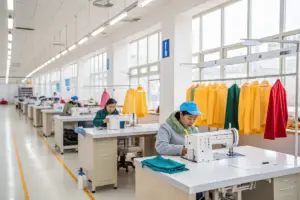
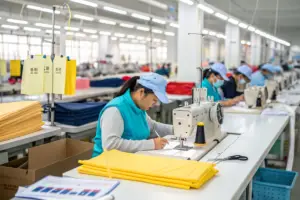
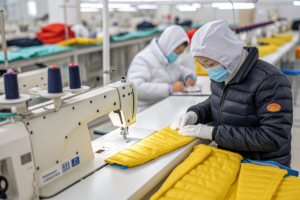
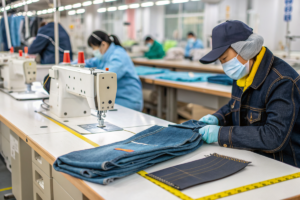
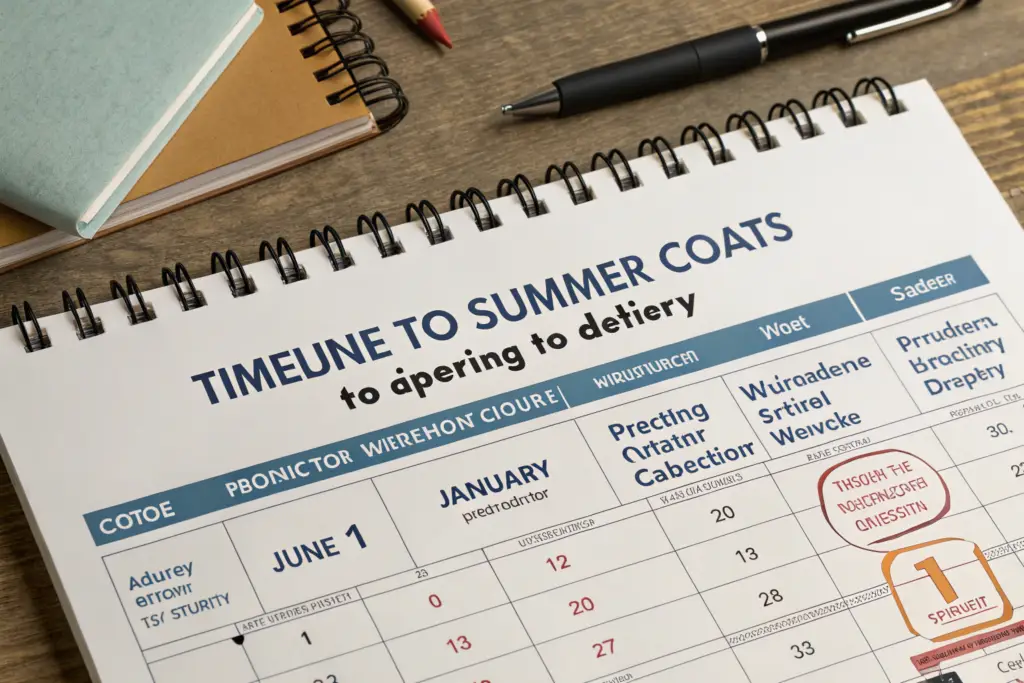
You time your summer coat orders to beat the shipping rush by working backwards from your must-have warehouse delivery date and inserting realistic buffers at each stage of the process. The formula is simple. Start with the date your goods must be on your warehouse floor. Subtract 7 days for destination handling and final mile delivery. Subtract 15 to 20 days for ocean transit from China to the US West Coast, or 30 to 35 days to the East Coast. Subtract 14 days for fabric sourcing and production scheduling. Subtract 21 to 35 days for bulk production depending on the coat complexity. Subtract 7 days for the pre-production sample approval. The result is your order placement date. For a June 1 warehouse delivery of a standard summer woven coat, the order must be placed by late January. For a March 1 delivery to supply a spring break launch, the order must be placed by early November of the previous year. At Shanghai Fumao, we provide our clients with a production calendar at the start of each season that maps every milestone from order placement to warehouse delivery, with explicit buffer allowances for the known bottlenecks.
The brands that consistently receive their summer coats on time are not lucky. They are not favored by the shipping lines. They have simply accepted the reality of the calendar and planned accordingly. The brands that are consistently late are the ones who compress every stage into the theoretical minimum and then act surprised when one link in the chain breaks. I will walk you through the entire timeline, the specific bottleneck periods that destroy on-time delivery, and the strategic decisions about warehousing and split shipments that can buy you weeks of flexibility.
What Is The Ideal Order Placement Calendar For Summer Outerwear?
The summer outerwear calendar is counterintuitive. You are thinking about summer coats in the sweltering heat of July, but you should be placing your orders for next summer in the freezing cold of January. The factory's production calendar fills up on a first-come, first-served basis. The brands that place their orders early get the production slots they want. The brands that place their orders late get whatever is left. The difference between an early order and a late order is not just a lower price or a more attentive service. It is the difference between your goods sailing on May 1 and your goods sitting in a warehouse waiting for a vessel on August 1.
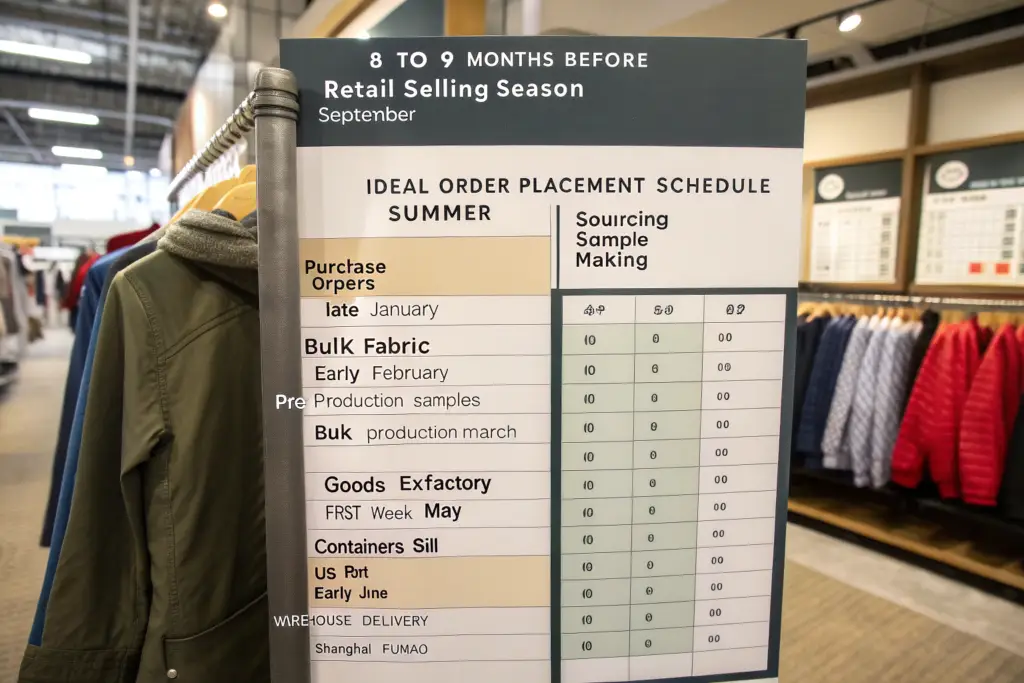
The ideal order placement calendar for summer outerwear is a phased schedule that begins 8 to 9 months before the retail selling season. For coats that will sell in May through July, the development phase with fabric sourcing and sample making should begin in September of the previous year. The purchase order should be placed and the deposit paid by late January. The bulk fabric should be ordered by early February. The pre-production sample should be approved by mid-March. The bulk production should run from late March through late April. The goods should be ex-factory by the first week of May. The container should sail by mid-May. The goods should arrive at the US port by early June. The warehouse delivery should occur by mid-June. This timeline includes buffers for a one-week delay at any stage without jeopardizing the ultimate delivery date. At Shanghai Fumao, we work with our clients to lock this calendar during the development phase. We do not wait for the purchase order to begin the fabric procurement because we know the mills have their own capacity constraints.
The brands that follow this calendar sleep well in May. The brands that place their summer orders in March because they were still designing in February spend May and June in a state of permanent anxiety. The anxiety is avoidable.
Why Does The Chinese New Year Holiday Dictate Your Order Timeline?
Chinese New Year, also called the Spring Festival, is the single most disruptive event in the global garment supply chain. It is not a one-day holiday. It is a multi-week shutdown that affects every factory, every mill, and every logistics provider in China. The exact date varies each year based on the lunar calendar, but it always falls in late January or February. The disruption begins two weeks before the holiday, when workers start leaving for their hometowns, and continues for two to four weeks after the holiday, when workers gradually return. The entire month surrounding Chinese New Year is a period of reduced capacity, unpredictable output, and extended lead times.
Any summer coat order that is not completed and shipped before the Chinese New Year shutdown must wait until after the holiday to finish production. The factory closes. The sewing lines stop. The cutting tables are quiet. The workers go home, and some do not return. Factories typically operate at 60% to 70% capacity for the first two weeks after the holiday as they rebuild their workforce. An order that was scheduled to finish on February 10 might not finish until March 10 if it straddles the holiday. This one-month delay cascades through the entire timeline. The late production means a late ex-factory date. The late ex-factory date means the goods hit the ocean freight market during the March-April peak, when rates are high and vessel space is tight. The late shipping means the goods arrive at the US port in May, right when every other importer is also receiving summer goods, and the port congestion and trucking delays are at their maximum. To avoid the Chinese New Year disruption entirely, you have two options. Option one is to complete production and ship the goods before the holiday, which means an ex-factory date in early January at the latest. Option two is to accept the post-holiday restart and plan for a March ex-factory date, but build a three-week buffer into the timeline to account for the slower ramp-up. The worst option is to assume the factory will operate at full capacity in late February. The Chinese New Year impact on manufacturing is a known, predictable event. The brands that ignore it in their planning calendar pay for the ignorance with late deliveries.
How Far In Advance Should You Book Fabric And Trim For A Summer Coat Program?
Fabric is the long pole in the production tent. You can sew 5,000 coats in three weeks with a well-organized line. You cannot weave, dye, and finish 5,000 meters of custom linen-viscose blend in three weeks. The textile supply chain is slow, capital-intensive, and operates on its own booking calendar. The mills have their own Chinese New Year shutdowns, their own capacity constraints, and their own minimum order quantities. A brand that places a fabric order after the purchase order is signed is already behind schedule.
For a summer coat program with a custom-developed fabric, the fabric order should be placed at least 30 days before the bulk production start date. This allows time for the mill to source the yarn, weave the greige, dye the color, apply the finishing treatment, inspect the rolls, and ship them to the factory. If the fabric requires a special finish, like a peach-skin sueding or a water-repellent coating, add another 10 to 14 days to the lead time. The trim components, the zippers, buttons, labels, and hang tags, have their own lead times. A custom-printed label from a specialized supplier might take 21 days to produce and ship. A custom YKK zipper with a specific color tape and a branded puller can take 28 days. These components must be ordered at the same time as the fabric, or earlier, to ensure they arrive before the cutting begins. At Shanghai Fumao, we maintain a trim library of standard components that are pre-approved for quality and available on short notice. For custom components, we order them during the sample approval phase, not after the purchase order is signed. This concurrent sourcing compresses the timeline by two to three weeks compared to a sequential process where the brand approves the sample, then the factory orders the materials. The textile fabric lead time management is a discipline that separates professional factories from amateurs. A professional factory orders the materials based on a forecast, not on a confirmed purchase order, because the factory knows the mill's calendar is less flexible than the brand's decision-making process.
When Is The Peak Shipping Season And How Can You Avoid It?
The peak shipping season for summer goods is not summer. It is spring. Every brand in the Northern Hemisphere wants their summer inventory to arrive between April and June. Every brand books containers for March, April, and May sailings. The result is a concentrated demand spike that overwhelms the ocean freight market. Vessel space sells out. Freight rates surge. Port terminals congest. Trucking capacity tightens. The peak season surcharges kick in. A container that costs $3,000 to ship in January costs $5,000 to ship in April, not because the underlying cost of fuel or labor has changed, but because the demand for a finite supply of vessel slots has spiked.
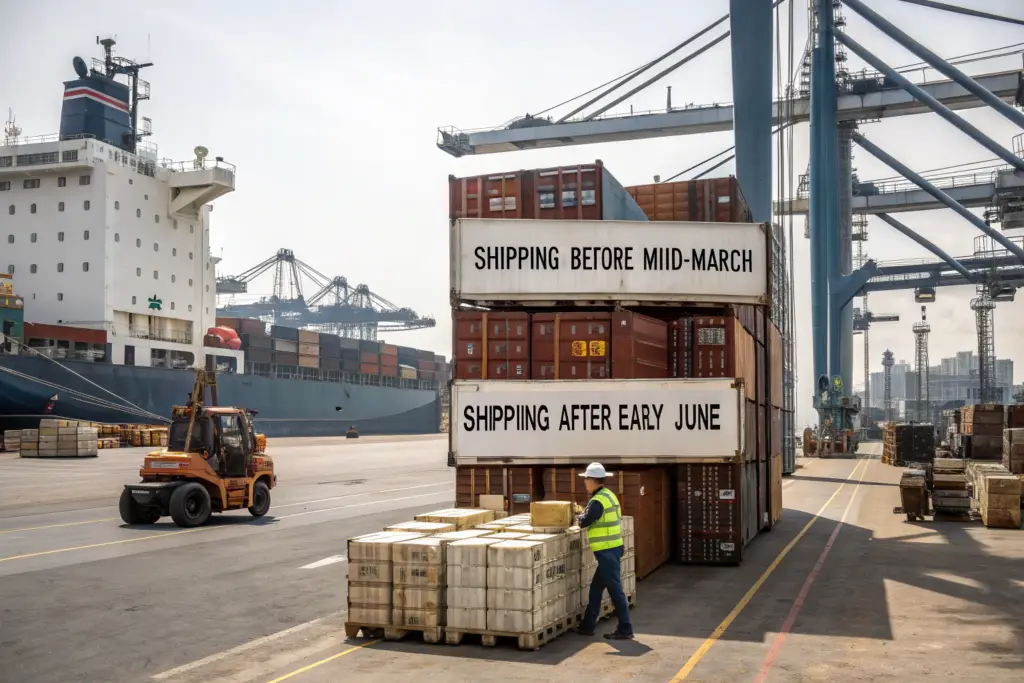
The peak shipping season for summer goods runs from late March through early June, with the most intense period in April and May. To avoid the peak, you must ship your summer coats before mid-March or after early June. Shipping before mid-March means your goods arrive at the US port in late March to early April, which positions your inventory for a May floor-set. Shipping after early June means your goods arrive in late June to early July, which is too late for the peak summer selling season but may work for a late-summer markdown strategy or a transitional early-fall collection. The brands that ship in April and May pay the peak surcharge, accept the congestion risk, and hope their goods do not get rolled to a later vessel. At Shanghai Fumao, we advise our clients to target a late February or early March ex-factory date for summer coats, which translates to a mid-March sailing and a mid-April warehouse arrival. This pre-peak window provides the best balance of inventory timing and logistics cost.
The peak season is not a secret. The shipping lines publish their peak season surcharge schedules months in advance. The freight forwarders warn their clients about the upcoming crunch. The brands that get caught in the peak are not surprised by its existence. They are surprised that their factory missed the pre-peak deadline and pushed their shipment into the peak window. The solution is not to find a faster shipping method in April. The solution is to enforce the pre-peak ex-factory date in the production contract.
What Are The Exact Date Windows When Freight Rates Spike For Summer Goods?
The ocean freight market has a seasonal rhythm that is as predictable as the tides. The rates begin to rise in late February as the post-Chinese New Year production starts to ship. The rates accelerate through March. The peak season surcharge, the PSS, is applied by most shipping lines starting in April. The rates remain elevated through May and begin to decline in June as the summer inventory rush subsides. The specific dates vary by year and by trade lane, but the pattern is consistent.
For the Shanghai to Los Angeles trade lane, the most common route for US-bound summer apparel, the rate ladder in a normal market year looks approximately like this. January to mid-February is the low season. The base rate for a 40-foot container is at its annual floor, typically around $1,800 to $2,500. Late February through March is the shoulder season. The rates begin to rise as the post-holiday production ships. The base rate climbs to $2,500 to $3,200. April through May is the peak season. The PSS adds $400 to $800 per container on top of the base rate. The effective rate is $3,200 to $4,500. June is the tail end of the peak. The PSS begins to phase out, but the base rate remains elevated. The effective rate is $2,800 to $3,500. July through August is the summer lull, where rates moderate to $2,000 to $2,800. These numbers are for a stable market without a major disruption like a canal blockage, a port strike, or a tariff shock. In a disrupted market, the peak rates can double or triple the normal peak. The ocean freight rate seasonality calendar is available from several freight analytics platforms. The exact dollar amounts change. The shape of the curve does not. Ship before March 15 to capture the low-season rate. Ship between March 15 and April 15 to capture the shoulder rate. Ship after April 15, and you pay the peak rate. The choice of sailing date is determined by the ex-factory date, which is determined by the order placement date. The freight rate you pay in April was decided by the order you placed in January.
How Does Port Congestion During The Peak Season Add Hidden Delays?
Port congestion is the silent delay that the transit time calculator does not show. The vessel schedule says Shanghai to Los Angeles is 14 days. The schedule does not say that the vessel might anchor outside the port for 5 days waiting for a berth. The schedule does not say that the container, once discharged, might sit on the terminal for 10 days waiting for a chassis. The schedule does not say that the trucker booked to pick up the container is double-booked because every importer in the country is trying to move goods in the same two-week window. The actual transit time from ex-factory to warehouse is the scheduled transit time plus the congestion buffer, and the congestion buffer is largest during the peak season.
The congestion at US ports is a function of volume concentration. When every summer coat, every patio furniture set, every barbecue grill, and every back-to-school supply arrives in the same six-week window, the port infrastructure cannot process the volume at the speed of the arrivals. The ships wait at anchor. The containers stack up on the terminal. The chassis fleet is fully utilized. The truckers prioritize their highest-volume clients. The small and mid-sized importers wait. During the peak congestion periods of 2021 and 2022, the average dwell time for a container at the Los Angeles and Long Beach ports exceeded 12 days, compared to a normal dwell time of 3 to 4 days. Even in a normal year, the peak season adds 2 to 5 days of port delay compared to a low-season shipment. This congestion delay must be built into the calendar. A brand that assumes a 14-day ocean transit plus 3 days of port handling will be late if the port handling actually takes 8 days. The 5-day difference is the congestion buffer. The US port congestion updates and tracking are published by the port authorities and monitored by the logistics industry. The data is available. The brands that use it plan for the realistic timeline. The brands that ignore it plan for the theoretical timeline and are disappointed every season.
Should You Consider US-Based Warehousing To Decouple Production From Demand?
The traditional model is direct injection. The goods leave the factory, cross the ocean, clear customs, and arrive at the brand's primary warehouse or 3PL just in time for the selling season. This model is efficient when everything works. When the vessel is on time, when the port is clear, when the trucker is available. When one of these links breaks, the just-in-time model becomes a just-too-late disaster. An alternative model is the buffer stock model. The goods leave the factory early, ship during the low season, and are stored in a US-based warehouse for a few months before the selling season begins. This model adds a warehousing cost but eliminates the timing risk.
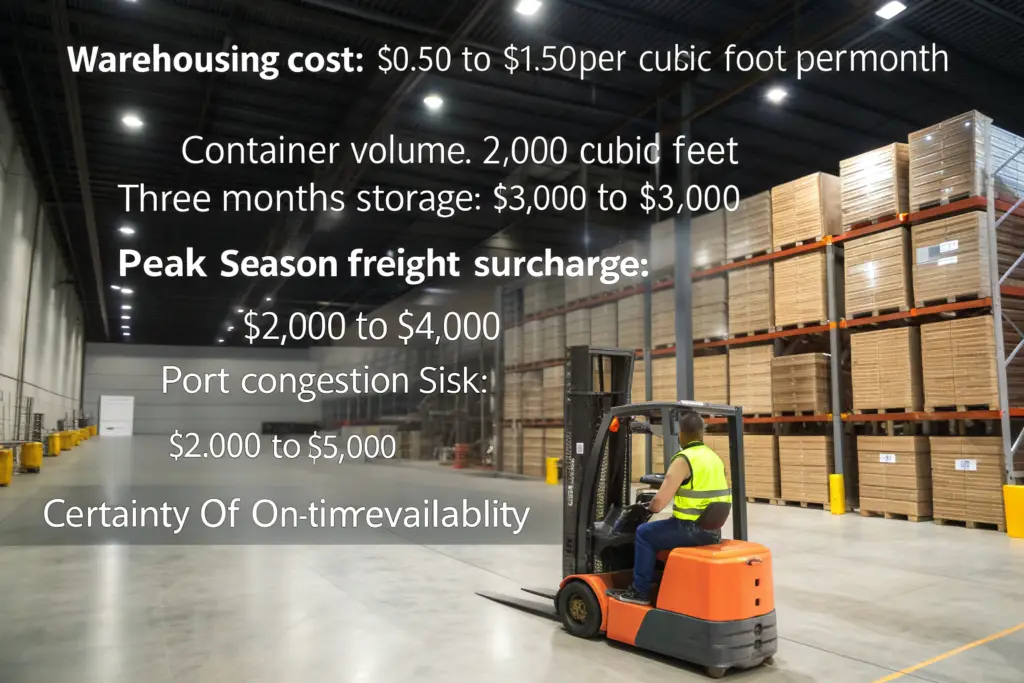
US-based warehousing can decouple production from demand by allowing you to ship your summer coats during the low season in January or February, avoid the peak freight rates and port congestion entirely, and store the goods in a US warehouse until the selling season begins in May. The additional cost is the warehousing fee, typically $0.50 to $1.50 per cubic foot per month depending on the facility. For a container of lightweight summer coats occupying 2,000 cubic feet, three months of storage costs $3,000 to $9,000. This cost must be weighed against the peak season freight surcharge of $2,000 to $4,000, the port congestion demurrage risk of $2,000 to $5,000, and the lost margin from late delivery. In many cases, the warehousing cost is equal to or less than the peak season risk cost, and the warehousing model provides the certainty of on-time availability that the just-in-time model cannot guarantee.
The buffer stock model is not for every brand. It requires the upfront capital to produce the goods early and pay for the storage. For a well-capitalized brand that values certainty over the absolute lowest cost, it is a strategic tool that removes the single largest variable from the summer launch: the ocean freight timeline.
What Are The Economics Of Shipping Early And Storing Versus Just-In-Time Delivery?
The just-in-time model has a seductive economic logic. You pay for the goods as late as possible. You receive the goods exactly when you need them. Your cash is not tied up in inventory sitting in a warehouse. The warehousing cost is zero. The carrying cost of inventory is minimal. This logic assumes the supply chain is reliable. The real cost of just-in-time is the cost of the reliability failure. When the goods are late, the brand loses sales, loses wholesale accounts, and liquidates inventory at a loss. The economic comparison must include the probability-weighted cost of failure, not just the best-case scenario.
Let me walk through the numbers for a 5,000-unit summer coat order with an FOB value of $75,000. Under the just-in-time model, the goods are produced in April and shipped in May. The ocean freight is $4,500 at the peak rate. The port handling and drayage are $1,800. The risk of a congestion delay is approximately 30% based on recent peak season data. If the delay occurs, the demurrage cost averages $2,500 and the lost margin from late delivery averages $15,000, a combination of wholesale order cancellations and markdowns. The probability-weighted cost of the delay is 30% multiplied by $17,500, which is $5,250. The total expected cost of the just-in-time model is the freight cost of $4,500 plus the handling cost of $1,800 plus the risk cost of $5,250, totaling $11,550.
Under the early-ship model, the goods are produced in January and shipped in February. The ocean freight is $2,500 at the low-season rate. The port handling and drayage are $1,200, lower because the ports are not congested and the truckers are available. The goods are stored in a 3PL warehouse for three months. The storage cost for 2,000 cubic feet at $0.80 per cubic foot per month is $4,800. There is also a cost of capital for paying the factory invoice three months earlier. If the brand pays $75,000 three months earlier and the cost of capital is 8% per year, the additional carrying cost is $1,500. The total cost of the early-ship model is the freight cost of $2,500 plus the handling cost of $1,200 plus the storage cost of $4,800 plus the capital cost of $1,500, totaling $10,000.
The early-ship model is actually $1,550 cheaper in expected value, and it carries zero risk of a late delivery that destroys the season. The inventory carrying cost calculation shows that the warehousing cost is offset by the freight savings and the elimination of the congestion risk. The just-in-time model only wins if the supply chain performs perfectly, which it does not.
How Does A 3PL Warehouse Enable Faster Wholesale Fulfillment For Summer Coats?
A 3PL, a third-party logistics provider, is a warehouse that stores your inventory and fulfills orders on your behalf. When your summer coats arrive from the factory, they are received into the 3PL, counted, inspected, and put away into inventory. When your wholesale accounts place orders, the 3PL picks, packs, and ships the coats directly to the retailers. The brand does not touch the goods. The brand does not need its own warehouse space or its own picking and packing staff.
This model is particularly powerful for a summer coat brand that sells to multiple wholesale accounts across the country. If the 3PL is strategically located near a major logistics hub, like Dallas, Chicago, or Atlanta, the ground shipping time to most US retail locations is 1 to 3 days. A wholesale order placed on Monday is delivered on Wednesday. The brand can offer later order deadlines and faster delivery than a brand that ships from a single warehouse on the coast. The 3PL also enables the brand to allocate inventory dynamically. If a specific style of summer blazer is selling faster in the Southeast region than in the Northwest, the 3PL can route the inventory accordingly, assuming the brand is using a distributed 3PL network. The 3PL can also handle the value-added services that wholesale accounts demand: the retail-ready packaging, the price ticket attachment, the UPC label application, and the compliance shipping to the retailer's specific routing guide. The factory in China cannot easily do these services because the routing guide requirements vary by retailer and the final destination is not known at the time of production. The 3PL in the US does these services daily. The 3PL warehousing and fulfillment services allow the brand to be a brand, not a logistics company. The factory produces the coats. The 3PL stores and ships them. The brand designs and markets them. Each party does what it does best.
How Can A Split Shipment Strategy Give You The Best Of Both Worlds?
The split shipment strategy is the solution to the fundamental tension of summer coat logistics: you need inventory early to seed the wholesale accounts and build the in-store presence, but you also need the ability to restock quickly when a specific style outperforms the forecast. A single shipment arriving on June 1 forces you to forecast perfectly in January. A split shipment acknowledges that the forecast will be wrong and builds the logistics around that reality.
A split shipment strategy divides your summer coat order into two or three waves. The first wave, typically 60% to 70% of the order, ships by sea during the pre-peak window in February or March. This wave arrives at your warehouse or 3PL in April, positions your inventory for the May floor-set, and provides the bulk of your stock for the full-price selling period. The second wave, typically 20% to 30% of the order, is held at the factory in greige form or as finished goods and shipped by air or express sea freight in May or June based on real-time sell-through data. This wave restocks the styles that are outperforming, captures the peak demand curve, and prevents stockouts on your best sellers. The third wave, if needed, is a small air freight restock in July for any late-breaking viral trend. At Shanghai Fumao, we structure our clients' orders around this split model. We produce the full quantity in one run to capture the production efficiency, but we ship in waves based on the brand's inventory strategy.
The split shipment strategy costs slightly more in freight than a single full-container shipment because the second wave may ship by air or by a less efficient LCL sea freight. The additional freight cost is a fraction of the gross margin gained by selling more units at full price and fewer units at markdown. The brand that splits its shipments captures the upside of a hot style without the downside of a late shipment.
How Do You Decide The Percentage Split Between The Early Sea Shipment And The Later Air Restock?
The percentage split is a function of three variables: the forecast accuracy of the brand, the margin structure of the product, and the restock lead time. A brand with a highly accurate forecast can ship 80% or more in the first wave. A brand with a new, unproven style should ship 50% to 60% in the first wave and hold back a larger reserve for the restock. The margin structure determines how much air freight the brand can absorb. A coat with a $58 FOB and a $198 retail price can afford a significant air freight restock. A coat with a $22 FOB and a $68 retail price has less margin to absorb the air freight premium and should lean more heavily on the sea shipment.
A practical starting point for a brand with a moderate level of forecast confidence is a 70/30 split. Ship 70% of the order by sea in the pre-peak window. Hold 30% at the factory, either in greige fabric or as finished goods, depending on the factory's storage capacity and the fabric's stability. When the first wave arrives and the brand has two weeks of sell-through data, the brand analyzes the performance by style, color, and size. The styles that are selling above forecast trigger a restock from the reserve. The styles that are selling below forecast have their reserve canceled or redirected to a later season. This model requires the brand to commit to the total production quantity upfront but allows the brand to defer the final allocation of units to specific styles until real demand data is available. The inventory allocation and split shipment strategies are standard practice in the fashion industry. The brands that master the split shipment consistently outperform their forecasts because they do not need their forecasts to be perfect. They only need them to be directionally correct.
How Does Holding Greige Inventory Enable The Ultimate Flexible Restock?
The most advanced form of the split shipment strategy is the greige reserve model, which I discussed in the article on urgent restocking. The brand produces the full quantity of coats, ships the finished coats for the first wave, and holds the remaining fabric in greige form at the factory. The greige is the unfinished woven fabric, before dyeing and finishing. It is stable, does not degrade, and can be dyed to any color in the brand's palette on short notice.
When the first wave sell-through data comes in, the brand knows which colors are hot and which are not. The brand then instructs the factory to dye the greige in the hot colors, finish the fabric, and sew the second wave of coats. The second wave ships by air or express sea freight. The coats that arrive in the second wave are in the exact colors that are selling, not in the colors the brand guessed would sell six months earlier. This model eliminates the color allocation risk entirely. The brand does not need to forecast the color mix. The brand forecasts the total unit volume, produces the fabric for that volume, and defers the color decision until real demand data is available. The additional cost is the greige storage and the two separate dyeing runs. The benefit is a near-perfect color match to demand, which translates to fewer markdowns on the unpopular colors and fewer stockouts on the popular colors. This model requires a factory that has the financial capacity to hold greige inventory, the dyeing relationships to do small-batch color runs, and the production flexibility to insert a restock order into the schedule on short notice. At Shanghai Fumao, we offer this model to our long-term DDP clients. The greige inventory management for apparel is the ultimate supply chain flexibility tool for a seasonal fashion business. It converts a fixed, forecast-driven supply chain into a responsive, demand-driven one.
Conclusion
Timing your summer coat orders is a discipline, not a guessing game. The brands that receive their goods on time, season after season, do not have a secret shipping method or a special relationship with the port authorities. They have a calendar. They work backwards from the must-have warehouse delivery date. They insert realistic buffers for the known bottlenecks: the Chinese New Year shutdown, the mill lead times, the peak season freight market, the port congestion window. They place their orders early, not because they are anxious, but because the factory's calendar fills up and the mill's capacity books out. They consider the strategic alternatives of buffer stock warehousing and split shipments, and they choose the model that matches their capital availability and their risk tolerance.
The brands that are consistently late are the ones who compress the timeline into the theoretical minimum. They believe the factory's fastest quoted lead time. They ignore the port congestion data. They ship in May and pay the peak rate. They arrive in June and pray for no exam. Some seasons they get lucky. Most seasons they do not. And the cost of the delay is not just the freight surcharge. It is the lost full-price sales, the canceled wholesale orders, and the markdown liquidation that turns a profitable collection into a breakeven one.
At Shanghai Fumao, we start the calendar conversation with our clients during the development phase. We do not wait for the purchase order to talk about the shipping date. We build the timeline backwards from the brand's selling season and we identify the bottlenecks before they become emergencies. We offer the full range of timing strategies: the pre-peak sea shipment, the early-ship warehousing model, the split shipment with air restock, and the greige reserve for the ultimate in color flexibility. We do this because a coat that arrives on time is a coat that sells at full price, and a brand that sells at full price is a brand that grows.
If you are planning your summer outerwear line and want to build a calendar that actually works, not one that assumes everything goes perfectly, reach out to our Business Director, Elaine, at elaine@fumaoclothing.com. Tell her your must-have warehouse delivery date, your approximate order volume, and the number of styles in your collection. She will send you a production calendar that maps every milestone from today to the delivery date, with explicit buffer allowances and a recommended shipping strategy. Because timing is not everything in the summer coat business, but it is the foundation that everything else rests on.