I received a panicked phone call from a brand owner in Texas two summers ago. She had sourced 4,000 lightweight linen dusters at an FOB price of $12.80. She budgeted $1.20 per unit for freight and duty. Her retail price was set at $68, and her gross margin projection was 62%. She thought she had a gold mine. The container arrived, and the real landed cost came in at $17.40 per unit. The freight rate had spiked. The customs broker had classified the coats under a higher duty rate than she expected. The port handling fees were twice what her forwarder had estimated. Her actual margin was 38%. She would have been better off putting the money in a savings account. The FOB price is the beginning of the calculation. It is not the end. The landed cost is the only number that tells you whether your summer coat program is a business or a hobby.
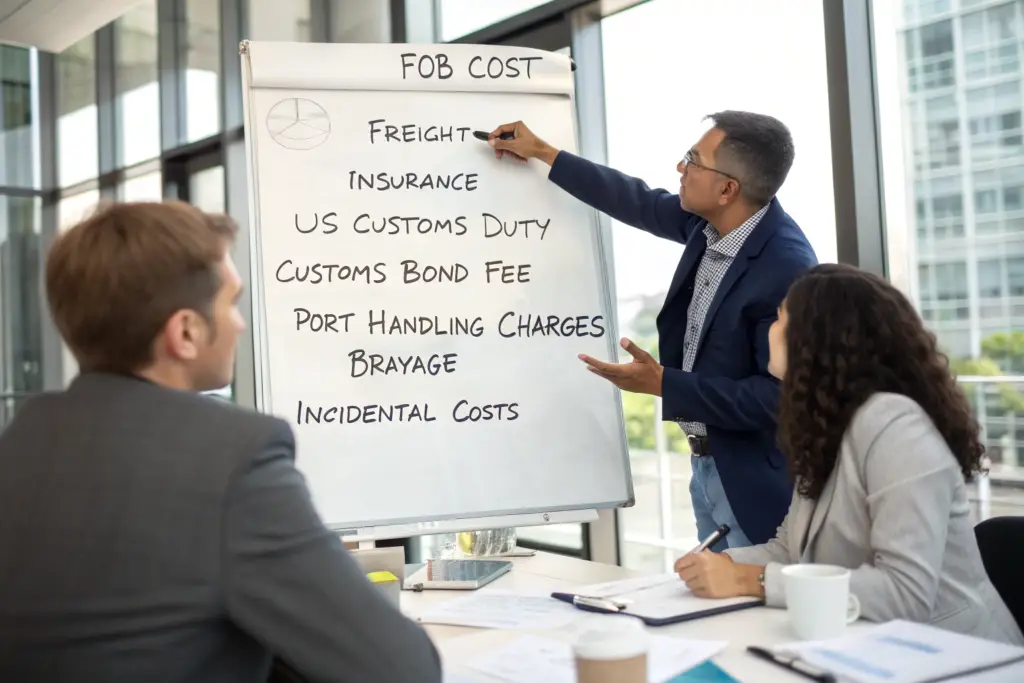
The landed cost for a container of summer coats is the sum of the FOB cost of the goods, the ocean or air freight, the marine insurance, the US customs duty calculated on the correct HTS code, the customs bond fee, the port handling and terminal charges, the trucking from the port to your warehouse, and any incidental costs like exams, demurrage, or broker fees. The formula is simple: Landed Cost = FOB + Freight + Insurance + Duty + Port Charges + Drayage + Incidentals. The execution is where most brands fail. At Shanghai Fumao, we provide our DDP clients with a guaranteed landed cost before the order ships, so there are no surprises when the container hits the dock.
You do not need to be a logistics expert to calculate your landed cost accurately. You need to know the right numbers to ask for, the hidden fees that forwarders bury in the fine print, and the tariff classification that can swing your duty bill by thousands of dollars. Let me walk you through the entire calculation, line by line, with real numbers from a typical summer coat shipment.
What Is The Exact Formula For A Summer Coat Container's Landed Cost?
The landed cost formula is not proprietary. It is basic arithmetic. The problem is that most brand owners do not populate the formula with real numbers. They use estimates from the first page of a Google search. They use a freight rate their friend told them six months ago. They guess the duty rate. A guess in any one of the formula's variables turns the entire calculation into a guess. And a guessed landed cost is a budget overrun waiting to happen.
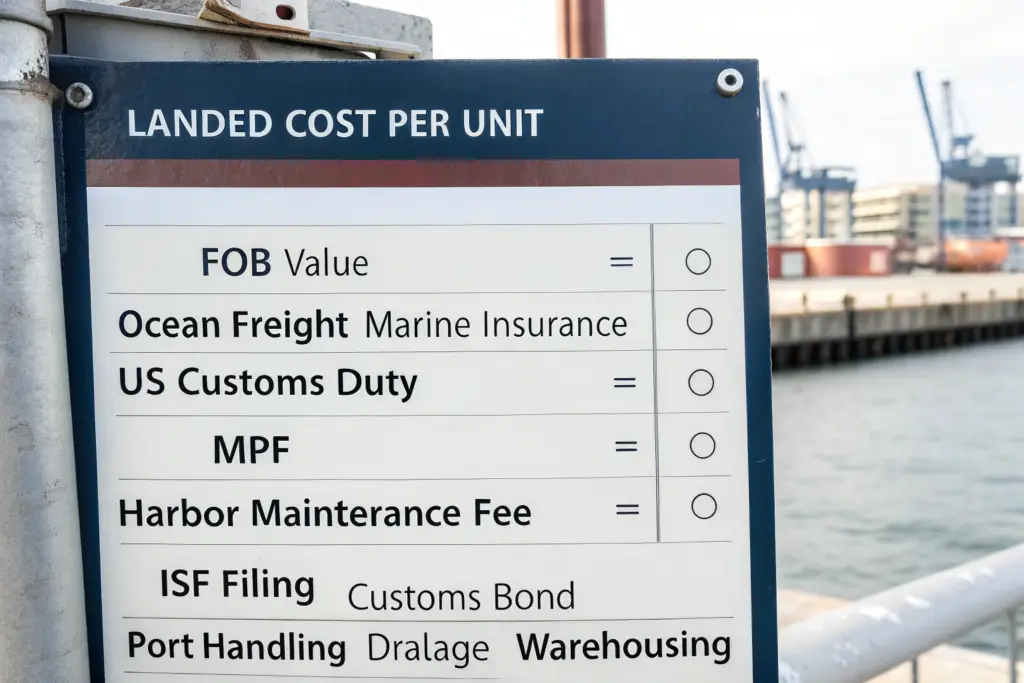
The exact formula is: Landed Cost Per Unit = (FOB Value + Ocean Freight + Marine Insurance + US Customs Duty + MPF + Harbor Maintenance Fee + ISF Filing + Customs Bond + Port Handling + Drayage + Warehousing) / Total Units. Let me define each variable. FOB Value is the total invoice value of the goods. Ocean Freight is the cost of the container from the port of loading to the port of discharge. Marine Insurance is typically 0.3% to 0.5% of the FOB value. US Customs Duty is the duty rate percentage applied to the FOB value. MPF, the Merchandise Processing Fee, is 0.3464% of the FOB value with a minimum of $29.66 and a maximum of $575.35. The Harbor Maintenance Fee is 0.125% of the FOB value. ISF, the Importer Security Filing, is a flat fee, usually $35 to $50. The Customs Bond is an annual or single-entry bond fee. Port Handling, Drayage, and Warehousing are destination charges that vary by port and distance. Every one of these variables is knowable before the goods ship. If your forwarder cannot give you a line-item breakdown of all these charges in writing, find a new forwarder.
The landed cost is the price of certainty. A DDP quote from a factory like Shanghai Fumao collapses all these variables into a single, guaranteed number. That number is your landed cost. No math required. No risk of a surprise exam fee. No duty classification error. Just one price, delivered to your door.
How Do Ocean Freight Rates Fluctuate And How Can You Lock Them In?
Ocean freight is the most volatile variable in the landed cost equation. A 40-foot container from Shanghai to Los Angeles can cost $1,500 in a soft market and $12,000 in a disrupted market. The summer season adds extra pressure because every brand is shipping goods for the same selling window. The peak season surcharges, the General Rate Increases, and the equipment shortages all hit hardest from June through September.
You cannot control the freight market. You can manage your exposure to it. The most effective strategy is to request a freight rate validity from your forwarder in writing. A rate validity locks the freight cost for a specific period, usually 14 to 30 days. You align your shipment booking with this validity window. If the factory is running late and the validity expires, the forwarder can re-quote at the prevailing rate. This is where many brands get burned. They budget based on a rate they saw three months ago, and by the time the goods are ready, the rate has doubled. The alternative is to source on DDP terms, where the factory bears the freight risk. At Shanghai Fumao, we maintain long-term contracts with our forwarders that give us priority allocation and stabilized rates even during peak season disruptions. We pass this stability on to our DDP clients. The ocean freight rate trends are published weekly by several freight analytics platforms. A professional buyer checks these trends monthly to understand where the market is moving. A casual buyer gets surprised by a rate spike. The market does not care which category you fall into, but your profit margin cares deeply.
What Are The Commonly Overlooked Destination Charges That Inflate Landed Cost?
The FOB price and the ocean freight are the visible costs. The destination charges are the invisible costs. They are the line items on the forwarder's final invoice that were not on the initial quote. They are the fees you discover after the container has already arrived and you have no leverage to dispute them.
The most commonly overlooked destination charges are the Pier Pass fee for Los Angeles and Long Beach ports, the Chassis Usage Fee if the trucker needs to rent a chassis to haul your container, the Fuel Surcharge on the drayage which can fluctuate weekly, the Pre-Pull fee if the trucker has to retrieve your container from the terminal the night before delivery, the Wait Time fee if the warehouse takes more than the allotted two hours to unload, and the Pallet Exchange fee if the container is floor-loaded and the warehouse requires palletized receipt. These fees can collectively add $400 to $800 to the cost of a single container. They are not random. They are standard. A good forwarder lists them on the initial quotation as a range. A bad forwarder hides them until the final invoice. When you request a freight quote, ask specifically for an "all-in" destination charge breakdown. The phrase "all-in" signals that you will not tolerate surprise line items. The destination port charges explained are available on most major forwarder websites. You owe it to your business to understand them before you sign a booking confirmation.
How Do You Determine The Correct HTS Code For Summer Coats?
The Harmonized Tariff Schedule code is the numerical code that classifies your product for US Customs purposes. It determines your duty rate. The difference between one HTS code and a very similar HTS code can be a duty rate of 0% or a duty rate of 27%. This is not a minor detail. On a container of summer coats with an FOB value of $50,000, the difference between a 0% duty and a 27% duty is $13,500. That single classification decision can be the difference between a profitable season and a loss.
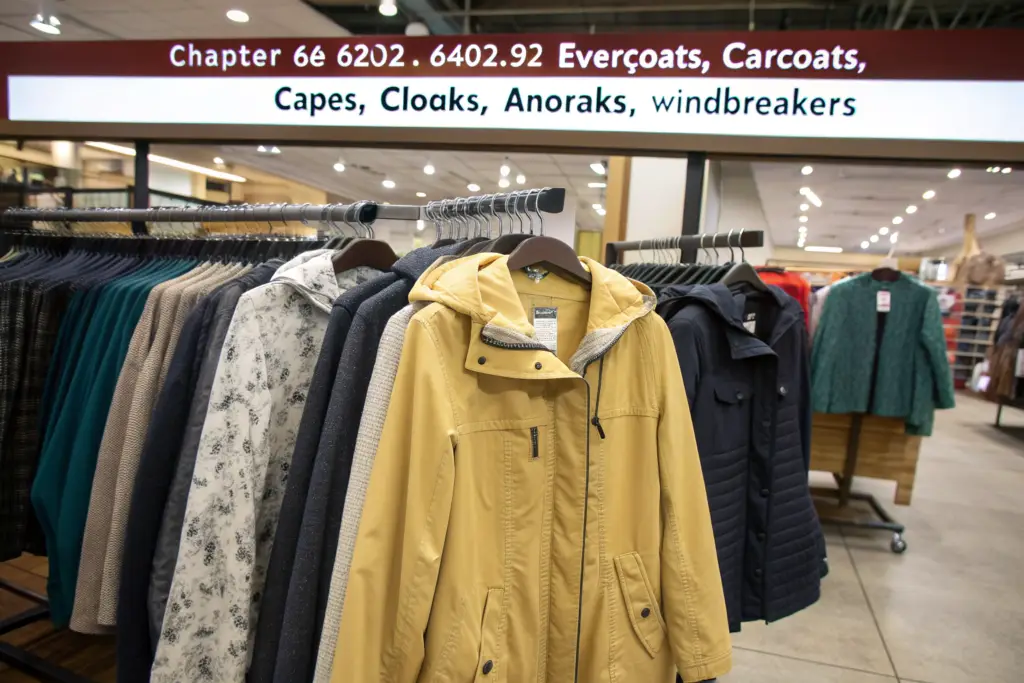
Women's woven summer coats typically fall under Chapter 62 of the HTS, specifically heading 6202 for overcoats, carcoats, capes, cloaks, anoraks, windbreakers, and similar articles. The exact subheading depends on the fiber content. A cotton summer coat is 6202.92. A man-made fiber summer coat is 6202.93. A linen or ramie summer coat is 6202.99. The duty rate for most of these subheadings ranges from 4% to 8%, but specific trade preference programs or Section 301 tariffs on Chinese goods can add additional duties. You must check the current rate at the time of shipment, not the rate from last year. The HTS code is not a static database. It is updated regularly.
Do not let your supplier classify your goods. Do not let your forwarder classify your goods without your review. The classification is your legal responsibility as the Importer of Record. A misclassification, even an innocent one, results in a bill from Customs for back duties plus interest. I have seen this bill arrive two years after the shipment.
What Is The Difference Between A Knit And Woven Coat For Duty Purposes?
The distinction between a knit coat and a woven coat is not just a textile trivia question. It determines which chapter of the HTS applies to your product. Knit garments fall under Chapter 61. Woven garments fall under Chapter 62. The duty rates between the two chapters can be significantly different for the same fiber content.
A knit fabric is constructed by interlocking loops of yarn. A woven fabric is constructed by interlacing two sets of yarns at right angles. The difference is visible to the naked eye. If your summer coat is made from a stretchy, looped fabric like a jersey or a french terry, it is a knit and should be classified in Chapter 61. If it is made from a rigid, interlaced fabric like a linen twill or a polyester taffeta, it is a woven and should be classified in Chapter 62. The confusion often arises with hybrid fabrics or with terminology. A "sweater coat" made of a chunky knit is Chapter 61. A "blazer" made of a woven linen is Chapter 62. A "soft jacket" made of a woven fabric with a small percentage of spandex for stretch is still Chapter 62 because the spandex is an additive to a woven construction, not a conversion to a knit construction. The HTS code classification for apparel requires you to know the construction method of your fabric. Your factory should provide this on a technical specification sheet. If they cannot tell you whether the base fabric is knit or woven, find a factory with better technical documentation.
How Can A Customs Broker Help You Avoid A Tariff Overpayment?
A customs broker is your interface with US Customs and Border Protection. A good broker saves you money. A bad broker costs you money and exposes you to legal liability. The broker's job is to review your commercial invoice, classify your goods under the correct HTS code, file the entry, pay the duties on your behalf, and ensure the goods are released.
A broker can help you avoid a tariff overpayment in three specific ways. First, they can identify whether your product qualifies for a free trade agreement or a special duty preference program. If your summer coat is made from fabric woven in a country that has a trade agreement with the US, the duty rate might be zero. Second, they can advise on the correct valuation methodology. The dutiable value is generally the FOB price, but certain additions like assists, which are materials or services you provided to the factory for free, must be added. Certain deductions like international freight and insurance, if separately itemized, are deducted. A broker who understands valuation can ensure you are not paying duty on costs that are not dutiable. Third, a broker can file a prior disclosure if a past classification error is discovered. A prior disclosure is a voluntary notification to Customs of a past error. It limits the penalties you face. A broker who discovers you have been overpaying for the last two years can file a protest and recover the overpaid duties. The US customs broker services are not an expense. They are an investment in compliance. Choose a broker who specializes in apparel. Do not use a generalist broker who also clears electronics, machinery, and food. Apparel classification is a specialized skill.
Why Is The Product Weight A Hidden Factor In Summer Coat Logistics?
Summer coats are light. That is the whole point. A winter parka weighs 1,200 grams. A summer linen blazer weighs 350 grams. The lighter weight is a design advantage, but it creates a logistics paradox. Ocean freight is charged by container volume, not weight, for most apparel shipments. A 40-foot container holds a certain number of cartons, and each carton holds a certain number of coats. The number of coats per carton, and therefore the freight cost per unit, is determined by the weight and bulk of the coat. A heavier, bulkier coat means fewer units per carton, fewer units per container, and a higher freight cost per unit. A lighter, compressible coat means more units per container and a lower freight cost per unit. The weight of your coat is not just a design feature. It is a direct driver of your landed cost.
The product weight impacts the landed cost because it determines the packing density. A summer coat that can be packed at 25 pieces per carton will have a freight cost per unit roughly 40% lower than a bulky summer coat that can only be packed at 15 pieces per carton, assuming both cartons are the same size and both containers are full. At Shanghai Fumao, we work with our clients during the product development phase to optimize the packing configuration. A slight change to the sleeve construction or the collar interfacing can sometimes reduce the folded thickness by 20%, which allows more units per carton and a lower per-unit freight cost without altering the design's appearance.
The packing density is a conversation that should happen before the sample is approved. Once the coat is designed with a stiff, oversized collar that cannot be folded flat, you have locked in a higher logistics cost for the life of the style.

How Does Carton Packing Density Affect Your Per-Unit Freight Cost?
The math of carton packing density is straightforward and brutal. A standard export carton for apparel measures roughly 60cm x 40cm x 40cm, giving a volume of 0.096 cubic meters. A 40-foot container holds approximately 68 cubic meters of cargo. At a carton volume of 0.096 cubic meters, you can fit about 700 cartons in a container, accounting for some wasted space.
If your summer coat packs at 20 pieces per carton, that container holds 14,000 units. If the ocean freight for the container is $4,000, the freight cost per unit is $0.29. If your coat is bulkier and packs at only 12 pieces per carton, that same container holds 8,400 units. The freight cost per unit jumps to $0.48. That is a $0.19 difference per unit. On an order of 10,000 units, that is $1,900 of hidden cost. The freight has not changed. The factory has not changed. The only variable is how the coat was designed to fold. This is why we pay attention to the weight and bulk of the interlining, the thickness of the shoulder pad, and the collapsibility of the collar. A coat with a soft, unstructured collar that folds flat packs more efficiently than a coat with a rigid, fused collar that must be packed in a fixed shape. The garment packing optimization for shipping is a cost-saving discipline that starts at the sketch stage, not at the loading dock.
What Is The Volumetric Weight Calculation And Why Does It Matter For Air Freight?
Volumetric weight, also called dimensional weight, is the pricing mechanism used for air freight and express courier shipments. Unlike ocean freight, which charges primarily by container volume, air freight charges by the greater of actual weight or volumetric weight. This is because an airplane has limited cargo hold space. A shipment of lightweight, bulky coats occupies a lot of space but weighs very little. The airline uses volumetric weight to ensure they are compensated for the space the cargo occupies.
The formula for volumetric weight is: Volumetric Weight (kg) = (Length x Width x Height in cm) / 5000 for most international air freight. If you have a carton that measures 60cm x 40cm x 40cm, the volumetric weight is (60 x 40 x 40) / 5000 = 19.2 kg. If the actual weight of the carton is 8 kg, you will be charged for 19.2 kg. Your summer coats are light, so the volumetric weight will almost always be higher than the actual weight. This is why air freight can be shockingly expensive for lightweight outerwear. The coats weigh very little, but the cartons are full of air. We mitigate this at Shanghai Fumao by using vacuum packing for air freight shipments of summer coats. The vacuum packing removes the air from the polybags, compressing the coats and allowing more units per carton, which reduces the volumetric weight. The coats recover their shape within 24 hours of being unpacked. The air freight volumetric weight calculator on most major forwarder websites can give you an instant quote. The lesson is simple: for ocean freight, optimize the carton cube. For air freight, compress the cube or accept the premium.
Should You Source Summer Coats On FOB Terms Or DDP Terms?
This is the most strategic sourcing decision you will make. FOB, Free On Board, means you pay the factory for the goods and the factory delivers them to the port of export. You then contract your own forwarder, pay the ocean freight, insure the goods, clear customs, pay the duties, and arrange the trucking to your warehouse. You control the logistics chain. You also own all the risk and the cost variability. DDP, Delivered Duty Paid, means the factory pays for everything. The factory contracts the freight, clears customs, pays the duties, and delivers the goods to your warehouse door. You pay one price. You own no logistics risk.
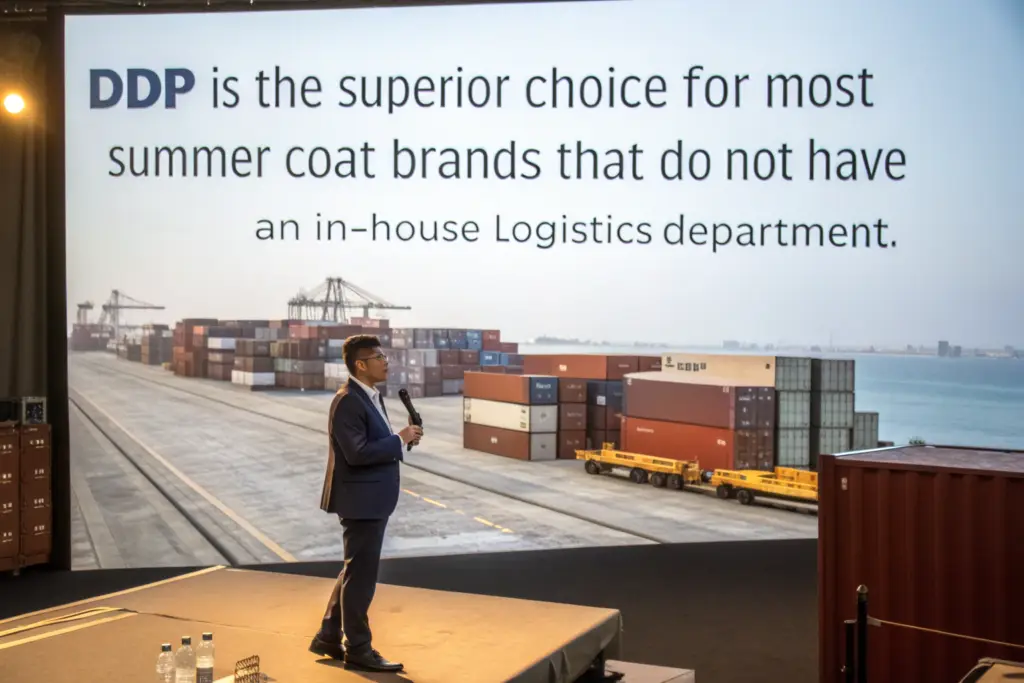
DDP is the superior choice for most summer coat brands that do not have an in-house logistics department. The DDP price is a guaranteed landed cost. You know your exact cost per unit before the production begins. You are not exposed to freight rate volatility, customs exam delays, port congestion surcharges, or duty classification errors. The factory bears all of those risks. At Shanghai Fumao, we recommend DDP for orders up to approximately 5,000 units. Our DDP clients sleep better during peak shipping season because they know their goods will arrive on time at a price that will not change.
FOB can be marginally cheaper for very large orders where the brand has enough volume to negotiate preferential freight rates and has the internal expertise to manage the customs clearance process without errors. For everyone else, the DDP premium is the cheapest insurance policy in the garment industry.
What Are The Hidden Risks Of Managing Your Own Freight Forwarding?
Managing your own freight forwarding gives you control. It also gives you a second full-time job and a new set of problems you did not know existed. The risks are not just financial. They are operational and legal.
The first hidden risk is the rollover. Your forwarder books your container on a vessel. The vessel is overbooked by the shipping line. Your container is rolled to the next vessel, which sails 7 days later. Your summer coat launch date is now 7 days late. You have no recourse. The shipping line's contract allows them to roll cargo. The forwarder is not liable. The factory is not liable because the goods were delivered to the port on time under FOB terms. You eat the delay alone. The second hidden risk is the customs examination. Your container is selected for a random exam. The exam takes 5 to 10 days. The port charges demurrage during the exam period. Your forwarder quotes you the storage fee after the fact. You pay. The third hidden risk is the classification error. Your forwarder or your internal team misclassifies the summer coat under a higher duty subheading. You overpay duties for years without realizing it. When you eventually discover the error, you file for a refund, and the process takes 18 months. The fourth hidden risk is the communication gap. The factory's responsibility ends when the goods cross the ship's rail at the port of loading. If the container is damaged during unloading at the destination port, the factory is not responsible. You must file a claim against the shipping line, a process that takes months and recovers a fraction of the value. The FOB vs DDP shipping terms are not just a price comparison. They are a risk allocation decision. DDP transfers the risk to the factory. FOB transfers the risk to you.
How Does DDP Shipping Simplify The Cash Flow Forecasting For Your Summer Season?
Cash flow forecasting is the difference between a brand that grows and a brand that goes broke. You place a deposit for summer coats in March. The goods ship in May. You pay the balance in June. The goods sell in July. You receive the cash from your wholesale accounts in August, maybe September if they are slow payers. This cycle is tight. Any unexpected cost between the deposit and the final sale reduces the cash available to fund the next season's production.
DDP shipping simplifies cash flow forecasting because it converts a variable cost into a fixed cost. You know the FOB price when you sign the purchase order. You know the DDP surcharge. The sum is your total cash outflow for the goods. There is no freight invoice that arrives two weeks after the container lands with an amount you did not budget. There is no customs duty bill from your broker that is higher than you expected. There is no trucking invoice with a fuel surcharge you did not anticipate. Every dollar is known. Every dollar is planned. This fixed-cost structure allows you to set your retail price with confidence. You know your real margin. You know your break-even point. You can forecast your profit accurately. The DDP premium, which is typically 8% to 15% above the FOB price depending on the destination and the product, is not a logistics fee. It is the price of converting an uncertain cash flow into a certain one. For a business that is growing and needs to conserve cash for marketing, inventory, and hiring, that certainty is worth far more than the premium. The landed cost calculation DDP is a tool that allows a brand owner to make decisions based on facts, not on guesses about what the freight market will do in June.
Conclusion
The landed cost is the only cost that matters. The FOB price is a component. The freight is a component. The duty is a component. The port fees are a component. The sum of all these components is the number that comes out of your bank account. That number, divided by the number of sellable units that arrive at your warehouse, is your real cost. If you do not know that number before you place the order, you are not running a business. You are gambling.
The calculation is not complicated. It is the FOB value plus the freight, insurance, duty, port handling, trucking, and incidentals. The difficulty is not the math. The difficulty is getting accurate numbers for each variable from the right sources. The freight rate from a forwarder with a written validity. The duty rate from a customs broker who specializes in apparel. The port charges from an all-in destination quote. The packing density from a factory that thinks about logistics during product development. And the risk allocation decision between FOB and DDP that determines who pays when one of these variables moves against you.
At Shanghai Fumao, we have structured our business around making the landed cost transparent and predictable for our brand partners. We provide DDP quotes that lock in your total cost. We optimize the packing configuration to minimize the per-unit freight. We maintain the compliance documentation that keeps your goods moving through customs without delays or surprise duty bills. We do this because we know that a profitable customer is a repeat customer. A customer who gets burned by a hidden logistics cost is a customer who sources elsewhere next season.
If you are planning your summer outerwear line and want a landed cost quote that covers everything, FOB to your warehouse door, with no surprises and no hidden fees, send your tech pack to our Business Director, Elaine, at elaine@fumaoclothing.com. She will return a DDP quote within 48 hours that shows you exactly what each coat will cost, landed, in your hands, ready to sell. Because the only margin that matters is the one you actually keep.