As a U.S. apparel brand owner or buyer, you know the feeling. You send a detailed email about fabric specs to your supplier in China. Days pass. The reply is brief, maybe a “OK” or “we check.” Later, you discover the sample used a completely different material. The project is delayed, costs rise, and stress builds. This inefficient communication cycle is a major pain point that erodes trust, timelines, and profits. But it doesn’t have to be this way.
Ineffective communication with overseas manufacturers often stems from cultural, linguistic, and procedural gaps, not from a lack of willingness. Streamlining this process requires proactive strategies, clear systems, and the right partnership focused on transparency. By implementing specific practices and choosing a supplier built for clear collaboration, you can transform a chaotic process into a smooth, predictable workflow.
For over a decade at Shanghai Fumao, we’ve specialized in bridging this gap for American brands. We’ve learned that streamlined communication is the single biggest predictor of project success—more than price, more than capacity. It’s the foundation for on-time delivery, flawless quality, and ultimately, a strong, profitable partnership. Let’s explore how you can achieve it.
What Are The Most Effective Tools For Supplier Communication?
Misunderstandings in apparel manufacturing are costly. A vague comment about “darker blue” can lead to a batch of navy instead of royal blue jeans, resulting in thousands of dollars in losses. The right digital tools create a single source of truth, eliminating guesswork and version confusion.
For daily and project-specific communication, a structured combination of project management platforms, visual annotation tools, and scheduled video calls is most effective. Email alone is insufficient for complex garment development.
Moving beyond email is crucial. While email is good for formal approvals, it’s terrible for tracking decisions and referencing files. We recommend a core toolkit:
- A Dedicated Project Management Platform: Use tools like Trello or Asana. We create a shared board for each client collection. Every style gets its own card. We pin the tech pack, fabric swatch photos, sample images, and comments there. Everyone—you, our product managers, and the factory floor lead—sees the same updated information. This kills long, confusing email chains.
- Visual Annotation Software: For sample feedback, don’t just write “adjust sleeve.” Use Markup.io or even WhatsApp’s drawing tool directly on photos. Circle the exact seam, draw an arrow to the issue, and add a short voice note. This is instant, clear, and leaves no room for interpretation. A client from Texas once sent us a marked-up photo of a polo shirt’s collar roll; we understood the issue in seconds and corrected the pattern immediately.
- Structured Video Calls: Weekly 30-minute video calls via Zoom are non-negotiable during critical phases. We share our screen to review the tech pack live, examine digital prints, and clarify points face-to-face. This builds rapport and prevents small questions from piling up.

How Can Project Management Software Prevent Errors?
Project management software acts as a centralized command center. In early 2023, we onboarded a new activewear brand from Colorado onto Asana. Their previous supplier had mixed up the size specs for men’s and women’s versions of the same hiking pants. With Asana, we uploaded the separate grading rules and size charts for each gender directly to the relevant task. The pattern maker and sample machinist accessed only the files linked to their task. The first sample set was perfectly sized for both genders, eliminating a common and expensive pre-production error. The transparency also allowed the client to see each approval step in real-time, greatly reducing their anxiety.
Why Are Visual Tools Better Than Text For Sample Feedback?
The human brain processes images 60,000 times faster than text. In apparel, a picture isn’t just worth a thousand words—it’s worth thousands of dollars. Text descriptions of physical flaws are subjective. Last fall, a client wrote, “The placket on the shirt looks puffy.” Our team wasn’t sure if it was a fabric tension, stitching, or interfacing issue. We asked for a photo. The client used their phone to take a picture and drew a circle around the specific puckered area. We instantly identified it as an undercured fusible interfacing problem. We fixed it for the next sample within 48 hours. Without the visual cue, we might have wasted a week testing the wrong solutions. This is why we insist on visual feedback for all quality control checkpoints.
How To Create A Bulletproof Tech Pack For Your Supplier?
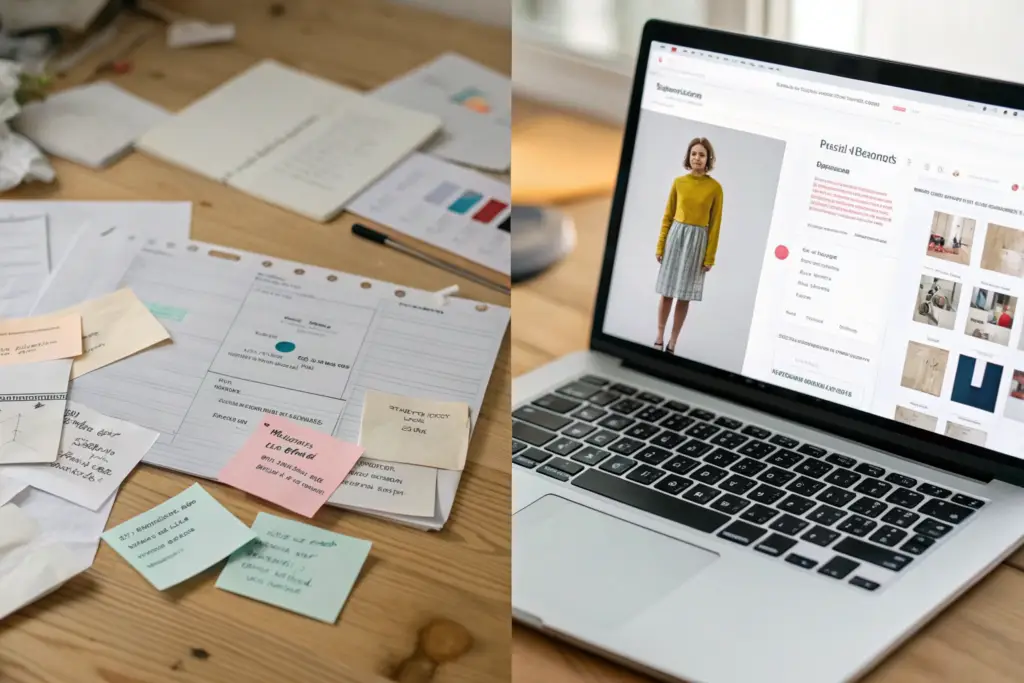
The tech pack is the bible of your garment. A weak tech pack guarantees problems, delays, and cost overruns. It’s the primary document that translates your creative vision into manufacturable instructions. Ambiguity here is the root cause of most communication breakdowns.
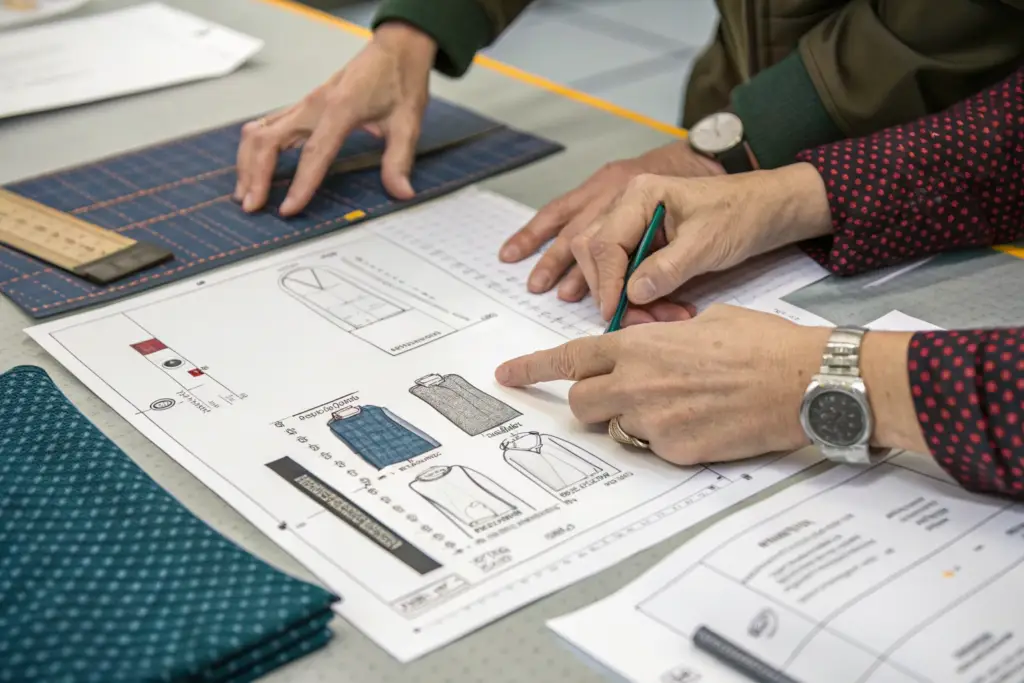
A bulletproof tech pack is a comprehensive, visual, and meticulously detailed digital document that leaves no critical element open to interpretation. It must include precise flat sketches, material specifications with supplier codes, detailed construction callouts, and exact measurement tables.
Many brands, especially growing ones, submit basic sketches and a fabric idea. They rely on the supplier to “figure it out.” This transfers too much risk and creative interpretation. A proper tech pack makes you the director, not just the idea person. Here’s what it must include:
- Clear, Multiple-Angle Flat Sketches: Front, back, and side views. Include close-ups of unique details like a special cuff or pocket construction.
- Bill of Materials (BOM) Table: This is non-negotiable. List every component: main fabric, lining, interlining, buttons, zippers, threads, labels. Don’t just say “brass button.” Provide the supplier part number (e.g., YKK #5 brass metal button) or attach a clear photo and link. We can help source materials, but we need a definitive reference.
- Detailed Construction Page: Use industry terminology. Instead of “sew neatly,” write “use single needle construction with 12 stitches per inch (SPI).” Specify seam types (flatlock for activewear, french seam for luxury shirts).
- Tolerance-Accurate Measurement Spec Sheet (POMs): Every critical measurement (chest, waist, length, sleeve) for every size (XS-XXL). Include a clear grading rule. Specify acceptable tolerances (e.g., +/- 0.5 cm).
What Are The Most Common Tech Pack Mistakes To Avoid?
The most common mistakes are omissions and assumptions. We see these three repeatedly:
- Missing Label & Care Instruction Specs: Brands forget to specify the exact content, size, and placement of main labels, size labels, and care labels. This leads to last-minute scrambling.
- Vague Fabric Descriptions: “Heavy cotton” is not a spec. You must provide the fabric composition (e.g., 100% Cotton), weight (e.g., 220 GSM), and construction (e.g., 2×2 Rib Knit). Better yet, send a physical fabric swatch to accompany the digital pack.
- Inconsistent Grading: The size chart shows a 2-inch difference between M and L, but the grading on the sketch is different. This confuses pattern makers. We once helped a Los Angeles streetwear brand rebuild their tech pack from scratch after their first factory produced wildly inconsistent sizing. We standardized their POMs and grading, which cut their sample iterations from four to just one.
Why Is A Detailed BOM Critical For Accurate Pricing?
A detailed Bill of Materials (BOM) is the foundation of an accurate and firm FOB price. If you only specify “premium zipper,” we must quote based on an average price. If you later decide you want a specific, more expensive YKK waterproof zipper, the price must change, causing delays. When you provide exact component codes from the start, like “YKK #5 Vislon Zipper in Black,” we can source the exact item and give you a fixed cost. This transparency prevents unpleasant surprises and builds trust. It also speeds up the material sourcing phase significantly, as our procurement team knows exactly what to order.
How To Set Clear Milestones And Manage Production Timelines?
Uncertainty about production status is a major stressor. The “black box” feeling—where you send money and designs into a void and hope something good comes out months later—is unacceptable. Proactive timeline management replaces anxiety with visibility.
Effective timeline management requires establishing mutually agreed-upon, date-specific milestones at the start of the project and maintaining regular, proactive updates at each stage, not just when problems arise.
At Shanghai Fumao, we break down every order into a visual timeline shared with the client. This isn’t just a rough estimate; it’s a living document. Here’s our standard milestone framework:
| Milestone | Key Deliverable | Client Action Required | Typical Duration (After Preceding Step) |
|---|---|---|---|
| 1. Pre-Production | Approved Tech Pack & Proto Sample | Approve sample & fabrics | 10-15 days |
| 2. Fabric & Trims Sourcing | Sourced materials, lab test reports | Review/approve test reports | 7-10 days |
| 3. Production Sample | Final sample from actual production line | Final confirmation for bulk | 5-7 days |
| 4. Bulk Production | Production status photos/videos | Monitor updates | 15-30 days (depends on QTY) |
| 5. Quality Control & Shipping | Pre-shipment inspection report, shipping docs | Approve shipment, provide docs | 5-7 days |
We update this tracker weekly. For a client from Chicago last year producing a line of technical outerwear, we provided short video clips from the factory floor during the sewing and waterproof seam taping stages. This gave them immense confidence and allowed them to start planning their marketing launch with certainty.
What Should A Reliable Production Timeline Include?
A reliable timeline is more than just a start and end date. It must include buffer time for client feedback and approval at each stage. It should list all dependent steps. For example, fabric sourcing can’t start without an approved proto sample, and cutting can’t begin without the fabric passing quality control inspection in our warehouse. We also include key external deadlines, like the latest date to confirm fabric to hit the target ship date. Crucially, we always discuss and agree on the “no-change date”—the point after which design or material changes will cause delays and cost penalties. This clarity protects both parties.
How Can Regular Updates Prevent Missed Deadlines?
Regular updates are your early warning system. They don’t prevent all delays (like sudden port congestion), but they prevent surprises. If our fabric mill informs us of a 3-day delay in dyeing, we immediately inform the client the same day. We then show a revised timeline, often suggesting ways to recover time in later stages, like organizing a partial air shipment for the first batch. This proactive approach allowed a Miami-based client to adjust their e-commerce launch campaign when a fabric issue arose, rather than being blindsold by a missed shipment weeks later. They appreciated the honesty and our collaborative effort to find a solution, strengthening our partnership.
How To Ensure Quality Control And Certifications Are Authentic?
This is a critical pain point. The fear that a supplier might cut corners or provide falsified documentation is real and damaging. It risks your brand’s reputation and legal compliance. Trust must be verified, not just given.
Ensuring authentic quality control and certifications involves a multi-layered approach: conducting in-person or third-party inspections at defined checkpoints, requesting verifiable test reports directly from accredited labs, and building a relationship where the supplier welcomes this scrutiny.
We treat quality control as a partnership, not a policing action. Our process is transparent and built around international standards like AQL inspection. However, we encourage our clients to add their own checks. Here is how you can verify authenticity:
- Define Inspection Points (IP): Agree on specific stages for inspection. Common ones are: During Production (DUPRO) after 20% of units are completed, and Final Random Inspection (FRI) when 100% is packed. You or your agent can be present.
- Use Verifiable Lab Reports: For tests like fabric composition, colorfastness, or OEKO-TEX® Standard 100, ask for the original PDF report from the lab (e.g., SGS, BV, Intertek). These reports have a unique number you can often verify on the lab’s website. Do not accept a simple “passed” certificate created by the factory.
- Audit the Process, Not Just the Product: Ask about the factory’s internal QC structure. Do they have a dedicated team? What is their defect classification system? At Shanghai Fumao, we have a QC team that reports separately from production, ensuring unbiased checks.

What Are The Key Certifications For The US Apparel Market?
For the U.S. market, certain certifications are crucial for compliance and consumer trust. The most important ones include:
- OEKO-TEX® Standard 100: Certifies that textiles are free from harmful substances. It’s highly respected by consumers.
- Global Organic Textile Standard (GOTS): For organic fibers. It covers environmental and social criteria.
- ISO 9001: Focuses on quality management systems, indicating the factory has structured processes.
- Specific Compliance Certificates: Such as proof of US CPSIA compliance for children’s wear.
Always request the actual certificate and verify its validity period. A reputable supplier like us will have these documents readily available and understand their importance for your brand reputation.
Why Is On-Site Inspection Or Third-Party QC Vital?
Photos can be staged. Reports can be faked. Physical presence is the ultimate verification. If you cannot visit, hiring a local third-party quality control company for pre-shipment inspection is a wise investment. They will follow your provided checklist, conduct a random AQL sampling, and provide an unbiased report with photos and videos of any defects. In one instance, a client’s third-party inspector found inconsistent dye lots in a shipment of black t-shirts that our internal team had missed due to lighting. We held the shipment, sorted the pieces, and only shipped the uniform ones. This saved the client from a retail disaster and showed our commitment to resolving issues fairly. We welcome this layer of oversight—it ultimately makes our process stronger and builds deeper trust.
Conclusion
Streamlining communication with your Chinese clothing supplier is not about finding a factory that simply says “yes” to everything. It’s about partnering with a manufacturer that has the systems, culture, and expertise to engage in clear, proactive, and transparent dialogue. It requires moving from ad-hoc emails to structured tools, from vague ideas to bulletproof tech packs, and from hopeful deadlines to managed timelines with verified quality. This transformation turns manufacturing from a constant source of stress into a reliable, strategic advantage for your brand.
The goal is a partnership where you feel in control and informed, not anxious and in the dark. When communication flows smoothly, you gain the confidence to innovate, the agility to respond to the market, and the assurance that your brand’s integrity is protected from concept to delivery. It’s the difference between just sourcing products and building a true extension of your team overseas.
If you are tired of communication breakdowns and are looking for a supplier who prioritizes clarity and partnership as much as you do, let’s talk. At Shanghai Fumao, we are built to be your transparent and reliable manufacturing partner. We invite you to experience a different way of working. Contact our Business Director Elaine today to discuss how we can bring clarity and efficiency to your next apparel project. Reach her at: elaine@fumaoclothing.com.