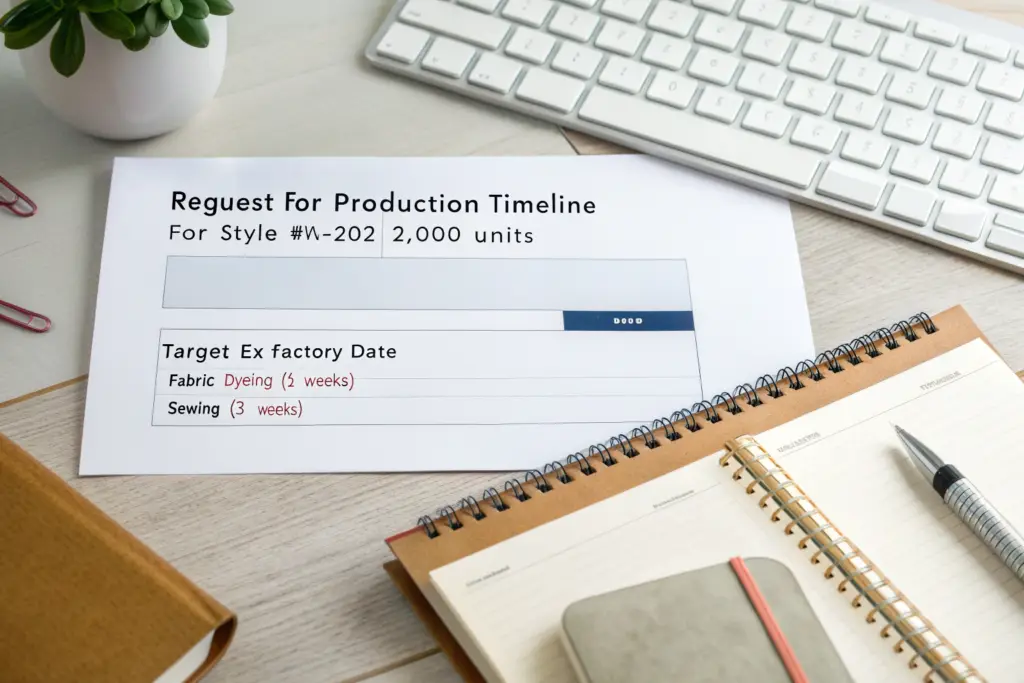
You have placed a bulk order for your new women's wear collection. The designs are finalized. The PO is in. Now, you need an answer to the most critical question: "When exactly will my clothes be ready?" But you have been burned before by vague, overly optimistic promises. You want a real, reliable, and transparent timeline you can build your business around. A seasoned production manager once told me, "A realistic timeline is not a gift; it's a contract. You don't ask for it as a favor. You request it as a professional, and you demand the granular detail that makes it credible. A factory that can't break down a 10-week lead time isn't managing it."
Requesting a realistic production timeline is a professional conversation that starts with your first inquiry. You must ask for a "Phased Production Schedule" or a "Gantt Chart" that breaks the total lead time down into its core components. A credible timeline will explicitly state the durations for: 1) Bulk Fabric Sourcing & Dyeing (often 3-5 weeks), 2) Bulk Cutting & Sewing (3-4 weeks), and 3) Finishing, QC, and Packing (1 week). A vague, single-number promise is a red flag; a phased breakdown is a sign of a professionally managed factory.
At Shanghai Fumao, we provide every B2B partner with a detailed, phased production timeline as a standard part of our order confirmation. We believe transparency in planning is the foundation of a trusted partnership. Let me show you how to ask the right questions and interpret the answers, so you get a schedule that is realistic, reliable, and built to protect your launch.
How to Ask for a "Phased" Timeline, Not a Vague Promise?
The single biggest mistake is accepting a vague, single-number lead time like "It will take 8-10 weeks." This is not a plan; it is a guess. A professionally managed factory can immediately break down that total time into its component parts. Requesting this phased breakdown is the single most effective way to test whether the factory has genuine control over its production planning, or is simply giving you a best-case scenario.
To get a realistic timeline, you must specifically request a "Phased Production Schedule" or a "Gantt Chart" that decomposes the total lead time. Ask them to explicitly identify the longest, most variable phase, which is almost always the custom fabric dyeing and finishing (3-5 weeks). A factory that can instantly provide this level of granular, phased detail—and explain the dependencies between the phases—is a factory with professional production management. A factory that hesitates or cannot provide it is a significant red flag.
A brand founder I mentor always asks a simple question on a first call: "For a 2,000-unit order, can you show me a sample phased timeline, and what's the longest single phase?" A bad factory will say, "It depends, about 8 weeks." A great factory will, like us, instantly share their screen and walk him through a sample Gantt chart, pointing to the "Bulk Fabric Dyeing" phase as the critical 4-week block. That single interaction tells him everything he needs to know about their operational competence. This is the test of a professionally managed factory .
What Are the Non-Negotiable Phases a Professional Timeline Must Include?
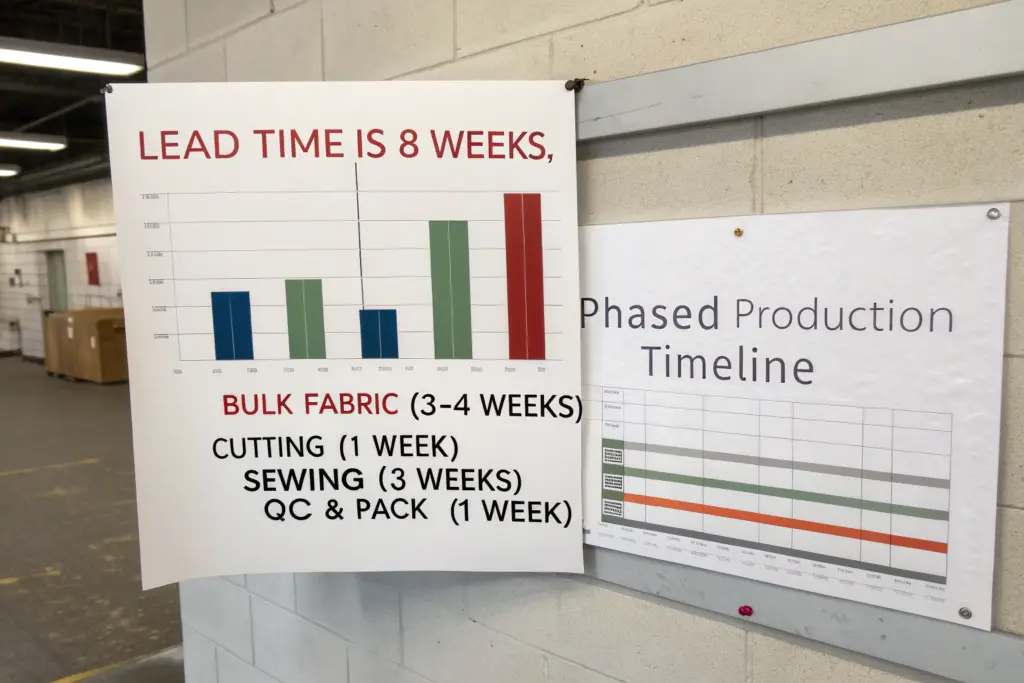
A credible timeline for a custom bulk order must explicitly break down these three phases:
- Bulk Material Sourcing & Preparation (3-5 weeks): This is the longest phase. It includes custom fabric dyeing and finishing. This phase cannot be ethically rushed.
- Bulk Cutting & Sewing (3-4 weeks): The actual manufacturing of your units.
- Finishing, Final QC & Packing (1 week): Trimming, pressing, inspection, and packing for shipment.
If a factory's timeline does not explicitly account for a 3-5 week fabric phase, they are either planning to use pre-existing stock (which you must clarify) or they are being dangerously optimistic. This is the core of our transparent production planning .
Why Is the "Fabric Phase" the Anchor for the Entire Timeline?
Everything else depends on it. You cannot cut what you do not have. The factory's entire production schedule should be planned backward from the confirmed in-hand date of the finished bulk fabric. Asking them to identify this anchor date and show how the subsequent phases flow from it is the key to validating the entire plan. This is a key part of our supply chain management .
What Key Milestones Inside the Plan Should You Lock in for Accountability?
A phased timeline is only as good as the specific, verifiable milestones within it. These are the "gates" that the factory must pass through at specific dates to keep the entire project on track. Locking in these dates and linking them to tangible events gives you the ability to track progress remotely and hold the factory accountable at critical moments. This turns a passive hope into an actively managed process.
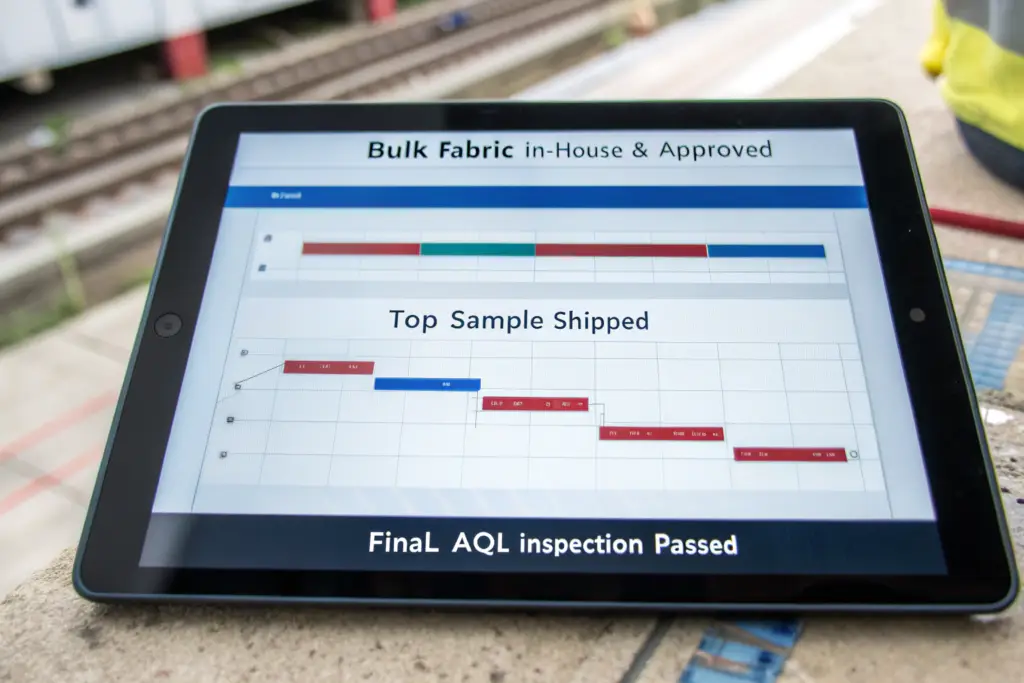
To make the timeline accountable, you must lock in key verifiable milestones with specific dates. The three most critical gates are: 1) The "Bulk Fabric In-House & Approved" date (the anchor of the entire schedule), 2) The "TOP Sample Shipment" date (the final quality check before mass production), and 3) The "Final AQL Inspection & Packing Complete" date (triggering the balance payment and shipping). These are the non-negotiable checkpoints you will track against in your weekly updates.
At Fumao, our Project Manager builds these exact milestones into every client's shared production calendar. The "Bulk Fabric In-House" date is the go/no-go point for the cutting room. The "PP Sample Approved" date is the trigger for a bulk cut. These are not just lines on a chart; they are hard, operational commitments. A brand we work with told us, "I don't even look at the final ship date anymore. I just track the milestone dates. If the fabric arrives on time and the TOP sample passes, I know the ship date is solid." This is the power of a milestone-driven production plan .
How Is the "TOP Sample" Date a Critical Gate for the Final Schedule?
The TOP (Top of Production) Sample is pulled from the first finished bulk units. Its shipment and your subsequent approval is the final, non-negotiable "go" signal for the factory to complete the entire order. This milestone must have a hard date. If your own review process takes longer than the 48 hours allocated on the timeline, the final ship date will slide. Accountability for this milestone is two-way. This is a key part of our collaborative scheduling .
How Should You Link These Milestones to Your Weekly Check-Ins?
Your first question on every weekly call should be, "Are we tracking on time against the three key milestones we locked in?" This consistent, data-driven focus on the critical path transforms a vague update into an efficient, objective, 5-minute accountability session. This is the discipline of our weekly production communication .
How to Negotiate a Faster Timeline by Making Strategic Material Choices?
You have a tight launch deadline, and the standard 10-12 week timeline is simply too long. You need to negotiate a faster schedule. The most productive way to do this is not to pressure the factory to "sew faster" (which compromises quality), but to offer a strategic trade-off: eliminate the longest phase in the process by choosing a material that is already available. This is a collaborative, intelligent negotiation.
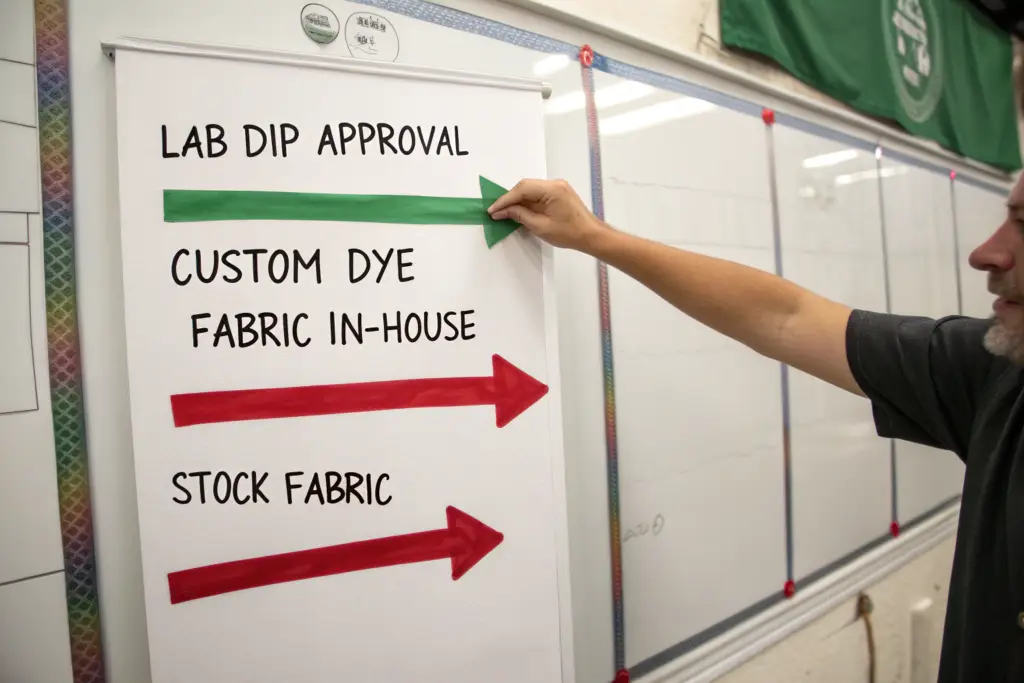
The most effective way to negotiate a faster timeline is to offer to use "Stock" or "Evergreen" fabrics instead of custom-dyed materials. By choosing a fabric that is already sitting in the mill's inventory (usually in core colors like Black, Navy, White), you can bypass the 3-5 week custom dyeing and finishing phase entirely. This one decision can shave an entire month off your production schedule. It is a strategic trade-off of color uniqueness for speed.
A brand we work with needed a fast restock of their best-selling blazer for a sudden influencer-driven demand spike. We sat down (virtually) and looked at the timeline. The bottleneck was the 4-week custom dyeing of their specific "Charcoal" wool. We proposed using a nearly identical, high-quality stock charcoal fabric from our library. The difference was imperceptible to the customer. The stock fabric was in our cutting room in 5 days. The entire order shipped in 5 weeks instead of 10. They captured the sales wave. This is the power of a smart, speed-driven material strategy .
What Is the Difference in Lead Time Between Custom-Dyed and Stock Fabric?
This is the single biggest lever you can pull. Custom Dyeing adds 3-5 weeks to a timeline. Stock Fabric, which is already woven, finished, and sitting in a warehouse, can be sourced and delivered to the cutting table in as little as a few days. Choosing a beautiful stock color for a reorder can be the difference between capturing a trend and missing it entirely. This is the foundation of our fast-track production options .
Can You Use Air Freight to Save Time, and How Much Time Does It Save?
Yes, for a critical, late-stage emergency. Shifting from ocean freight (3-4 weeks) to air freight (1 week) can save 2-3 weeks. However, this is an extremely costly decision that can wipe out your profit margin. It should be viewed as an emergency lever for a specific, small batch, not a standard practice. A proactive material strategy is always the better first resort. This is a key part of our logistics guidance .
How Does Fumao's Transparent Planning Process Give You a Reliable Timeline?
A realistic timeline is not a one-time answer; it is a living document that is actively managed and transparently communicated. Our entire project management system is designed to provide our B2B partners with not just a schedule, but a process of continuous verification and proactive communication. We turn the anxiety of "when will my order be ready" into the confidence of a managed, predictable plan.
Fumao's transparent planning process provides a reliable timeline by making the entire production schedule visible and accountable. You receive a detailed, phased Gantt chart with your order confirmation. Your Project Manager then provides a weekly "Milestone Update" that explicitly tracks progress against the key dates, complete with photos of your actual goods in production. This is not a static, one-time promise; it is a continuous, verifiable, and transparent process of schedule management.
A brand partner recently told us, "Your weekly update with the photo of my cutting table is my favorite email of the week. I don't have to ask where my order is. I can see it. The timeline you gave me wasn't a guess; it was a plan, and you've hit every milestone. That predictability is pure gold." That is the standard we hold ourselves to. We provide not just a production service, but a reliable planning partnership. This is the value of our transparent project management .

How Do Our Weekly Updates Keep the Timeline Honest and Transparent?
Our weekly email is not just a status report; it is an accountability tool. It forces us to measure our progress against the promised milestones and communicate that status to you with visual proof. If a date is at risk, we communicate it proactively, along with our mitigation plan. This internal and external transparency is what keeps our entire production system disciplined. This is the core of our accountability culture .
How Can You Use Our Timeline Transparency to Plan Your Own Marketing and Launch?
When you have a high-confidence, reliable timeline, you can reverse-engineer your entire launch plan. You can schedule your photoshoot, announce the collection drop date to your customers, and plan your email marketing campaigns with the certainty that the product will be in your warehouse when you need it. Our reliable planning empowers your entire business. This is the ultimate value of a predictable manufacturing partnership .
Conclusion
Requesting a realistic production timeline is not a passive act of asking for a date; it is an active audit of a factory's professional competence. By demanding a phased breakdown, locking in key milestones, and understanding the strategic levers that can compress the schedule, you move from a hopeful guess to a managed, predictable, and reliable plan.
At Shanghai Fumao, our transparent, milestone-driven planning process is the foundation of your peace of mind. We do not just give you a date; we give you a detailed, verifiable roadmap and then prove our adherence to it every single week. We provide the predictable, reliable manufacturing backbone upon which you can confidently build your brand's success.
If you are ready to work with a partner who treats your production timeline as a sacred commitment, let's talk. Our Business Director, Elaine, can show you a sample of our phased production planning and weekly communication. Please email Elaine at: elaine@fumaoclothing.com.